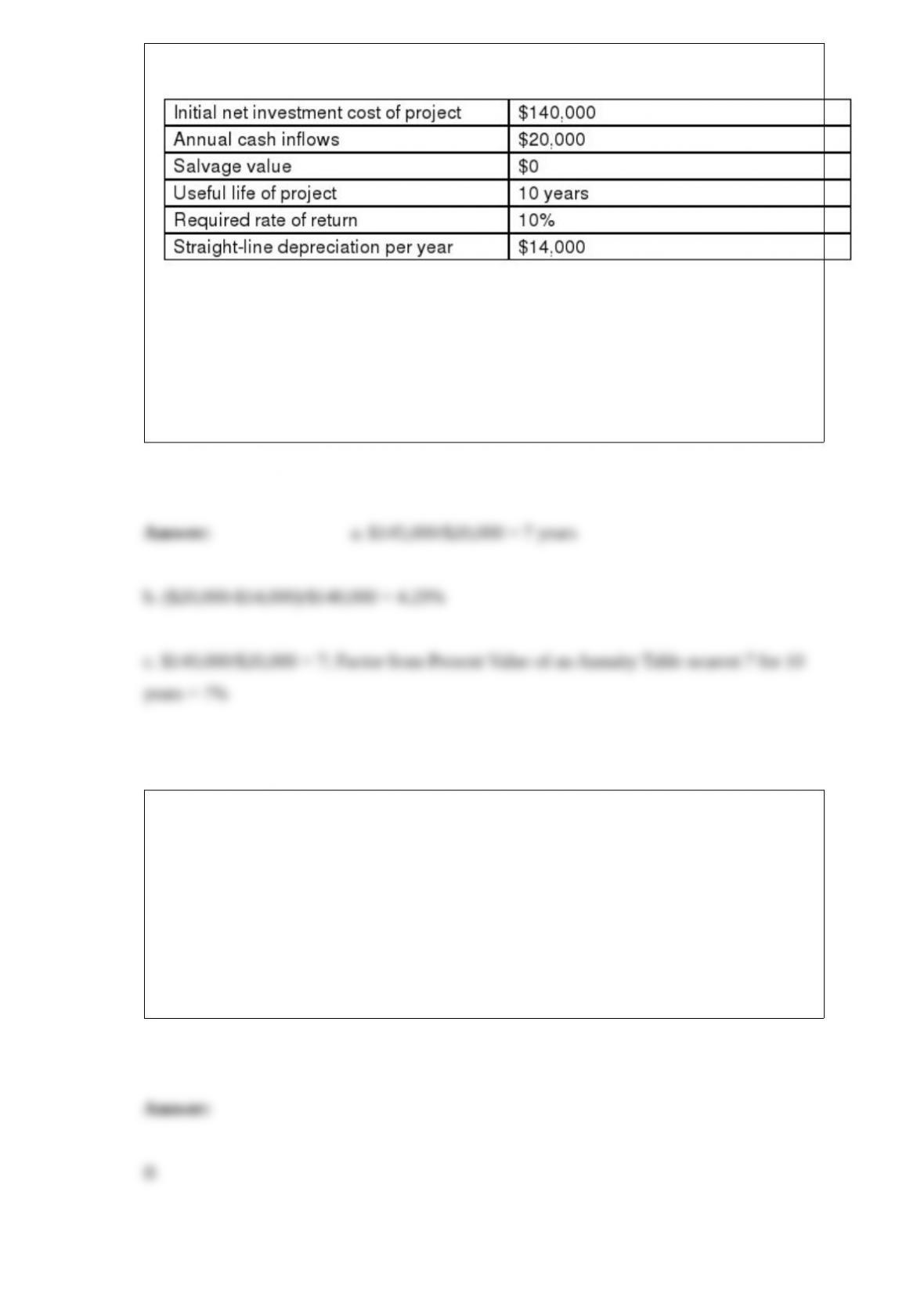
Sycamore Industries has provided the following information on a proposed project:
Required:
a. What is the payback period for the investment?
b. What is the simple rate of return on the investment?
c. What is the internal rate of return on the investment?
If a cost is incurred specifically for a segment of an organization, it is referred to as a
a. Common cost.
b. Traceable cost.
c. Allocated cost.
d. Unavoidable cost.
The payback period and the accounting rate of return ignore are two methods of
evaluating capital budgeting decisions. Like other approaches, these two methods have
advantages and disadvantages.
Required:
a. What is an advantage of these two methods?
b. List two disadvantages of the payback period and explain how to calculate the
payback period.
c. List two advantages and two disadvantages of the accounting rate of return and
explain how to calculate the return.
Those activities that consume resources but do not contribute to the value of the product
are referred as
a. Contribution activities.
b. Non-value-added activities.
c. Manufacturing overhead.
d. Period costs.

If a product’s variable cost per unit increases while the selling price and fixed costs
remain constant, what will happen to the breakeven point?
a. It will increase.
b. It will decrease.
c. It will remain the same.
d. It may increase or decrease, depending on how much the variable cost per unit
changes.
Which of the following is not a measure that relates to the learning and growth
perspective?
a. Revenue growth
b. Revenue per employee
c. Training dollars spent per employee
d. Technology spending per employee
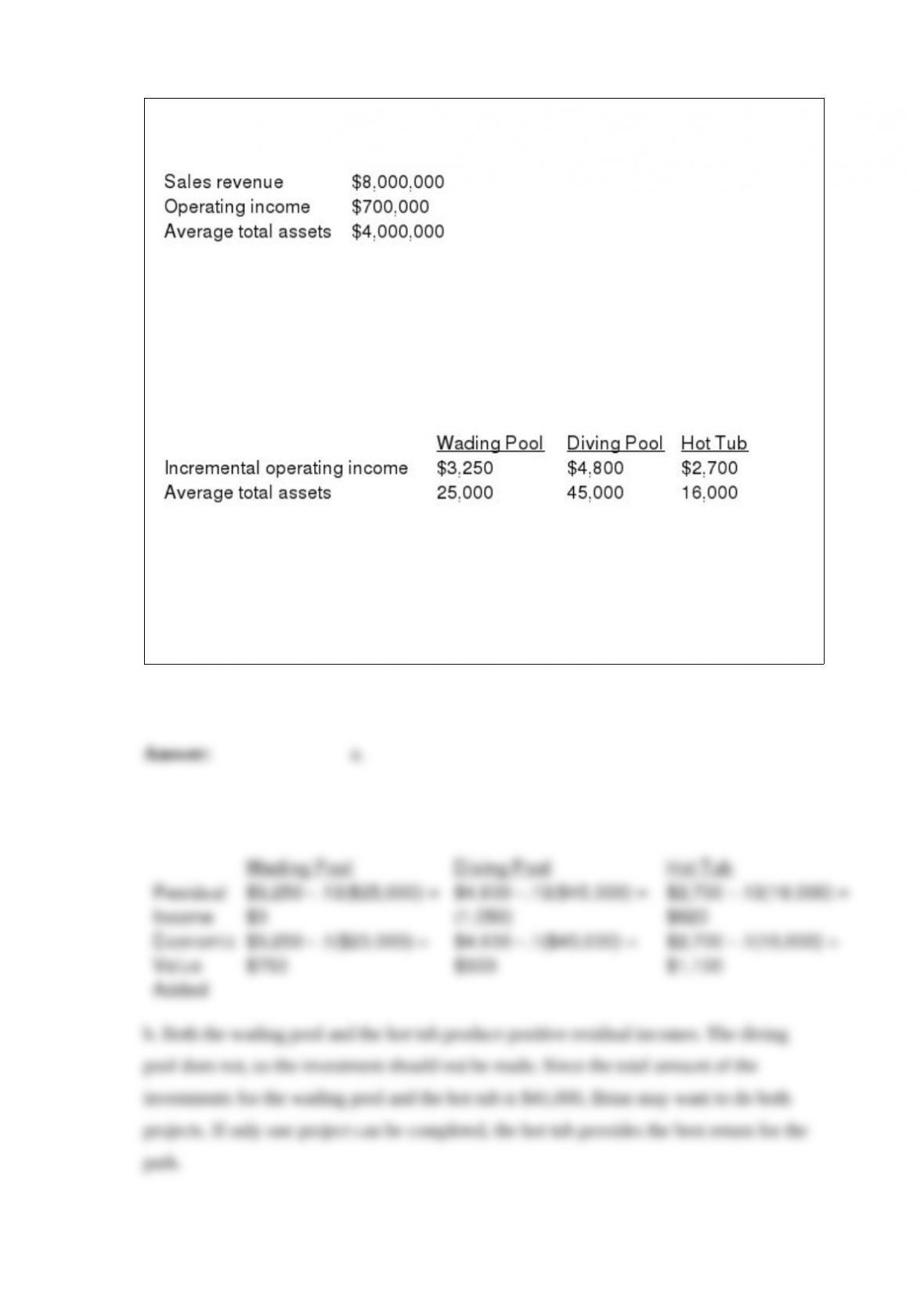
Brian Lochte operates a popular water park. Projections for the current year are as
follows:
The camp ‘s weighted-average cost of capital is 10%, and Brian requires that all new
investments generate a return on investment of at least 13%.
At last week ‘s board meeting, Brian told the board that he had up to $50,000 to invest
in new facilities at the Park and asked them to recommend some projects. Today the
board ‘s president presented Brian with the following list of three potential investments
to improve the camp facilities.
Required
a. Calculate the residual income and economic value added for each of the three
projects.
b. Which of the three projects do you recommend Brian undertake? Why?

A costing technique that assigns costs to cost objects such as products or customers,
based on the activities those cost objects require is referred to as
a. Activity-job costing.
b. Activity-based costing.
c. Activity-pool costing.
d. None of these answer choices are correct..
When the units sold exceeds the units produced
a. Operating income is higher under absorption costing than under variable costing.
b. Operating income is lower under absorption costing than under variable costing.
c. Operating is the same under absorption costing and variable costing.
d. Cannot be determined with the information given.
You are assigned to a team responsible for evaluating segment managers ‘ performance
measures. A team member has indicated that a friend who is a manager at a competitor
‘s company is evaluated using “ROI”, but does not know what “ROI” is.
Required:
a. Explain what ROI is and why it is a useful tool in measuring managers ‘ performance.
b. Give an example of when ROI would not be an appropriate performance
measurement.
If an organization wants to make a profit, it must generate more sales revenue than the
total costs it incurs. This relation can be expressed using which of the following profit
equations?
a.Operating income = [Sales price per unit – Fixed cost per unit) x # units produced] –
Variable cost
b.Operating income = [Contribution margin per unit x # units sold] – Fixed costs
c.Operating income = Sales revenue – Total variable costs – Committed costs
d.Operating income = Sales revenue – Product costs – Discretionary costs
The master budget process usually begins with the
a. Cash budget.
b. Operating budget.
c. Production budget.
d. Sales budget.
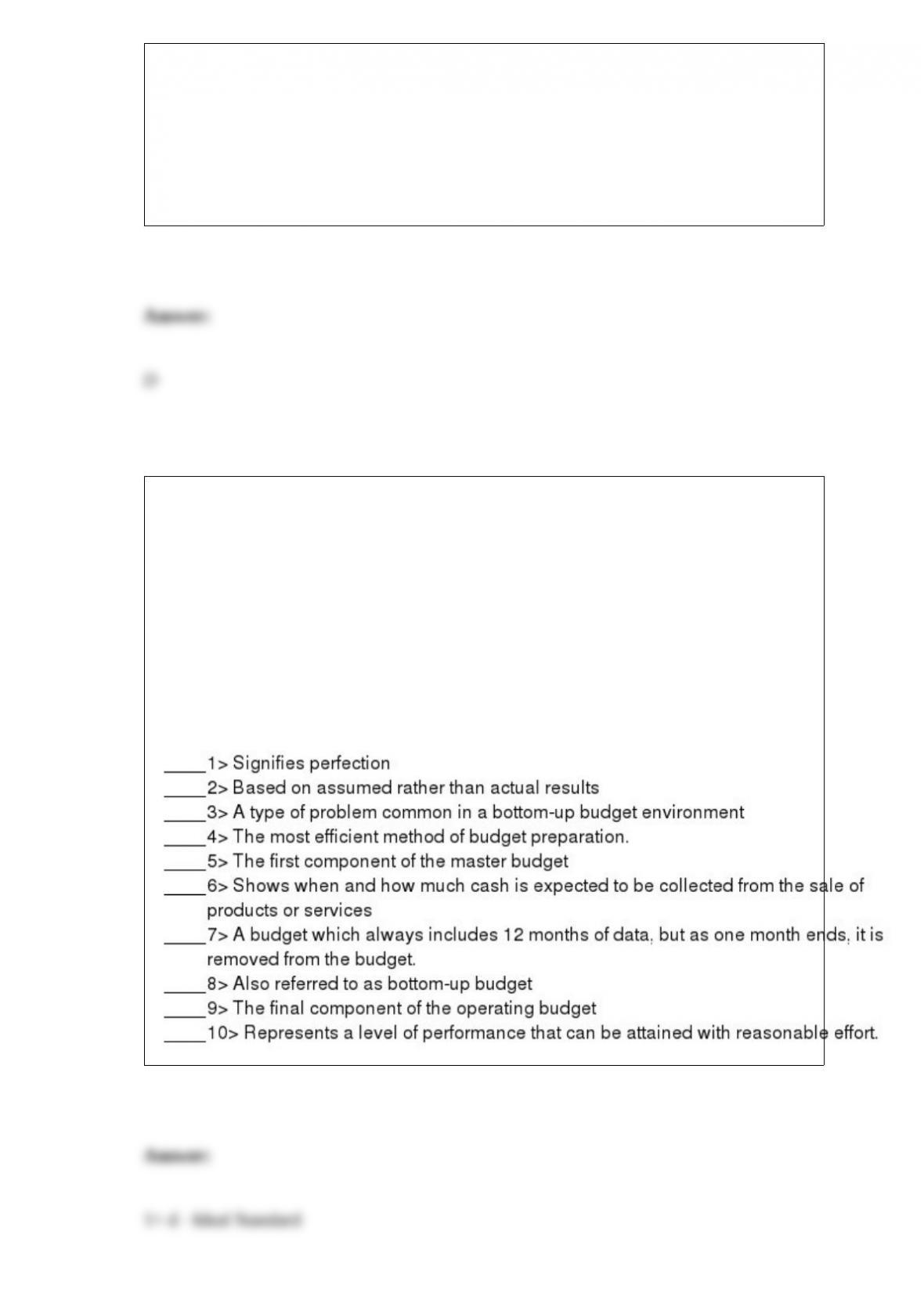
Match the following terms to the appropriate statement by placing the letter to the left
of each statement. a. Budgetary Slack f. Participative Budget
b. Cash Receipts Budget g. Practical Standard
c. Ending Inventory and Cost of Goods Sold Budget h. Pro-Forma Financial Statements
d. Ideal Standard i. Rolling Budget
e. Operating Budget j. Top-Down Budget
Assume you are planning a spring break ski trip to Colorado. You are preparing a
budget of your costs. You are staying at a lodge that has a special where the lodge
charges you a flat fee of $25 for up to ten ski lift rides. You believe you will ride the ski
lift 40 times during the week, so you budget $100. The ski lift charge is an example of a
a.Fixed cost.
b.Variable cost.
c.Mixed cost.
d.Step cost.
Sometimes you may know only the total dollar amount of direct materials purchased

rather than the actual unit price. You can still calculate the price variance by using
which of the following?
a. The total purchases amount
b. Dividing the total purchases amount by the actual number of units purchased
c. Both by using the total purchases amount and by dividing the total purchases amount
by the actual number of units purchased.
d. None of these answer choices are correct.
In preparing a common-size balance sheet, you express all account balances as a
percentage of
a. Total stockholders’ equity.
b. Total liabilities.
c. Total assets plus total liabilities minus stockholders’ equity.
d. Total assets.
The current ratio is calculated as
a. Current assets divided by current liabilities.
b. Current assets divided by total assets.
c. Current liabilities divided by current assets.

d. Current liabilities divided by total liabilities.
According to the 2011 edition of Accounting Trends and Techniques, approximately
what percentage of companies use the direct method to report cash flows provided by
operating activities?
a. 2%
b. 33%
c. 67%
d. 98%
The formula for calculating units required to meet target operating income is
a. (Total fixed costs plus target operating income) divided by contribution margin per
unit.
b. Total fixed costs divided by (contribution margin plus target operating income).
c. Contribution margin per unit divided by (total fixed costs plus target operating
income).
d. (Contribution margin plus target operating income) divided by total fixed costs.