The predetermined overhead rate is found by dividing total estimated overhead costs by
the total estimated volume of the overhead allocation base.
Under all circumstances, unfavorable variances are bad; favorable variances are good.
Under job-order costing, the actual direct material, actual direct labor, and estimated
overhead costs are recorded on the job cost sheet.
Two budgeting games sometimes played by employees are building in budget slack and
making the numbers.
A potential danger from outsourcing is that a company may become too dependent on
the supplier.
Burgess Company incurred product costs of $50,000 during the period when no units
were sold. No product costs will be reported on the company’s income statement for the
period.
The marketing department is primarily responsible for establishing the sales forecast.
When using least-squares regression to determine variable and fixed costs, the r-square
refers to the degree to which the change in the dependent variable can be explained by a
change in the independent variable.
When debt is used to finance the purchase of assets, the term or time span of the debt
should always be shorter than the lifespan of the assets.
A schedule of cash receipts is often prepared in conjunction with the sales budget.
For a company that sells several products, cost-volume-profit techniques cannot be used
to calculate the sales volume required to yield a target level of profit.
Most firms have found that it is cost-effective to achieve a “zero defects” condition
among their products and services.
Transportation costs incurred to transfer products to customers are downstream costs.
The payback method of evaluating capital investments measures the recovery of the
investment, but it does not measure profitability.
The quick ratio although similar to the current ratio is more conservative.
In regression analysis, an r-square value of one indicates that there is a perfect fit
between the independent and dependent variables.
Using a single plant-wide overhead rate is likely to cause some distortion in allocation
of product-level costs.

Executive management at Ballard Books is very optimistic about the chain’s ability to
achieve significant increases in sales in each of the next five years. The company will
most benefit if management creates a:
A. low leverage cost structure.
B. medium leverage cost structure.
C. high leverage cost structure.
D. no leverage cost structure.
All of the following are external failure costs except:
A. warranty repairs and replacement.
B. reliability testing
C. customer relations.
D. restocking and packaging.
Which capital budgeting technique defines returns in terms of income instead of cash
flows?
A. The unadjusted rate of return method
B. The internal rate of return technique
C. The net present value technique
D. The payback period
The study of an individual item or account over several periods in the same financial
year or over many years is known as:
A. Liquidity analysis
B. Ratio analysis
C. Vertical analysis
D. Horizontal analysis
On December 31, 2013, Houston Company’s total current assets were $560,000 and its
total current liabilities were $420,000. On January 1, 2014, Houston issued a long-term
note to a bank for $30,000 cash.
Required:
(a) Compute Houston’s working capital before and after issuing the note payable.
(b) Compute Houston’s current ratio before and after issuing the note payable. Round
your answer to two decimal places.

Assuming actual volume is 10,000 units and planned volume is 12,000 units, the sales
volume variance in units:
A. Equals 2,000 units unfavorable.
B. Equals 2,000 units favorable.
C. Cannot be determined without additional information.
D. None of these answers is correct.
What is the role of top management in a participative budgeting system?
A. Top management has no role – the budget is entirely developed by the lower-level
employees.
B. Top management must always tighten employee-set budget standards to eliminate
employees’ attempts to build slack into the standards.
C. Top management must ensure that employee-generated objectives are consistent with
those of the company.
D. All of these answers are correct.

Which of the following budgets would be prepared by a manufacturing company but
not a merchandising company?
A. Selling and administrative expense budget
B. Cost of goods sold budget
C. Sales budget
D. Raw materials budget
An activity center:
A. is an organizational structure where companies are organized into related activities
and the overhead costs associated with performing these activities are combined into
cost pools.
B. combines overhead costs into cost pools.
C. is an organizational structure associated with minimal record-keeping tasks.
D. None of these answers is correct.
Custom Quilters makes decorative comforters, quilted garments, and other products in a
small sewing factory. In 2014, the company expects to make 2,000 comforters. With
respect to the comforters, how would the supervisory salaries be classified?
A. Direct and variable
B. Direct and fixed
C. Indirect and variable
D. Indirect and fixed
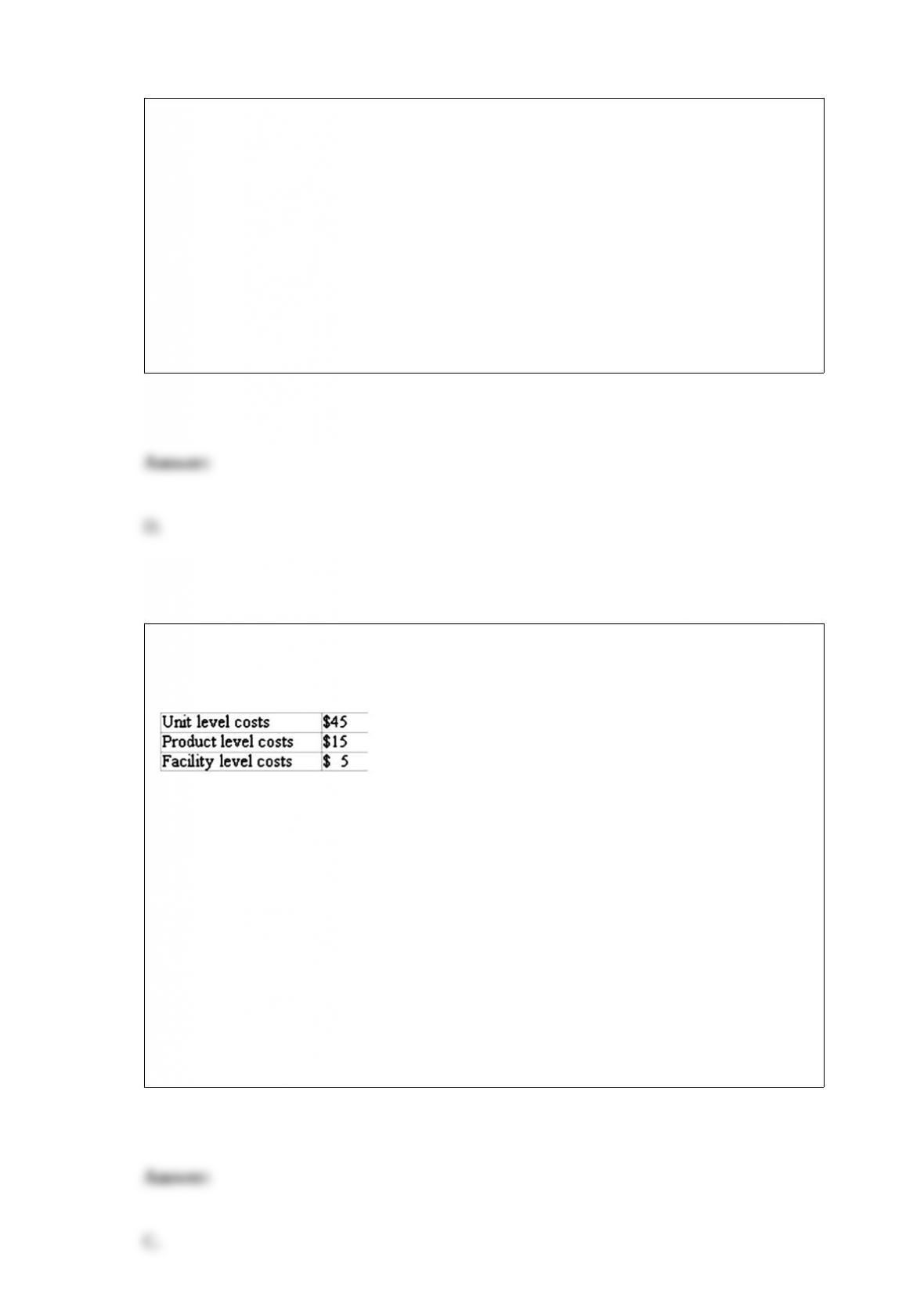
The Mighty Music Company produces and sells a desktop speaker for $100. The
company has the capacity to produce 50,000 speakers each period. At capacity, the
costs assigned to each unit are as follows:
The company has received a special order for 500 speakers. If this order is accepted, the
company will have to spend $15,000 on additional costs. Assuming that no sales to
regular customers will be lost if the order is accepted, at what selling price will the
company be indifferent between accepting and rejecting the special order?
A. $95
B. $45
C. $75
D. $60

Starwood Corporation has current assets of $200,000, total current liabilities of
$750,000 net credit sales of $1,300,000, beginning accounts receivable of $65,000 and
ending accounts receivable of $69,000. What is Starwood’s accounts receivable
turnover?
A. 21.8 times
B. 19.4 times
C. 22.4 times
D. 5.8 times
Companies A and B are in the same industry and are identical except for cost structure.
At a volume of 50,000 units, the companies have equal net incomes. At 60,000 units,
Company A’s net income would be substantially higher than B’s. Based on this
information,
A. Company A’s cost structure has more variable costs than B’s.
B. Company A’s cost structure has higher fixed costs than B’s.
C. Company B’s cost structure has higher fixed costs than A’s.
D. At a volume of 50,000 units, Company A’s magnitude of operating leverage was
lower than B’s.

Once sales reach the break-even point, each additional unit sold will:
A. increase fixed cost by a proportionate amount.
B. reduce the margin of safety.
C. increase the company’s operating leverage.
D. increase profit by an amount equal to the per unit contribution margin.
Fortune Company had beginning raw materials inventory of $16,000. During the
period, the company purchased $92,000 of raw materials on account. If the ending
balance in raw materials was $10,000, the amount of raw materials transferred to work
in process inventory is:
A. $86,000.
B. $98,000.
C. $102,000.
D. $92,000.
During her first year with the company, Ann mistakenly accumulated some of the
company’s period costs in ending inventory. Which of the following indicates how this
error affects the company’s financial statements assuming number of units produced
exceeded number of units sold during the period?
A. Cash flows from operations are understated.

B. Gross margin is unaffected.
C. Net income is overstated.
D. Inventory is understated.
The 2014 income statement of Collins Co. reported total sales revenue of $115,000. The
December 31, 2013 balance sheet showed a balance in accounts receivable of $17,500,
while the 2014 balance sheet showed a balance in accounts receivable of $25,000. The
cash inflow from customers for 2014 would be:
A. $107,500.
B. $132,500.
C. $115,000.
D. $122,500.
The method of allocating service department costs that allocates the costs to both
service departments and operating departments is the:
A. direct method.
B. indirect method.
C. weighted average method.
D. step method.
Costs associated with holding inventory often include:
A. theft, damage, and obsolescence.
B. financing.
C. warehouse space.
D. supervision.
E. All of these.
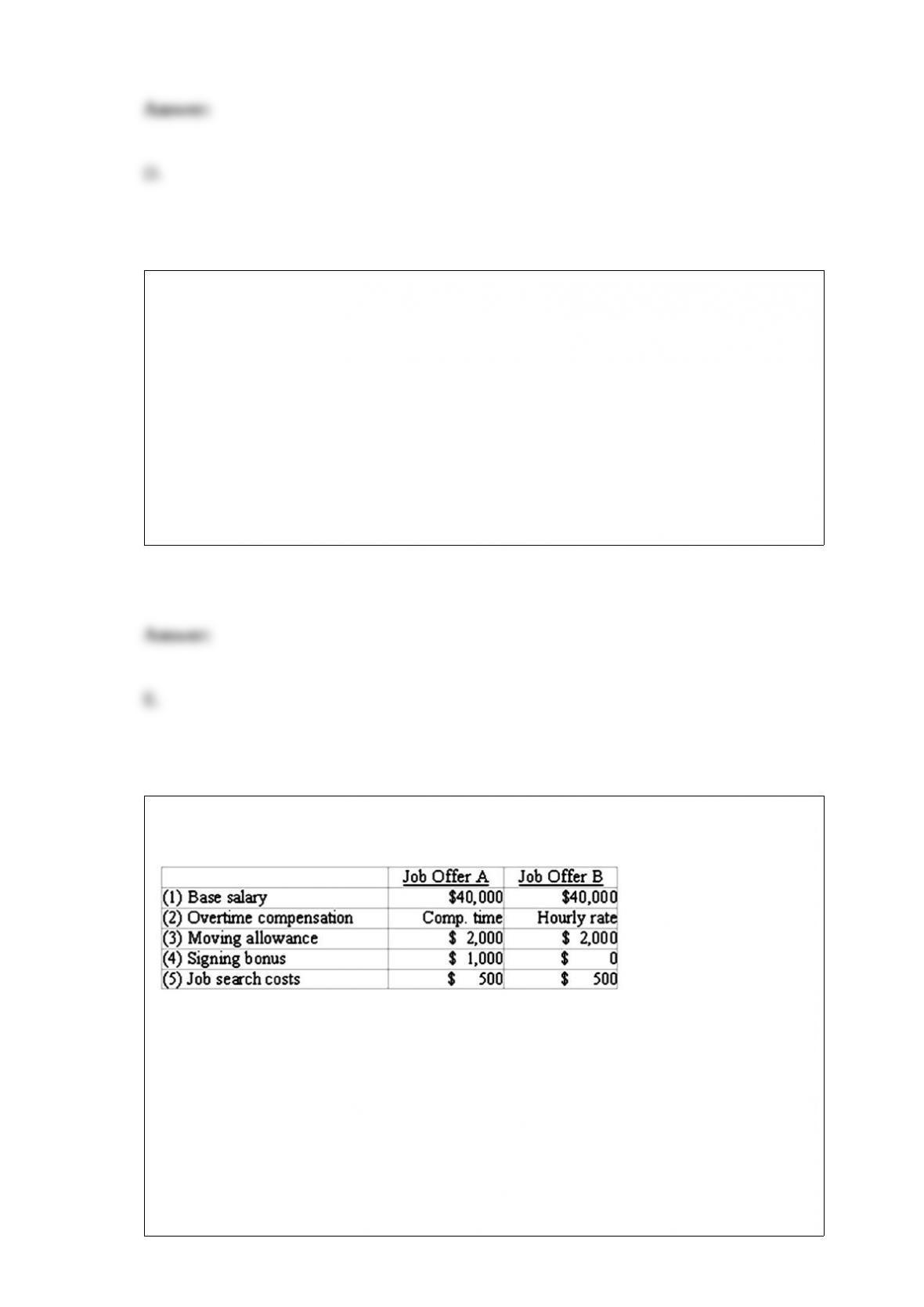
Jason is trying to decide which one of two job offers he will accept. Several items are
presented below:
Which of the above items would be considered relevant costs?
A. (1), (3), (5)
B. (2), (4)
C. (5)
D. None of these.
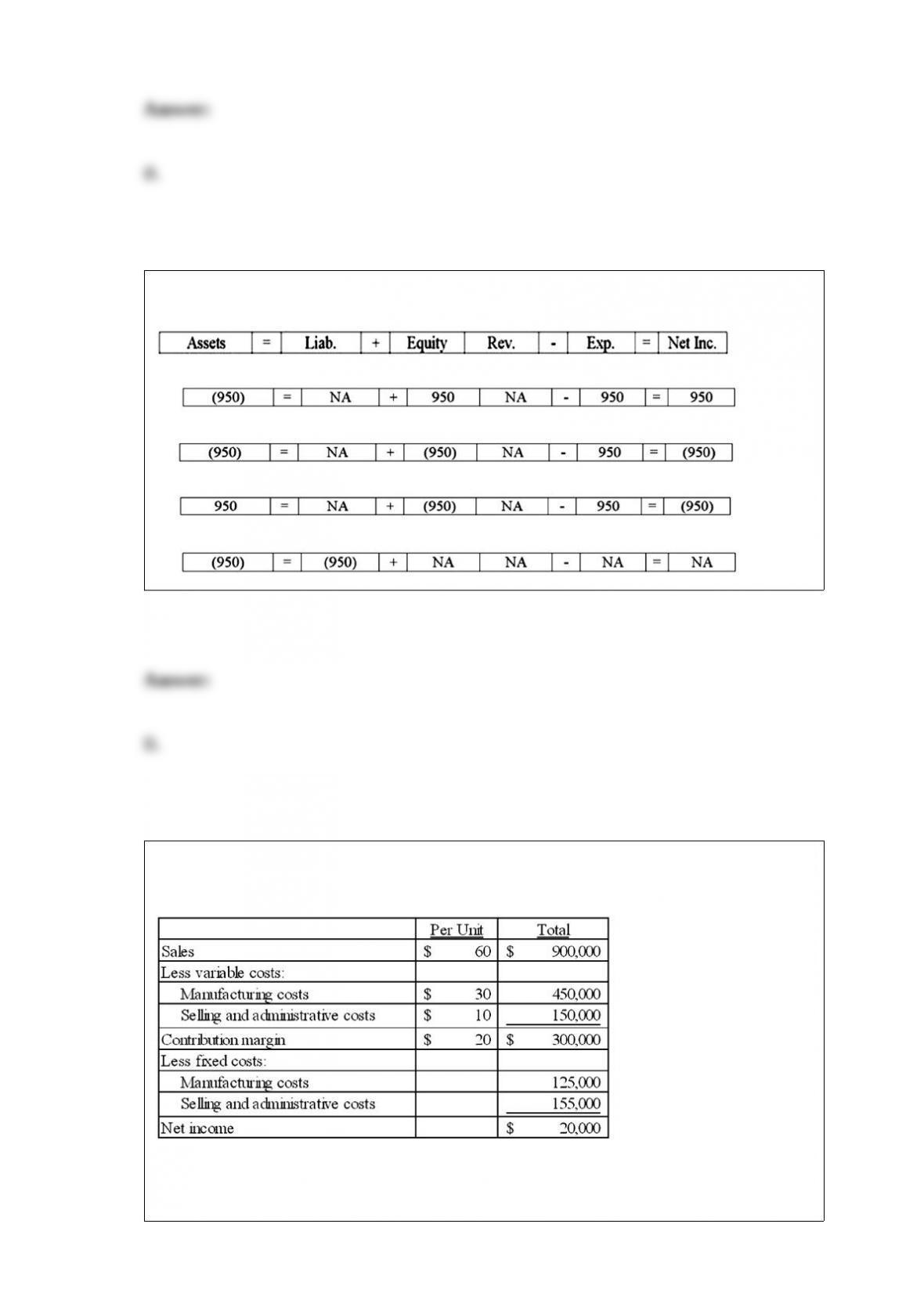
Ferguson Company sold goods that had cost $950 to manufacture. How does this
transaction affect the financial statements?
A.
B.
C.
D.
Grenada Company estimates sales of 15,000 units for the upcoming period. At this sales
volume its budgeted income is as follows:
During the period the company actually produced and sold 18,000 units.
Required:Prepare a flexible budget based on 18,000 units.
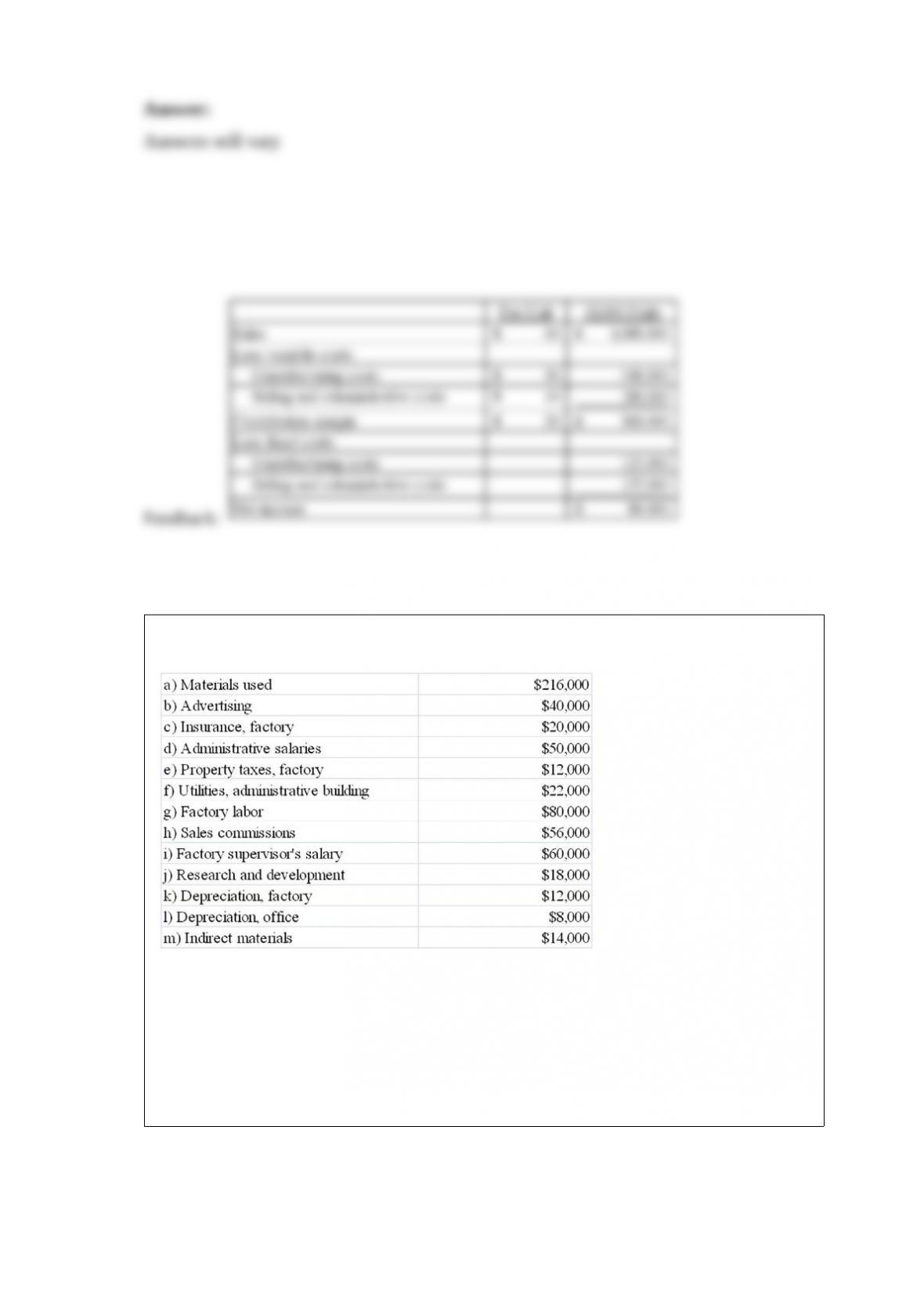
The Giga Company produces tablet computers. The following information is provided:
Required:
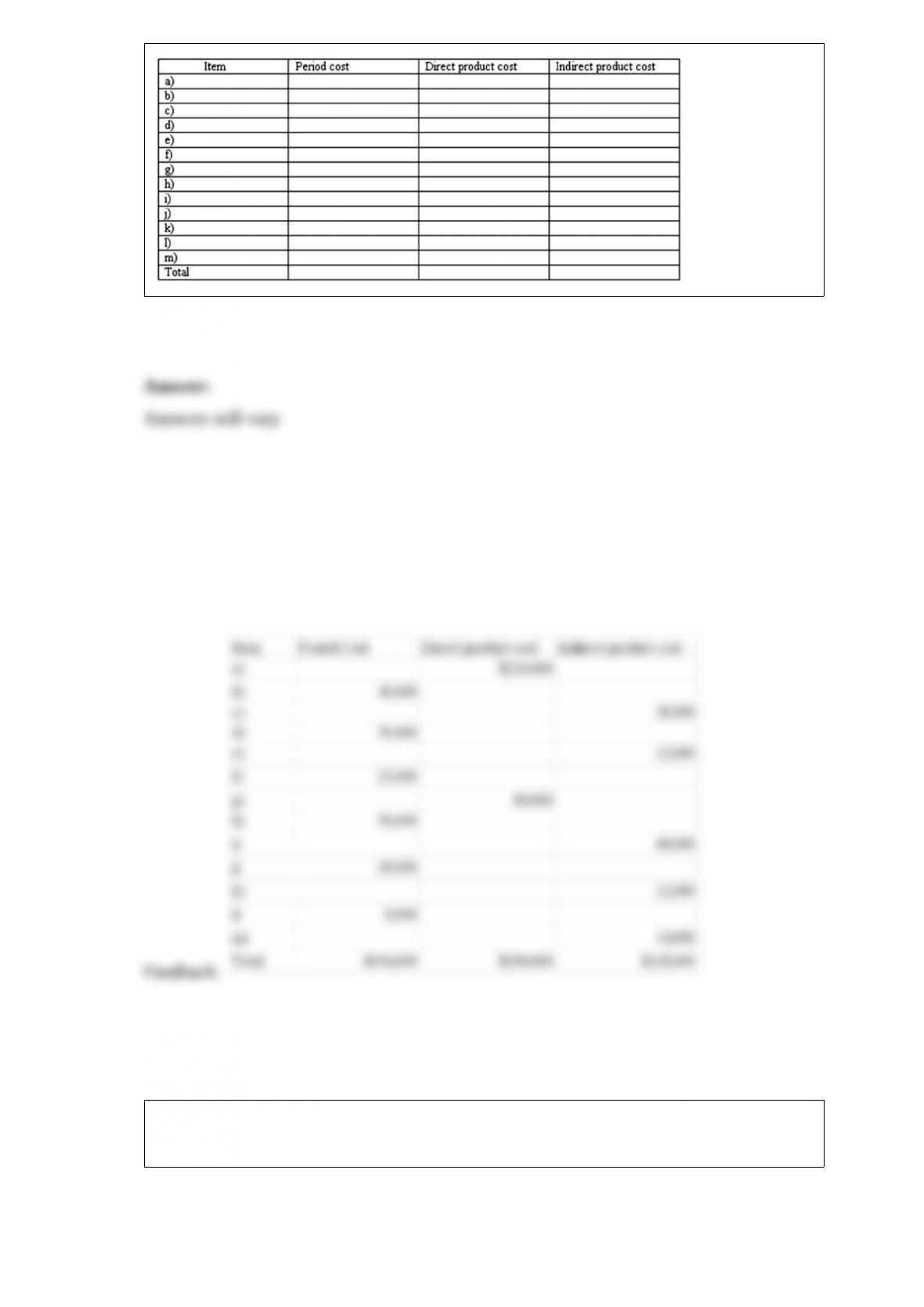
Classify each of the company’s costs as a period cost (general, selling, and
administrative cost) or as a direct or indirect product cost. Enter the dollar amount of
the cost in the appropriate column. After entering all amounts, calculate the total
general, selling, and administrative cost, the total direct product cost, and the total
indirect product cost.
Phoenix Corporation manufactures smartphones, generally selling from 200,000 to
300,000 units per year. The following cost data apply to the activity levels shown:
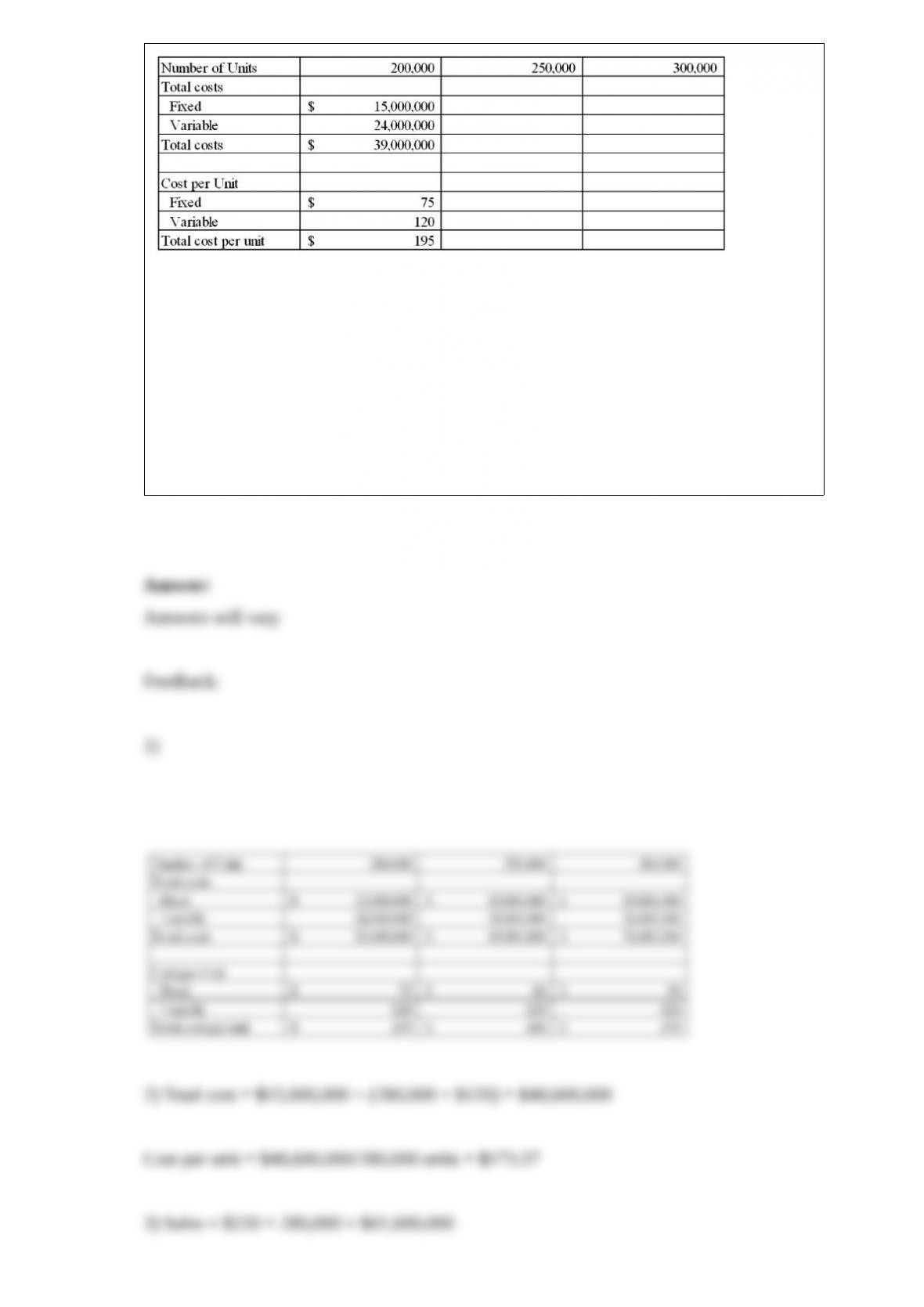
Required:
1.) Complete the preceding table by filling the missing amounts for 250,000 and
300,000 units.
2.) Assume that Phoenix actually makes 280,000 units. What would be the total costs
and the cost per unit at this level of activity?
3.) If Phoenix sells each unit for $220, what is Phoenix’s magnitude of operating
leverage at sales of 280,000 units?
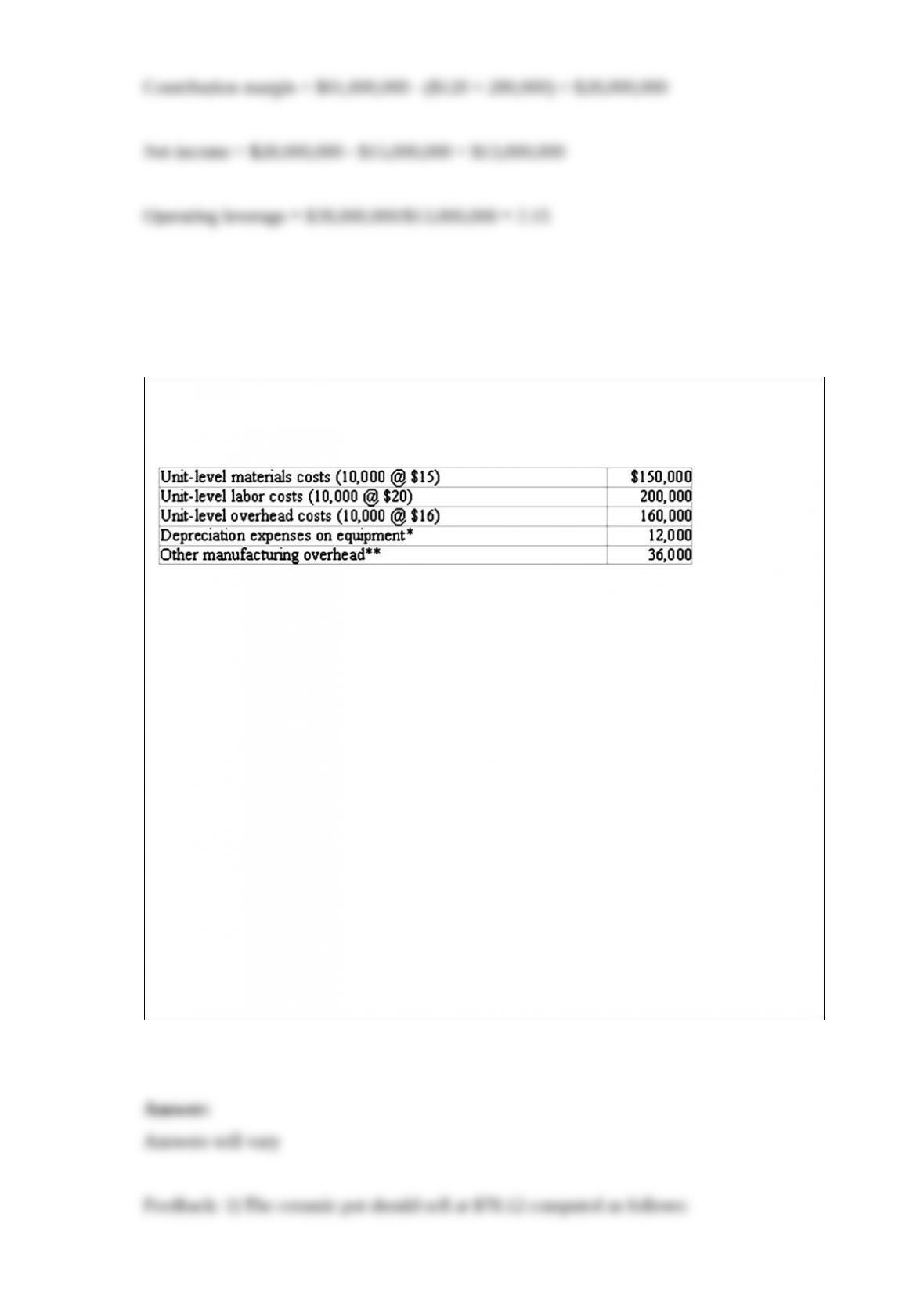
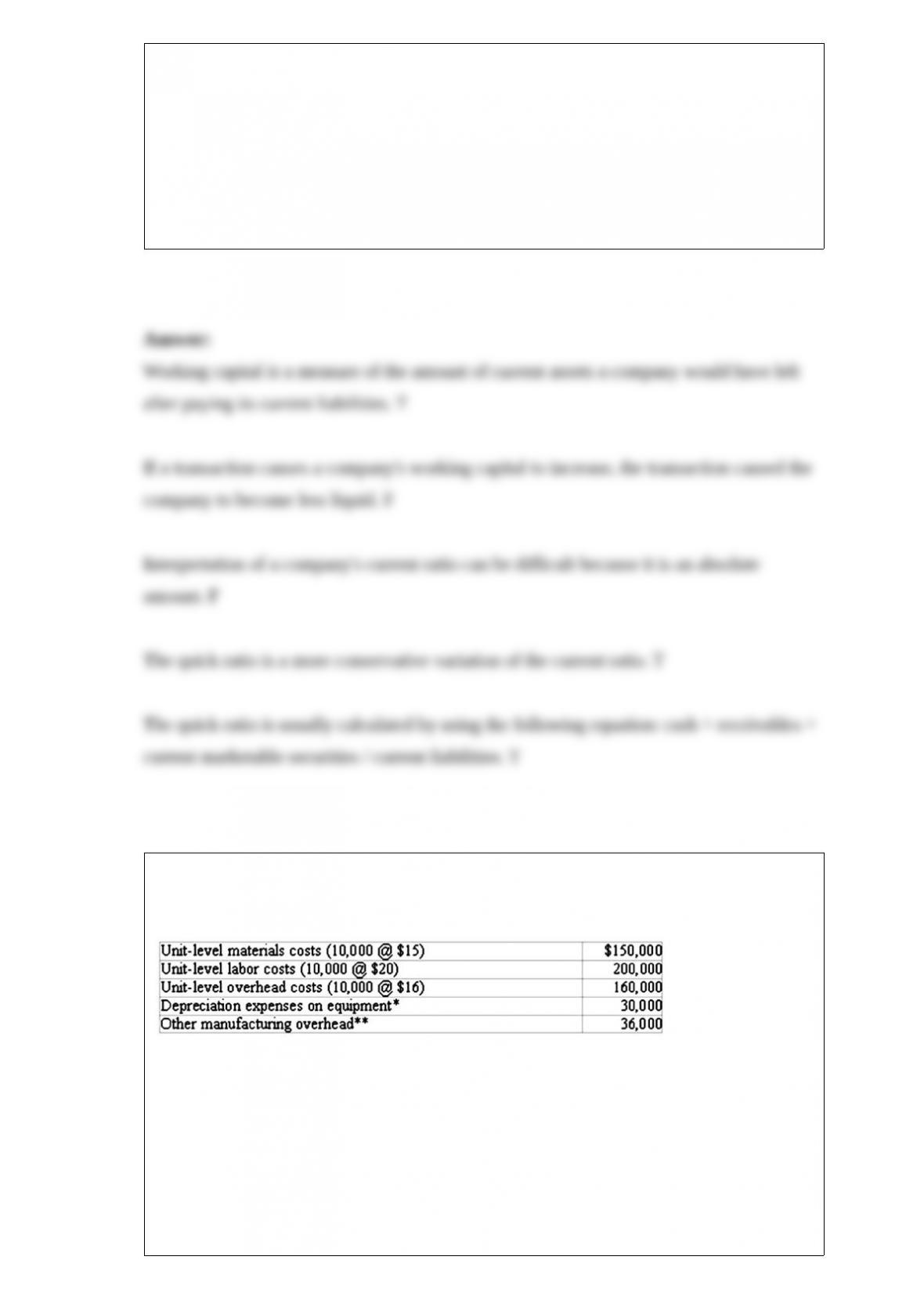
The Enhanced Products Division of Forrest Industries makes ceramic pots that are used
to hold large decorative plants. During 2013, the division produced 10,000 pots and
incurred the following costs:
*The equipment was purchased last year for $150,000 and has a current book value of
$120,000, remaining useful life of four years, and a zero salvage value. If the
equipment is not used to produce ceramic pots, it can be leased for $8,000 per year.
**Includes supervisors’ salaries and rent for manufacturing plant.Required:
1) Assume Evergreen Industries uses a cost plus pricing strategy. What price should be
charged for the ceramic pot product if the division sets its price 40 percent above the
unit product cost?
2) A potential overseas customer who would not compete with the division’s existing
customers would like to purchase 1,000 ceramic pots but is not willing to pay the
regular price. At what selling price would the division be indifferent about accepting the
special order?
3) Suppose the division has the opportunity to purchase the ceramic pot from another
manufacturer for $60. The supplier is willing to hold sufficient inventories to meet
Evergreen’s demand. Should the division outsource its ceramic pots? Why or why not?
Indicate whether each of the following statements about financial statement analysis is
true or false.
Working capital is a measure of the amount of current assets a company would have left
after paying its current liabilities.
If a transaction causes a company’s working capital to increase, the transaction caused
the company to become less liquid.
Interpretation of a company’s current ratio can be difficult because it is an absolute
amount.
The quick ratio is a more conservative variation of the current ratio.
The quick ratio is usually calculated by using the following equation: cash + receivables
+ current marketable securities / current liabilities.
The Enhanced Products Division of Forrest Industries makes ceramic pots that are used
to hold large decorative plants. During 2013, the division produced 10,000 pots and
incurred the following costs:
*The equipment was purchased for $150,000 and has a current book value of $120,000,
remaining useful life of four years, and a zero salvage value. If the company does not
use the equipment, it can be leased for $8,000 per year.
**Includes supervisors’ salaries and rent for manufacturing plant.Required:
The division is considering replacing the equipment used to manufacture its ceramic
pots. Replacement equipment can be purchased at a price of $200,000. The new
equipment, which is expected to last 4 years and have a salvage value of $20,000, will
reduce unit-level labor costs by 25 percent. Assuming the division desires to maintain
its production and sales at 10,000 ceramic pots per year, prepare a schedule that shows
the relevant cost of operating the existing equipment versus the cost of operating the
new equipment. Should the existing equipment be replaced? Why or why not?