In its 2013 income statement, WME reported $440,000 for the cost of goods sold.
WME paid inventory suppliers $380,000 in 2013, and its inventory balance decreased
by $41,000 during the year. In its reconciliation schedule, WME should: A. Show a
$19,000 positive adjustment to net income under the indirect method for the increase in
accounts payable.
B. Show a $19,000 positive adjustment to net income under the indirect method for the
decrease in accounts payable.
C. Show a $19,000 negative adjustment to net income under the indirect method for the
increase in accounts payable.
D. Show a $19,000 negative adjustment to net income under the indirect method for the
decrease in accounts payable.
Answer:
Todd Sweeney is an artist who sells his work under consignment (he displays his work
in local barbershops, and customers purchase his work there). Sweeney recently
transferred a painting to a local barbershop.
After Sweeney has transferred a painting to a barbershop, the painting: A. Should be
counted in Sweeney’s inventory until the barbershop sells it.
B. Should be counted in the barbershop’s inventory, as they now possess it.
C. Should be counted in either Sweeney’s or the barbershop’s inventory, depending on
which incurred the cost of preparing the painting for display.
D. None of the other answers is correct.

Answer:
Tri Fecta, a partnership, had revenues of $360,000 in its first year of operations. The
partnership has not collected on $35,000 of its sales and still owes $40,000 on $150,000
of merchandise it purchased. There was no inventory on hand at the end of the year. The
partnership paid $25,000 in salaries. The partners invested $40,000 in the business and
$25,000 was borrowed on a five-year note. The partnership paid $3,000 in interest that
was the amount owed for the year and paid $8,000 for a two-year insurance policy on
the first day of business.
Compute the cash balance at the end of the first year for Tri Fecta.
Answer:
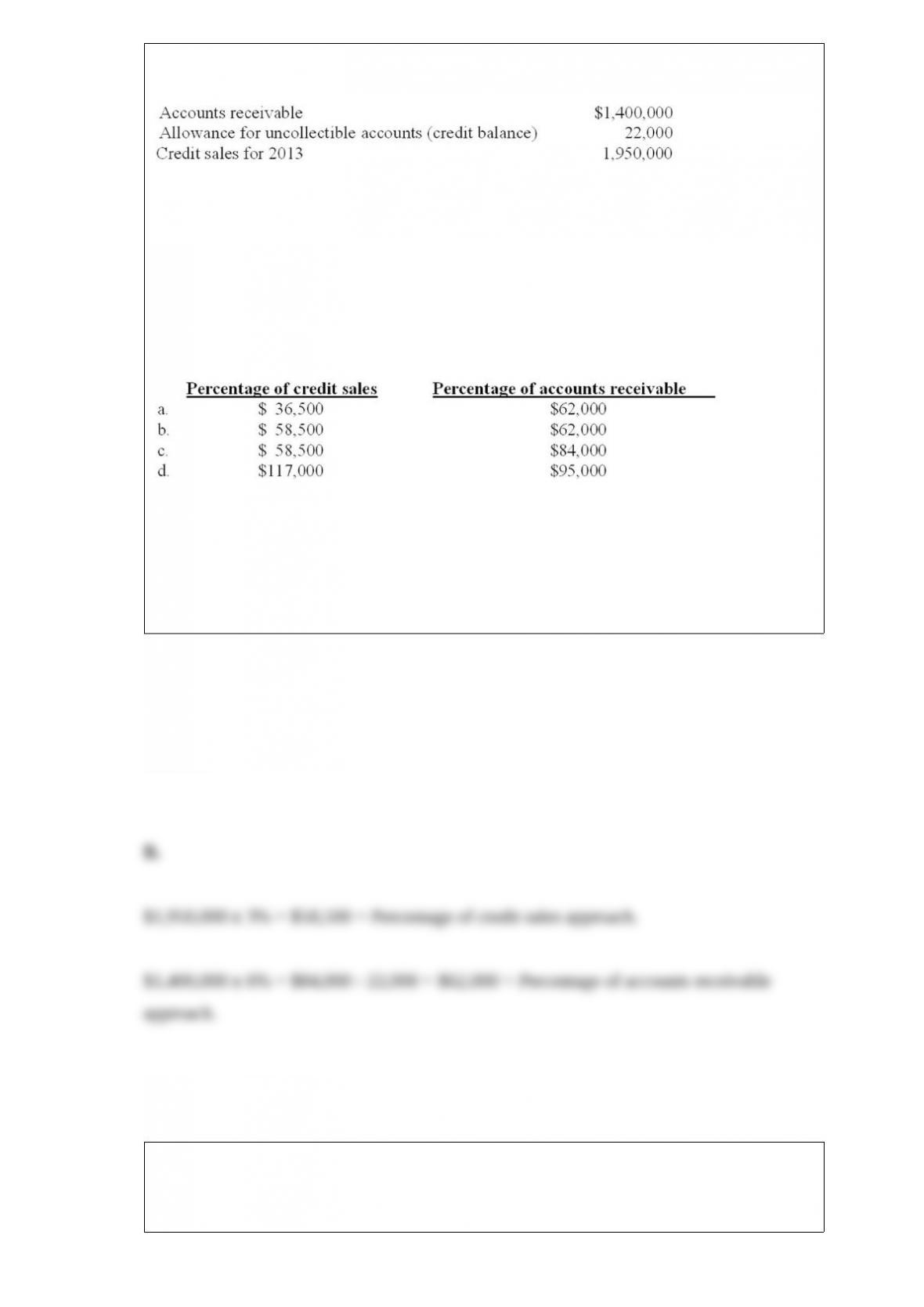
San Mateo Company had the following account balances at December 31, 2013, before
recording bad debt expense for the year:
San Mateo is considering the following approaches for estimating bad debts for 2013:
– Based on 3% of credit sales
– Based on 6% of year-end accounts receivable
What amount should San Mateo charge to bad debt expense at the end of 2013 under
each method?
A. Option a
B. Option b
C. Option c
D. Option d
Answer:
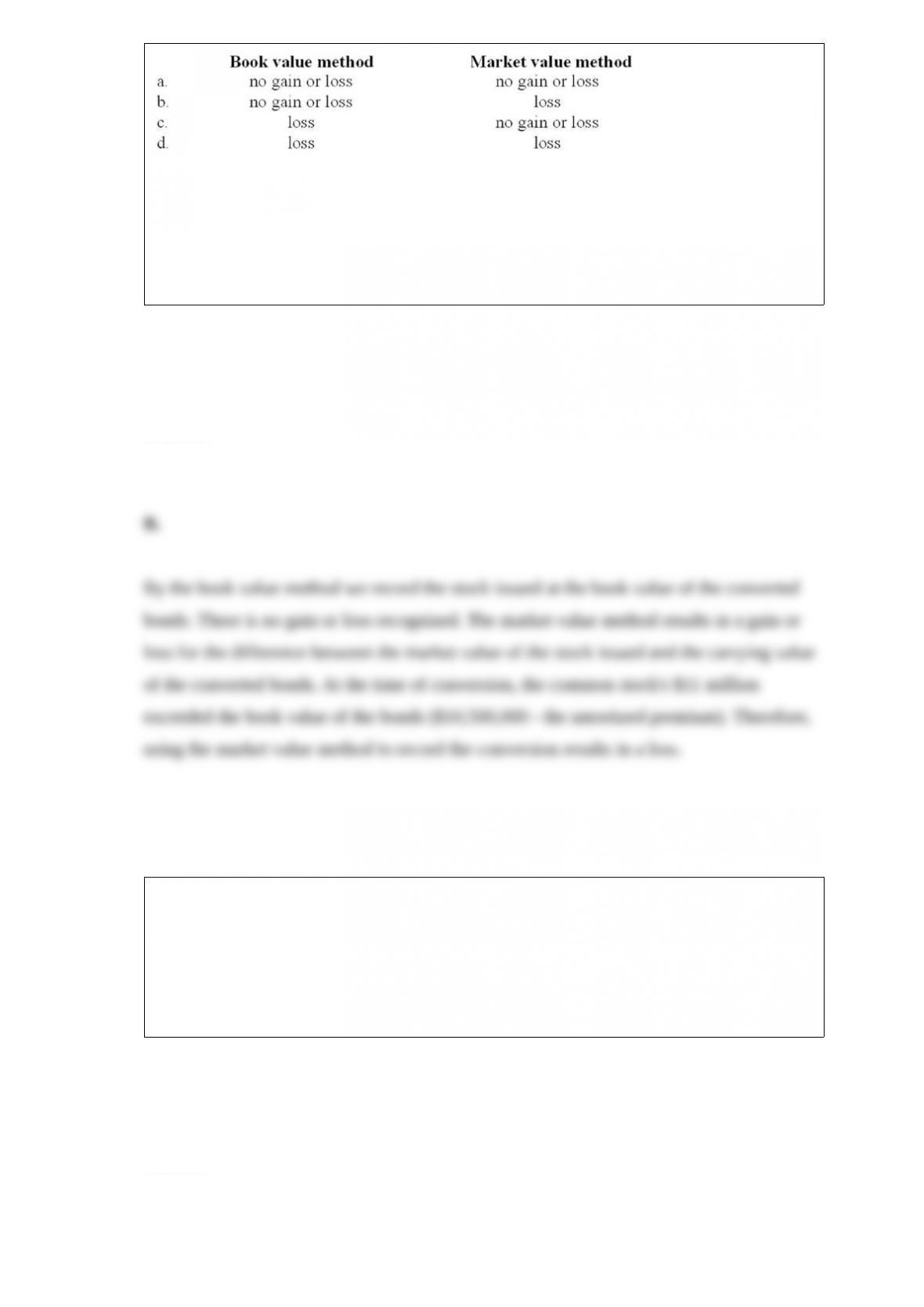
On January 1, 2013, Bell Co. issued $10 million of 10-year convertible bonds at 105.
On January 1, 2018, the bonds were converted into common stock with a market value
of $11 million. Upon conversion, Bell would recognize:
A. Option a
B. Option b
C. Option c
D. Option d
Answer:
When using the gross profit method to estimate ending inventory, it is not necessary to
know: A. Beginning inventory.
B. Net purchases.
C. Cost of goods sold.
Answer:

Listed below are five terms followed by a list of phrases that describe or characterize
each of the terms. Match each phrase with the correct term. 1)Operating activities
(SCF)
2)Extraordinary items
3)Restructuring costs
4)Comprehensive income
5)Noncash financing and investing activities
A. Unusual, infrequent, and material gains and losses.
B. When grouped together, essentially net income on a cash basis.
C. Costs incurred often relate to downsizing.
D. The acquisition of assets by issuing debt or equity securities.
E. Total nonowner change in equity for a reporting period.
Answer:
In determining cash flows from operating activities (indirect method), adjustments to
net income should not include: A. An addition for depreciation expense.
B. An addition for bond discount amortization.
C. An addition for a gain on sale of equipment.

D. An addition for patent amortization.
Answer:
On January 1, 2013, Badger Inc. adopted the dollar-value LIFO method. The inventory
cost on this date was $100,000. The 2013 ending inventory, valued at year-end costs,
was $126,000. The relative cost index for this inventory in 2013 was 1.05.
Suppose that Badger’s 2014 ending inventory, valued at year-end costs, was $143,000
and that the relative cost index for this inventory in 2014 was 1.10. In determining the
inventory balance should Badger report in its 12/31/14 balance sheet: A. An additional
layer of $23,000 is added to the 1/1/14 balance.
B. An additional layer of $22,000 is added to the 1/1/14 balance.
C. An additional layer of $11,000 is added to the 1/1/14 balance.
D. None of the above is correct.
Answer:

For reporting purposes, current deferred tax assets and current deferred tax liabilities
are: A. Netted against one another in the balance sheet.
B. Reported separately in the balance sheet.
C. Reflected only in the footnotes.
D. Combined respectively with noncurrent deferred tax assets and noncurrent deferred
tax liabilities in the balance sheet.
Answer:
Under IFRS, a deferred tax asset for stock options: A. Is created for the cumulative
amount of the fair value of the options the company has recorded for compensation
expense.
B. Is the portion of the options’ intrinsic value earned to date times the tax rate.
C. Is the tax rate times the amount of compensation.
D. Isn’t created if the award is “in the money;” that is, it has intrinsic value.
Answer:

In its first four years of operations Peridot Jewelers reported the following operating
income (loss) amounts:
There were no other deferred income taxes in any year. In 2012, Peridot elected to carry
back its operating loss. The enacted income tax rate was 40%. In its 2013 income
statement, what amount should Peridot report as income tax expense? A. $80,000.
B. $110,000.
C. $170,000.
D. $180,000.
Answer:
In applying LCM, market cannot be: A. Less than net realizable value.
B. Greater than the normal profit.
C. Less than the normal profit margin.
D. Greater than net realizable value.
Answer:
On April 1, 2013, Austere Corporation issued $300,000 of 10% bonds at 105. Each
$1,000 bond was sold with 25 detachable stock warrants, each permitting the investor to
purchase one share of common stock for $17. On that date, the market value of the
common stock was $15 per share and the market value of each warrant was $2. Austere
should record what amount of the proceeds from the bond issue as an increase in
liabilities? A. $285,000.
B. $300,000.
C. $315,000.
D. $0.
Answer:
Notes payable: A. Is a current liability account.

B. Usually has a debit balance.
C. Is a noncurrent liability account.
D. Cannot determine its classification without additional information.
Answer:
Cash flows from financing activities include:A. Interest received.
B. Interest paid.
C. Dividends received.
D. Dividends paid.
Answer:
Persoff Industries International has a defined benefit pension plan. The company
revised its estimate of future salary levels causing its defined benefit obligation to
increase by $16 million. Also, Persoff’s $25 million actual return on plan assets
exceeded the 5% high-grade corporate bond rate times the $440 million plan assets.
Persoff prepares its financial statements in accordance with International Financial
Reporting Standards. The company will: A. Record a $3 million decrease in its plan
assets.
B. Record a $16 million gain-OCI.
C. Change an amount in the equity section of the balance sheet to be subsequently
amortized to pension expense.
D. Change an amount in the equity section of the balance sheet that will never be
amortized to pension expense.
Answer:
Which of the following differences between financial accounting and tax accounting
ordinarily creates a deferred tax liability? A. Interest income on municipal bonds.
B. Proceeds from life insurance received due to death of an executive.
C. Prepaid rent.
D. None of the above.
Answer: