From a financial accounting perspective, the main purposes of a system of internal
control are to improve the accuracy and reliability of accounting information and to
safeguard assets.
Sellers recognize revenue for gift cards at the point in time control of the gift card is
transferred to the customer.
The transaction price should be adjusted to reflect the time value of money for interest
payable, but not for interest receivable.
On a sale-leaseback transaction, any gain on the ‘sale” portion of the transaction is
recognized immediately.
If the seller is an agent, the seller typically recognizes cost associated with the sale on
its own line in the income statement.
Under IAS No. 39, transfers of debt investments out of the FVPL category into AFS or
HTM are permitted under “rare circumstances.”
The right of return is a separate performance obligation, and a portion of the transaction
price needs to be allocated to it for revenue recognition.
Amounts held in cash equivalent investments must be reported separately from amounts
held as cash in the statement of cash flows.
The three factors in cost allocation of a depreciable asset are service life, allocation
base, and allocation method.
The monetary unit assumption requires that items in financial statements be measured
in a particular monetary unit.
Large, highly rated firms sometimes sell commercial paper:
a. To borrow funds at a lower rate than through a bank.
b. To earn a profit on the paper.
c. To avoid paperwork.
d. Because the interest rate is locked in by the Federal Reserve Board.
Which of the following is not a characteristic that defines a reportable operating
segment according to U.S. GAAP?
a. Operating results are regularly reviewed by the enterprise’s chief operating officer.
b. Discrete financial information is available.
c. Engages in business activities from which it may recognize revenues and incur
expenses.
d. Represents more than 20% of total company revenues, assets, or net income.
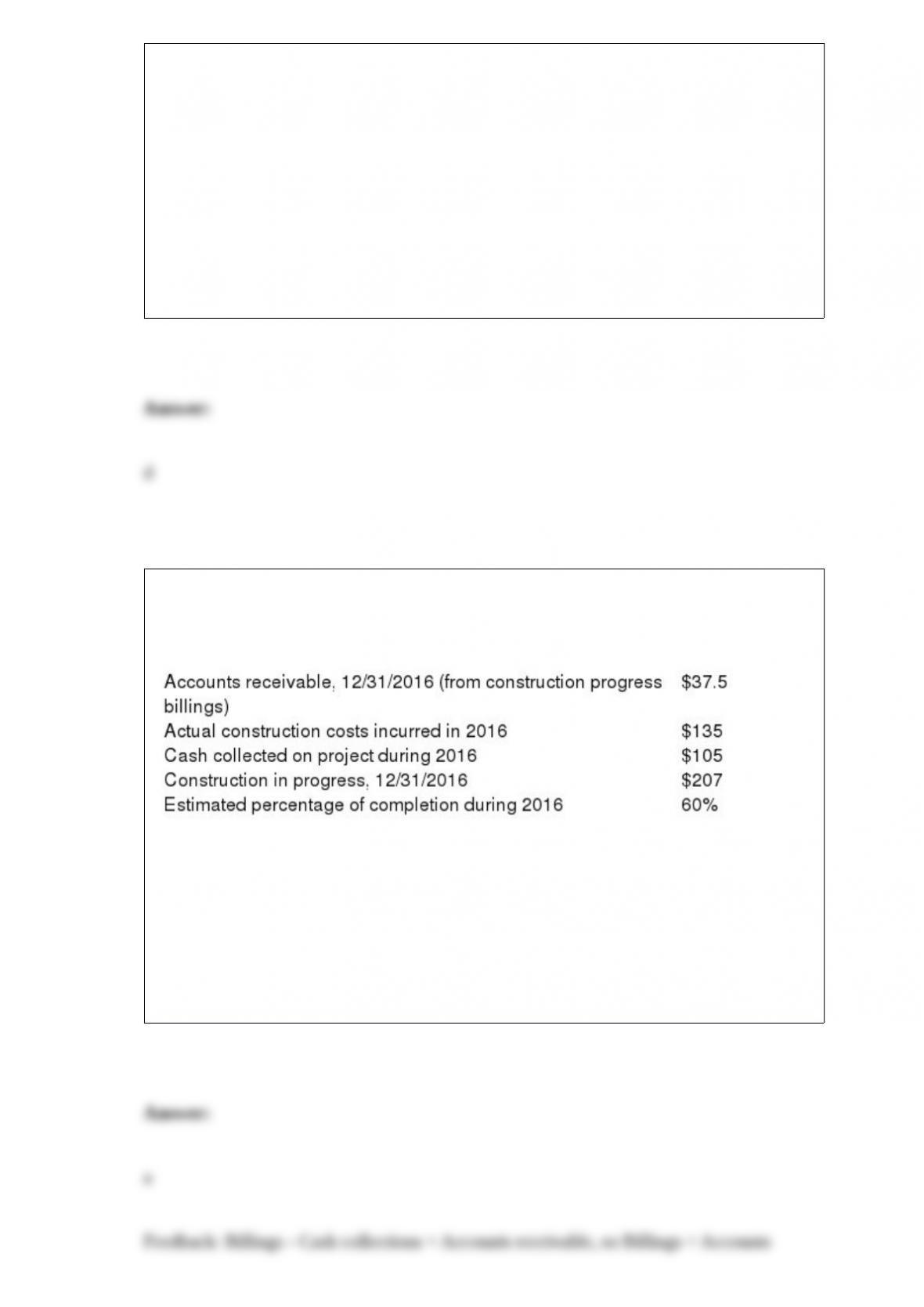
In 2016, Cupid Construction Co. (CCC) began work on a two-year fixed price contract
project. CCC recognizes revenue over time according to percentage of completion for
this contract, and provides the following information (dollars in millions):
What were the construction billings by CCC during 2016?
a. $142.5 million.
b. $67.5 million.
c. $37.5 million.
d. Cannot be determined from the given information.
Sanjeev enters into a contract offering variable consideration. The contract pays him
$1,000/month for six months of continuous consulting services. In addition, there is a
60% chance the contract will pay an additional $2,000 and a 40% chance the contract
will pay an additional $3,000, depending on the outcome of the consulting contract.
Sanjeev concludes that this contract qualifies for revenue recognition over time.
Assume that Sanjeev estimates variable consideration as the most likely amount. After
Sanjeev has recognized revenue for two months of the contract, he changes his
assessment of the chance the contract will pay him $3,000 to 70%. What adjustment to
revenue should Sanjeev recognize to account for that change in estimate?
a. Debit of $1,000
b. Debit of $334
c. Credit of $1,000
d. Credit of $334
One of the four criteria for a capital lease specifies that the lease term be equal to or
greater than:

a. 75% of the expected economic life of the leased property.
b. 90% of the expected economic life of the leased property.
c. 80% of the expected economic life of the leased property.
d. 50% of the expected economic life of the leased property.
Pierce Company issued 11% bonds, dated January 1, with a face amount of $800,000
on January 1, 2016. The bonds sold for $739,816 and mature in 2035 (20 years). For
bonds of similar risk and maturity the market yield was 12%. Interest is paid
semiannually on June 30 and December 31. Pierce determines interest at the effective
rate and elected the option to report these bonds at their fair value. On December 31,
2016, the fair value of the bonds was $730,000. The entire change in fair value was due
to a change in the general (risk-free) rate of interest. Pierce’s net income for the year
will include:
a. An unrealized gain from change in the fair value of debt of $10,617.
b. An unrealized loss from change in the fair value of debt of $10,617.
c. A gain from change in the fair value of debt of $10,204.
d. A loss from change in the fair value of debt of $10,204.
On January 1, 2016, Oliver Foods issued stock options for 40,000 shares to a division
manager. The options have an estimated fair value of $5 each. To provide additional
incentive for managerial achievement, the options are not exercisable unless Oliver
Foods’ stock price increases by 5% in four years. Oliver Foods initially estimates that it
is not probable the goal will be achieved. How much compensation will be recorded in
each of the next four years?
a. $10,000.
b. $45,000.
c. $50,000.
d. No effect.
In its first four years of operations Peridot Jewelers reported the following operating
income (loss) amounts:
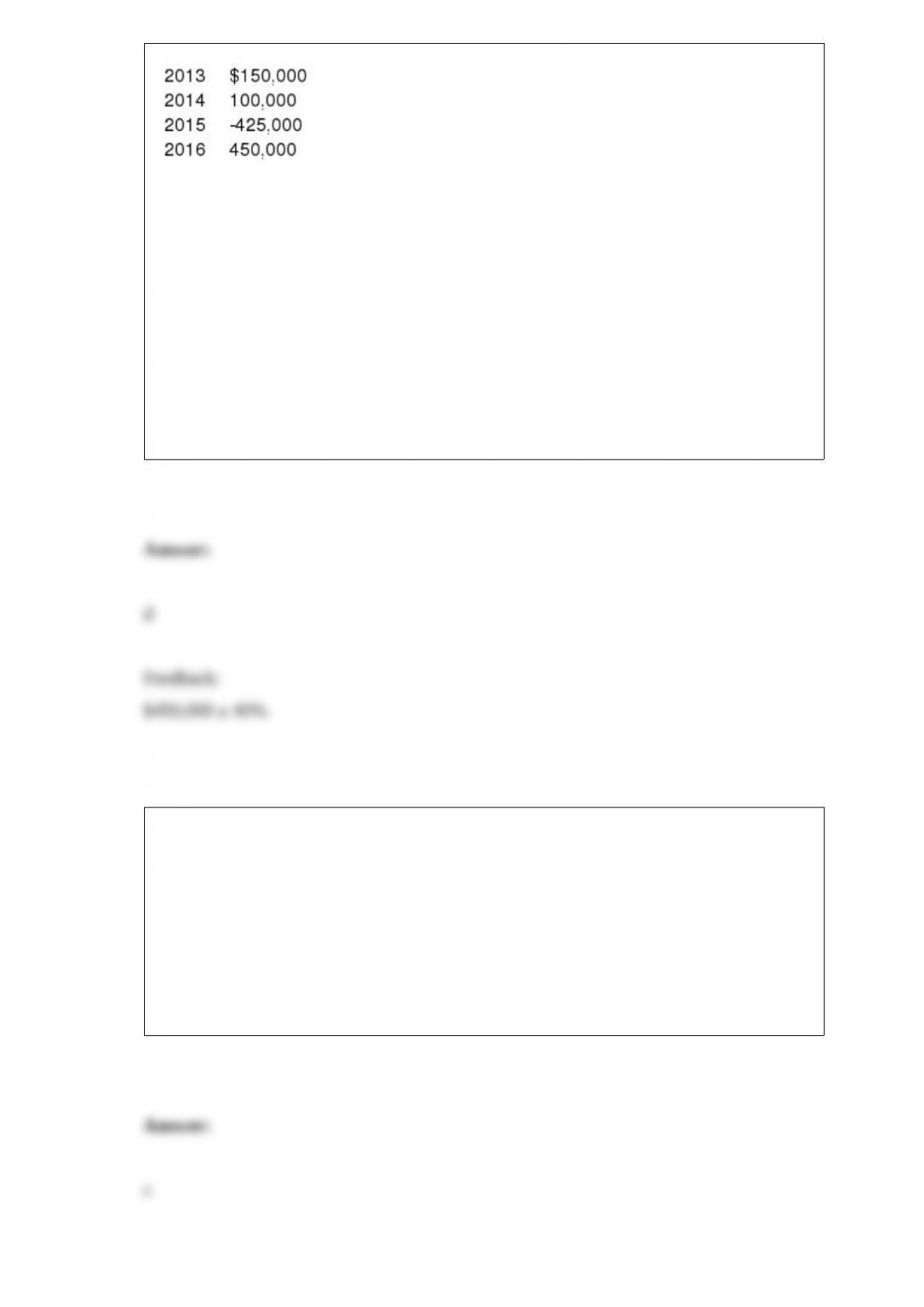
There were no other deferred income taxes in any year. In 2015, Peridot elected to carry
back its operating loss. The enacted income tax rate was 40%. In its 2016 income
statement, what amount should Peridot report as income tax expense?
a. $ 80,000.
b. $110,000.
c. $170,000.
d. $180,000.
Trading securities, by definition, are properly classified in the balance sheet as:
a. Shareholders’ equity.
b. Intangibles.
c. Current assets.
d. Other assets.

The following is the 2016 report of the independent registered public accounting firm
for The Great Food Company, Inc., a large supermarket chain:
In our opinion, the accompanying consolidated balance sheets and the related
consolidated statements of operations, stockholders’ deficit and comprehensive loss, and
cash flows present fairly, in all material respects, the financial position of The Great
Food Company, Inc. and its subsidiaries (debtor-in-possession) at December 31, 2016,
and December 31, 2015, and the results of their operations and their cash flows for each
of the three years in the period ended December 31, 2016, in conformity with
accounting principles generally accepted in the United States of America. In addition,
in our opinion, the financial statement schedule listed in Item 15(a)(2) presents fairly, in
all material respects, the information set forth therein when read in conjunction with the
related consolidated financial statements. Also in our opinion, the Company
maintained, in all material respects, effective internal control over financial reporting as
of December 31, 2016, based on criteria established in Internal Control – Integrated
Framework issued by the Committee of Sponsoring Organizations of the Treadway
Commission (COSO). The Company’s management is responsible for these financial
statements and financial statement schedule, for maintaining effective internal control
over financial reporting and for its assessment of the effectiveness of internal control
over financial reporting, included in Management’s Annual Report on Internal Control
over Financial Reporting appearing under Item 9A. Our responsibility is to express
opinions on these financial statements, on the financial statement schedule, and on the
Company’s internal control over financial reporting based on our integrated audits. We
conducted our audits in accordance with the standards of the Public Company
Accounting Oversight Board (United States). Those standards require that we plan and
perform the audits to obtain reasonable assurance about whether the financial
statements are free of material misstatement and whether effective internal control over
financial reporting was maintained in all material respects. Our audits of the financial
statements included examining, on a test basis, evidence supporting the amounts and
disclosures in the financial statements, assessing the accounting principles used and
significant estimates made by management, and evaluating the overall financial
statement presentation. Our audit of internal control over financial reporting included
obtaining an understanding of internal control over financial reporting, assessing the
risk that a material weakness exists, and testing and evaluating the design and operating
effectiveness of internal control based on the assessed risk. Our audits also included
performing such other procedures as we considered necessary in the circumstances. We
believe that our audits provide a reasonable basis for our opinions. The accompanying
financial statements have been prepared assuming that the Company will continue as a
going concern. However, the Company is currently operating pursuant to a Chapter 11
bankruptcy filing which, together with the uncertain outcomes of the matters discussed
in Note 1 to the consolidated financial statements, raise substantial doubt about the
Company’s ability to continue as a going concern. Management’s plans in regard to
these matters are also described in Note 1. The consolidated financial statements do not
include any adjustments that might result from the outcome of these uncertainties. As
discussed in Note 1 to the consolidated financial statements, the Company changed the
manner in which it accounts for share lending arrangements during fiscal 2015. A
company’s internal control over financial reporting is a process designed to provide
reasonable assurance regarding the reliability of financial reporting and the preparation
of financial statements for external purposes in accordance with generally accepted
accounting principles. A company’s internal control over financial reporting includes
those policies and procedures that (i) pertain to the maintenance of records that, in
reasonable detail, accurately and fairly reflect the transactions and dispositions of the
assets of the company; (ii) provide reasonable assurance that transactions are recorded
as necessary to permit preparation of financial statements in accordance with generally
accepted accounting principles, and that receipts and expenditures of the company are
being made only in accordance with authorizations of management and directors of the
company; and (iii) provide reasonable assurance regarding prevention or timely
detection of unauthorized acquisition, use, or
disposition of the company’s assets that could have a material effect on the financial
statements.
Required. Interpret the main points indicated in this report by Great Food’s auditors.
On December 31, 2016, Wellstone Company reported net income of $70,000 and sales
of $210,000. The company also reported beginning and ending accounts receivable at
$20,000 and $25,000, respectively. Wellstone will report cash collected from customers
in its 2016 statement of cash flows (direct method) in the amount of:
a. $215,000.
b. $285,000.
c. $135,000.
d. $205,000.
The following information is related to the defined benefit pension plan of Simpson
Company for the year:
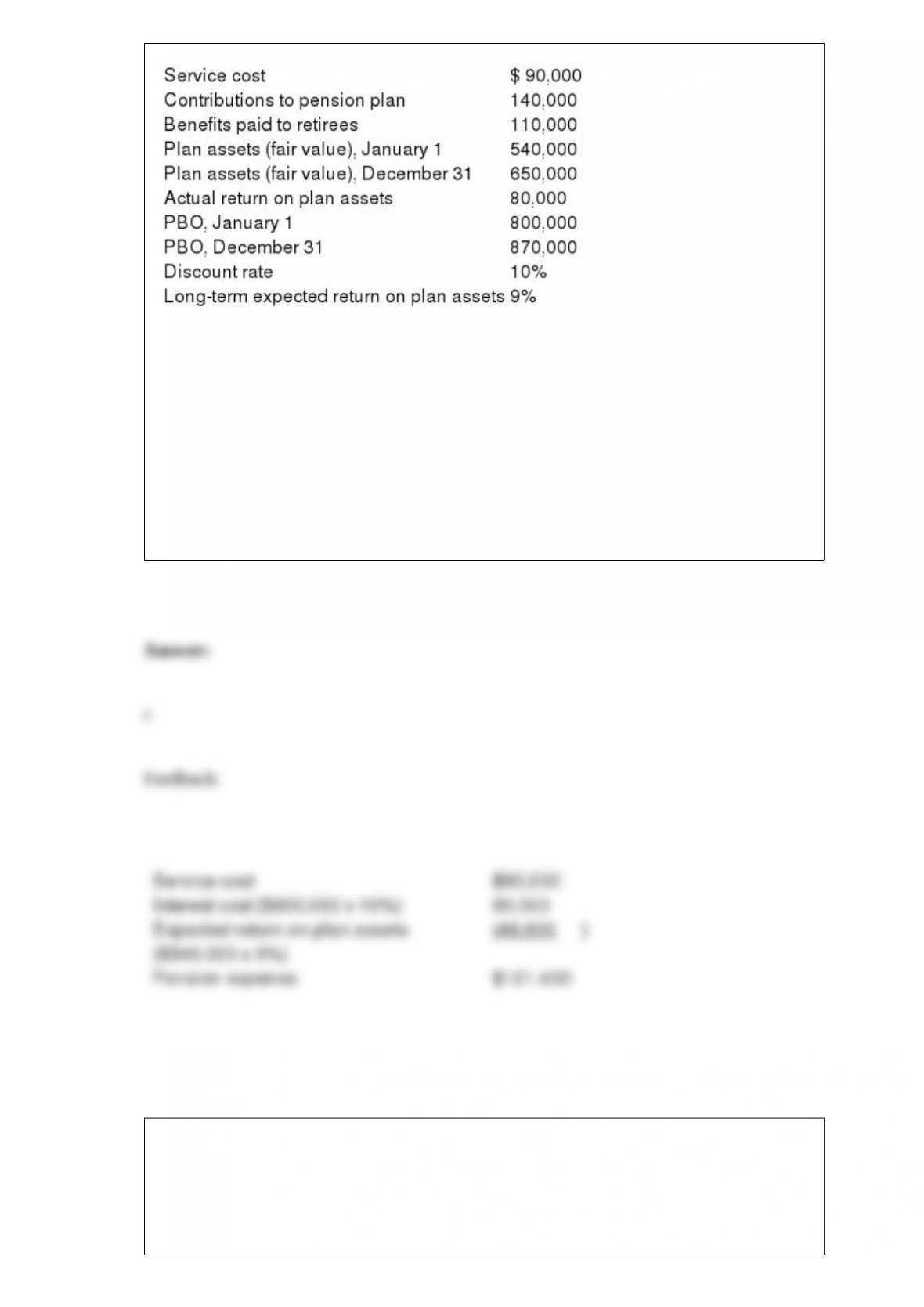
Assuming no other relevant data exist, what is the pension expense for the year?
a. $ 90,000.
b. $230,600.
c. $121,400.
d. $154,000.
On January 1, 2016, Hobart Mfg. Co. purchased a drill press at a cost of $36,000. The
drill press is expected to last 10 years and has a residual value of $6,000. During its
10-year life, the equipment is expected to produce 500,000 units of product. In 2016
and 2017, 25,000 and 84,000 units, respectively, were produced. Required:
Compute depreciation for 2016 and 2017 and the book value of the drill press at
December 31, 2016 and 2017, assuming the sum-of-the-years’-digits method is used.
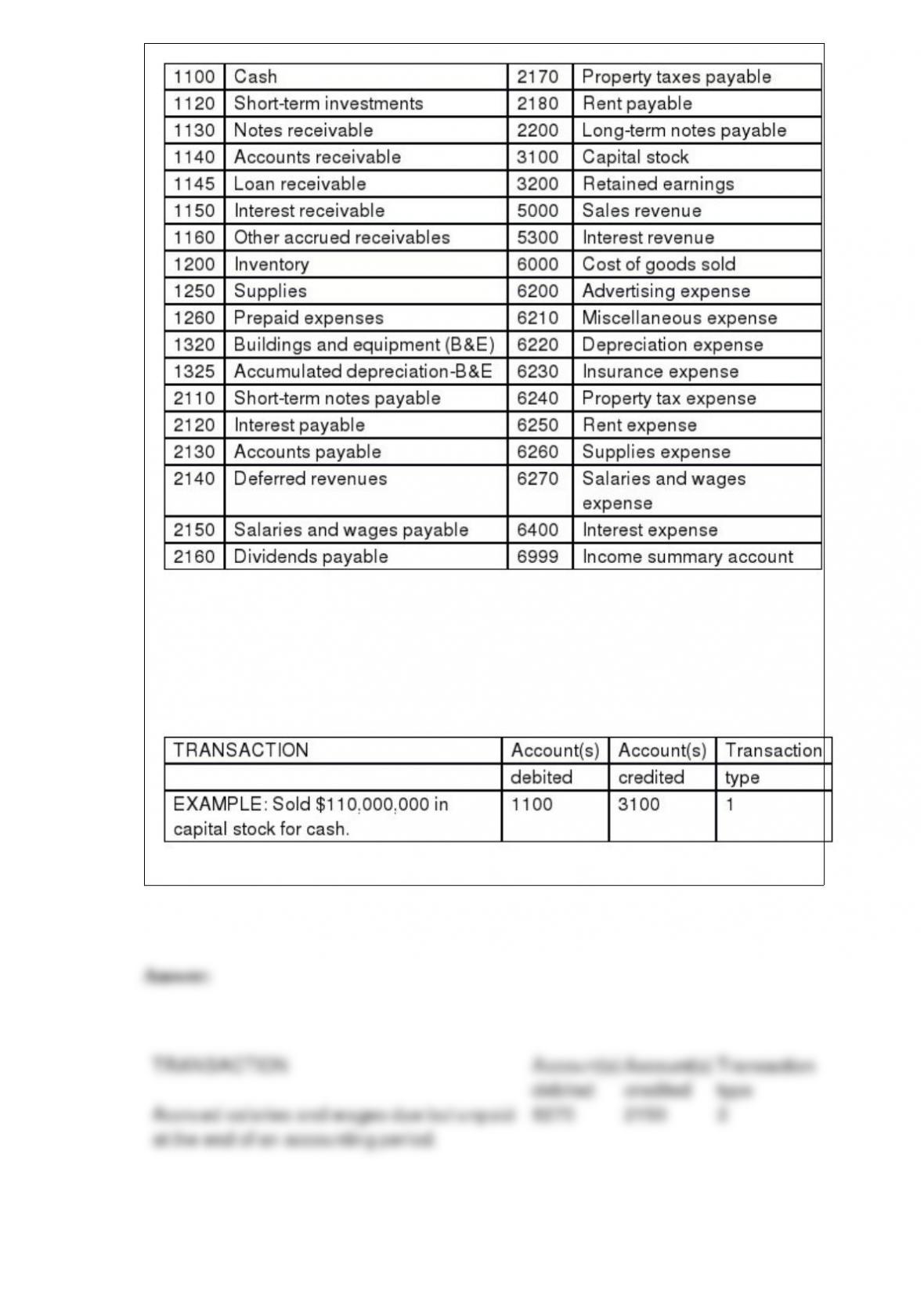
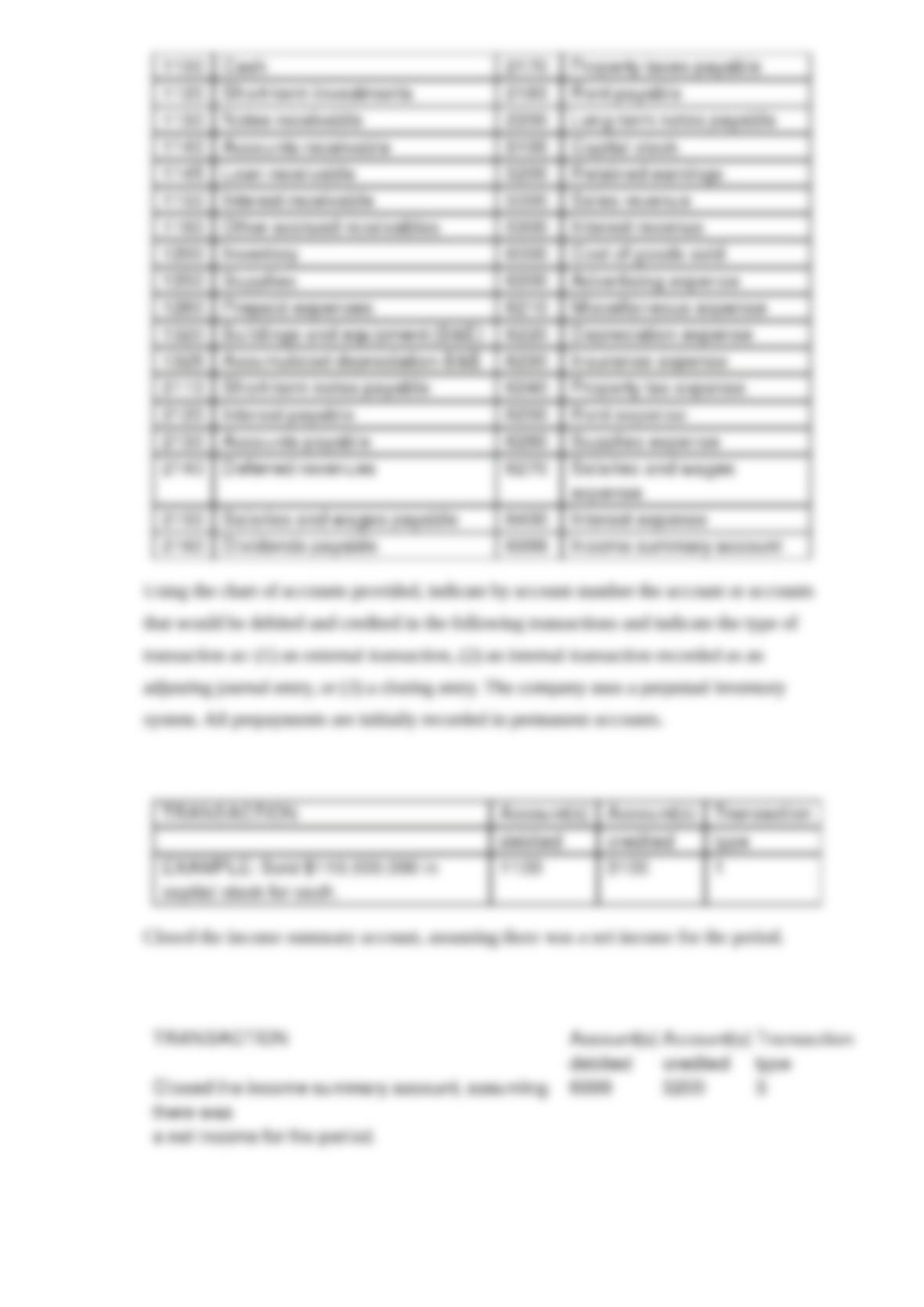
Using the chart of accounts provided, indicate by account number the account or
accounts that would be debited and credited in the following transactions and indicate
the type of transaction as: (1) an external transaction, (2) an internal transaction
recorded as an adjusting journal entry, or (3) a closing entry. The company uses a
perpetual inventory system. All prepayments are initially recorded in permanent
accounts.
Salaries and wages have been earned but are unpaid at the end of an accounting period.
White & Decker Corporation’s 2016 financial statements included the following
information in the long-term debt disclosure note:
The disclosure note stated the debenture bonds were issued late in 2011 and have a
maturity value of $500 million. The maturity value indicates the amount that White &
Decker will pay bondholders in 2031. Each individual bond has a maturity value (face
amount) of $1,000. Zero-coupon bonds pay no cash interest during the term to maturity.
The company is ‘œaccreting’ (gradually increasing) the issue price to maturity value
using the bonds’ effective interest rate computed on an annual basis. Required:
1> Determine the effective interest rate on the bonds.
2> Determine the issue price in late 2011 of a single, $1,000 maturity-value bond.
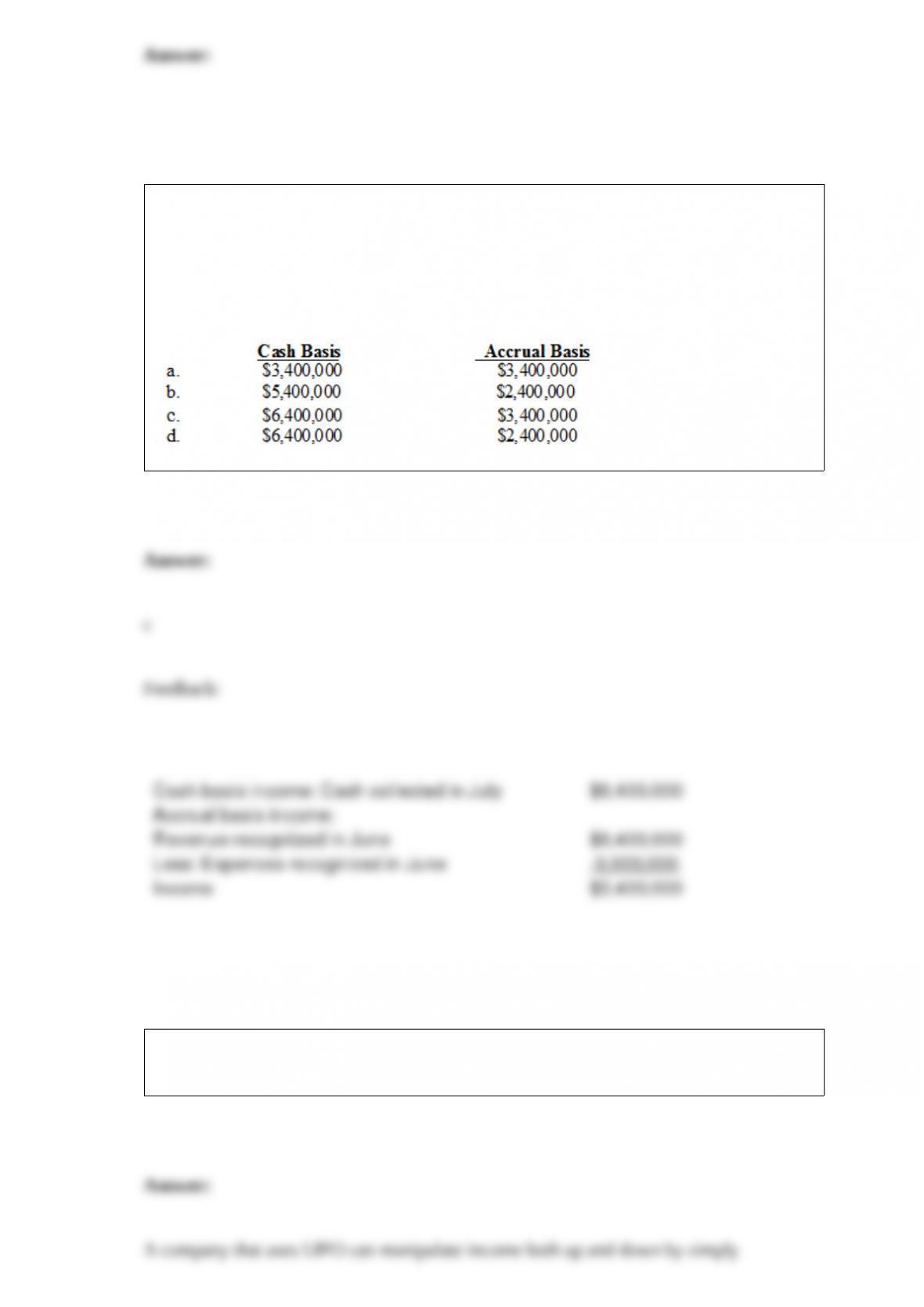
On June 1, Royal Corp. began operating a service company with an initial cash
investment by shareholders of $2,000,000. The company provided $6,400,000 of
services in June and received full payment in July. Royal also incurred expenses of
$3,000,000 in June that were paid in August. During June, Royal paid its shareholders
cash dividends of $1,000,000. What was the company’s income before income taxes for
the two months ended July 31 under the following methods of accounting?
Briefly explain how companies that use LIFO can both increase and decrease reported
earnings by “managing” ending inventories.
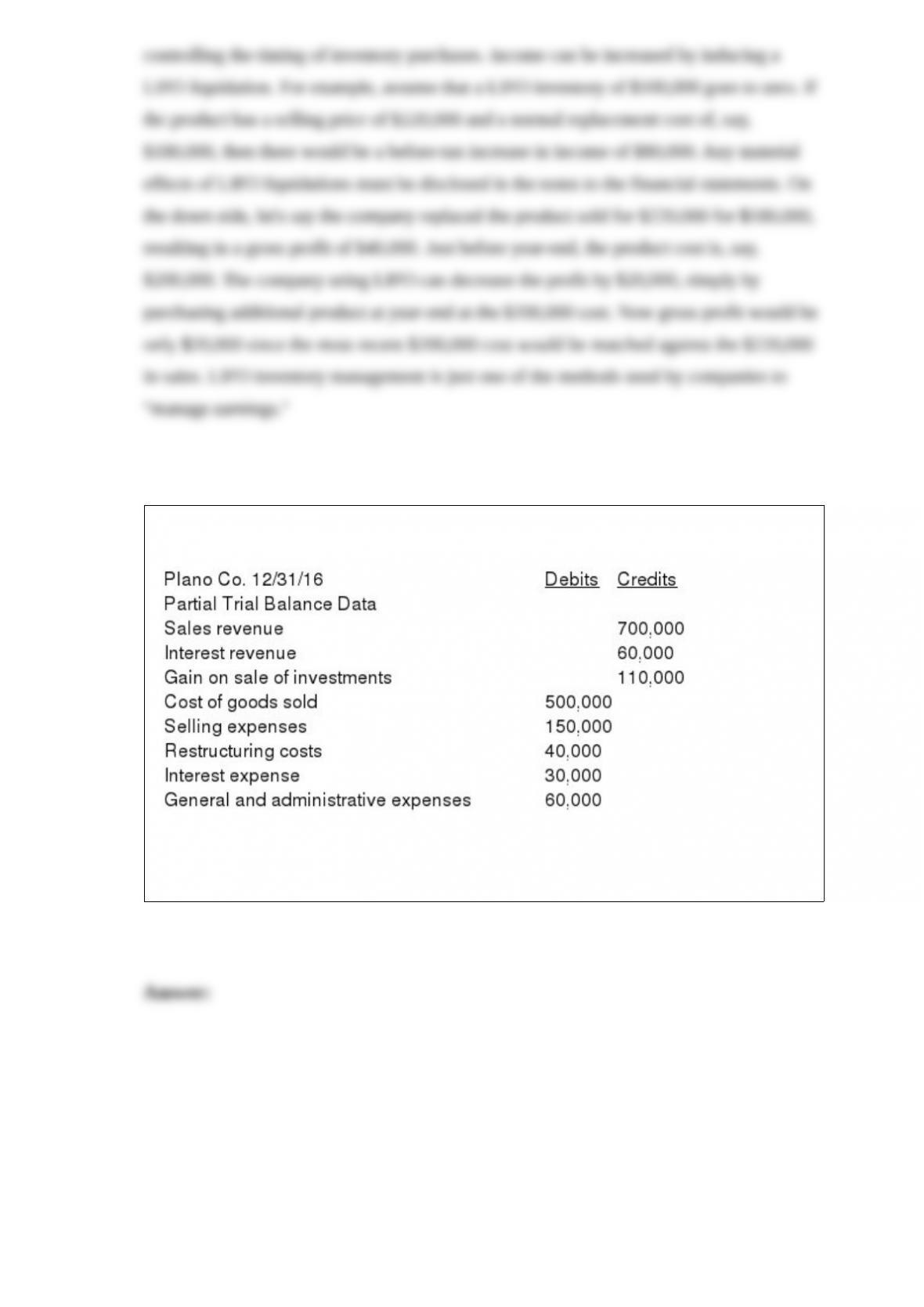
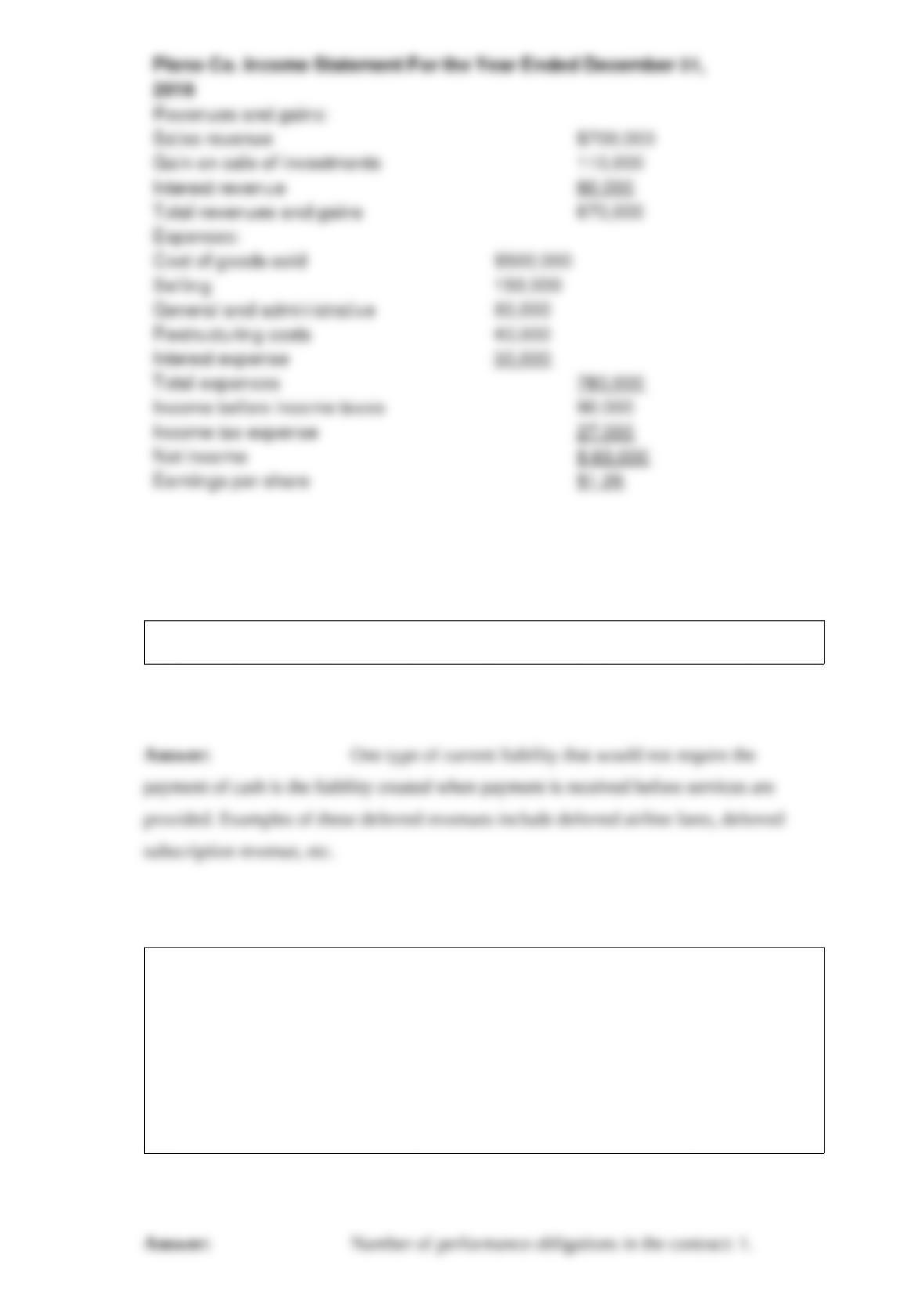
Plano had 50,000 shares of stock outstanding throughout the year. Income tax expense
has not yet been accrued. The effective tax rate is 30%.
Required: Prepare a single-step income statement with earnings per share disclosure.
Provide an example of a liability that would not require the payment of cash.
Summerhill Construction builds luxury houses in remote areas. On June 1, 2016, the
company signed a contract to build a house in an undeveloped section of a
mountainside, and received $2 million in advance for the job. To complete the project,
the company must construct a pathway leading to the building lot, clear a large hillside,
and construct a wooden house. Normally, the company would charge $400,000,
$1,400,000, and $500,000, respectively, for each of these tasks if done separately.
Required: Given the information above, how many performance obligations are
included in this contract?
Over time, accounting standards have developed to reflect changes in the business
world as well as changes in our ability to account for such changes. Using the example
of marking assets and liabilities to their fair value, explain why you would expect
accounting standards to change.