Presented below are two independent situations:
(a) Yount Company exchanged an old machine (cost $150,000 less $90,000
accumulated depreciation) plus $10,000 cash for a new machine. The old machine had a
fair value of $54,000. Prepare the entry to record the exchange of assets by Yount
Company.
(b) Lawson Company trades old equipment (cost $90,000 less $54,000 accumulated
deprecia-tion) for new equipment. Lawson paid $36,000 cash in the trade. The old
equipment that was traded had a fair value of $54,000. Prepare the entry to record the
exchange of assets by Lawson Company. The transaction has commercial substance.
Answer:
Nirvana Corporation issued a one-year, 9%, $400,000 note on April 30, 2015. Interest
expense for the year ended December 31, 2015 was
a. $21,000.
b. $24,000.
c. $27,000.
d. $36,000.
Answer:
Which of the following steps is not required in preparing the statement of cash flows?
a. Determine the net change in cash.
b. Determine the net cash provided by operating activities.
c. Determine cash from investing and financing activities.
d. Determine the change in current assets.
Answer:
The assumption that the unit of measure remains sufficiently constant over time is part
of the
a. economic entity assumption.
b. cost principle.
c. historical cost principle.

d. monetary unit assumption.
Answer:
Accounts often need to be adjusted because
a. there are never enough accounts to record all the transactions.
b. many transactions affect more than one time period.
c. there are always errors made in recording transactions.
d. management can’t decide what they want to report.
Answer:
(a) A company purchased a patent on January 1, 2015, for $2,500,000. The patent’s
legal life is 20 years but the company estimates that the patent’s useful life will only be
5 years from the date of acquisition. On June 30, 2015, the company paid legal costs of
$135,000 in successfully defending the patent in an infringement suit. Prepare the
journal entry to amortize the patent at year end on December 31, 2015.
(b) Trent Company purchased a franchise from Tastee Food Company for $400,000 on
January 1, 2015. The franchise is for an indefinite time period and gives Trent Company
the exclusive rights to sell Tastee Wings in a particular territory. Prepare the journal
entry to record the acquisition of the franchise and any necessary adjusting entry at year
end on December 31, 2015.
(c) Kline Company incurred research and development costs of $500,000 in 2015 in
developing a new product. Prepare the necessary journal entries during 2015 to record
these events and any adjustments at year end on December 31, 2015.
Answer:
In recognizing a decline in the fair value of short-term stock investments, an unrealized
loss account is debited because
a. management intends to realize this loss in the near future.
b. the securities have not been sold.
c. the stock market is volatile.
d. management cannot determine the exact amount of the loss in value.
Answer:

Kingston Company purchased a piece of equipment on January 1, 2015. The equipment
cost $200,000 and had an estimated life of 8 years and a salvage value of $25,000.
What was the depreciation expense for the asset for 2016 under the
double-declining-balance method?
a. $21,667.
b. $37,500.
c. $50,000.
d. $39,063.
Answer:
Which of the following accounts has a normal credit balance?
a. Sales Returns and Allowances
b. Sales Discounts
c. Sales Revenue
d. Selling Expense
Answer:
A company purchased factory equipment for $700,000. It is estimated that the
equipment will have a $70,000 salvage value at the end of its estimated 5-year useful
life. If the company uses the double-declining-balance method of depreciation, the
amount of annual depreciation recorded for the second year after purchase would be
a. $280,000.
b. $168,000.
c. $252,000.
d. $120,960.
Answer:
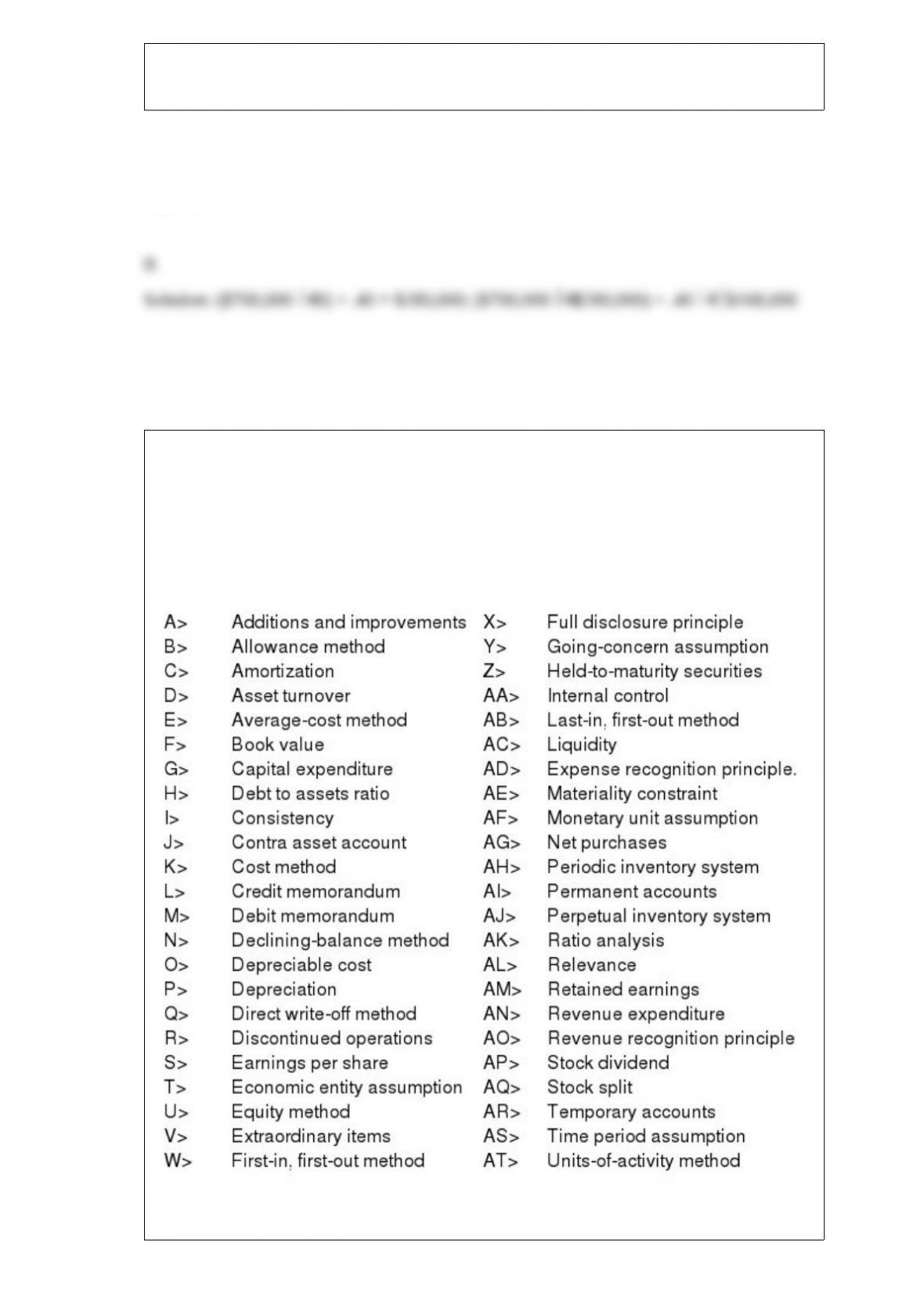
Instructions
Designate the terminology that best represents the definition or statement given below
by placing the identifying letter(s) in the space provided. No letter should be used more
than once.
___ 1> The periodic write-off of an intangible asset.

___ 2> The total amount subject to depreciation.
___ 3> The principle that efforts be matched with accomplishments.
___ 4> An expenditure charged against revenues as an expense when incurred.
___ 5> The inventory costing method that assumes that the costs of the earliest goods
purchased are the first to be recognized as cost of goods sold.
___ 6> Measures the percentage of total assets provided by creditors.
___ 7> An inventory costing method that assumes that the latest units purchased are the
first to be allocated to cost of goods sold.
___ 8> An assumption that economic events can be identified with a particular unit of
accountability.
___ 9> A quality of information that indicates the information makes a difference in a
decision.
___ 10> An assumption that the economic life of a business can be divided into
artificial time periods.
___ 11> This method of accounting for uncollectible accounts is required when bad
debts are significant in size.
___ 12. An accounting method in which cash dividends received are credited to
Dividend Revenue.
___ 13> Used by a bank when a previously deposited customer’s check ‘bounces’
because of insufficient funds.
___ 14> The assumption that the enterprise will continue in operation long enough to
carry out its existing objectives and commitments.
___ 15> A system in which detailed records are not maintained and cost of goods sold
is determined only at the end of an accounting period.
___ 16> The ability to pay maturing obligations and meet unexpected needs for cash.
___ 17> The methods and measures adopted within a business to safeguard its assets
and enhance the accuracy and reliability of its accounting records.
___ 18> Revenue, expense, and dividends accounts whose balances are transferred to
retained earnings at the end of an accounting period.
___ 19> A technique for evaluating financial statements that expresses the relationship
among selected financial statement data.
___ 20> A depreciation method that applies a constant rate to the declining balance

book value of the asset and produces a decreasing annual depreciation expense over the
useful life of the asset.
___ 21> A pro rata distribution of a corporation’s own stock to its stockholders.
___ 22> Events and transactions that are unusual in nature and infrequent in
occurrence.
___ 23> The disposal of a significant component of a business.
___ 24> The net income earned by each share of outstanding common stock.
Answer:
A promissory note
a. is not a formal credit instrument.
b. may be used to settle an accounts receivable.
c. has the party to whom the money is due as the maker.
d. cannot be factored to another party.
Answer:
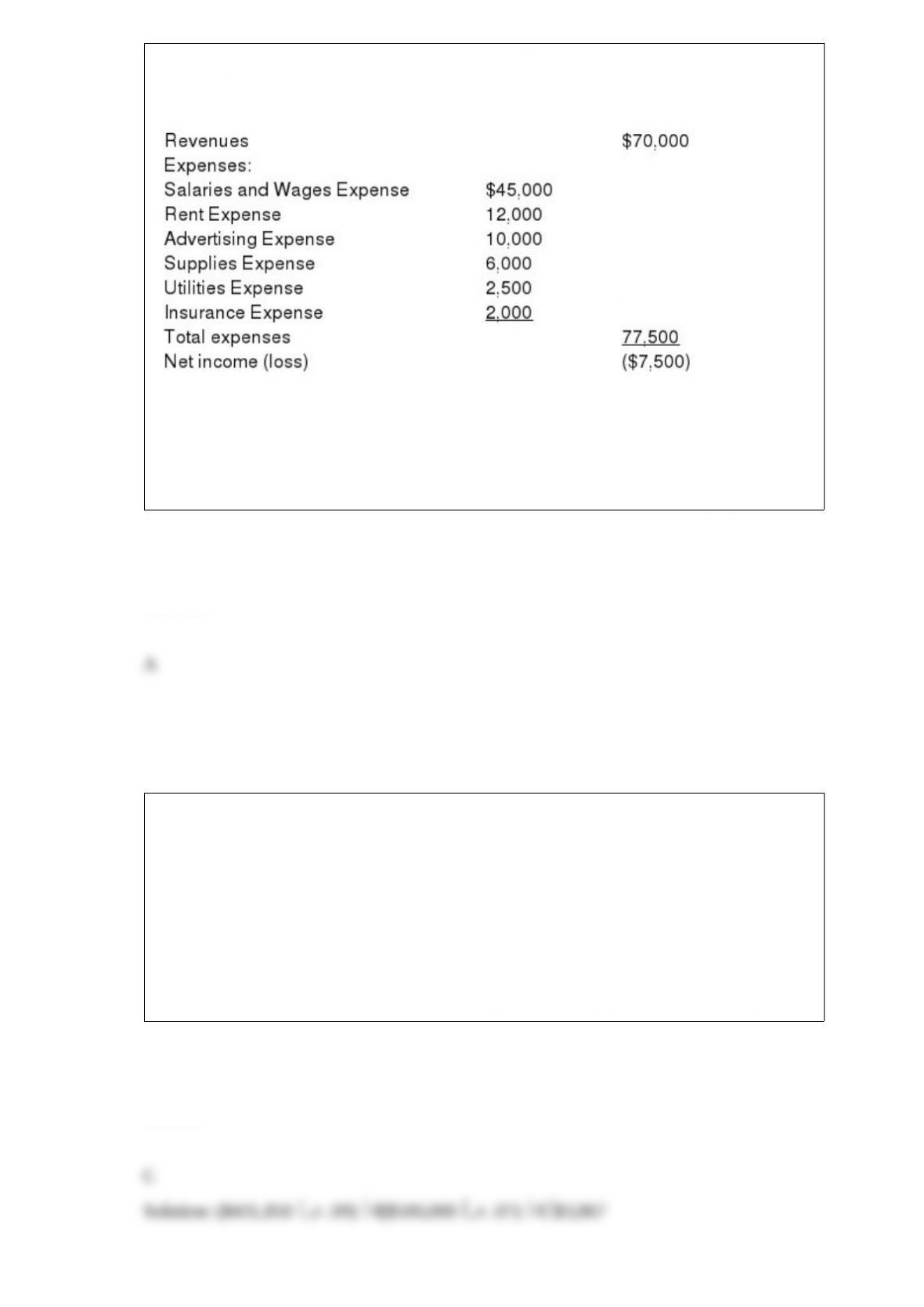
The income statement for the year 2015 of Fugazi Co. contains the following
information:
After all closing entries have been posted, the revenue account will have a balance of
a. $0.
b. $70,000 credit.
c. $70,000 debit.
d. $7,500 credit.
Answer:
Silk Company issued $500,000 of 7%, 10-year bonds on one of its interest dates for
$431,850 to yield an effective annual rate of 9%. The effective-interest method of
amortization is to be used. Interest is paid annually.
The journal entry on the first interest payment date, to record the payment of interest
and amortization of discount will include a
a. debit to Interest Expense for $35,000.
b. credit to Cash for $38,867.
c. credit to Discount on Bonds Payable for $3,867.
d. debit to Interest Expense for $45,000.
Answer:

Disclosures about inventory should include each of the following except the
a. basis of accounting.
b. costing method.
c. quantity of inventory.
d. major inventory classifications.
Answer:
The cost method of accounting for long-term investments in stock should be employed
when the
a. investor owns more than 50% of the investee’s stock.
b. investor has significant influence on the investee and the stock held by the investor
are marketable equity securities.
c. market value of the shares held is greater than their historical cost.
d. investor’s influence on the investee is insignificant.
Answer:
Hardy Company has current assets of $95,000, current liabilities of $100,000, long-term
assets of $180,000 and long-term liabilities of $80,000. Hardy Company’s working
capital and its current ratio are:
a. $85,000 and .95:1.
b. -$5,000 and 1.95:1.
c. $5,000 and .95:1.
d. -$5,000 and .95:1.
Answer:
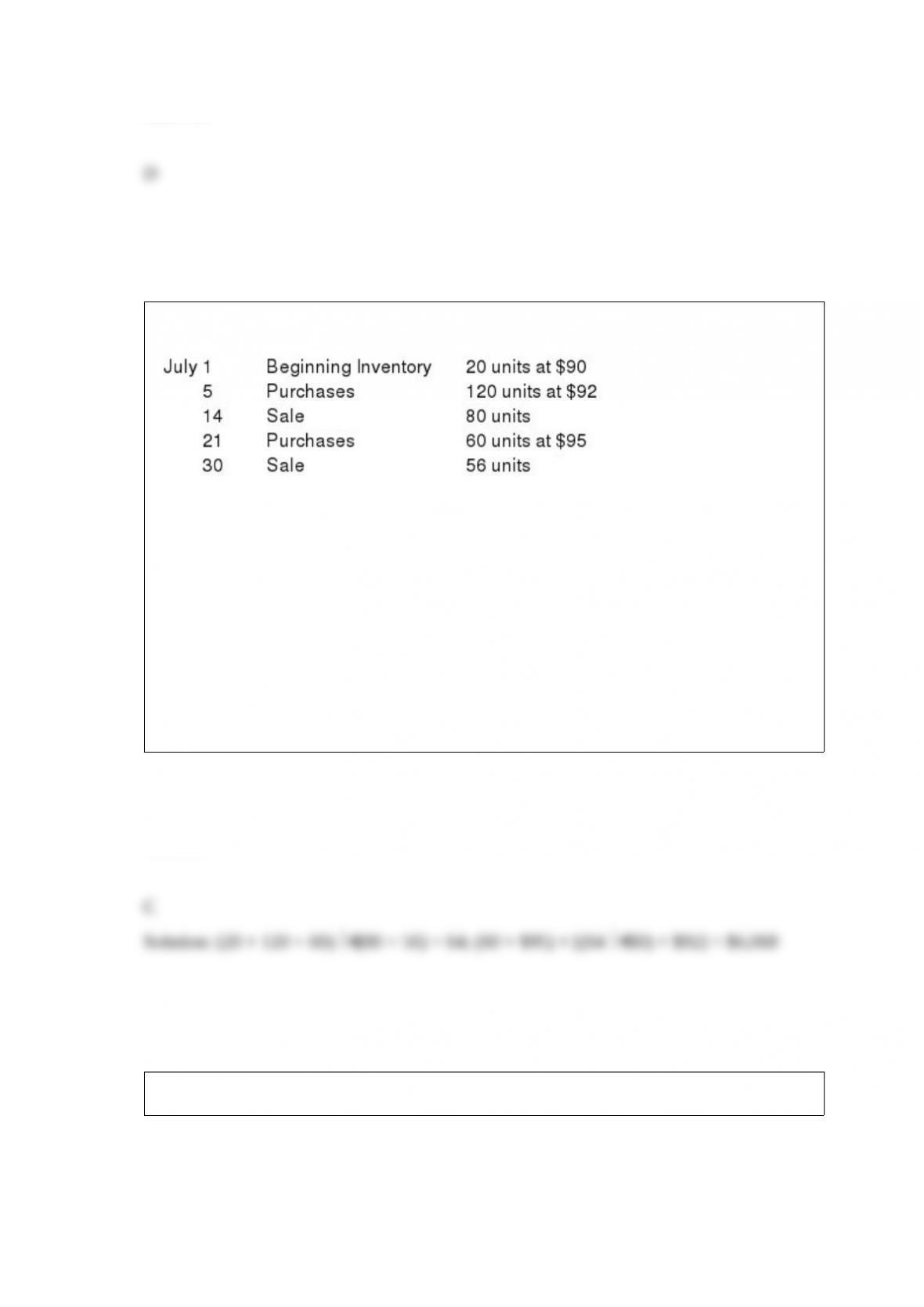
Pappy’s Staff has the following inventory information.
Assuming that a perpetual inventory system is used, what is the ending inventory on a
FIFO basis?
a. $5,848
b. $5,860
c. $6,068
d. $6,346
Answer:
The following information is for Bright Eyes Auto Supplies:
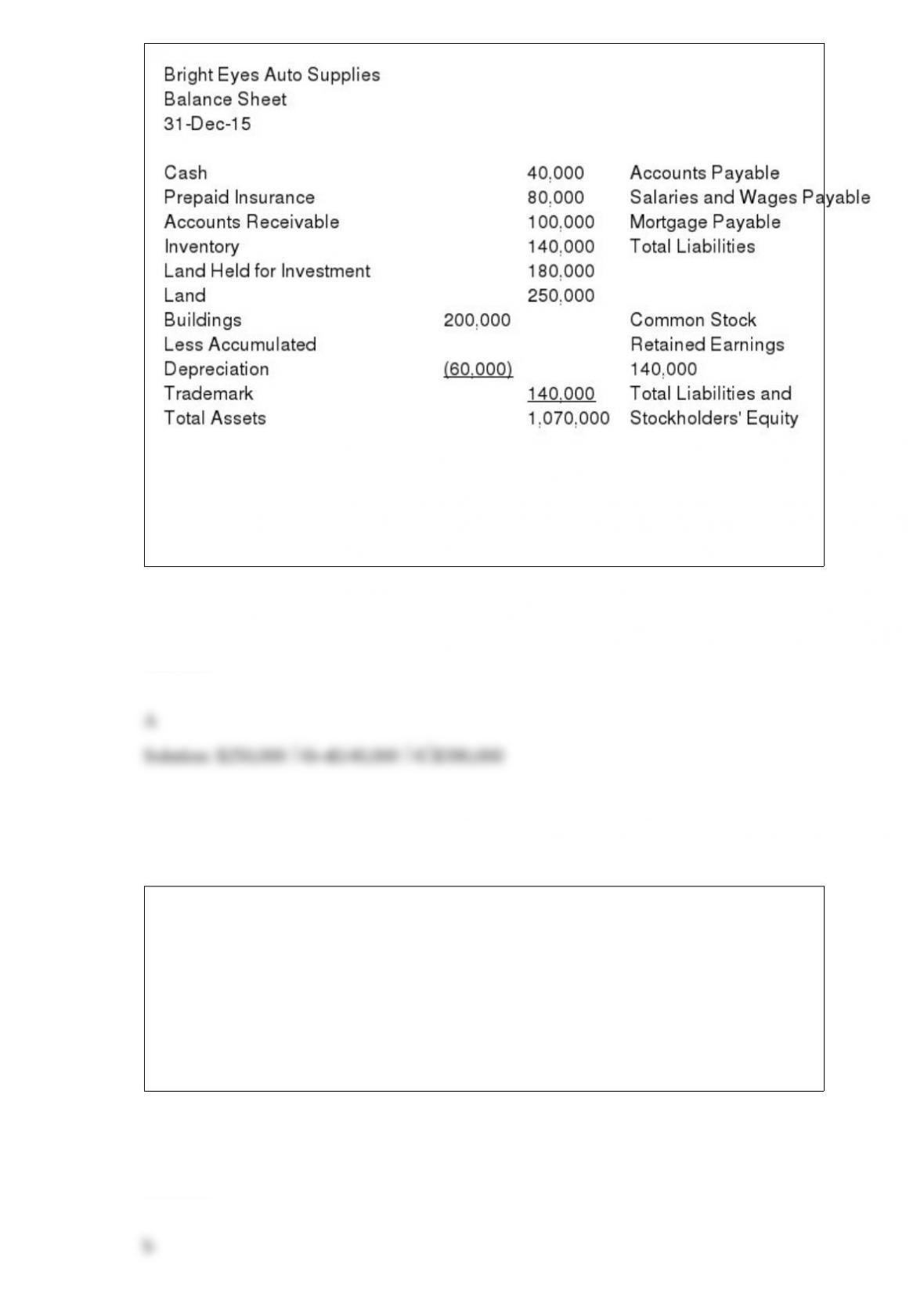
The total dollar amount of assets to be classified as property, plant, and equipment is
a. $390,000.
b. $450,000.
c. $570,000.
d. $630,000.
Answer:
At September 1, 2015, Promise Ring Co. reported stockholders’ equity of $156,000.
During the month, Promise Ring generated revenues of $38,000, incurred expenses of
$21,000, purchased equipment for $5,000 and paid dividends of $2,000. What is the
amount of stockholders’ equity at September 30, 2015?
a. $166,000
b. $171,000
c. $173,000
d. $176,000
Answer:
As Mel Smith was doing his year-end accounting, he noticed that the bookkeeper had
made errors in recording several transactions. The erroneous transactions are as follows:
[a] A check for $700 was issued for goods previously purchased on account. The
bookkeeper debited Accounts Receivable and credited Cash for $700.
[b] A check for $180 was received as payment on account. The bookkeeper debited
Accounts Payable for $810 and credited Accounts Receivable for $810.
[c] When making the entry to record the year’s depreciation expense, the bookkeeper
debited Accumulated Depreciation’”Equipment for $1,000 and credited Cash for
$1,000.
[d] When accruing interest on a note payable, the bookkeeper debited Interest
Receivable for $200 and credited Interest Payable for $200.
Instructions
Prepare the appropriate correcting entries. [Do not reverse the original entries.)
Answer:
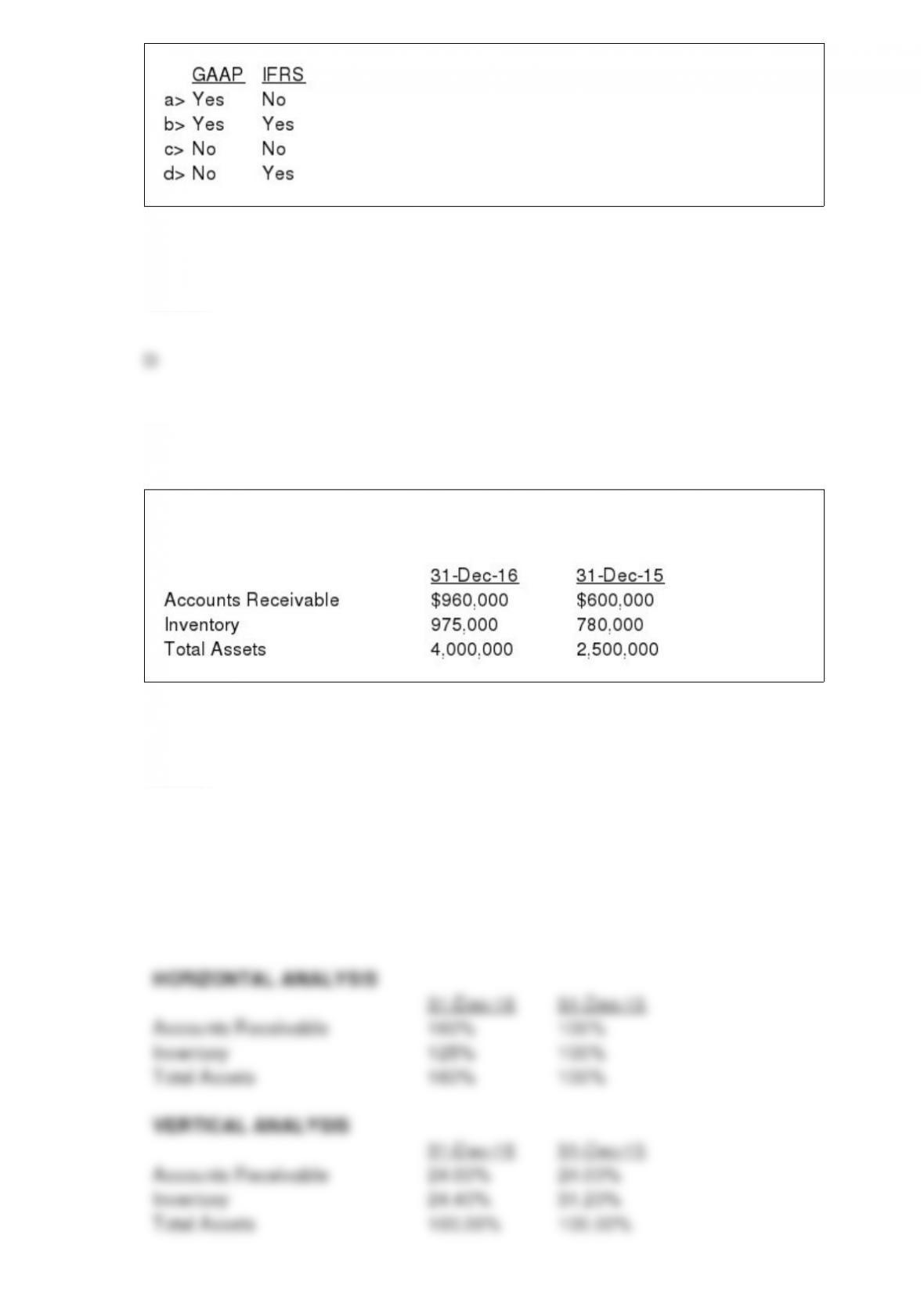
Inventory written down under lower-of-cost-or market may be written back up to
original cost in a subsequent period under
Answer:
Using the following selected items from the comparative balance sheet of Ames
Company, illustrate horizontal and vertical analysis.
Answer:
For a merchandising company, all accounts that affect the determination of income are
closed to the Income Summary account.
Answer:
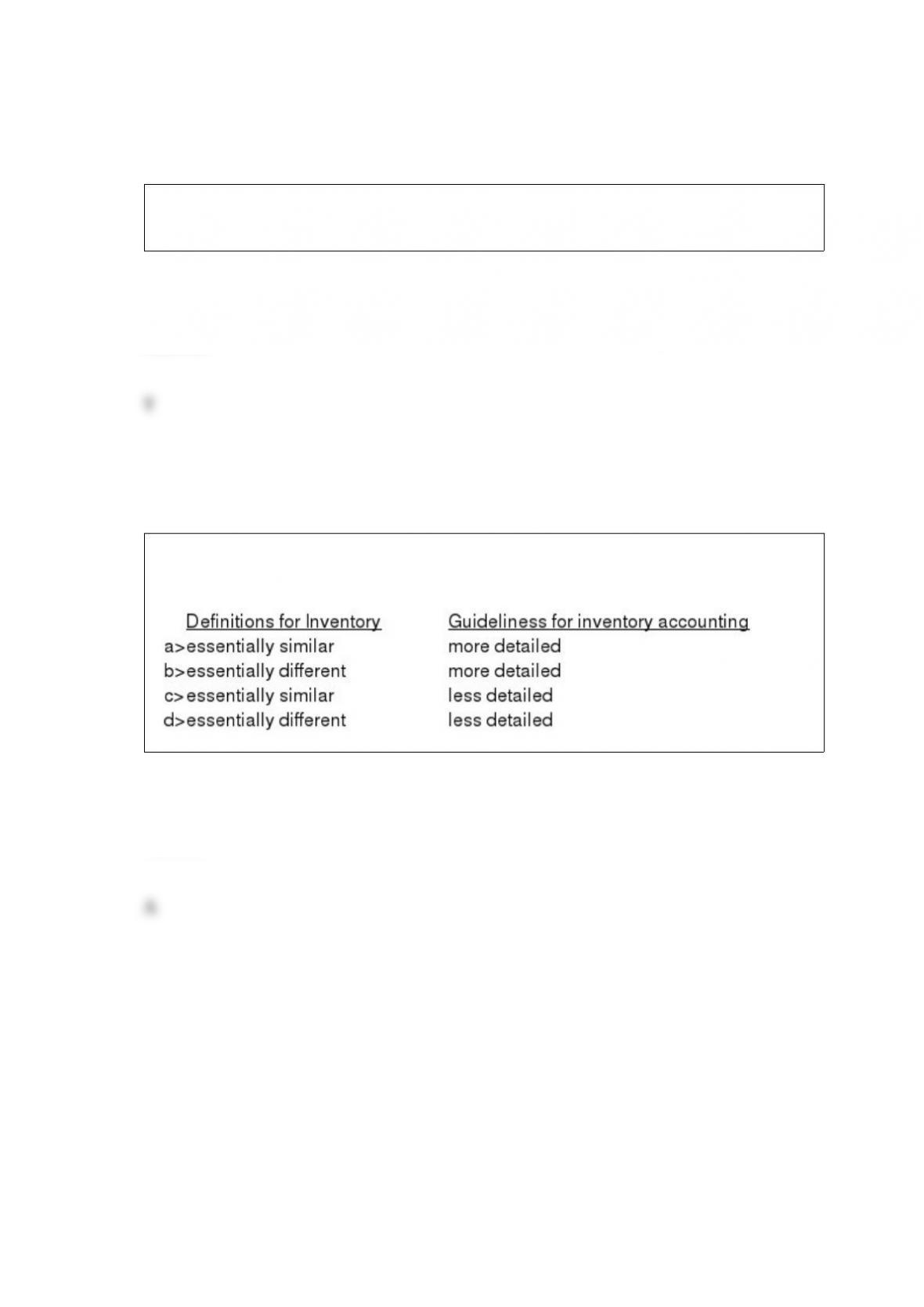
GAAP’s definition for inventory and provision of guidelines for inventory accounting,
as compared to IFRS are:
Answer: