
The average days inventory for ATC (rounded) for 2013 is: A. Less than 100 days.
B. 114 days
C. 132 days.
D. 151 days.
Answer:
Listed below are five terms followed by a list of phrases that describe or characterize
each of the terms. Match each phrase with the most correct term. 1) Capital leases
2) Present value of minimum lease payments
3) Bargain purchase option
4) Executory costs
5) Depreciable assets
A. Accounting for these is based on substance over form
B. The amount capitalized by the lessee
C. Capital lease expense
D. Reduces the lessor’s lease payment calculation
E. Leasehold improvements

Answer:
Like U.S. GAAP, international standards also require a statement of cash flows.
Consistent with U.S GAAP, cash flows are classified as operating, investing, or
financing activities. However, with regard to interest and dividend inflows and
outflows, the international standard for cash flow statements: A. Allows companies to
report cash outflows from interest payments as either operating or investing cash flows.
B. Allows companies to report cash inflows from interest and dividends as either
operating or investing cash flows.
C. Allows companies to report dividends paid as either investing or operating cash
flows.
D. Designates cash outflows for interest payments and cash inflows from interest and
dividends received as operating cash flows.
Answer:
Stock splits are issued primarily to: A. Increase the number of outstanding shares.
B. Increase the number of authorized shares.
C. Increase legal capital.
D. Induce a decline in market value per share.

Answer:
On December 31, 2012, the Bennett Company had 100,000 shares of common stock
issued and outstanding. On July 1, 2013, the company sold 20,000 additional shares for
cash. Bennett’s net income for the year ended December 31, 2013, was $650,000.
During 2013, Bennett declared and paid $89,000 in cash dividends on its
nonconvertible preferred stock. What is the 2013 basic earnings per share? A. $5.91.
B. $5.61.
C. $5.10.
D. None of these is correct.
Answer:
Flapper Jack’s Pancake Restaurants Inc. sells franchises for an initial fee of $36,000
plus operating fees of $500 per month. The initial fee covers site selection, training,
computer and accounting software, and on-site consulting and troubleshooting, as
needed, over the first five years. On March 15, 2012, Tim Cruise signed a franchise
contract, paying the standard $6,000 down with the balance due over five years with
interest.

Assume that at the time of signing the contract, collection of the receivable was assured
and that service obligations were substantial. However, by October 20, 2012,
substantially all continuing obligations had been met. The journal entry required at
October 20, 2012 would include a: A. Credit to franchise fee receivable for $27,000.
B. Debit to unearned franchise fee revenue for $36,000.
C. Credit to franchise fee revenue for $9,000.
D. Debit to unearned franchise fee revenue for $27,000.
Answer:
In 2012, HD had reported a deferred tax asset of $90 million with no valuation
allowance. At December 31, 2013, the account balances of HD Services showed a
deferred tax asset of $120 million before assessing the need for a valuation allowance
and income taxes payable of $80 million. HD determined that it was more likely than
not that 30% of the deferred tax asset ultimately would not be realized. HD made no
estimated tax payments during 2013. What amount should HD report as income tax
expense in its 2013 income statement? A. $50 million.
B. $80 million.
C. $86 million.
D. $116 million.
Answer:
Panther Co. had a warranty liability of $350,000 at the beginning of 2013 and $310,000
at the end of 2013. Warranty expense is based on 4% of sales, which were $50 million
for the year. What were the warranty expenditures for 2013? A. $0.
B. $1,960,000.
C. $2,000,000.
D. $2,040,000.
Answer:
If a company uses LIFO, a LIFO liquidation is problematic for a company’s income
taxes: A. When inventory purchase costs are rising.

B. When inventory purchase costs are declining.
C. Whether inventory purchase costs are declining or rising.
D. LIFO liquidations are not problematic for a company’s income taxes.
Answer:
Which of the following is not a change in estimate? A. A change in the useful life of a
depreciable asset.
B. A change in the mortality rate used for pension computations.
C. A change from the cost to the equity method in accounting for investments.
D. A change in the warranty expense percentage.
Answer:
Wall Drugs offered an incentive stock option plan to its employees. On January 1, 2013,
options were granted for 60,000 $1 par common shares. The exercise price equals the
$5 market price of the common stock on the grant date. The options cannot be exercised

before January 1, 2016, and expire December 31, 2017. Each option has a fair value of
$1 based on an option pricing model.
What is the total compensation cost for this plan? A. $0.
B. $60,000.
C. $240,000.
D. $300,000.
Answer:
Alison’s dress shop buys dresses from McGuire Manufacturing. Alison purchased
dresses from McGuire on July 17 and received an invoice with a list price amount of
$6,000 and payment terms of 2/10, n/30. Alison uses the net method to record
purchases. Alison should record the purchase at: A. $5,940.
B. $5,880.
C. $6,000.
D. $6,120.
Answer:

The preemptive right refers to the shareholder’s right to: A. Maintain a proportional
ownership interest in the corporation.
B. Vote for members of the board of directors.
C. Receive a share of dividends.
D. Share in profits proportionally with all other stockholders.
Answer:
The retained earnings balance reported in the balance sheet typically is not affected
by:A. Net income.
B. A prior period adjustment.
C. Dividends paid.
D. Restrictions.
Answer:
Excerpts from Dowling Company’s December 31, 2013 and 2012, financial statements
and key ratios are presented below (all numbers are in millions):
Dowling’s 2013 profit margin is (rounded): A. 17.4%.
B. 18.5%.
C. 18.0%.
D. 16.5%.
Answer:
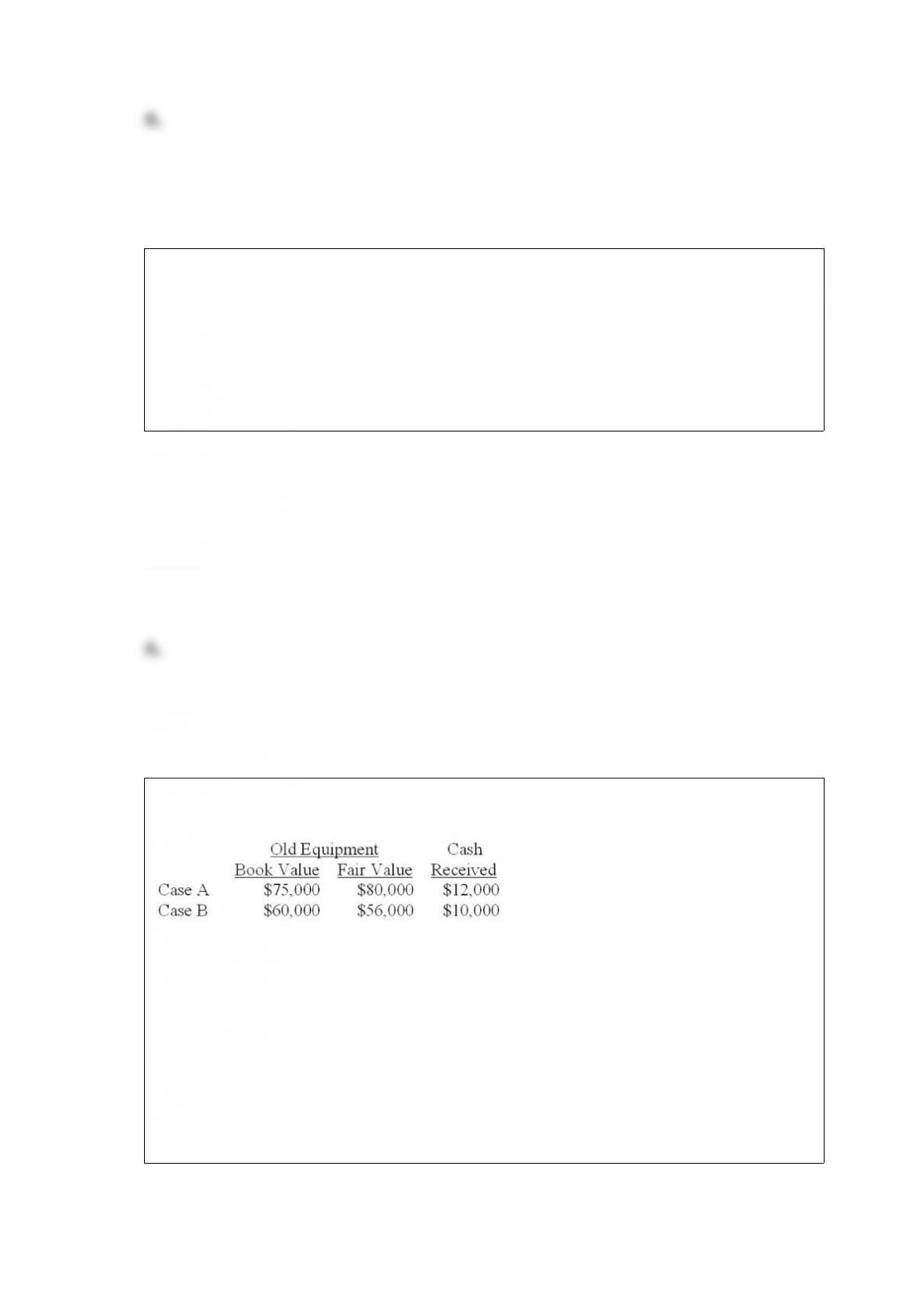
Ace Bonding Company purchased merchandise inventory on account. The inventory
costs $2,000 and is expected to sell for $3,000. How should Ace record the purchase?
A.
B.
C.
D.
Answer:
Change in equity from nonowner sources is: A.Comprehensive income.
B.Revenues.
C.Expenses.
D.Gains and losses.
Answer:
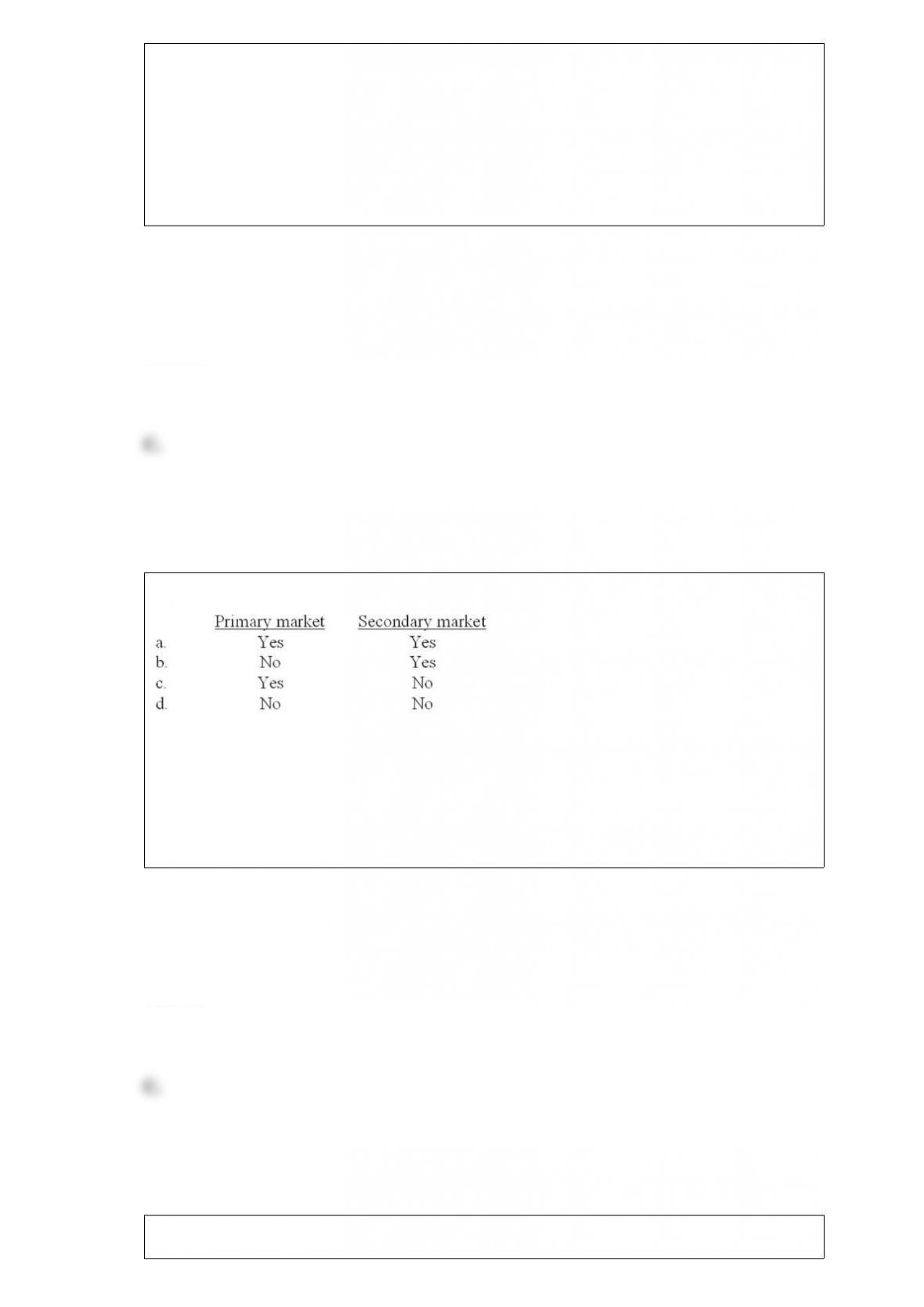
Below is information relative to an exchange of equipment by Pensacola Inc. Assume
the exchange has commercial substance.
Interest may be capitalized: A. On routinely manufactured goods as well as
self-constructed assets.
B. On self-constructed assets from the date an entity formally adopts a plan to build a
discrete project.
C. Whether or not there is specific borrowing for the construction.
D. Whether or not there are actual interest costs incurred.

Answer:
The method used to pay interest depends on whether the bonds are:A. Registered or
coupon.
B. Mortgaged or unmortgaged.
C. Indentured or debentured.
D. Callable or redeemable.
Answer:
Memorex Disks sells computer disk drives with right-of-return privileges. Returns are
material and reasonably predictable. Memorex should: A. Not record sales until the
right to return has expired.
B. Record an allowance for sales returns in the year of the sale.
C. Debit sales returns in the period of the return.
D. Debit sales in the period of the return.
Answer:

Matt Co. is the lessor in connection with a lease. Under the new ASU, Matt Co. would
not record: A. Accretion revenue.
B. A residual asset.
C. Interest revenue.
D. A right-of-use asset.
Answer:
An example of an error would be:A. Purchasing inventory from a related party.
B. Counting an inventory item twice when taking a physical inventory.
C. Holding back invoices so that accounts payable are understated.
D. Receiving kickbacks in exchange for issuing a purchase order to a vender.
Answer:

In periods when costs are rising, LIFO liquidations: A. Can’t occur.
B. Are used to reduce tax liabilities.
C. Are a source of off-balance-sheet financing.
D. Distort the net income.
Answer:
Which of the following is not true regarding accounting for transfers of receivables
under IFRS? A. Transfers of receivables sometimes are treated as a sale of receivables.
B. Transfers of receivables sometimes are treated as a secured borrowing.
C. Transfers of receivables can be treated as a sale if the transferee is a QSPE.
D. Transfer of substantially all the risk and rewards of ownership is an important
consideration.
Answer:

A company’s total obligation for postretirement benefits is measured by the: A. APBO.
B. HMOP.
C. HOBO.
D. EPBO.
Answer:
Important elements of an internal control system for cash disbursements include each of
the following except: A. Only authorized personnel should sign checks.
B. All expenditures should be authorized before a check is prepared.
C. All disbursements, other than very small disbursements, should be made by check.
D. The same person that prepares the check should also record it in the proper journal.
Answer:
When more than one security is sold for a single price and the total selling price is not
equal to the sum of the market prices, the cash received is allocated between the
securities based on: A. Relative book values.
B. Par values.
C. Relative market values.
D. The earnings per share.
Answer:
Corporations issue their shares to the investing public in the:
A.Option a
B.Option b
C.Option c
D.Option d
Answer:
Elements of financial statements do not include: A.Monetary unit.

B.Investments by owners.
C.Comprehensive income.
D.Losses.
Answer:
Cal’s Cookies reported 2013 before-tax income before extraordinary items of $152,000
and a before-tax extraordinary loss of $32,000. All tax items are subject to a 30% tax
rate. In its 2013 income statement, Cal’s reported the following amounts as separate line
items for net income and income tax expense: A. $120,000 and $36,000.
B. $84,000 and $45,600.
C. $84,000 and $36,000.
D. $120,000 and $45,600.
Answer:

Missoula Inc. reported the following selected financial statement data:
Required: Compute the average days in inventory for 2013.
Answer:
During its first year of operations, Cole’s Electronics Inc. completed the following
transactions relating to shareholders’ equity.
January 5: Issued 1,000,000 shares of common stock for $25 per share.
February 12: Issued 20,000 shares of common stock to accountants for $500,000 of
professional services.
The articles of incorporation authorize 5,000,000 shares of common stock with a par
value of $1 per share and 1,000,000 preferred shares with a par value of $100 per share.
Required:
Record the above transactions in general journal form.
Answer:
L Company discovered that a three-year insurance premium payment of $240,000 one
year ago was debited to insurance expense.
Required:
1) What action is required? Ignore taxes.
2)What action is required if the error is not discovered until four years after it occurred?
Answer:
The December 31, 2013 (preclosing) adjusted trial balance for Kline Enterprises was as
follows:
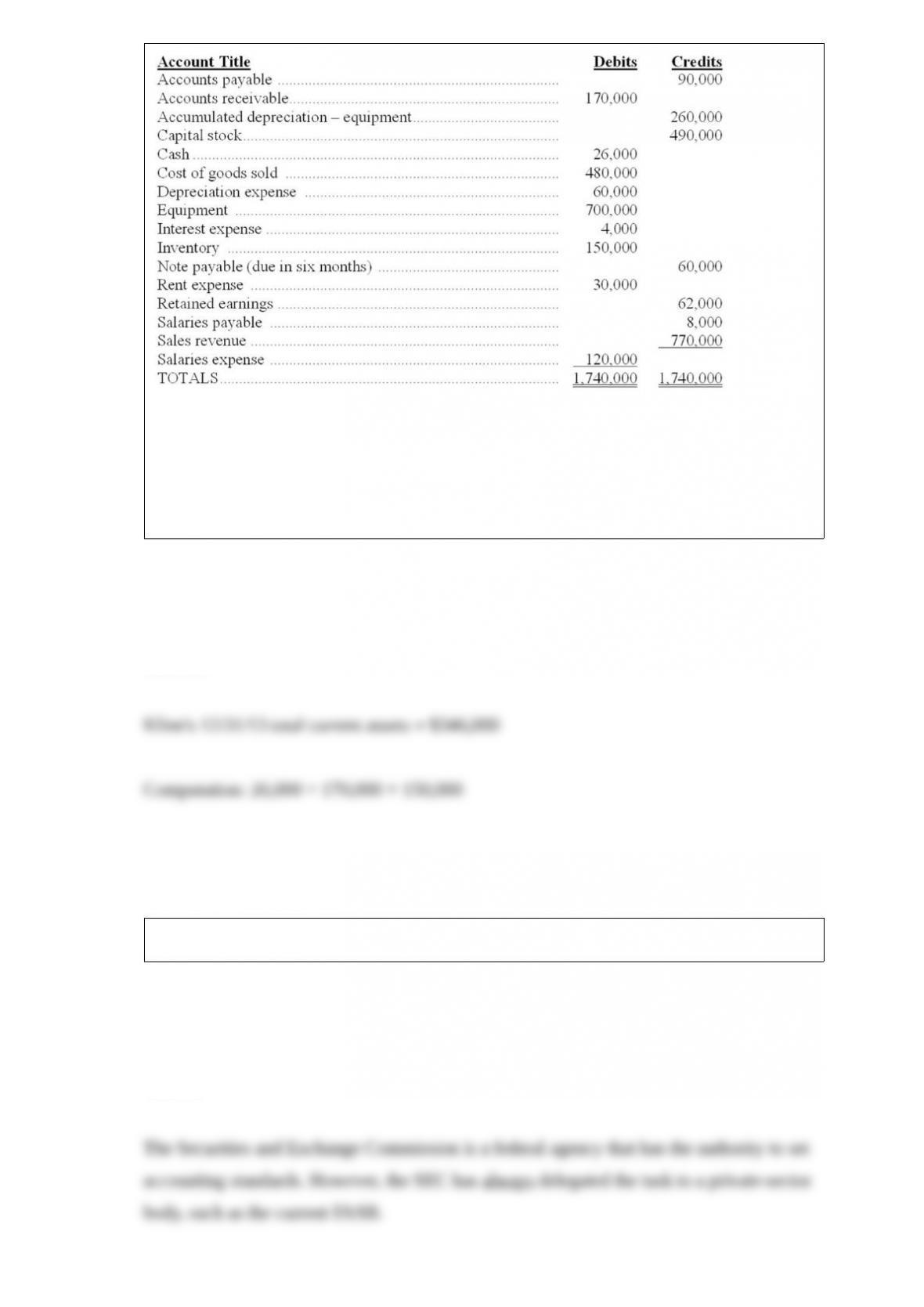
Required:
Assuming no income taxes, compute the following, and place your answer in the space
provided:
Kline’s 12/31/13 total current assets:
Answer:
What is the SEC and how is it involved with accounting standard setting?
Answer:
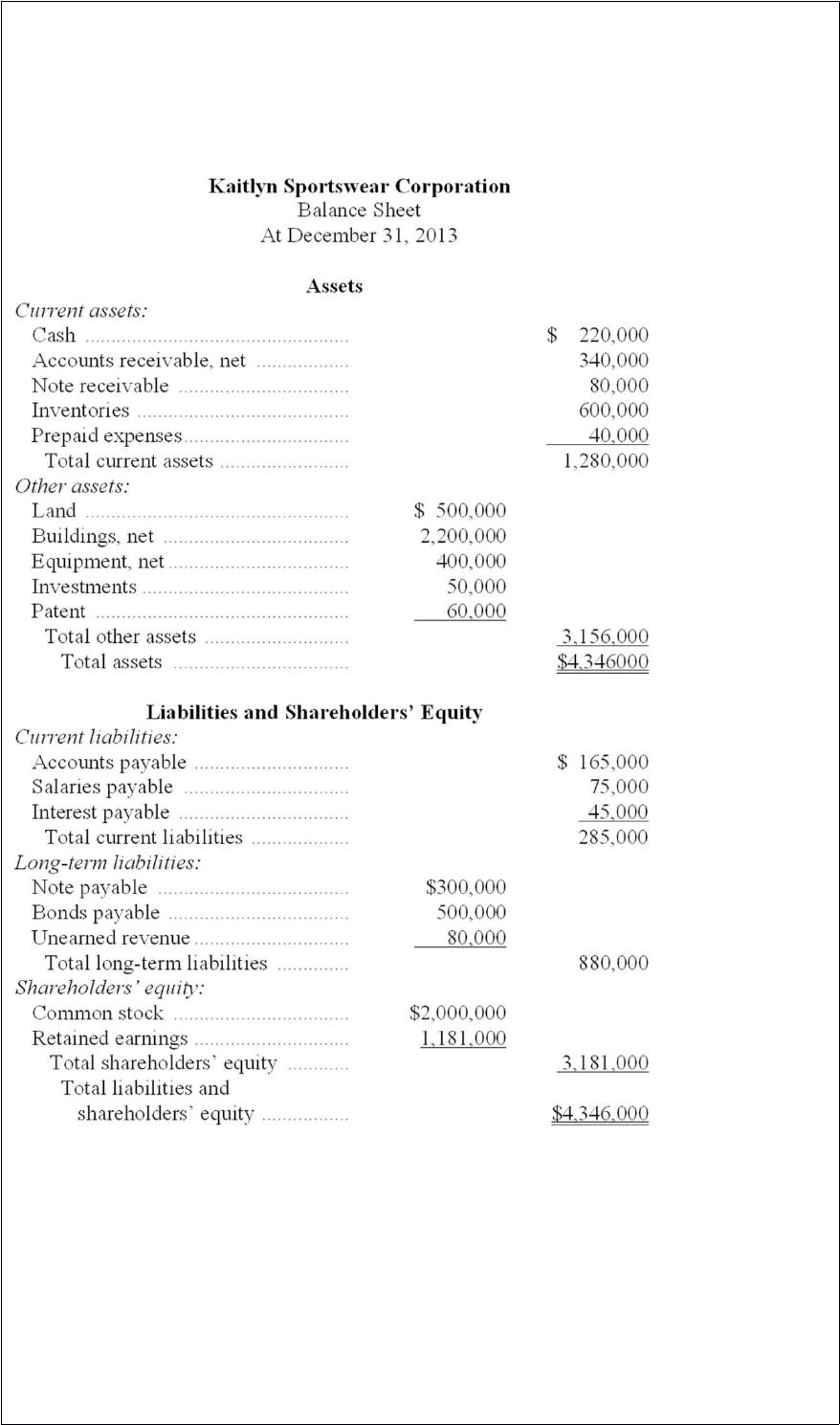
You recently joined the internal auditing department of Kaitlyn Sportswear Corporation.
As one of your first assignments, you are examining a balance sheet prepared by a staff
accountant.
In the course of your examination you uncover the following information pertaining to
the balance sheet:
1. The land and buildings represent the corporate headquarters and manufacturing
facilities.
2. The note receivable is due in 2015. The balance of $80,000 includes $5,000 of
accrued interest. The next interest payment is due in July
3. The note payable is due in installments of $50,000 per year. Interest on both the notes
and bonds is payable annually.
4. The company’s investments consist of marketable equity securities of other
corporations. Management does not intend to liquidate any investments in the coming
year.
5. Unearned revenue will be earned ratably (equally) over the next two years.
Required:
Identify and explain the deficiencies in the statement prepared by the company’s
accountant. Include in your answer items that require additional disclosure, either on
the face of the statement or in a note.
Answer:
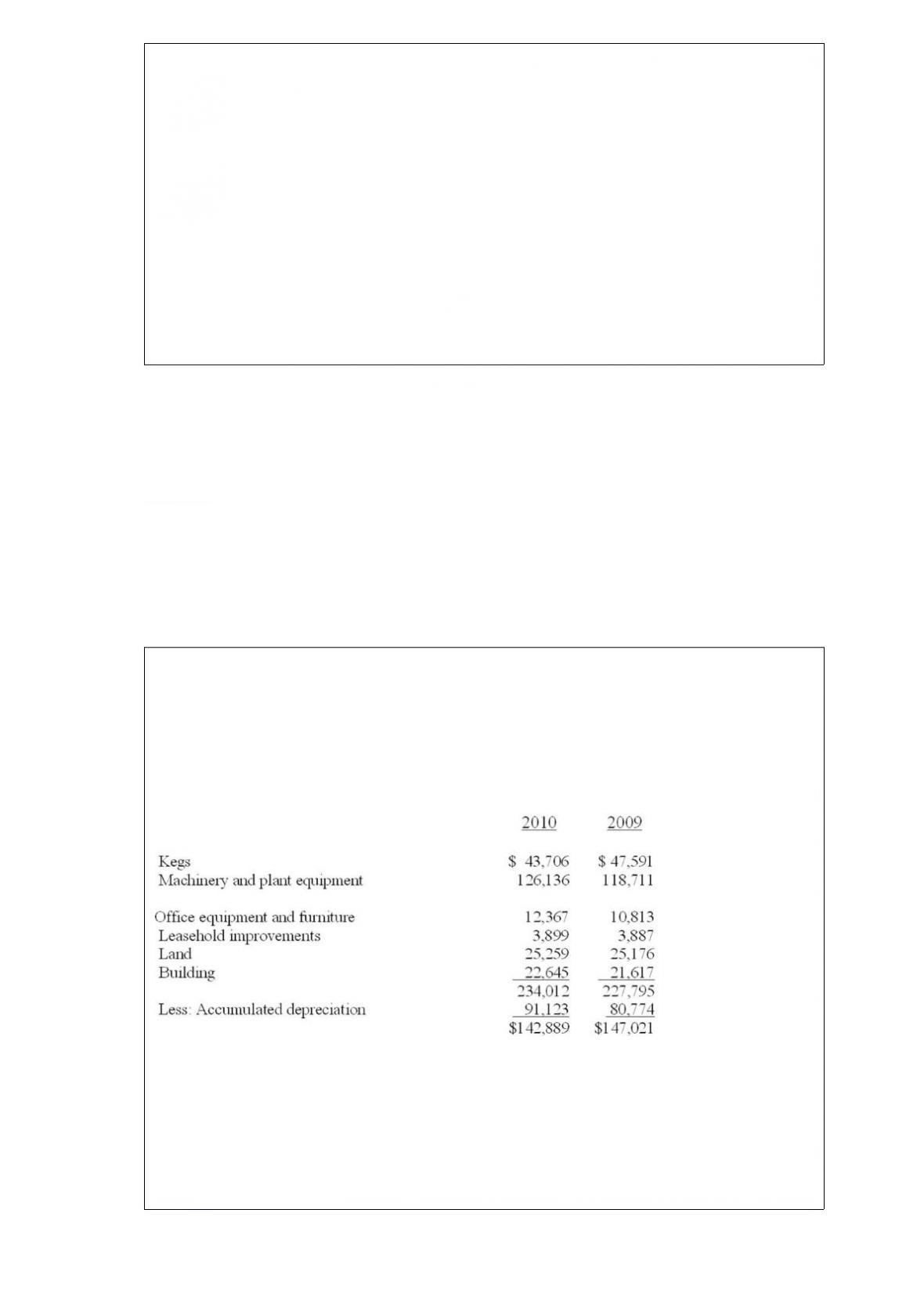
In its 2010 annual report to shareholders, Boston Beer Company, Inc. disclosed the
following in a disclosure note:
E. Property, Plant, and Equipment
Property, plant, and equipment for the years ended December 25, 2010, and December
26, 2009, consisted of the following ($ in thousands):
The Company recorded depreciation expense related to these assets of $17.3 million
and $16.8 million related to these assets for the years ended December 25, 2010, and
December 26, 2009, respectively.
Also, Boston Beer reported the following information in the annual report ($ in
thousands):
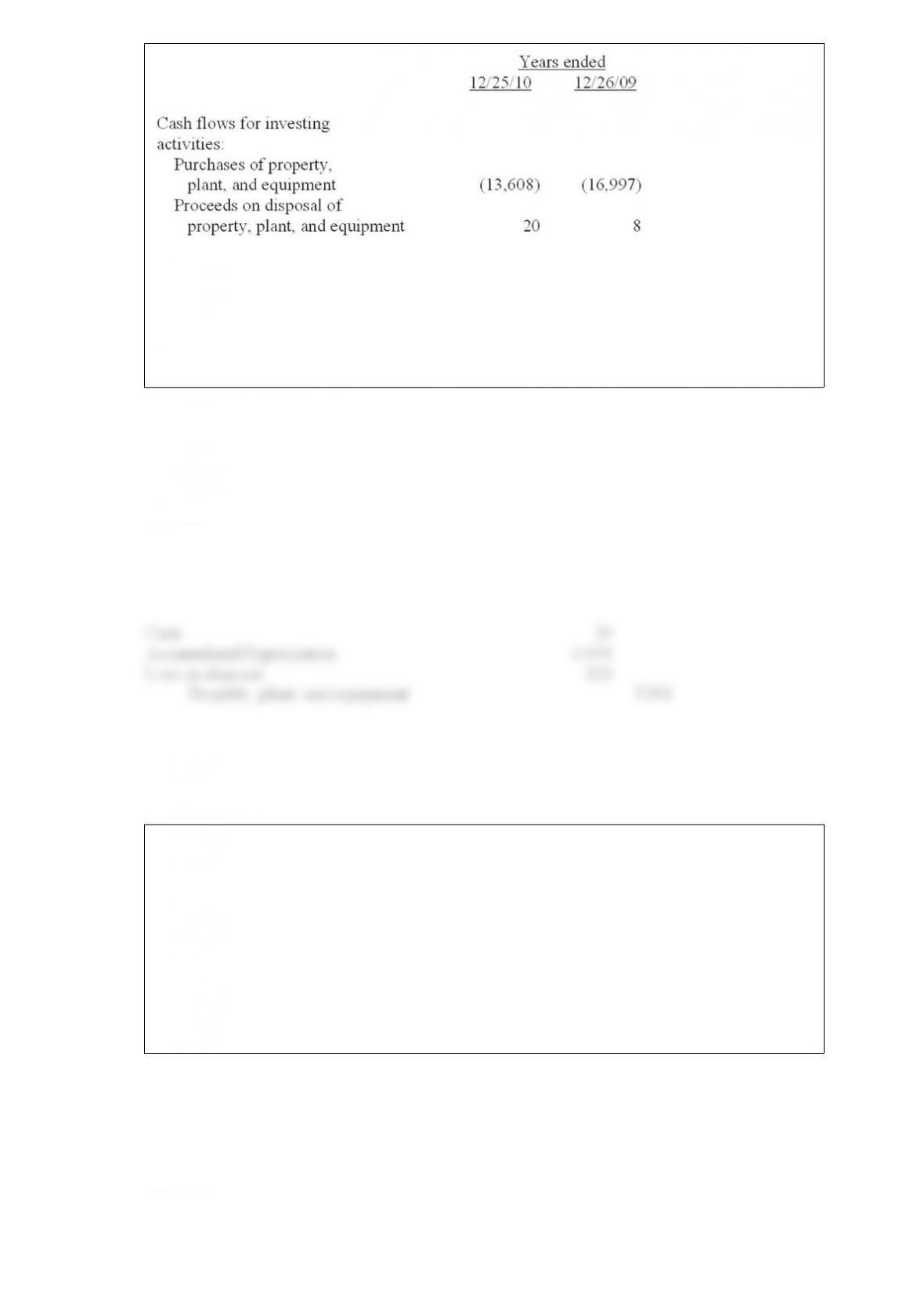
The disclosure notes also reported that the company wrote off $300 (in thousands) in
previously capitalized costs.
Show the journal entry to record Boston Beer’s sale of property, plant, and equipment
during 2010.
Answer:
In 2013, the internal auditors of Blooper Inc. discovered that goods costing $12 million
that were shipped f.o.b. shipping point in December of 2012 were in transit on
December 31. The goods were recorded as a purchase in December of 2012 but were
not included in the 2012 year-end inventory.
Required:
Prepare the journal entry needed in 2013 to correct the error. Also, briefly describe any
other measures Blooper would take in connection with correcting the error. (Ignore
income taxes.)
Answer:
Explain the differences between how a principal and agent would show a sale of a
product that has gross revenues of $1,000, cost of goods sold of $750, and a
commission paid by the principle of 10% of gross sales on their respective income
statements.
Answer:
What activities are included in the statement of cash flows under the section titled
“Cash flows from financing activities”?
Answer:
Waddle Company amended its defined benefit pension plan on January 1, 2013, to
increase retirement benefits earned with each service year. The actuary estimated the
prior service cost to be $216,000. Waddle’s 80 present employees are expected to retire
at the rate of about 10 each year at the end of each of the next eight years.
Required:
1) Using the service method, calculate the amount of prior service cost to be amortized
to pension expense in 2013.
2) Using the straight-line method, calculate the amount of prior service cost to be
amortized to pension expense in 2013.
Answer:
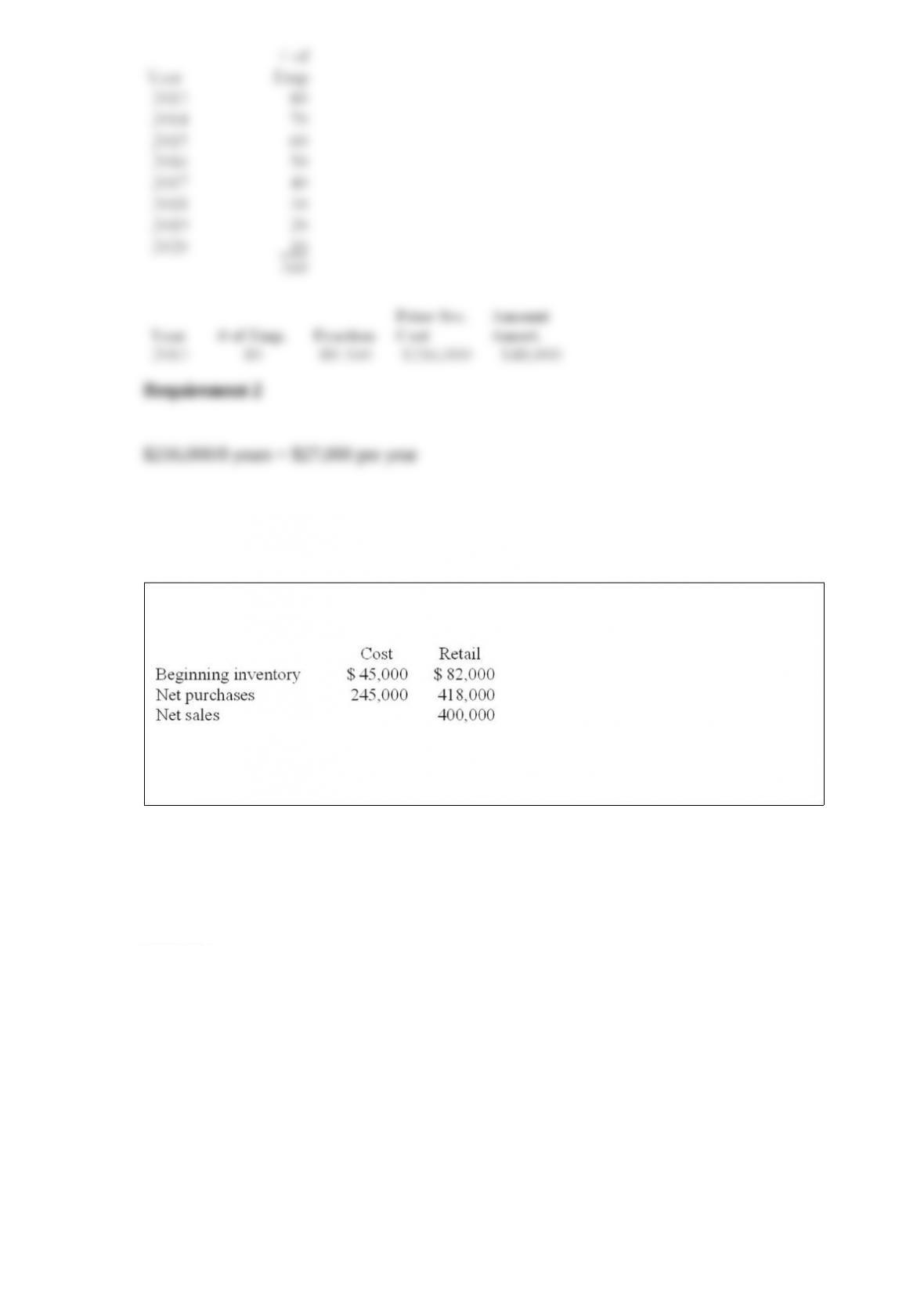
Andover Stores uses the average cost retail method to estimate its ending inventory.
Information as of June 30, 2013, is as follows:
Required:
Use the retail method to estimate the June 30, 2013, inventory.
Answer:
Discuss the financial statement disclosure requirements for all leases entered into by the
lessee.
Answer:
In its 2013 Annual Report to Shareholders, Sisters Corporation included the following
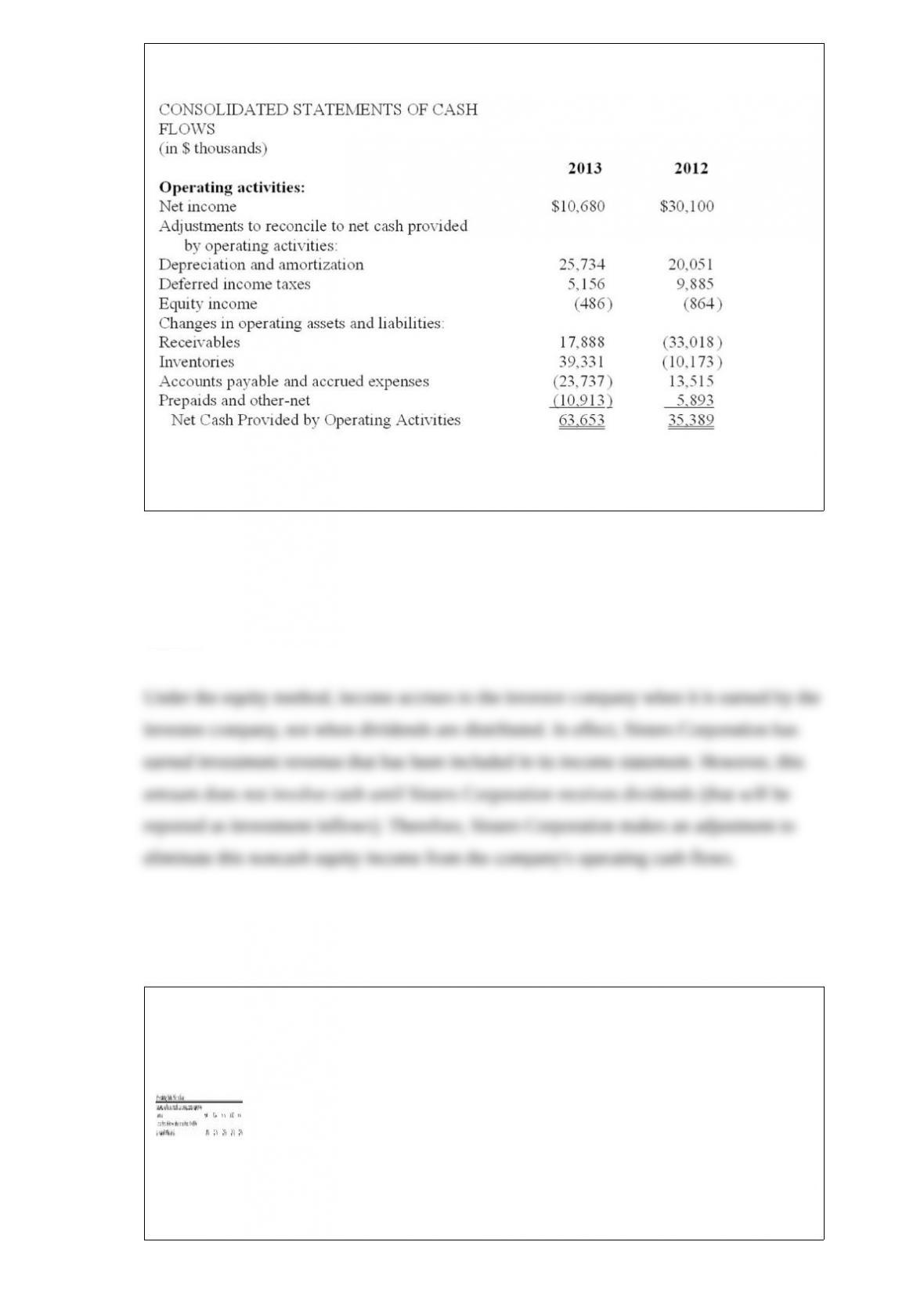
information on cash flows from operations:
Explain why Sisters Corporation subtracts equity income from its net income in its
measurement of cash flows.
Answer:
Brook Company has taken a position on its tax return to claim a tax credit of $30
million (direct reduction in taxes payable) and has determined that its sustainability is
“more likely than not” based on its technical merits. Brook’s management has
developed the probability table shown below of all possible material outcomes:
Brook’s taxable income is $300 million for the year, and its effective tax rate is 40%.
The tax credit would be a direct reduction in current taxes payable.
Required:
1) At what amount would Brook measure the tax benefit in its income statement?
2) Prepare the appropriate journal entry for Brook to record its income taxes for the
year.
Answer:

Listed below are 5 terms followed by a list of phrases that describe or characterize the
terms. Match each phrase with the correct term. 1)Right of return
2)Percentage-of-completion method
3)Billings on construction contract
4)Cost recovery method
5)Cost-to-cost ratio
•Contra account to construction in progress.
•Defers gross profit until cash collected equals costs.
•Assumes cost incurred is a measure of completion.
•Recognition is in proportion to work completed.
•Requires deferral of revenue if cannot estimate returns accurately.
•
Answer:
Briefly explain the critical similarities and differences between the completed contract
method used by U.S. GAAP and the cost recovery method used in IFRS for accounting
for long-term contracts when the percentage-of-completion method is not appropriate.
(Ignore accounting for contract losses.)
Answer:
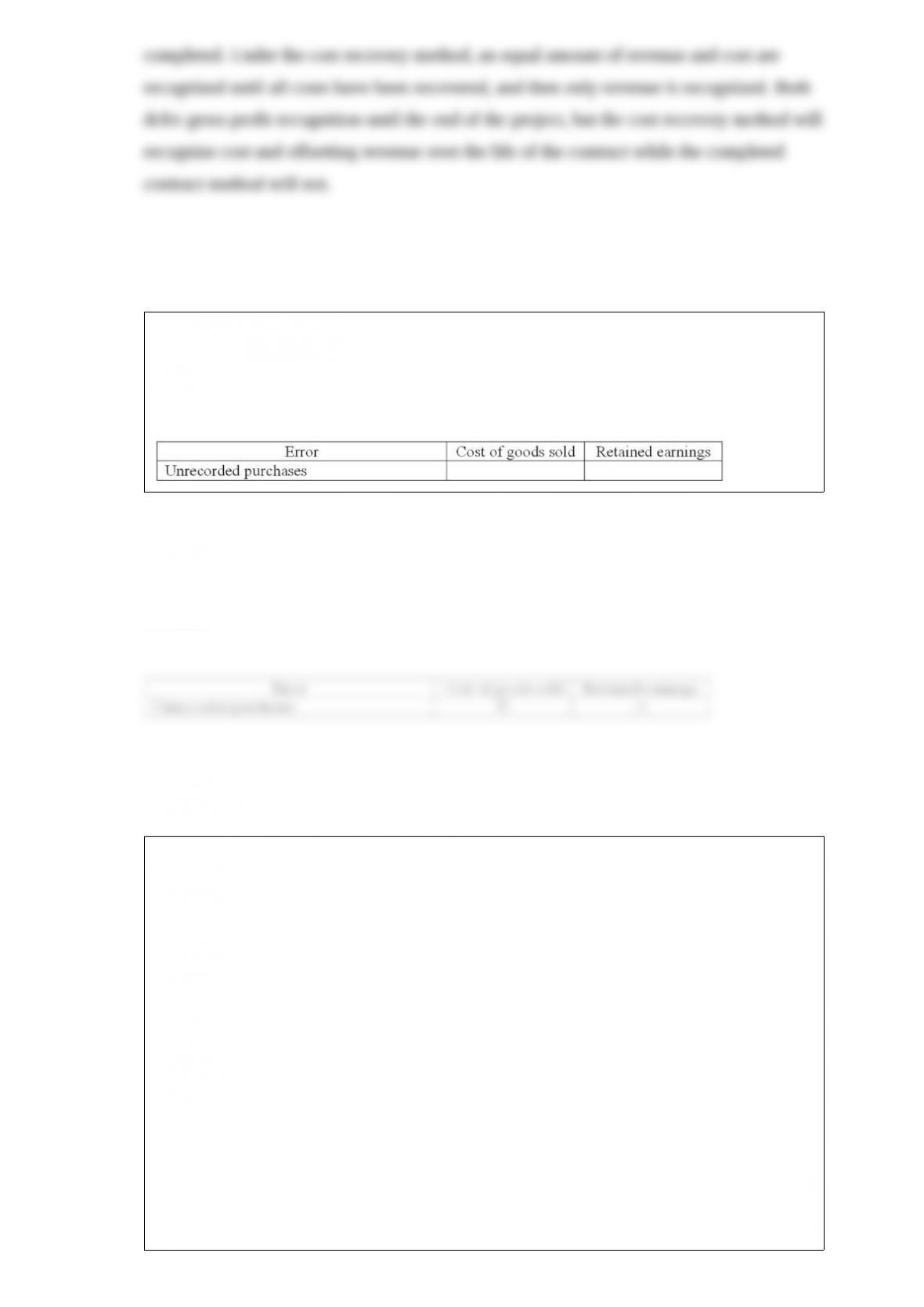
In the following question, inventory errors are noted for 2013. Assume that the errors
are not discovered until 2012, and that the company uses a periodic inventory system.
Indicate the effect of the error, if any, on the accounts noted in the columns, using the
following code:
U = Understated; O = Overstated; NE = No effect
Answer:
Indicate the nature of each of the situations described below using the following
three-letter code.
CODE DESCRIPTION
CPR: Change in principle reported retrospectively
CPP: Change in principle reported prospectively
CES: Change in estimate
CRE: Change in reporting entity
PPA: Prior period adjustment required
____ Change from FIFO inventory costing to LIFO inventory costing.
____ Change from LIFO inventory costing to FIFO inventory costing.

____ Change in the composition of a group of firms reporting on a consolidated basis.
____ Change to the installment method of accounting for receivables.
____ Change in actuarial assumptions for a defined benefit pension plan.
____ Change from sum-of-the-years’ digits depreciation to straight-line.
____ Change from expensing extraordinary repairs erroneously recorded as an expense
to capitalizing the expenditures.
____ Change in the percentage used to determine warranty expense.
____ Change from reporting postretirement benefits according to the provisions of U.S.
GAAP.
____ Change in the residual value of machinery.
Answer:
The accounting records of Eastlake Industries provided the data below.
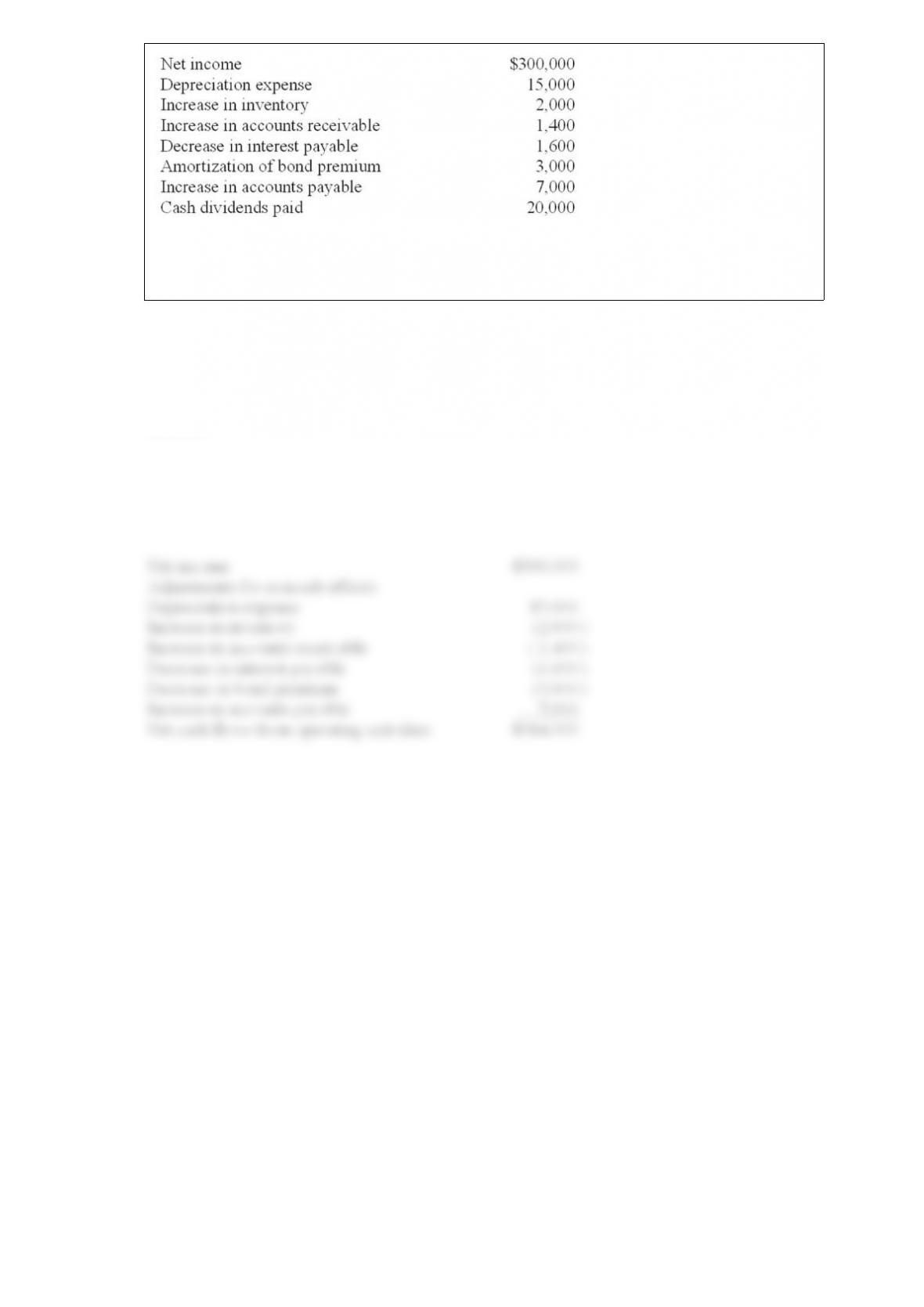
Required:
Prepare a reconciliation of net income to net cash flows from operating activities.
Answer: