On January 1, a company lends a corporate customer $80,000 at 6% interest. The
amount of interest revenue that should be recorded for the first quarter is:
A. $4,800.
B. $1,200.
C. $400.
D. $1,600.
Answer:
When existing assets are used up in the ordinary course of business:
A. an expense is recorded.
B. unearned revenue is recorded.
C. an accrual is recorded.
D. a prepaid expense is recorded.
Answer:
Income statement accounts are closed at what stage of the accounting process?
A. At the time that adjustments are made.
B. After adjustments are made and before the income statement is prepared.
C. After the income statement and the statement of retained earnings are prepared, but
before the balance sheet is prepared.
D. As the last journal entries at the end of each accounting year.
Answer:
Many companies use accelerated depreciation in computing taxable income because
A. it reports higher net income in the early years as compared to other methods.
B. it is required by IFRS.
C. it is easier than straight-line deprecation.
D. it postpones tax payments until later years because it lowers taxable income in the
early years.
Answer:
Husain, Inc.’s income statement and other financial information is presented below.
A. Using the information above,
1. Perform vertical analysis. Round to the nearest whole percent.
2. Calculate the debt to assets ratio. Round to two decimal places.
3. Calculate the times interest earned ratio. Round to two decimal places.
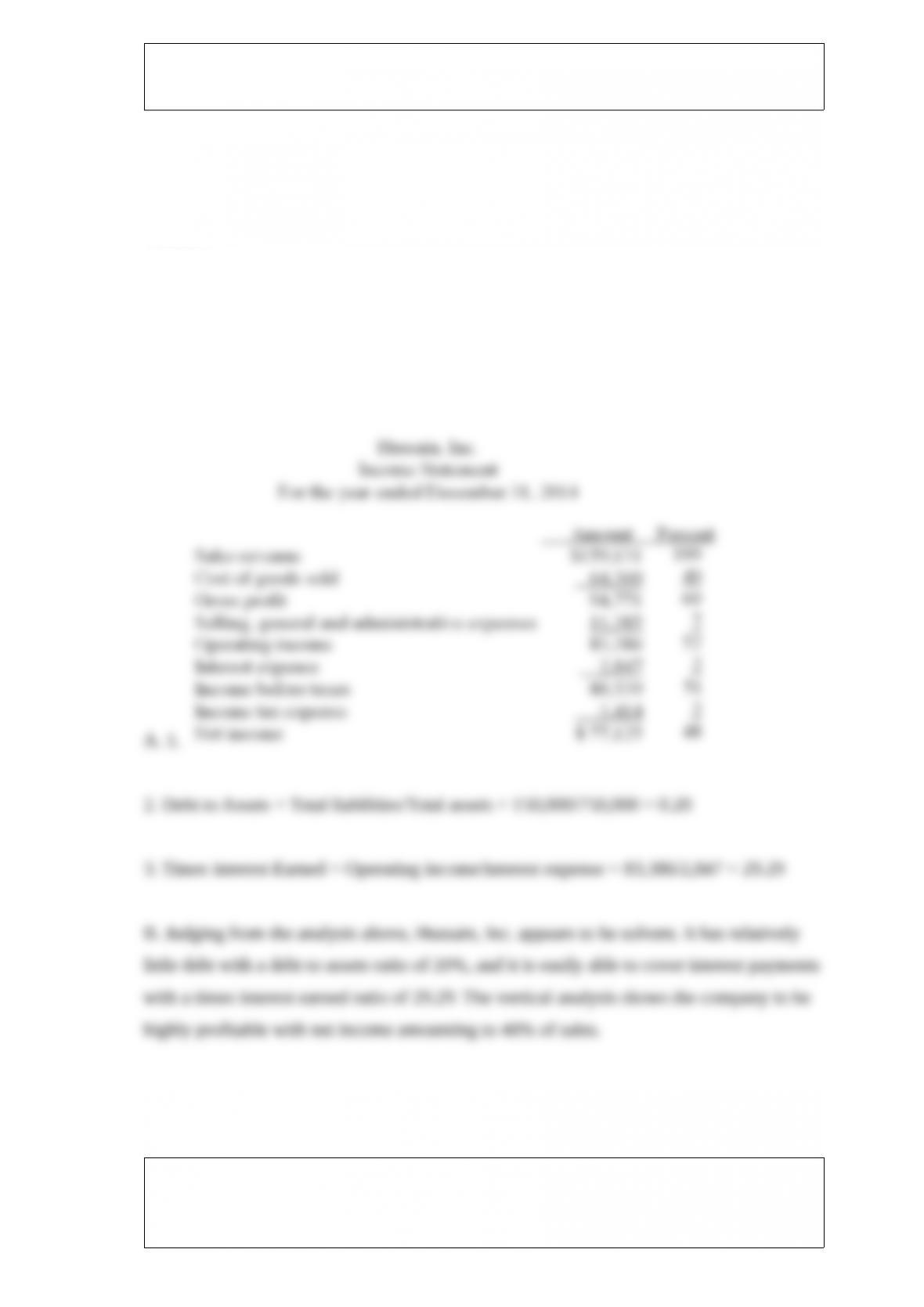
B. Evaluate the company’s solvency.
Answer:
The following is a listing of some of the balance sheet accounts and all of the income
statement accounts for Mulberry Street Sportswear as they appear on the 12/31/14
adjusted trial balance.
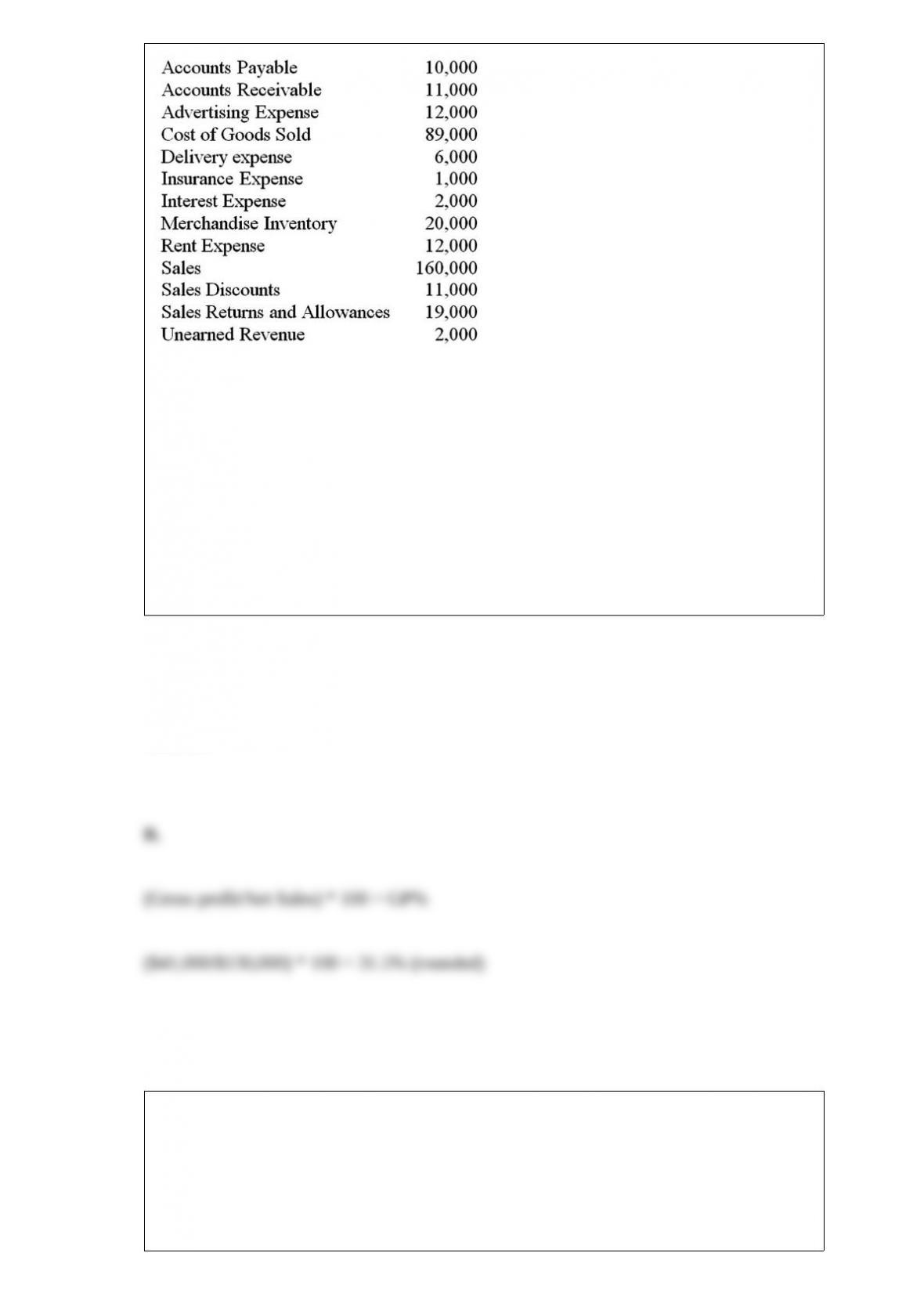
Use the information above to answer the following question. The gross profit
percentage for 2014 would be closest to:
A. 25.6%.
B. 31.5%.
C. 55.6%.
D. 68.5%.
Answer:
Choose the appropriate letter to match the term and the explanation. Not all
explanations will be used.
TERM
_____ 1/ Net credit sales
_____ 2/ Allowance method

_____ 3/ Notes receivable
_____ 4/ Accounts receivable
_____ 5/ Average net receivables
_____ 6/ Subsidiary account
_____ 7/ Bad debt loss rate
_____ 8/ Annual interest rate
EXPLANATION
A. The amount of interest a lender receives during a year.
B. A system used by companies to allocate their budgets over the different operating
expenses.
C. The numerator of the receivables turnover ratio.
D. A separate record for each accounts receivable customer.
E. The historical average percentage of credit sales that a company has been unable to
collect.
F. Another name for a company’s total revenue which is calculated by multiplying the
quantity sold by the average price.
G. The costs of maintaining accounts with customers who have not made recent
purchases.
H. The interest that a company receives during the year divided by the principal of the
loan.
I. The rate at which a company pays off its liabilities or debts.
J. The total amount of money loaned through notes that the lender has not yet collected.
K. The denominator of the receivables turnover ratio.
L. The average level of net sales revenue the firm earns each month.
M. An accounting method which involves estimating bad debts.
N. The portion of past credit sales that have not yet been collected.
Answer:
Employer payroll taxes:
A. represent the federal taxes withheld from the employees’ paychecks.
B. are the amounts paid by the employee.
C. are an added payroll expense beyond the wages or salaries earned by employees.
D. represent the FICA taxes withheld from employees’ paychecks.
Answer:
The process of buying and selling inventory is known as inventory:
A. circulation.
B. management.
C. turnover.
D. allocation.
Answer:
A company issued 10-year, 7% bonds with a face value of $100,000. The company
received $97,947 for the bonds. Using the straight-line method of amortization, the
amount of interest expense for the first interest period is:
A. $7,000.00
B. $7,205.30
C. $6,794.70
D. $2,053.00
Answer:
When a dividend has been declared but not yet paid,
A. assets will increase and stockholders’ equity will decrease.
B. assets will decrease and stockholders’ equity will increase.
C. no accounts will be affected until the dividend is paid.
D. liabilities will increase and stockholders’ equity will decrease.
Answer:
Cash flows from investing activities include all of the following except:
A. a purchase of an automobile.
B. a sale of a trademark.
C. a purchase of stock of another company.
D. an issuance of bonds.
Answer:
On October 10, a company paid $12,000 to its suppliers, of which $2,000 was for
supplies received on October 10 and $10,000 was for supplies received and recorded
during September. The $12,000 payment would be recorded as a:
A. $10,000 debit to Supplies, a $2,000 debit to Accounts Payable, and a $12,000 credit
to Cash.
B. $12,000 debit to Supplies and a $12,000 credit to Cash.
C. $12,000 debit to Supplies Expense and a $12,000 credit to Cash.
D. $2,000 debit to Supplies, a $10,000 debit to Accounts Payable, and a $12,000 credit
to Cash.
Answer:
Customers paid $8,000 on their accounts. Which accounts are affected by this
transaction?
A. Revenue and Retained Earnings increase $8,000.
B. Cash and Revenue increase $8,000. Liabilities and Expense increase $8,000.
C. Cash increases $8,000 and Accounts Receivable decreases $8,000. Revenue and
Retained Earnings are unchanged.
D. Cash and liabilities decrease $8,000.
Answer:
Which of the following statements regarding straight-line depreciation is correct?
A. Straight-line depreciation is the most common method of depreciation used in the
U.S. for financial reporting, but is not commonly used for taxes.
B. When the straight-line method is used to compute depreciation, an asset’s carrying
value remains constant over the life of the asset.
C. Straight-line depreciation is an approved method to allocate the cost of an asset to
expense and it serves as a measure of the physical decline in the asset.
D. The straight line method of depreciation results in a straight-line increase of
depreciation expense over the life of an asset.
Answer:
A company reported net income of $6 million. During the year the average number of
common shares outstanding was 3 million. The price of a share of common stock at the
end of the year was $5. There were 400,000 shares of preferred stock outstanding on
average and no dividends were declared and the preferred stock is noncumulative.
Use the information above to answer the following question. The Price/Earnings Ratio
is approximately:
A. 2.00.
B. 2.50.
C. 2.84.
D. 12.50.
Answer:
The principles of internal control include which of the following?
A. Use only computerized systems.
B. Establish responsibilities.
C. Maintain perpetual inventory records.
D. Eliminate fraud.
Answer:

The Fastbank Motorcycle Service Company (FMSC) wins a $10 million bid to provide
the repair service for a recall on a popular brand of motorcycles. No money is
exchanged. The repairs are expected to take place next quarter. How will these events
affect the balance sheet?
A. Accounts Receivable will increase by $10 million this quarter and Inventories will
decrease next quarter.
B. Both Accounts Receivable and Accounts Payable will increase by $10 million this
quarter.
C. Both Accounts Receivable and Stockholders’ Equity will increase by $10 million this
quarter.
D. These events will not impact the balance sheet this quarter.
Answer:
If we were to compare the financial statements of Microsoft Corporation for 2011, 2012
and 2013, this would be:
A. an external audit.
B. a cross-sectional analysis.
C. a business model.
D. a time-series analysis.
Answer:
Marvelous Enterprises, Inc. is an entertainment company, The company’s stock is traded
publicly on the New York Stock Exchange.
You have been asked three questions about the financial results in 2015 and 2014:
A. Did the company increase or decrease its relative reliance on creditors for financing
the purchase of assets?
B. Did the company become more efficient or less efficient in using its assets to
generate sales?
C. Did the company become more successful or less successful in controlling its
expenses while generating sales?
For each question, (1) name the appropriate ratio for answering the question, (2)
calculate the ratio for each of the two years (using the summary data below), and (3)
use your calculations to prepare an answer.
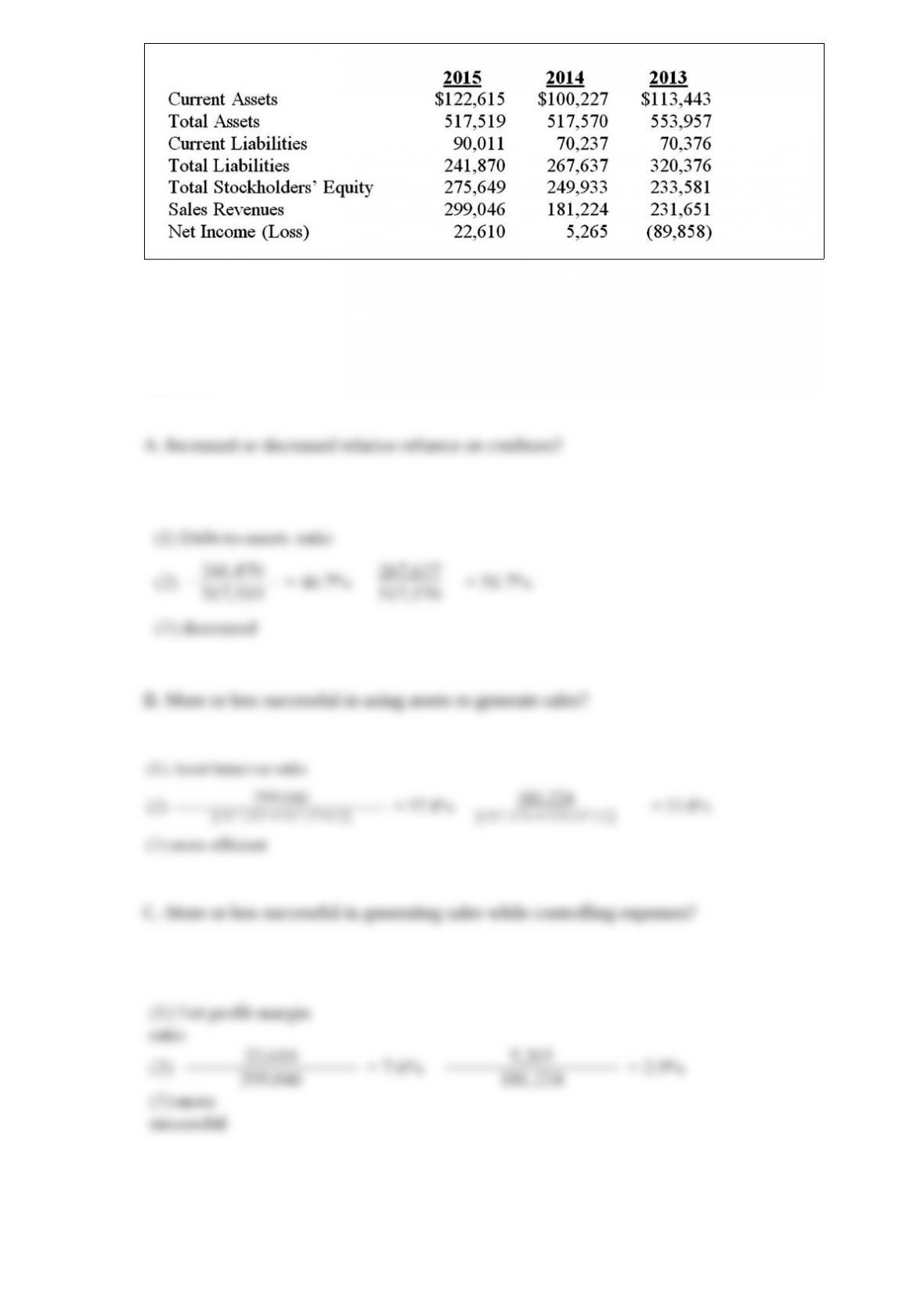
Answer:
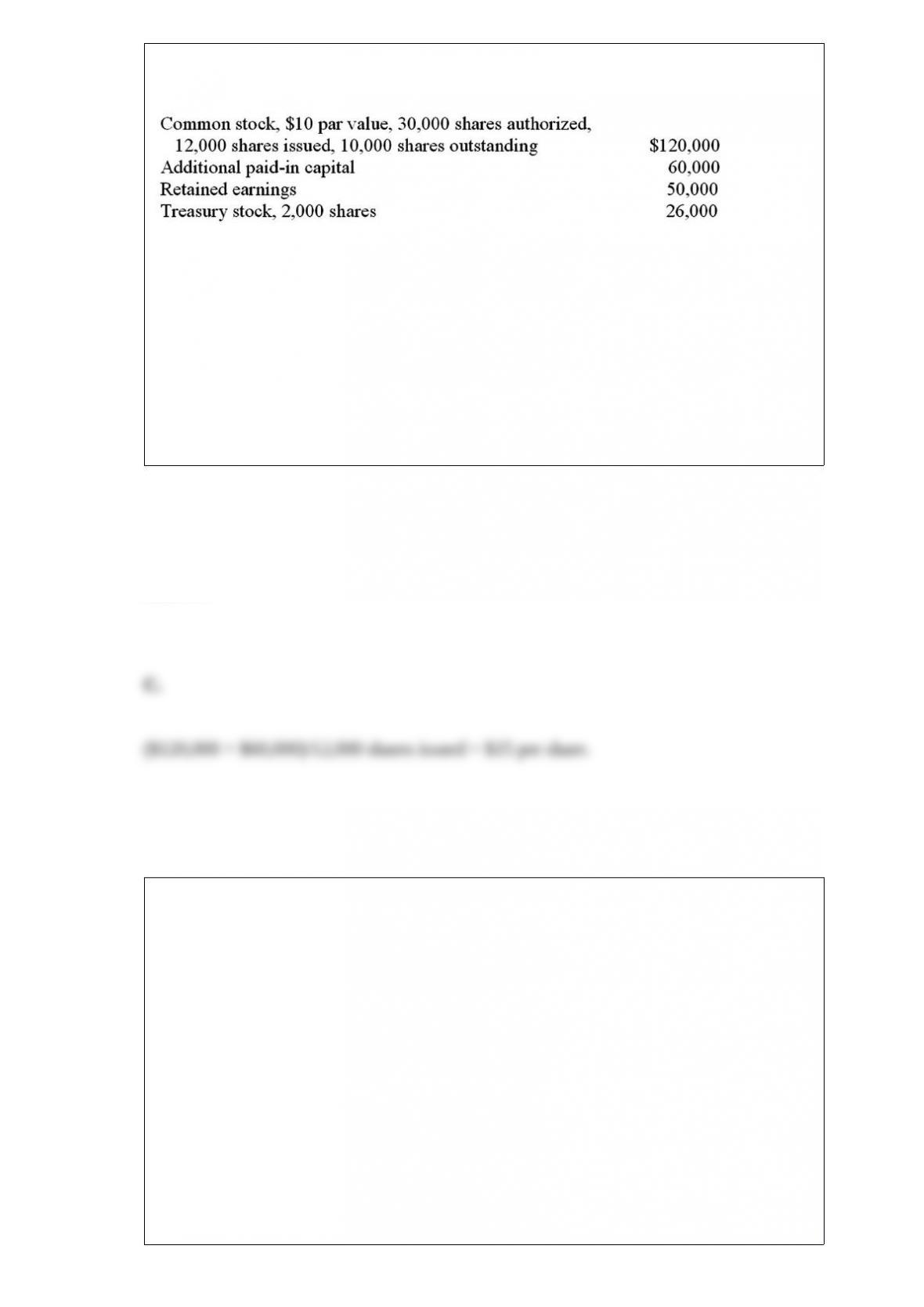
The following data are taken from the stockholders’ equity section of the balance sheet
of a company:
What was the average issue price per share of the common stock?
A. $13.00
B. $10.00
C. $15.00
D. $18.00
Answer:
Choose the appropriate letter to match the term and the definition. Not all definitions
will be used.
TERM
_____ 1/ raw materials inventory.
_____ 2/ FIFO.
_____ 3/ inventory write-down.
_____ 4/ merchandiser.
_____ 5/ purchase discount.
_____ 6/ lower of cost or market.

_____ 7/ manufacturer.
_____ 8/ finished goods inventory.
_____ 9/ conservatism.
_____ 10/ LIFO.
DEFINITION
A. Inventory that reflects goods currently in production.
B. The concept that a company should take special care to not overstate its assets.
C. A company that buys raw materials and produces goods for sale to others.
D. Also known as least cost measure, it is the concept that firms should use the lowest
unit cost of those in inventory to evaluate all units.
E. When the company reduces the book value of inventory that has declined in market
value.
F. The percentage of a company’s total inventory that is in raw materials inventory.
G. A reduction in the cost of inventory purchased that is given for paying promptly.
H. The concept that a company should report inventory at either its cost or its current
market value, whichever is less.
I. A company that buys finished goods from other companies and sells them to others.
J. An inventory costing method that assumes the goods sold were the oldest in
inventory.
K. A reduction in the cost of inventory purchased that is given for unsatisfactory goods.
L. When a company does not immediately report a known loss but waits until a period
with high revenues to report it.
M. An inventory costing method that assumes the goods sold were the newest in
inventory.
N. A company’s inputs to be used to manufacture goods.
O. A manufacturer’s goods that are ready to be sold.
Answer:
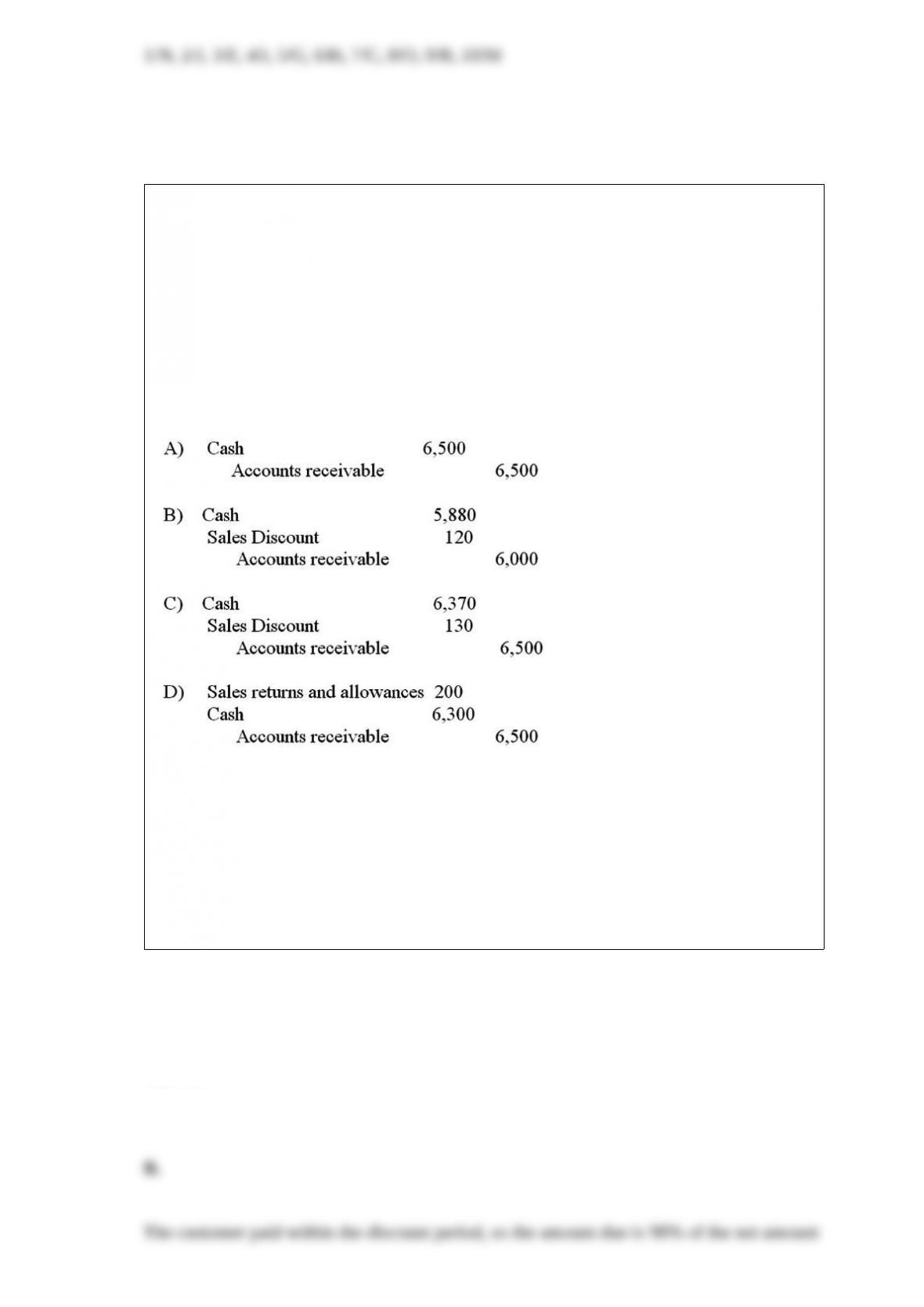
On October 1, B. Darin Company sold merchandise in the amount of $6,500 to S. Dee
Company, terms 2/10, n/30. The items cost B. Darin $4,200 and the company uses the
perpetual inventory method. On October 4, S. Dee returns some of the merchandise.
This merchandise had a selling price of $500 and a cost of $200. On October 8, S. Dee
Company paid B. Darin Company the correct amount due.
Use the information above to answer the following question. What is the journal entry
that B. Darin Company makes on October 8 to record the receipt of payment from S.
Dee?
A. Option A
B. Option B
C. Option C
D. Option D
Answer:
A 6-month note is issued on November 1. If no previous accruals have been made, how
many months of interest should be accrued on December 31?
A. 6
B. 2
C. 4
D. 0
Answer:
A company sells a long-lived asset that originally cost $200,000 for $50,000 on
December 31, 2014. The accumulated depreciation account had a balance of $110,000
after the current year’s depreciation of $45,000 had been recorded. The company should
recognize a:
A. $100,000 loss on sale.
B. $40,000 gain on sale.
C. $40,000 loss on sale.
D. $25,000 loss on sale.
Answer:
A company pays wages every two weeks. Wages amount to $100 a day, 7 days a week.
On March 31, the company pays wages for the two weeks ending March 24. At the end
of the month, the related adjusting journal entry will include a
A. debit to Wages Payable for $1,400 and a credit to Wages Expense for $1,400.
B. debit to Wage Expense for $700 and a credit to Wages Payable for $700.
C. debit to Wages Payable for $700 and a credit to Cash for $700.
D. debit to Wages Expense for $1,400 and a credit to Wages Payable for $1,400.
Answer:
During June, the Grass is Greener Company mows 100 lawns a week; the company was
paid in advance during May by those customers. The company uses the accrual basis of
accounting. How will these events affect the company’s financial statements?
A. The income statement shows the effects of the transactions in May.
B. The income statement shows the effects of the transactions in June.
C. The balance sheet shows no effect from the transactions in May.
D. The transactions have no effect on the balance sheet.
Answer:
The following is a listing of some of the balance sheet accounts and all of the income
statement accounts for Mulberry Street Sportswear as they appear on the 12/31/14
adjusted trial balance.
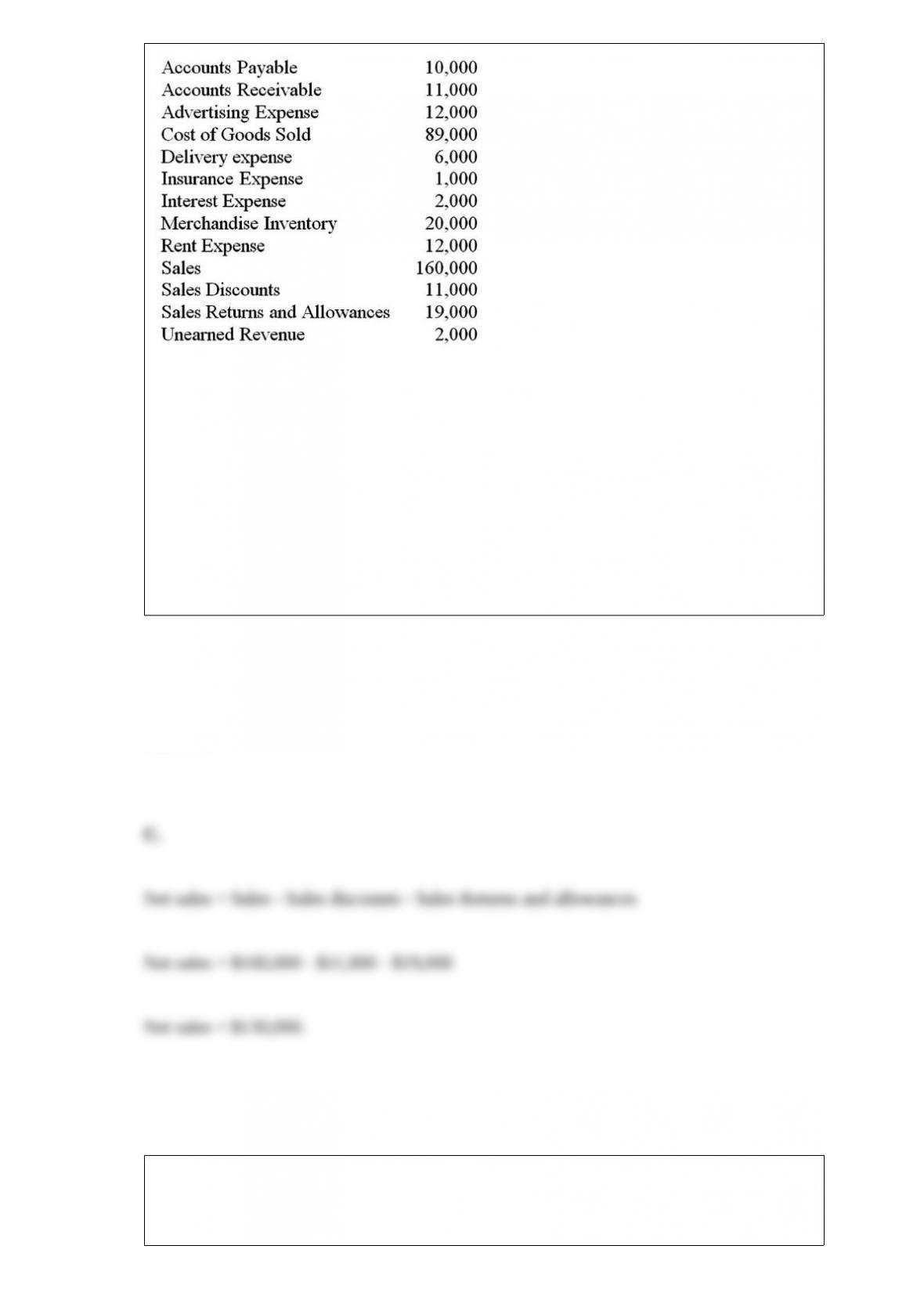
Use the information above to answer the following question. Net Sales for 2014 would
be
A. $30,000.
B. $124,000.
C. $130,000.
D. $160,000.
Answer:
If a company borrows money from a bank and signs an agreement to repay the loan
several years from now, in which account would the company report the amount
borrowed?
A. Contributed Capital
B. Accounts Payable
C. Notes Payable
D. Retained Earnings
Answer:
Features of common stock usually include all of the following except:
A. voting rights.
B. dividends.
C. primary claim to the company’s assets in case of liquidation.
D. preemptive right.
Answer: