
1) Period costs for a manufacturing company, such as selling and administrative
expenses, are recorded directly to Work In Process Inventory when they are incurred.
2) Even if the end of an accounting period occurs between the signing of a note payable
and its maturity date, the matching principle requires that interest expense not be
accrued on a note payable until the note is paid.
3) Managerial accounting provides financial and nonfinancial information to an
organization’s managers and other internal decision makers.
4) When an investor company owns more than 25% of the voting stock of an investee
company, it has a controlling influence.
5) There are two basic types of cost accounting systems: job order costing and periodic
costing.
6) A transaction that credits an asset account and credits a liability account must also
affect one or more other accounts.
7) A corporation has a $40,000 credit balance in the Income Tax Payable account.
Period end information shows that the actual liability is $47,000. The company should

record an entry to debit Income Tax Expense for $7,000 and credit Income Taxes
Payable for $7,000.
8) A process cost summary is an accounting report that describes the costs charged to
each department, the equivalent units of production by each department, and
determining the costs assigned to each department’s output.
9) Overstating beginning inventory will understate cost of goods sold and net income.
10) On a work sheet, if the Debit total exceeds the Credit total of the Income Statement
columns, a net loss is indicated.
11) Equivalent units of production are always the same as the total number of physical
units finished during the period.
12) Selling and administrative expenses are normally period costs.
13) Issuers of coupon bonds are not allowed to deduct the interest expense on their tax
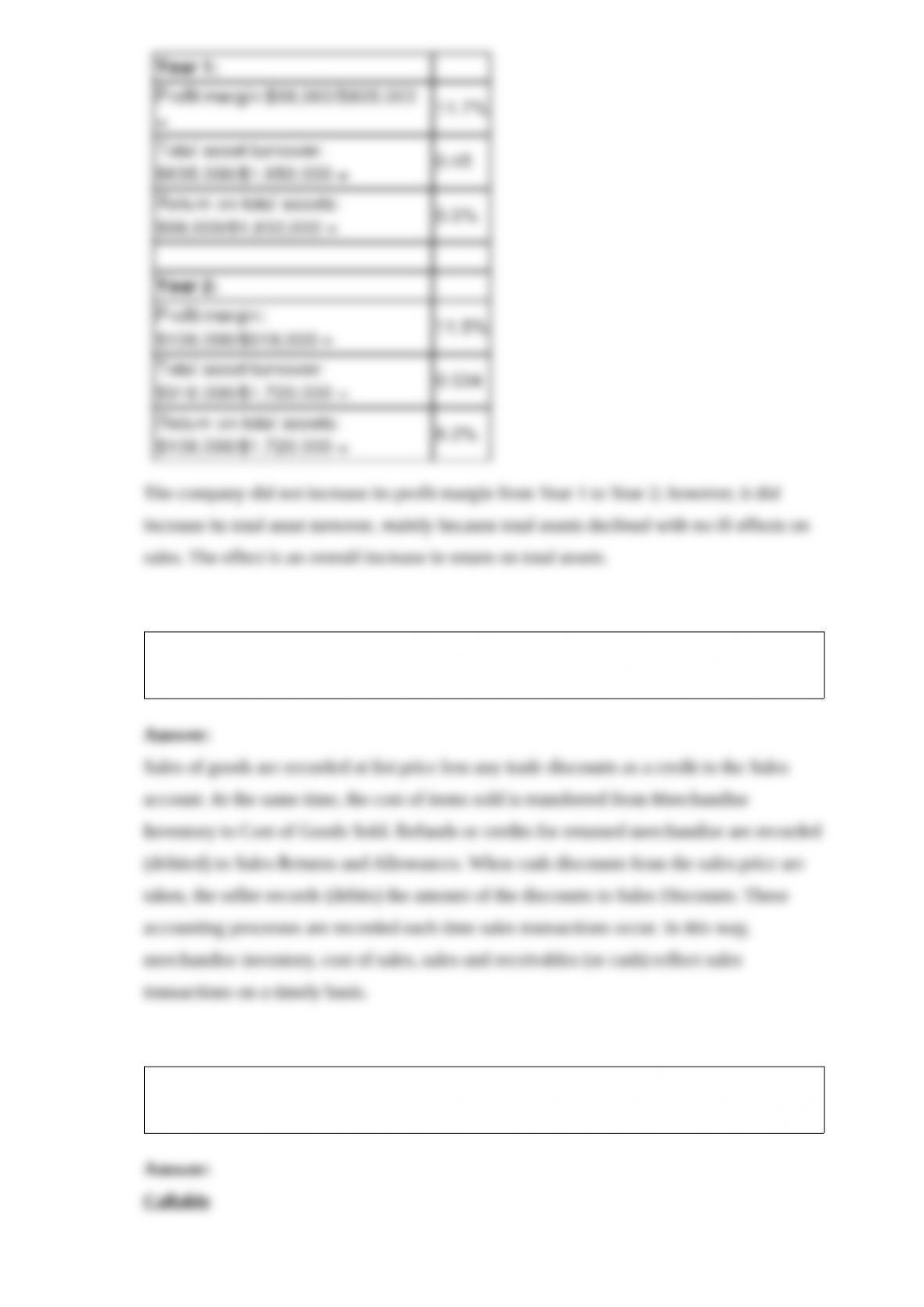
returns.
14) A company pays $15,000 per period to rent a small building that has 10,000 square
feet of space. This cost is allocated to the company’s three departments on the basis of
the amount of the space occupied by each. Department One occupies 2,000 square feet
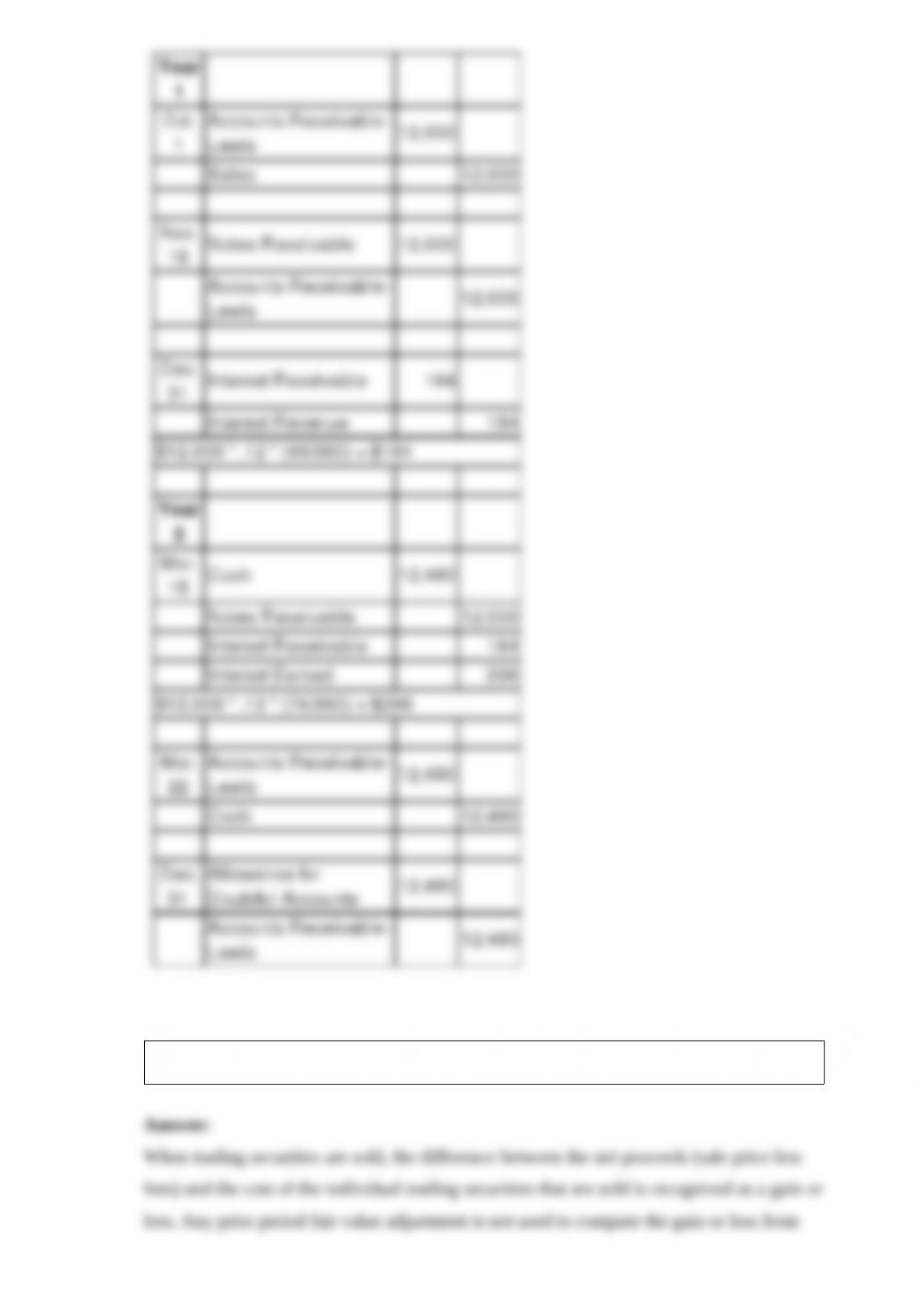
of floor space, Department Two occupies 3,000 square feet of floor space, and
Department Three occupies 5,000 square feet of floor space. If the rent is allocated
based on the total square footage of the space, Department One should be charged rent
expense for the period of:
A.$4,400.
B.$3,000.
C.$4,000.
D.$2,200.
E.$2,000.
15) An accounting system that is set up to control costs and evaluate managers’
performance by assigning costs to the managers responsible for controlling them is
called a:
A.Cost accounting system.
B.Managerial accounting system.
C.Responsibility accounting system.
D.Financial accounting system.
E.Activity-based accounting system.
16) Riu Corporation has a Parts Division that does work for other Divisions in the
company as well as for outside customers. The company’s Repair Division has asked
the Parts Division to provide it with 2,000 special parts each year. The special parts
would require $17.00 per unit in variable production costs. The Repair Division has a
bid from an outside supplier for the special parts at $28.00 per unit. In order to have
time and space to produce the special part, the Parts Division would have to cut back
production of another part-the B83 that it presently is producing. The B83 sells for
$34.00 per unit, and requires $22.00 per unit in variable production costs. Packaging
and shipping costs of the B83 are $4.00 per unit. Packaging and shipping costs for the
new special part would be only $0.50 per unit. The Parts Division is now producing and
selling 10,000 units of the B83 each year. Production and sales of the B83 would drop
by 10% if the new special part is produced for the Repair Division.
Required:
a. What is the range of transfer prices within which both the Divisions’ profits would
increase as a result of agreeing to the transfer of 2,000 special parts per year from the
Parts Division to the Repair Division?
b. Is it in the best interests of Riu Corporation for this transfer to take place? Explain.
17) Which of the following is not classified as plant assets?
A.Land.
B.Land improvements.
C.Buildings.
D.Machinery and equipment.
E.Patent.
18) A company had $43 missing from petty cash that was not accounted for by petty
cash receipts. The correct procedure is to:
A.Debit Cash Over and Short for $43.
B.Credit Cash Over and Short for $43.
C.Debit Petty Cash for $43.
D.Credit Petty Cash for $43.
E.Credit Cash for $43.
19) The sales budget for Modesto Corp. shows that 20,000 units of Product A and
22,000 units of Product B are going to be sold for prices of $10 and $12, respectively.
The desired ending inventory of Product A is 20% higher than its beginning inventory
of 2,000 units. The beginning inventory of Product B is 2,500 units. The desired ending
inventory of B is 3,000 units. Budgeted purchases of Product A for the year would be:
A.22,400 units.
B.20,400 units.
C.20,000 units.
D.19,500 units.
E.12,200 units.
20) A company reported that its bonds with a par value of $50,000 and a carrying value
of $57,000 are retired for $60,000 cash, resulting in a loss of $3,000. The amount to be
reported under cash flows from financing activities is:
A.($3,000).
B.$60,000.
C.($57,000).
D.$7,000.
E.($7,000).
21) On November 19, Nicholson Company receives a $15,000, 60-day, 8% note from a
customer as payment on account. What adjusting entry should be made on the
December 31 year-end?
A.Debit Interest Receivable $1,200; credit Interest Revenue $1,200.
B.Debit Interest Receivable $140; credit Interest Revenue $140.
C.Debit Interest Receivable $200; credit Interest Revenue $200.
D.Debit Interest Revenue $140; credit Interest Receivable $140.
E.Debit Interest Revenue $200; credit Interest Receivable $200.
22) Wildlife Wholesale Supply sold birdseed to a retailer for $860, receiving cash at the
time of sale. The cost of the birdseed was $370. When recording the collection from the
customer, in its cash receipts journal, Wildlife would enter:
A.$860 in the Cash Dr. column and $860 in the Accounts Receivable Cr. column.
B.$370 in the Cash Dr. column and $370 in the Accounts Receivable Cr. column.
C.$860 in the Cash Dr. column; $860 in the Sales Cr. column; and $370 in the Other
Accounts Cr. column.
D.$860 in the Accounts Receivable Dr. column, $860 in the Cash Cr. column; and $370
in the Cost of Goods Sold Dr./Inventory Cr. column.
E.$860 in the Cash Dr. column; $860 in the Sales Cr. column; and $370 in the Cost of
Goods Sold Dr./Inventory Cr. column.
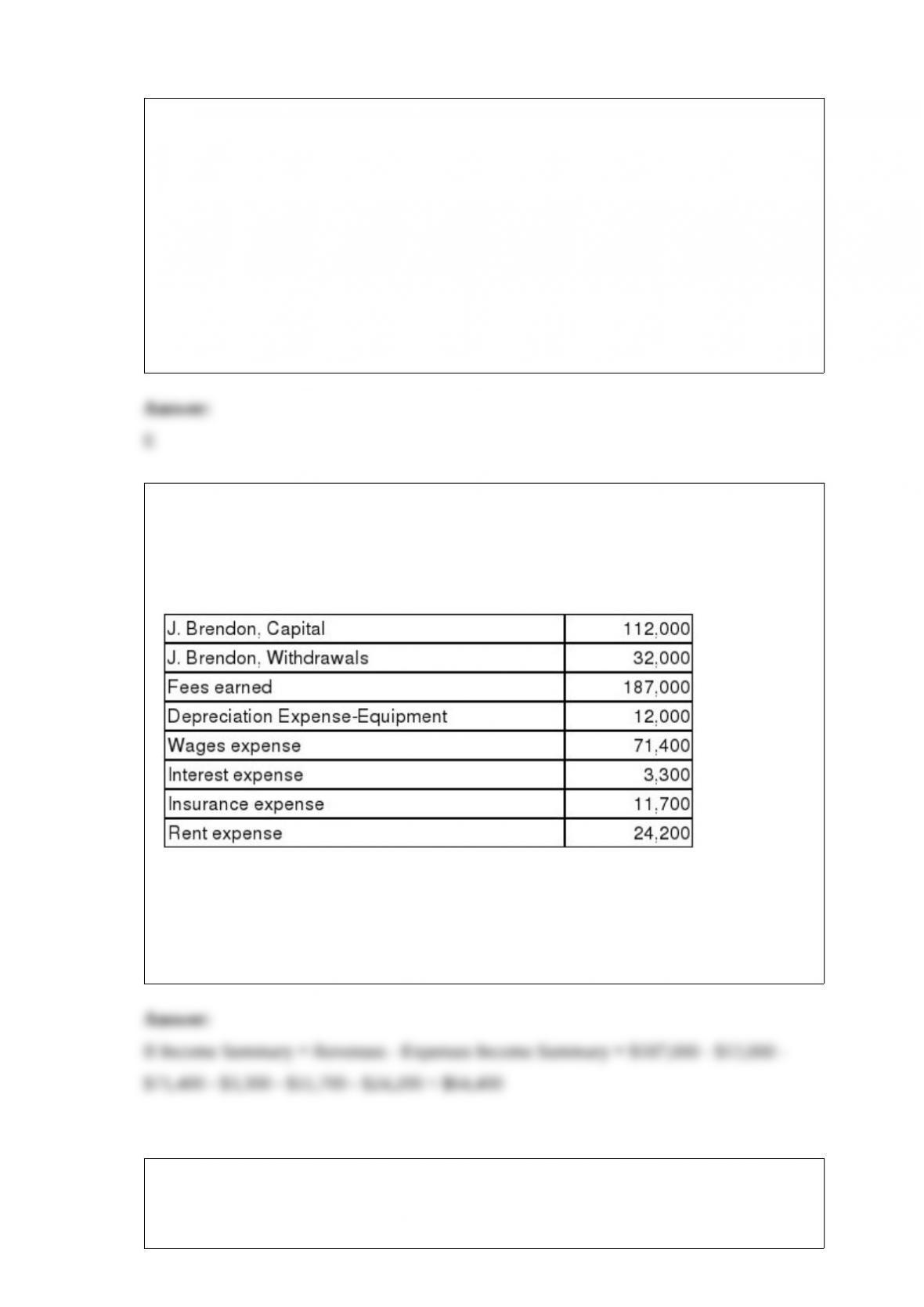
23) The following information is available for Brendon Company before closing the
accounts. What will be the amount in the Income Summary account that should be
closed to Brendon, Capital?
A.$80,000.
B.$64,400.
C.$43,000.
D.$32,400.
E.$42,400.
24) During August, Boxer Company sells $356,000 in merchandise that has a one year
warranty. Experience shows that warranty expenses average about 5% of the selling
price. The warranty liability account has a credit balance of $12,800 before adjustment.
Customers returned merchandise for warranty repairs during the month that used
$9,400 in parts for repairs. The entry to record the estimated warranty expense for the
month is:
A.Debit Warranty Expense $17,800; credit Estimated Warranty Liability $17,800.
B.Debit Warranty Expense $5,000; credit Estimated Warranty Liability $5,000.
C.Debit Warranty Expense $14,400; credit Estimated Warranty Liability $14,400.
D.Debit Estimated Warranty Liability $9,400; credit Warranty Expense $9,400.
E.Debit Estimated Warranty Liability $17,800; credit Warranty Expense $17,800.
25) If a company applies overhead to production with a predetermined overhead rate, a
credit balance in the Factory Overhead account at the end of the period means that:
A.The bookkeeper has made an error because the debits don’t equal the credits.
B.The balance will be carried forward to the next period as an overhead cost.
C.Actual overhead incurred was less than the overhead amount applied to production.
D.The overhead was underapplied for the period.
E.Actual overhead was greater than the overhead amount applied to production.
26) Define and contrast period costs and product costs. How are they reported in the
financial statements of a manufacturing company?
27) A company reported net income for Year 1 of $98,000 and $106,000 for Year 2. It
also reported net sales of $835,000 in Year 1 and $918,000 in Year 2. The company’s
average total assets in Year 1 were $1,850,000 and $1,720,000 in Year 2. Calculate the
company’s profit margin, total asset turnover and return on total assets for Year 1and
Year 2. Comment on the results.
28) Describe the recording process (including costs) for the types of transactions
associated with sales of merchandise inventory using a perpetual inventory system.
29) ___________________ bonds have an option exercisable by the issuer to retire
them at a stated dollar amount prior to maturity.
30) ___________________________ is a budget system based on expected activities
and their levels that enables management to plan for resources required to perform the
activities.
31) The following series of transactions occurred during Year 1 and Year 2, when
Foxworth Co. sold merchandise to Kevin Lewis. Foxworth’s annual accounting period
ends on December 31
Prepare Foxworth Co.’s journal entries to record the above transactions. The company
uses the allowance method to account for its bad debt expense.
32) Explain how to record the sale of trading securities.
33) Clevenger Co. planned to produce and sell 30,000 units with a selling price of $10
per unit. Variable costs are expected to be $4 per unit and fixed costs are expected to be
$80,000. Clevenger actually produced and sold 37,000 units.
Using a contribution margin format:
Prepare a flexible budget income statement for the actual level of sales and production.
34) The total amount of cash and other assets the corporation receives from its
stockholders in exchange for common stock is called _____________.
35) Describe a bank reconciliation and discuss its purpose.