When a lease qualifies as a capital lease, what is the cost basis of the asset acquired?
a. The present value of the minimum lease payments, exclusive of executory costs.
b. The present value of the minimum lease payments plus executory costs.
c. The sum of the gross minimum lease payments.
d. The present value of the minimum lease payments plus the present value of
executory costs.
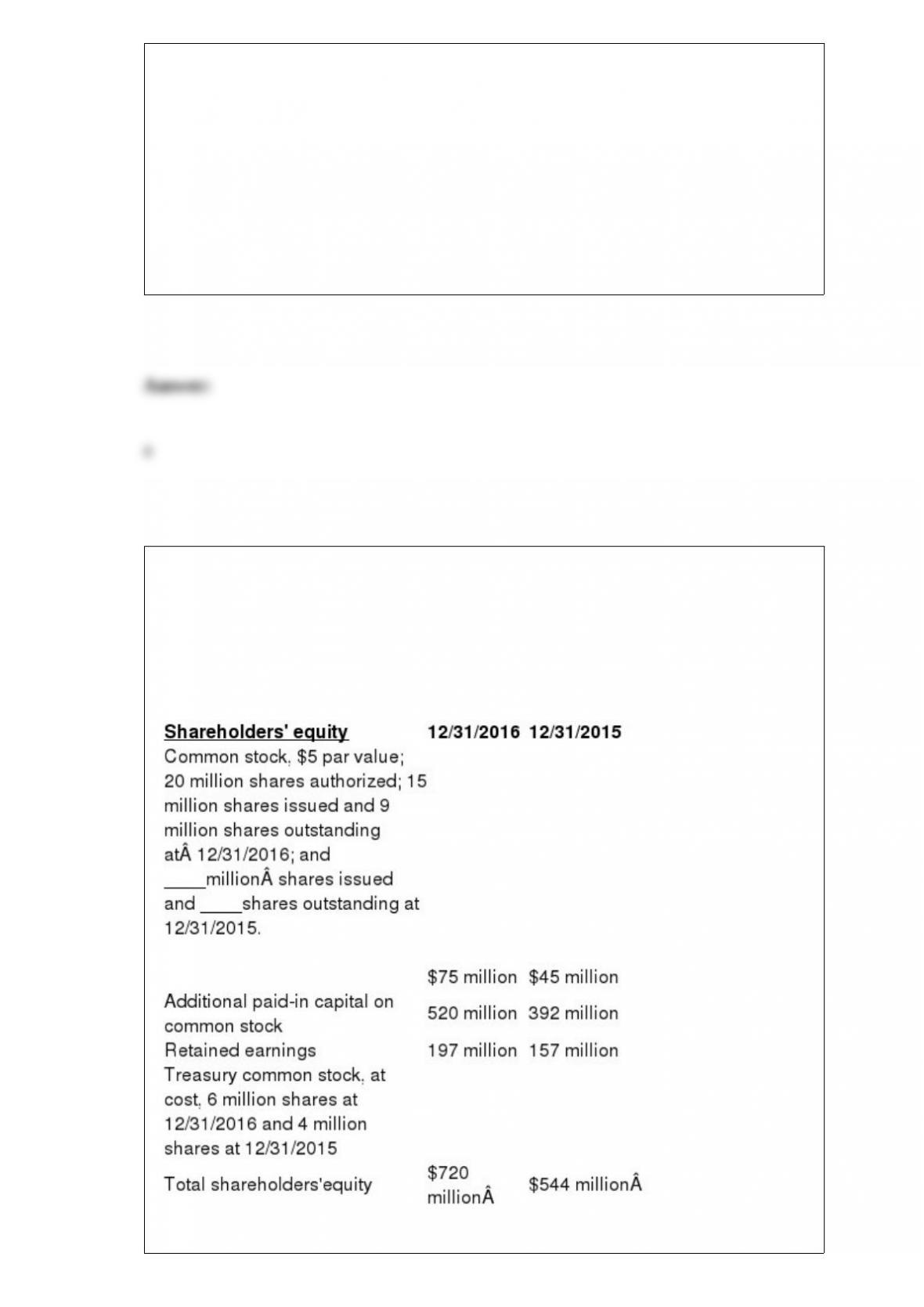
What was the average price of the additional treasury shares purchased by Levi during
2016?
The following partial information is taken from the comparative balance sheet of Levi
Corporation:
a. $11 per share.

b. $12 per share.
c. $12.50 per share.
d. None of these answer choices is correct.
The division’s book value and fair value less cost to sell on December 31 were
$3,000,000 and $3,500,000, respectively. What before-tax amount(s) should Mercedes
report as loss on discontinued operations in its 2016 income statement?
On October 28, 2016, Mercedes Company committed to a plan to sell a division that
qualified as a component of the entity according to GAAP regarding discontinued
operations and was properly classified as held for sale on December 31, 2016, the end
of the company’s fiscal year. The division’s loss from operations for 2016 was
$2,000,000. a. $2,000,000 loss.
b. $2,500,000 loss.
c. No loss would be reported.
d. $500,000 gain included in continuing operations and a $2,000,000 loss from
discontinued operations.

Dollar-value LIFO:
a. Starts with ending inventory measured at current costs and re-creates LIFO layers for
measuring inventory costs.
b. Increases the recordkeeping costs of LIFO.
c. Only is allowed for internal reporting purposes.
d. None of the above is correct.
Contingently issuable shares may be included in:
a. Basic EPS.
b. Diluted EPS.
c. Both A and B.
d. None of these answer choices is correct.
When more than one security is sold for a single price and the total selling price is not

equal to the sum of the market prices, the cash received is allocated between the
securities based on:
a. Relative book values.
b. Par values.
c. Relative market values.
d. The earnings per share.
Property, plant, and equipment and intangible assets are:
a. Created by the normal operation of the business and include accounts receivable.
b. All assets except cash and cash equivalents.
c. Current and long-term assets used in the production of either goods or services.
d. Long-term revenue-producing assets.
The par value of shares issued is normally recorded in the:
a. Paid-in capital in excess of par account.
b. Common stock account.

c. Retained earnings account.
d. Appropriated retained earnings account.
If a company’s deferred tax asset is not reduced by a valuation allowance, the company
believes it is more likely than not that:
a. Sufficient accounting income will be generated in future years to realize the full tax
benefit.
b. Sufficient accounting and taxable income will exist in future years to realize the full
tax benefit.
c. Sufficient taxable income will be generated in future years to realize the full tax
benefit.
d. Tax rates will not change in future years.
Which of the following changes in inventory costing usually should not be reported by
revising the financial statements of prior periods?
a. The weighted-average method to the LIFO method.
b. The weighted-average method to the FIFO method.
c. FIFO method to the weighted-average method.
d. LIFO method to the weighted-average method.

Griggs Co. failed to amortize the premium on an outstanding five-year bond issue.
What is the resulting effect on interest expense and the bond book value, respectively?
a. Understated, understated.
b. Understated, overstated.
c. Overstated, understated.
d. Overstated, overstated.
A major expenditure increased a truck’s life beyond the original estimate of life. GAAP
permits the expenditure to be debited to:
a. Repairs.
b. Accumulated depreciation.
c. Major repairs.
d. None of these answer choices are correct.

The times interest earned ratio indicates:
a. The margin of safety provided to creditors.
b. The extent of “trading on the equity” or financial leverage.
c. Profitability without regard to how resources are financed.
d. The effectiveness of employing resources provided by owners.
Indiana Co. began a construction project in 2016 with a contract price of $150 million
to be received when the project is completed in 2018. During 2016, Indiana incurred
$36 million of costs and estimates an additional $84 million of costs to complete the
project. Indiana recognizes revenue over time and for this project recognizes revenue
over time according to the percentage of the project that has been completed. Suppose
that, in 2017, Indiana incurred additional costs of $63.75 million and estimated an
additional $42.75 million in costs to complete the project. Indiana:
a. Recognized $3.75 million loss on the project in 2017.
b. Recognized $5.25 million gross profit on the project in 2017.
c. Recognized $7.5 million gross profit on the project in 2017.
d. Recognized $1.5 million loss on the project in 2017.

The basic principle used to value an asset acquired in a nonmonetary exchange is to
value it at:
a. Fair value of the asset(s) given up.
b. The book value of the asset given plus any cash or other monetary consideration
received.
c. Fair value or book value, whichever is smaller.
d. Book value of the asset given.
The inventories disclosure note in the 2014 financial statements for SUPERVALU Inc.,
one of the largest grocery chains in the United States, included the following: “During
fiscal 2014, 2013 and 2012, inventory quantities in certain LIFO layers were reduced.
These reductions resulted in a liquidation of LIFO inventory quantities carried at lower
costs prevailing in prior years as compared with the cost of fiscal 2014, 2013 and 2012
purchases. As a result, Cost of sales decreased by $14, $6 and $9 in fiscal 2014, 2013
and 2012, respectively. All inventories are stated at the lower of cost or current market
values. Cost for inventories at the majority of our operations is determined on a last-in,
first-out (“LIFO”) basis.” Required:
The disclosure note indicates an inventory liquidation during 2014, 2013, and 2012. By
how much did net income in 2014 increase due to the liquidation? Assume an income
tax of 40%.
Salle Services issued $300 million of 6% bonds in 2014. The bonds are convertible into
60 million shares of its no par common stock. Salle elected the option to report the
bonds at fair value, with changes in fair value reported in earnings. As a result the
bonds are reported at $312 million in the December 31, 2016, balance sheet.
Required:
When calculating diluted EPS at December 31, 2016, what will be the net increase in
the denominator of the EPS fraction? Explain.
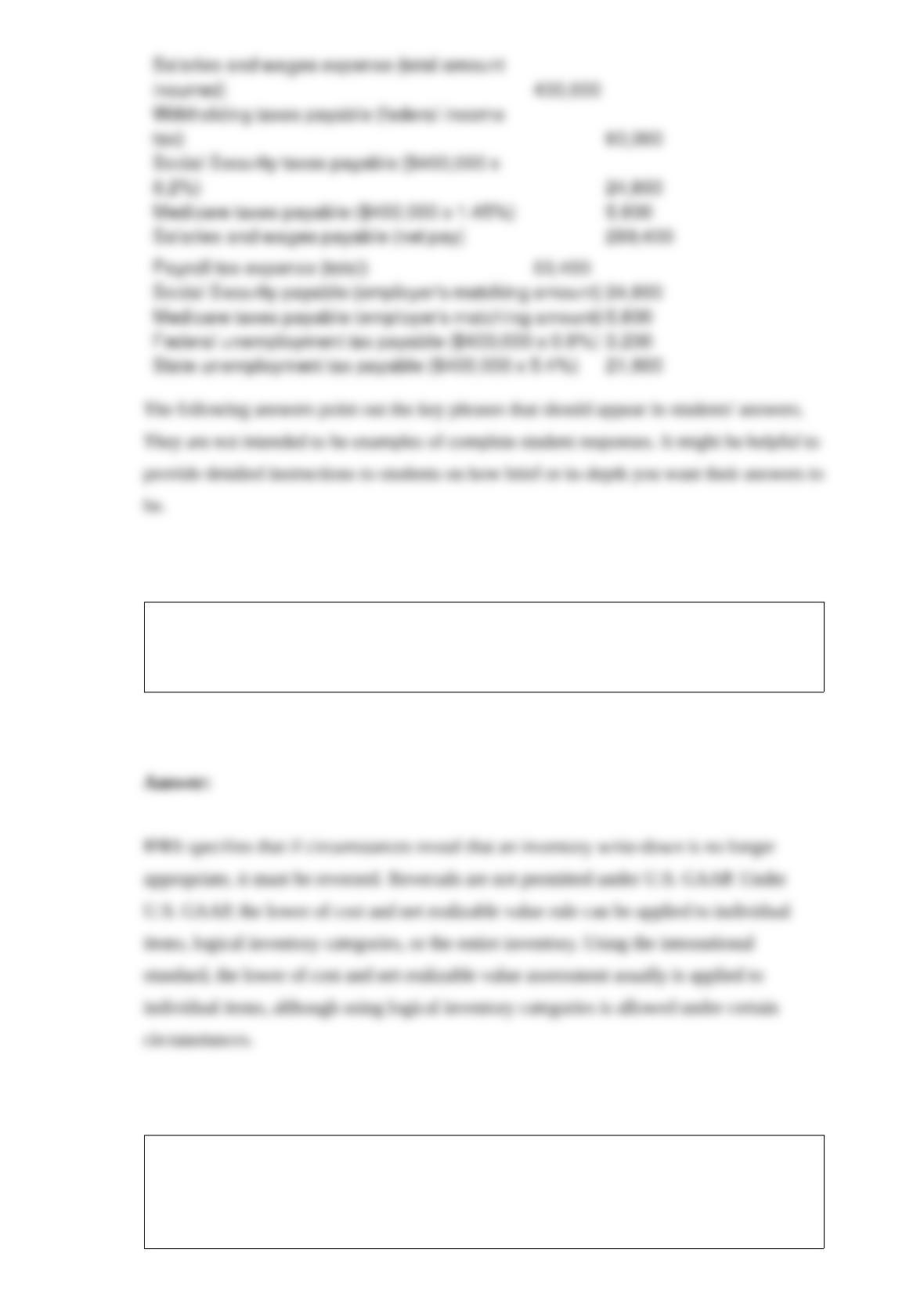
Muller Corp. pays its employees monthly. The payroll information listed below is for
January 2016, the first month of Muller’s fiscal year.
Required:
Prepare the appropriate journal entries to record salaries and wages expense and payroll
tax expense for the January 2016 pay period.
Briefly explain the differences between U.S. GAAP and International Financial
Reporting Standards (IFRS) in the application of the lower of cost and net realizable
value rule for valuing inventory.
In its 2016 annual report to shareholders, Custard Cup Inc. included the following note:
Note 4 Property, Plant, and Equipment
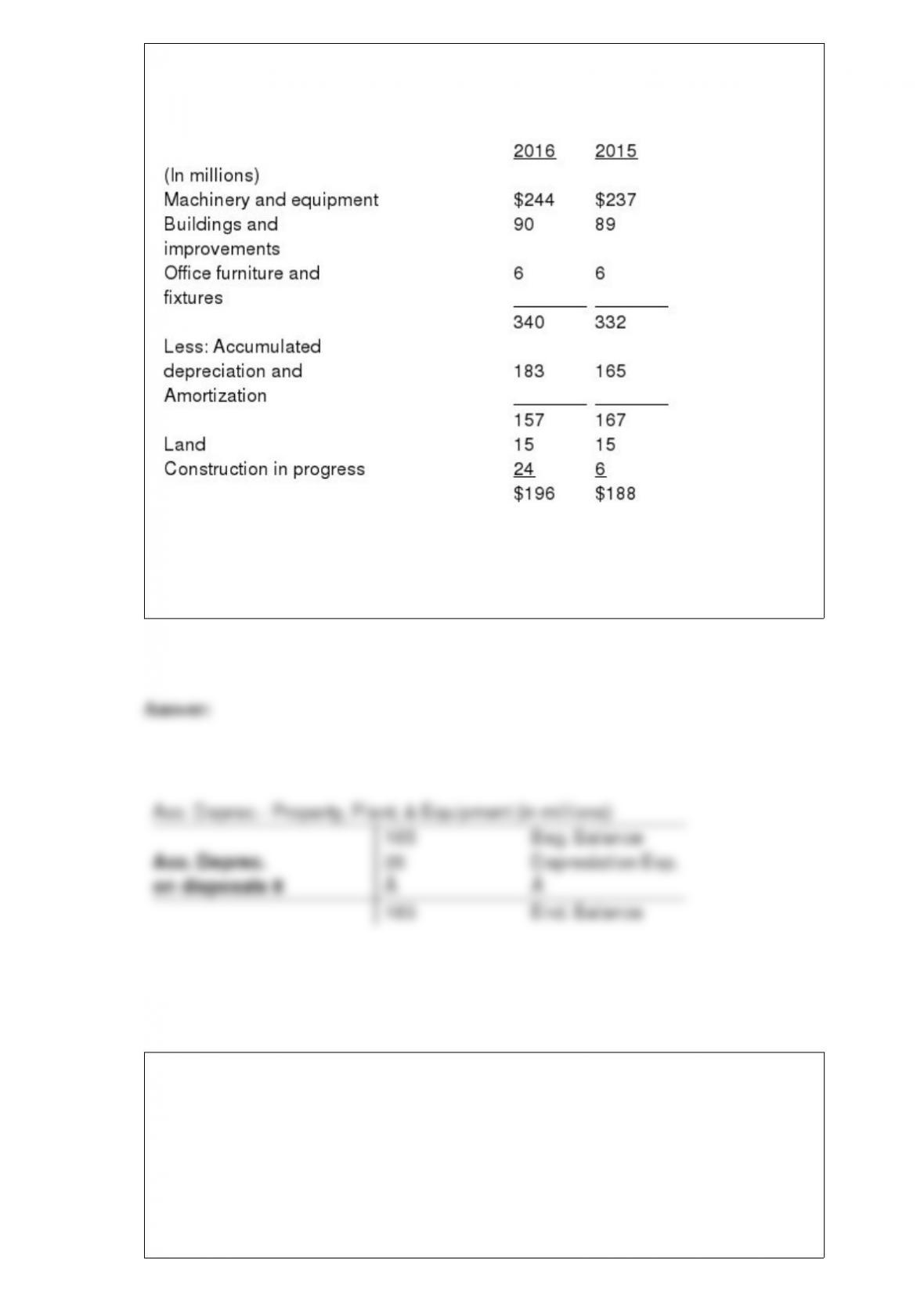
Property, plant, and equipment (PPE) at December 31, 2016, and December 31, 2015,
consisted of the following:
Depreciation expense for property, plant and equipment was $26 million in 2016.
Required: Compute the Accumulated depreciation on PPE disposed of by Custard Cup
during 2016.
On September 30, 2016, Sternberg Company sold office equipment for $12,000. The
equipment was purchased on March 31, 2013, for $24,000. The asset was being
depreciated over a five-year life using the straight-line method, with depreciation based
on months in service. No residual value was anticipated.
Required:
Prepare the journal entries to record 2016 depreciation and the sale of the equipment.
U.S. GAAP requires that actuarial gains and losses be included among OCI items in the
statement of comprehensive income, thus subsequently become part of AOCI.
($ in millions)
Loss-OCI (from change in assumption) 7
PBO 7

($ in millions)
‘ƒDBO balance, January 1 $ 960
Service cost 150
‘ƒ Interest cost (10% x $960) 96
‘ƒ Gain from change in actuarial assumption (44)
Past service cost 24
Benefits paid (72)
‘ƒDBO balance, December 31 $1,114
Plan assets balance, January 1 $ 600
Actual return on plan assets 40
‘ƒ Contributions 2016 120
Benefits paid (72)
Plan assets balance, December 31 $ 688
Because the plan is underfunded, Dharma Initiative will report a net pension liability:
‘ƒDBO balance, December 31 $1,114
Plan assets balance, December 31 (688)
Net pension liability $ 426
On January 1, 2016, Cool Universe issued 10% bonds dated January 1, 2016, with a
face amount of $20 million. The bonds mature in 2025 (10 years). For bonds of similar
risk and maturity, the market yield is 12%. Interest is paid semiannually on June 30 and
December 31.
Required:
1> Determine the price of the bonds at January 1, 2016.
2> Prepare the journal entry to record the bond issuance by Cool on January 1, 2016.
3> Prepare the journal entry to record interest on June 30, 2016, using the straight-line
method.
4> Prepare the journal entry to record interest on December 31, 2016, using the
straight-line method.
Explain how management’s discussion and analysis of its operations and liquidity may
be helpful to investors.