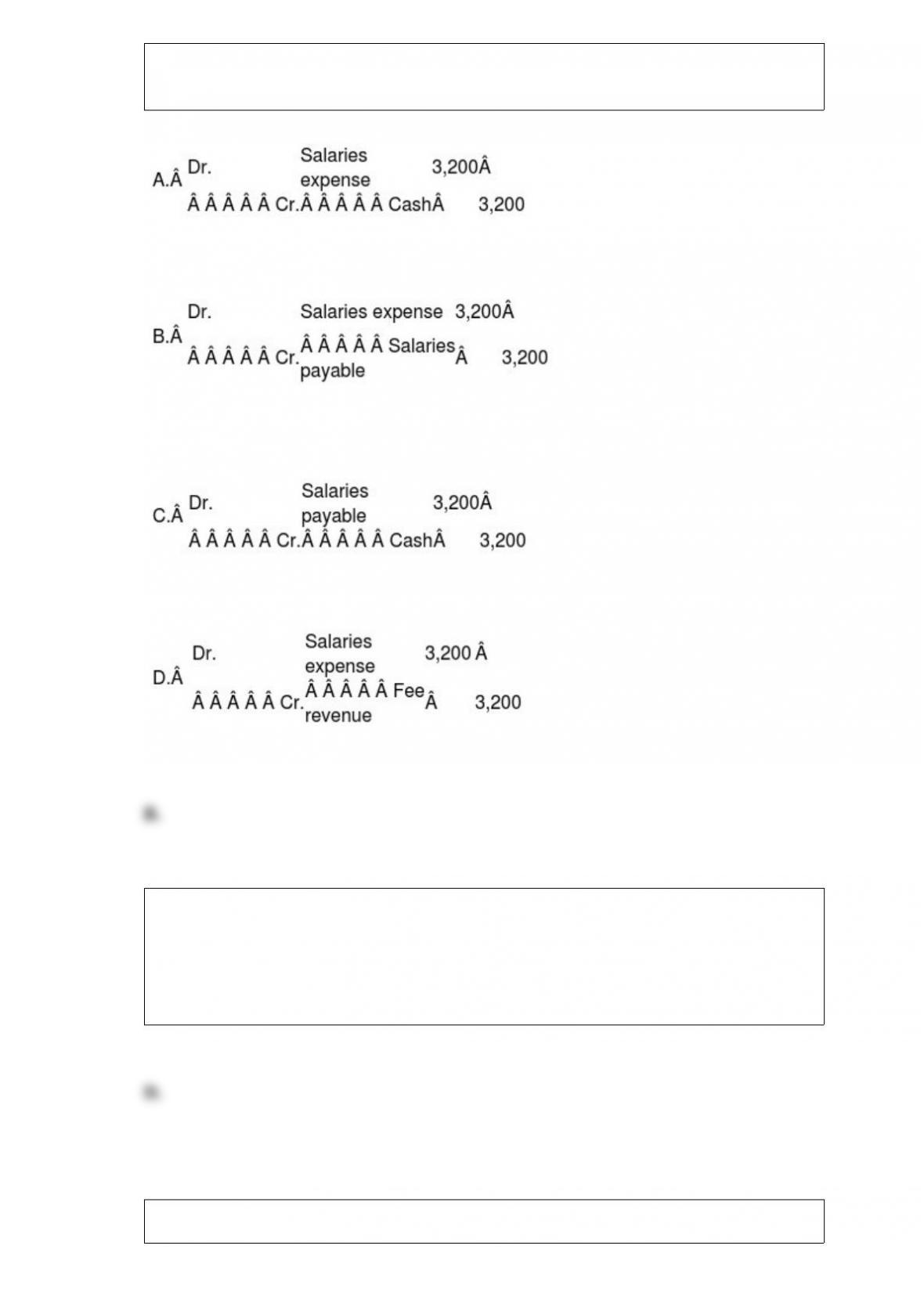
To accrue $3,200 of employee salaries for the last week of February, the employer’s
journal entry is:
The cash budget is especially important to a firm when:
A. there is not a lot of confidence in the sales forecast.
B. it has a relatively large amount of operating cash.
C. the P/E ratio has been trending downwards.
D. it may have to negotiate a short-term bank loan.
The purchasing agent of an organization acquired some raw materials at a bargain price,

even though she knew that their quality was lower than that of the materials customarily
used. This action resulted in a favorable raw materials purchase price variance that
might very well have been more than offset by:
A. an unfavorable raw materials usage variance.
B. a favorable direct labor efficiency variance.
C. an unfavorable variable overhead spending variance.
D. an unfavorable direct labor rate variance.
_____________ costs between two alternative projects are those that would result from
selecting one alternative instead of the other.
A. Allocated
B. Differential
C. Sunk
D. Irrelevant
Which of the following is(are) a true statement(s) pertaining to bonds?
A. Bonds can be sold at a discount, par, or payable.
B. Bonds can be sold at a discount, par, or premium.
C. The SEC sets the market price of a bond.
D. The issuing firm sets the price of a bond.
Over the years, the Securities and Exchange Commission (SEC) has delegated its
statutory authority to establish accounting principles for publicly traded companies in
the United States to each of the following organizations except the:
A. Committee on Accounting Procedures of the American Institute of Accountants.
B. Accounting Principles Board (APB).
C. Financial Accounting Standards Board (FASB).
D. None of the above organizations were ever delegated authority by the SEC to
establish accounting principles in the U.S.
E. Each of the organizations listed in A, B, and C were at one time or another delegated
authority by the SEC to establish accounting principles in the U.S.
Moped, Inc. purchased machinery at a cost of $44,000 on January 1, 2017. The
expected useful life is 5 years and the asset is expected to have salvage value of $4,000.
Moped depreciates its assets using the double-declining balance method.
What is the firm’s depreciation expense for the year ended December 31, 2017?
A. $4,000
B. $8,800
C. $12,000
D. $17,600
Budget slack is:
A. sometimes called padding or cushion.
B. the result of budget estimates submitted that are slightly higher than what the costs
are really expected to be.
C. an allowance for contingencies built into a budget.
D. all of the above.
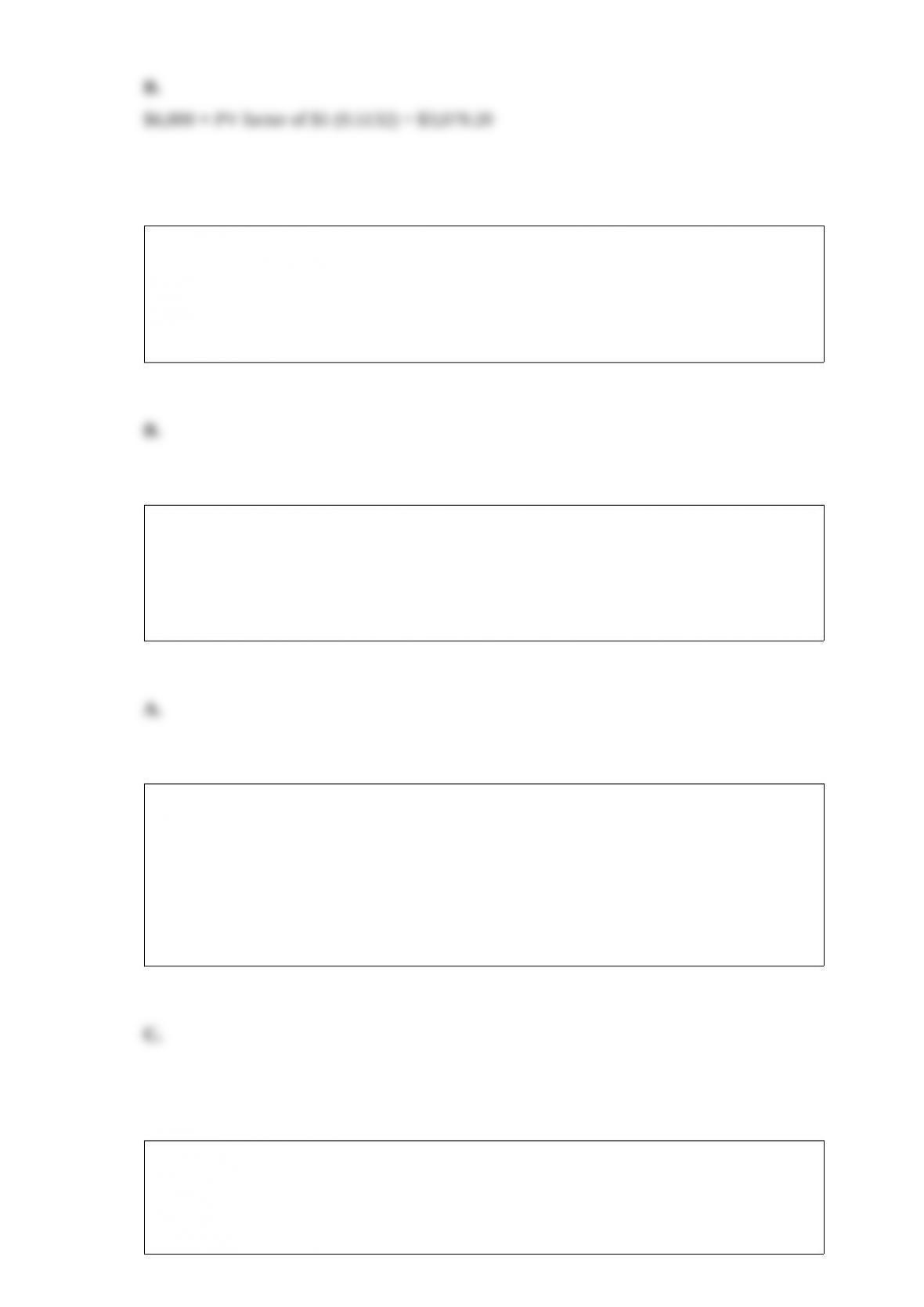
The present value of $6,000 to be received in 7 years at 10% is:
A. $1,232.44
B. $3,079.20
C. $6,000.00
D. $11,691.34
“Accumulated other comprehensive income (loss)”:
A. is a component of net income and reported on the income statement.
B. is a component of stockholders’ equity and reported on the balance sheet.
C. includes a component that adjusts for the effects of treasury stock transactions.
D. is another name for the cumulative foreign currency translation adjustment.
The principal objective of a performance report is to:
A. highlight activities that need management attention.
B. direct blame to those managers who did not meet goals.
C. provide a basis for rewarding effective managers.
D. highlight budgets that have been incorrectly established.
Which of the following descriptions is not one of the “Thirteen Financial Shenanigans”
identified by Schilit and Perler, and listed in Exhibit 10-1?
A. recording revenue too soon or that is of a questionable quality.
B. boosting income with one-time gains.
C. failing to record intangible assets which the company has ownership rights to.
D. shifting future expenses to the current period as a special charge.
E. failing to record or improperly reducing liabilities.
The amortization of bond discount:
A. increases the cash paid to bondholders for interest.
B. results in bond interest expense being greater than the interest paid to bondholders.
C. results in bond interest expense being less than the interest paid to bondholders.
D. reduces the carrying value of bonds payable on the balance sheet.
Which of the following is NOT an example of an inventory account a manufacturing
firm might use?
A. Work in process inventory.
B. Finished goods inventory.
C. Merchandise inventory.
D. Raw materials inventory.
When a company issues a bond at a premium:
A. the company is more profitable than most companies in its industry.
B. investors perceive the bond to be a very safe investment.
C. the company’s interest expense will be less than the interest paid each year.
D. the company’s interest expense will be more than the interest paid each year.
If an organization has an obligation to pay $25,000 to a supplier two years from now,
the present value of the obligation:
A. is less than $25,000.
B. is $25,000.
C. is more than $25,000.
D. could be calculated using an annuity factor from the present value tables.
A budgeting approach that implies little or no input from lower levels of management is
known as the:
A. top-down approach.
B. zero based approach.
C. proportionate increase approach.
D. participative approach.
Accrual accounting:
A. is designed to match revenues and expenses.
B. results in the balance sheet showing the fair value of the entity’s assets.
C. means that expenses are recorded when they are paid.
D. cannot result in the entity having net income unless cash is received from customers.
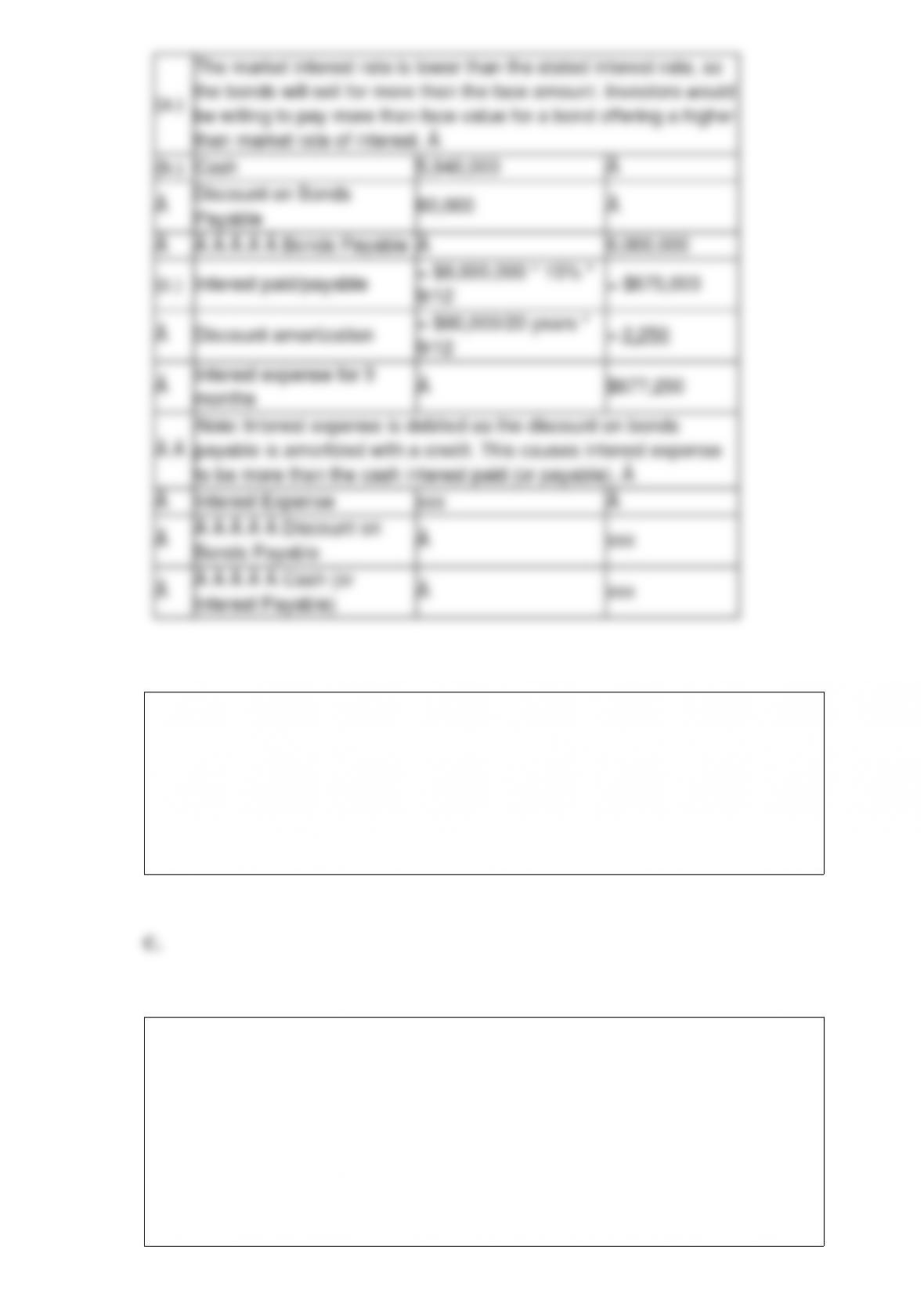
Ariana Co. issued $6,000,000 face amount of 15%, 20-year bonds on April 1, 2017. The
bonds pay interest on a semi-annual basis on June 30 and December 31 each year.
(a.) Assume that market interest rates were slightly lower than 15% when the bonds
were sold. Would the proceeds from the bond issue have been more than, less than, or
equal to the face amount?
(b.) Independent of part (a), assume that the proceeds were $5,940,000. Write the
journal entry or use the horizontal model to show the effects of issuing the bonds.
(c.) Assume that the bonds were issued for $5,940,000 as in part (b). Calculate the
interest expense that Ariana Co. will show with respect to these bonds in its income
statement for the year ended December 31, 2017, assuming that the discount of $60,000
is amortized on a straight-line basis.
The return on investment measure of performance:
A. is never as important a measure of management effectiveness as the amount of net
income.
B. relates dividends paid to the entity’s assets.
C. is calculated using net income as the amount of return.
D. is calculated by dividing average assets for a period by the amount of net income for
the period.
The amount of cash related to a particular bank checking account that is shown on the
balance sheet at December 31 is:
A. the cash balance shown on the bank’s records at the close of business on December
31, without further adjustments.
B. the cash balance shown in the company’s general ledger account for this checking
account at the close of business on December 31, without further adjustments.
C. the cash balance shown in the general ledger account for this checking account as of
the close of business on December 31, after recognizing any outstanding checks and/or
deposits in transit from the December 31 bank account reconciliation.
D. the cash balance shown in the general ledger account for this checking account as of
the close of business on December 31, after recognizing any bank service charges
and/or interest income from the December 31 bank account reconciliation.
Which classification of accounting is most concerned with the use of economic and
financial information to plan and control many of the activities of the entity?
A. Financial accounting.
B. Auditing-Public accounting.
C. Managerial accounting.
D. Income tax accounting.
The principal reason for a company having a common stock split is to:
A. increase the total cash dividends paid to stockholders.
B. capitalize retained earnings.
C. decrease total stockholders’ equity.
D. decrease the market value per share of common stock.
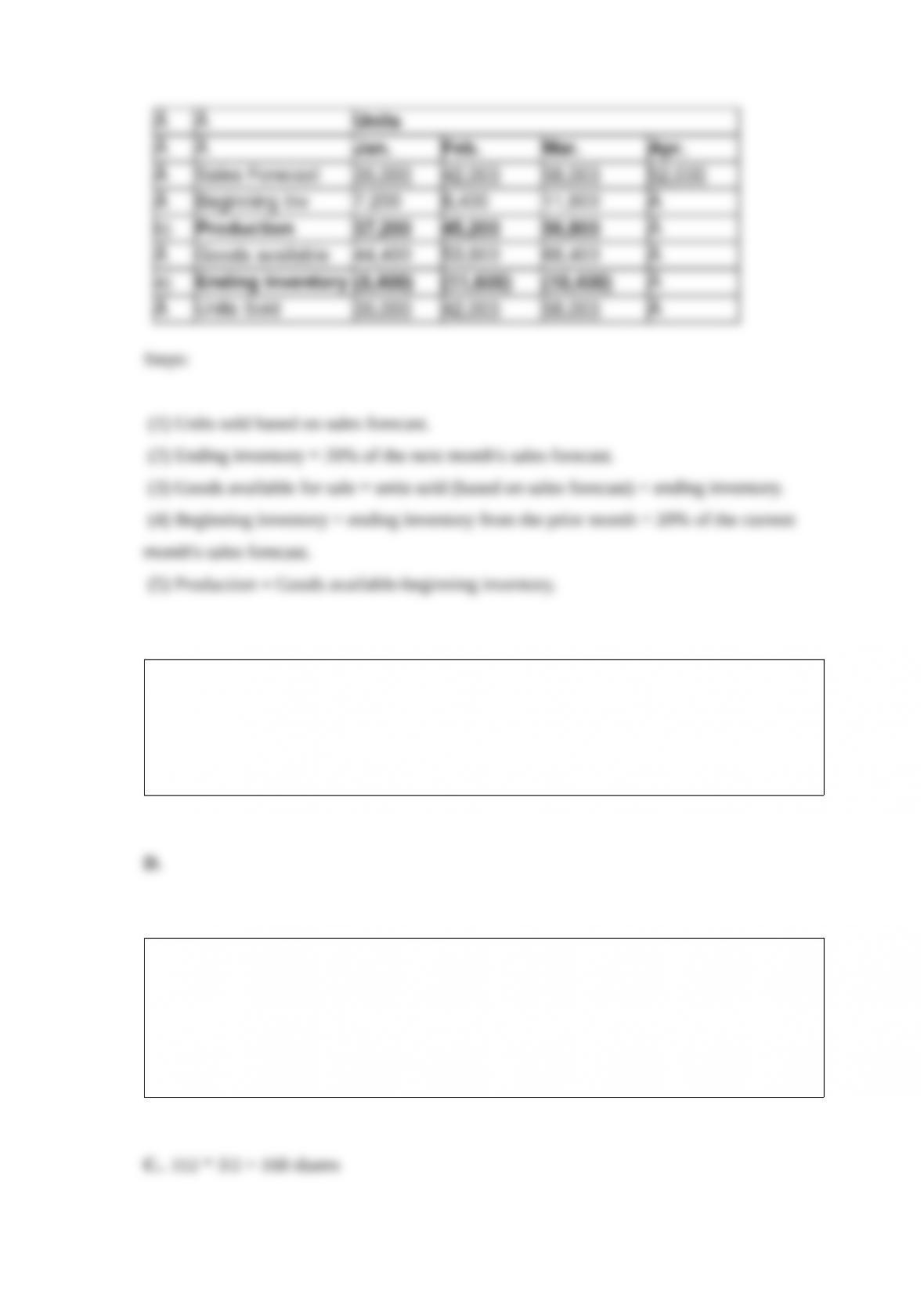
Breaded Oak, Inc. has a policy that requires 20 percent of the expected sales of its
product to be on hand at the end of the prior month. Forecasted sales, in units, for the
months of January through April are as follows:
(a.) Calculate the number of units planned for ending inventory for January, February, and
March.
(b.) Calculate the number of units budgeted to be produced in January, February, and
March.
When a manufacturer invests in short-term marketable securities:
A. the return on investment is more important than the risk involved.
B. the securities are likely to have a maturity date more than a year in the future.
C. the market value of the securities is likely to fluctuate significantly.
D. risk avoidance is of great importance.
Spike Jones owns 112 shares of the Robust Corporation’s stock. Robust announces a
3-for-2 stock split. How many shares will Fred have after this split?
A. 356 shares.
B. 224 shares.
C. 168 shares.
D. 112 shares

A cash budget would include:
A. gain on sale of equipment.
B. sale of common stock.
C. building depreciation.
D. accounts receivable.
Which of the following lists the components of the master budget in correct
chronological order?
A. direct labor budget, production budget, cost of goods sold budget.
B. sales budget, production budget, cash budget.
C. sales budget, raw materials budget, production budget.
D. cash budget, production budget, manufacturing overhead budget.
Management of ABC Company is considering new production robotics to replace some
current manual labor operations for one of their product lines. ABC’s current cost
structure for this product line consists of variable expenses of $40 per unit and fixed
expenses totaling $86,400 per month. If the robotics were installed, variable expenses
would drop to $28 per unit, but fixed expenses would increase to $135,600 per month.
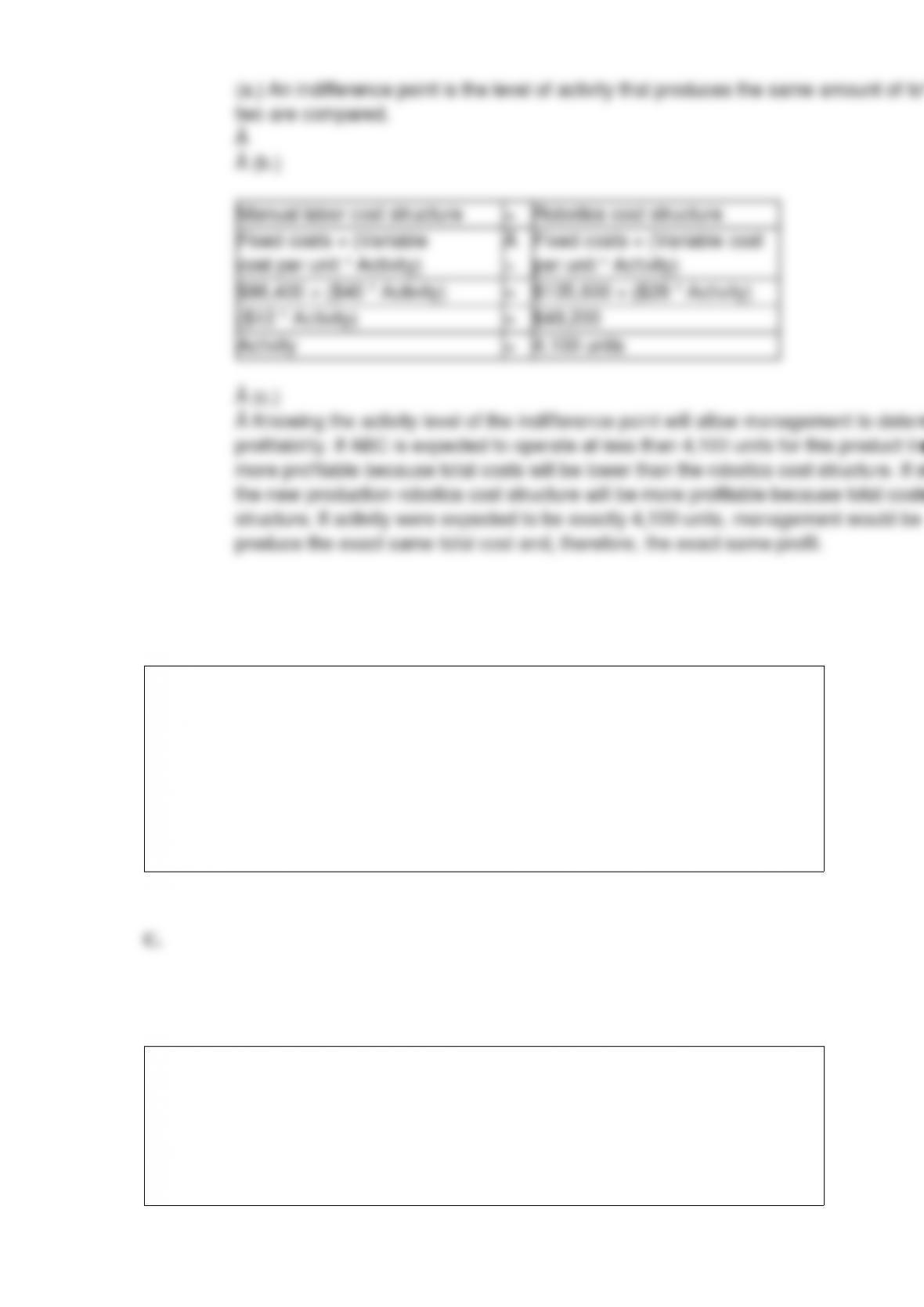
(a.) Define the term indifference point.
(b.) Calculate the indifference point between the alternative cost structures for ABC
Company’s product line.
(c.) Explain how ABC’s management would use the indifference point in the decision to
replace the manual operations with the new production robotics.
When an entity changes its accounting from one generally accepted method to another
generally accepted method:
A. financial statements of all prior years are changed to maintain comparability.
B. an explanatory note stating that the change was approved by the Financial
Accounting Standards Board is required.
C. the dollar effect of the change on both the balance sheet and income statement must
be disclosed.
D. changes like this are not permitted.
Which of the following organizational perspectives is not reported on a balanced
scorecard?
A. Environmental.
B. Customer.
C. Financial.
D. Internal Business Process.
Many airlines have frequent flyer programs that permit travelers to accumulate credits
that can be applied to the cost of tickets for future flights. Most airlines recognize the
cost of their frequent flyer programs when the credits are used to purchase tickets. This
practice, which seems to ignore the matching concept, results in:
A. stating liabilities and expenses at appropriate amounts.
B. overstating liabilities and expenses.
C. understating liabilities and expenses.
D. understating liabilities and overstating expenses.
The income statement shows amounts for:
A. revenues, expenses, losses, and liabilities.
B. revenues, expenses, gains, and fair value per share.
C. revenues, assets, gains, and losses.
D. revenues, gains, expenses and losses.
Each of a company’s several product lines has a different contribution margin ratio.
Total sales in 2017 were 20% higher than total sales in 2016. Total contribution margin
for 2017 will be:
A. the same as it was in 2016, regardless of changes in sales mix.
B. 20% higher than it was in 2016, regardless of changes in sales mix.
C. more than 20% higher than it was in 2016, if the sales mix changes and
proportionately more high contribution margin ratio products are sold in 2017 than in
2016.
D. less than 20% higher than it was in 2016, if the sales mix changes and
proportionately more high contribution margin ratio products are sold in 2017 than in
2016.
Net sales for the year were $300,000 and cost of goods sold was $174,000 for the
company’s existing products. A new product is presently under development and has an
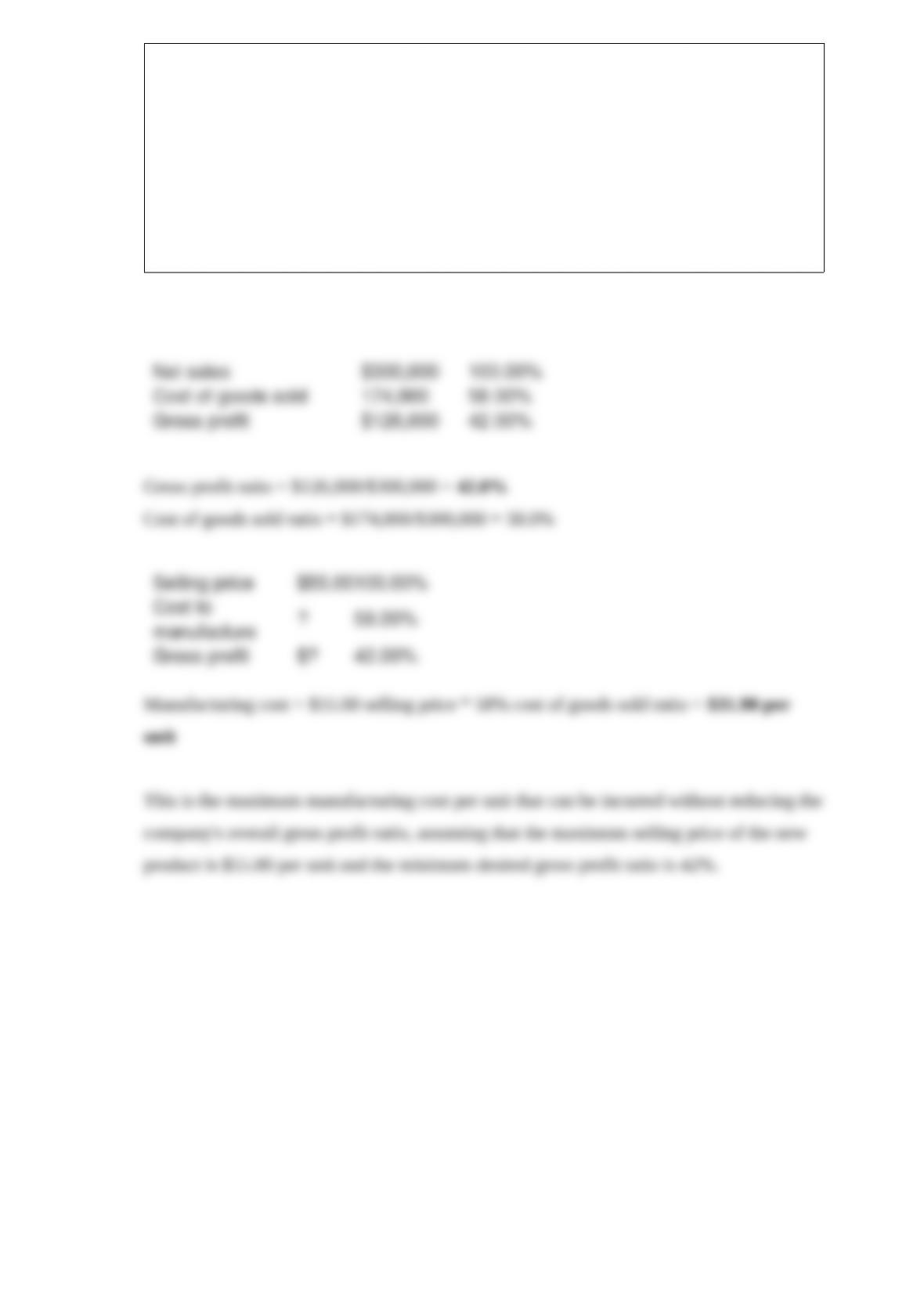
expected selling price of not more than $55 per unit in order to remain competitive with
similar products in the marketplace.
Required:
(a.) Calculate gross profit and the gross profit ratio for the year.
(b.) What is the maximum cost per unit that can be incurred to manufacture the new
product so that the product can be priced competitively and will not result in a reduction
to the company’s gross profit ratio?