
When we take into account the dilutive effect of stock options, rights, and warrants in
the calculation of EPS, the method used is called the:A. Optional method.
B. If converted method.
C. Dilution method.
D. Treasury stock method.
Answer:
As of December 31, 2013, Amy Jo’s Appliances had unadjusted account balances in
accounts receivable of $311,000 and $970 in the allowance for uncollectible accounts,
following 2013 write-offs of $6,450 in bad debts. An analysis of Amy Jo’s December
31, 2013, accounts receivable suggests that the allowance for uncollectible accounts
should be 2% of accounts receivable. Bad debt expense for 2013 should be: A. $6,220.
B. $6,450.
C. $5,250.
D. None of the above is correct.
Answer:

In 2013, Cupid Construction Co. (CCC) began work on a two-year fixed price contract
project. CCC uses the percentage-of-completion method to account for projects and
provides the following information (dollars in millions):
What is the fixed contract price for CCC’s project? A. $120 million.
B. $225 million.
C. $345 million.
D. None of the other answers is correct.
Answer:
Cutter Enterprises purchased equipment for $72,000 on January 1, 2013. The equipment
is expected to have a five-year life and a residual value of $6,000.
Using the double-declining balance method, the book value at December 31, 2014,
would be: A. $14,400.
B. $24,960.
C. $27,360.
D. $25,920.

Answer:
A simple capital structure might include: A. Stock rights.
B. Convertible bonds.
C. Nonconvertible preferred stock.
D. Stock purchase warrants.
Answer:
The Mateo Corporation’s inventory at December 31, 2013, was $325,000 based on a
physical count priced at cost, and before any necessary adjustment for the following:
▪ Merchandise costing $30,000, shipped f.o.b. shipping point from a vendor on
December 30, 2013, was received on January 5, 2014.
▪ Merchandise costing $22,000, shipped f.o.b. destination from a vendor on December
28, 2013, was received on January 3, 2014.
▪ Merchandise costing $38,000 was shipped to a customer f.o.b. destination on
December 28, arrived at the customer’s location on January 6, 2014.
▪ Merchandise costing $12,000 was being held on consignment by Traynor Company.
What amount should Mateo Corporation report as inventory in its December 31, 2013,
balance sheet? A. $367,000.
B. $427,000.
C. $405,000.
D. $325,000.
Answer:
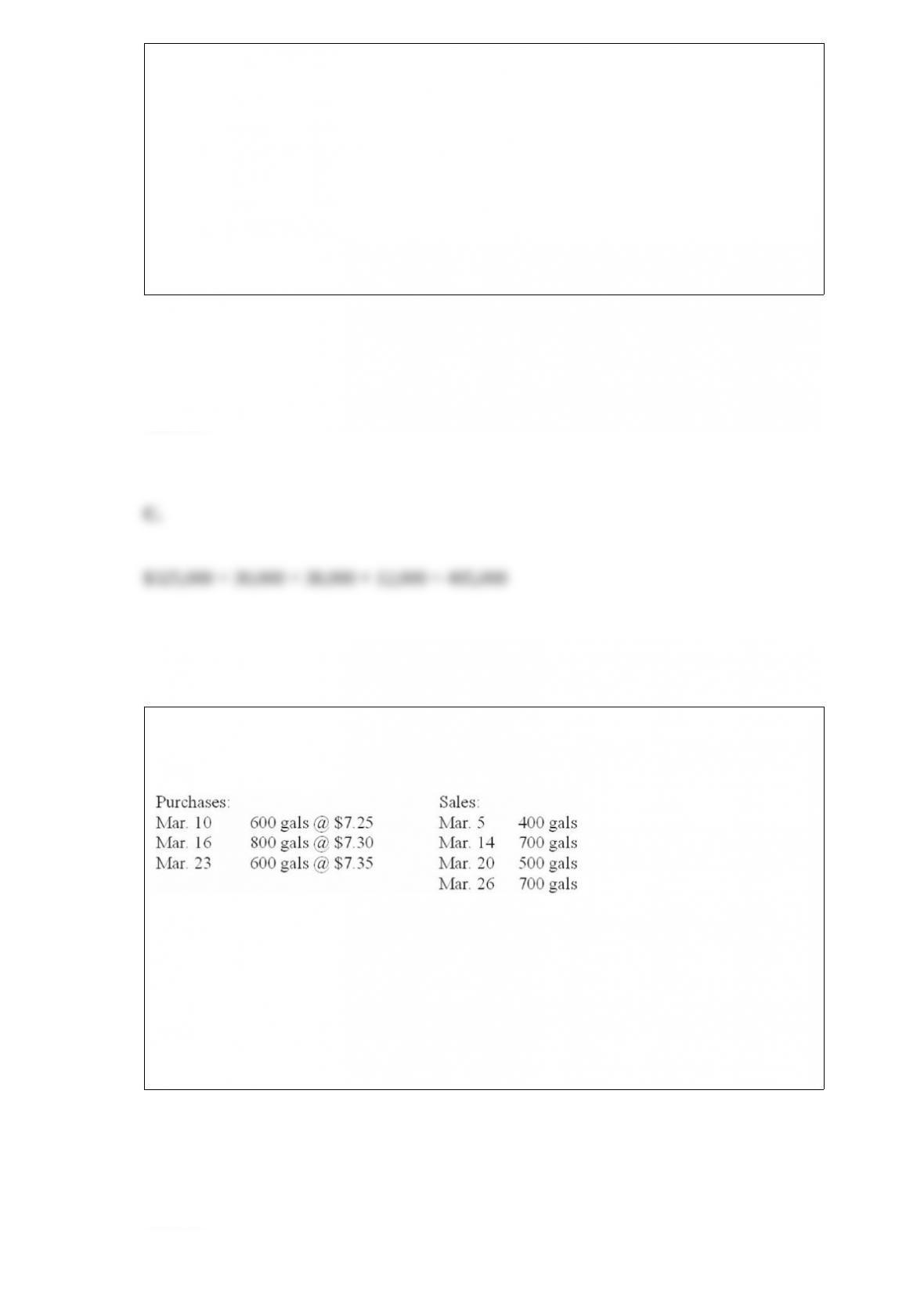
Inventory records for Herb’s Chemicals revealed the following:
March 1, 2013, inventory: 1,000 gallons @ $7.20 = $7,200
Ending inventory assuming LIFO in a perpetual inventory system would be: A. $4,960.
B. $5,060.
C. $5,080.
D. $5,140.
Answer:

When the retrospective approach is used for a change to the FIFO method, which of the
following accounts is usually not adjusted? A. Deferred Income Taxes.
B. Inventory.
C. Retained Earnings.
D. All of the above usually are adjusted.
Answer:

Unrealized holding gains and losses on securities available for sale would have the
following effects on retained earnings:
A. Option a
B. Option b
C. Option c
D. Option d
Answer:
JRE2 Inc. entered into a contract to install a pipeline for a fixed price of $2,200,000.
JRE2 uses the completed contract method of revenue recognition.
In 2013, JRE2 would report (rounded to the nearest thousand) gross profit (loss) of: A.
$(223,000).
B. $(150,000).
C. $(206,000).
D. $0.
Answer:

Which one of the following financial statements does not report amounts primarily on
an accrual basis? A. Income statement.
B. Balance sheet.
C. Statement of cash flows.
D. Statement of shareholders’ equity.
Answer:
Cutter Enterprises purchased equipment for $72,000 on January 1, 2013. The equipment
is expected to have a five-year life and a residual value of $6,000.
Using the straight-line method, depreciation for 2014 and the equipment’s book value at
December 31, 2014, would be: A. $14,400 and $43,200.
B. $28,800 and $37,200.
C. $13,200 and $39,600.
D. $13,200 and $45,600.
Answer:

Mega Loan Company has very stringent credit requirements and, accordingly, has
negligible losses from uncollectible accounts. The company’s independent accountants
did not protest when, contrary to GAAP, the company recorded bad debt expense only
when specific accounts were determined to be uncollectible, rather than use an
allowance for uncollectible accounts. The concept demonstrated is: A.Comparability.
B.Faithful representation.
C.Cost-effectiveness.
D.Materiality.
Answer:
When treasury shares are sold at a price above cost:A. A gain account is credited.
B. A loss is reported.
C. A revenue account is credited.
D. Paid-in capital is increased.
Answer:

The changes in account balances for Allen Inc. for 2013 are as follows:
Assuming the only changes in retained earnings in 2013 were for net income and a
$25,000 dividend, what was net income for 2013? A. $30,000.
B. $20,000.
C. $15,000.
D. $5,000.
Answer:
When a long-term note is given in exchange for equipment, the amount considered as
paid for the machine is: A. The invoice price.
B. The wholesale price.
C. The present value of cash outflows discounted at the stated rate.
D. The present value of the note payments discounted at the market rate.

Answer:
In a statement of cash flows using the indirect method, an increase in available-for-sale
securities not due to an increase in their fair value should be reported as: A. A deduction
from net income in determining cash flows from operating activities.
B. An addition to net income in determining cash flows from operating activities.
C. A net cash outflow from investing activity.
D. A net cash inflow from investing activity.
Answer:
Cutter Enterprises purchased equipment for $72,000 on January 1, 2013. The equipment
is expected to have a five-year life and a residual value of $6,000.
Using the straight-line method, depreciation for 2013 would be: A. $13,200.
B. $14,400.
C. $72,000.
D. None of the above is correct.

Answer:
The following information relates to Franklin Freightways for its first year of
operations (data in millions of dollars):
The applicable tax rate is 40%. There are no other temporary or permanent differences.
Franklin’s net income ($ in millions) is: A. $134.
B. $124.
C. $119.4.
D. $118.
Answer:
In its 2013 income statement, WME reported $11,000 of interest expense on its
outstanding bonds. During the year, WME paid its regular installments of $9,000 of

interest in cash. In its reconciliation schedule, WME should: A. Show a $2,000 positive
adjustment to net income under the indirect method for the decrease in bond premium.
B. Show a $2,000 negative adjustment to net income under the indirect method for the
decrease in bond premium.
C. Show a $2,000 positive adjustment to net income under the indirect method for the
decrease in bond discount.
D. Show a $2,000 negative adjustment to net income under the indirect method for the
decrease in bond discount.
Answer:
The calculation of diluted earnings per share assumes that stock options were exercised
and that the proceeds were used to buy treasury stock at: A. The average market price
for the reporting period.
B. The market price at the end of the period.
C. The purchase price stated on the options.
D. The stock’s par value.
Answer:

Primecoat Corporation could disseminate its annual financial statements two days
earlier if it shifted substantial human resources from other operations to the annual
report project. Management decided the value of the earlier report was not worth the
added commitment of resources. The concept demonstrated is: A.Timeliness.
B.Materiality.
C.Relevance.
D.Cost-effectiveness.
Answer:
Frankenstein Enterprises received two notes from customers for sales that Frankenstein
made to them in 2013. The notes included:
Note A: Dated 5/31/2013, principal of $120,000 and interest due 3/31/2014.
Note B: Dated 7/1/2013, principal of $200,000 and interest at 8% annually, due on
4/1/2014.
Frankenstein had accrued interest receivable from these notes of $14,400 on its
12/31/2013 balance sheet. What amount of interest revenue would Frankenstein earn on
these notes during 2014? A. Above $12,000.
B. Between $7,000 and 10,000.
C. Less than $5000.
D. None of the above is correct.
Answer:

Goosen Company bought a copyright for $90,000 on January 1, 2010, at which time the
copyright had an estimated useful life of 15 years. On January 5, 2013, the company
determined that the copyright would expire at the end of 2018. How much should
Goosen record retrospectively as the effect of change? A. $0.
B. $12,000.
C. $8,000.
D. $14,400.
Answer:
From the perspective of the lessee, leases may be classified as either: A. Direct
financing or sales-type.
B. Capital or direct financing.
C. Capital or operating.
D. Direct financing or operating.
Answer:
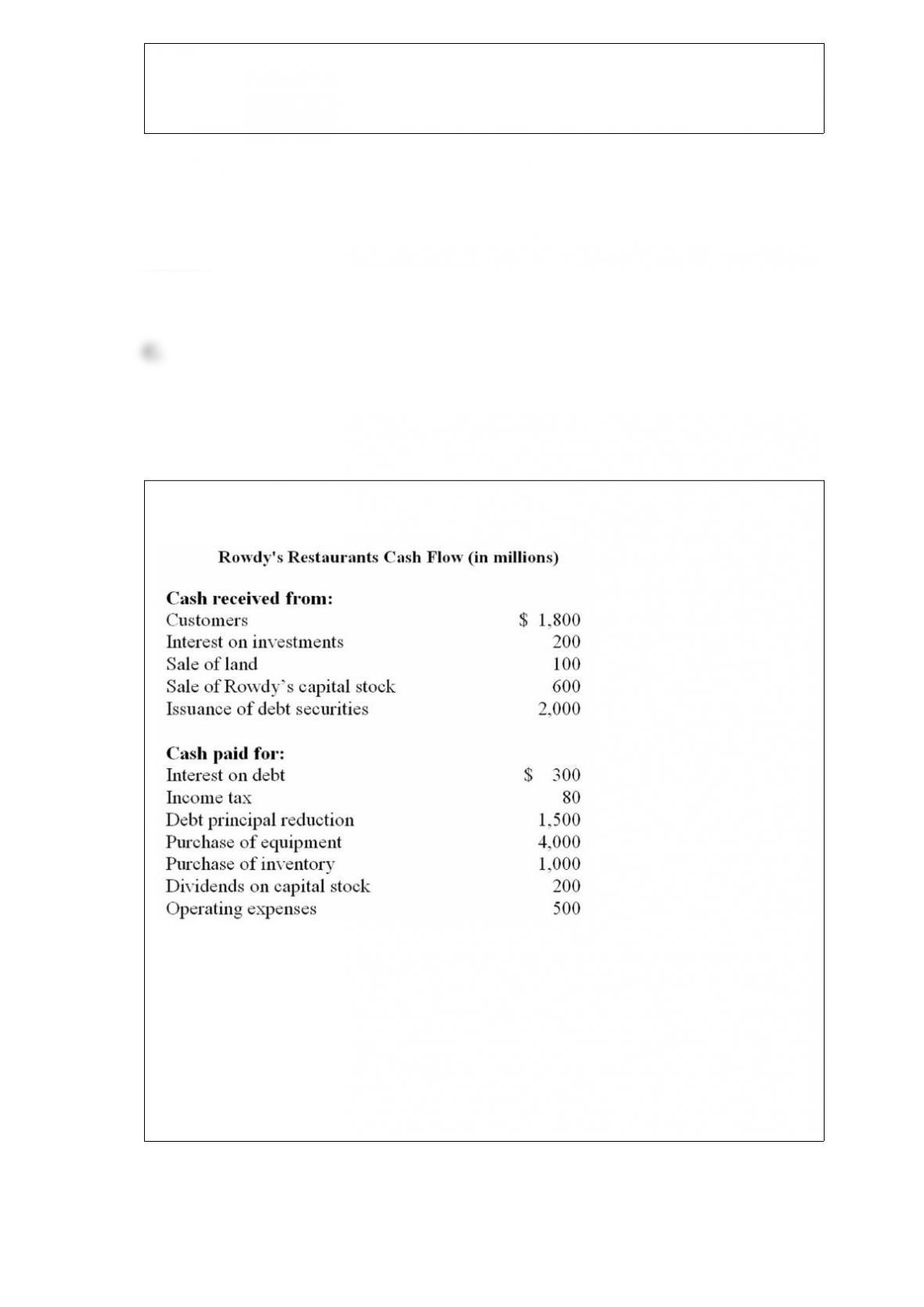
Rowdy’s would report net cash inflows (outflows) from investing activities in the
amount of: A. $(4,000).
B. $100.
C. $(3,900).
D. $(1,900).

Answer:
Which of the following is not a provision of the Public Company Accounting Reform
and Investor Protection Act of 2002? A.Corporate executive accountability.
B.Auditor rotation.
C.Retention of work papers.
D.All of the above are provisions of the Act.
Answer:
Carla Salons leased equipment from SmithCo on July 1, 2013. The present value of the
lease payments discounted at 10% was $80,000. Ten annual lease payments of $12,000
are due at the beginning of each fiscal year beginning July 1, 2013. SmithCo had
constructed the equipment recently for $66,000, and its retail fair value was $100,000.
Its estimated useful life was 16 years. Following the guidance of the new ASU, the total
decrease in earnings (pretax) in Carla’s December 31, 2013 income statement would be:
A. $5,000.
B. $7,400.
C. $8,400.
D. $9,000.

Answer:
On January 1, 2013, an investor paid $291,000 for bonds with a face amount of
$300,000. The stated rate of interest is 8% while the current market rate of interest is
10%. Using the effective interest method, how much interest income is recognized by
the investor in 2013 (assume annual interest payments and amortization)? A. $23,280.
B. $29,100.
C. $24,000.
D. $30,000.
Answer:
At the end of the current year, Newsmax Inc. has $400,000 of subscriptions received in
advance included in its balance sheet. A disclosure note reveals that the entire $400,000
will be earned in the next year. In the absence of other temporary differences, in the
balance sheet one would also expect to find a: A. Noncurrent deferred tax liability.

B. Noncurrent deferred tax asset.
C. Current deferred tax liability.
D. Current deferred tax asset.
Answer:
How do U.S. GAAP and International Financial Reporting Standards (IFRS) differ with
respect to debt and equity for preferred stock?
Answer:
The Burford Corporation provides an executive stock option plan. Under the plan, the
company granted options on January 1, 2013, that permit executives to acquire 12
million of the company’s $1 par value common shares within the next five years, but

not before December 31, 2016 (the vesting date). The exercise price is the market price
of the shares on the date of the grant, $14 per share. The fair value of the options,
estimated by an appropriate model, is $3 per option. No forfeitures are anticipated.
Ignore taxes.
Required:
(1) Determine the total compensation cost pertaining to the options. Show calculations.
(2) Prepare the appropriate journal entry (if any) to record the award of options on
January 1, 2013.
(3) Prepare the appropriate journal entry (if any) to record compensation expense on
December 31, 2013.
Answer:
In order to encourage employee ownership of the company’s $1 par common shares, T
Corp. permits any of its employees to buy shares directly from the company through
payroll deduction. There are no brokerage fees and shares can be purchased at a 15%
discount. During June, employees purchased 150,000 shares at a time when the market
price of the shares on the New York Stock Exchange was $10 per share.
Required:
Prepare the appropriate journal entry to record the June purchases of shares under the
employee share purchase plan.
Answer:
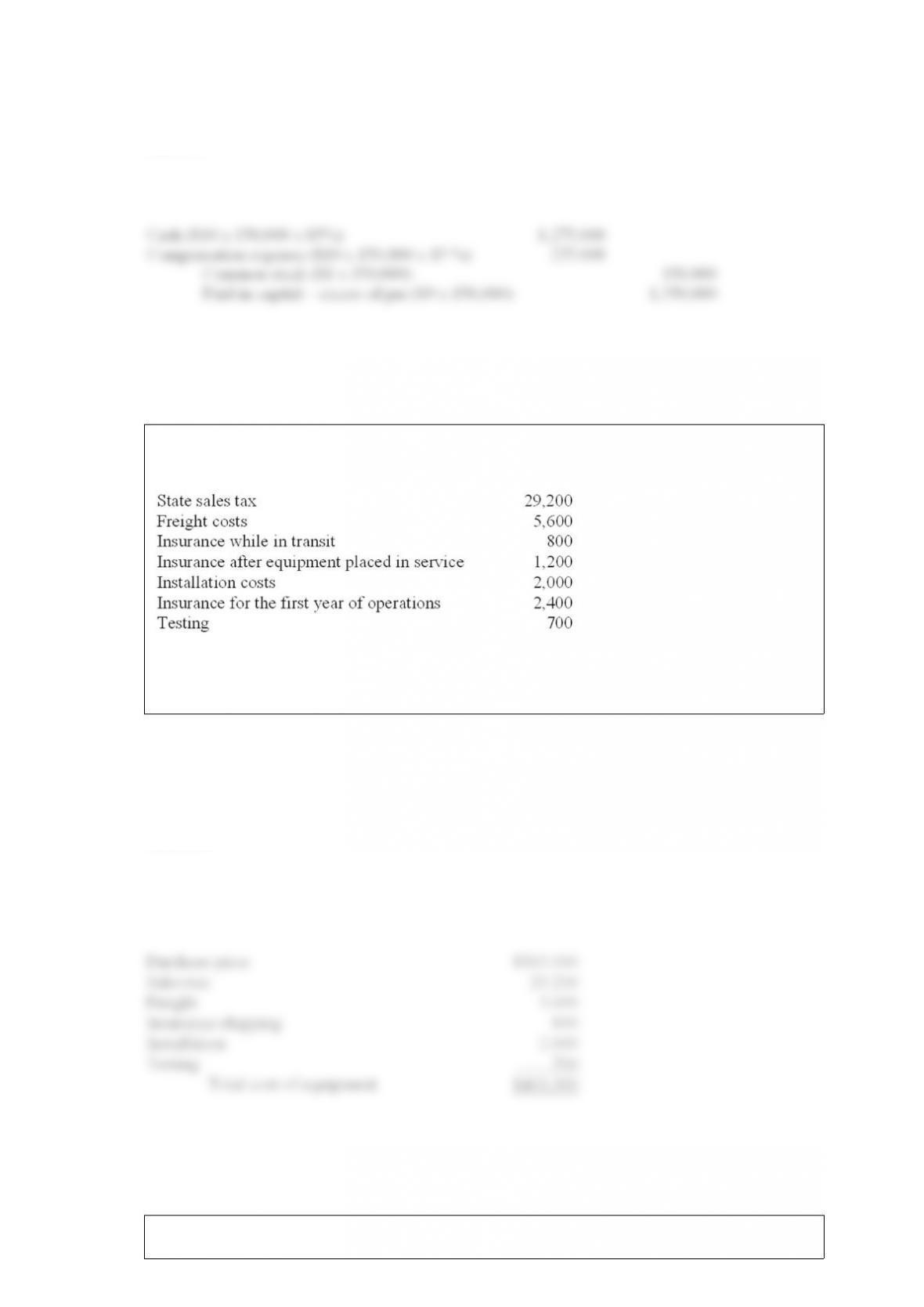
Mad Hatter Enterprises purchased new equipment for $365,000, terms f.o.b. shipping
point. Other costs connected with the purchase were as follows:
Required:
Determine the capitalized cost of the equipment.
Answer:
The following information ($ in millions) comes from a recent annual report of
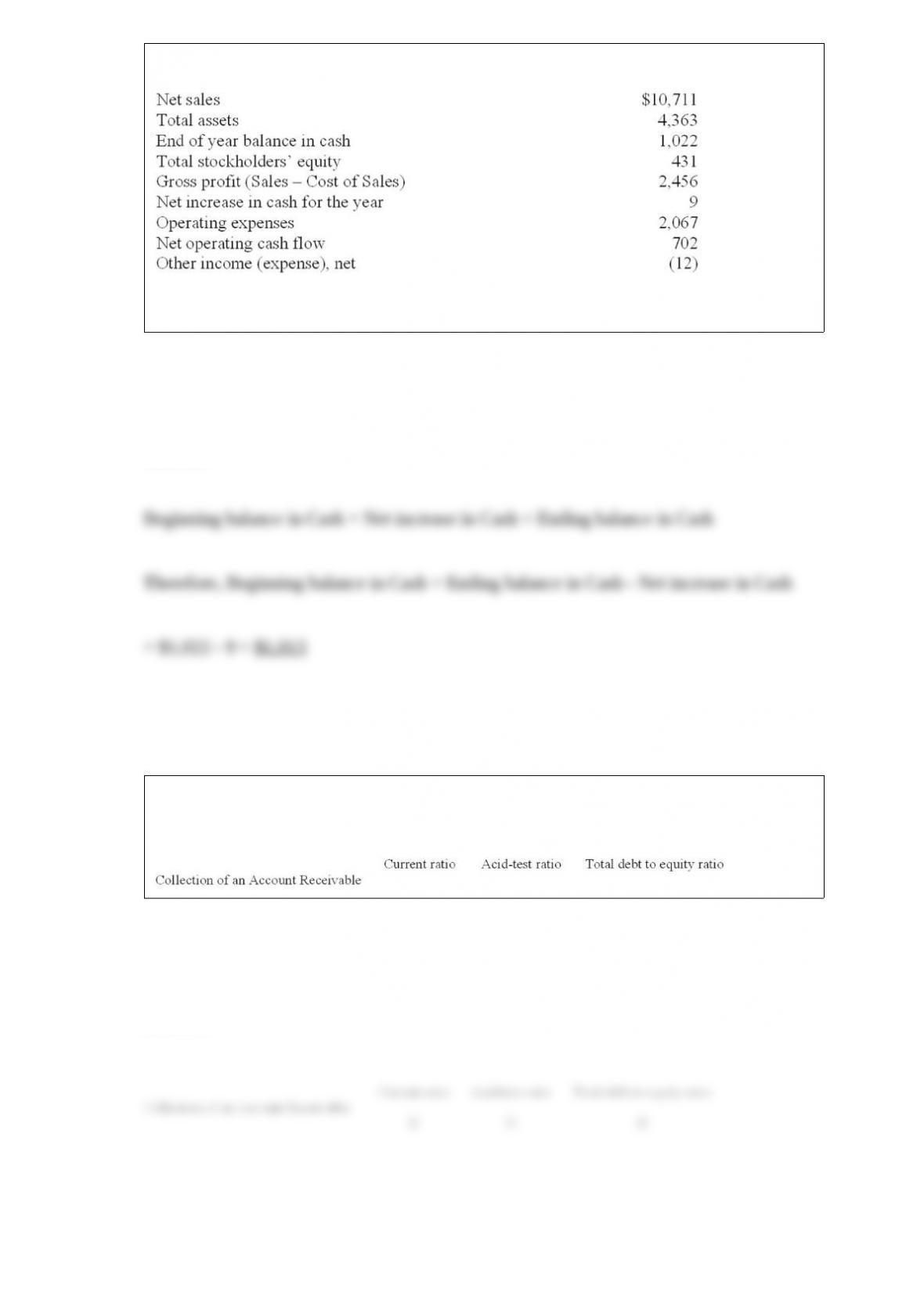
Amazon.com, Inc.:
Compute Amazon’s balance in cash at the beginning of the year.
Answer:
Indicate whether each of the actions listed below will immediately increase (I), decrease
(D), or have no effect (N) on the ratios shown. Assume each ratio is greater than 1.0
before the action is taken.
Answer:

Ellen’s Antiques reported the following in its December 31, 2013, balance sheet:
In a disclosure note, Ellen’s indicates that it uses straight-line depreciation over eight
years and estimates salvage value at 10% of cost.
Required:
Compute the average age of Ellen’s equipment at 12/31/2012.
Answer:
Identify and define the three classifications prescribed by GAAP regarding accounting
for contingencies to identify the range of possibilities for the likelihood of a confirming
event for contingent liabilities. Describe the accounting action to be taken for each
term.
Answer:
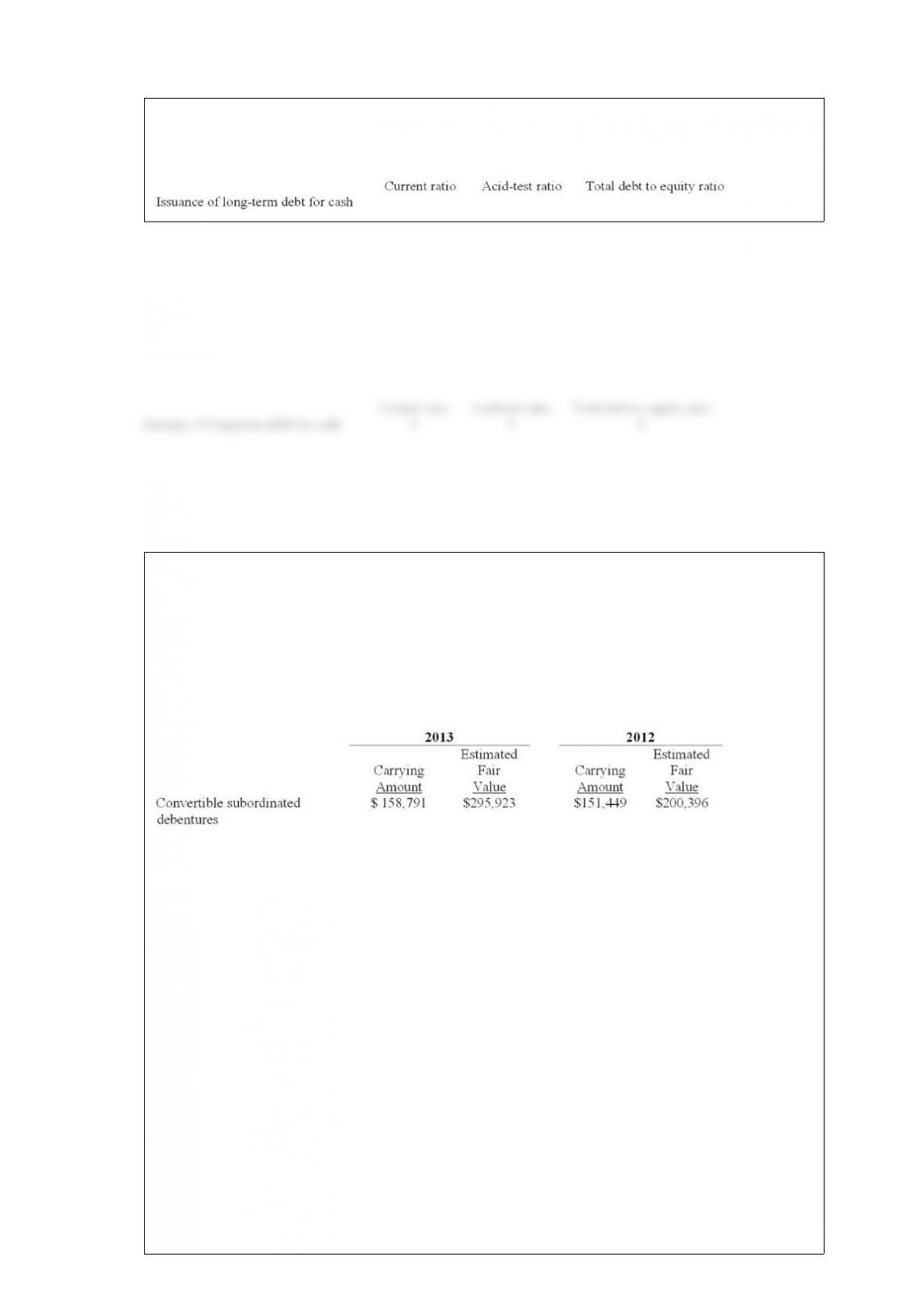
Indicate whether each of the actions listed below will immediately increase (I), decrease
(D), or have no effect (N) on the ratios shown. Assume each ratio is greater than 1.0
before the action is taken.
Answer:
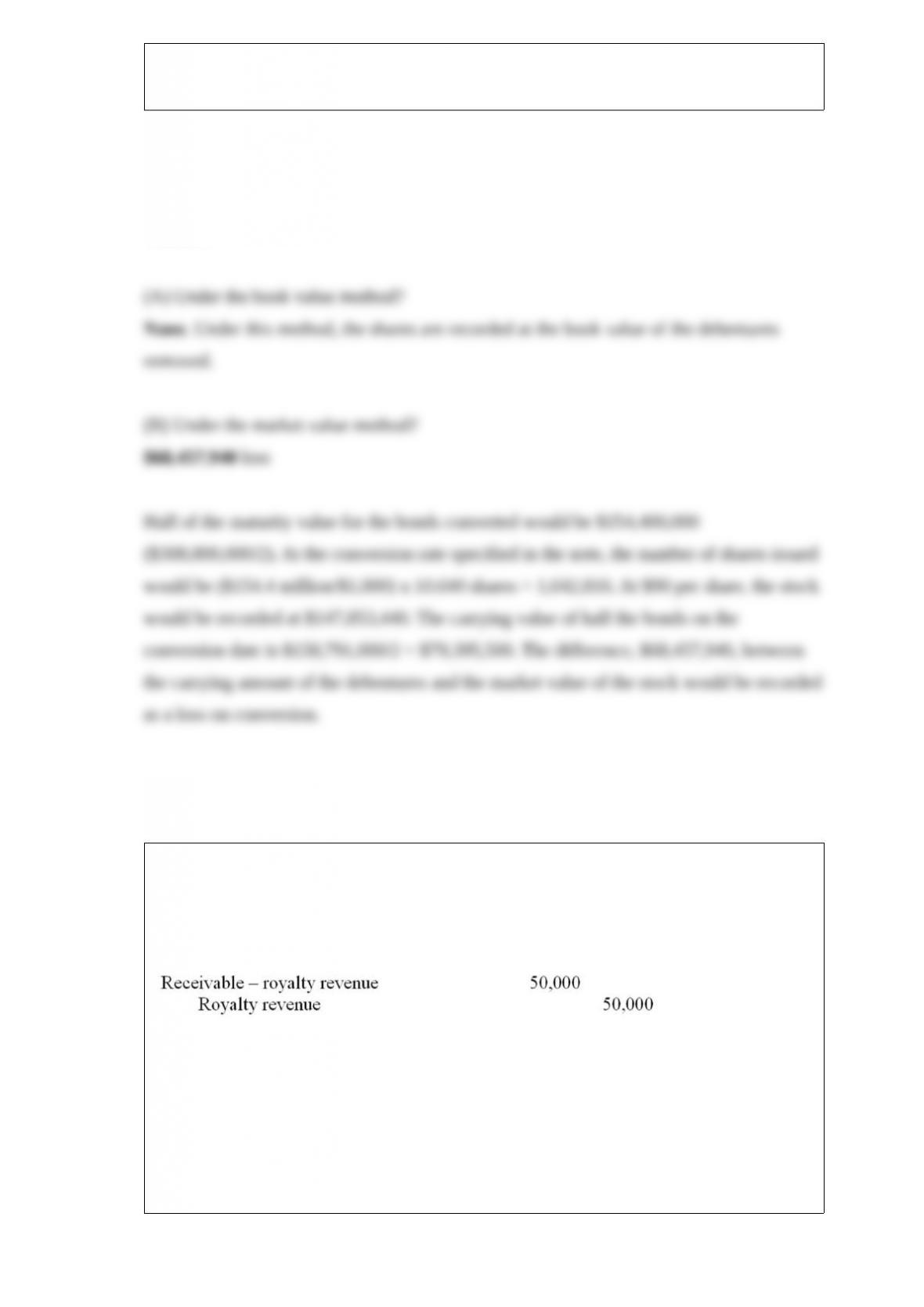
In its 2013 annual report to shareholders, Health Foods, Inc., disclosed the following
information about some of its indebtedness:
The fair value of convertible subordinated debentures is estimated using quoted market
prices. Carrying amounts and estimated fair values of our financial instruments other
than those for which carrying amounts approximate fair values as noted above are as
follows (in thousands)
In addition, the company disclosed the following:
We have outstanding zero coupon convertible subordinated debentures which had a
carrying amount of approximately $158.8 million and $151.4 million at September 26,
2013, and September 28, 2012, respectively. The debentures have an effective yield to
maturity of 5 percent and a principal amount at maturity on March 2, 2027, of
approximately $308.8 million. The debentures are convertible at the option of the
holder, at any time on or prior to maturity, unless previously redeemed or otherwise
purchased. The debentures have a conversion rate of 10.640 shares per $1,000 principal
amount at maturity, representing 3,285,632 shares. The debentures may be redeemed at
the option of the holder on March 2, 2017, or March 2, 2022, at the issue price plus
accrued original discount totaling approximately $188 million and $241 million,
respectively.
Required:
Suppose that half of the bondholders had converted them into Health Foods’ stock at the
end of the 2013 fiscal year when the stock price is $90 per share. What gain or loss
from this conversion would Health Foods have recorded on the transaction using the
book value method? The market value method?
Answer:
Johnson Company receives royalties on a patent it developed several years ago.
Royalties are 5% of net sales, receivable on September 30 for sales from January
through June and receivable on March 31 for sales from July through December. The
patent rights were distributed on July 1, 2012, and Johnson accrued royalty revenue of
$50,000 on December 31, 2012, as follows:
Johnson received royalties of $65,000 on March 31, 2013, and $90,000 on September
30, 2013. The patent user indicated to Johnson that sales subject to royalties for the
second half of 2013 should be $600,000.
Required:
Prepare any journal entries Johnson should record during 2013 related to the royalty
revenue.

Answer:
Below is a list of accounts in no particular order. Assume that all accounts have normal
balances.
Required:
In column A, indicate whether a debit will:
1. Increase the account balance, or
2. Decrease the account balance.
In column B, classify each account according to the following scheme. For contra
accounts, indicate the classification of the account to which it relates.
1. A current asset in the balance sheet.
2. A noncurrent asset in the balance sheet.
3. A current liability in the balance sheet.
4. A long-term liability in the balance sheet.
5. A permanent equity account in the balance sheet.
6. A revenue account in the income statement.
7. An expense account shown in the income statement.

8. Account does not appear in either the balance sheet or the income statement.
Short-term notes payable
Answer:
Assume Gibson Company is an equal partner in a joint venture with Glover Company.
Each company owns 50% of Pesci Company, and equally shares decision-making
authority.
Required:
Describe how U.S. GAAP and IFRS differ in how they would have Gibson account for
this investment.
Answer:
On January 1, 2013, Cool Universe issued 10% bonds dated January 1, 2013, with a
face amount of $20 million. The bonds mature in 2022 (10 years). For bonds of similar

risk and maturity, the market yield is 12%. Interest is paid semiannually on June 30 and
December
Required:
1) Determine the price of the bonds at January 1, 2013.
2) Prepare the journal entry to record the bond issuance by Cool on January 1, 2013.
3) Prepare the journal entry to record interest on June 30, 2013, using the straight-line
method.
4) Prepare the journal entry to record interest on December 31, 2013, using the
straight-line method.
Answer:
The income statement of Starboard Industries includes $12 million for the amortization
of a loss resulting from the company’s actuary changing an estimate used in calculating
the obligation for the pension plan. Does Starboard Industries prepare its financial
statements according to U.S. GAAP or IFRS?

Answer:
What is the justification for a corporation determining income for financial reporting
purposes differently than the way it is determined for tax purposes?
Answer: