Warranty expense is recorded along with the related liability in the reporting period in
which the product under warranty is sold.
When accounting for a capital lease, the lessee records the leased asset at the present
value of the minimum lease payments or the asset’s fair value, whichever is lower.
When available-for-sale securities are sold, the amount of gain or loss realized from the
date of purchase is included in before-tax net income.
Changes in enacted tax rates that do not become effective in the current period affect
deferred tax accounts only after the new rates take effect.

Under IFRS No. 9, debt investments are classified as either “available for sale” or “fair
value through profit and loss (FVTPL).”
Generally speaking, cash flows from operating activities include the elements of net
income reported on a cash basis.
Revenues are inflows or other enhancements of assets or settlements of liabilities from
activities that constitute the entity’s ongoing operations.

Under IFRS No. 9, investments for which the investor lacks significant influence use
basically the same reporting classifications as those used under U.S. GAAP.
The criteria for determining which items comprise cash equivalents often is disclosed in
the summary of significant accounting policies.
Interest payments on debt are classified as cash outflows from financing activities.
Prior service cost is recognized as pension expense over a period of several years.

Once selected for existing assets, a company must consistently use the same method of
depreciation for all subsequent fixed asset acquisitions.
Under IFRS, accounts receivable impairments due to troubled debt restructuring are not
recognized.
The carrying value of zero-coupon bonds increases by the periodic amount of interest
recognized.

Horizontal analysis involves expressing each item in the financial statements as a
percentage of an appropriate total, or base amount, within the same year.
The percentage-of-completion and completed contract methods calculate different
amounts of total profit or loss for a particular contract.
Comprehensive income is another term for net income.
In determining lower of cost or market, market is the expected selling price under
normal operations.

Liquidity refers to the riskiness of a company with regard to the amount of liabilities in
its capital structure.
Under the LIFO retail method, the current period cost-to-retail percentage includes both
net markdowns and net markups.
Unless specific sales criteria are met, the factoring of accounts receivable with recourse
is accounted for as a loan.

The income statement summarizes the operating activity of a firm at a particular point
in time.
In a statement of cash flows prepared under International Financial Reporting
Standards, interest received is most often classified as an operating cash flow.
Stock options will be dilutive and included in the calculation of dilutive EPS if the
exercise price is greater than the average market value of the stock.
Both trading securities and securities available for sale are reported at their fair values.

The initial cost of property, plant, and equipment includes all the identifiable
expenditures necessary to bring the asset to its desired condition and location for use.
A change in reporting entity requires note disclosure in all subsequent financial
statements prepared for the new entity.
The monetary unit assumption requires that items in financial statements be measured
in a particular monetary unit.

Accounting for stock-based compensation is an area in which the FASB has received
little political interference.
Investors should be wary of stock buybacks during down times because the resulting
decrease in shares and increase in earnings per share can be used to mask a slowdown
in earnings growth.
The periodicity assumption requires that present value calculations take into account the
number of compounding periods in each year.
According to International Financial Reporting Standards, all research and development
expenditures are expensed in the period incurred.

The main difference between perpetual and periodic inventory systems is the timing of
the allocation of costs between inventory and cost of goods sold.
If a company’s capital structure includes convertible bonds, diluted EPS might be
reduced even if the bonds are not actually converted during the year.
Popson Inc. incurred a material loss that was not unusual in character but was clearly an
infrequent occurrence. This loss should be reported as: A. An extraordinary loss.
B. A separate line item between income from continuing operations and income from
discontinued operations.
C. A separate line item within income from continuing operations.
D. A separate line item in the retained earnings statement.

Information for Kent Corp. for the year 2013:
Reconciliation of pretax accounting income and taxable income:
Cumulative future taxable amounts all from depreciation temporary differences:
The enacted tax rate was 30% for 2012 and thereafter.
What should be the balance in Kent’s deferred tax liability account as of December 31,
2013? A. $5,200.
B. $7,500.
C. $25,000.
D. None of the above is correct.
The lessee’s option to purchase a leased asset at a price that is sufficiently lower than
the asset’s expected fair value so that the exercise of the option appears reasonably
assured is called a: A. Bargain purchase option.
B. Lessee buy-out option.
C. Lessor sell-out option.

D. Guaranteed purchase option.
Puritan Corp. reported the following pretax accounting income and taxable income for
its first three years of operations:
Puritan’s tax rate is 40% for all years. Puritan elected a loss carryback.
Puritan was certain it would recover the full tax benefit of the NOL. What did it report
on December 31, 2013, as the deferred tax asset for the NOL carryforward? A.
$280,000.
B. $200,000.
C. $100,000.
D. $0.
On September 30, 2013, Bricker Enterprises purchased a machine for $200,000. The
estimated service life is 10 years with a $20,000 residual value. Bricker records
partial-year depreciation based on the number of months in service. Depreciation for
2013, using double-declining balance, would be: A. $40,000.
B. $10,000.

C. $36,000.
D. $9,000.
Revenue should not be recognized until:A.The earnings process is complete and
collection is reasonably assured.
B.Contracts have been signed and payment has been received.
C.Work has been performed and customer has been billed.
D.Collection has been made and warrantees have expired.
When converting an income statement from a cash basis to an accrual basis, which of
the following is incorrect? A. An adjustment for depreciation reduces net income.
B. A decrease in salaries payable decreases net income.
C. A reduction in prepaid expenses decreases net income.
D. An increase in accrued payables decreases net income.

Sox Corporation purchased a 40% interest in Hack Corporation for $1,500,000 on
January 1, 2013. On November 1, 2013, Hack declared and paid $1 million in
dividends. On December 31, Hack reported a net loss of $6 million for the year. What
amount of loss should Sox report on its income statement for 2013 relative to its
investment in Hack? A. $1,100,000.
B. $2,400,000.
C. $1,500,000.
D. $1,600,000.
ABC Company leased equipment to Best Corporation under a lease agreement that
qualifies as a direct financing lease. The cost of the asset is $120,000. The lease
contains a bargain purchase option that is effective at the end of the fifth year. The
expected economic life of the asset is 10 years. The lease term is five years. The asset is
expected to have a residual value of $2,000 at the end of 10 years. Using the
straight-line method, what would Best record as annual depreciation? A. $23,600.
B. $12,200.
C. $12,000.

D. $11,800.
Land was acquired in 2013 for a future building site at a cost of $40,000. The assessed
valuation for tax purposes is $27,000, a qualified appraiser placed its value at $48,000,
and a recent firm offer for the land was for a cash payment of $46,000. The land should
be reported in the financial statements at: A.$40,000.
B.$27,000.
C.$46,000.
D.$48,000.
During 2013, Falwell Inc. had 500,000 shares of common stock and 50,000 shares of
6% cumulative preferred stock outstanding. The preferred stock has a par value of $100
per share. Falwell did not declare or pay any dividends during 2013.
Falwell’s net income for the year ended December 31, 2013, was $2.5 million. The
income tax rate is 40%. Falwell granted 10,000 stock options to its executives on
January 1 of this year. Each option gives its holder the right to buy 20 shares of
common stock at an exercise price of $29 per share. The options vest after one year.
The market price of the common stock averaged $30 per share during 2013.
What is Falwell’s diluted earnings per share for 2013, rounded to the nearest cent? A.

$3.14.
B. $4.90.
C. $4.34.
D. Cannot determine from the given information.
Rick Co. had 30 million shares of $1 par common stock outstanding at January 1, 2013.
In October 2013, Rick Co.’s Board of Directors declared and distributed a 1% common
stock dividend when the market value of its common stock was $60 per share. In
recording this transaction, Rick would: A. Debit retained earnings for $18 million.
B. Credit paid-in capitalexcess of par for $18 million.
C. Credit common stock for $18 million.
D. None of the above is correct.

A company overstated its liability for warranties by $200,000. Its tax rate is 30%. As a
result of this error, income tax expense is: A. Unaffected.
B. Overstated by $60,000.
C. Understated by $60,000.
D. Understated by $140,000.
Bowers Corporation reported the following ($ in 000s) for the year:
Sales on account were $1,900 for the year. How much cash was collected from
customers on account? A. $1,627.
B. $1,642.
C. $1,638.
D. $2,142.

On March 31, 2013, MDS, Inc.’s bondholders exchanged their convertible bonds for
common stock. The carrying amount of these bonds on Ashley’s books was less than the
fair value but greater than the par value of the common stock issued. If Ashley used the
book value method of accounting for the conversion, which of the following statements
correctly states an effect of this conversion?A. Shareholders’ equity is increased.
B. Additional paid-in capital is decreased.
C. Retained earnings is increased.
D. An extraordinary loss is recognized.
C Corp. has a rate of return on assets of 10%. Not including any indirect effects on
earnings, the rate of return on assets is immediately increased when C records:
A. Option a
B. Option b
C. Option c
D. Option d

P Corp. leased an asset to L Corp. using an operating lease in February. P Corp.’s
December 31 statement of cash flows will report: A. A cash outflow from investing
activities.
B. A cash outflow from financing activities.
C. A cash inflow from operating activities.
D. No cash outflow.
The rate of return on shareholders’ equity indicates:A. The margin of safety provided to
creditors.
B. The extent of “trading on the equity” or financial leverage.
C. Profitability without regard to how resources are financed.
D. The effectiveness of employing resources provided by owners.

When using the percentage-of-completion method of accounting for long-term
contracts, the percentage of completion used to recognize gross profit in the first year
usually is determined by measuring: A. Costs incurred in the first year, divided by
estimated remaining costs to complete the project.
B. Costs incurred in first year, divided by estimated total costs of the completed project.
C. Costs incurred in first year, divided by estimated gross profit.
D. None of the other answers is correct.
Listed below are five terms followed by a list of phrases that describe or characterize
each of the terms. Match each phrase with the correct term by placing the number
designating the best term in the space provided by the phrase. 1) Earnings available to
common shareholders
2) Dividend payout ratio
3) Multiple convertible securities
4) Basic EPS
5) Options, rights, and warrants
A. The treasury stock method is used
B. Need to be ranked high to low in terms of dilutive effect
C. No dilution considered.
D. The numerator in the EPS formula
E. Tends to be low for growth companies

Cost of goods sold is: A. An asset account.
B. A revenue account.
C. An expense account.
D. A permanent equity account.
When we take into account the dilutive effect of convertible securities in the calculation
of EPS, the method used is called the:A. Treasury stock method.
B. If converted method.
C. Optional method.
D. Dilution method.
If Ziggy Company concluded that an investment originally classified as held to maturity
would now more appropriately be classified as available for sale, Ziggy would: A. Not

reclassify the investment, as original classifications are irrevocable.
B. Reclassify the investment as available for sale and immediately recognize in net
income any unrealized gain or loss on the reclassification date.
C. Reclassify the investment as available for sale and immediately recognize in
accumulated other comprehensive income any unrealized gain or loss on the
reclassification date.
D. Need to restate earnings, as the original classification was in error.
Sahara Desert Homes (SDH) reports under IFRS and constructed a new subdivision
during 2012 and 2013 under contract with Cactus Development Co. Relevant data are
summarized below:
SDH uses the cost recovery method under IFRS to recognize revenue.
In its December 31, 2012, balance sheet, SDH would report: A. The asset, cost and
profits in excess of billings, of $500,000.
B. The liability, billings in excess of cost, of $300,000.
C. The asset, contract amount in excess of billings, of $1,500,000.
D. The asset, deferred profit, of $400,000.

Puritan Corp. reported the following pretax accounting income and taxable income for
its first three years of operations:
Puritan’s tax rate is 40% for all years.
Assuming that Puritan elected a loss carryback, what would be the net loss in 2013
reported in Puritan’s income statement? A. $360,000.
B. $240,000.
C. $460,000.
D. $500,000.
Wilson Company had the following cash balance items listed in its trial balance at
12/31/2013:
If Wilson reports under IFRS, its 12/31/2013 balance sheet would show what cash
balance? A. ($5,000).
B. $55,000.
C. $60,000.
D. None of the above.

Bridges Inc. holds a debt investment from RiteCo and had viewed that investment as
adversely affected by particular events in the market for RiteCo’s products, but without
specific information about deterioration of RiteCo’s credit quality. However, Bridges
just learned that RiteCo is entering bankruptcy. As a result of receiving this information,
what is Bridges likely to do with the RiteCo investment? A. Transfer it from Bucket 1 to
Bucket 2.
B. Transfer it from Bucket 2 to Bucket 3.
C. Transfer it from Bucket 3 to Bucket 2.
D. Transfer it from Bucket 2 to Bucket 1.
Which of the following would not be a cash inflow from financing activities? A. Cash
from issuing common stock.
B. Cash from issuing bonds.
C. Cash from issuing preferred stock.
D. Cash from the sale of stock of a supplier.

When an impairment of an equity investment that is classified as available for sale
occurs for a reason that is judged to be “other than temporary,” the investment is written
down to its fair value and the amount of the write-down is: A. Recorded as a deferred
credit.
B. Included in income.
C. Recorded as deferred asset.
D. Treated as unrealized.
What is the effect of bad debts on revenue recognition under the proposed ASU? A. Bad
debts are recognized as an extraordinary item.
B. Bad debts must be estimable in order to recognize revenue.
C. Bad debts are deducted from revenue to calculate net revenue on the income
statement, similar to sales returns.
D. Bad debts are an expense.

The balance sheet reports: A. Net income at a point in time.
B. Cash flows for a period of time.
C. Assets and equities at a point in time.
D. Assets and liabilities for a period of time.
The attribution approach required by GAAP for postretirement health care plans is to
assign: A. An equal fraction of the EPBO to each year the employee is on the company
payroll.
B. An equal fraction of the APBO to each year the employee is on the company payroll.
C. An equal fraction of the APBO to each year of service from the employee’s hire date
to the employee’s full eligibility date.
D. An equal fraction of the EPBO to each year of service from the employee’s hire date
to the employee’s full eligibility date.
On December 31, 2012, Reagan Inc. signed a lease for some equipment having a
eight-year useful life with Silver Leasing Co. The lease payments are made by Reagan
annually, beginning at signing date. Title does not transfer to the lessee, so the
equipment will be returned to the lessor on December 31, 2018. There is no bargain
purchase option, and Reagan guarantees a residual value to the lessor on termination of
the lease.
Reagan’s lease amortization schedule appears below:
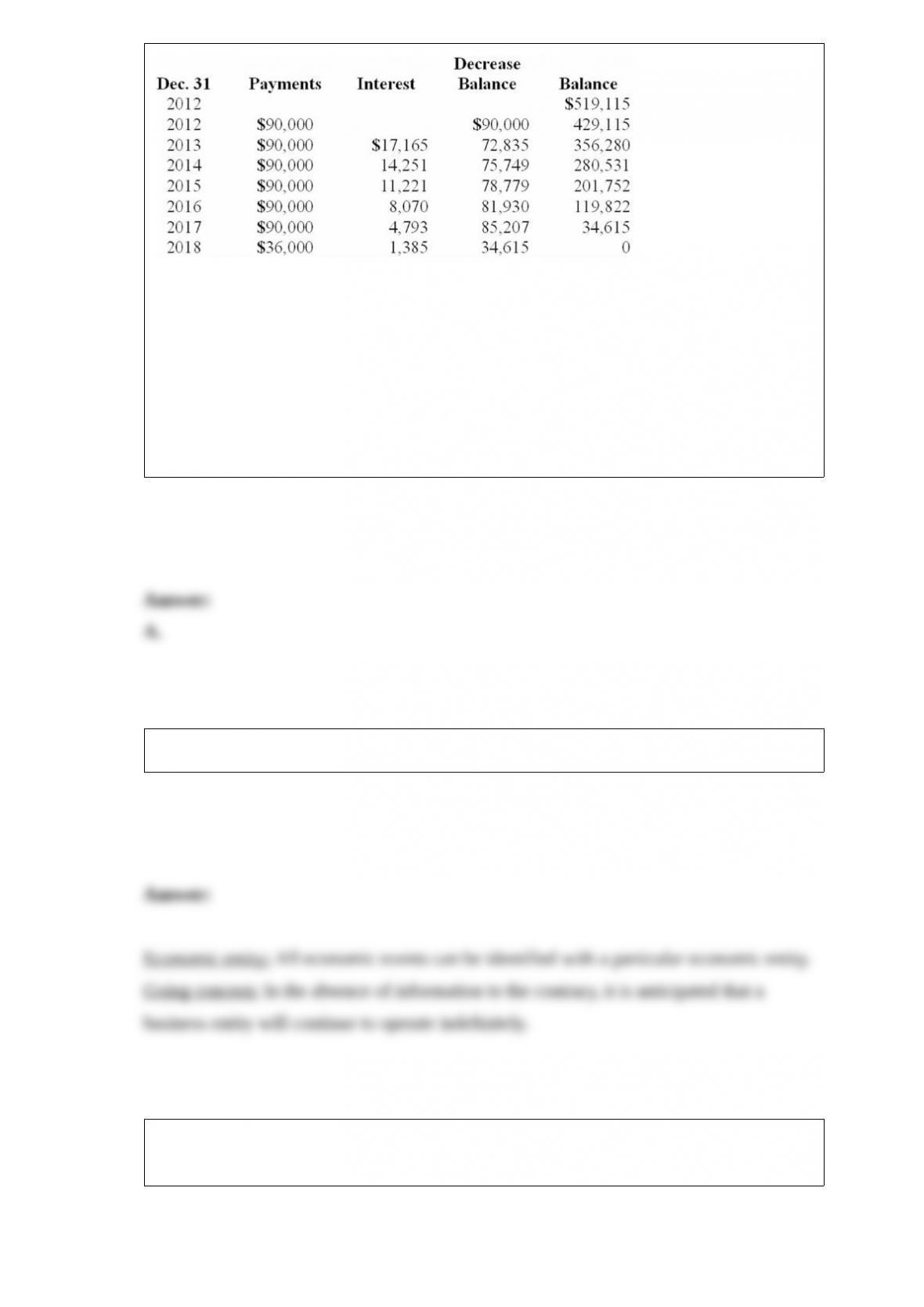
At what amount would Reagan record the leased asset at inception of the agreement? A.
$519,115.
B. $429,115.
C. $540,000.
D. $576,000.
Identify or define the following terms: economic entity, going concern.
DeAngelo Yards, Inc., calculated pension expense for its underfunded pension plan as
follows:
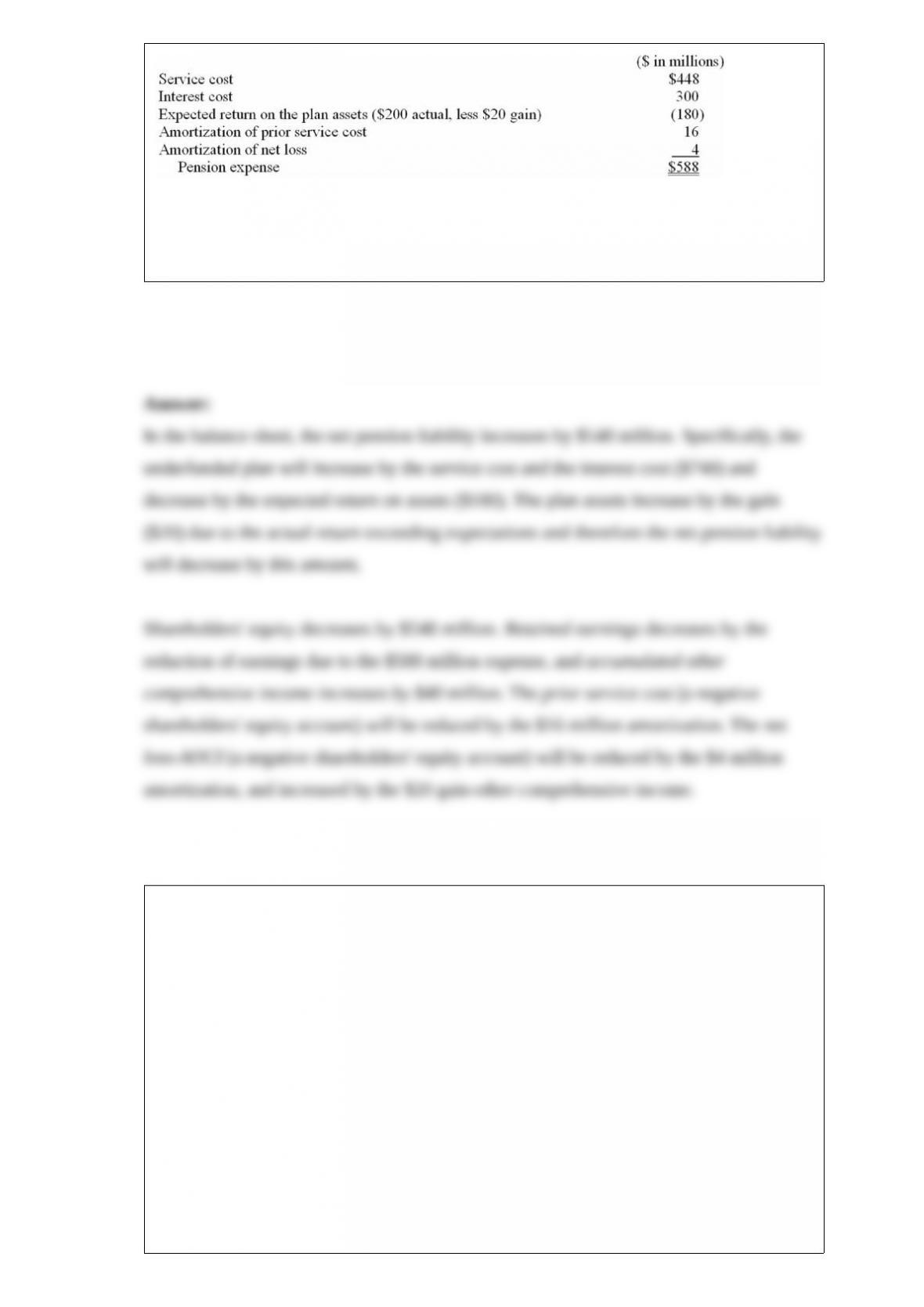
Required:
Which elements of DeAngelo’s balance sheet are affected by the components of pension
expense? What are the specific changes in these accounts?
On June 30, 2013, Blue, Inc., leased a machine from Big Leasing Corporation. The
lease agreement qualifies as a capital lease and calls for Blue to make semiannual lease
payments of $281,454 over a three-year lease term, payable each June 30 and
December 31, with the first payment at June 30, 2013. Blue’s incremental borrowing
rate is 10%, the same rate Big uses to calculate lease payment amounts. Depreciation is
recorded on a straight-line basis at the end of each fiscal year.
Required:
1) Determine the present value of the lease payments at June 30, 2013, (to the nearest
$000) that Blue uses to record the leased asset and lease liability.
2) What would be the pretax amounts related to the lease that Blue would report in its
balance sheet at December 31, 2013?
3) What would be the pretax amounts related to the lease that Blue would report in its
income statement for the year ended December 31, 2013?
How do U.S. GAAP and International Financial Reporting Standards (IFRS) differ with
respect to classifying a lease as a capital lease?
Branch Industries changes from declining balance depreciation to straight-line
depreciation for existing assets. Describe in detail the way Branch would account for
the change and include reasons for the accounting.
According to GAAP, companies can elect the fair value option when accounting for
many investments.
Required:
Describe how accounting for a held-to-maturity investment, an available-for-sale
investment, and an equity-method investment is affected by a company electing the fair
value option.
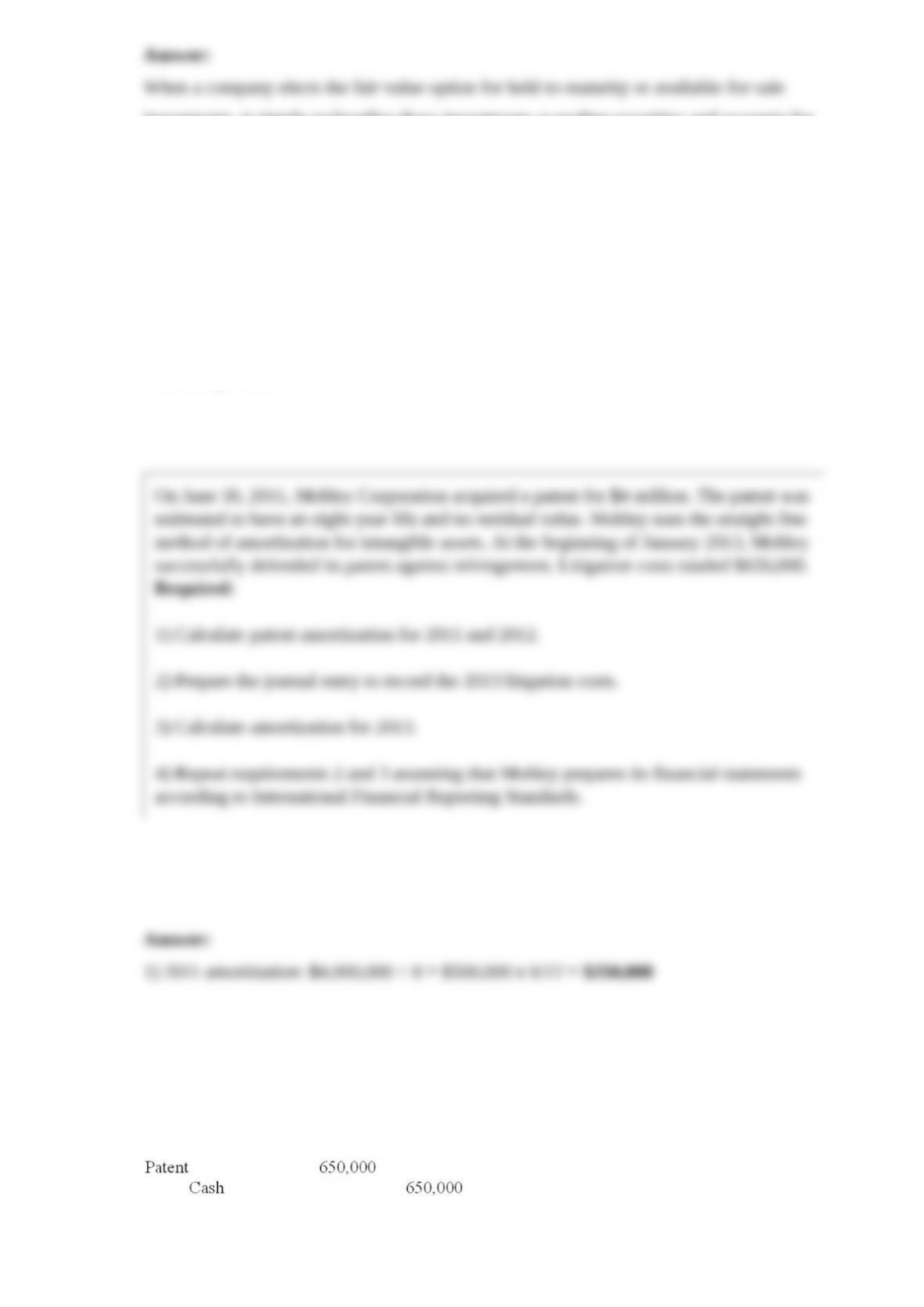
On June 30, 2011, Mobley Corporation acquired a patent for $4 million. The patent was
estimated to have an eight-year life and no residual value. Mobley uses the straight-line
method of amortization for intangible assets. At the beginning of January 2013, Mobley
successfully defended its patent against infringement. Litigation costs totaled $650,000.
Required:
1) Calculate patent amortization for 2011 and 2012.
2) Prepare the journal entry to record the 2013 litigation costs.
3) Calculate amortization for 2013.
4) Repeat requirements 2 and 3 assuming that Mobley prepares its financial statements
according to International Financial Reporting Standards.
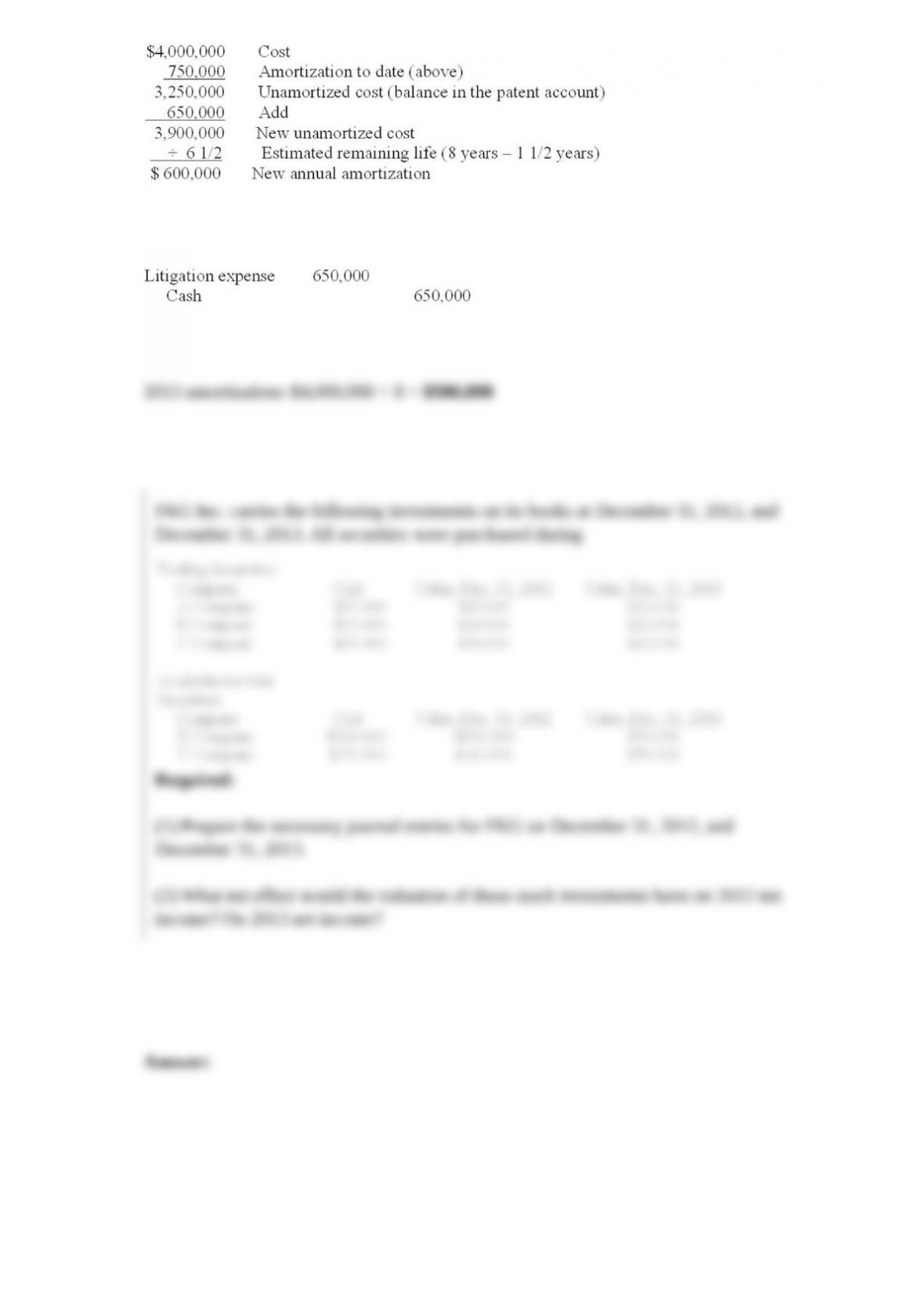
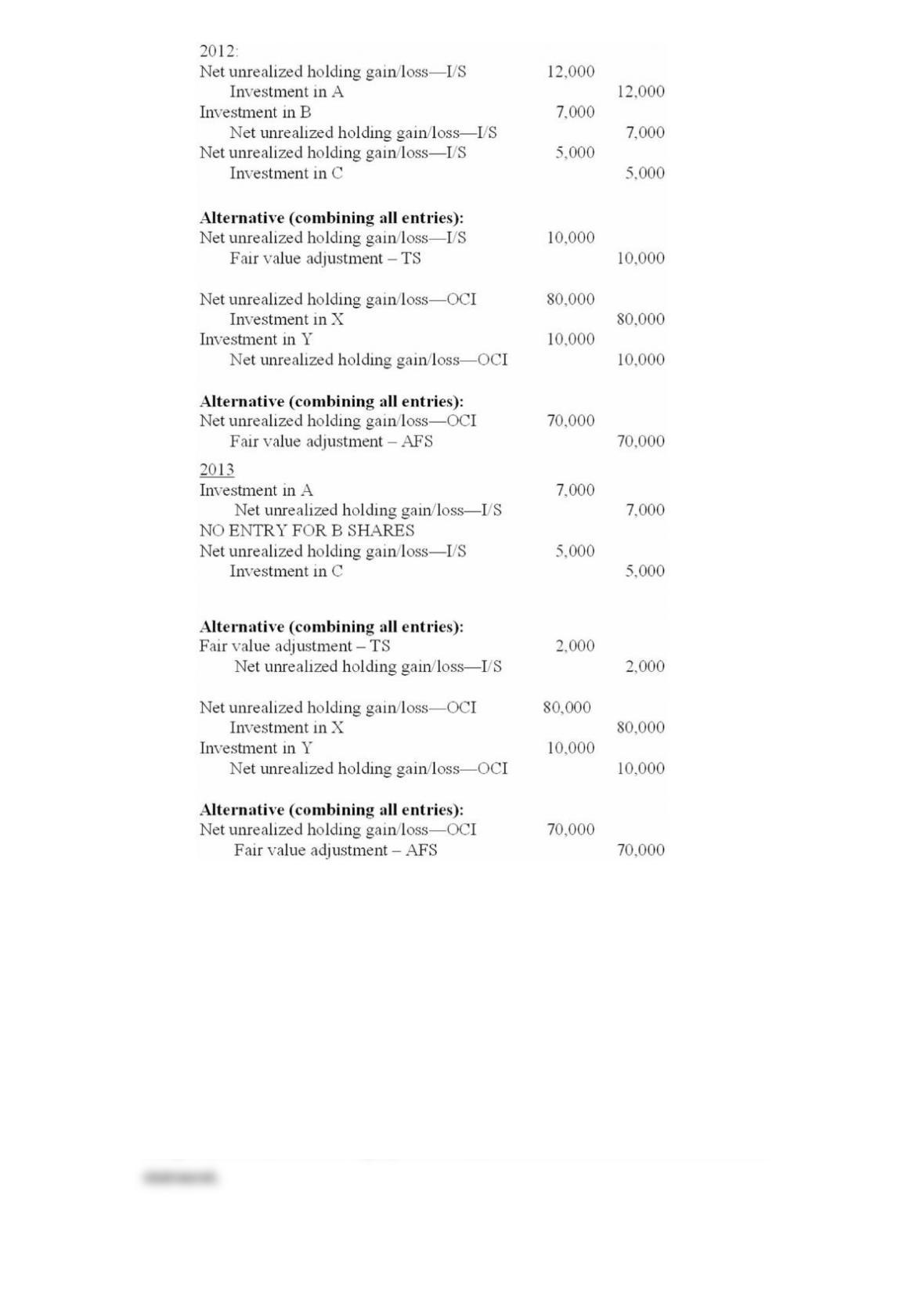
FKG Inc. carries the following investments on its books at December 31, 2012, and
December 31, 2013. All securities were purchased during
Required:
(1) Prepare the necessary journal entries for FKG on December 31, 2012, and
December 31, 2013.
(2) What net effect would the valuation of these stock investments have on 2012 net
income? On 2013 net income?
B Co. reported a deferred tax liability of $24 million for the year ended December 31,
2012, related to a temporary difference of $60 million. The tax rate was 40%. The
temporary difference is expected to reverse in 2014 at which time the deferred tax
liability will become payable. There are no other temporary differences in 2012-2014.
Assume a new tax law is enacted in 2013 that causes the tax rate to change from 40% to
30% beginning in 2014. (The rate remains 40% for 2013 taxes.) Taxable income in
2013 is $90 million.
Required:
Determine the effect of the change and prepare the appropriate journal entry to record
B’s income tax expense in 2013. What adjustment, if any, is needed to revise retained
earnings as a result of the change?
Iowa Development (ID) made the following land sales and had the following cash
collections:
Assume ID can estimate uncollectible accounts accurately, accrues bad debts at 5% of
sales, and recognizes revenue upon transfer of title.
Required: Prepare journal entries to record the sale, cash collections, and recognition
of gross profit (if appropriate) in 2012 and
On January 1, 2012, Slug Corporation issued $6 million of 8%, 10-year convertible
bonds at 102. The bonds pay interest on June 30 and December 31. Each $1,000 bond is
convertible into 40 shares of $1 par common stock. Fuzz Company purchased 20% of
the issue as an investment. On July 1, 2016, Fuzz converted all of its bonds into
common stock of Slug. The market price per share for Slug was $32 at the time of the
conversion. Both companies use the straight-line method for amortization.
Required:
1) Prepare journal entries for the issuance of the bonds on the issuer and the investor
books.
2) Prepare the journal entries for the conversion on the books of the issuer and the
investor.
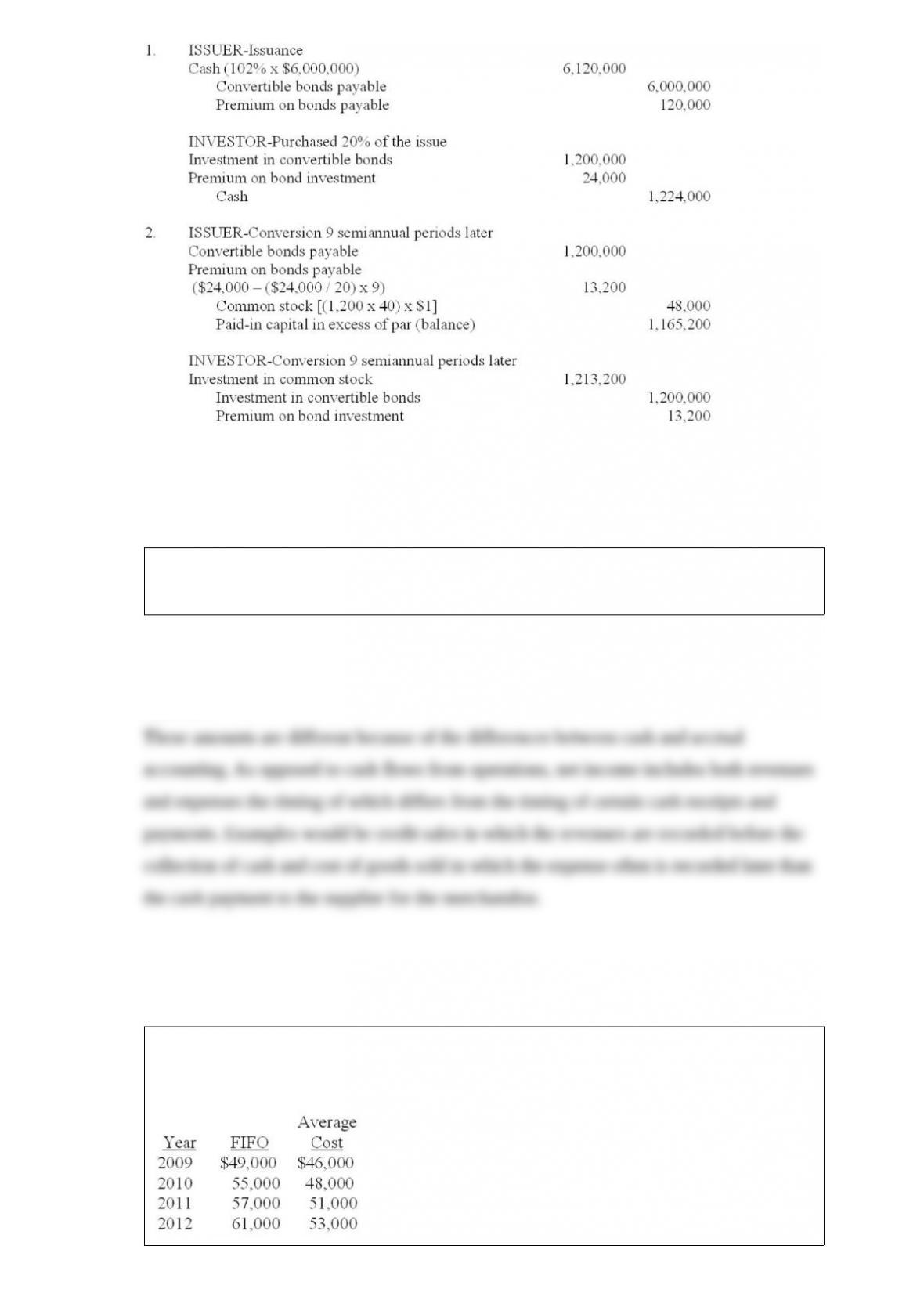
Ramsgate Company has used the FIFO method for inventory valuation since it began
business in 2009, but has elected to change to the average cost method starting in 2012.
Year-end inventory valuations under each method are shown below:

Required:
How, and when, would Ramsgate reflect the change in accounting principle in its
financial statements (ignore income taxes)?
Some preferred stock is cumulative while other preferred stock is noncumulative. What
does this mean?
The Santiago Corporation provides an executive stock option plan. Under the plan, the
company granted options on January 1, 2013, that permit executives to acquire 70
million of the company’s $1 par value common shares within the next eight years, but
not before December 31, 2016 (the vesting date). The exercise price is the market price
of the shares on the date of the grant, $27 per share. The fair value of the options,
estimated by an appropriate option pricing model, is $4 per option. No forfeitures are
anticipated. Ignore taxes.
Required:
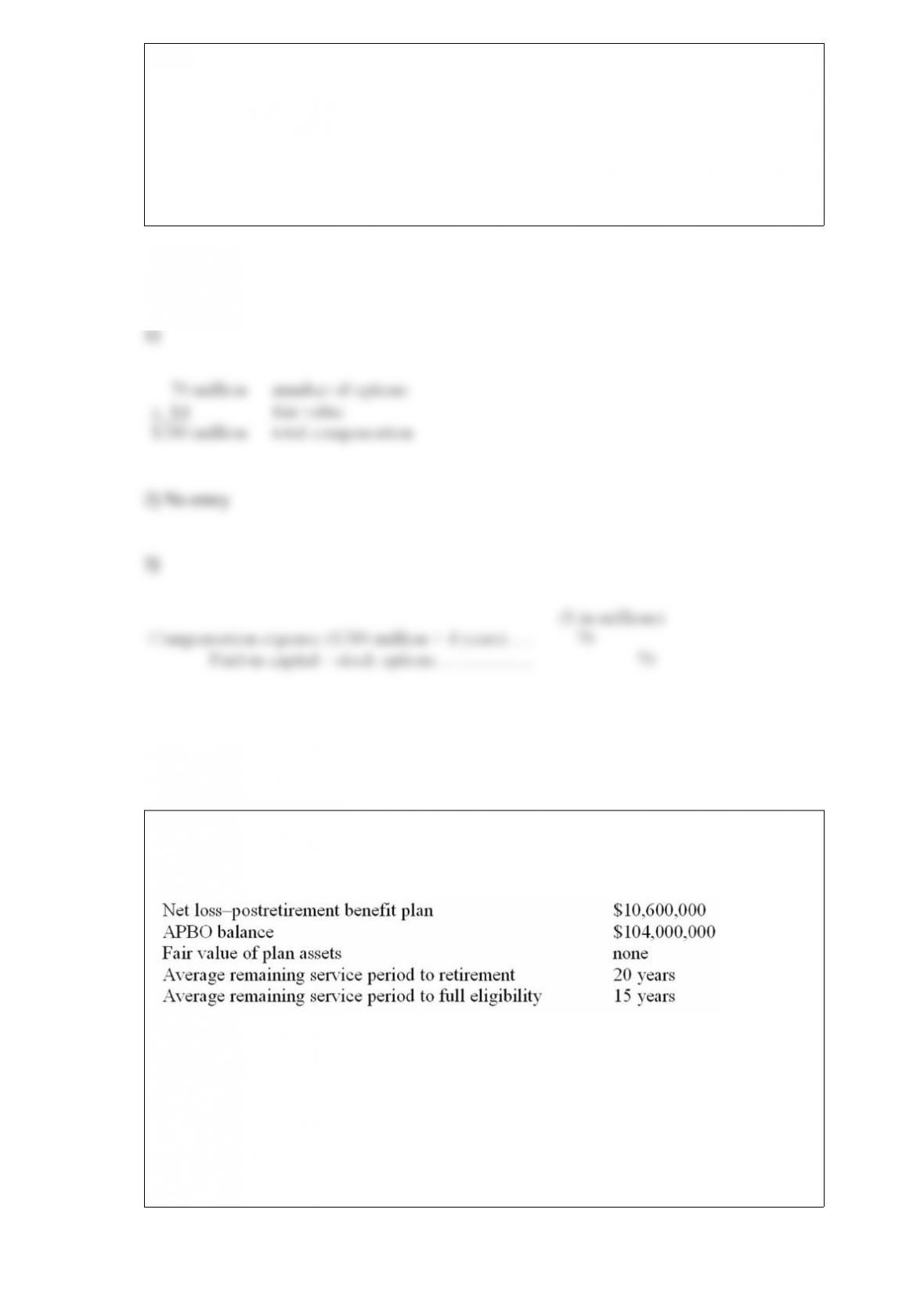
1) Determine the total compensation cost pertaining to the options.
2) Prepare the appropriate journal entry (if any) to record the award of options on
January 1, 2013.
3) Prepare the appropriate journal entry (if any) to record compensation expense on
December 31, 2013.
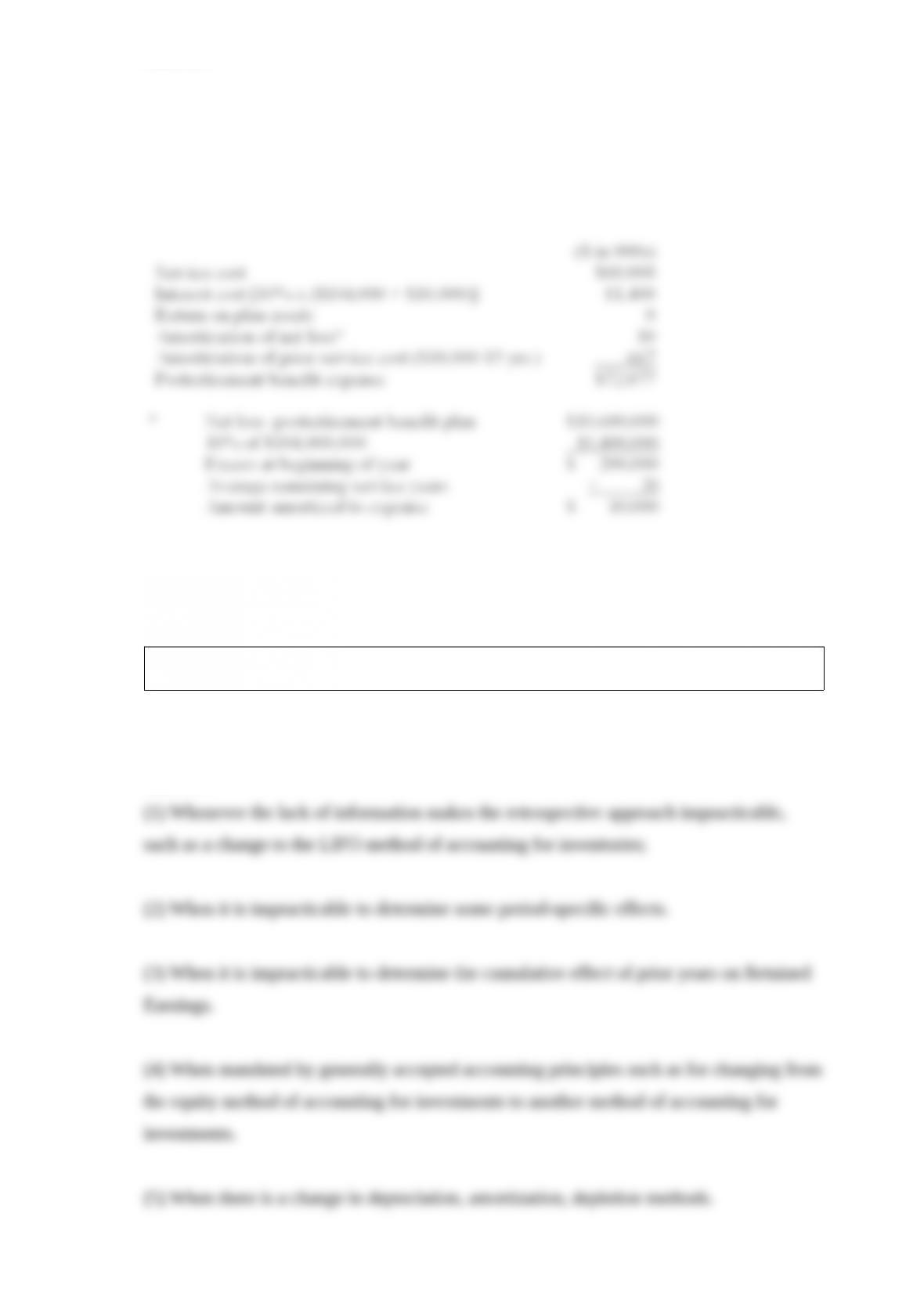
Oberon Company provides postretirement health care benefits to employees who
provide at least 10 years of service and reach the age of 65 while in service. On January
1 of the current year, the following plan-related data were available.
On January 1 of the current year, Oberon amended the plan to provide dental benefits.
The actuary determines that the cost of making the amendment increases the APBO by
$10,000,000. Management chooses to amortize this amount on a straight-line basis. The
service cost is $60,000,000. The appropriate interest rate is 10%.
Required:
Calculate the postretirement benefit expense for the current year.
What are the changes in accounting principle that require the prospective approach?
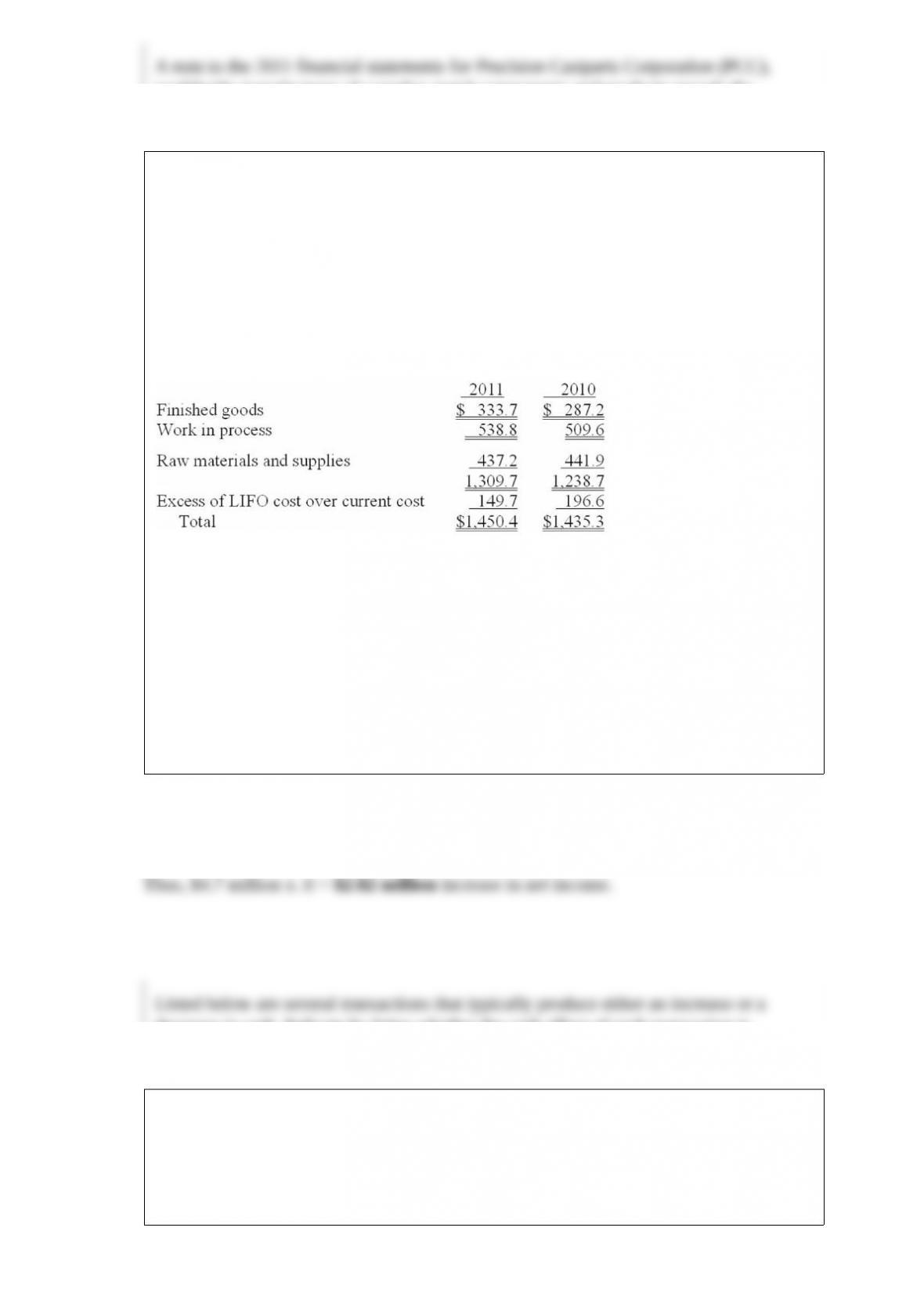
A note to the 2011 financial statements for Precision Castparts Corporation (PCC),
worldwide manufacturer of complex metal components and products reveals the
following:
“All inventories are stated at the lower of cost or current market values. Cost for
inventories at the majority of our operations is determined on a last-in, first-out
(“LIFO”) basis.”
Inventories consisted of the following ($ in millions):
“During fiscal 2011 and 2010, certain LIFO inventory quantities were reduced. The
reductions resulted in a liquidation of LIFO inventory quantities carried at costs paid in
prior years, which had the effect of increasing cost of goods sold by approximately $0.1
million in fiscal 2011 and decreasing cost of goods sold by $4.7 million in fiscal 2010
as compared with the cost of purchases in fiscal 2011 and 2010, respectively.”
Required:
The disclosure note indicates an inventory liquidation during 2010 and By how much
did net income in 2010 increase due to the liquidation? Assume an income tax of 40%.
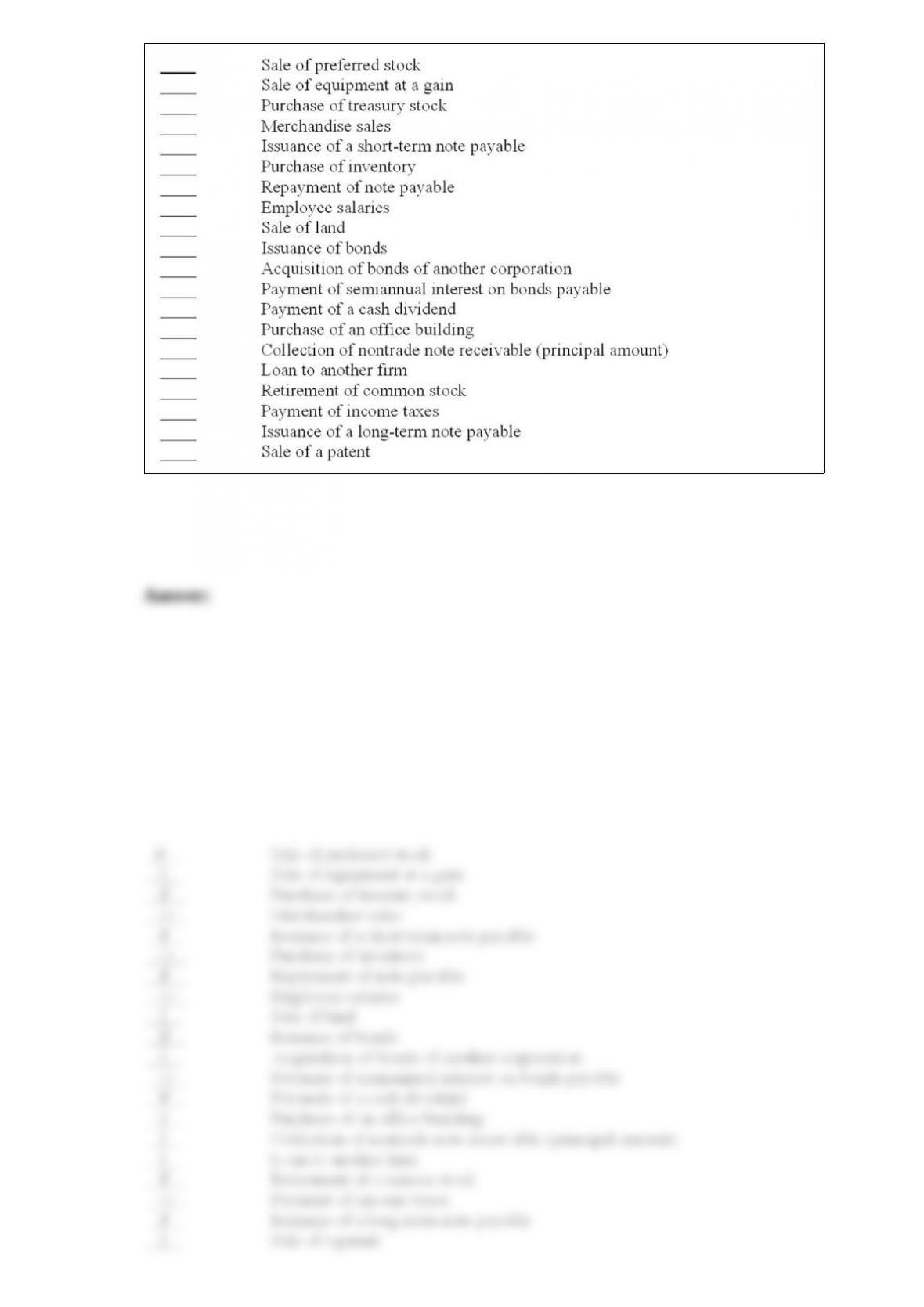
Listed below are several transactions that typically produce either an increase or a
decrease in cash. Indicate by letter whether the cash effect of each transaction is
reported on a statement of cash flows as an operating (O), investing (I), or financing (F)
activity.
Transactions