Toys “R” Us had cost of goods sold of $8,321 million and its ending inventory was
$2,027 million. Therefore its days’ sales in inventory equals 89 days.
Comparative financial statements are reports that show financial amounts placed side
by side in columns on a single statement for analysis purposes.
A company received dividends of $0.35 per share on 300 shares of stock. The journal
entry to record this transaction would be to debit Cash for $105 and credit Dividend
Revenue for $105.
Equity securities reflect a creditor relationship such as investments in notes, bonds, and
certificates of deposit.
The periodic inventory system uses a temporary account called Purchases.
Underapplied overhead is the amount by which overhead applied to jobs using the
predetermined overhead allocation rate exceeds the overhead incurred during a period.
A debit entry is always favorable.
When convertible bonds are converted to a company’s stock, the carrying value of the
bonds is transferred to equity accounts and no gain or loss is recorded.
Accounting procedures for all items are the same for both C corporations and S
corporations in all aspects.
An out-of-pocket cost benefits a business, but is paid by an outside party.
The last step in the four-step accounting procedure for process costing is the calculation
of equivalent units of production.
The purchase of treasury stock usually restricts the amount of retained earnings
available for cash dividends.
Capital intensive companies have a relatively large amount invested in assets to
generate a given level of sales.
Accrued revenues at the end of one accounting period are expected to result in cash
payments in a future period.
Reebok’s net income of $117 million and average assets of $1,400 million results in a
return on assets of 8.36%.
Process cost accounting systems consider direct costs to include those costs that can be
readily identified with a particular process.
The current ratio is calculated as current liabilities divided by current assets.
When an equity security is sold, the sale proceeds are compared with the cost, and if the
cost is greater than the proceeds, a gain on the sale of the security is recorded.
Direct costs are incurred for the benefit of more than one cost object.
Purchasing treasury stock reduces the corporation’s assets and stockholders’ equity by
equal amounts.
Most managers stress the importance of understanding and predicting cash flows for
business decisions.
The reliability of the gross profit method depends on a good estimate of the gross profit
ratio.
Degree of operating leverage (DOL) is defined as total contribution margin in dollars
divided by pretax income.
The sales budget is derived from the production budget.
A preemptive right means that a shareholder has the right to sell his/her shares back to
the corporation.
The high-low method is used to derive an estimated line of cost behavior by graphically
connecting the two cost amounts identified with the highest and lowest volume levels.
Revenue expenditures are additional costs of plant assets that materially increase the
assets’ life or productive capabilities.
The Sarbanes-Oxley Act (SOX) does not require public companies to apply both
accounting oversight and stringent internal controls.
If the exchange rate for Canadian and U.S. dollars is 0.7382 to 1, this implies that 2
Canadian dollars will buy 1.48 worth of U.S. dollars.
On January 1, a company issued a $500,000, 10%, 8-year bond payable, and received
proceeds of $487,000. Interest is payable each June 30 and December 31. The company
uses the straight-line method to amortize the discount. The amount of discount
amortized each period is $812.50.
On May 15, Briar Company purchased 10,000 shares of Broder Corp. for $80,000.
These securities are considered available-for-sale. On September 30, the stock had a
market value of $85,000. The $5,000 difference must be reported on the income
statement as a $5,000 gain.

Financial accounting relies on accepted principles that are enforced through an
extensive set of rules and guidelines; on the other hand, managerial accounting systems
are flexible.
Inventory shrinkage:
A.Refers to the loss of inventory.
B.Is determined by comparing a physical count of inventory with recorded inventory
amounts.
C.Is recognized by debiting Cost of Goods Sold.
D.Can be caused by theft or deterioration.
E.All of these.
Which of the following is the formula used to calculate the debt ratio?
A.Total Equity/Total Liabilities.
B.Total Liabilities/Total Equity.
C.Total Liabilities/Total Assets.
D.Total Assets/Total Liabilities.

E.Total Equity/Total Assets.
The two basic types of cost accounting systems are:
A.Job order costing and perpetual costing.
B.Job order costing and customized product costing.
C.Job order costing and customized service costing.
D.None of the above
E.All of the above
A system of assigning costs to departments and products on the basis of a variety of
activities instead of only one allocation base is called:
A.A responsibility accounting system.
B.A cost center accounting system.
C.Controllable costing.
D.Activity-based costing.
E.Performance costing.
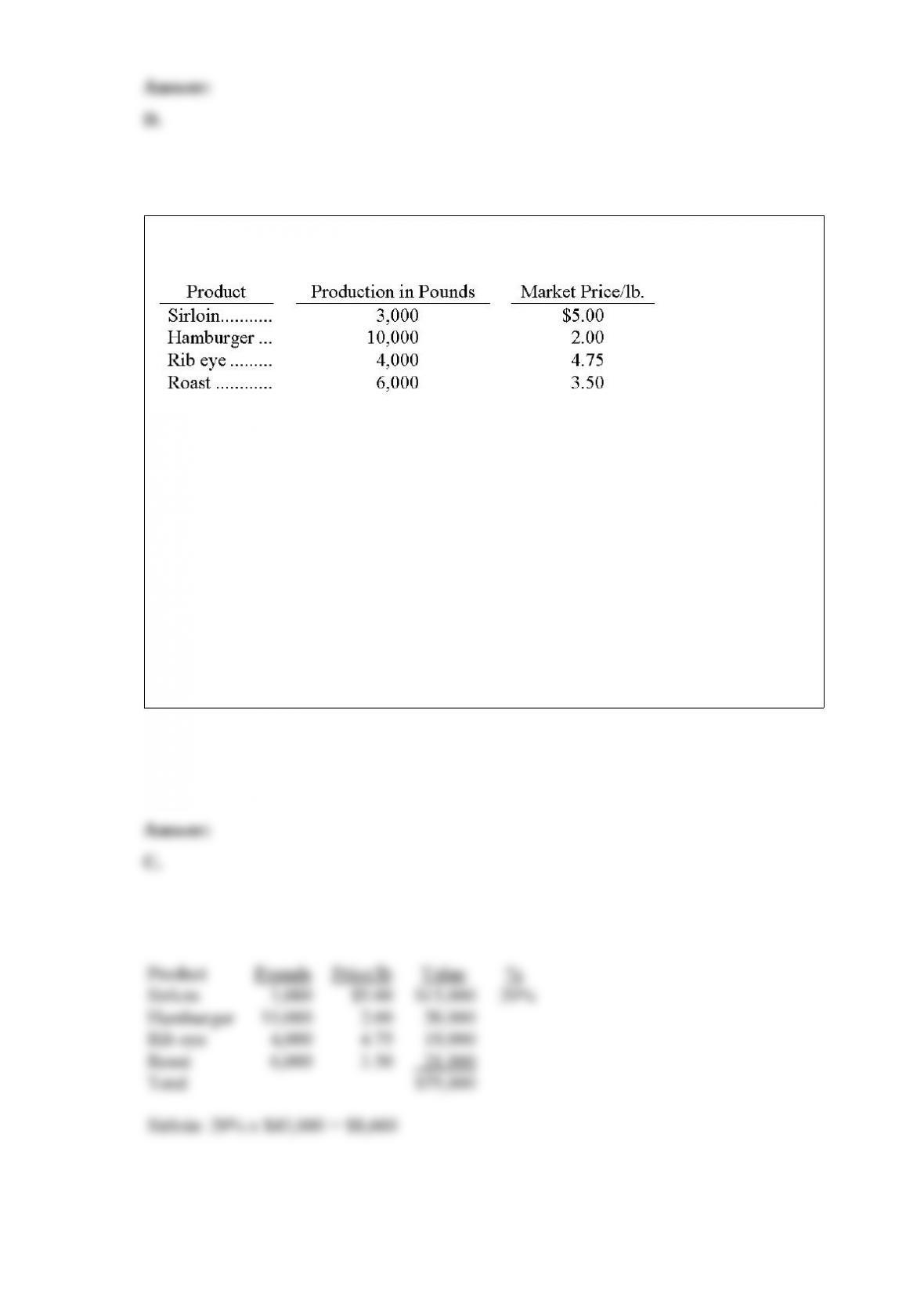
Breon Beef Company uses the relative market value method of allocating joint costs in
its production of beef products. Relevant information for the current period follows:
The total joint cost for the current period was $43,000. How much of this cost should
Breon Beef allocate to sirloin?
A.$ 0.
B.$ 5,909.
C.$ 8,600.
D.$10,750.
E.$43,000.

The building blocks of financial statement analysis include:
A.Liquidity and efficiency.
B.Solvency.
C.Profitability.
D.Market prospects.
E.All of these.
Regardless of the system used in departmental cost analysis:
A.Direct costs are allocated, indirect costs are not.
B.Indirect costs are allocated, direct costs are not.
C.Both direct and indirect costs are allocated.
D.Neither direct nor indirect costs are allocated.
E.Total departmental costs will always be the same.
Describe what happens to the net income of a company under each of the following
assumptions: (a) Sales volume is less than break-even sales. (b) Sales volume is greater
than break-even sales. (c) Sales volume is equal to the break-even point.
The amount of income earned per share of a company’s common stock is known as:
A.Restricted retained earnings per share.
B.Earnings per share.
C.Continuing operations per share.
D.Dividends per share.
E.Book value per share.
A premium on common stock:
A.Is the amount paid in excess of par by purchasers of newly issued stock.
B.Is the difference between par value and issue price when the amount paid is below
par.
C.Represents profit from issuing stock.
D.Represents capital gain on sale of stock.
E.Is prohibited in most states.
Common-size statements:
A.Reveal changes in the relative magnitude of each financial statement item.
B.Do not emphasize the relative magnitude of each item.
C.Compare financial statements over time.
D.Show the dollar amount of change for financial statement items.
E.Consist of two or more balance sheets arranged side-by-side.
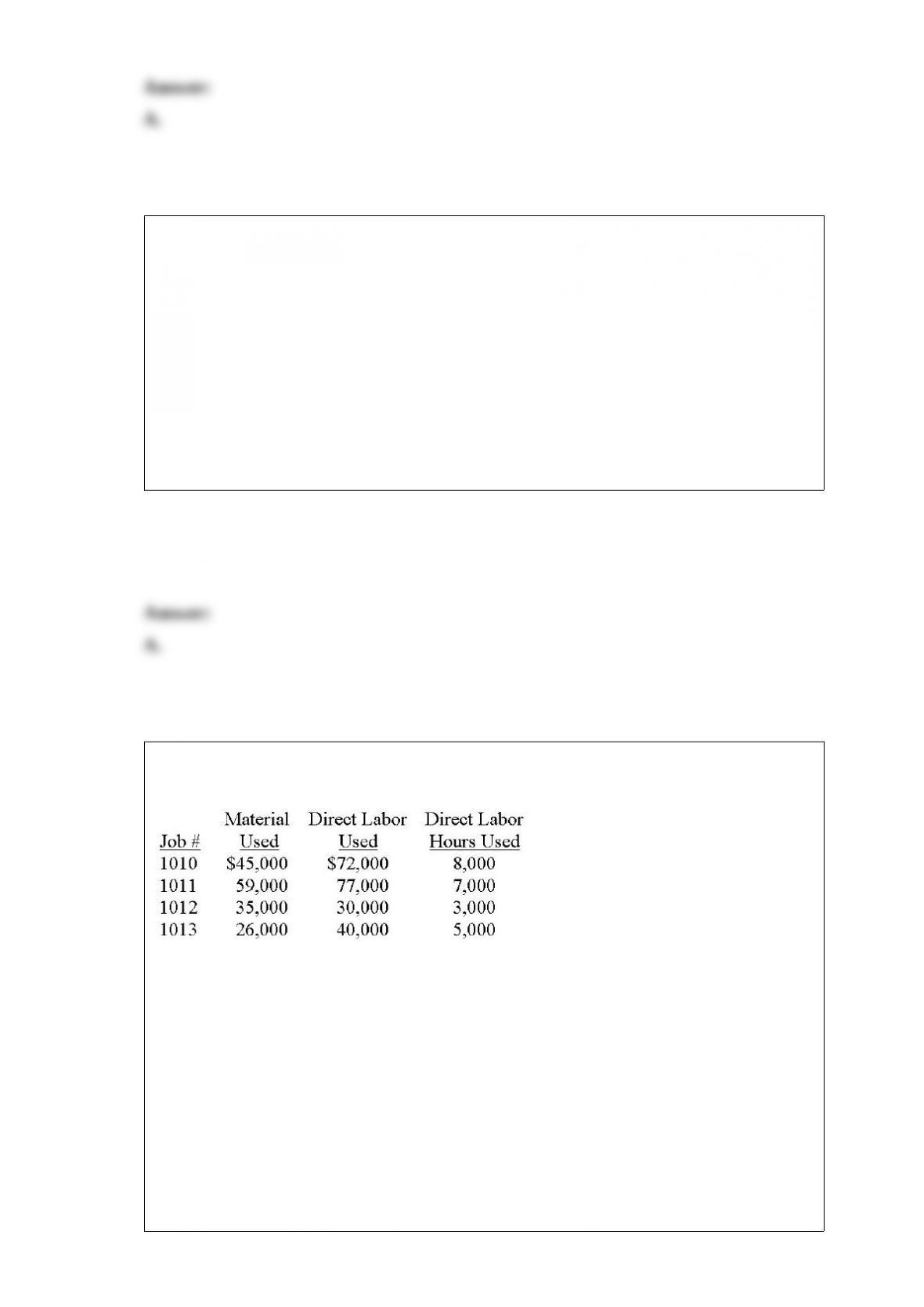
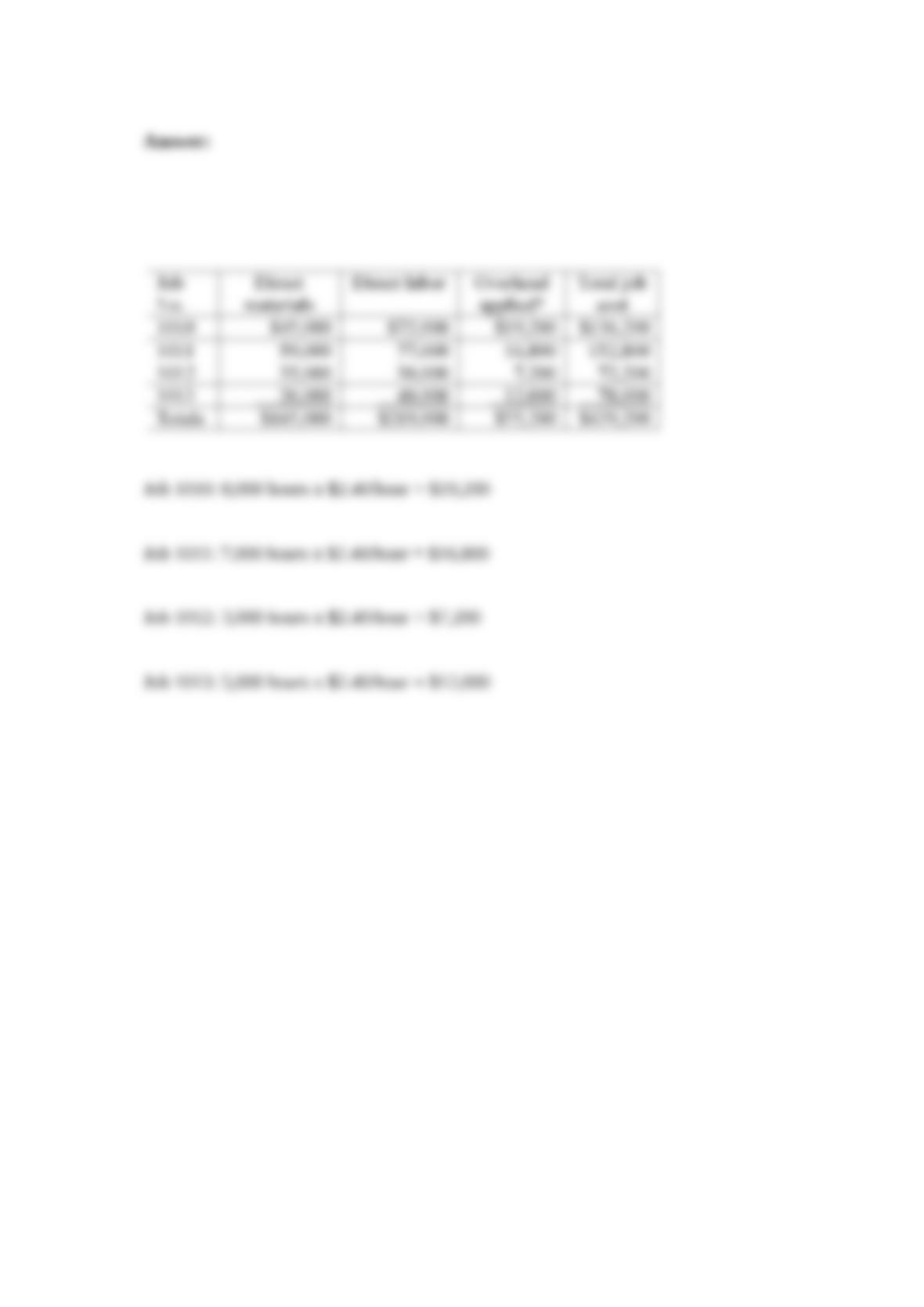
Dina Corp. uses a job order cost accounting system. Four jobs were started during the
current year. The following is a record of the costs incurred:
Actual overhead costs were $55,800. The predetermined overhead allocation rate is
$2.40 per direct labor hour. During the year, Jobs 1010, 1012, and 1013 were
completed. Also, Jobs 1010 and 1013 were sold for $387,000. Assuming that this is
Dina’s first year of operations:
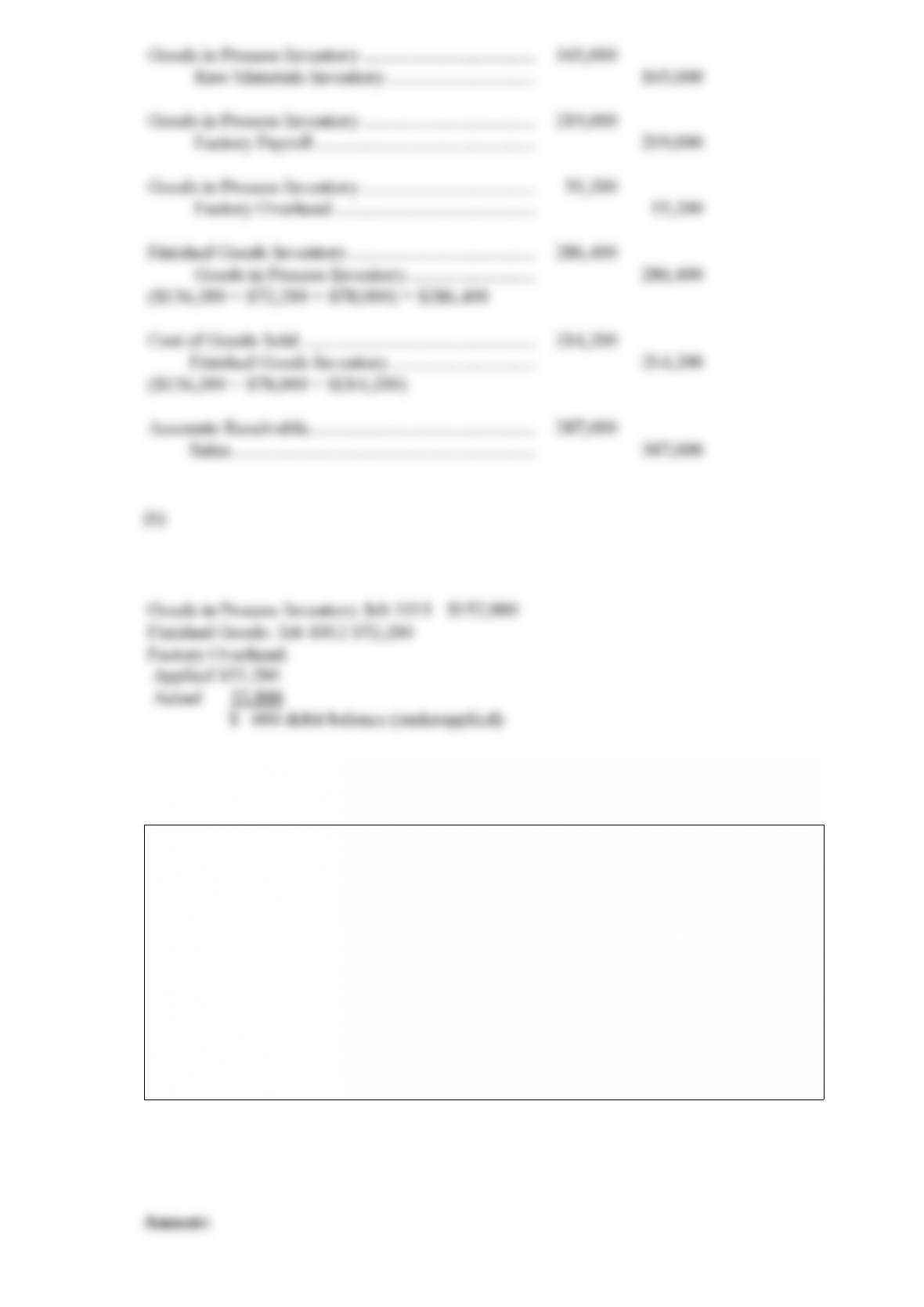
(a) Make the necessary journal entries to charge the costs to the jobs started and to
record the completion and sale of finished jobs.
(b) Calculate the balance in the Goods in Process Inventory, Finished Goods Inventory,
and Factory Overhead accounts. Does the Factory Overhead account balance indicate
an over- or underapplication of overhead?
The rate that yields a net present value of zero for an investment is the:
A.Internal rate of return.
B.Accounting rate of return.
C.Net present value rate of return.
D.Zero rate of return.
E.Payback rate of return.
The difference between actual and standard cost caused by the difference between the
actual price and the standard price is called the:
A.Standard variance.
B.Quantity variance.
C.Volume variance.
D.Controllable variance.
E.Price variance.
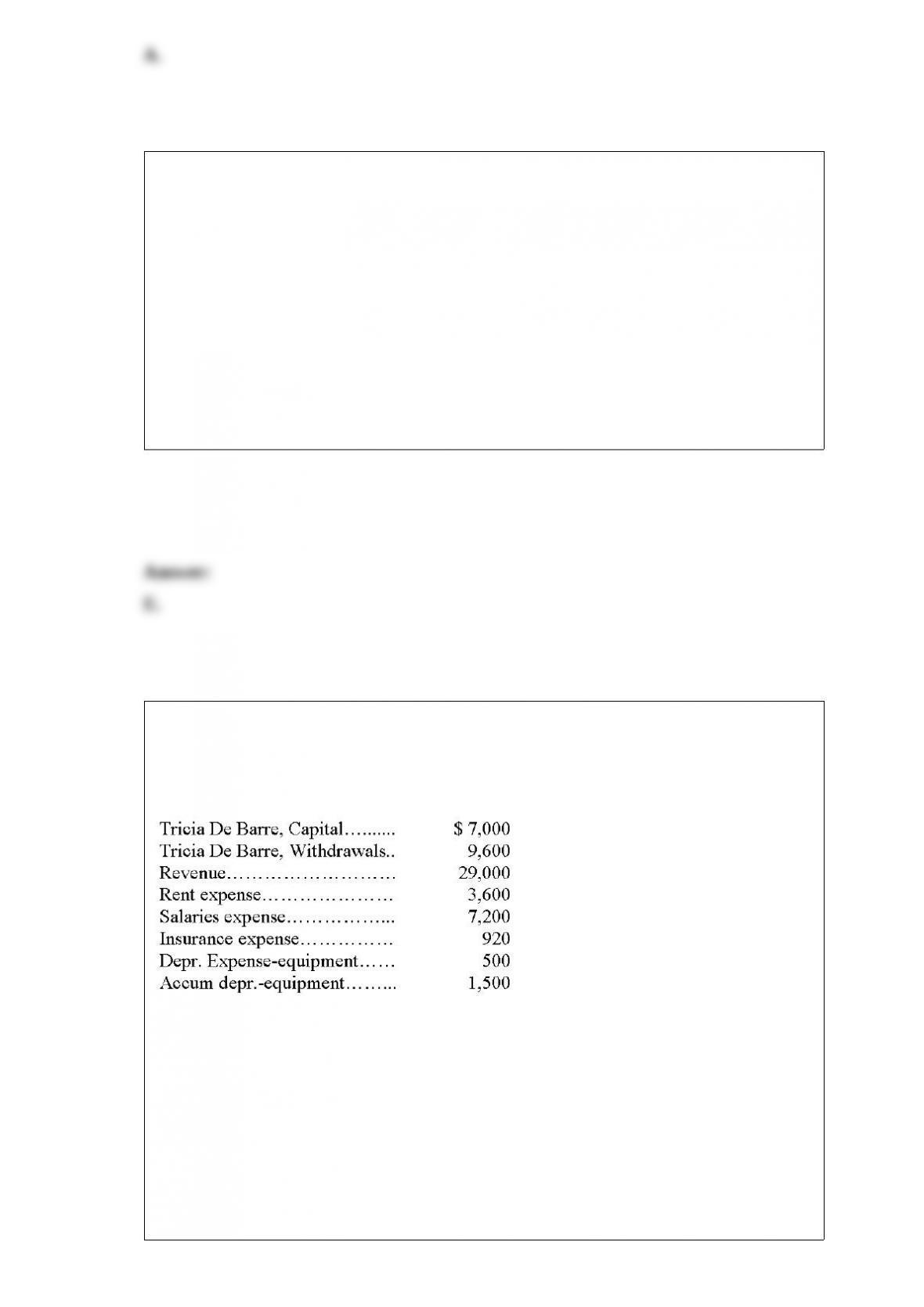
A company’s ledger accounts and their end-of-period balances before closing entries are
posted are shown below. What amount will be posted to Tricia DeBarre, Capital in the
process of closing the Income Summary account? (Assume all accounts have normal
balances.)
A.$16,780 debit.
B.$ 7,180 credit.
C.$16,780 credit.
D.$18,280 credit.
E.$23,780 credit.
Internal control procedures include:
A.Procedures to ensure reliable financial reports.
B.Safeguards to protect company assets.
C.Policies to direct operations toward common goals.
D.Methods to achieve compliance with laws and regulation.
E.All of these.
The contract rate of interest is also called the:
A.Coupon rate.
B.Stated rate.
C.Nominal rate.
D.Market rate.
E.Each of A, B, and C.
Prior to recording adjusting entries, the Office Supplies account had a $359 debit
balance. A physical count of the supplies showed $105 of unused supplies available.
The required adjusting entry is:
A.Debit Office Supplies $105 and credit Office Supplies Expense $105.
B.Debit Office Supplies Expense $105 and credit Office Supplies $105.
C.Debit Office Supplies Expense $254 and credit Office Supplies $254.
D.Debit Office Supplies $254 and credit Office Supplies Expense $254.
E.Debit Office Supplies $105 and credit Supplies Expense $254.
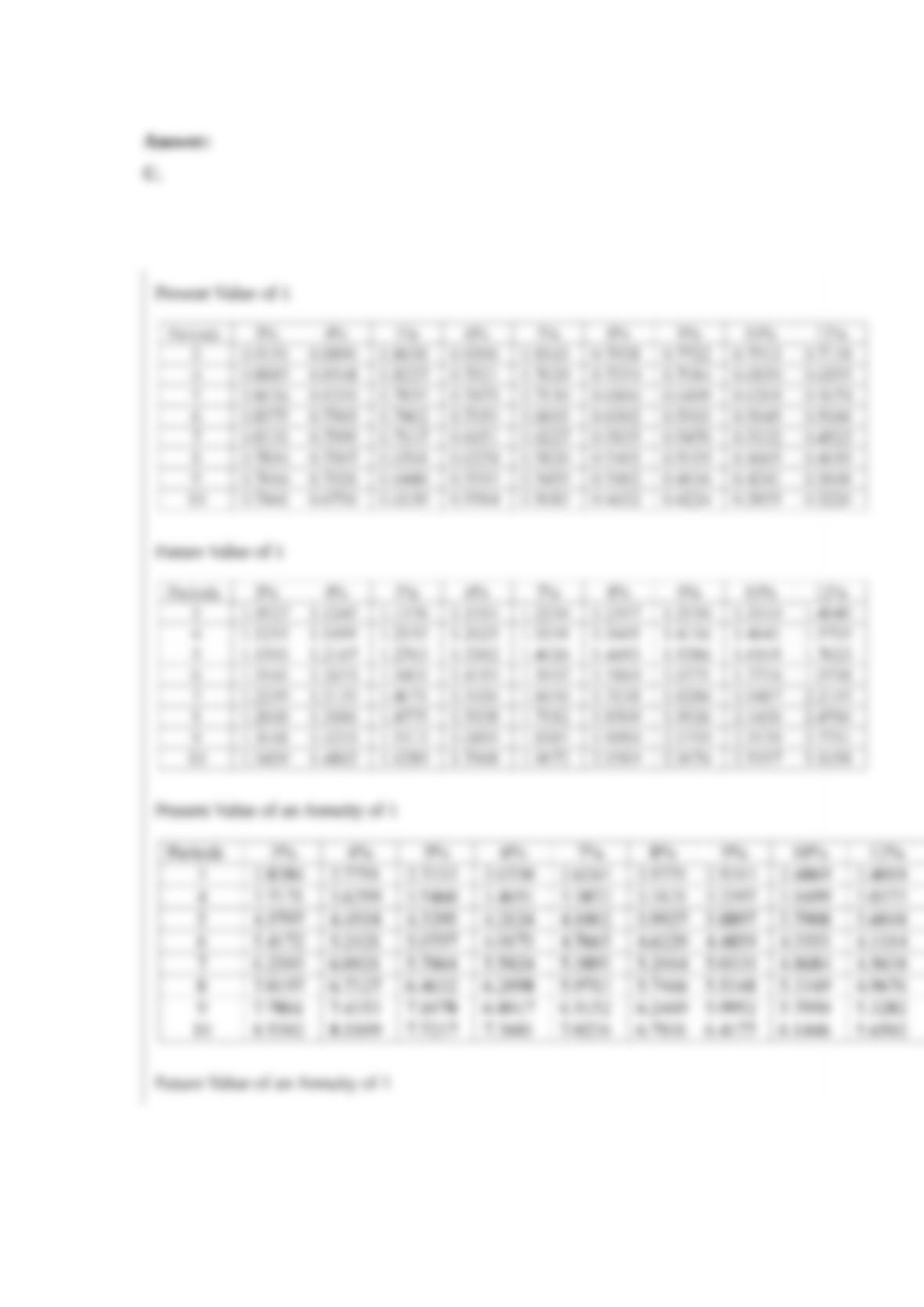
Present Value of 1
Future Value of 1
Present Value of an Annuity of 1
Future Value of an Annuity of 1
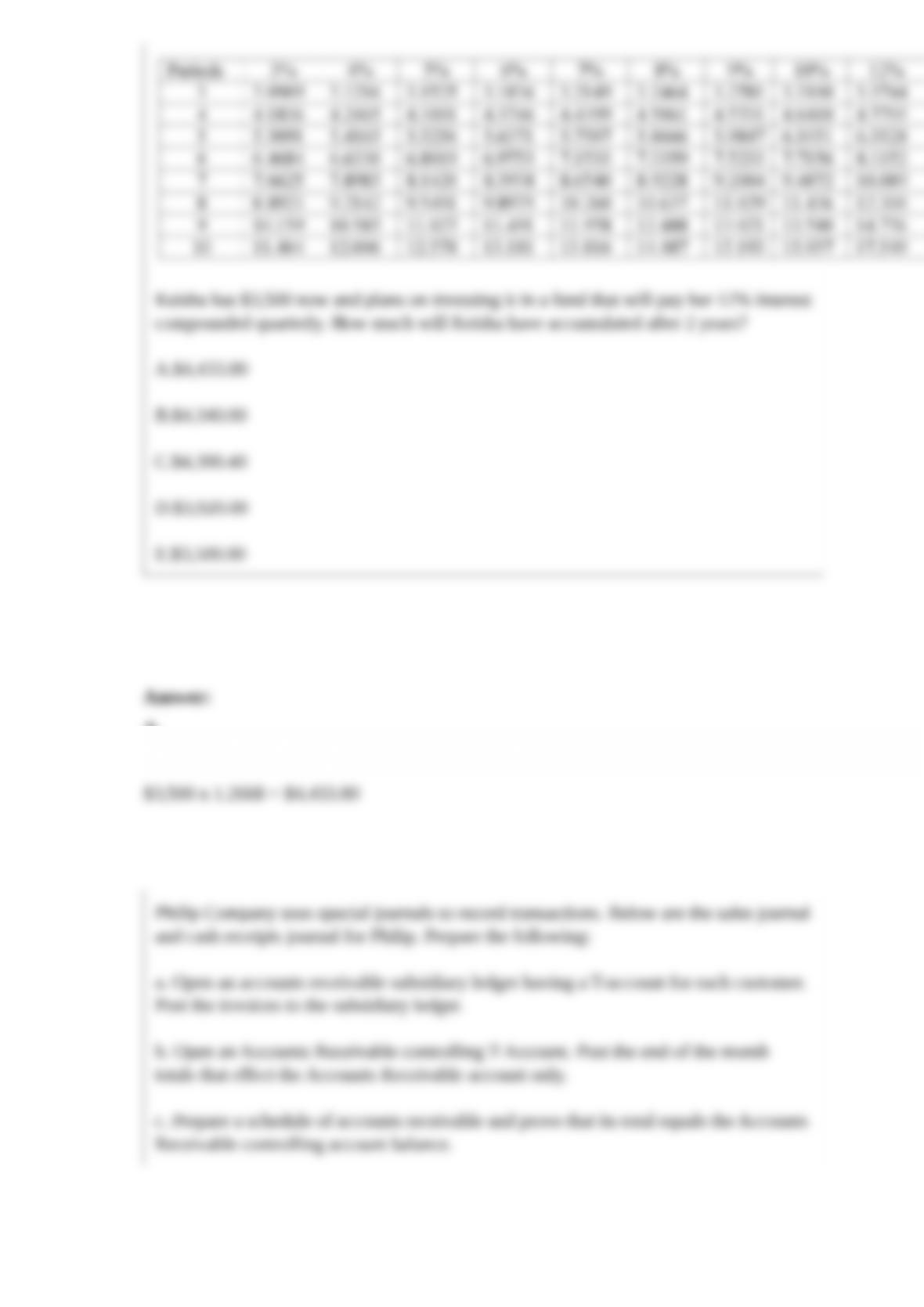
Keisha has $3,500 now and plans on investing it in a fund that will pay her 12% interest
compounded quarterly. How much will Keisha have accumulated after 2 years?
A.$4,433.80
B.$4,340.00
C.$4,390.40
D.$3,920.00
E.$3,500.00
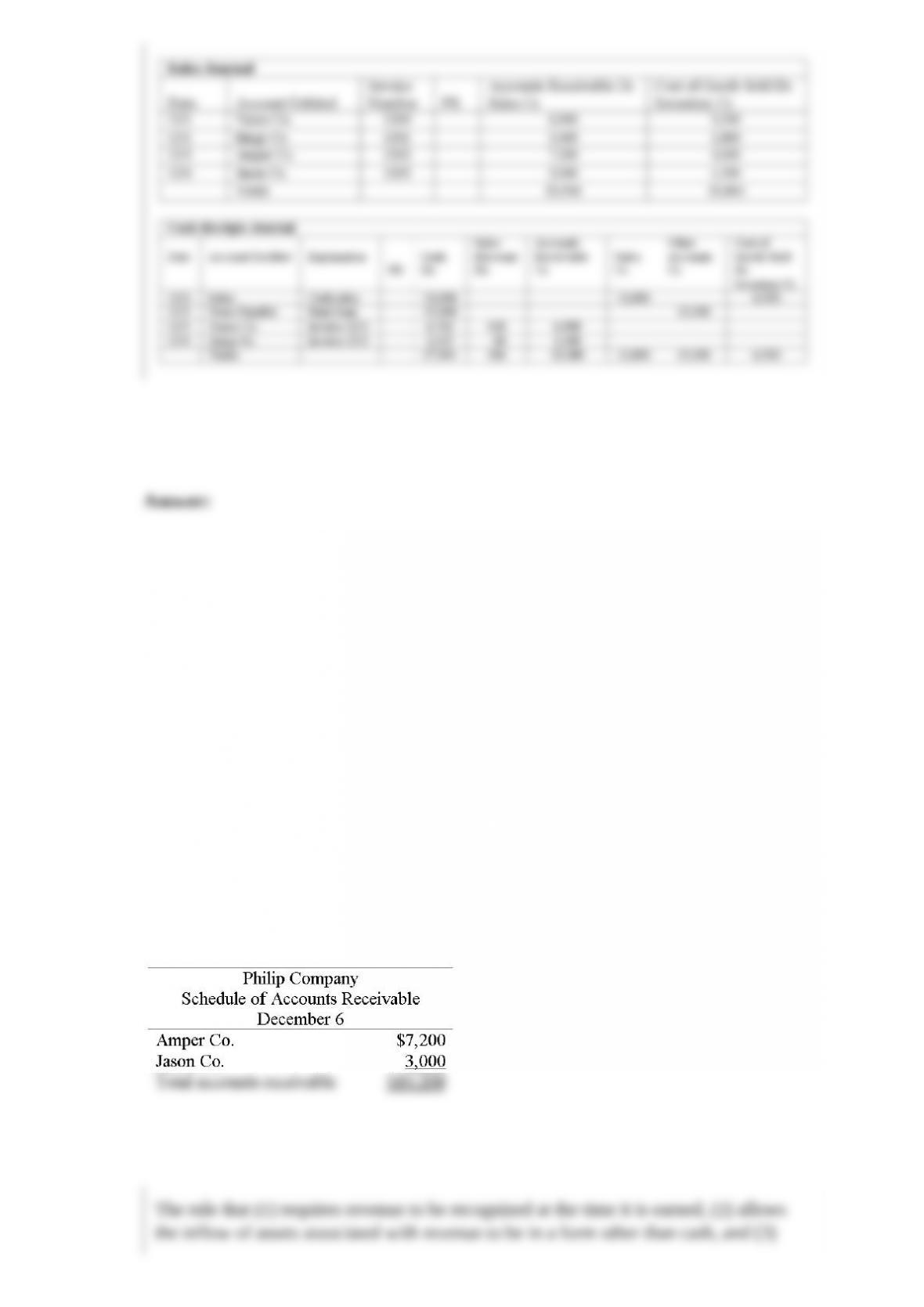
Philip Company uses special journals to record transactions. Below are the sales journal
and cash receipts journal for Philip. Prepare the following:
a. Open an accounts receivable subsidiary ledger having a T-account for each customer.
Post the invoices to the subsidiary ledger.
b. Open an Accounts Receivable controlling T-Account. Post the end-of the month
totals that effect the Accounts Receivable account only.
c. Prepare a schedule of accounts receivable and prove that its total equals the Accounts
Receivable controlling account balance.
The rule that (1) requires revenue to be recognized at the time it is earned, (2) allows
the inflow of assets associated with revenue to be in a form other than cash, and (3)
measures the amount of revenue as the cash plus the cash equivalent value of any
noncash assets received from customers in exchange for goods or services, is called the:
A.Going-concern principle.
B.Cost principle.
C.Revenue recognition principle.
D.Objectivity principle.
E.Business entity principle
The first line item in the operating activities section of a spreadsheet for a statement of
cash flows prepared using the indirect method is:
A.Cash.
B.Cash received from customers.
C.Increase (decrease) in accounts receivable.
D.Net income.
E.Adjustments to net income.
Which of the following statements describing the debt ratio is false?
A.It is of use to both internal and external users of accounting information.
B.A relatively high ratio is always desirable.
C.The dividing line for a high and low ratio varies from industry to industry.
D.Many factors such as a company’s age, stability, profitability and cash flow influence
the determination of what would be interpreted as a high versus a low ratio.
E.The ratio might be used to help determine if a company is capable of increasing its
income by obtaining further debt.
Physical counts of inventory:
A.Are not necessary under the perpetual system.
B.Are necessary to measure and adjust for inventory shrinkage.
C.Must be taken at least once a month.
D.Requires the use of hand-held portable computers.
E.Are not necessary under the cost-to benefit constraint.
Net sales divided by average accounts receivable is the:
A.Days’ sales uncollected.
B.Average accounts receivable ratio.
C.Current ratio.
D.Profit margin.
E.Accounts receivable turnover ratio.
Flexibility of practice when applied to managerial accounting means that
A.The information must be presented in electronic format so that it is easily changed.
B.Managers must be willing to accept the information as the accountants present it to
them, rather than in the format they ask for.
C.The managerial accountants need to be on call twenty-four hours a day.
D.The design of a company’s managerial accounting system largely depends on the
nature of the business and the arrangement of the internal operations of the company.
E.Managers must be flexible with information provided in varying forms and using
inconsistent measures.
A budget system based on expected activities and their levels that enables management
to plan for resources required to perform the activities is:
A.Traditional budgeting.
B.Management budgeting.
C.Master budgeting.
D.Activity-based budgeting.
E.Cash budgeting.
Expenses that support the overall operations of a business and include the expenses
relating to accounting, human resource management, and financial management are
called:
A.Cost of goods sold.
B.Selling expenses.
C.Purchasing expenses.
D.General and administrative expenses.
E.Nonoperating activities.
Match each of the following terms with the appropriate definitions.
1)Federal depository bank
2)Short-term note payable
3) Times interest earned
4) Employee benefits
5) Gross pay
6)Payroll register
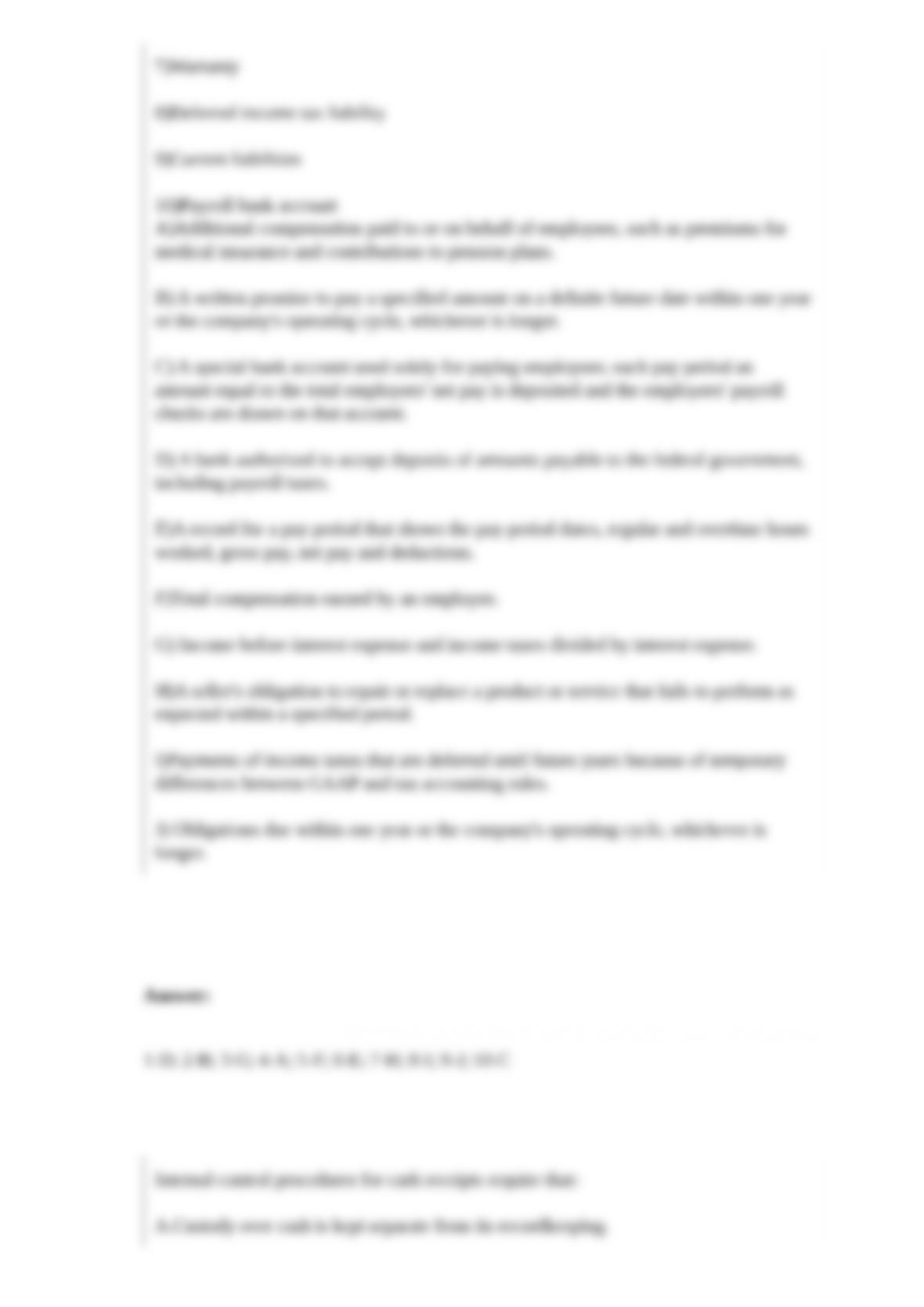
7)Warranty
8)Deferred income tax liability
9)Current liabilities
10)Payroll bank account
A)Additional compensation paid to or on behalf of employees, such as premiums for
medical insurance and contributions to pension plans.
B) A written promise to pay a specified amount on a definite future date within one year
or the company’s operating cycle, whichever is longer.
C) A special bank account used solely for paying employees; each pay period an
amount equal to the total employees’ net pay is deposited and the employees’ payroll
checks are drawn on that account.
D) A bank authorized to accept deposits of amounts payable to the federal government,
including payroll taxes.
E)A record for a pay period that shows the pay period dates, regular and overtime hours
worked, gross pay, net pay and deductions.
F)Total compensation earned by an employee.
G) Income before interest expense and income taxes divided by interest expense.
H)A seller’s obligation to repair or replace a product or service that fails to perform as
expected within a specified period.
I)Payments of income taxes that are deferred until future years because of temporary
differences between GAAP and tax accounting rules.
J) Obligations due within one year or the company’s operating cycle, whichever is
longer.
Internal control procedures for cash receipts require that:
A.Custody over cash is kept separate from its recordkeeping.
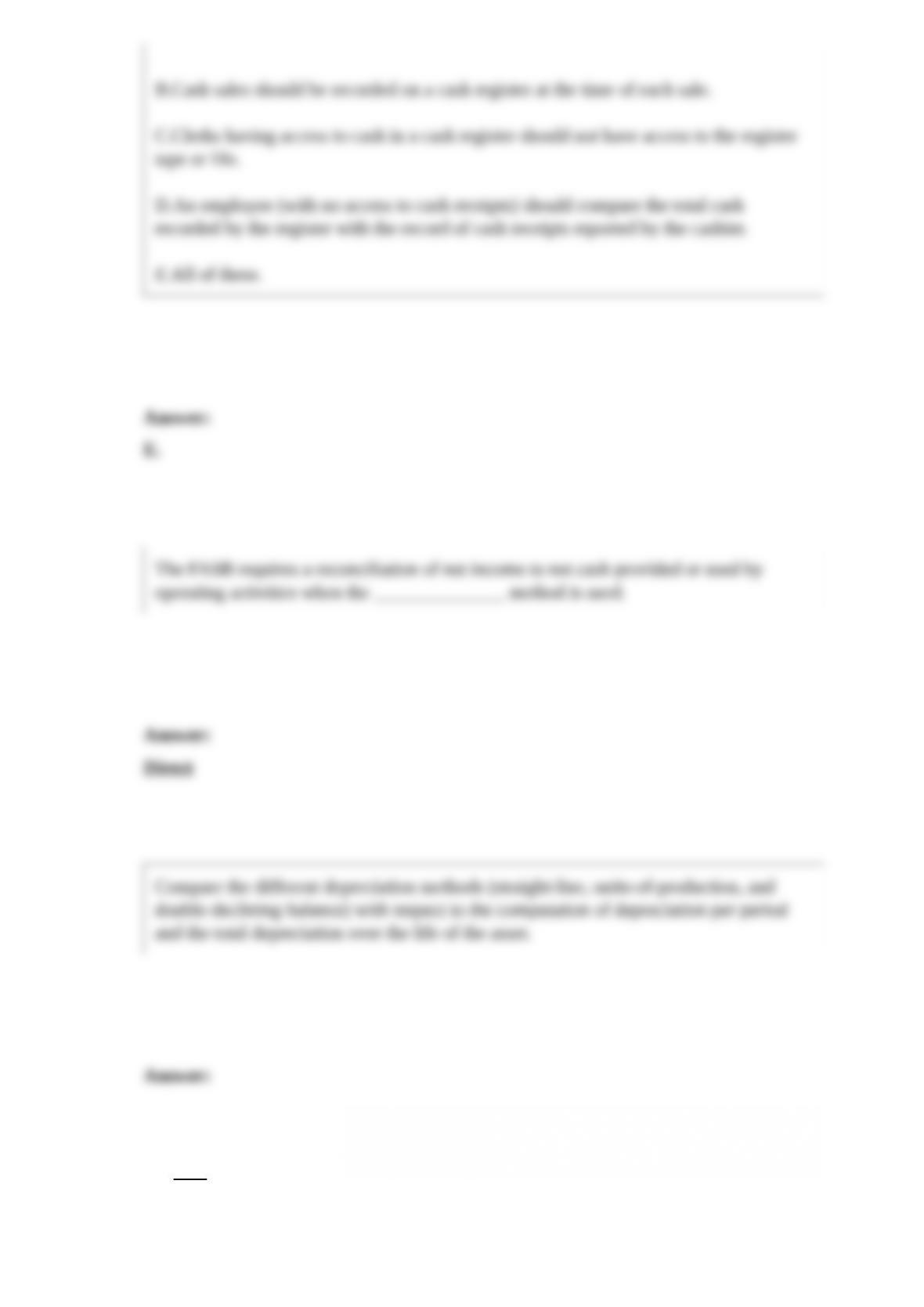
B.Cash sales should be recorded on a cash register at the time of each sale.
C.Clerks having access to cash in a cash register should not have access to the register
tape or file.
D.An employee (with no access to cash receipts) should compare the total cash
recorded by the register with the record of cash receipts reported by the cashier.
E.All of these.
The FASB requires a reconciliation of net income to net cash provided or used by
operating activities when the ______________ method is used.
Compare the different depreciation methods (straight-line, units-of-production, and
double-declining-balance) with respect to the computation of depreciation per period
and the total depreciation over the life of the asset.
Explain how the cash flows from operating activities section of the statement of cash
flows is prepared using the indirect method.
What is comprehensive income and how is it usually reported in the financial
statements?
Harrison Company’s balance sheet reflects total assets of $250,000 and total liabilities
of $150,000. Calculate the company’s debt-to-equity ratio.
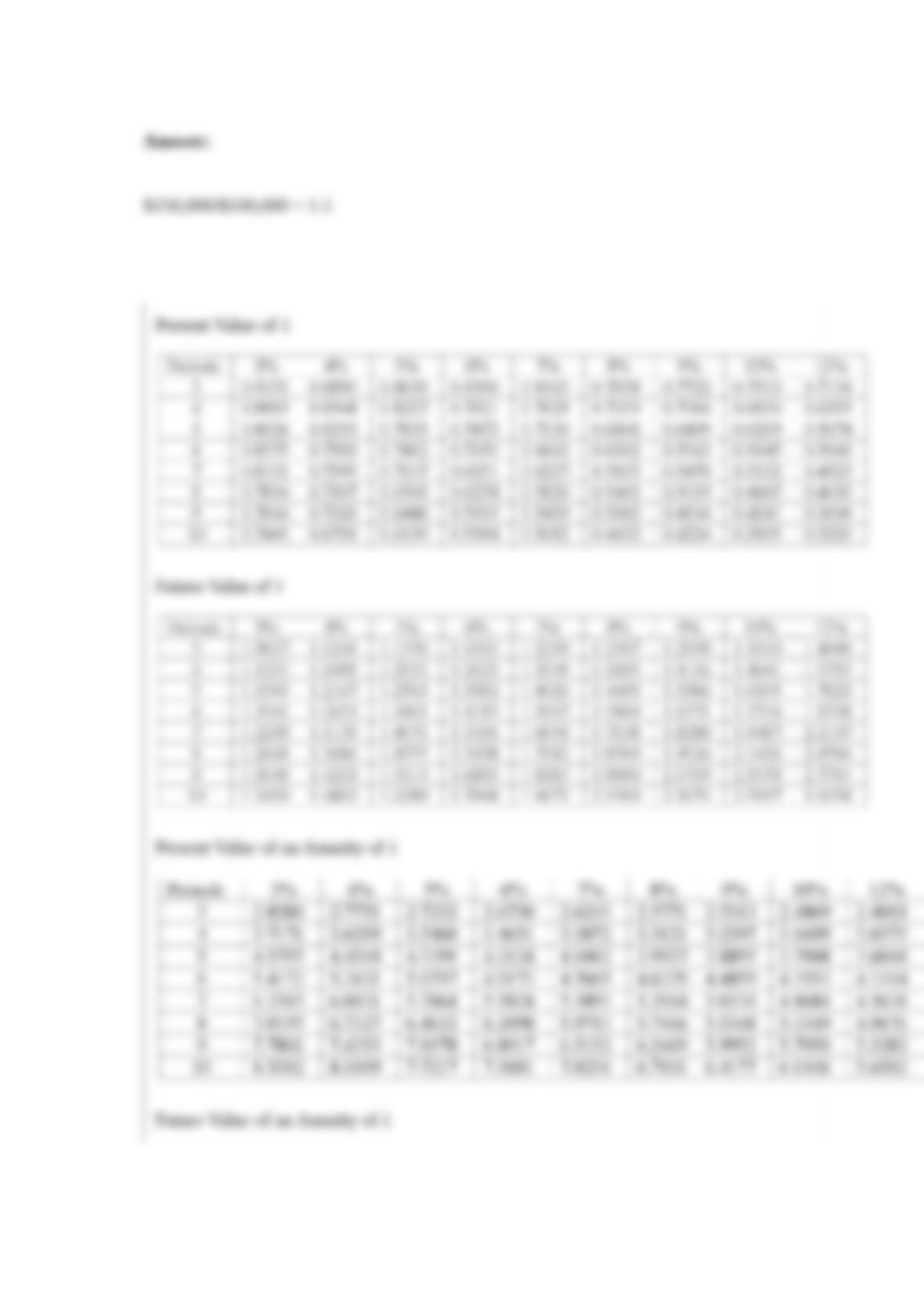
Present Value of 1
Future Value of 1
Present Value of an Annuity of 1
Future Value of an Annuity of 1
Thompson Company has acquired a machine from a dealer that requires a payment of
$45,000 at the end of five years. This transaction includes interest at 8%, compounded
semiannually. What is the value of the machine today?
For each of the characteristics below, identify whether it is a focus of financial
accounting or managerial accounting. Use the letter F to identify financial accounting
and M to identify managerial accounting.
1)Information is available quickly without the need to wait for an audit.
2)Information is structured and controlled by GAAP.
3)Used to assist managers in making planning and control decisions.
4)Information is mainly historical with some predictions.
5)Information is mostly monetary, but includes nonmonetary information.
6) Emphasis of the information is on the whole organization.
7)Users are generally managers, employees and decision makers internal to the
organization.
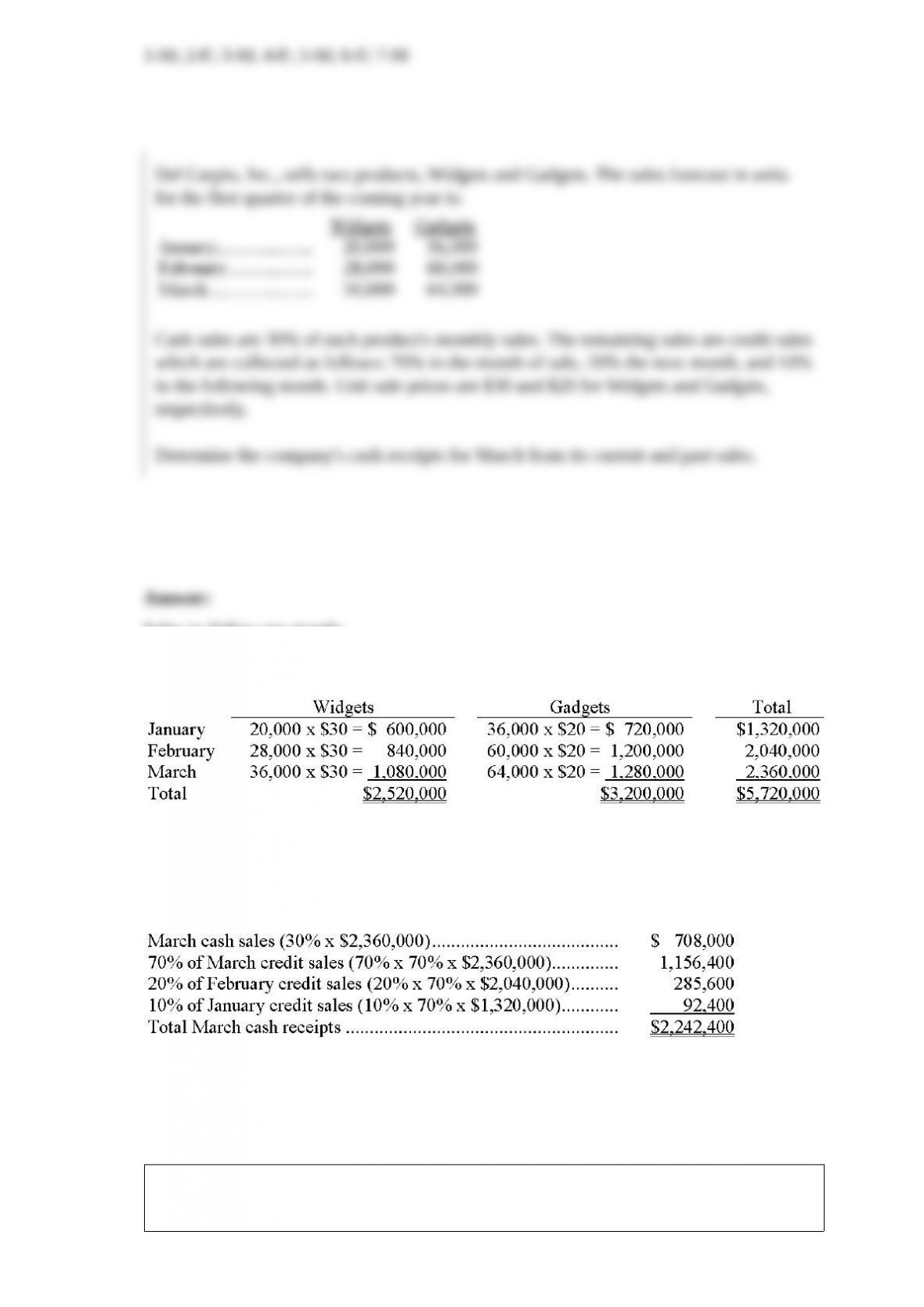
Del Carpio, Inc., sells two products, Widgets and Gadgets. The sales forecast in units
for the first quarter of the coming year is:
Cash sales are 30% of each product’s monthly sales. The remaining sales are credit sales
which are collected as follows: 70% in the month of sale, 20% the next month, and 10%
in the following month. Unit sale prices are $30 and $20 for Widgets and Gadgets,
respectively.
Determine the company’s cash receipts for March from its current and past sales.
Individual transactions in the sales journal are posted regularly to customers’ accounts
in the ________________________________________.
An _____________________ cost requires the future outlay of cash and is relevant for
decision making.
Why is the sales budget usually prepared first?

The _________________________ describes a company’s financial position and types
and amounts of assets, liabilities, and equity at a point in time.
The __________________ inventory system continually updates accounting records for
merchandise transactions for the amounts of inventory available for sale and inventory
sold.
____________________ refer to merchandise that customers return to the seller after a
sale.