
An accounting information system comprises five generic parts. Which of the following
gives an example of an internal control associated with the sales/collection process?
A. Depositing cash in the bank daily
B. Adequately supervising employees who handle inventory
C. Both depositing cash in the bank daily and adequately supervising employees who
handle inventory
D. Neither depositing cash in the bank daily nor adequately supervising employees who
handle inventory
In which of the following situations would a systems flowchart be appropriate?
A. Documenting the steps in a financial statement audit
B. Evaluating an organization’s employee training programs
C. Both documenting the steps in a financial statement audit and evaluating an
organization’s employee training programs
D. Neither documenting the steps in a financial statement audit nor evaluating an
organization’s employee training programs
Consider the following case as you respond to the questions:
HSO Corp. designs, manufactures and sells golf carts, scooters and similar vehicles.
When a prospective client contacts one of their seven corporate offices, the office
manager fills out an “intake questionnaire” to determine if HSO can meet the

prospective client’s needs. The office manager assembles a team of employees with
expertise in design, production, marketing and accounting; the team reviews the intake
questionnaire and determines if HSO can take on the order. If so, the office manager
prepares a three-page written proposal for the prospective client; the proposal explains
the responsibilities of both HSO and the client, along with a timeline and a budget. The
proposal is forwarded to the prospective client electronically, and the client has ten
calendar days to accept it. If HSO cannot take on the order, the prospective client
receives an automatically generated form letter; if the prospective client does not accept
the proposal within ten calendar days, they receive a different form letter. The new
client remits half of the fee at the time the proposal is accepted, and HSO prepares
weekly progress reports as the project moves forward. The reports are filed in HSO’s
database; a hard copy is sent to the client. On a monthly basis, HSO’s office manager
prepares a comprehensive status report for all current engagements. One week before
each project is concluded, HSO bills the client for half of the remaining amount due;
after the client has paid all outstanding invoices, HSO completes the work and bills the
client for all remaining amounts. HSO delivers the finished product; the client must pay
the full amount due within 30 days of the final invoice date. If the client pays within 15
days, HSO gives a 3% discount off the amount due.
Accounting information systems comprise five generic parts. From HSO’s perspective,
which of the following pairs a generic part with an example from the case?
A. internal control, the office manager assembles a team of employees
B. input, budget and timeline
C. Both internal control, the office manager assembles a team of employees and input,
budget and timeline
D. Neither internal control, the office manager assembles a team of employees nor
input, budget and timeline
AIS can be linked to other areas of study in accounting by focusing on the five generic
elements of the AIS. Which of the following is a process that might be studied in
management or cost accounting?

A. Components of the master budget
B. How to prepare the master budget
C. Both components of the master budget and how to prepare the master budget
D. Neither components of the master budget nor how to prepare the master budget
Carlos is the vice president of finance at PLP Corporation. When he joined the company
five years ago, the finance division was organized in two departments: operating
transactions and non-operating transactions. Each department had two employees and a
manager. The operating transactions department handled all aspects of transactions
dealing with inventory, supplies, payroll and other operating expenses; the
non-operating transactions department handled all aspects of transactions dealing with
short-term investments, long-term debt and shareholders. Any transactions that did not
fit one of the two groups were handled by the vice president of finance. The finance
division had its own procedures manual, organized into three chapters: operating
transactions, non-operating transactions, other transactions. Within the operating
transactions department, one employee handled payroll only, while the other employee
handled all aspects of non-payroll transactions. Within the non-operating transactions
department, one employee handled transactions related to short-term investments. The
other employee handled long-term debt transactions, while the department manager
handled all aspects of transactions dealing with shareholders. Risk exposures for the
finance division at PLP include:
a) Cash dividends being sent to the wrong shareholders
b) Dividend miscalculations
c) Embezzlement of cash
d) Missed payments on long-term debt
e) Payroll checks issued to employees no longer working for PLP
f) Payroll miscalculations
g) Poor choices for short-term investments
h) Purchasing supplies and inventory from unauthorized vendors

i) Theft of supplies
To address those risks, PLP might institute the following internal controls: adequate
supervision, segregation of duties, appropriate use of information technology. Divide
the risk exposures listed into three groups based on the internal control that would best
address the risk; each group must have no fewer than two and no more than four risk
exposures. Each risk exposure must be associated with exactly one internal control.
Ways to combat information overload include:
A. Applying effective models for making decisions.
B. Managing knowledge.
C. Both applying effective models for making decisions and managing knowledge.
D. Neither applying effective models for making decisions nor managing knowledge.
Raul was leading a team charged with developing a new system for budgeting.
Immediately after the team is formed, they should proceed with:
A. Requirements analysis
B. Design
C. Build

D. Test
Information technology can be an important tool in which of the five generic elements
of an AIS?
A. Inputs and outputs only
B. Outputs and storage only
C. Processes and storage only
D. Any of the elements
Gelton was leading a team of three co-workers focused on improving their company’s
process for hiring new employees. They had read the company procedures manual
describing the current process, then interviewed newly-hired workers about their
experiences. They used the principles of activity-based costing to determine the average
cost of hiring a new employee, then created a line graph tracing the average cost over
the last twelve months. Which of the following statements is most true?
A. Creating a line graph helps fulfill the fourth step of the generalized BPM model
discussed in the text.
B. Determining the average cost of hiring a new employee helps fulfill the second step
of the generalized BPM model discussed in the text.
C. The narrative includes exactly one way of fulfilling the third step of the generalized
BPM model discussed in the text.

D. The business process is poorly defined.
All of the following are types of Big Data except:
A. big transaction data.
B. web and social media data.
C. biometric data.
D. accounting data.
Determine which of the following statements are: (a) true for systems flowcharts only,
(b) true for data flow diagrams only, (c) true for both or (d) true for neither.
1) Can be prepared using information technology tools
2) Clearly specifies responsibility for business processes
3) Commonly thought of as the one best way to represent an AIS
4) Incorporates verb phrases to label processes
5) Labels data flows between processes
6) May span multiple pages
7) Processes can be represented with different types of symbols
8) Represents processes with a single symbol type

9) Should be uncluttered and easy to read
10) Uses a symbol to represent a database
When the Internal Revenue Service encourages individual taxpayers to submit forms
electronically, it is engaging in which form of e-business?
A. B2C
B. G2C
C. C2C
D. B2B

Gelton was leading a team of three co-workers focused on improving their company’s
process for hiring new employees. They had read the company procedures manual
describing the current process, then interviewed newly-hired workers about their
experiences. They used the principles of activity-based costing to determine the average
cost of hiring a new employee, then created a line graph tracing the average cost over
the last twelve months. What should Gelton and his team do next?
A. Read more books about business process management.
B. Implement a newer, more efficient hiring process.
C. Prepare a presentation to the board of directors.
D. Brainstorm ways the process could be improved.
Consider the following short case as you respond to the question:
Amanda is a partner in a CPA firm; she supervises a staff of ten professionals, some of
whom are already licensed CPAs and some of whom are still working toward licensure.
She is responsible for audits of independent bookstores in California, Nevada and
Arizona. Amanda is concerned that the less experienced professionals she supervises
are repeating the mistakes she and the more experienced professionals on her team
made when they began auditing. She therefore wants to create a knowledge
management system.
In assigning personnel to a specific audit team, Amanda normally has one licensed CPA
working with a professional who is not yet licensed. Rather than considering alternative
approaches to the audit that might achieve the same goals more efficiently, the licensed
CPAs in Amanda’s firm rely on their past practice in conducting audits. The licensed
CPAs are therefore demonstrating:
A. Bounded rationality.

B. At least one countermeasure for information overload.
C. Both bounded rationality and at least one countermeasure for information
overload.D. Neither bounded rationality nor at least one countermeasure for
information overload.
Nestor and Maureen are partners in a small consulting firm located in the Republic of
Bufflufia; the firm has six employees. For the last five years, the firm has focused on
tax planning and tax return preparation. But, Nestor and Maureen are now interested in
expanding the firm’s scope of services. They are considering risk management
consulting, fraud examination and business valuation as potential areas to expand the
firm. They are sure at least three of their six employees would put effort into at least
one of those three areas, but expanding the firm’s services would require additional
training for everyone.
Based on the short case above, which of the following statements is most true?
A. An enterprise risk management plan will be required only if they decide to expand
into risk management consulting.
B. Nestor and Maureen need to increase their own valence.
C. Both an enterprise risk management plan will be required only if they decide to
expand into risk management consulting and Nestor and Maureen need to increase their
own valence are true.
D. Neither an enterprise risk management plan will be required only if they decide to
expand into risk management consulting nor Nestor and Maureen need to increase their
own valence is true.
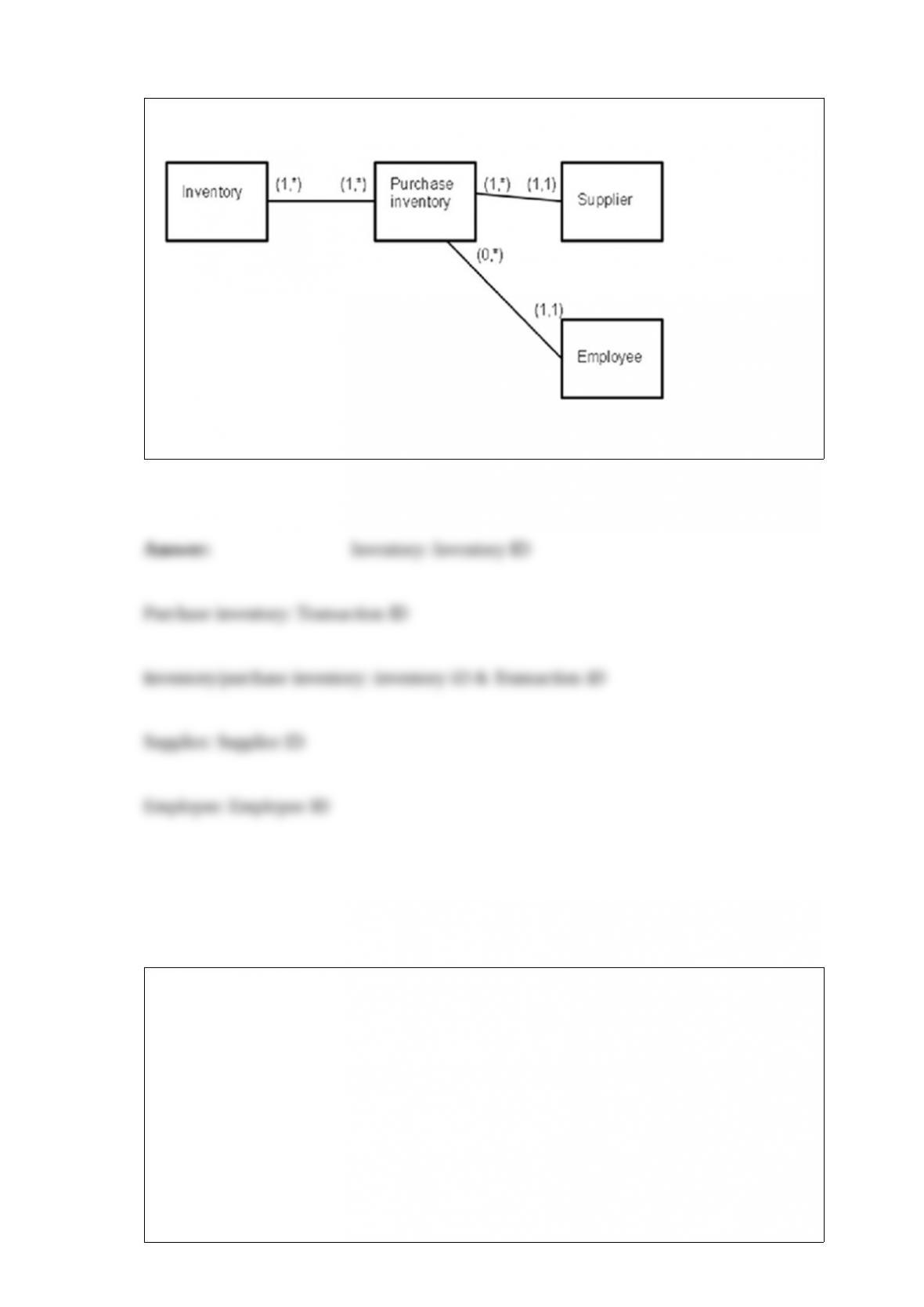
Consider the REA model below:
List all the tables indicated by the model. In each table, specify the primary key.
Which generally accepted auditing standard is indicated by each independent item
below? Use each standard exactly one time.
1) Charlie, the manager of an audit team, reviewed the work of inexperienced auditors
closely.
2) Jill refused to accept an audit engagement because her friend was CEO of the
company.
3) Leigh completed a risk/control matrix as part of an audit.

4) Leo prepared a disclaimer of report on an audit client’s financial statements.
5) Marsha reviewed the background and experience of auditors in her firm as part of
developing an audit team.
6) Nolan determined that a client’s financial statements were fairly presented in
accordance with GAAP.
7) Patricia noted that footnotes to the financial statements needed some improvement.
8) Renee explained a change between the applications of GAAP in two successive
years.
9) Rich e-mailed an audit client’s vendors to help determine the client’s accounts
payable balances.
10) Sally completed a continuing education program on auditing mortgage companies.

Using XBRL creates some risk exposures for organizations; an effective tool for
managing risk exposures is the risk/control matrix. Using the format discussed in the
text, create a risk/control matrix for the risk of XBRL tagging errors.
Consider the process you use to register for courses and pay your fees each term.
Referring to the previously presented set of flowcharting symbols labeled Symbol A
through Symbol J., give one specific example of Symbols A, B, F, G, H, and I within
the context of that process.

Bonnie is the owner of Doggie Day Care, a pet-sitting service. Pet owners bring their
dogs to Bonnie’s facility, where they are either given private accommodations or are put
in a large pen with other dogs. (Private accommodations are more expensive.) Bonnie
and her employees feed the dogs twice a day; those dogs in private accommodations are
also given two exercise periods per day. Owners pay half the daily fee at the start of the
day, and the other half when they pick up the dog at the end of the day; owners must
also certify that their dogs have had all required vaccinations. As Bonnie’s company is a
day care service, no dogs stay the night in her facility. Bonnie accepts cash, checks and
major credit cards in payment. Bonnie has approached you, as a consultant, with
concerns about the risks her company faces and how she might address them. Explain
the concept of a risk/control matrix to Bonnie, then design such a matrix for three risks
Bonnie’s company must address.
JRS Corporation attempted to install an enterprise resource planning system with very
poor results. The project took significantly longer than expected; actual costs exceeded
budgeted costs by a significant margin. In addition, the system has been poorly utilized
because it was never completed. The management of JRS has hired you to bring the
project to a successful completion.
Write a letter to management explaining three common causes of ERP implementation
failure; also make four recommendations that will help them be more successful with
the implementation now.

Bumble Beasley wanted to create three database tables for the information items shown
below: supplies table, purchases table and purchases/supplies table. Apply the
principles of normalization to show how he should organize them. Specify primary keys
by underlining and foreign keys with bracket
“As of” date for beginning inventory
Beginning quantity on hand
Cost per unit purchased
Cost per unit–beginning inventory
Item description–office supplies
Office supplies item number
Purchase date
Quantity purchased
Transaction number
Vendor ID

Tim graduated from college three years ago, and recently has been promoted to a
management position at a local charitable organization. The organization’s internal
controls are weak, and Tim wants to improve them; but, his employees lack motivation
for doing so. Tim has sent an e-mail to Jackie, his professional mentor, asking for ideas
about improving the employees’ motivation.
Compose an e-mail to Tim explaining how he could use expectancy theory to motivate
his employees to improve the organization’s internal controls. Make sure the e-mail has
sufficient detail for Tim to implement the ideas you suggest.
For which of the following tasks would a data flow diagram be appropriately used in
AIS work?
__ To accompany systems flowcharts as an aid in understanding an AIS
__ To assist in the creation of normalized database tables
__ To break down a process into its component parts
__ To designate the format of data stores (paper or electronic)
__ To help users understand information flows in an AIS
__ To identify needed databases
__ To make journal entries in the AIS
__ To represent an AIS on a single sheet of paper
__ To show which data crosses the system boundary
__ To specify clearly who is responsible for a business process
Use COSO’s internal control framework to develop an internal control plan for
Homemade Craft Company based on the following narrative. Focus your plan on
internal controls for the sales/collection process.
Homemade Crafts Company (HCC) sells collectible items such as dolls, jewelry, drink
coasters and table linens. The company, which has five full-time employees, obtains its

merchandise from independent contractors throughout the United States; they then
mark up the products and sell them at craft stores and other outlets. Two of the five
employees interact with the independent contractors, arranging inventory purchases
based on demand for HCC’s products and their own personal preferences. Those same
employees use their personal vehicles to transport the inventory from HCC’s main
office to the retail locations where they will be sold. A third employee serves as the
company’s receptionist, while the fourth manages all aspects of the accounting
information system. The company president is the fifth employee, and is in charge of
administrative affairs such as hiring, performance evaluation and publicity.
HCC purchases its entire inventory on account from the independent contractors, some
of whom offer cash discount terms for early payment. All HCC’s sales are for cash;
each inventory item is marked up 25% on its cost to determine the selling price. For
example, if a product costs $100 to buy, HCC sells it for $125. The two sales employees
bring all cash receipts back to HCC’s main office; the receptionist deposits the cash in
the bank at least once a week.