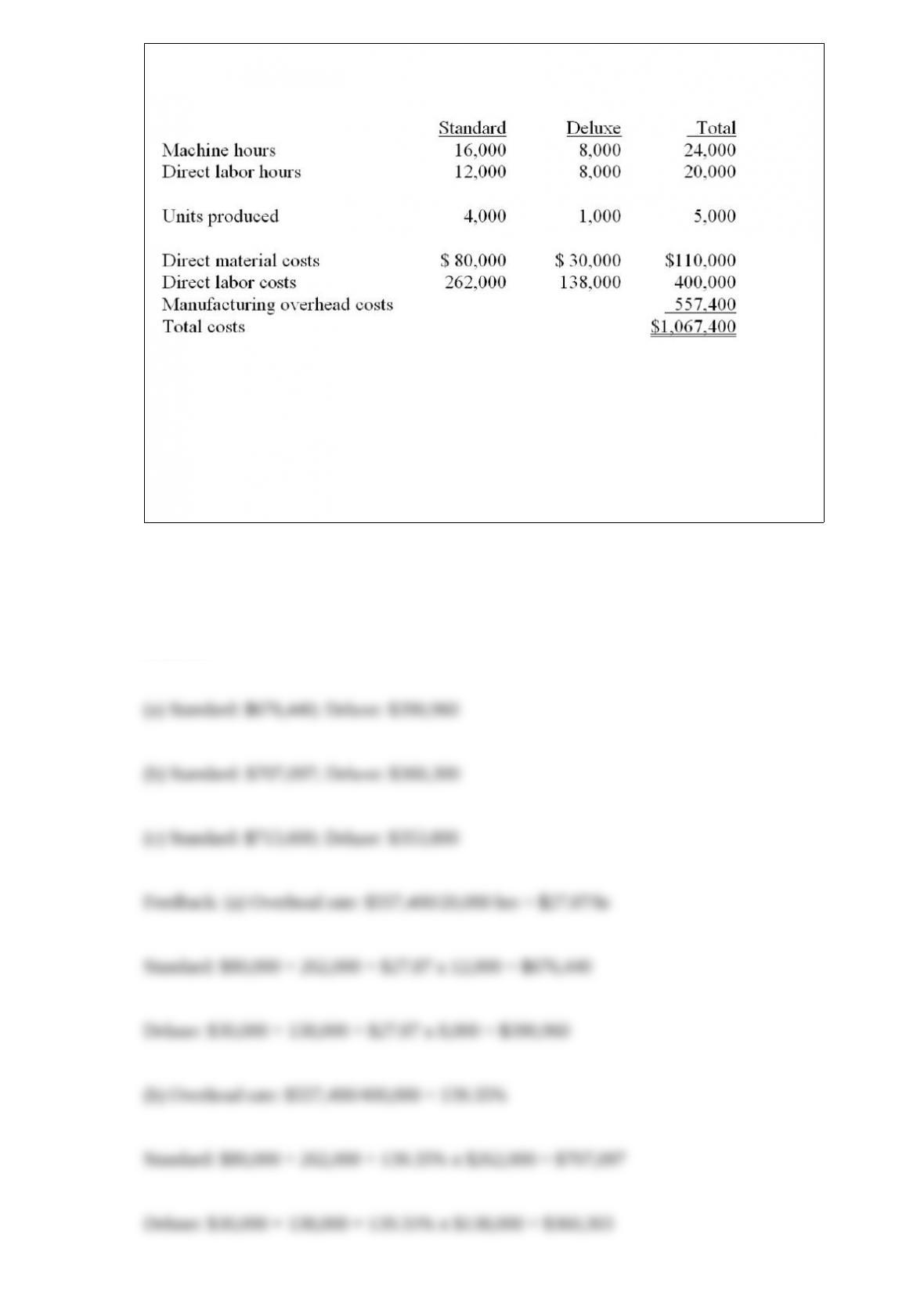
Lombard Carts produces two models of push carts, the Standard and the Deluxe. Data
on operations and costs for the month are:
Required: Compute the total cost for each model, assuming Lombard Carts uses:
(a) Direct labor hours to allocate overhead costs.
(b) Direct labor costs to allocate overhead costs.
(c) Machine hours to allocate overhead costs.
Answer:
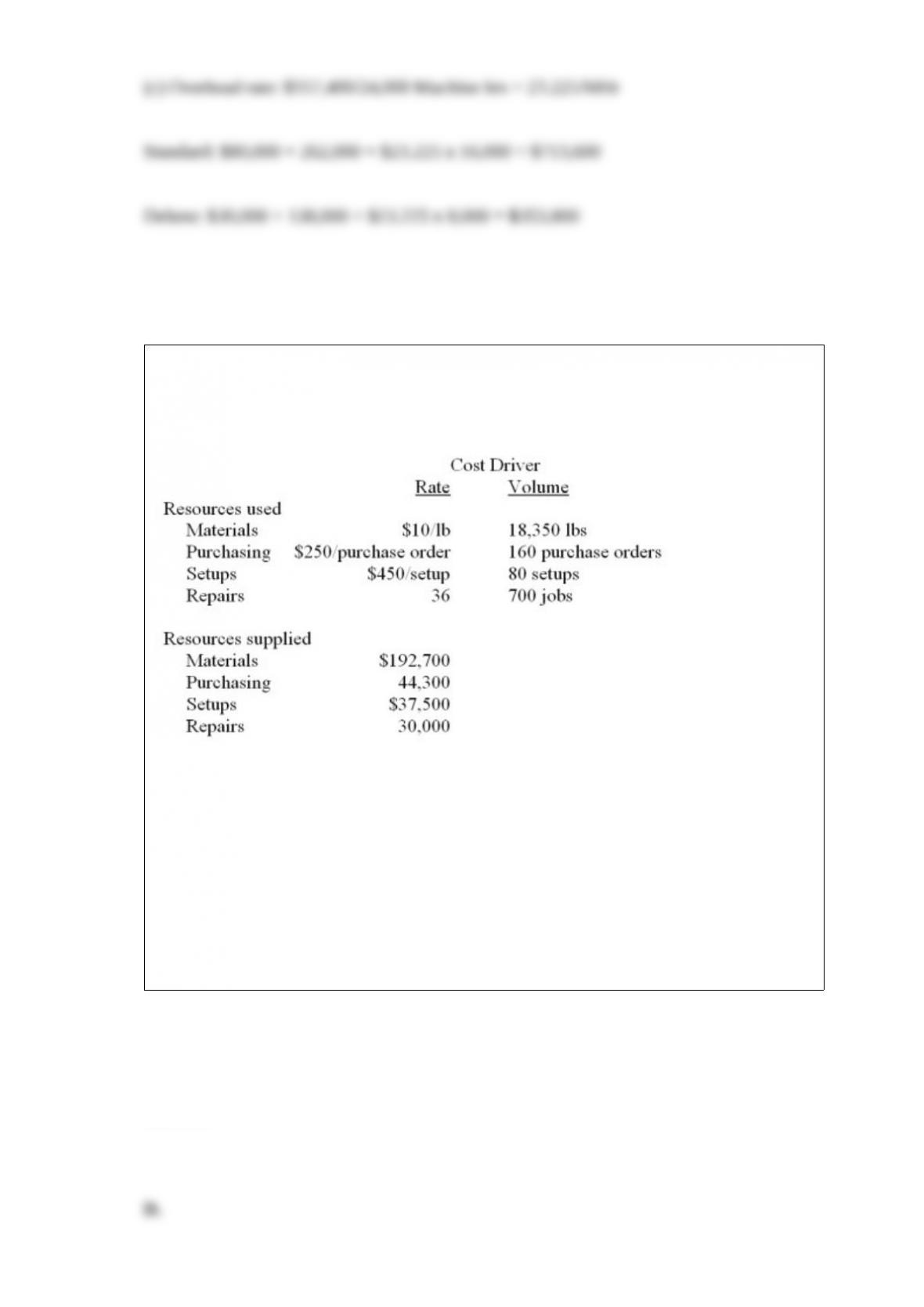
Sullivan Inc. reports the following information about resources. At the beginning of
the year, Sullivan estimated it would spend $180,000 for materials, $42,000 for
purchasing, $35,000 for setups and $36,000 for repairs.
Compute unused resource capacity for materials for Sullivan.
A. $12,700
B. $3,500
C. $19,270
D. $9,200
Answer:
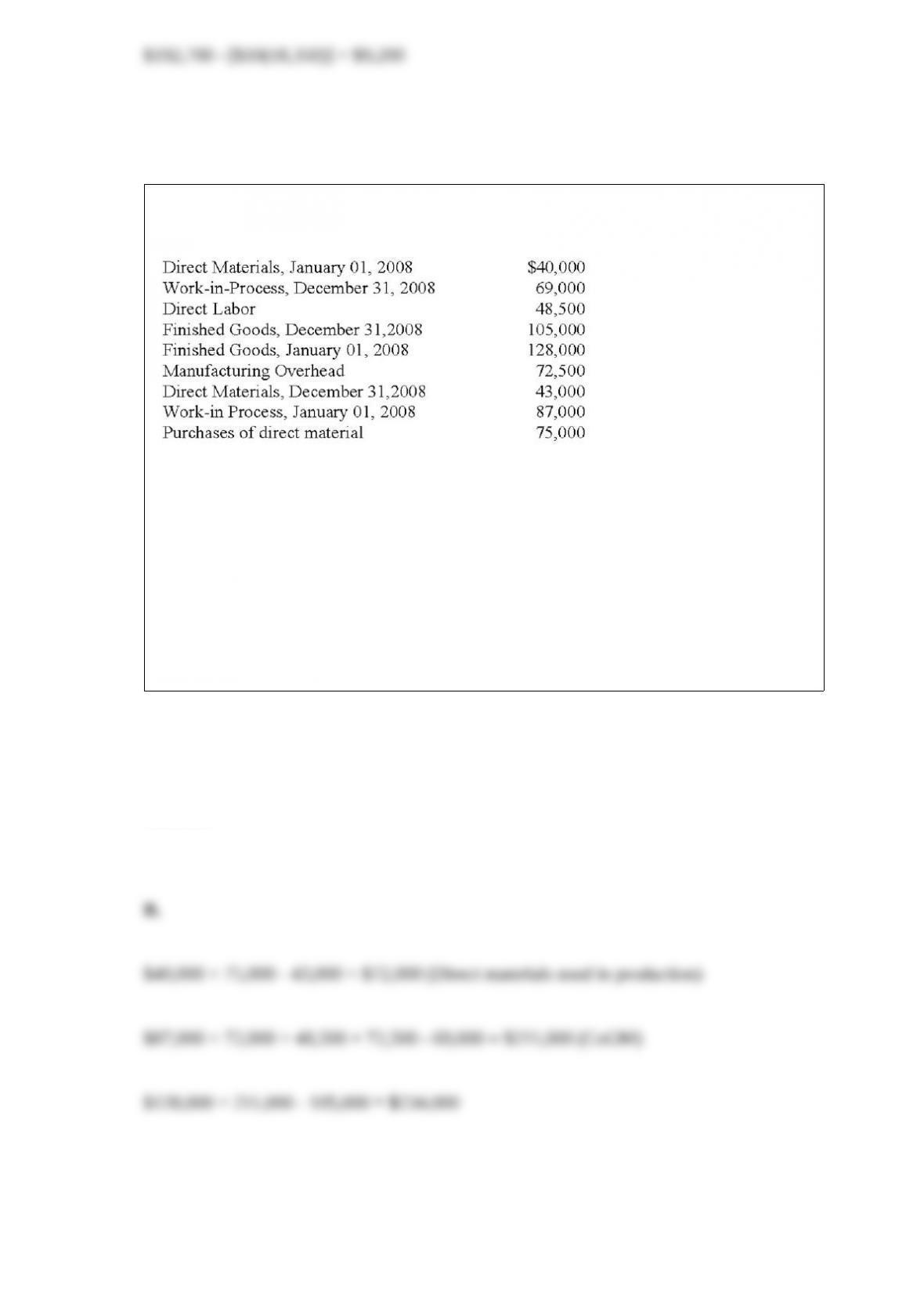
Compute the Cost of Goods Sold for 2008 using the following information:
A. $244,000
B. $234,000
C. $211,000
D. $198,000
E. $188,000
Answer:
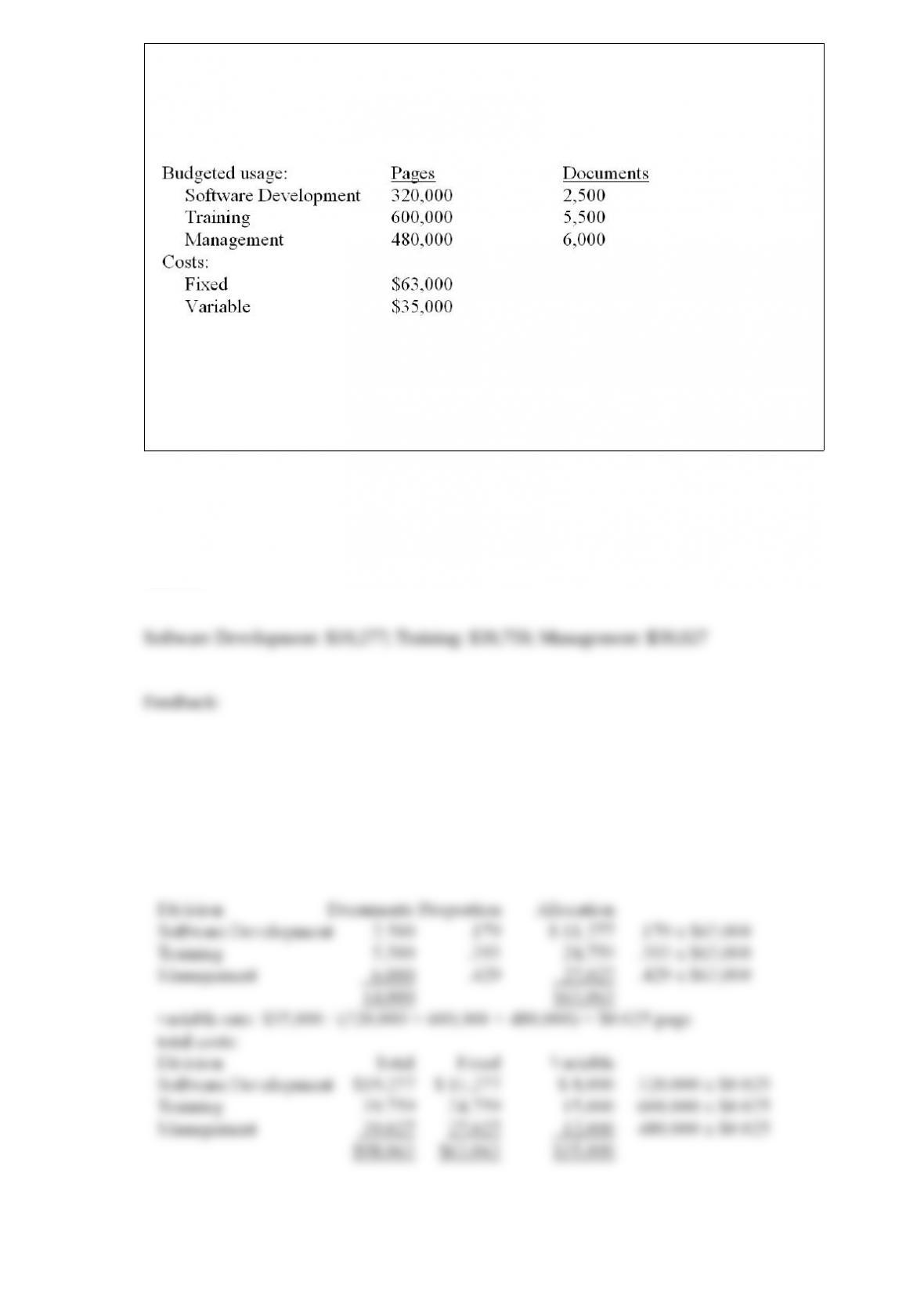
The Document Creation Center (DCC) for Aelerion Corp. provides document services
for three departments in the Denver office. The following budget has been prepared for
the month.
Required (use three decimal places in your calculations):
a) If DCC uses a dual rate for allocating its costs; allocating fixed costs based on
number of documents and variable costs based on number of pages, how much cost will
be allocated to the three user departments?
Answer:
Which of the following items would be classified as a product-level cost in an
activity-based cost management (ABM) system?
A. Change order to meet a new customer’s specification
B. Movement of materials for products in production
C. Long-term lease payments for factory equipment
D. Insurance and property taxes on faculty building
Answer:
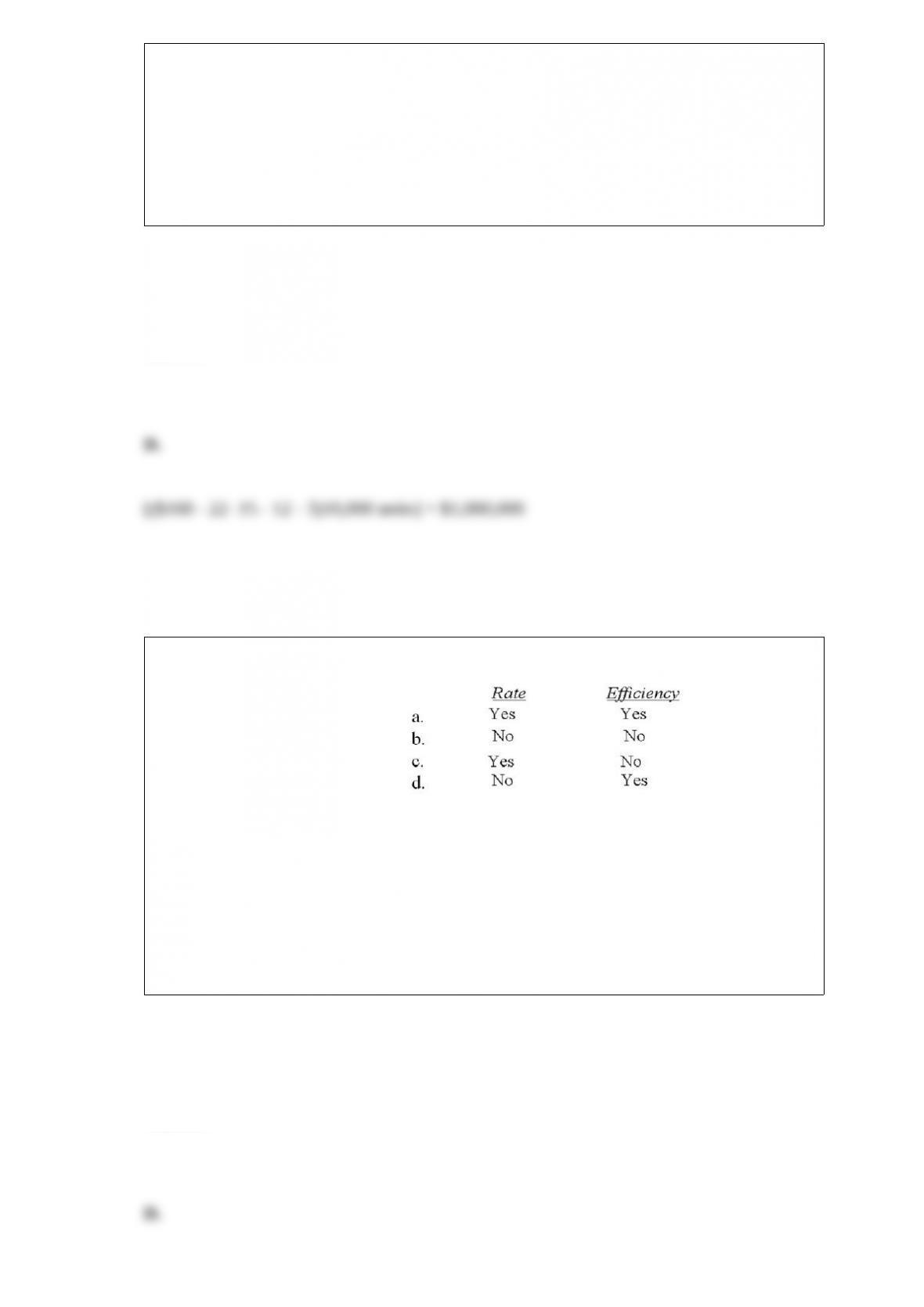
Kator Inc. manufactures industrial components. One of its products used as a
subcomponent in auto manufacturing is KB-96. The selling price and cost per unit data
for 9,000 units of KB-96 is as follows.
During the next year, sales of KB-96 are expected to be 10,000 units. All costs will
remain the same except for fixed manufacturing overhead, which will increase 20%,
and material, which will increase 10%. The selling price per unit for next year will be
$160. Based on this data, Kator Inc.’s total contribution margin for next year will be:
(CMA adapted)
A. $882,000
B. $980,000
C. $972,000
D. $1,080,000
Answer:
Which of the following direct labor variances uses the standard hours allowed for the
actual number of units produced?
A. a
B. b
C. c
D. d
Answer:
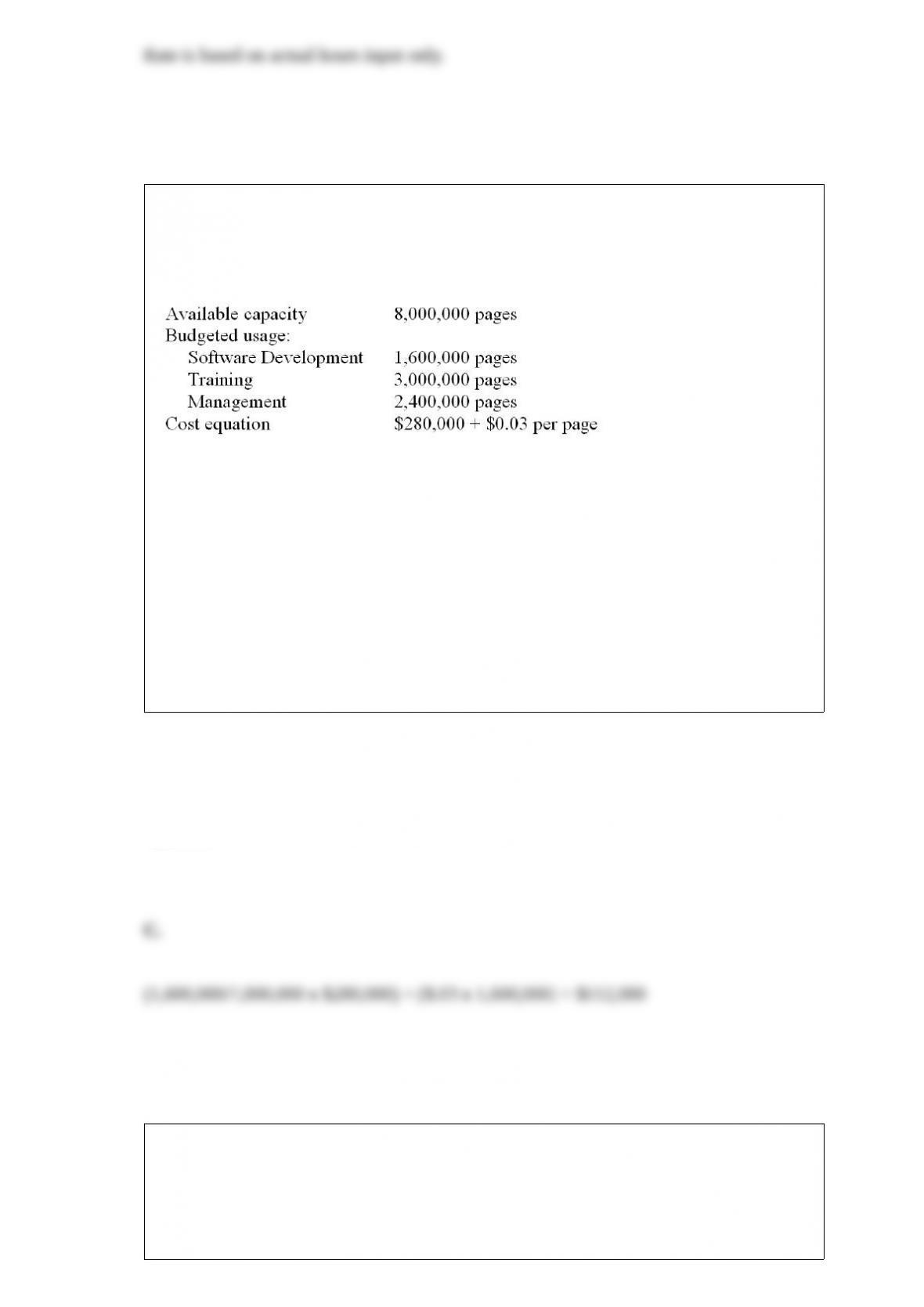
The Document Creation Center (DCC) for Alegis Corp. provides photocopying and
document services for three departments in the St. Paul office. The following budget
has been prepared for the year.
If DCC uses a dual rate for allocating its costs based on usage, how much cost will be
allocated to the Software Development Department?
A. $98,000
B. $104,000
C. $112,000
D. $118,857
Answer:
The system that allows firms to target profitable customers by assessing customer
revenue and costs is called
A. customer relationship management
B. distribution chain
C. total quality management
D. cost of quality
E. enterprise resource planning
Answer:
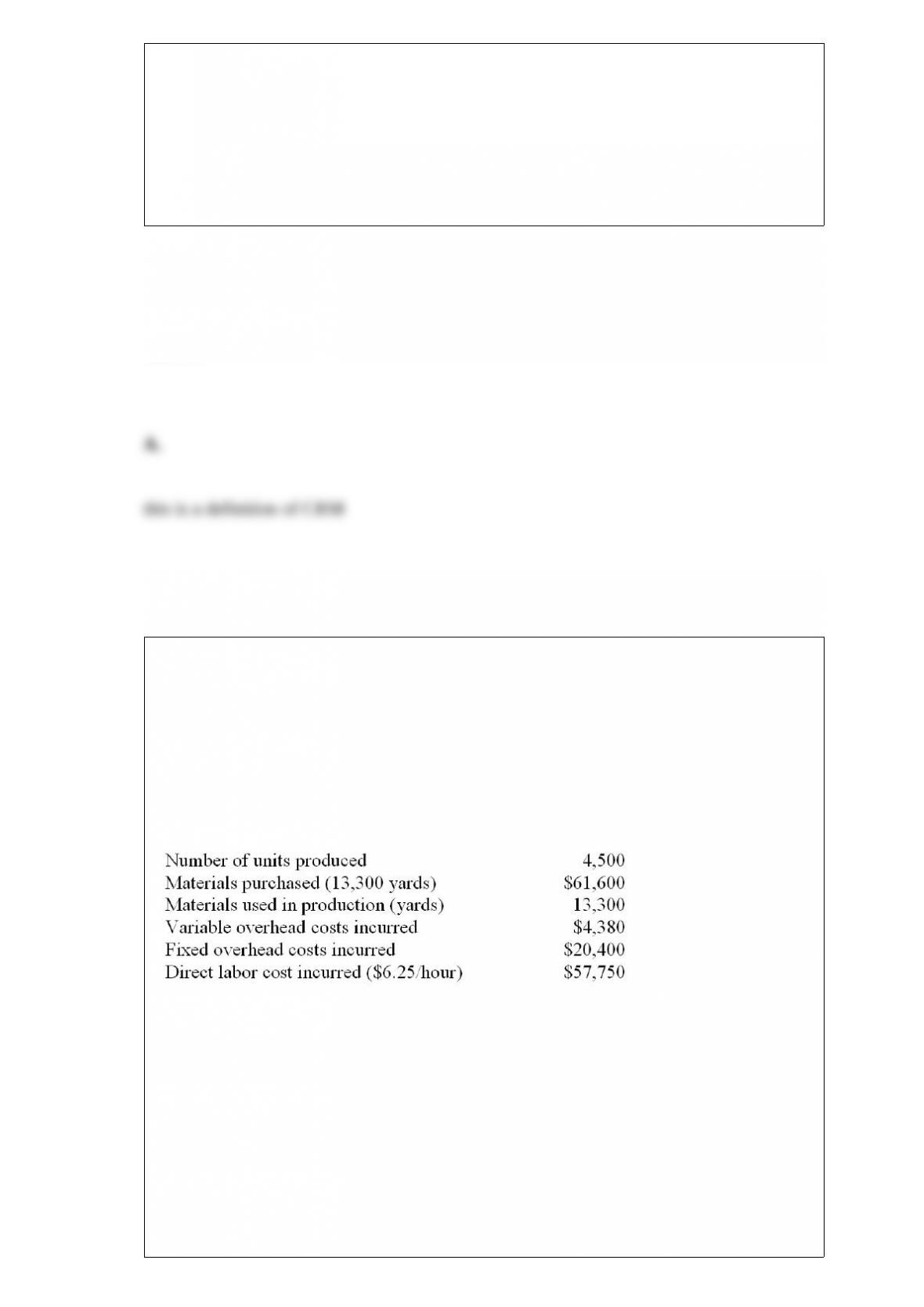
The Acme Company uses a standard cost accounting system and estimates production
for the year to be 60,000 units. At this volume, the company’s variable overhead costs
are $.50 per direct labor hour.
The company’s single product has a standard cost of $30.00 per unit. Included in the
$30.00 is $13.20 for direct materials (3 yards) and $12.00 of direct labor (2 hours).
Production information for the month of March follows:
Required: Prepare the journal entries to record the following:
a) Purchase and use of direct materials (Assume materials are used as purchased and no
inventory is maintained).
b) Recognition of direct labor.
c) Incurring actual overhead
d) Application of overhead to production.
e) Closing of overhead accounts and recognizing variances.
f) Transferring production to finished goods.
Answer:
Which of the following statements regarding the use of historical costs and current
costs to compute return on investment (ROI) is (are) true?
(A) Historical costs are based on the original costs to acquire a long-term asset, while
current costs represent the costs to replace the long-term asset.
(B) For a specific multiple-period project, the return on investment (ROI) computed
using current costs will generally be less than the ROI computed using historical costs.
A. only (A) is true
B. only (B) is true
C. both (A) and (B) are true
D. neither (A) and (B) is true
Answer:
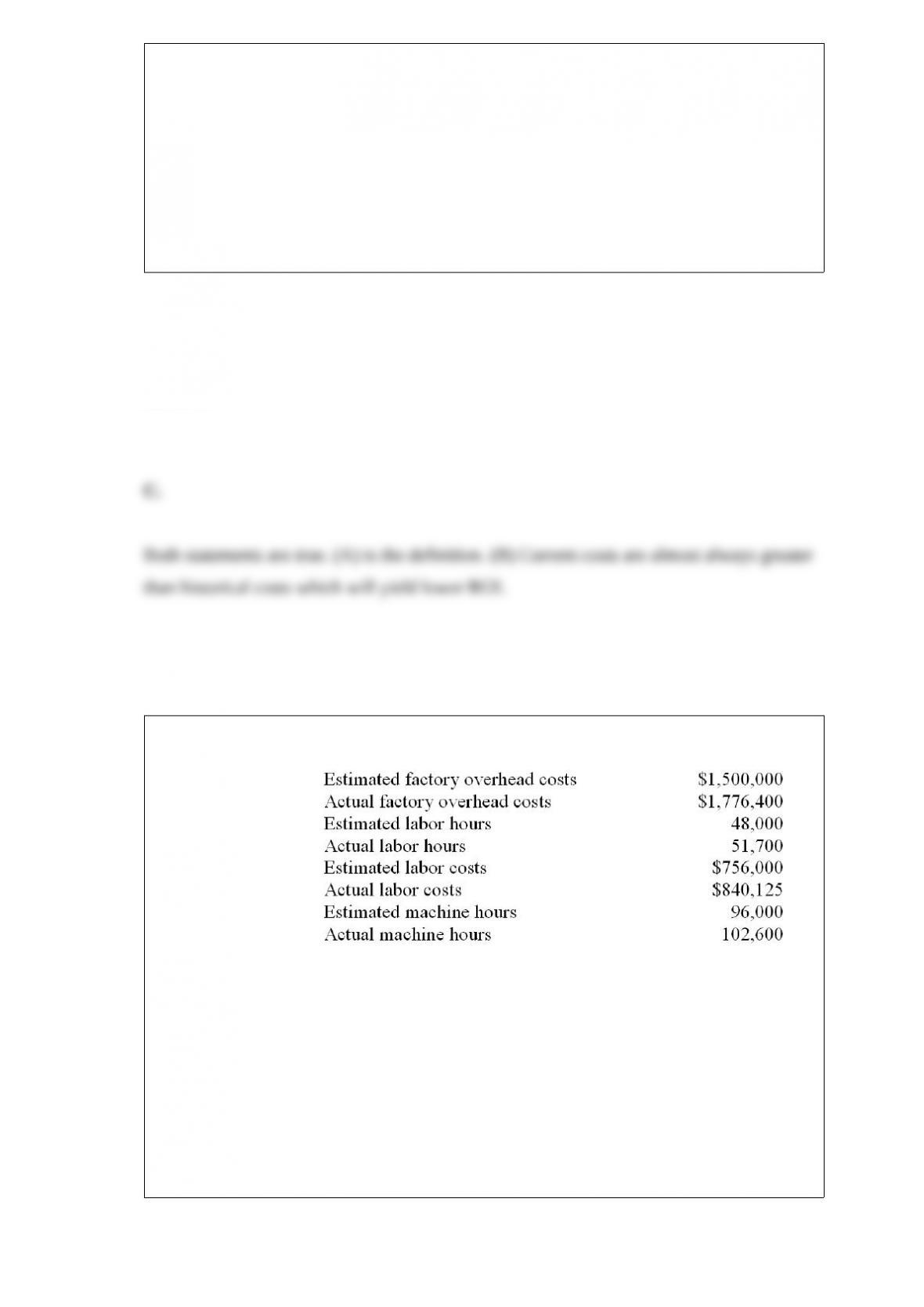
The following information has been gathered for Roswell Machining for its fiscal year
ending December 31:
What is the predetermined factory overhead rate per machine hour?
A. $15.625
B. $14.620
C. $18.504
D. $17.314
Answer:
Which of the following would not cause the break-even point to change?
A. Sales price increases.
B. Fixed cost decreases.
C. Sales volume decreases.
D. Variable costs per unit increases.
E. Product mix shifts towards the cheaper products.
Answer:
What is the value of the ending Finished Goods Inventory?
A. $13,250
B. $24,628.50
C. $26,481.00
D. $164,190.00
Answer:
The Regal Baking Company is considering the expansion of its business into
door-to-door delivery service. This would require an additional $12,500 in labor costs
per month. Company-owned vehicles now used to make morning deliveries to
restaurants could be used in the afternoons to make the home deliveries. However, it is
estimated that an additional $5,000 would be required per month for gas, oil, and
maintenance. It is further estimated that the home delivery use of the trucks would be
allocated 45% of the existing $6,500 fixed vehicle costs. What is the differential
delivery cost per month for expanding into the home delivery market?
A. $12,500
B. $17,500
C. $19,750
D. $20,425
Answer:
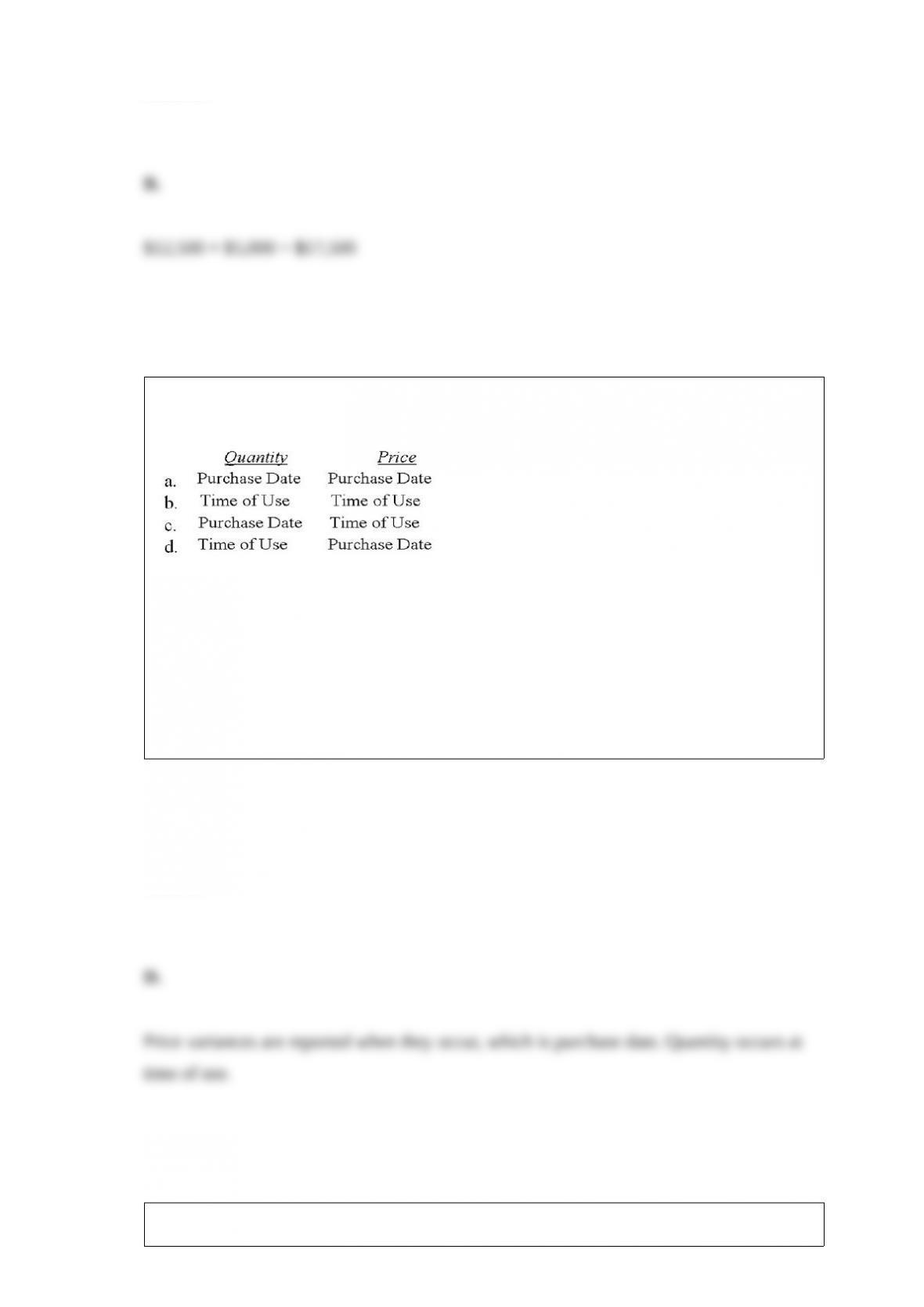
When are the following direct materials variances ideally reported?
A. a
B. b
C. c
D. d
Answer:
Osgood Inc has 6,400 machine hours available each month. The following information
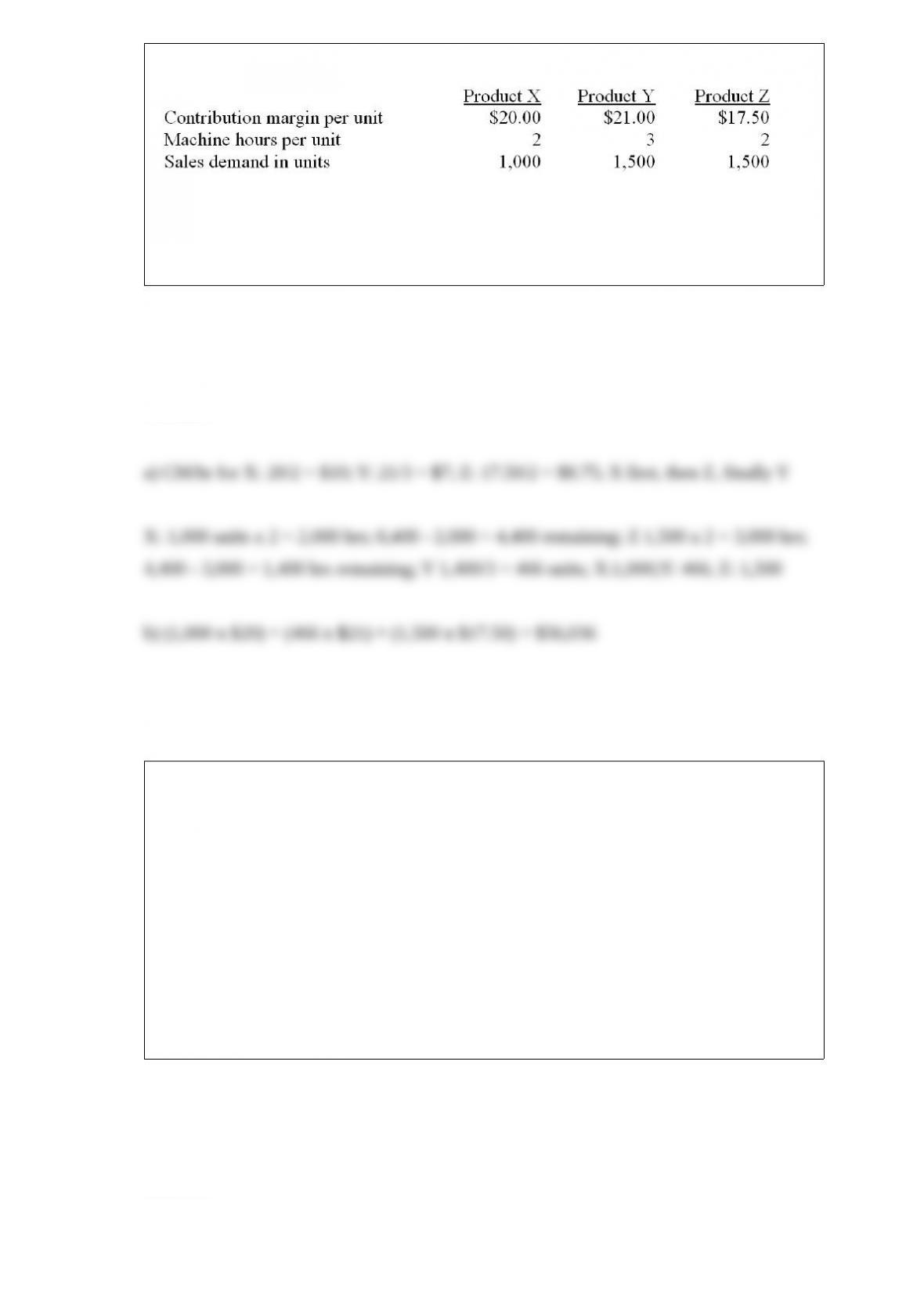
on the company’s three products is available:
a) What production schedule will maximize the company’s profits?
b) What will be the maximum possible contribution margin?
Answer:
Mounder processes rebate requests for a large building supply firm. Mounder
processed 420,000 rebates in March. All rebates are processed the same day they are
received. March costs were labor of $28,000 and overhead of $14,000. What is the cost
to process 1,000 rebates?
A. $66.67
B. $100.00
C. $10.00
D. $42.00
Answer:
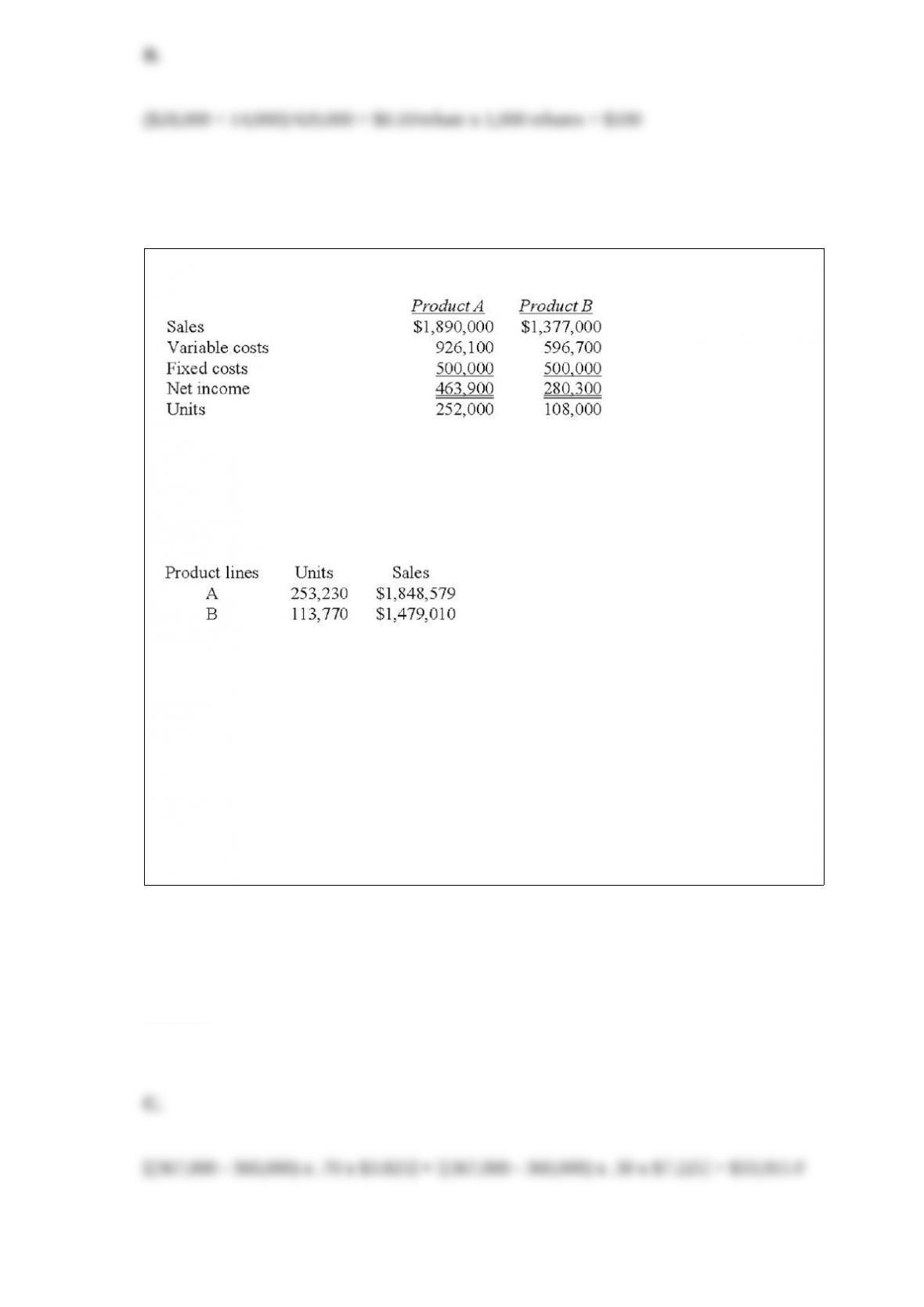
The next year’s budget for Green, Inc., a multi-product company, is given below:
At the end of the year, the total fixed costs and the variable costs per unit were exactly
as budgeted, but the following units per product line were sold. Green analyzes the
effects its sales variances have on the profitability of the company.
What is the total sales quantity variance?
A. $3,570.00
B. $20,815.00
C. $33,915.00
D. $40,553.50
Answer:
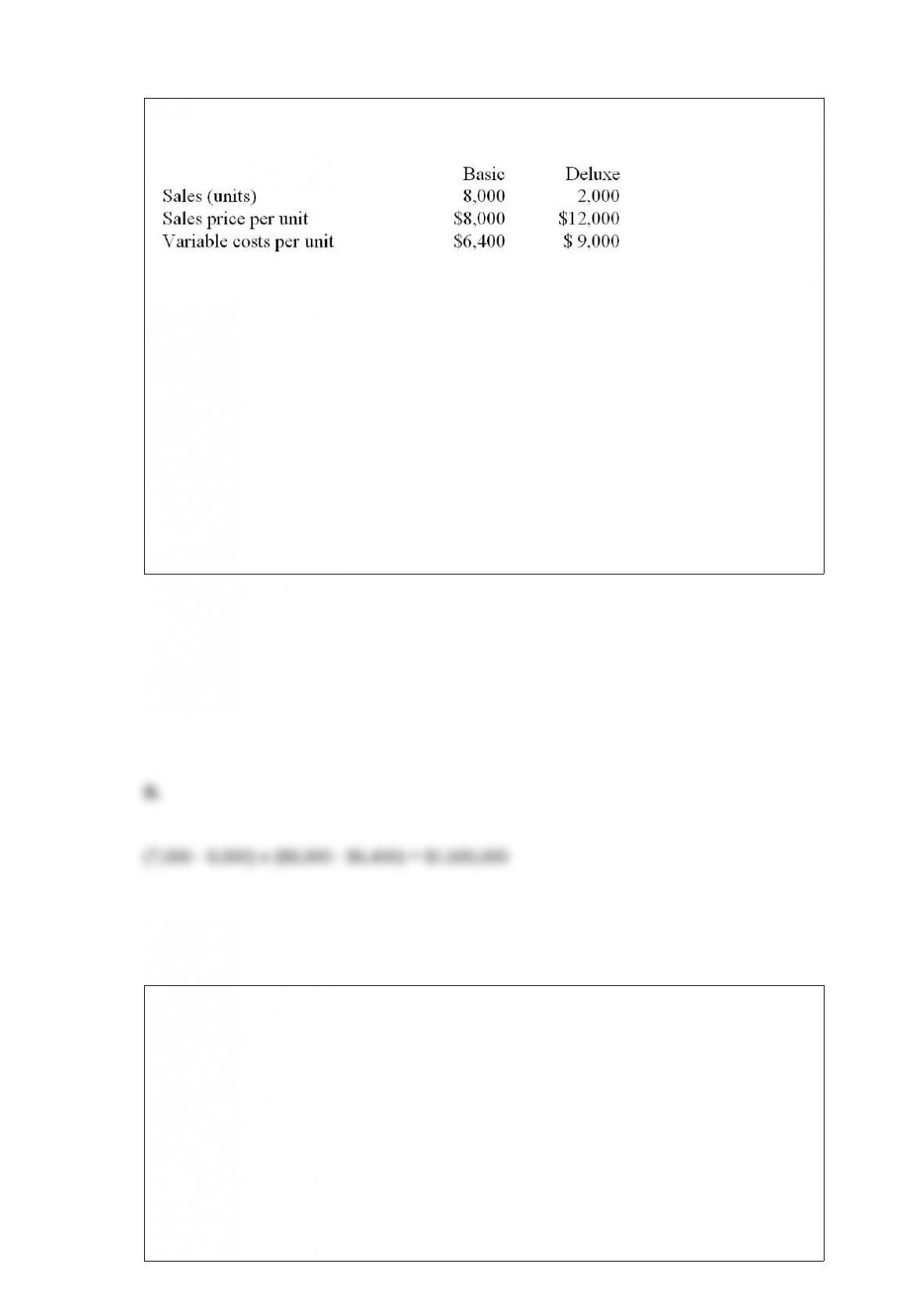
A machine distributor sells two models, basic and deluxe. The following information
relates to its master budget.
Actual sales were 7,000 basic models and 2,800 deluxe models. The actual sales prices
were the same as the budgeted sales prices for both models.
What is the sales activity variance for the basic model?
A. $1,280,000
B. $1,600,000
C. $11,200,000
D. $12,800,000
Answer:
JJ Motors Inc. employs 45 sales personnel to market their line of luxury automobiles.
The average car sells for $23,000, and a 6 percent commission is paid to the
salesperson. JJ Motors is considering a change to the commission arrangement where
the company would pay each salesperson a salary of $2,000 per month plus a
commission of 2 percent of the sales made by that salesperson. The amount of total
monthly car sales at which JJ Motors would be indifferent as to which plan to select is
A. $2,250,000.
B. $3,000,000.
C. $1,500,000.
D. $1,250,000.
E. $4,500,000.
Answer:
Materials are added at the beginning of a process in a process costing system. The
beginning Work-in-Process Inventory was 30% complete as to conversion costs. Using
first-in, first-out (FIFO) process costing, the total equivalent units for material are
A. beginning inventory this period for this process.
B. units started this period in this process.
C. units started this period in this process plus the beginning inventory.
D. units started this period in this process plus 70% of the beginning inventory this
period.
Answer:
Which of the following statements is (are) true?
I. For cost control, the FIFO method of process costing is better than the
weighted-average method.
II. The weighted-average method of process costing assigns more cost to units
completed (transferred out) than the FIFO method.
A. I only.
B. II only.
C. Both I and II.
D. Neither I nor II.
Answer:
Which of these variances is least significant for cost control?
A. labor price variance
B. material quantity variance
C. fixed overhead price variance
D. production volume variance
E. labor efficiency variance
Answer:
The period of time over which capacity will be unchanged is
A. long run
B. sunk cost
C. short run
D. product life cycle
Answer:
Which one of the following items would most likely not be incorporated into the
calculation of a division’s investment base when using the residual income approach for
performance measurement and evaluation?
A. Land being held by the division as a potential site for a new plant and parking lot.
B. Division inventories when division management exercises control over the inventory
levels.
C. Division accounts payable when division management exercises control over the
amount of short-term credit utilized.
D. Division accounts receivable when division management exercises control over
credit policy and credit terms.
Answer:
Mounder Manufacturing Company employs job costing to account for its costs. There
are three production departments, and separate departmental overhead application rates
are employed. All jobs generally pass through all three production departments. Data
regarding the hourly direct labor rates, overhead application rates, and three jobs on
which work was done during the month appear below. Job 611 and Job 613 were
completed during the current month, Job 612 was still in process. (CIA Examination
adapted)
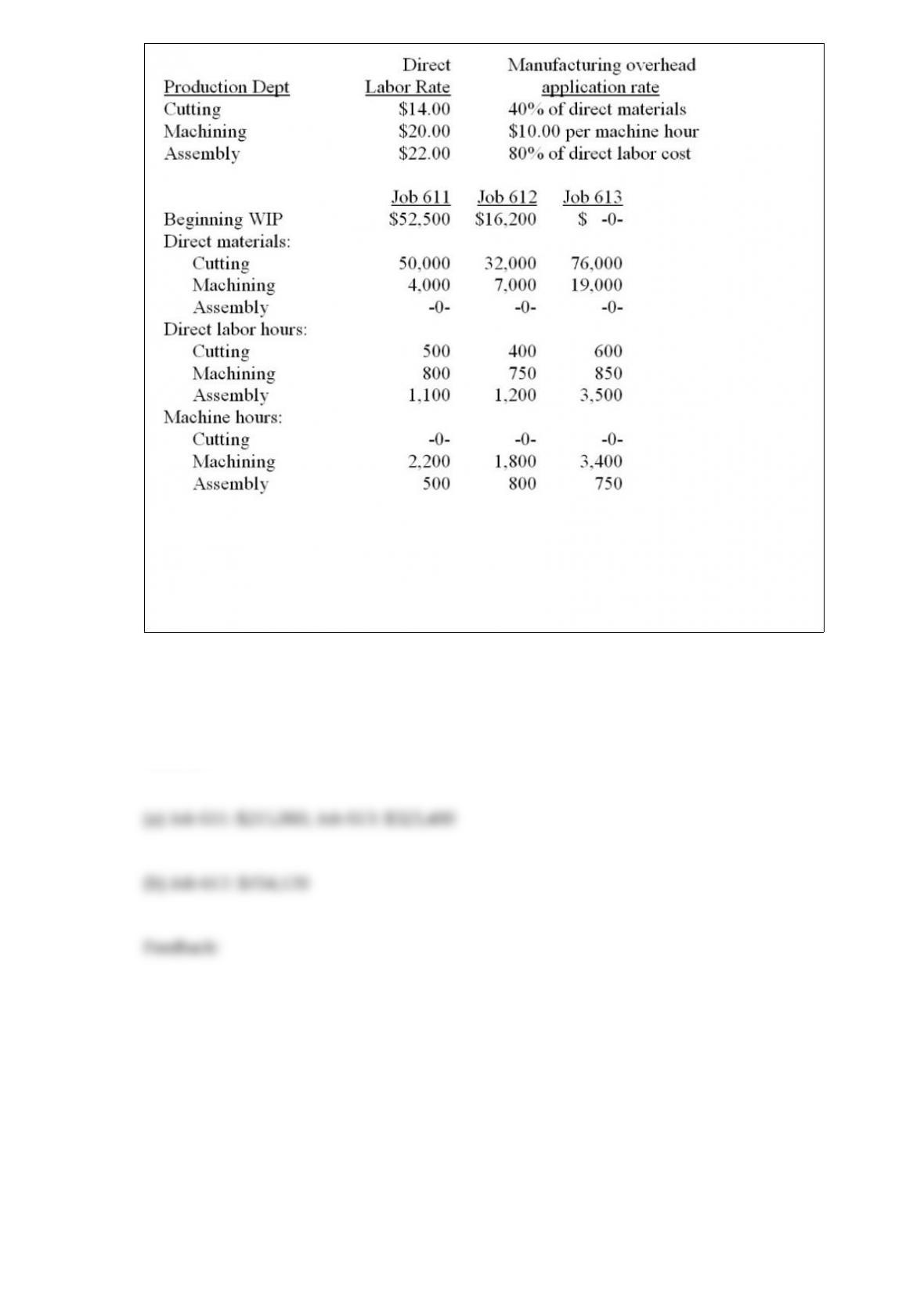
Required:
(a) Compute the completed costs of Job 611 and Job 613.
(b) Compute the value of the Work-in-Process Inventory at the end of the month.
Answer:
Cost pools are:
A. costs that are accumulated before being allocated to cost objects on some common
basis.
B. costs that are relevant to decision-making but irrelevant to financial reporting.
C. product costs that are assigned to cost objects using direct labor or machine hours.
D. accounts in the product life cycle from research and development to customer
service.
Answer:
Which of the following statements is (are) true regarding the application of
manufacturing overhead?
(A) Manufacturing overhead is only recorded on the job cost sheets when (a) financial
statements are prepared or a job is completed.
(B) Overapplied overhead occurs when the actual overhead costs incurred during a
period are greater than the overhead costs applied during the period.
A. Only A is true.
B. Only B is true.
C. Both A and B are true.
D. Neither A nor B is true.
Answer:
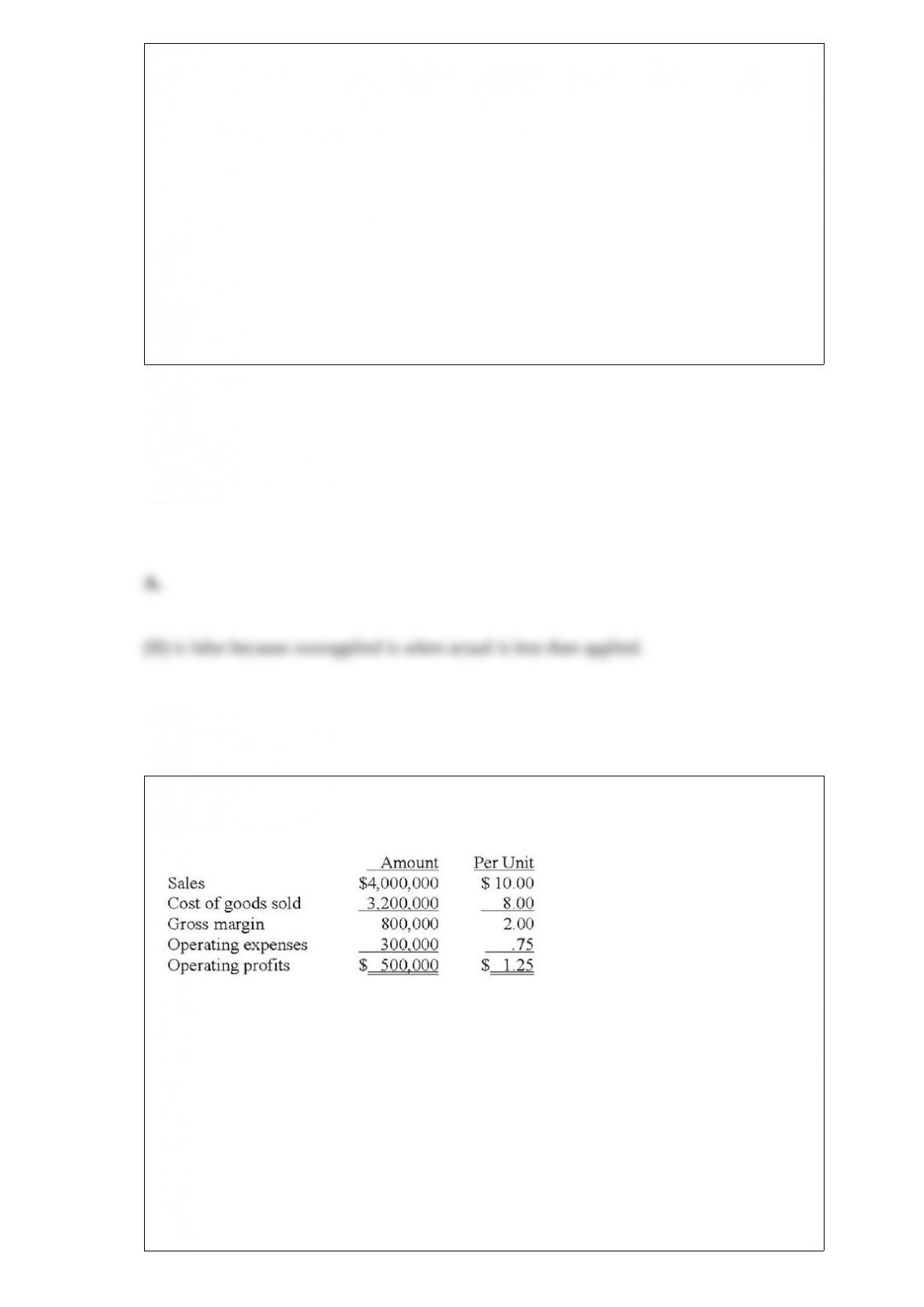
The following information relates to the Tram Company for the upcoming year.
The cost of goods sold includes $1,200,000 of fixed manufacturing overhead; the
operating expenses include $100,000 of fixed marketing expenses. A special order
offering to buy 50,000 units for $7.50 per unit has been made to Tram. Fortunately,
there will be no additional operating expenses associated with the order and Tram has
sufficient capacity to handle the order. How much will operate profits be increased if
Tram accepts the special order?
A. $25,000
B. $62,500
C. $100,000
D. $125,000
E. Operating profits will not increase as a result of accepting the special order.
Answer:
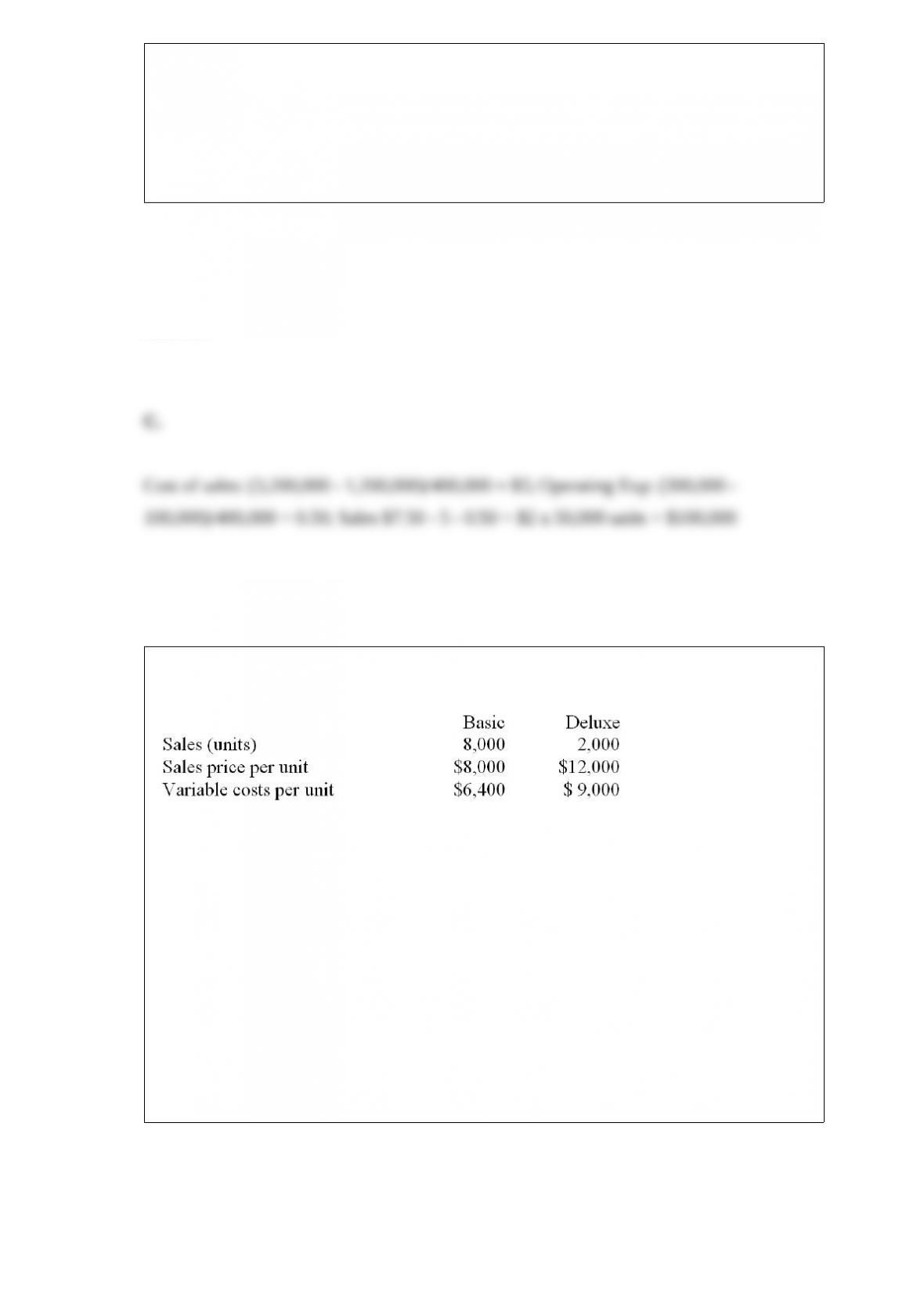
A machine distributor sells two models, basic and deluxe. The following information
relates to its master budget.
Actual sales were 7,000 basic models and 2,800 deluxe models. The actual sales prices
were the same as the budgeted sales prices for both models.
What is the sales quantity variance for the basic model?
A. $120,000
B. $256,000
C. $1,344,000
D. $1,600,000
Answer:
Breakeven analysis assumes that over the relevant range (CPA adapted):
A. Total Fixed Costs are nonlinear.
B. Total Costs are unchanged.
C. Unit Variable Costs are unchanged.
D. Unit Revenues are nonlinear.
Answer:
In an activity-based cost management (ABM) system, facility-level costs are those that
are incurred to:
A. sustain the company’s marketing program.
B. maintain the plant’s production capacity.
C. support the research and development process.
D. caused by a change in the engineering plans for a product.
Answer: