The balance sheet caption for common stock is:
Common stock, no par value, 15,000,000 shares authorized, 9,200,000 shares issued,
8,900,000 shares outstanding $1,104,000,000
(a.) Calculate the average price at which the shares were issued.
(b.) If these shares had been assigned a stated value of $10 each, show how the above
caption would be different.
(c.) Calculate the total amount of cash that would be paid to stockholders if a cash
dividend of $1.50 per share were declared.
Which of the following is not an example of a decision or informed judgment that a
potential investor would make from accounting information?
A. Future profitability based on past profitability.
B. Probability of success of a new product development.
C. A forecast of dividends.
D. Assessment of risk that a company may have more debt than it can repay if the
economy enters a recession.
A cash equivalent is a current asset that:
A. will be converted to cash within one year.
B. will be converted to cash within one month.
C. is readily convertible into cash with a minimal risk.
D. is readily convertible into cash with a substantial risk.
E. none of the above.

Which of the following is not a transaction to be recorded in the accounting records of
an entity?
A. Investment of cash by the owners.
B. Sale of product to customers.
C. Receipt of a plaque recognizing the firm’s encouragement of employee participation
in the United Way fund drive.
D. Receipt of services from a “quick-print” shop in exchange for the promise to provide
advertising design services of equivalent value.
When a company splits its common stock 3 for 1:
A. total paid-in capital increases by a factor of 3.
B. retained earnings is decreased by the market value of the shares issued.
C. the market value of the company’s stock normally falls by two-thirds.
D. the stockholders are assured of receiving larger cash dividends.
When an appropriately established and effective standard cost system is used to value
inventory:
A. cumulative variances are deferred.
B. a significant unfavorable net variance may be reported as an expense of the current
period.
C. a significant favorable net variance may be reported as an expense of the current
period.
D. the explanatory notes to the financial statements will explain the disposition of the
net variance.
When an income statement shows data for segments of the organization, and data for
each segment are added together to get totals for the whole organization:
A. all expenses should be allocated to the segments.
B. common fixed expenses should be allocated to the segments.
C. only direct revenues and direct expenses should be assigned to segments.
D. direct fixed expenses should be subtracted as one amount in the “total” column.
When a firm has financial leverage:
A. ROI will be greater than ROE.
B. ROI will usually be less than it would be without leverage.
C. risk is greater than if there wasn’t any leverage.
D. the firm will always have a higher ROE than it would without leverage.
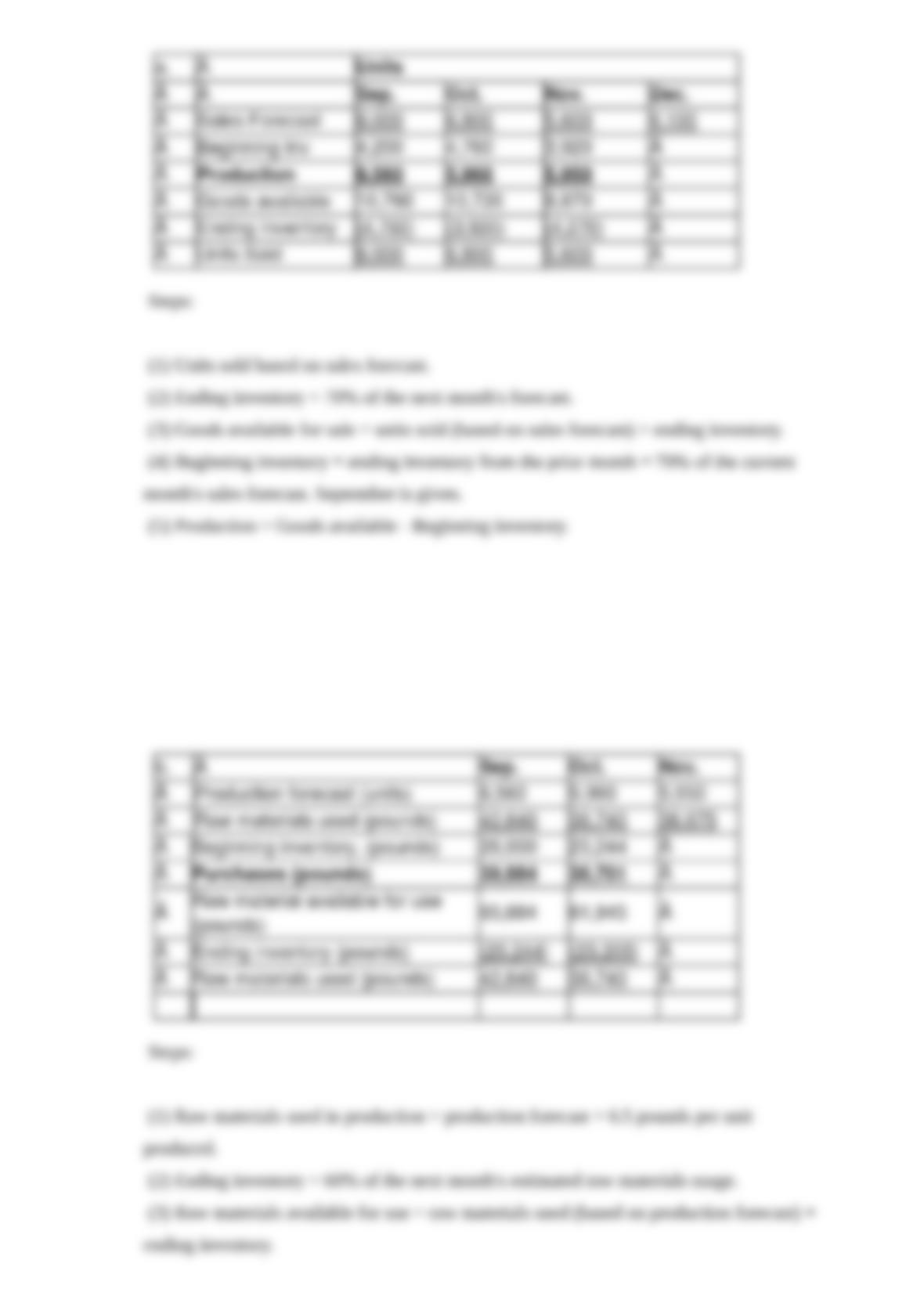
Pacesetters, Inc., has actual sales for July and August and forecasted sales for
September, October, November, and December as follows:
(a.) The firm’s policy is to have finished goods inventory on hand at the end of the month
that is equal to 70 percent of the next month’s sales. It is currently estimated that there will
be 4,200 units on hand at the end of August. Calculate the number of units to be produced
in each of the months of September, October, and November.
(b.) Each unit of finished product requires 6.5 pounds of raw materials. The firm’s policy
is to have raw material inventory on hand at the end of each month that is equal to 60
percent of the next month’s estimated usage. It is currently estimated that 26,000 pounds of
raw materials will be on hand at the end of August. Calculate the number of pounds of raw
materials to be purchased in each of the months of September and October.
Southern Company’s accountant failed to accrue as of 12/31/16 some employee fringe
benefit program expenses that were incurred in 2016 and that will be paid in 2017. The
result of this omission is to:
A. overstate the current ratio at 12/31/16 and overstate ROI and ROE for the year ended
12/31/16.
B. overstate the current ratio at 12/31/16 and understate ROI and ROE for the year
ended 12/31/16.
C. understate the current ratio at 12/31/16 and understate ROI and ROE for the year
ended 12/31/16.
D. not affect the current ratio at 12/31/16 but to overstate ROI and ROE for the year
ended 12/31/16.
Selling price per unit $100 Variable expenses per unit $40 Fixed expenses per month
$60,000
The break-even point volume of units is:
A. 0.
B. 360.
C. 720.
D. 1000.
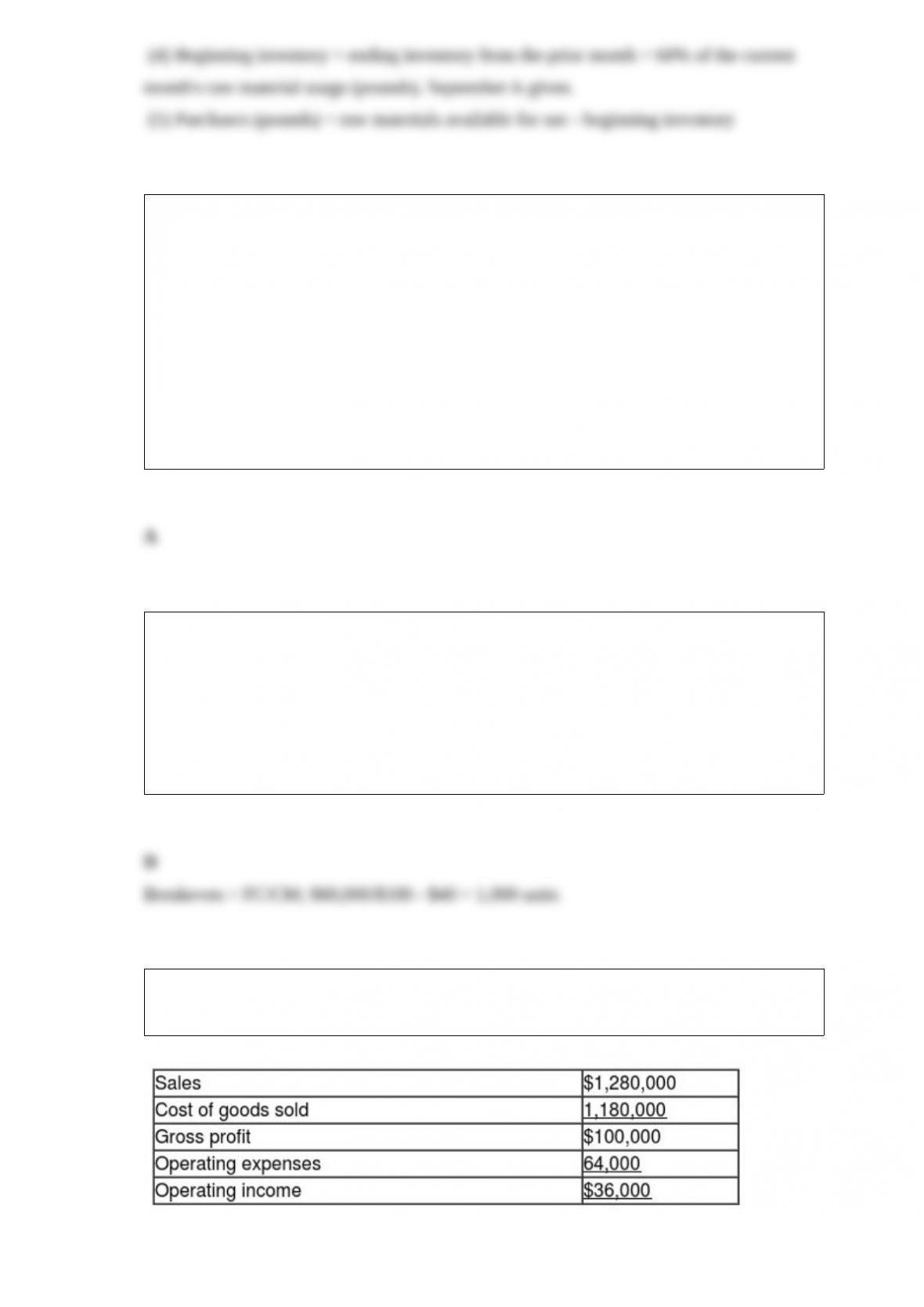
Presented below is the income statement for Ackee Food Center for the month of July:
Based on an analysis of cost behavior patterns, it has been determined that the company’s
contribution margin ratio is 15 percent.
(a.) Rearrange the above income statement to the contribution margin format.
(b.) If sales increase by 10 percent, what will be the firm’s operating income?
(c.) Calculate the amount of revenue required for Ackee’s Food Center to break even.
The part of the variable overhead budget variance due to the difference between actual
variable overhead cost and the standard cost allowed for the actual inputs used is called
the:
A. variable overhead spending variance.
B. variable overhead budget variance.
C. variable overhead efficiency variance.
D. variable overhead volume variance.
The term “relevant range” refers to:
A. the range of activity where costs will fluctuate.
B. the range of activity where fixed costs change as activity changes.
C. the range of activity where total variable cost remains constant as activity changes.
D. the range of activity where cost relationships are valid.
The term preemptive right pertains to which of the following?
A. The Board of Directors rights in liquidation.
B. Present shareholders’ right to purchase shares from any additional share issuances.
C. Present shareholders’ right to purchase treasury shares when reissued.
D. Preferred stockholders’ right to dividends.
Which of the following descriptions is not one of the “Thirteen Financial Shenanigans”
identified by Schilit and Perler, and listed in Exhibit 10-1?
A. recording revenue too soon or that is of a questionable quality.
B. boosting income with one-time gains.
C. failing to record intangible assets which the company has ownership rights to.
D. shifting future expenses to the current period as a special charge.
E. failing to record or improperly reducing liabilities.
In the seller’s records, the sale of merchandise on account would:
A. increase assets and increase expenses.
B. increase assets and decrease liabilities.
C. increase assets and increase paid-in capital.
D. increase assets and decrease revenues.
If a common stock has no par value:
A. there is no way of determining the market value per share.
B. the stock must have a stated value.
C. there will not be any additional paid-in capital related to it.
D. the stockholders do not have a preemptive right.
The balance sheet of an entity:
A. shows the fair value of the assets at the date of the balance sheet.
B. reflects the impact of inflation on the replacement cost of the assets.
C. reports plant and equipment at its opportunity cost.
D. shows amounts that are not adjusted for changes in the purchasing power of the
dollar.
Consolidated financial statements report financial position, results of operations, and
cash flows for:
A. a parent corporation and its subsidiaries.
B. a parent corporation alone.
C. two corporations that are owned by the same individual.
D. a parent corporation and its 100% owned subsidiaries only.
The nature and content of disclosures relate to all of the following except:
A. accounting changes.
B. segment information.
C. management’s plans for the future.
D. contingencies and commitments.
E. events subsequent to the balance sheet date.
An advantage of the DuPont model for calculating ROI is that:
A. it focuses on asset utilization as well as net income.
B. it is easier to use than the straightforward ROI formula.
C. it uses average assets and the straightforward ROI formula does not.
D. it uses stockholders’ equity.
A key to estimating an accurate amount of cash to be collected from sales is:
A. the accuracy of the sales forecast.
B. the accuracy of the estimated collection patterns for sales.
C. both a and b are keys.
D. neither a nor b are keys.
Which of the following is not a limitation of financial statements?
A. Financial statements report quantitative economic information; they do not reflect
qualitative economic variables.
B. The cost principle requires assets to be recorded at their original cost; thus, the
balance sheet does not generally reflect the fair values of most assets and liabilities.
C. Net income from the income statement is added to the Retained Earnings account
balance in the balance sheet.
D. Estimates are used in many areas of accounting; when the estimate is made, about
the only fact known is that the estimate is probably not equal to the “true” amount.
In addition to developing the standard cost for a unit of product, organizations may
determine standards for such activities as:
A. quality control measures.
B. machine usage and performance.
C. customer service response times.
D. all of the above.
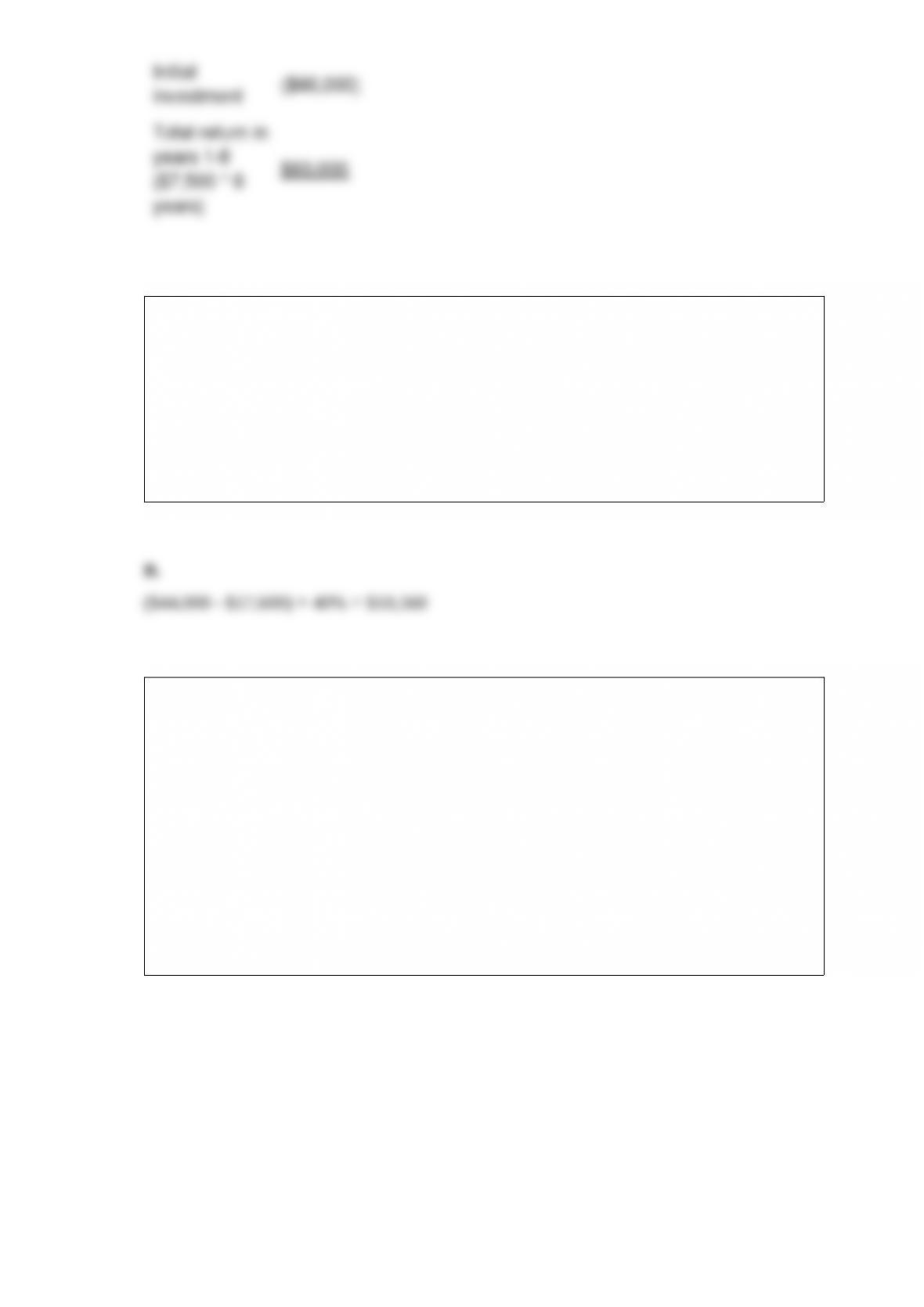
Springfield Manufacturing Co. is considering the investment of $60,000 in a new
machine. The machine will generate cash flow of $7,500 per year for each year of its 15
year life and will have a salvage value of $4,000 at the end of its life. Springfield’s cost
of capital is 10%.
(a.) Calculate the net present value of the proposed investment. Ignore income taxes,
and round all answers to the nearest $1.
(b.) Calculate the present value ratio of the investment.
(c.) What will the internal rate of return on this investment be relative to the cost of
capital? Explain your answer.
(d.) Calculate the payback period of the investment.
Moped, Inc. purchased machinery at a cost of $44,000 on January 1, 2017. The
expected useful life is 5 years and the asset is expected to have salvage value of $4,000.
Moped depreciates its assets using the double-declining balance method.
What is the accumulated depreciation for this asset on December 31, 2018?
A. $8,800
B. $10,560
C. $17,600
D. $28,160
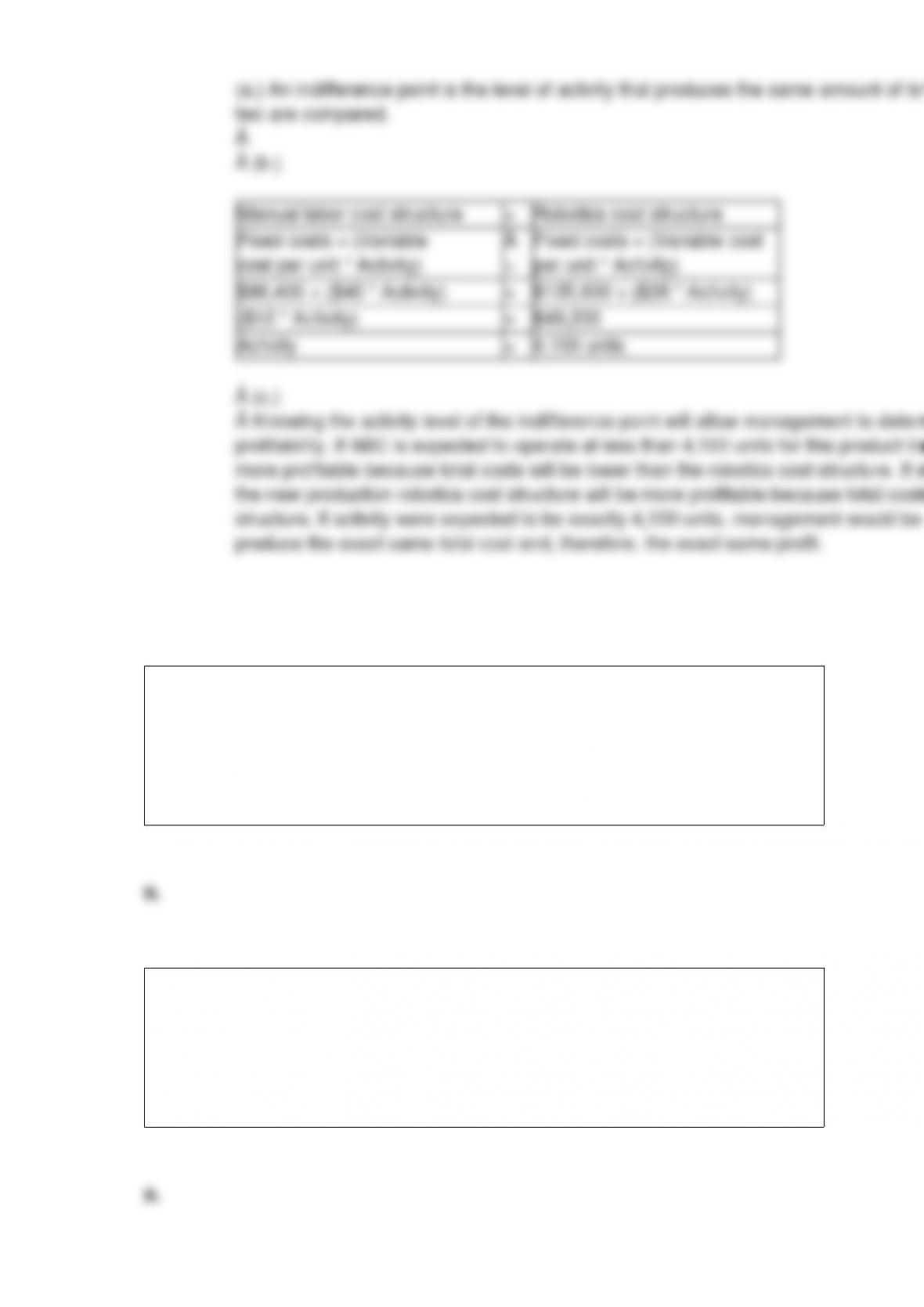
Management of ABC Company is considering new production robotics to replace some
current manual labor operations for one of their product lines. ABC’s current cost
structure for this product line consists of variable expenses of $40 per unit and fixed
expenses totaling $86,400 per month. If the robotics were installed, variable expenses
would drop to $28 per unit, but fixed expenses would increase to $135,600 per month.
(a.) Define the term indifference point.
(b.) Calculate the indifference point between the alternative cost structures for ABC
Company’s product line.
(c.) Explain how ABC’s management would use the indifference point in the decision to
replace the manual operations with the new production robotics.
If a firm’s payment terms for sales made on account to its customers were 2/10, n30, the
number of days’ sales in accounts receivable would be expected to be:
A. less than 10.
B. between 10 and 25.
C. between 25 and 40.
D. over 40.
An organization’s value chain refers to:
A. the process of using cost information to manage the activities of the organization.
B. the sequence of functions and related activities that add value for the customer.
C. the process of collecting and recording valuable information in the accounting
information system.
D. None of the above.
Recognition of revenue in accrual accounting requires:
A. that cash be received.
B. only that the amount of cash to be received from the sale of a product or service be
known.
C. only that a product be delivered or a service be performed.
D. that the revenue be realized or realizable, and earned.
Val’s travel budget for October was $720, based on her plan to drive 3,000 miles at a
cost of $0.24 per mile. During October, she actually drove 2,800 miles at a total cost of
$700. A flexed budget performance report would show a variance of:
A. $50 F.
B. $20 F.
C. $28 U.
D. $30 U.
A fiscal year:
A. is always the same as the calendar year.
B. is frequently selected based on the firm’s operating cycle.
C. must always end on the same date each year.
D. must end on the last day of a month.