
A guaranteed residual value at the inception of a capital lease should be: A. Excluded
from minimum lease payments.
B. Included as part of minimum lease payments at present value.
C. Included as part of minimum lease payments at future value.
D. Included as part of minimum lease payments only to the extent that guaranteed
residual value is expected to exceed estimated residual value.
Answer:
Listed below are five terms followed by a list of phrases that describe or characterize
each of the terms. Match each phrase with the correct term. 1) Current liabilities
2) Usual valuation of long-term liabilities
3) Long-term liabilities
4) Commercial paper
5) Disclosure notes
A. Required for contingencies
B. Avoids registration with SEC
C. Payable with current assets
D. Present value of interest plus present value of principal

E. Short-term debt to be refinanced with long-term bonds payable
Answer:
Under IFRS, the conceptual framework: A.Emphasizes the overarching concept of the
financial statements providing a “true and fair representation” of the company.
B.Is not designed to provide guidance to standard setters, but rather only to
practitioners.
C.Is not designed to provide guidance to practitioners, but rather only to standard
setters.
D.Specifies a set of rules that determine what constitutes a true IFRS standard.
Answer:
From the perspective of the lessor, leases may be classified as either: A. Direct
financing or sales-type.
B. Operating, capital, or direct financing.
C. Operating, sales-type, indirect financing.
D. Operating, direct financing, or sales-type.

Answer:
Which of the following would not be accounted for using the retrospective approach?
A. A change from LIFO to FIFO inventory costing.
B. A change from the completed contract method to the percent-of-completion method
for long-term construction contracts.
C. A change in depreciation methods.
D. A change from the full cost method in the oil industry.
Answer:
Independent auditors express an opinion on the: A.Fairness of financial statements.
B.Accuracy of financial statements.
C.Soundness of a company’s future.
D.Quality of a company’s management.
Answer:

Under IFRS, revenue for a product sale should occur when: A. Inventory production is
complete.
B. Warrantee fulfillment is viewed as unlikely.
C. The seller has transferred to the buyer the risks and rewards of ownership and doesn’t
effectively manage or control the goods.
D. The buyer has paid a preponderance of installment amounts due.
Answer:
Which of the following usually results in an increase in a deferred tax liability? A.
Accrual of estimated operating expenses.
B. Revenue collected in advance.
C. Prepaid operating expenses, currently deductible.
D. All of the above are correct.
Answer:

A company failed to record unrealized gains of $20 million on its available for sale
security investments. Its tax rate is 30%. As a result of this error, comprehensive income
would be: A. Understated by $14 million.
B. Understated by $6 million.
C. Understated by $20 million
D. Unaffected.
Answer:
Listed below are five terms followed by a list of phrases that describe or characterize
each of the terms. Match each phrase with the correct term. 1)Component of an entity
2)Earnings per share
3)Earnings quality
4)Indirect method
5)Restructuring costs
A. Required disclosure for publicly traded corporations.
B. Calculations work backward from net income to cash flow from operating activities.
C. Separately stated component of continuing operations.
D. Ability of reported income to predict future earnings.
E. If sold or held for sale, reported as a discontinued operation.

Answer:
If a company incurs disposition obligations as a result of acquiring an asset: A. The
company recognizes the obligation at fair value when the asset is acquired.
B. The company recognizes the obligation at fair value when the asset is disposed.
C. The company records the difference between the fair value of the asset and the
obligation when the asset is acquired.
Answer:
The portion of the obligation that plan participants are entitled to receive regardless of
their continued employment is called the: A. Vested benefit obligation.
B. Retiree benefit obligation.
C. Actual benefit obligation.
D. True benefit obligation.

Answer:
When using the completed contract method of accounting for long-term contracts: A.
Estimated losses on the overall contract are recognized before the contract is completed.
B. Expenses are recorded each period, but revenue is only recognized when the contract
is completed.
C. Use of this method is not permitted under generally accepted accounting principles.
D. Neither gains nor losses are recognized until the contract is completed.
Answer:
Excerpts from Dowling Company’s December 31, 2013 and 2012, financial statements
and key ratios are presented below (all numbers are in millions):
Dowling’s return on equity for 2013 is (rounded): A. 22%.
B. 24.3%.
C. 17.4%.
D. 9%.

Answer:
ABC declared and paid cash dividends to its common shareholders in January of the
current year. The dividend: A. Will be added to the numerator of the earnings per share
fraction for the current year.
B. Will be added to the denominator of the earnings per share fraction for the current
year.
C. Will be subtracted from the numerator of the earnings per share fraction for the
current year.
D. Has no effect on the earnings per share for the coming year.
Answer:
Archie Co. purchased a framing machine for $45,000 on January 1, 2013. The machine
is expected to have a four-year life, with a residual value of $5,000 at the end of four
years.
Using the straight-line method, depreciation for 2013 and book value at December 31,
2013, would be: A. $10,000 and $30,000.
B. $11,250 and $28,750.
C. $10,000 and $35,000.

D. $11,250 and $33,750.
Answer:
In December 2013, Kojak Insurance Co. received $500,000 in premiums for a two-year
property insurance policy. The company recorded the transaction by debiting cash and
crediting insurance premium revenue for the full amount. An internal audit conducted in
early 2014 flagged this transaction. A. Kojak needs to correct an accounting error.
B. Kojak has made a change in accounting principle, requiring retrospective
adjustment.
C. Kojak is required to adjust a change in accounting estimate prospectively.
D. Kojak is not required to make any accounting adjustments.
Answer:
Change statements include a: A. Retained earnings statement, balance sheet, and cash
flow statement.

B. Balance sheet, cash flow statement, and income statement.
C. Cash flow statement, income statement, and retained earnings statement.
D. Retained earnings statement, balance sheet, and income statement.
Answer:
Which of the following is reported as an investing activity in the statement of cash
flows? A. Sale of a subsidiary.
B. Issuance of a long-term promissory note.
C. Sale of treasury stock.
D. Purchase of highly liquid, short-term investments with excess cash.
Answer:
Respond to the following question with the presumption that the guidance provided by
the new Accounting Standards Update is being applied.
Stanhope Associates holds the following investments:

1) 10 shares of Blackstone equity, held for long-term investment.
2) 10 shares of Erickson equity, held for risk management.
3) 10 shares of AT&E equity, held for immediate resale.
4) 10 bonds issued by Filo Inc., held for long-term investment.
5) 10 bonds of SimSung, held for risk management.
6) 10 bonds issued by Attachi, held for immediate resale.
Required:
For each investment, indicate: (a) the accounting approach that will be used to account
for the investment, and briefly explain why that approach is appropriate, and (b) the
effect on earnings of an increase in the fair value of the investment in the period
following acquisition of the investment, assuming that Stanhope does not sell the
investment. You may group the specific investments if they have the same answers.
Identify the investments you are including in the group.
Answer:

Under the dollar-value LIFO retail method, to determine the value of a LIFO layer: A.
Divide the LIFO layer by the layer-year price index and multiply by the layer-year
cost-to-retail percentage.
B. Multiply the LIFO layer by the base year price index and the current year
cost-to-retail percentage.
C. Multiply the LIFO layer by the layer-year price index and by the layer-year
cost-to-retail percentage.
D. Divide the LIFO layer by the layer-year cost-to-retail percentage and multiply by the
layer-year price index.
Answer:
Listed below are 10 terms, followed by a list of phrases that describe or characterize the
terms. Match each phrase with the correct term by placing the letter designating the best
term in the space provided by the phrase. 1)Average cost
2)Perpetual inventory system
3)FIFO
4)LIFO conformity rule
5)F.o.b. shipping point
6)LIFO
7)F.o.b. destination
8)Dollar-value LIFO
9)Periodic inventory system
10)Consignment
A. Items sold are those acquired first.

B. Items sold come from a mixture of goods acquired during the period
C. Goods are transferred to another company but title remains with transferor
D. Legal title passes when goods are delivered to common carrier
E. Inventory is viewed as a quantity of value
F. Continuously records changes in inventory
G. Items sold are those acquired last
H. Adjusts inventory at the end of the period
I. Legal title passes when goods arrive at customer location.
J. If LIFO is used for income tax purposes, it must be used for financial reporting
Answer:
Sahara Desert Homes (SDH) reports under IFRS and constructed a new subdivision
during 2012 and 2013 under contract with Cactus Development Co. Relevant data are
summarized below:
SDH uses the cost recovery method under IFRS to recognize revenue.
What is SDH’s journal entry to record revenue in 2013? A.
B.
C.

D.
Answer:
Listed below are five terms followed by a list of phrases that describe or characterize
each of the terms. Match each phrase with the correct term. 1) Materiality
2) Faithful representation
3) Completeness
4) Gain
5) Comprehensive income
A. Results if an asset is sold for more than book value.
B. Concerns the decision-making impact of both the amount and nature of an item.
C. Contains all information necessary for faithful representation.
D. The change in equity from nonowner transactions.
E. Along with relevance, a fundamental decision-specific quality.
Answer:
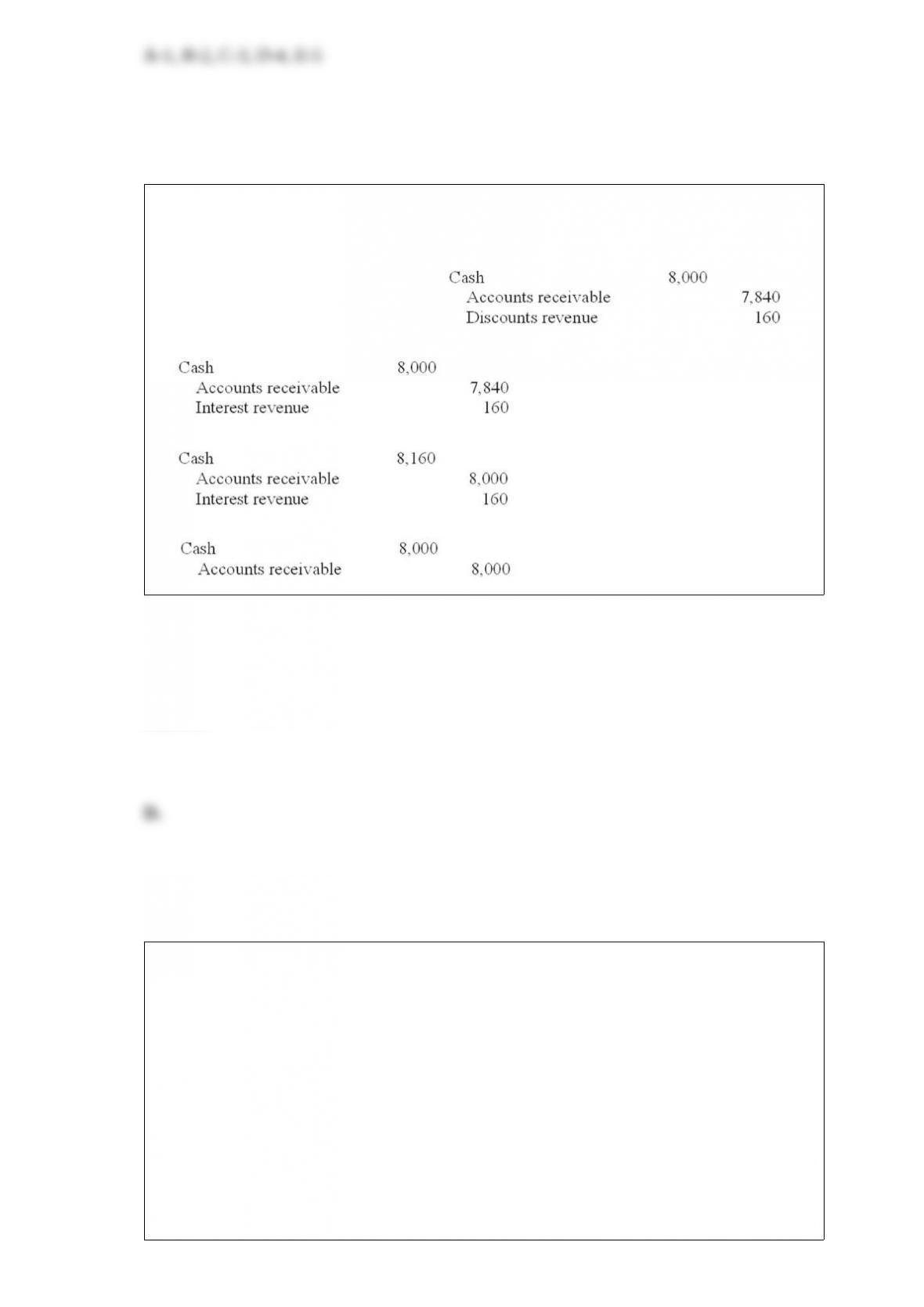
On November 10 of the current year, Flores Mills sold carpet to a customer for $8,000
with credit terms 2/10, n/30. Flores uses the gross method of accounting for cash
discounts. What is the correct entry for Flores on December 5, assuming the correct
payment was received on that date? A.
B.
C.
D.
Answer:
Listed below are 5 terms followed by a list of phrases that describe or characterize each
of the terms. Match each phrase with the most correct term. 1) Times interest earned
ratio
2) Convertible bonds
3) Coupon bonds
4) Debt to equity ratio
5) Debenture bonds

A. Measures ability to service debt
B. No specific assets pledged
C. Measures default risk
D. Name of owner not registered
E. May become stock
Answer:
When preparing the statement of cash flows using the indirect method for determining
net cash flows from operating activities, depreciation is added to net income because:
A. It was deducted as an expense on the income statement, but does not require cash.
B. It was deducted as an expense on the income statement and affects the amount of
cash.
C. It is a significant portion of the year’s expenses.
D. It represents a source or inflow of cash.
Answer:
Unrealized holding gains and losses on securities available for sale would have the
following effects on accumulated other comprehensive income:

A. Option a
B. Option b
C. Option c
D. Option d
Answer:
In the DuPont formula, return on assets equals: A. Gross margin on sales x Inventory
turnover.
B. Profit margin on sales x Inventory turnover.
C. Gross margin on sales x Asset turnover.
D. Profit margin on sales x Asset turnover.
Answer:
When a material gain contingency is probable and the amount of gain can be reasonably

estimated, the gain should be: A. Reported in the income statement and disclosed.
B. Offset against shareholders’ equity.
C. Disclosed but not recognized in the income statement.
D. Neither recognized in the income statement nor disclosed.
Answer:
Recognizing tax benefits in a loss year due to a net operating loss carryforward
requires: A. Creating a tax refund receivable.
B. Note disclosure only.
C. Creating a deferred tax asset.
D. Creating a deferred tax liability.
Answer:
When stock is issued in exchange for property, the best evidence of fair value might be
any of the following except: A. The appraised value of the property received.
B. The selling price of the stock in a recent transaction.

C. The price of the stock quoted on the stock exchange.
D. The average book value of outstanding stock.
Answer:
Distinguish between:
(a) Convertible and callable bonds.
(b) Serial and term bonds.
Answer:
ZIP Company owns 40,000 shares of the common stock of PIK Company. ZIP decided
to divest itself of this investment by distributing the PIK shares in the form of a
property dividend. The dividend ratio is one share of PIK for every four shares of ZIP
common held by shareholders. ZIP has 160,000 common shares outstanding. On April

15, 2013, the date of declaration, PIK stock had a par value of $5 per share, a carrying
value of $12 per share, and a market value of $17 per share.
Required:
Prepare any necessary journal entries. The shares were distributed on May 15, 2013, to
stockholders of record on May 1, 2013.
Answer:
North Dakota Corporation began operations in January 2012 and purchased a machine
for $20,000. North Dakota uses straight-line depreciation over a four-year period for
financial reporting purposes. For tax purposes, the deduction is 50% of cost in 2012,
30% in 2013, and 20% in 2014. Pretax accounting income for 2012 was $150,000,
which includes interest revenue of $20,000 from municipal bonds. The enacted tax rate
is 30% for all years. There are no other differences between accounting and taxable
income.
Required:Prepare a journal entry to record income taxes for the year 2012. Show
well-labeled computations for the amount of income tax payable and the change in the
deferred tax account.
Answer:

Gore Company, organized on January 2, 2013, had pretax accounting income of
$7,000,000 and taxable income of $10,000,000 for the year ended December 31, 2013.
The 2013 tax rate was 40%. The only difference between book and taxable income is
estimated warranty costs. Expected payments and scheduled enacted tax rates are as
follows:
Required:
Prepare one compound journal entry to record Gore’s provision for taxes for the year
2013.
Answer:
The following information relates to Hatami Company’s defined benefit pension plan
during the current reporting year:
Required:
Determine the balance of pension plan assets at fair value on December
Answer:

Yummy Rice Cereal offers an all-star bowl in exchange for three return box tops.
Yummy Rice estimates that 30% will be redeemed. The bowls cost Yummy Rice $1
each. In 2013, 5,000,000 boxes of cereal were sold. By year-end 900,000 box tops had
been redeemed.
Required:
Calculate the liability that Yummy Rice should report at December 31,
Answer:
Fully vested incentive stock options for 100,000 shares of common stock at an exercise
price of $50 were outstanding for the entire year. The market price of the stock during
the year averaged $56.
Required:
By how many shares will the assumed exercise of these options increase the
weighted-average number of shares outstanding when calculating diluted earnings per

share?
Answer:
Olde Corporation provides an executive stock option plan. Under the plan, the company
granted options on January 1, 2013, that permit executives to acquire 2 million of the
company’s $1 par value common shares within the next five years, but not before
December 31, 2014 (the vesting date). The exercise price is the market price of the
shares on the date of the grant, $14 per share. The fair value of the options, estimated by
an appropriate option pricing model, is $2 per option. No forfeitures are anticipated.
Ignore taxes.
Required:
(1) Determine the total compensation cost pertaining to the options, assuming the fair
value approach has been selected.
(2) Prepare the appropriate journal entry to record the award of the options on January
1, 2013.
(3) Prepare the journal entry to record compensation expense on December 31, 2013.
(4) Prepare the journal entry to record compensation expense on December 31, 2014.
Answer:
Krogstad Corporation bought 1,000 shares of Cole Inc. for $90 per share plus a
brokerage fee of $1,800. Three months later, the shares were sold for $110 per share.
The brokerage fee on the sale was $2,200.
Required:
(1) Prepare the appropriate journal entry to record the purchase of the stock.
(2) Prepare the appropriate journal entry to record the sale of the stock.
Answer:
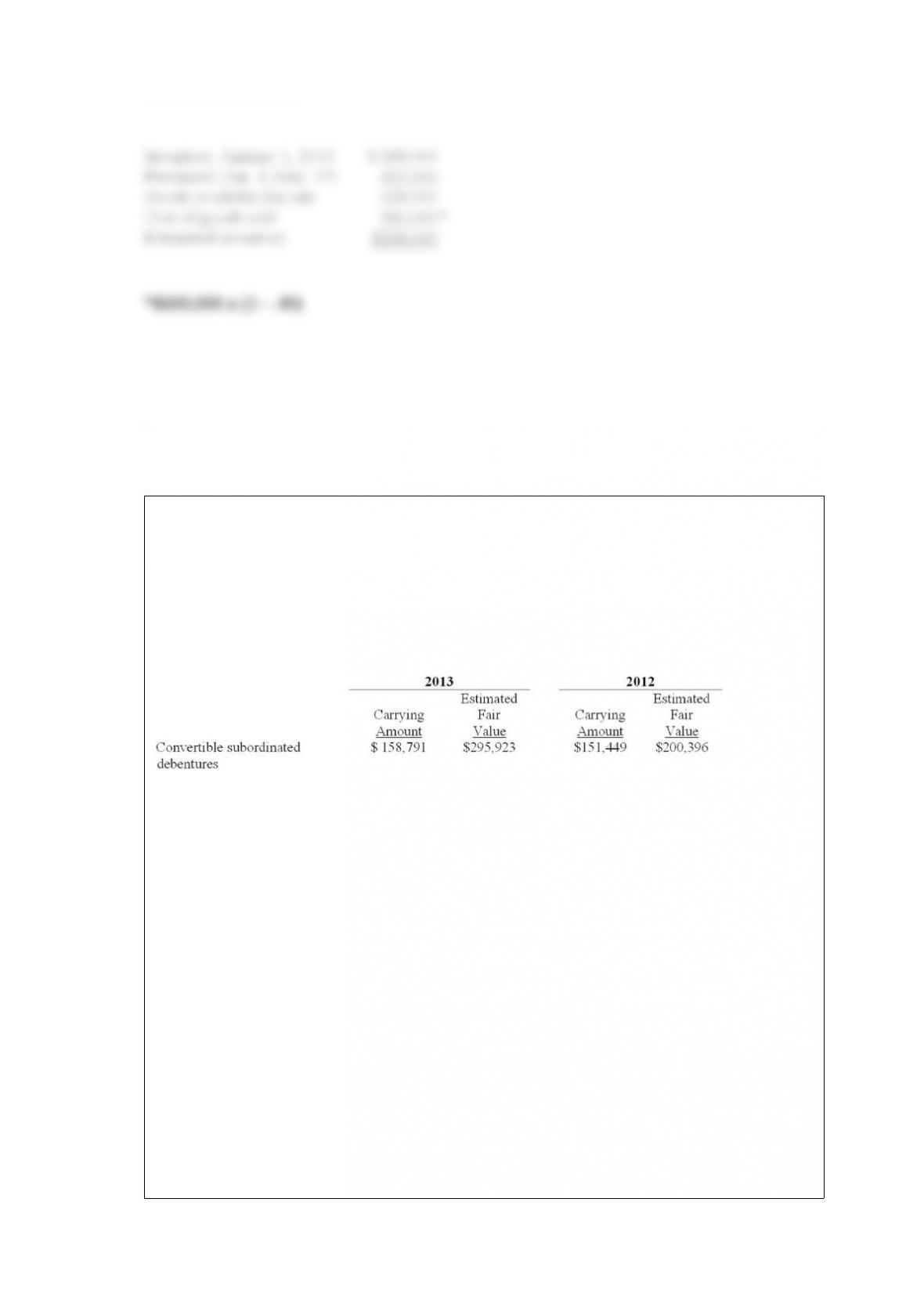
On March 17, 2013, a flood destroyed the entire inventory of Beatty Co. The following
information is available from its accounting records:
Required:
Compute the estimated cost of inventory lost in the flood.
Answer:
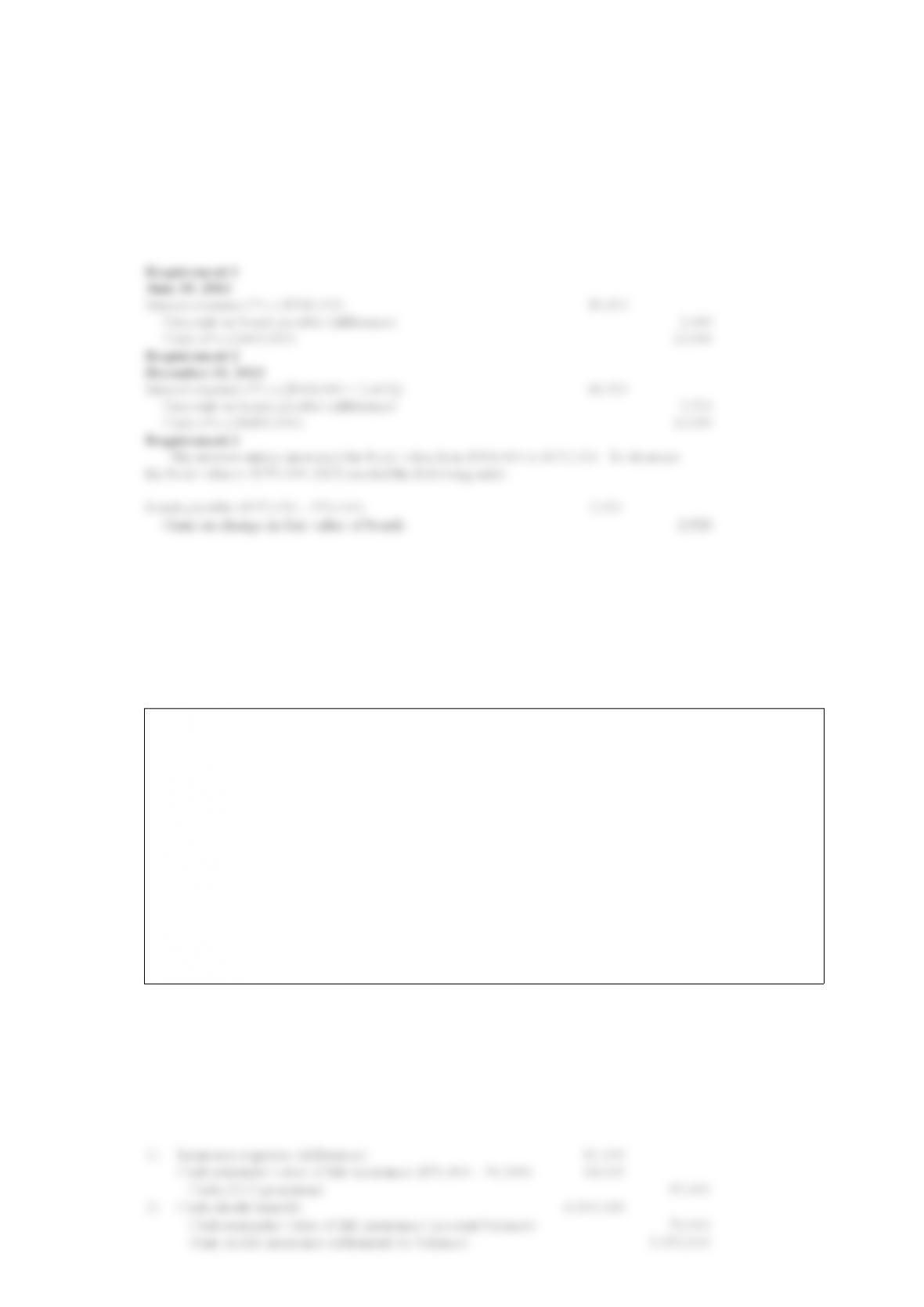
In its 2013 annual report to shareholders, Health Foods, Inc., disclosed the following
information about some of its indebtedness:
The fair value of convertible subordinated debentures is estimated using quoted market
prices. Carrying amounts and estimated fair values of our financial instruments other
than those for which carrying amounts approximate fair values as noted above are as
follows (in thousands)
In addition, the company disclosed the following:
We have outstanding zero coupon convertible subordinated debentures which had a
carrying amount of approximately $158.8 million and $151.4 million at September 26,
2013, and September 28, 2012, respectively. The debentures have an effective yield to
maturity of 5 percent and a principal amount at maturity on March 2, 2027, of
approximately $308.8 million. The debentures are convertible at the option of the
holder, at any time on or prior to maturity, unless previously redeemed or otherwise
purchased. The debentures have a conversion rate of 10.640 shares per $1,000 principal
amount at maturity, representing 3,285,632 shares. The debentures may be redeemed at
the option of the holder on March 2, 2017, or March 2, 2022, at the issue price plus
accrued original discount totaling approximately $188 million and $241 million,
respectively.
Required:
What amount of interest expense will Health Foods accrue on the debentures during
fiscal year 2014?

Answer:
Smithson Ltd. prepares its financial statements according to IFRS. On March 30, 2013,
the company purchased a franchise for $3,000,000. The franchise has a 10-year
contractual life with no residual value. Smithson uses the straight-line amortization
method for all intangible assets. On December 31, 2013, the end of the company’s fiscal
year, Smithson chooses to revalue the franchise. There is an active market for this
particular franchise and its fair value on December 31 is $2,860,000.
Required:
1) Calculate amortization for 2013.
2) Prepare the journal entry to record the revaluation of the patent.
3) Calculate amortization for 2014.
Answer:

In its 2013 annual report to shareholders, Hyer Aviation Group Inc. included the
following disclosure:
On October 6, 2012, the company’s subsidiary, Pyro Aeroplex, filed suit against Syntex,
an unincorporated division of Bright American Corporation, for breach of contract and
fraud with regard to the supply of deficient wire rope that is installed as aircraft flight
control cables on WD-50 aircraft. The case, filed in the circuit court of Bell County,
Arkansas, was brought to trial and on September 20, 2013, a jury returned with a
verdict in favor of the company in the amount of $17.5 million. The Court, upon a
post-judgment motion filed by Pyro, reduced the judgment to $4.5 million. Pyro has
appealed that Order to the Supreme Court of Arkansas. The company believes the
appeal is without merit and will continue to pursue final judgment on the Order. The
company, pending appeal, has not recorded the $4.5 million favorable judgment.
Required:
What journal entries, if any, has Hyer recorded regarding this contingency? Explain its
rationale.
Answer:
On January 1, 2013, BBX issued $400,000 of its 8% bonds for $368,000. The bonds
were priced to yield 10%. Interest is payable semiannually on June 30 and December
31. BBX records interest at the effective rate and elected the option to report these
bonds at their fair value. On December 31, 2013, the fair value of the bonds was
$370,000 as determined by their market value on the NYSE.
Required:
1) Prepare the journal entry to record interest on June 30, 2013 (the first interest
payment).
2) Prepare the journal entry to record interest on December 31, 2013 (the second
interest payment).
3) Prepare the journal entry to adjust the bonds to their fair value for presentation in the
December 31, 2013, balance sheet.
Answer:
LaBelle Corporation owns a $6 million whole life insurance policy on the life of its
CEO, naming LaBelle as beneficiary. The annual premiums are $95,000 and are
payable at the beginning of each year. The cash surrender value of the policy was
$56,000 at the beginning of
Required:
1) Prepare the appropriate 2013 journal entry to record insurance expense and the
increase in the investment, assuming the cash surrender value of the policy increased
according to the contract to $70,000.
2) The CEO died at the end of 2013. Prepare the appropriate journal entry.
Answer:
Sometimes companies change the extent to which they can significantly influence an
investee, such that they have to change to the equity method or from the equity method
of accounting for the investment.
Required:
Describe the adjustments necessary when a company (1) changes to the equity method
from another method, and (2) when a company changes from the equity method to
another method.
Answer:
The following partial income statement and balance sheet information (in $millions)
comes from the Annual Report of Saratoga Springs Co. for the year ending 12/31/2013:
Required: Compute the following amounts for Saratoga Springs Co.

Its average collection period for 2013. Round your final answer to one decimal place.
Answer:
Below is a list of accounts in no particular order. Assume that all accounts have normal
balances.
Required:
In column A, indicate whether a debit will:
1. Increase the account balance, or
2. Decrease the account balance.
In column B, classify each account according to the following scheme. For contra
accounts, indicate the classification of the account to which it relates.
1. A current asset in the balance sheet.
2. A noncurrent asset in the balance sheet.
3. A current liability in the balance sheet.
4. A long-term liability in the balance sheet.
5. A permanent equity account in the balance sheet.
6. A revenue account in the income statement.
7. An expense account shown in the income statement.
8. Account does not appear in either the balance sheet or the income statement.
Interest revenue
Answer:
Nickle leased equipment to Back Company on July 1, 2013. The present value of the
lease payments discounted at 10% was $120,000. Ten lease payments of $18,000 are
due at the beginning of each fiscal year beginning July 1, 2013. Nickle had constructed
the equipment recently for $99,000 and its retail fair value was $150,000.
Required:
Following the guidance of the new ASU, prepare the journal entries to record the lease
by Nickle (lessor) at its commencement and at December 31,
Answer:
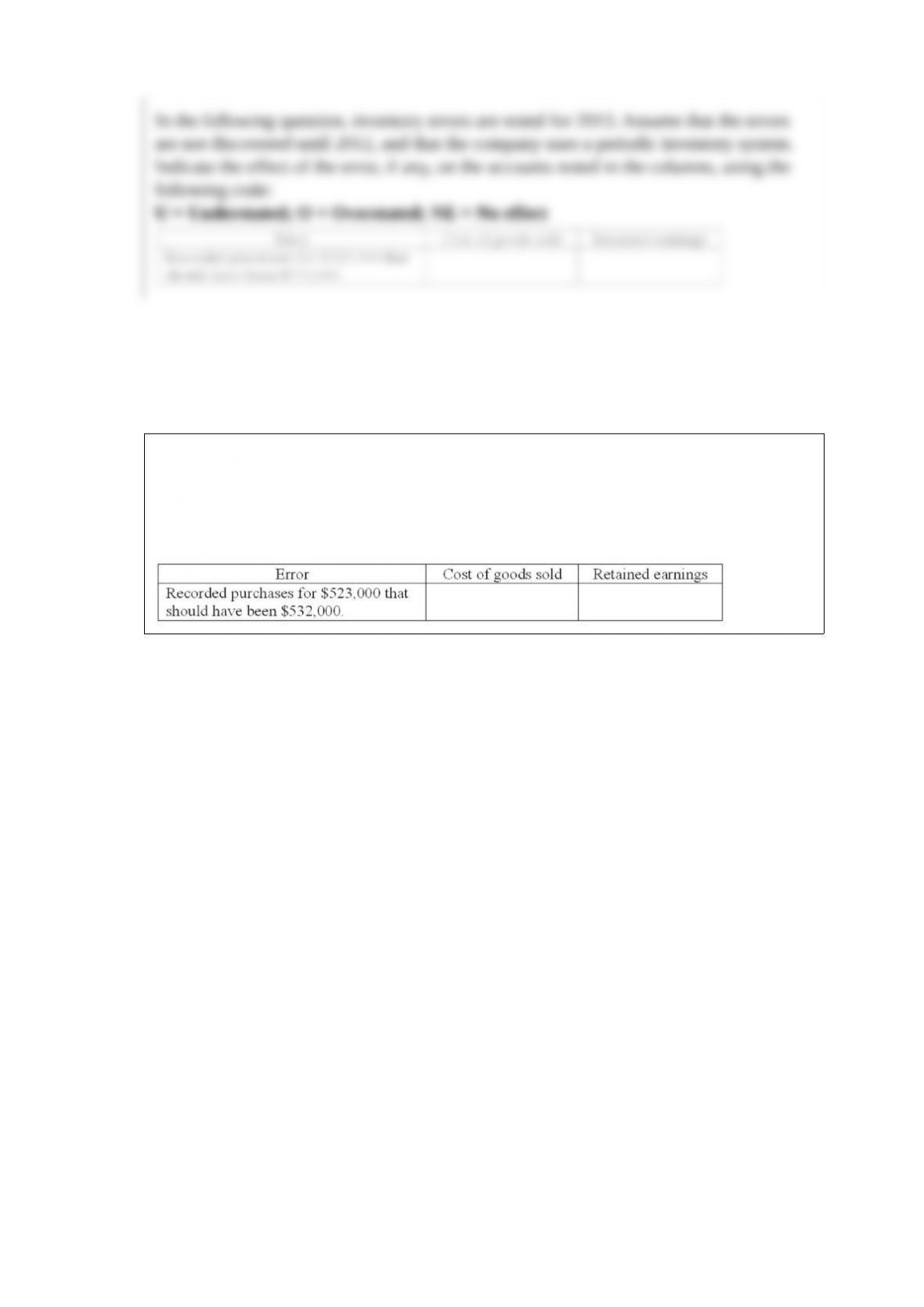
In the following question, inventory errors are noted for 2013. Assume that the errors
are not discovered until 2012, and that the company uses a periodic inventory system.
Indicate the effect of the error, if any, on the accounts noted in the columns, using the
following code:
U = Understated; O = Overstated; NE = No effect
Answer: