1) How is residual income calculated? What potential disadvantage is there in using
residual income to evaluate and compare divisions of a company?
2) Indicate whether each of the following statements is true or false.
1>A cost driver causes a cost to be incurred
2>A cost that is indirect with respect to one cost object also must be indirect with
respect to other cost objects
3>Information prepared using allocated costs often is used in evaluating the
performance of managers
4>Information prepared using allocated costs should not be used in budgeting and
resource allocation decisions within a company
5>Fixed costs generally are direct costs, and variable costs generally are indirect
3) Company A has variable costs per unit of $20, fixed costs of $300,000, and a
break-even sales volume of 60,000 units.
If a company had a pure fixed cost structure (with no variable costs), what would be the
relationship between a given increase in Sales and the amount of net income?
4) Indicate whether each of the following statements is true or false.
1>A US company can use LIFO for income tax purposes only if it also uses LIFO for
financial reporting purposes
2>The weighted average cost per unit is computed by dividing the total cost of goods
purchased by the dollar amount of sales
3>Under the FIFO method, the cost of goods sold for each sale is computed using the
cost of the most recently acquired units
4>In a period of rising inventory prices, use of FIFO allows a company to minimize its
income tax expense
5>To compute cost of goods sold under the weighted average method, it is necessary to
first make a computation of the weighted average cost per unit
5) What are some advantages to a business of accepting credit cards for sales? What
cost to the business is involved?
6) On which financial statement(s) would the account “Loss on Sale of Land” appear?
7) Illustrate with examples how cost definitions are independent and context sensitive.
In other words, indicate how a cost can be classified as fixed or variable and direct or
indirect, based on the situation.
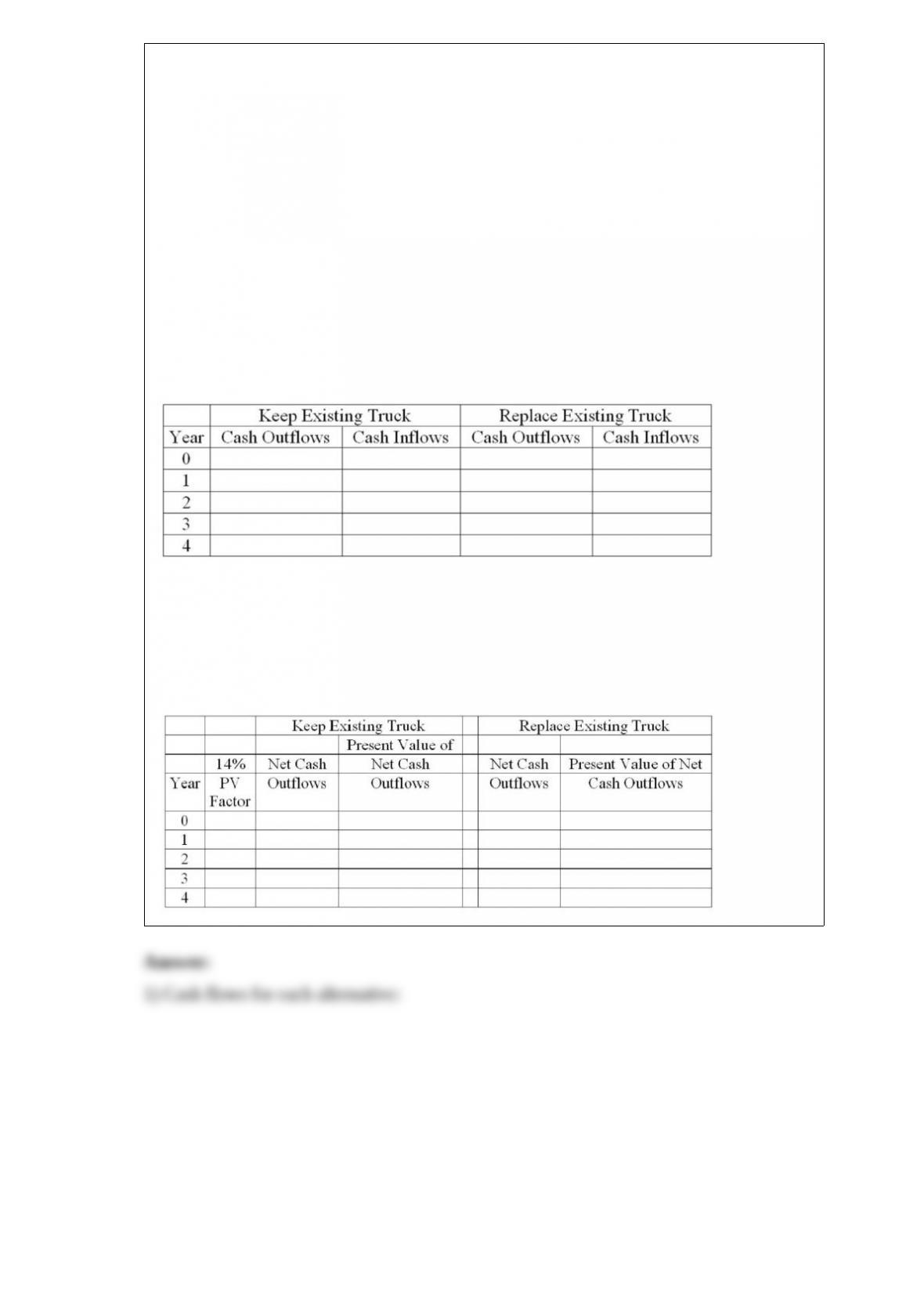
8) Brett Company is considering replacing one of its delivery trucks. The truck in
question was purchased two years ago at a cost of $47,000. At the time of purchase the
truck was expected to have a $5,000 salvage value at the end of its six-year life. Given
the use of straight-line depreciation, the truck has a current book value of $33,000. If
sold today, the company could get $25,000 for the truck. It costs $28,000 per year to
operate the existing truck. The new truck would cost $50,000 and would cost only
$22,000 per year to operate. The new truck would be depreciated on a straight-line basis
over its four-year useful life to its expected salvage value of $7,500. The company’s
required rate of return is 14%. Ignore income taxes.
Required:
1) Identify the cash flows for each alternative by completing the following table:
2) The company’s objective is to minimize costs. Complete the following table to
determine whether the existing truck should be replaced. Ignore income taxes. What is
your recommendation?
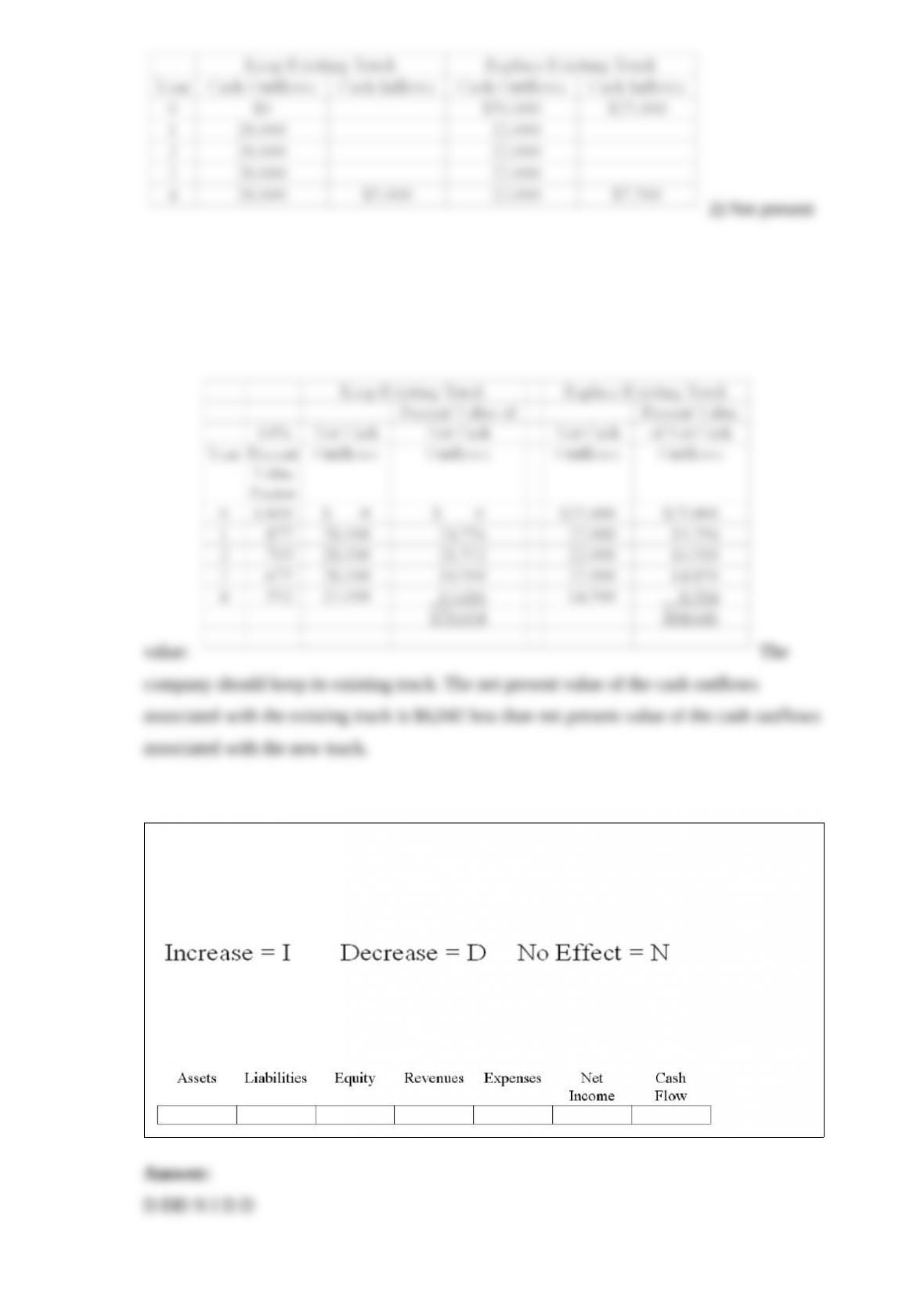
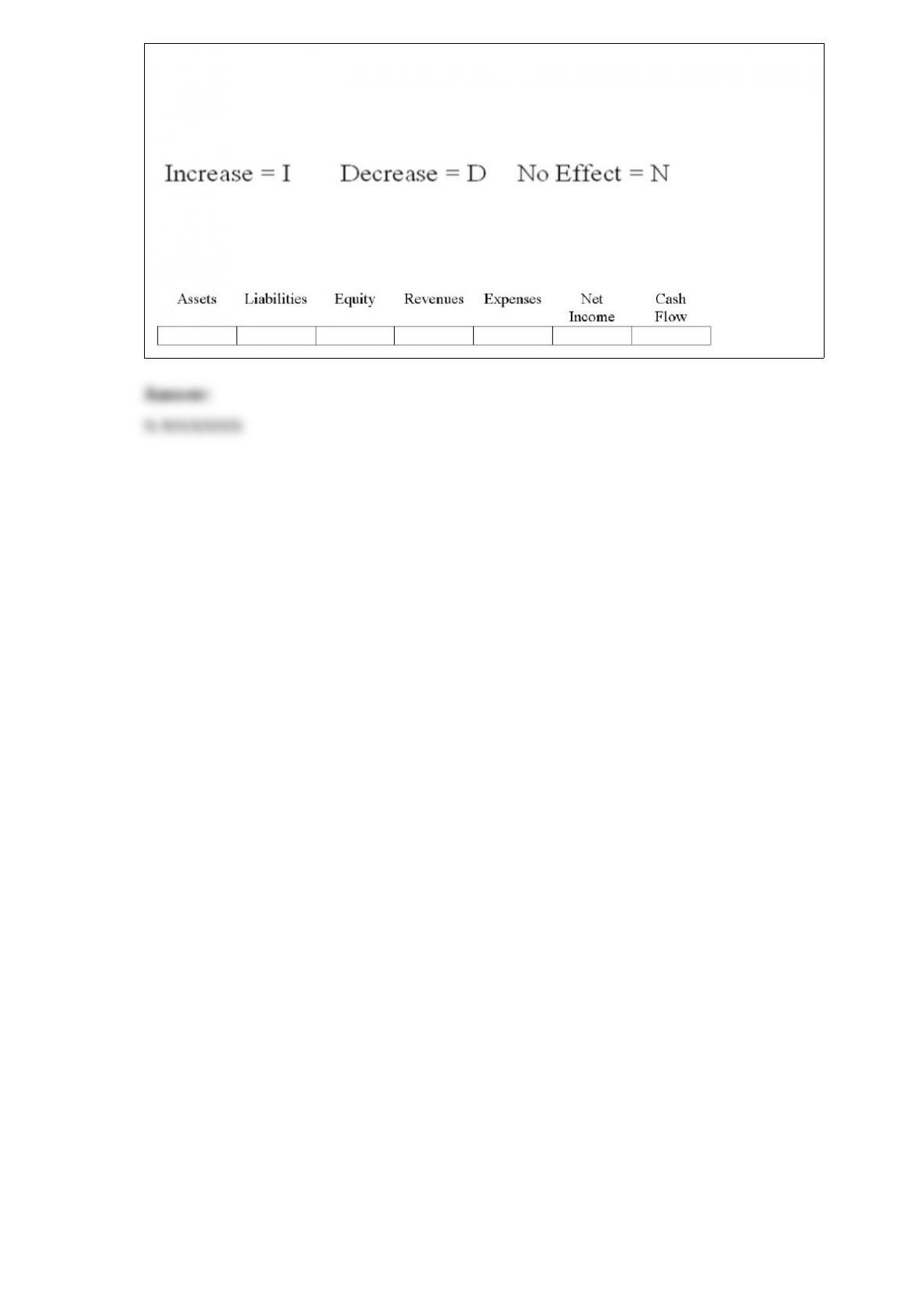
9) Indicate how each event affects the elements of financial statements. Use the
following letters to record your answer in the box shown below each element. You do
not need to enter amounts.
On December 31, 2012, Washta Company made the annual payment on a long-term
note. The payment included a reduction in the principal balance and payment of interest
for the year. Show how this annual payment affected Washta’s financial statements.
10) Indicate how each event affects the elements of financial statements. Use the
following letters to record your answer in the box shown below each element. You do
not need to enter amounts.
On January 1, 2012, Spencer Corporation signed a contract with the Mid-Rivers Bank
for a line of credit that permitted Spencer to borrow up to $50,000. Indicate the effects
of signing this contract.