
Additional paid-in capital is most likely to appear on the balance sheet of a corporation
that:
A. has par value stock.
B. has no-par value stock.
C. has issued stock at different dates.
D. has issued stock dividends.
If a firm’s payment terms for sales made on account to its customers were 2/10, n30, the
number of days’ sales in accounts receivable would be expected to be:
A. less than 10.
B. between 10 and 25.
C. between 25 and 40.
D. over 40.
An example of a cost that is noncontrollable in the short run is:
A. direct labor.
B. property taxes.
C. raw materials.
D. supervisors salaries.
The balance sheet equation can be represented by:
A. Assets = Liabilities + Stockholders’ Equity
B. Assets – Liabilities = Stockholders’ Equity
C. Net Assets = Stockholders’ Equity
D. All of the above.
Which of the following statements concerning repair and maintenance expenditures is
true?
A. Routine repair costs and preventive maintenance expenditures are capitalized as
assets in the period in which they are incurred.
B. For income tax purposes, most taxpayers would prefer to capitalize an expenditure
and depreciate the asset over time rather than expensing the expenditure and deducting
the entire amount in the year it is incurred.
C. Maintenance expenditures that extend the useful life and ∕or increase the salvage
value of an asset should be capitalized and depreciated over the asset’s remaining useful
life.
D. All repair and maintenance expenditures are accounted for as expenses in the year in
which they are incurred.
If there is a loss on the disposal of a depreciable asset:
A. no cash was received in the disposal transaction.
B. the net book value of the asset was negative.
C. in retrospect, the life over which the asset was depreciated was too short.
D. in retrospect, the depreciation expense recognized over the asset’s life was too low.
The standards for one case of Peardrax are:
During the week ended June 7, the following activity took place:
• 5,740 machine hours were worked;
• 22,600 lbs. of raw material were purchased for inventory at a total cost of $83,620;
• 2,700 cases of finished product were produced;
• 21,330 lbs. of raw material were used;
• 10,650 labor hours were worked at an average rate of $15.20 per hour;
• $27,552 actual variable overhead costs were incurred.
Calculate each of the following variances:
(a.) Price variance for raw materials purchased.
(b.) Raw materials usage variance.
(c.) Direct labor rate variance.
(d.) Direct labor efficiency variance.
(e.) Variable overhead spending variance.
(f.) Variable overhead efficiency variance.

The three sections of a statement of cost of goods manufactured include:
A. raw material, direct labor, manufacturing overhead.
B. variable expenses, contribution margin, fixed expenses.
C. sales revenue, gross profit, selling and administrative expenses.
D. direct costs, indirect costs, operating profit.
The following data have been collected by capital budgeting analysts at Condel
Brothers Oil Co. concerning the drilling and production of known reserves at an
off-shore location:
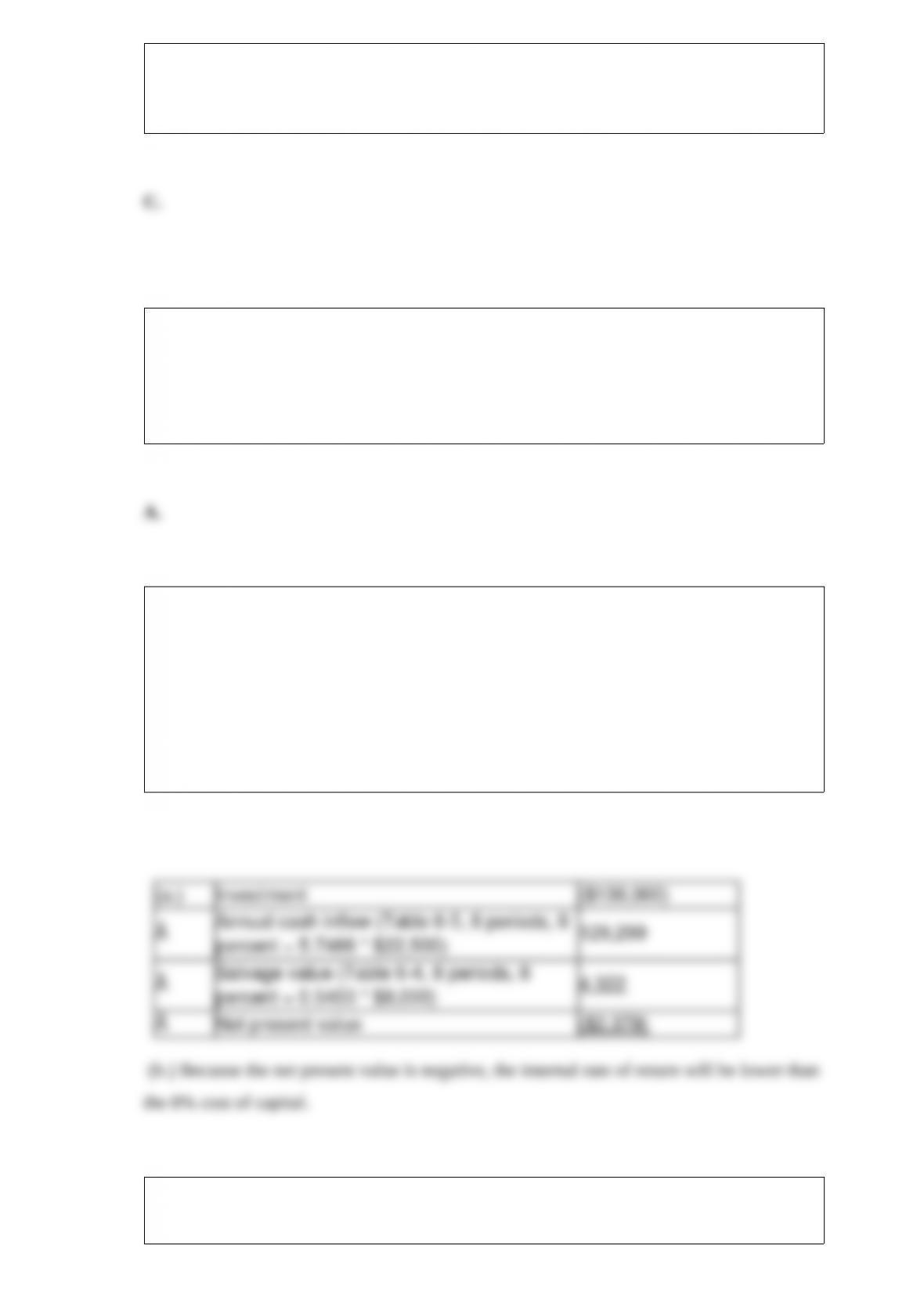
(a.) Calculate the net present value of the proposed investment in the drilling and
production operation. Ignore income taxes, and round answers to the nearest $1.
(b.) What will the internal rate of return on this investment be relative to the cost of
capital? Explain your answer.
Bonner’s, Inc. borrowed $36,000 for 4 months on a discount basis. The lender used an
interest rate of 8% to calculate the discount. The amount of cash Bonner’s, Inc. actually
had available to use from this loan was:
A. $33.120
B. $35,040
C. $36,000
D. $36,960
How is performance evaluated for a cost center?
A. Actual costs incurred compared to budgeted costs.
B. Actual segment margin compared to budgeted segment margin.
C. Comparison of actual and budgeted return on investment (ROI) based on segment
margin and assets controlled by the segment.
D. None of the above.
The balance sheet might also be called:
A. Statement of Financial Position.
B. Statement of Assets.
C. Statement of Changes in Financial Position.
D. None of the above.
At the beginning of the year, paid-in capital was $164 and retained earnings was $94.
During the year, the stockholders invested $48 and dividends of $12 were declared and
paid. Retained earnings at the end of the year were $104.
Net income for the year was:
A. $20
B. $22
C. $30
D. $40

A credit entry will:
A. always decrease the account balance.
B. always increase the account balance.
C. increase the balance of a revenue account.
D. increase the balance of an expense account.
As the level of activity increases:
A. fixed cost per unit increases.
B. variable cost per unit increases.
C. variable cost per unit decreases.
D. fixed cost per unit decreases.
A standard cost or production standard that assumes maximum operating conditions and
100% efficiency at all times is called a(n):
A. attainable standard.
B. ideal standard.
C. past experience standard.
D. average standard.
Which of the following statements about the Financial Accounting Standards Board is
correct?
A. The FASB is an agency of the Federal government.
B. The FASB has the authority to fine a noncompliant firm.
C. The FASB follows a due process procedure that permits input from interested parties
before a standard is issued.
D. The FASB is controlled by the American Institute of CPA’s.
E. None of the above statements is correct.

An accounts receivable results from the sale of:
A. property, plant, and equipment for cash.
B. goods and services to customers on account.
C. goods and services to customers for cash.
D. the firm’s common stock.
An important reason for imposing a minimum cash balance in the cash budget is:
A. it provides a cushion that can absorb forecast errors.
B. it provides extra funds for managers to spend.
C. it makes the balance sheet look better.
D. all of the above.
Which of the following is not a characteristic or limitation of the kind of information
that financial reporting by business enterprises can provide?
A. The information results in approximate, rather than exact, measures.
B. The information largely reflects the financial effects of transactions that have already
happened.
C. The information is provided and used at a cost.
D. All of the above are characteristics or limitations of the kind of information that
financial reporting by business enterprises can provide.
The Sarbanes-Oxley Act (SOX) of 2002 does not specifically prohibit an independent
auditor from performing the following non-audit function(s) for an audit client:
A. financial information systems design and implementation.
B. internal audit outsourcing services.
C. tax services.
D. “expert” services.
E. SOX specifically prohibits an independent auditor from performing all of the
non-audit services for an audit client.
A journal entry recording an accrual:
A. results in a better matching of revenues and expenses.
B. will involve a debit or credit to cash.
C. will affect balance sheet accounts only.
D. will most likely include a debit to a liability account.
Griffin Co. is considering the investment of $136,000 in a new machine. The machine
will generate cash flow of $22,500 per year for each year of its eight-year life and will
have a salvage value of $8,000 at the end of its life. Griffin Co.’s cost of capital is 8
percent.
(a.) Calculate the net present value of the proposed investment. Ignore income taxes,
and round all answers to the nearest $1.
(b.) What will the internal rate of return on this investment be relative to the cost of
capital? Explain your answer.
An expanded version of the accounting equation could be:
A. Assets + Revenues = Liabilities + Stockholders’ Equity – Expenses
B. Assets – Liabilities = Paid-in Capital – Revenues – Expenses
C. Assets = Liabilities + Paid-in Capital + Beginning Retained Earnings + Revenues –
Expenses – Dividends
D. Assets = Liabilities + Paid-in Capital – Revenues + Expenses
On March 15, 2017, Birkshire Energy obtained a nine-month working capital loan from
the First National Bank of Oglesby. The face amount of the note signed by the treasurer
was $900,000. The interest rate charged by the bank was 10 percent. The bank made the
loan on a discount basis. (Round your final answers to the nearest dollar).
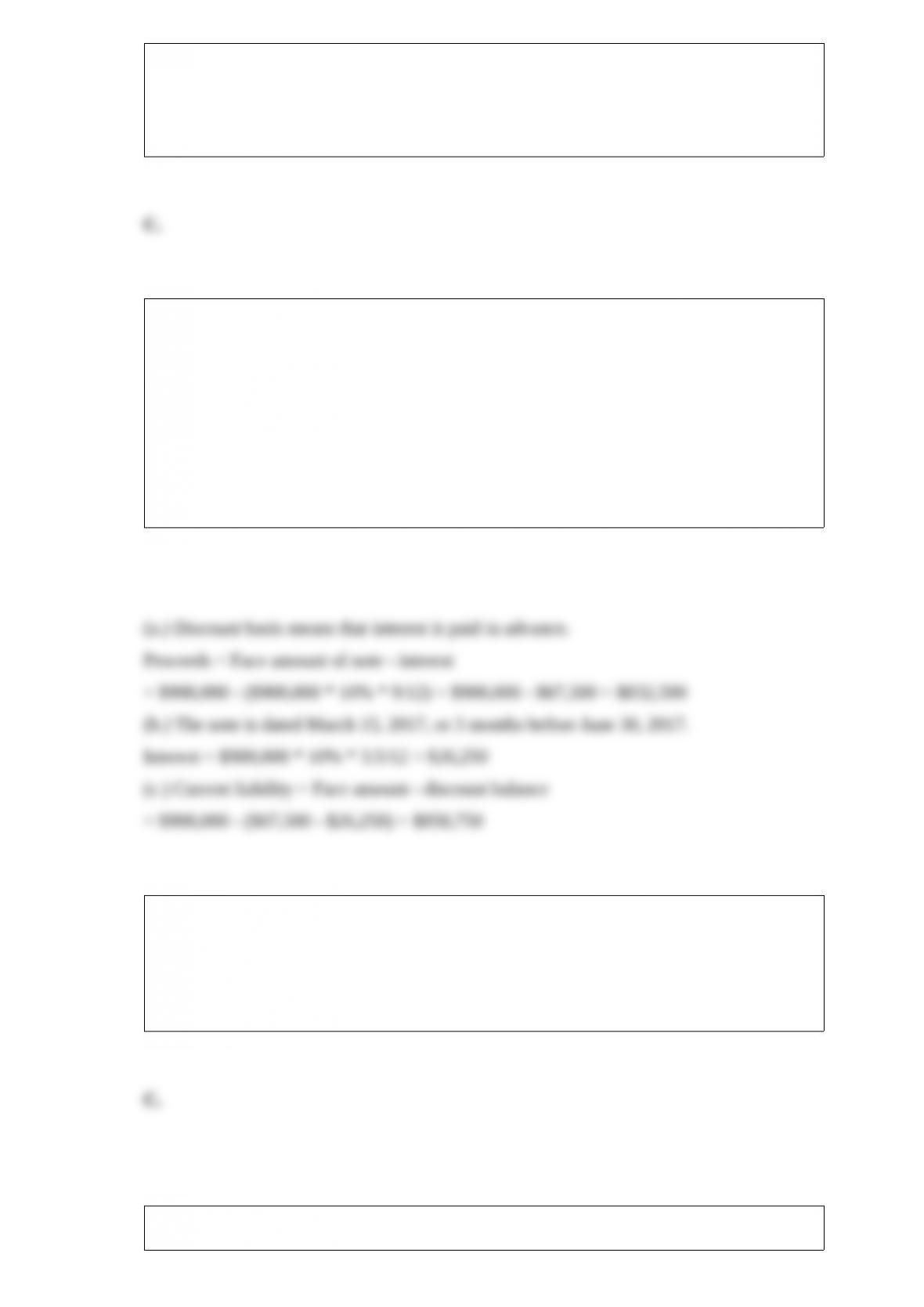
(a.) Calculate the loan proceeds made available to Birkshire.
(b.) Calculate the amount of interest expense related to this loan during the six months
ended June 30, 2017.
(c.) What is the amount of the current liability related to this loan to be shown in the
June 30, 2017, balance sheet?
A key to estimating an accurate amount of cash to be collected from sales is:
A. the accuracy of the sales forecast.
B. the accuracy of the estimated collection patterns for sales.
C. both a and b are keys.
D. neither a nor b are keys.
A stock dividend is similar to a cash dividend in that:

A. the stockholder’s equity in the firm’s net assets is reduced by each.
B. the stockholder’s cash is increased by each.
C. the stockholder’s equity in the firm’s net assets is increased by each.
D. retained earnings and the amount of potential future dividends is reduced by each.
Many companies use accelerated depreciation for tax purposes because:
A. it is easier to calculate than straight-line depreciation.
B. it reflects the amount of cash used in depreciation.
C. it results in lower taxable income than straight-line depreciation.
D. it is used for determining net income reported to stockholders.
An advantage of the DuPont model for calculating ROI is that:
A. it focuses on asset utilization as well as net income.
B. it is easier to use than the straightforward ROI formula.
C. it uses average assets and the straightforward ROI formula does not.
D. it uses stockholders’ equity.
Which of the following is not a stockholders’ equity account?
A. Common stock.
B. Capital stock.
C. Retained earnings.
D. Accumulated depreciation.
E. Paid-in-capital in excess of par.
“Noncontrolling interest”:
A. is a component of the parent company’s net income and reported on the income
statement.
B. is a component of stockholders’ equity attributable to the parent company and
reported on the balance sheet.
C. is the portion of equity in a subsidiary not attributable, directly or indirectly, to the
parent company, and reported on the balance sheet within equity, but separate from the
parent company’s equity.
D. is not reported within the parent company’s consolidated financial statements, but
instead reported within the minority stockholders’ financial statements.
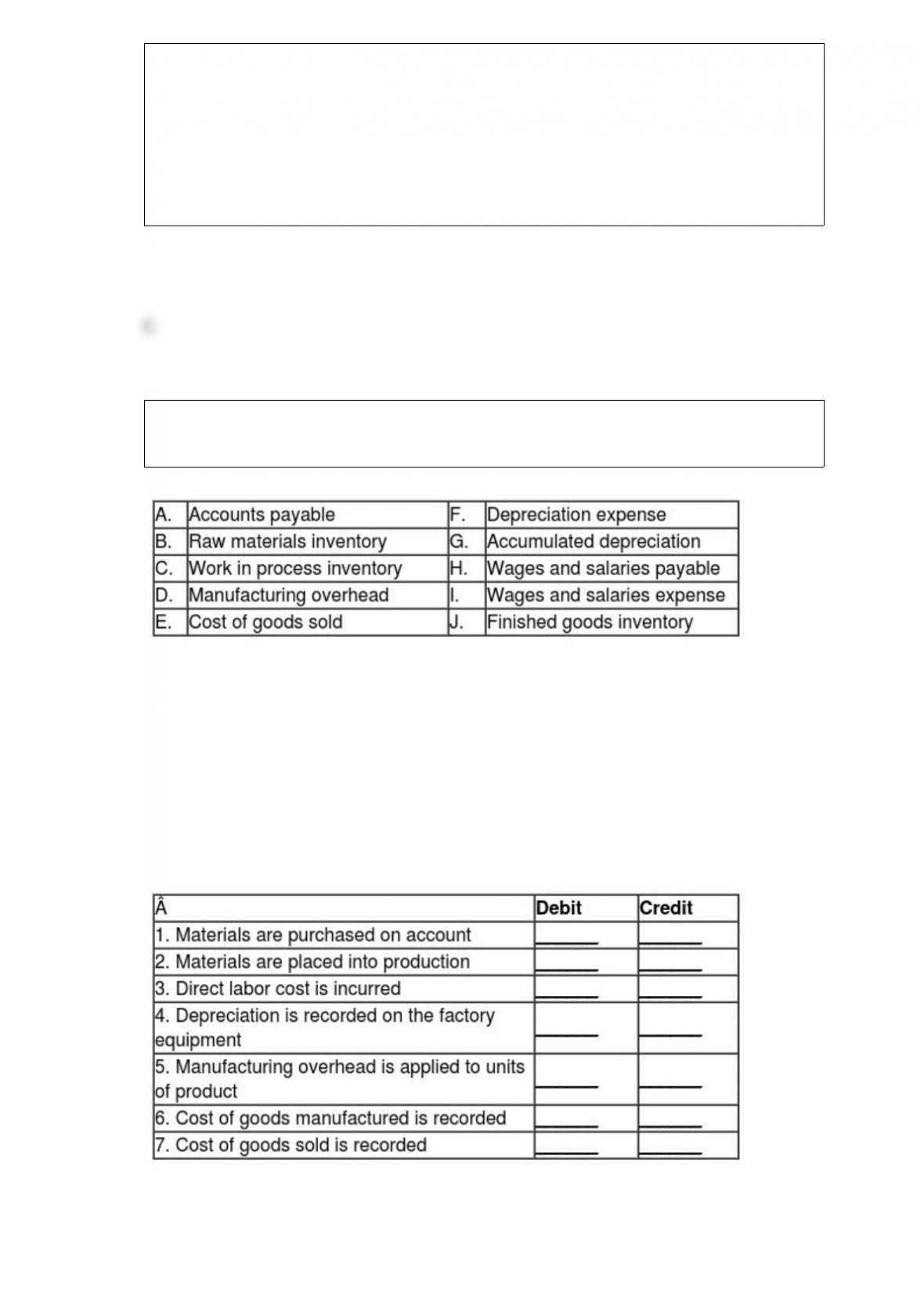
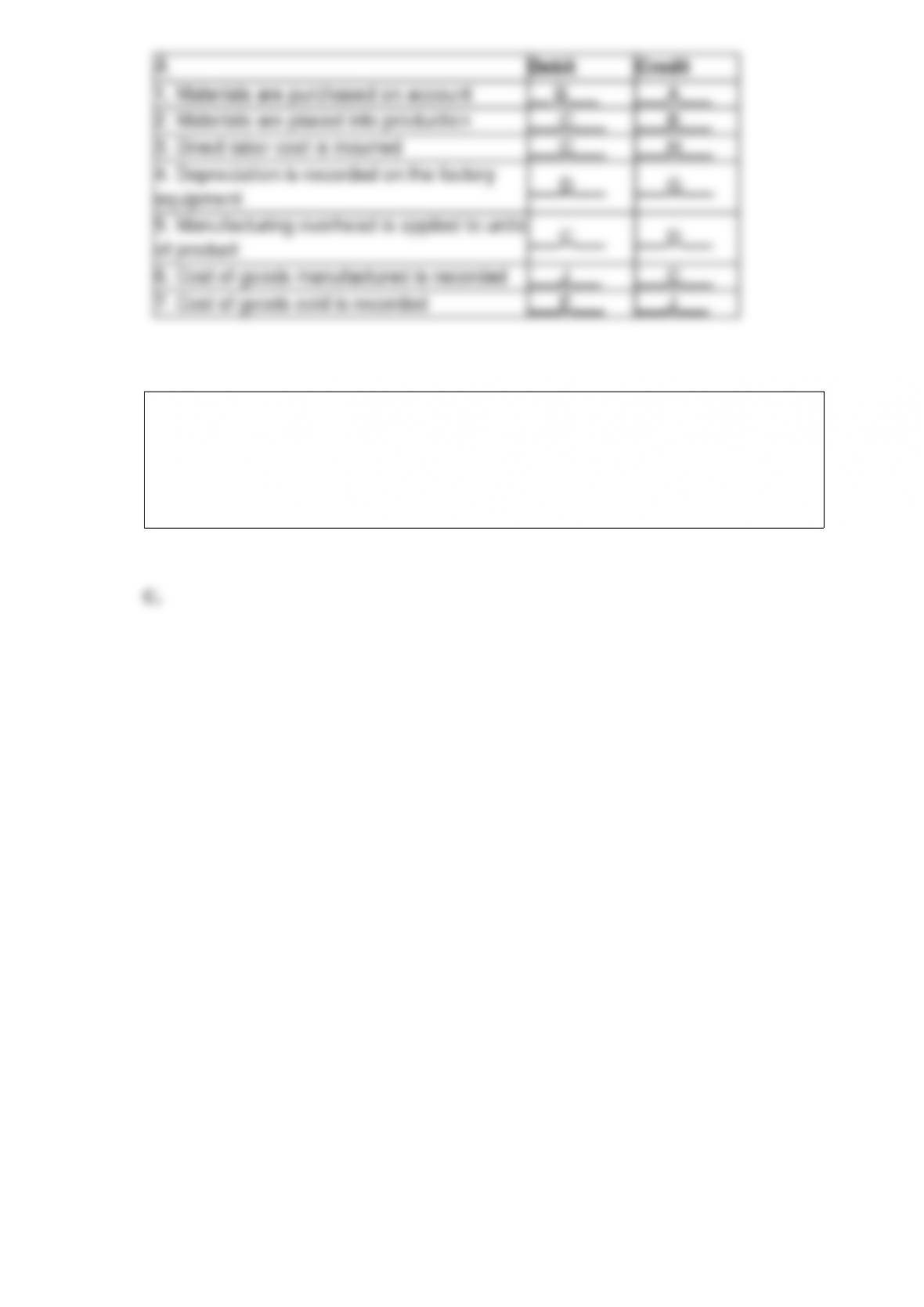
Webster World Products uses the following account titles:
For each transaction described below, indicate which accounts would be debited and
credited under a job order cost system:
If they are to be useful to managers, variances should be reported:
A. simultaneously to all managers within a week after the end of the month.
B. in dollar amounts as soon as all costs are known.
C. in physical terms or dollar amounts as promptly as feasible.
D. in physical terms and dollar amounts if the variance exceeds 10% of the budget.