1) The LIFO inventory method will result in the lowest gross profit in comparison with
the FIFO method when unit costs are decreasing.
2) The year-end journal entry to record bad debt expense reduces the accounts
receivable account and increases net income.
3) LIFO liquidation results when a company has a lower level of inventory at the end of
the year than it had at the beginning of the year.
4) Stockholders’ equity on the balance sheet includes common stock and retained
earnings.
5) When using the percentage of credit sales method, net sales multiplied by a historical
percentage for credit losses equal bad debt expense.
6) Intangible assets have no physical existence and no life.
7) The FIFO inventory method will result in the lowest net income in comparison with
the LIFO method when costs are decreasing.
8) Collections from customers are cash flows from operating activities.
9) Rye Company has provided the following information:
♦ Number of issued common shares, 225,000
♦ Net income, $500,000
♦ Number of authorized common shares, 400,000
♦ Number of treasury shares, 25,000
What is Rye’s earnings per share?
A.$2.50
B.$1.25
C.$2.00
D.$1.33
10) Which of the following statements about the Modified Accelerated Cost Recovery
System (MACRS) is correct?
A.It is similar to the units-of-production depreciation method.
B.It is applied using longer asset lives than the estimated useful lives required by
GAAP.
C.It provides a short-term tax benefit because of the higher depreciation expense
reported in the early years of an asset’s life.
D.It is acceptable for use when preparing financial statements.
MACRS is an accelerated depreciation method, which results in higher amounts of
depreciation expense and less taxable income during the earlier years of an asset’s life.
11) Which of the following transactions results in an increase in both net income and
stockholders’ equity?
A.Paying cash to acquire a six-month insurance policy.
B.Collecting cash from a customer for services to be provided in the future.
C.The accrual of interest expense year-end.
D.Adjustment of the unearned revenue account for revenue earned during the period.
12) Which of the following best describes operating revenues?
A.They are increases in assets or increases in liabilities as a result of peripheral
transactions.
B.They are decreases in assets or decreases in liabilities as a result of ongoing
operations.
C.They are increases in assets or decreases in liabilities as a result of ongoing
operations.
D.They are decreases in assets or increases in liabilities as a result of peripheral
transactions.
13) What is the net adjustment to net income with respect to the determination of cash
flows from operating activities when inventory increases $100,000 and accounts
payable increases $20,000?
A.An increase of $120,000.
B.A decrease of $120,000.
C.An increase of $80,000.
D.A decrease of $80,000.
14) On January 1, 2014, Turtle Inc. bought 30% of the outstanding shares of Shell
Corporation common stock at a cost of $150,000. Turtle uses the equity method of
accounting for this investment is used. During 2014, Shell Corporation reported
$40,000 of net income and paid a total of $5,000 in cash dividends. At the end of 2014,
the shares had a fair value of $160,000. How much investment income will Turtle
report for equity in affiliate earnings during 2014?
A.$12,000.
B.$22,000.
C.$10,500.
D.$1,500.
Investment income = $12,000 = Affiliate net income $40,000 30% ownership
percentage.
15) Which of the following are not part of disclosure notes to the financial statements?
A.Descriptions of the significant accounting methods applied in the company’s financial
statements.
B.Additional detail of income taxes payable reported in the balance sheet.
C.Names of executive officers and the salaries for each officer listed.
D. Commitments under long-term supply agreements to buy inventory and equipment.
16) Which of the following statements regarding the balance sheet is false?
A.Property and equipment is reported at book value.
B.Assets are reported in the order of liquidity.
C.Current liabilities are obligations to be paid with current assets.
D.The balance sheet reflects balances for a period of time.
17) A $25,000 overstatement of the 2013 ending inventory was discovered after the
financial statements for 2013 were prepared. Which of the following describes the
effect of the inventory error on the 2014 financial statements?
A.Net income and stockholders’ equity are both understated.
B.Net income is understated and stockholders’ equity is correct.
C.Net income and stockholders’ equity are both overstated.
D. Net income and stockholders’ equity are both unaffected.
18) Which of the following transactions would not increase the fixed asset turnover
ratio?
A.A decrease in sales revenue.
B.A profitable sale of fixed assets for cash.
C.Selling manufacturing equipment for a loss.
D.A decrease in operating expenses.
19) Which of the following journal entries is created as the result of a deferral?
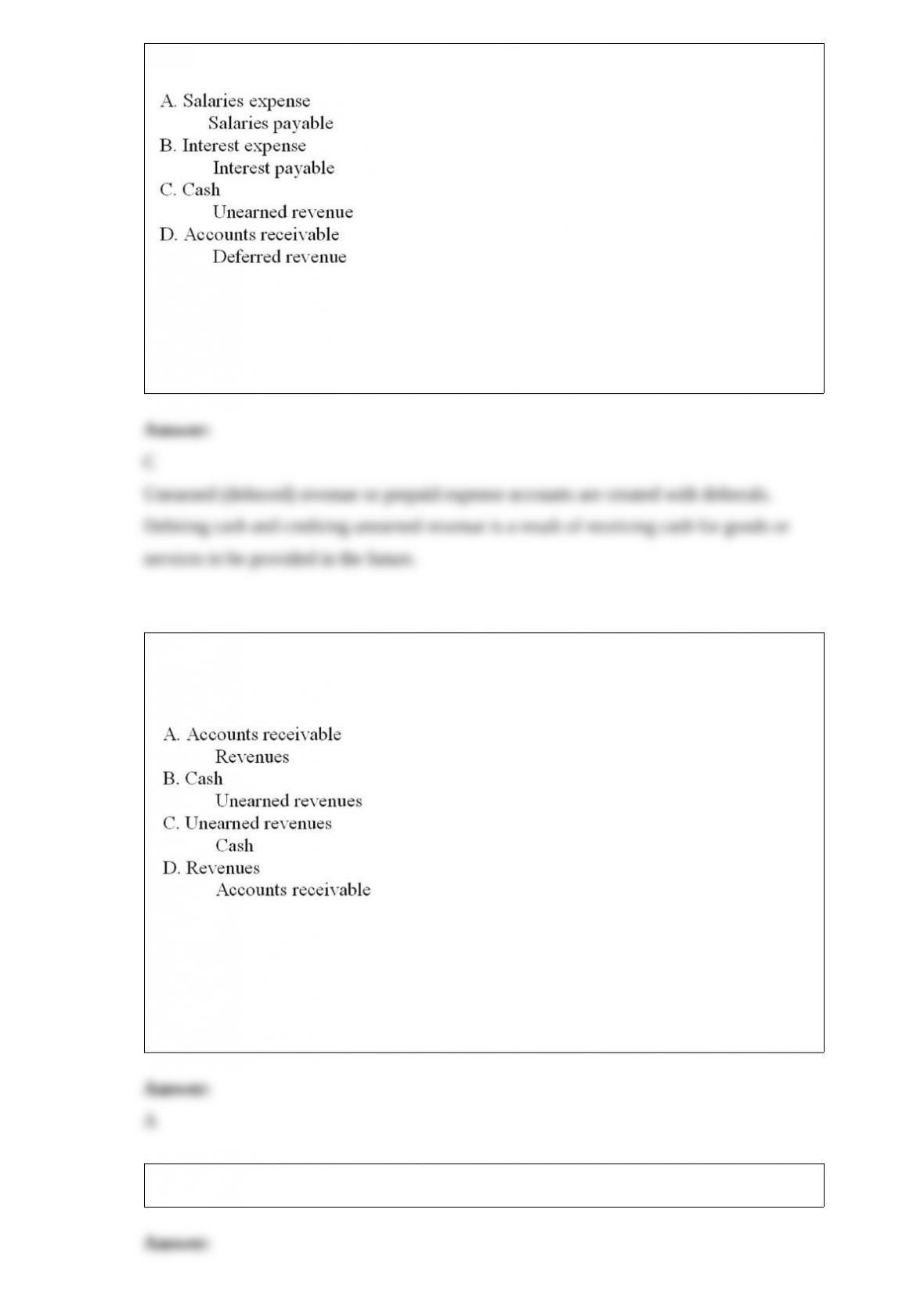
A.Option A
B.Option B
C.Option C
D.Option D
20) Which of the following journal entries is prepared by an auto repair shop when a
customer will pay cash subsequent to delivery of goods or services?
A.Option A
B.Option B
C.Option C
D.Option D
When goods or services are sold or provided to a customer, on account, an accounts
receivable (an asset) is created at the time of sale or service.
22) On October 1, 2014, Adams Company paid $4,800 for a two-year insurance policy
with the insurance coverage beginning on that date. As of December 31, 2014, which of
the following account balances are correct after adjusting entries have been made?
A.Prepaid insurance $4,800, and Insurance expense $0.
B.Prepaid insurance $0, and Insurance expense $4,800.
C.Prepaid insurance $2,400, and Insurance expense $2,400.
D.Prepaid insurance $4,200, and Insurance expense $600.
23) Which of the following correctly describes the effect of a sales discount?
A.Gross profit increases.
B.Net sales increases.
C.Current assets remain the same.
D.Net income decreases.
24) Teague Company€s working capital was $40,000 and total current liabilities were
1/4 of that amount. What was the current ratio?
A.1.00
B.1.25
C.3.00
D.5.00
25) Which of the following ratios increases when a company switches from FIFO to
LIFO during a period of increasing unit costs?
A.Profit margin.
B.Inventory turnover.
C.Quick.
D.Current.
26) What would be incorrect about reporting accounts receivable in the balance sheet?
A.Presenting accounts receivable net of allowance for doubtful accounts.
B.Presenting accounting receivable at estimated net realizable value.
C.Presenting accounts receivable less bad debt expense and write-offs.
D.Presenting accounts receivable at gross amount, less allowance for doubtful accounts.
28) Failure to make a necessary adjusting entry for accrued interest on a note payable
would result in which of the following?
A.Liabilities and stockholders’ equity would both be understated.
B.Net income would be overstated and assets would be understated.
C.Net income would be understated and liabilities would be understated.
D. Net income and stockholders’ equity would be overstated and liabilities would be
understated.
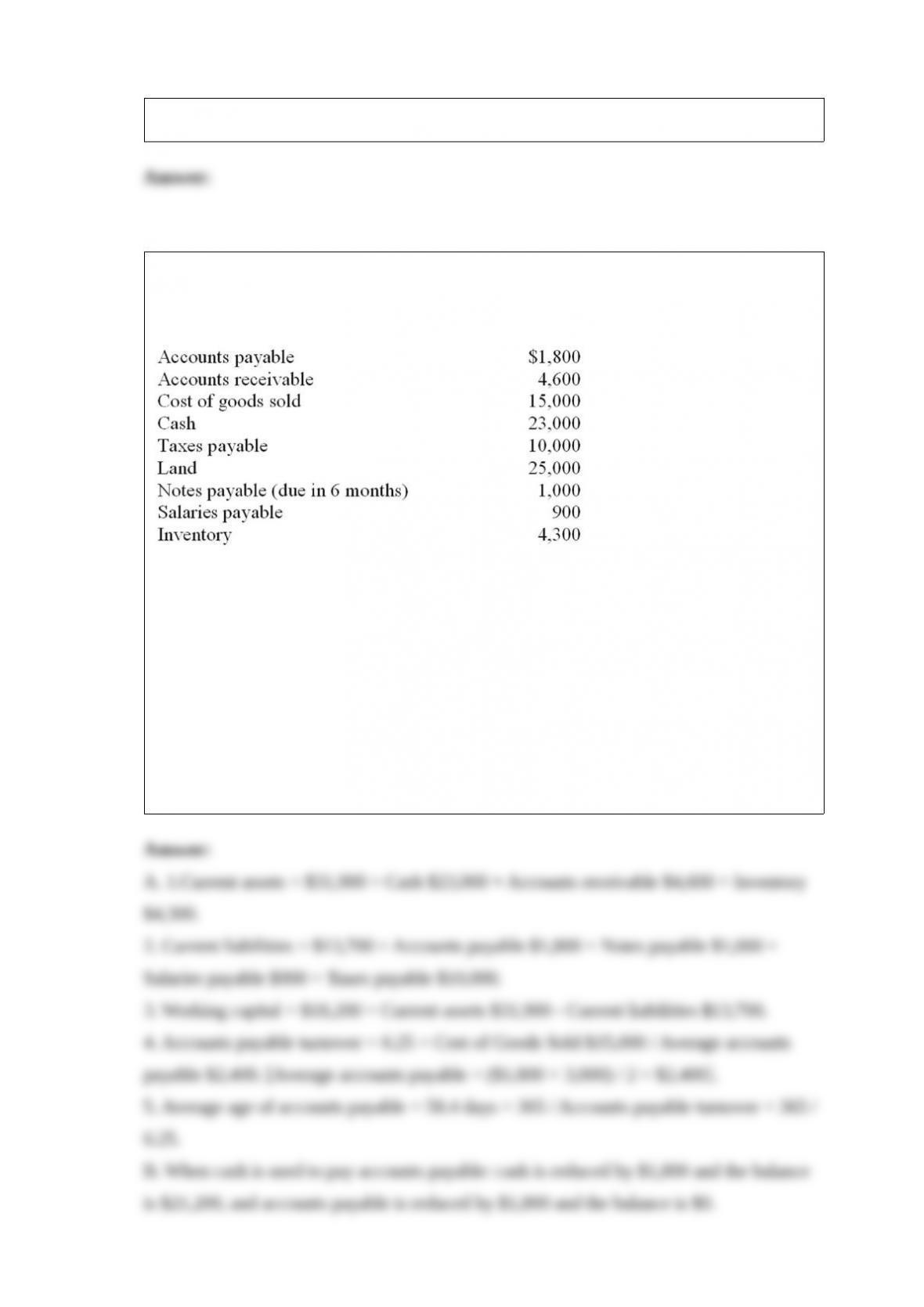
30) Moore Company has the following partial list of account balances at year-end
December 31, 2014:
Additional information: The accounts payable balance at the end of the prior year was
$3,000.
(All answers are for December 31, 2014.)A Determine the following items:1. Current
assets2. Current liabilities3. Working capital4. Accounts payable turnover ratio5.
Average age of accounts payableB Assume that cash is used at December 31, 2014 to
pay the entire balance of accounts payable. Determine the revised amounts from part
(A) above for the following items:1. Current assets2. Current liabilities3. Working
capital4. Accounts payable turnover ratio5. Average age of accounts payableC
Comment on the effect of paying accounts payable at year-end with regard to working
capital and accounts payable management.
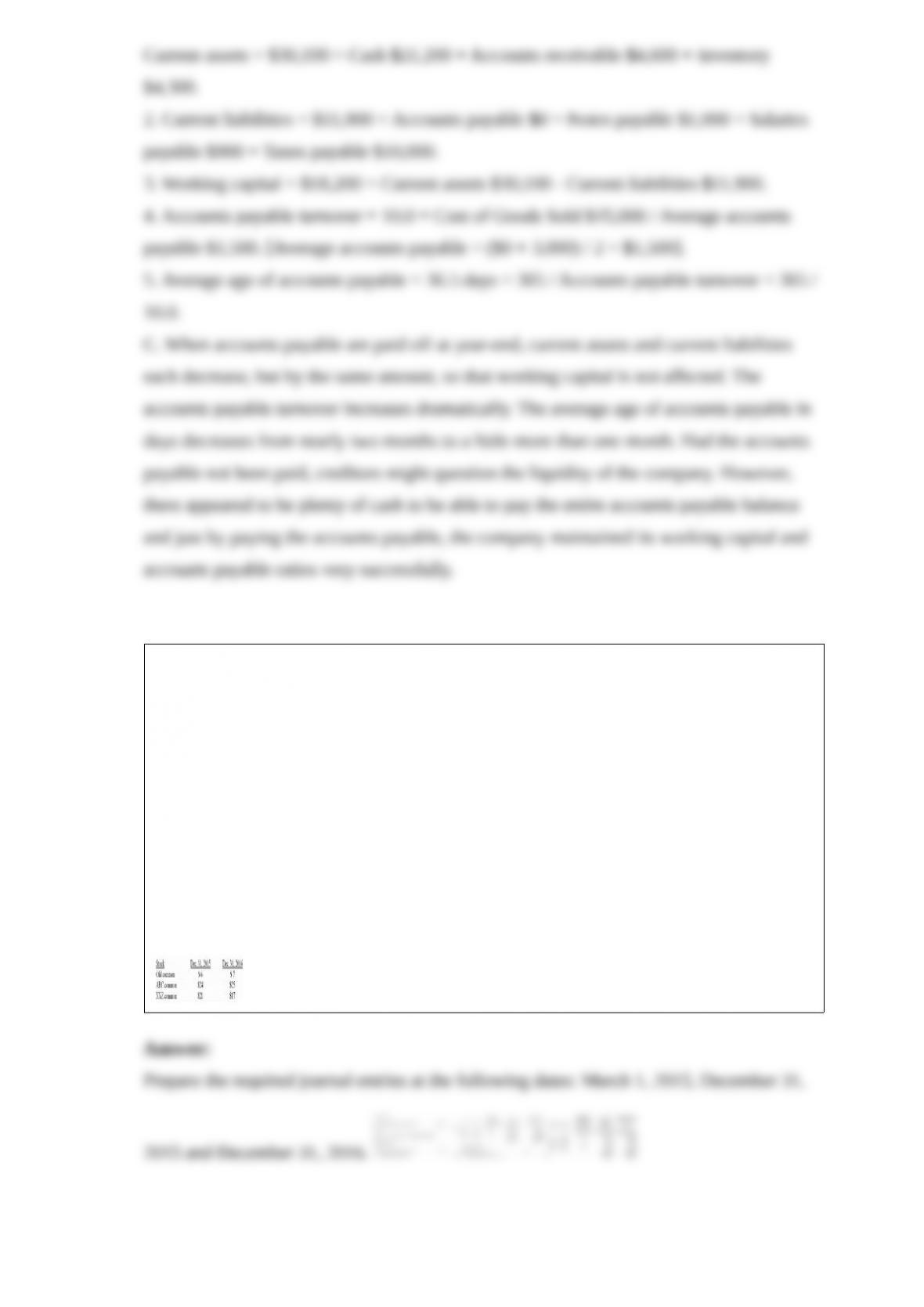
31) On March 1, 2015, Young Company paid cash to purchase the following stocks as
long-term investments in available-for-sale securities:
Old Corporation common stock (par $5), 2,000 shares at $5 per share (10% of
outstanding shares)
ABC Corporation common stock (par $10), 3,000 shares at $25 per share (15% of
outstanding shares)
XYZ Corporation common stock (par $10), 3,000 shares at $20 per share (10% of
outstanding shares)
The market prices per share at December 31, end of the accounting period, were as
follows:
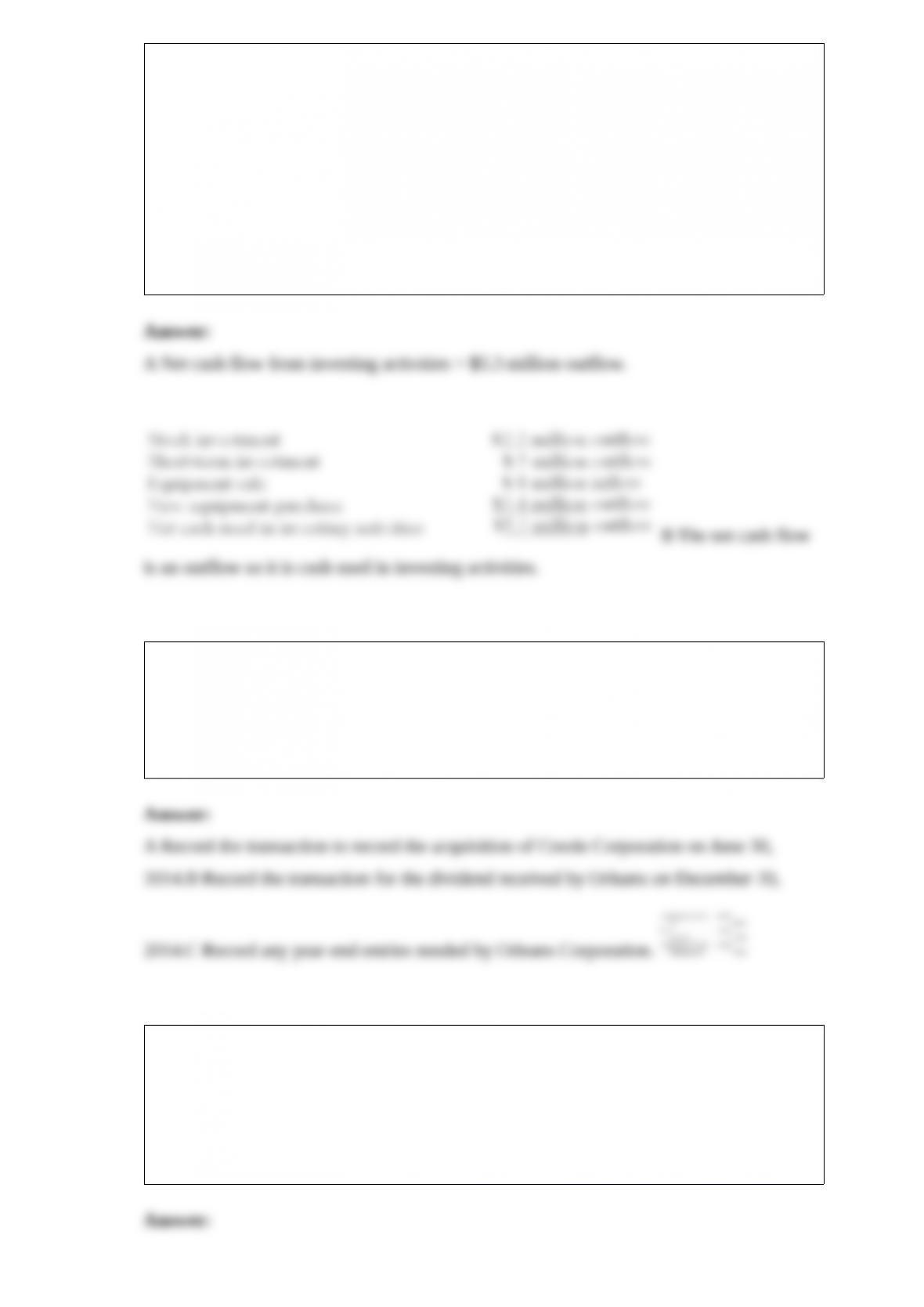
32) Blythe Company paid $2.2 million to purchase stock in another company, $1.0
million to purchase its common stock for treasury shares, $.5 million to buy short-term
investments, sold used equipment for $.8 million when its book value was $.6 million,
and purchased new equipment for $3.4 million.
A What amount will be reported in the investing activities section of Blythe’s cash flow
statement?
B Is the net cash flow cash provided by investing activities, or cash used in investing
activities?
33) Orleans Corporation purchased 1,000,000 shares of Creole Corporation’s common
stock, which constitutes 10% of Creole’s voting stock on June 30, 2014 for $42 per
share. Orleans’ intent is to keep these shares beyond the current year. On December 20,
2014, Creole paid a $4,000,000 cash dividend. On December 31, 2014, Creole’s stock
was trading at $45 per share and their reported 2014 net income was $52 million.
34) Landmark Restaurants reported net income of $45.9 million during Year 6.
Landmark reported depreciation and amortization of plant and equipment of $48.8
million and cash paid for additions to property, plant and equipment of $162.9 million
during Year 6.
Explain where each of these items would be reported and their impact on cash flows on
the statement of cash flows.

35)