Which of the following cost items is not allocable as joint costs when a single
manufacturing process produces several main products and several by-products?
A. Direct materials
B. Variable overhead
C. Direct labor
D. Fixed overhead
E. Freight-out
Answer:
Which of the following is a nonvalue-added activity?
A. Product design
B. Customer service
C. Research and development
D. Rework of defective items
Answer:

Metalbinders, Inc., has two divisions for its metal fabrication business. Division A
stamps the objects and then transfers them to Division B, which finishes and sells them.
Last year, Division A had administrative expenses of $40,000. Division B incurred
additional production costs of $120,000 (exclusive of amounts paid to Division A for
the stamped steel) to process 120,000 units. Division B sold the finished goods for
$500,000 and incurred $80,000 in variable selling and administrative expenses.
Required:
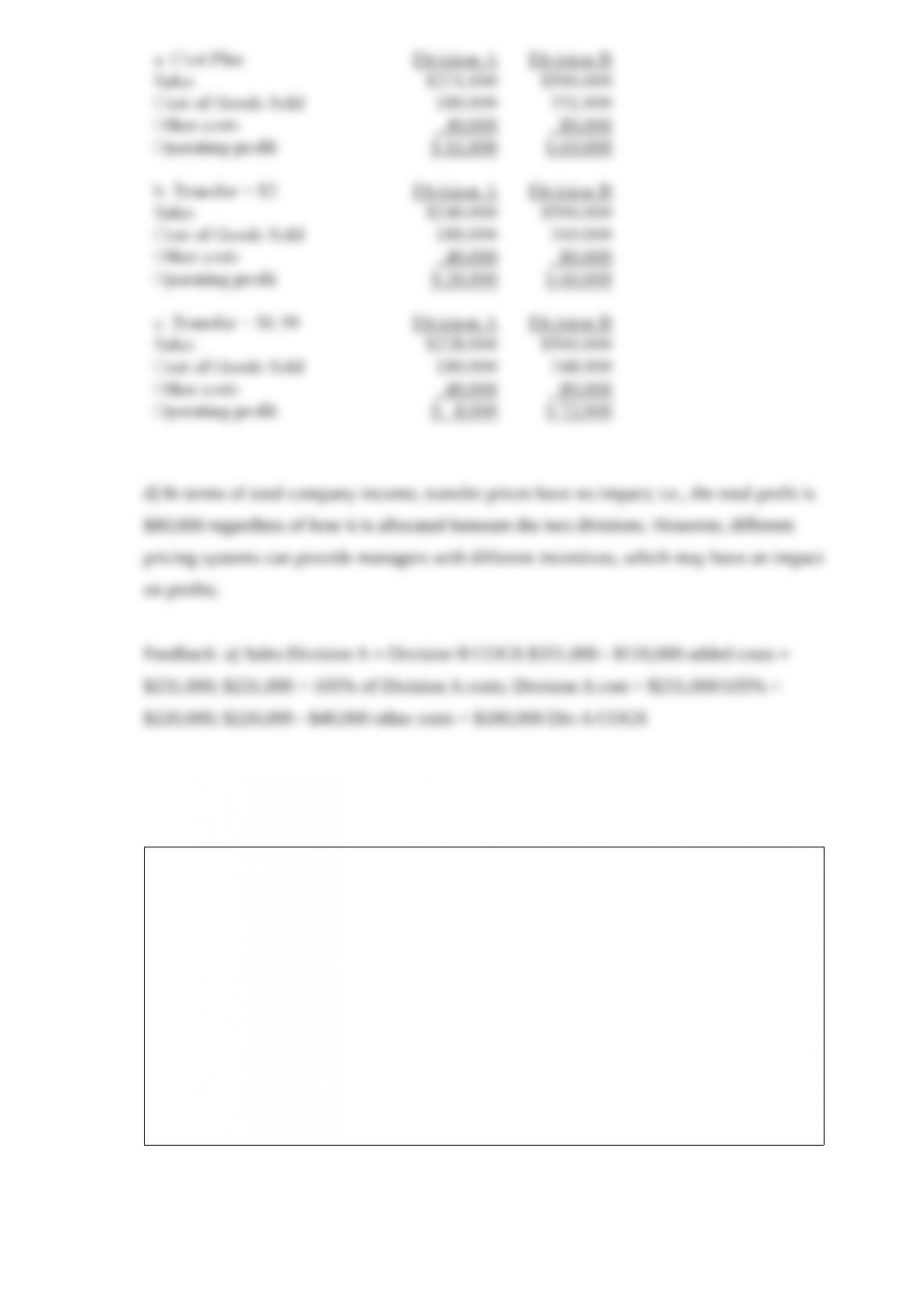
a) Prepare income statements for each division. Use a transfer price of Division A’s total
cost plus 5%. Assume Cost of Goods Sold for Division B is $351,000.
b) Repeat (a), using a transfer price of $2.00 per unit; this is also the market price.
c) Repeat (a), using a negotiated transfer price of $1.90 per unit.
d) Which transfer price results in higher income to Metalbinders, Inc.?
Answer:
The Work-in-Process Inventory of the Rapid Fabricating Corp. was $3,000 higher on
December 31, 2010 than it was on January 1, 2010. This implies that in 2010
A. cost of goods manufactured was higher than cost of goods sold.
B. cost of goods manufactured was less than total manufacturing costs.
C. manufacturing costs were higher than cost of goods sold.
D. manufacturing costs were less than cost of goods manufactured.
E. cost of goods manufactured was less than cost of goods sold.
Answer:
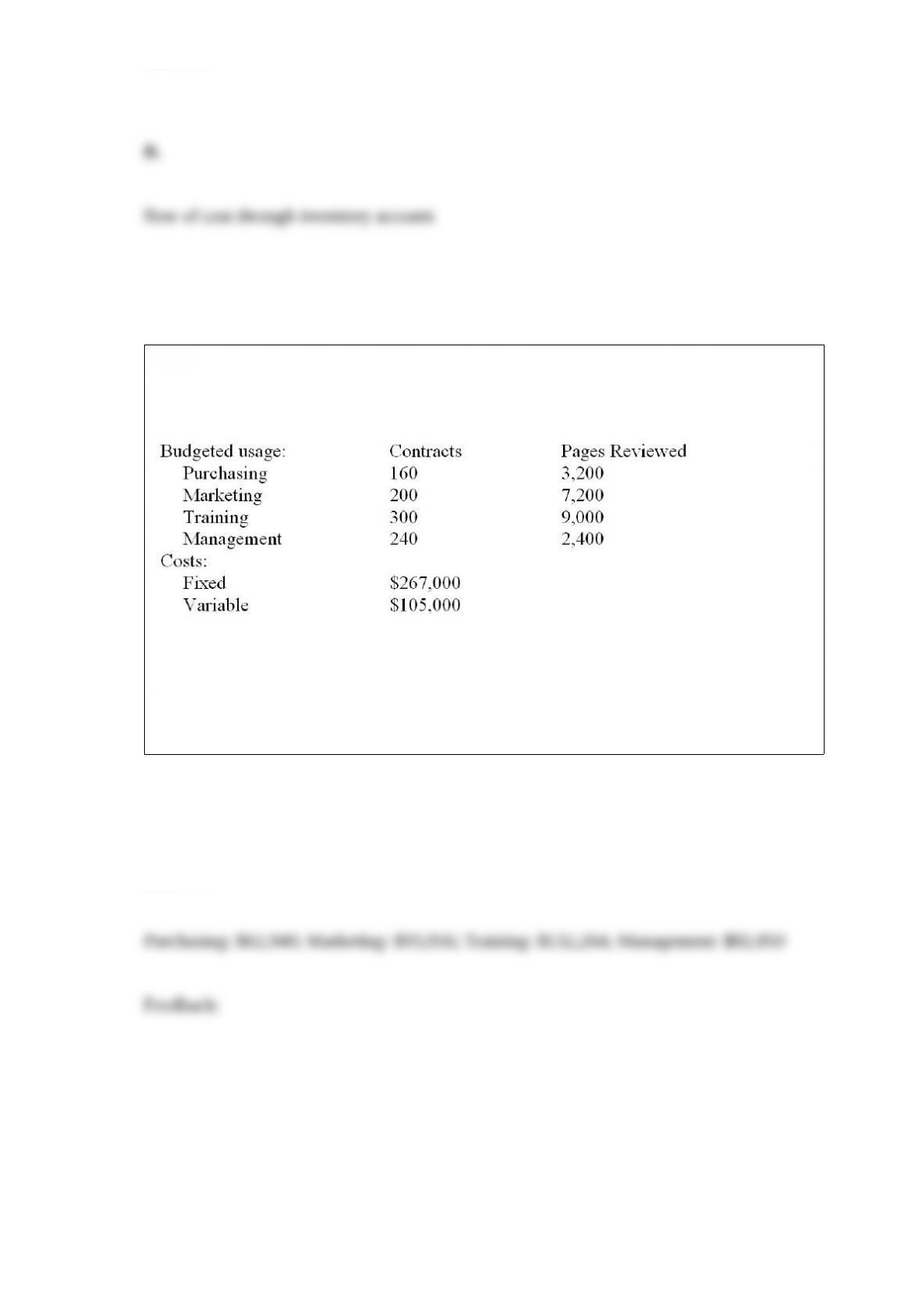
The legal department for Buffet Corp. provides legal services for four departments in
the Omaha office. The following budget has been prepared for the month.
Required (use three decimal places in your calculations):
a) If Buffet uses a dual rate for allocating its costs, allocating fixed costs based on
number of contracts and variable costs based on number of pages reviewed, how much
cost will be allocated to the four user departments?
Answer:
The UVW Manufacturing Company produces a single uniform product throughout the
year. Which of the following product costing systems should be used by UVW?
A. job-order costing
B. process costing
C. operation costing
D. batch costing
Answer:
The Miller Company manufactures wiring tools. The company is currently producing
well below its full capacity. The Brisbois Company has approached Miller with an offer
to buy 5,000 tools at $17.50 each. Miller sells its tools wholesale for $18.50 each; the
average cost per unit is $18.30, of which $2.70 is fixed costs.
Required:
a) If Miller were to accept Brisbois’s offer, what would be the increase in Miller’s
operating profits?
b) Assume that Miller is operating at full capacity. If Miller were to accept Brisbois’s
offer, what would be the change in Miller’s operating profits?
Answer:
KR Sales had $1,200,000 in sales last month. The variable cost ratio was 60% and
operating profits were $80,000. What sales volume does KR’s need to yield a $200,000
operating profit?
A. $1,000,000
B. $1,200,000
C. $1,500,000
D. $2,000,000
Answer:
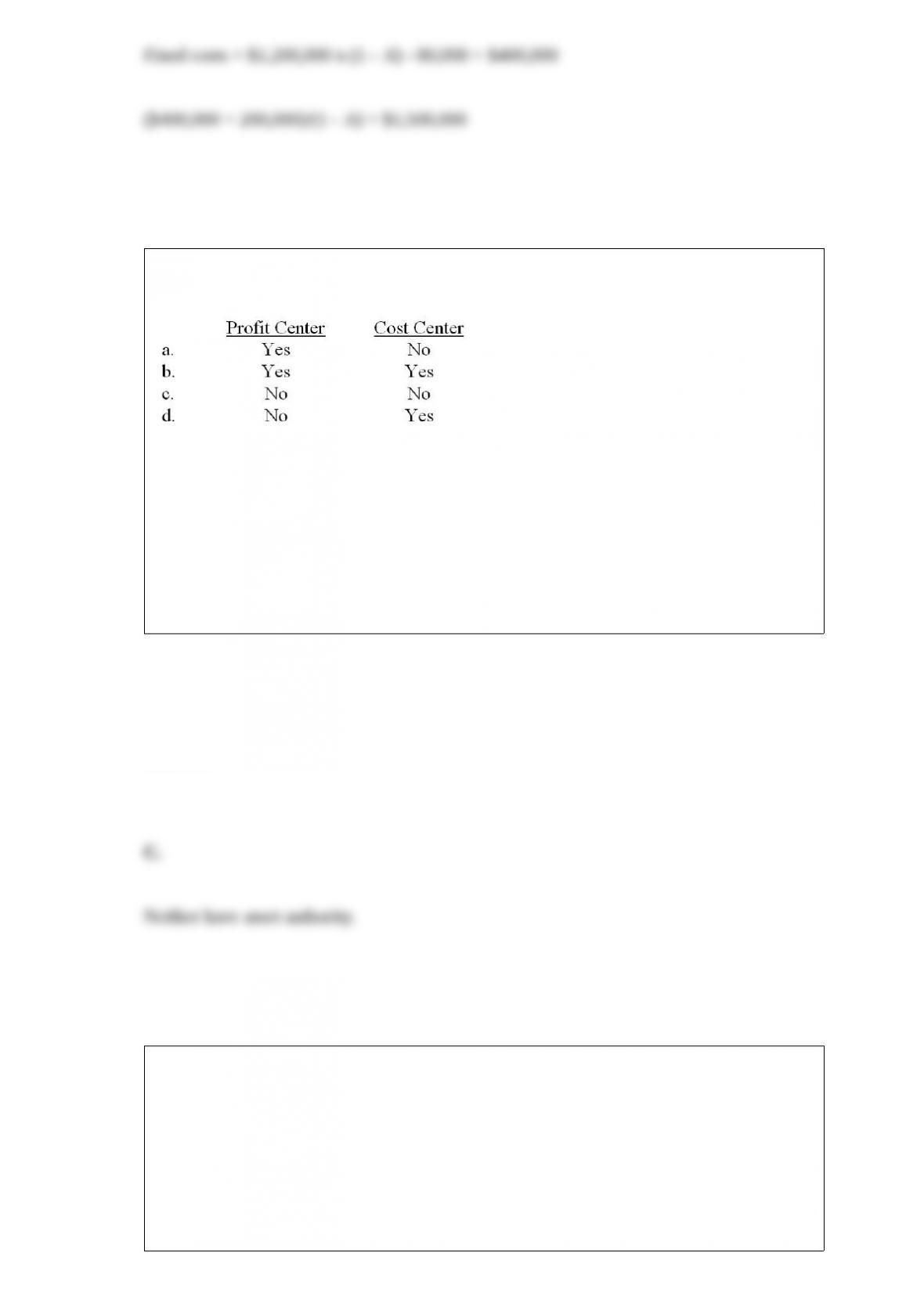
Assets invested in a responsibility center are included in a performance report of
A. a
B. b
C. c
D. d
Answer:
The Finishing Department had 5,000 incomplete units in its beginning Work-in-Process
Inventory which were 100% complete as to materials and 30% complete as to
conversion costs. 15,000 units were received from the previous department. The ending
Work-in-Process Inventory consisted of 2,000 units which were 50% complete as to
materials and 30% complete as to conversion costs. The Finishing Department uses
first-in, first-out (FIFO) process costing. The How many units were started and
completed during the period?

A. 12,000
B. 13,000
C. 18,000
D. 20,000
Answer:
The starting point in preparing a comprehensive budget for a manufacturing company
limited by its ability to produce and not by its ability to sell is
A. a sales forecast.
B. an estimate of productive capacity.
C. an estimate of cash receipts and disbursements.
D. a projection of fixed asset acquisitions.
Answer:
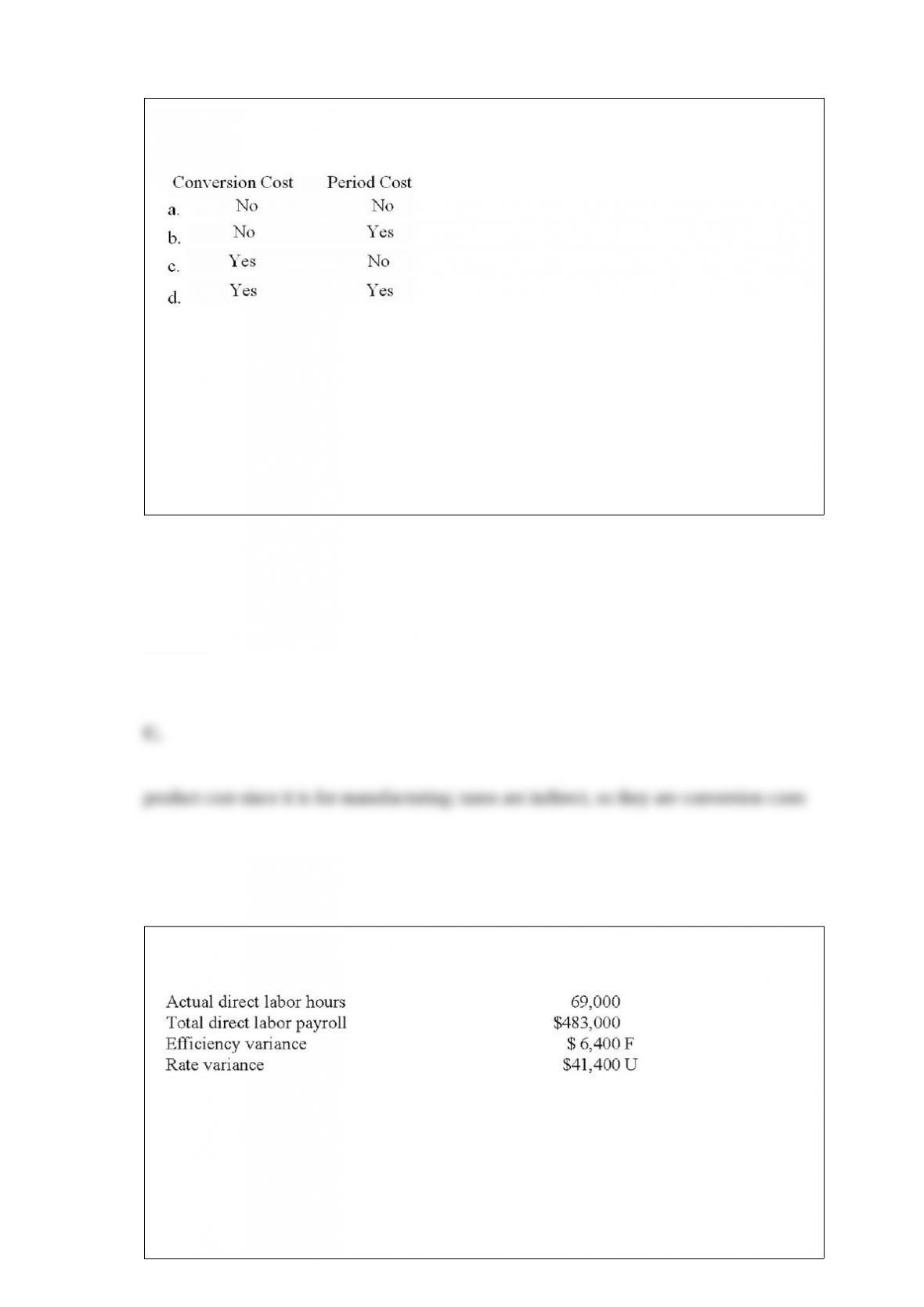
Property taxes on the manufacturing facility are an element of
A. Option A
B. Option B
C. Option C
D. Option D
Answer:
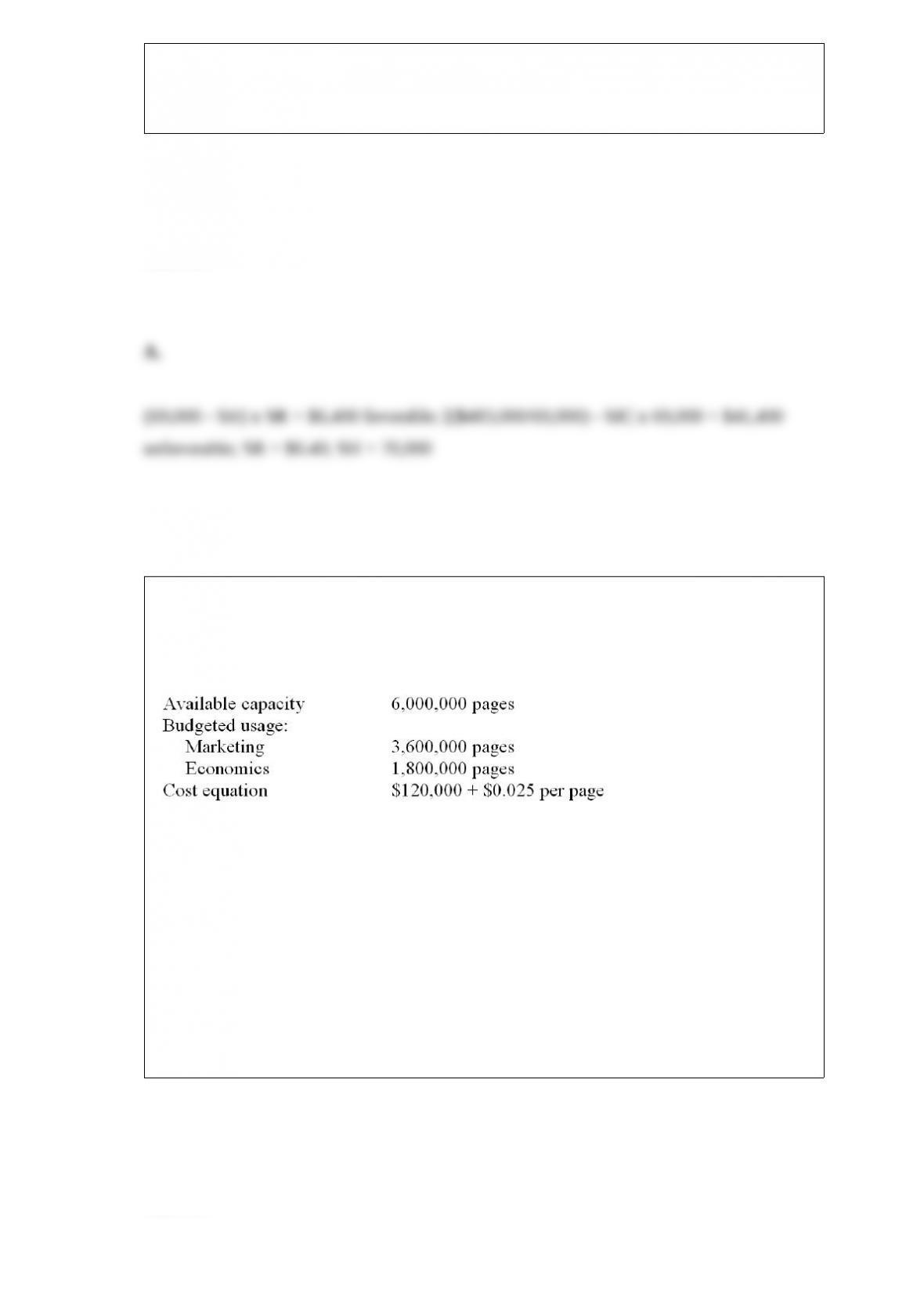
Information for Nighttime Company’s direct labor cost for February is as follows:
What were the standard direct labor hours for February?
A. 70,000
B. 69,000
C. 72,000
D. 71,400
Answer:
The Copy Department in the College of Business at State University provides
photocopying service for both the Marketing and Economics Department. The
following budget has been prepared for the year.
If the Copy Department uses a dual rate for allocating its costs based on usage, how
much cost will be allocated to the Economics Department?
A. $85,000
B. $90,000
C. $105,000
D. $120,000
Answer:
A manager makes a decision that is beneficial for a specific investment center but not
for the entire organization. From the organization’s perspective, this decision results in
A. goal congruence.
B. decentralization.
C. contingent compensation.
D. fixed compensation.
Answer:
Cascade Cliffs, Inc., operates two divisions: (1) a management division that owns and
manages bulk carriers on the Great Lakes and (2) a repair division that operates a dry
dock in Cheboygan, Michigan. The repair division works on company ships, as well as
other large-hull ships.
The repair division has an estimated variable cost of $37 per labor-hour. The repair
division has a backlog of work for outside ships. They charge $70.00 per hour for labor,
which is standard for this type of work. The management division complained that it
could hire its own repair workers for $45.00 per hour, including leasing an adequate
work area.
What is the minimum transfer price per hour that the repair division should obtain for
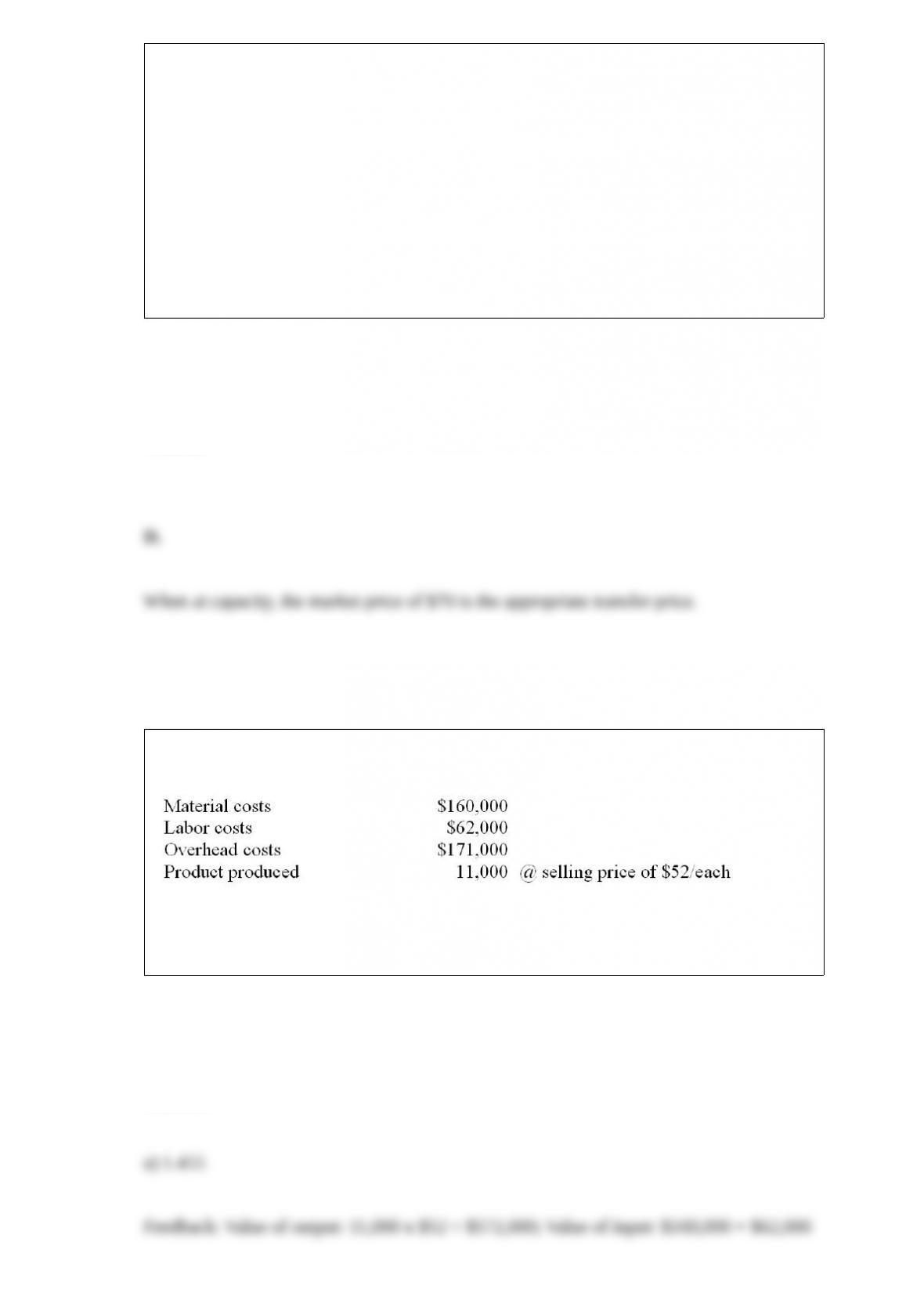
its services, assuming it is operating at capacity?
A. $33.00
B. $37.00
C. $45.00
D. $70.00
E. $82.00
Answer:
Laguna Co. has provided the following information for last year:
Required:
a) Calculate the total factor productivity measure.
Answer:
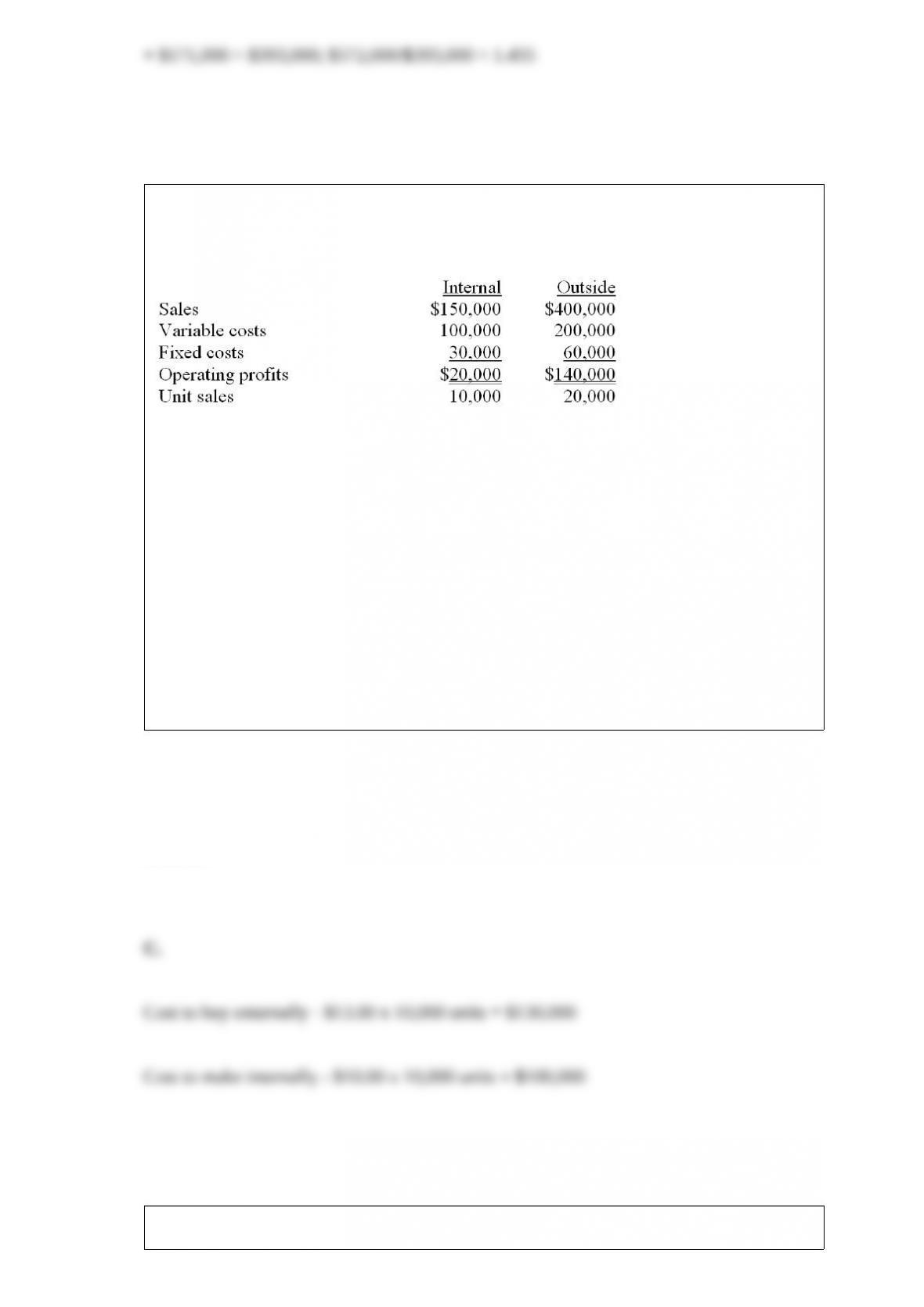
The Axle Division of Becker Company produces axles for off-road sport vehicles.
One-third of Axle’s output is sold to an internal division of Becker; the remainder is
sold to outside customers. Axle’s estimated operating profit for the year is:
The internal division has an opportunity to purchase 10,000 axles of the same quality
from an outside supplier on a continuing basis. The Axle Division cannot sell any
additional products to outside customers. Should the Becker Company allow its internal
division to purchase the axles from the outside supplier at $13.00 per unit?
A. No; making the axles will save Becker $15,000.
B. Yes; buying the axles will save Becker $15,000.
C. No; making the axles will save Becker $30,000.
D. Yes; buying the axles will save Becker $30,000.
Answer:
How will increases in the following items affect return on investment (ROI)?
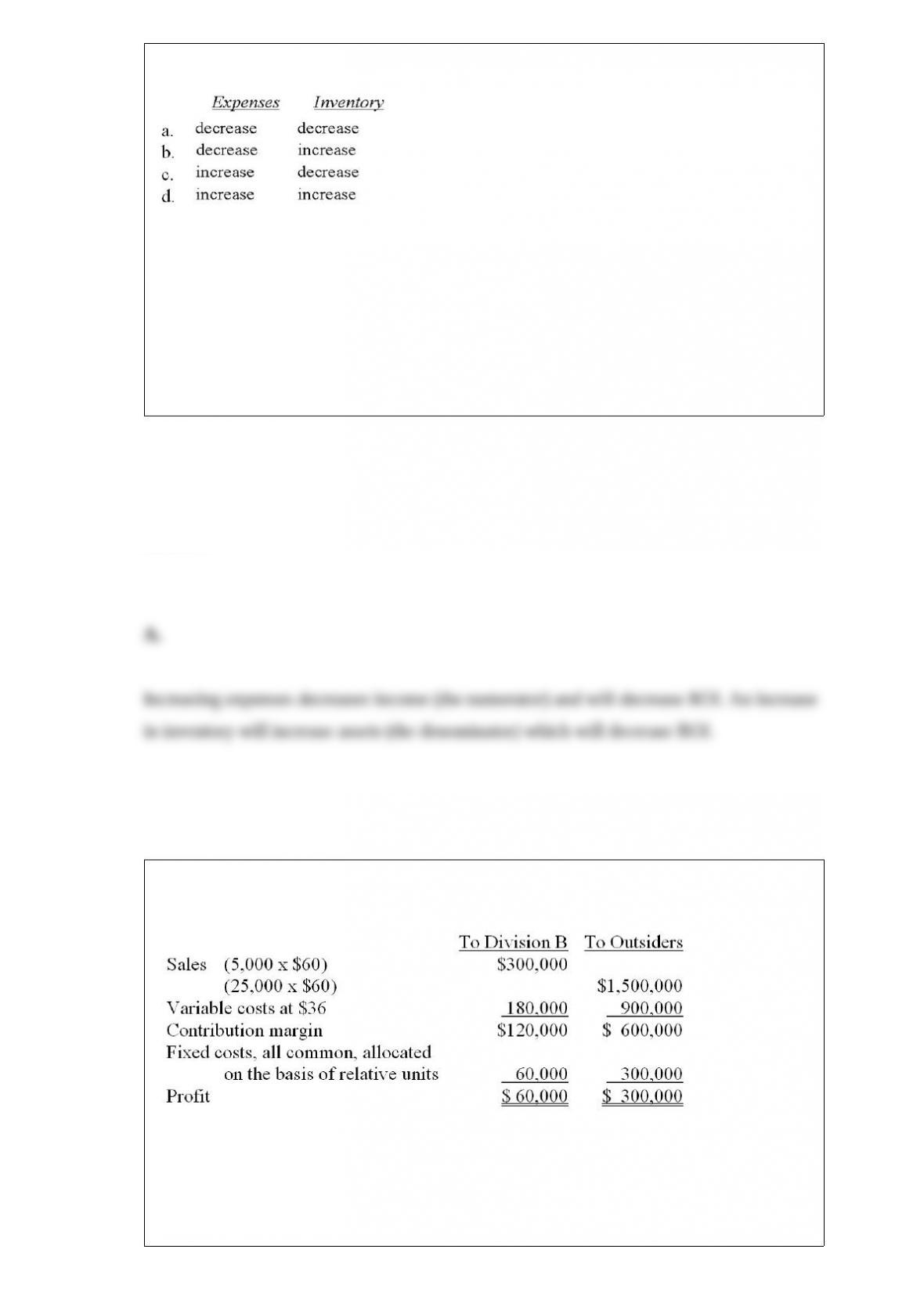
A. a
B. b
C. c
D. d
Answer:
Division A of Stills Company expects the following results:
Division B has the opportunity to buy its needs of 5,000 units from an outside supplier
at $45 each. Assume that Division A cannot increase sales to outsiders.
Required:
a) What would be the optimal transfer price?
b) Assume that Stills allows the divisional managers to negotiate transfer prices. What
would the maximum transfer price be?
c) Assume that Stills allows the divisional managers to negotiate transfer prices. What
would the minimum transfer price be?
Answer:
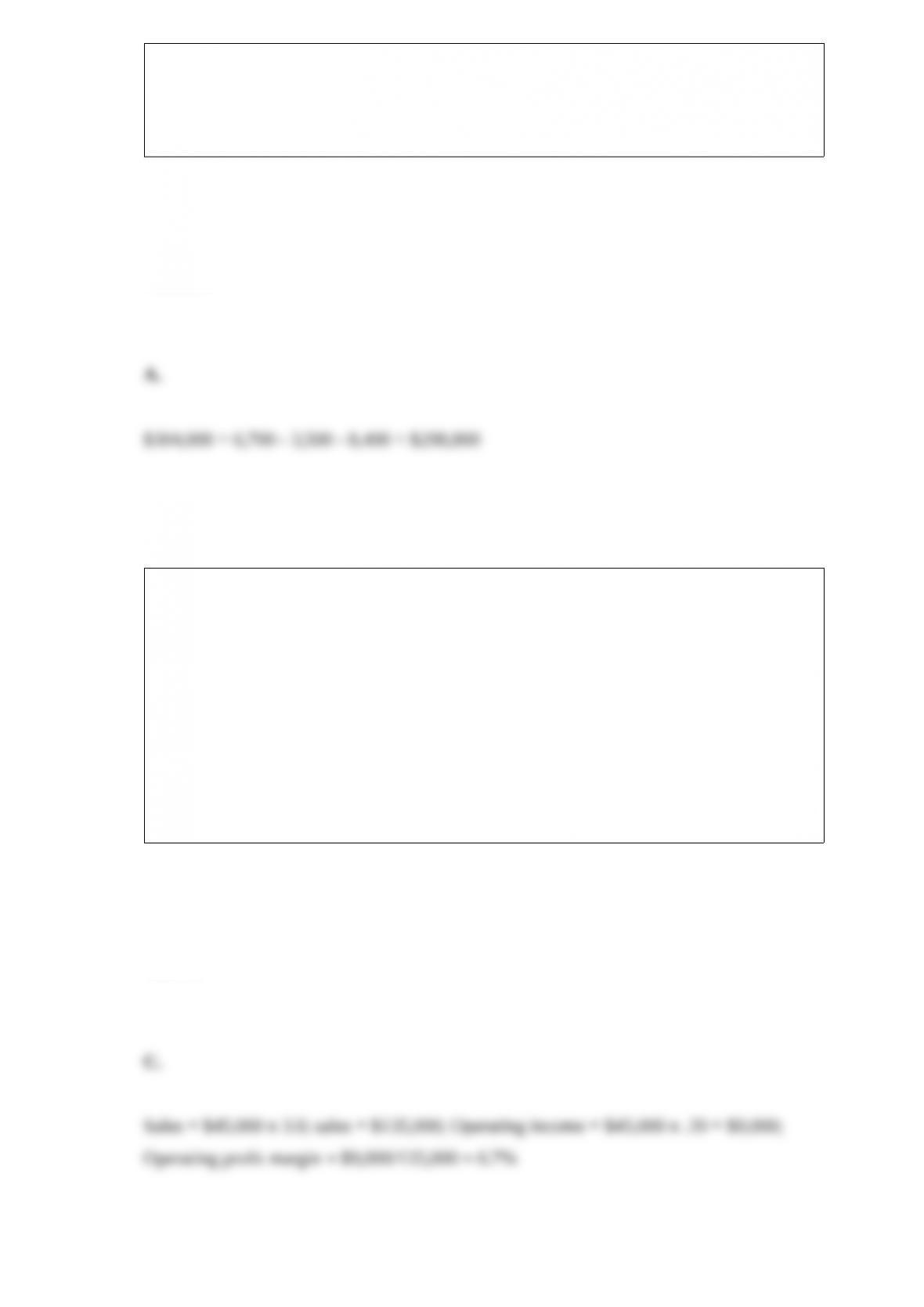
Given the following information for a retail company, what is the total cost of goods
purchased for the period?
A. $298,800
B. $290,800
C. $282,100
D. $304,000
Answer:
The FGH Company has an asset turnover of 3.0 times, using assets of $45,000. The
company also has a return on investment (ROI) of 20%. What was the company’s
operating profit margin?
A. 5.0%
B. 6.0%
C. 6.7%
D. 8.3%
Answer:
Cruises, Inc., operates two divisions: (1) a management division that owns and
manages cruise ships in the Florida Keys and (2) a repair division that operates a dry
dock in Marble Sand Florida. The repair division works on company ships, as well as
other large-hull ships.
The repair division has an estimated variable cost of $28.50 per labor-hour. The repair
division has a backlog of work for outside ships. They charge $48.00 per hour for labor,
which is standard for this type of work. The management division complained that it
could hire its own repair workers for $30.00 per hour, including leasing an adequate
work area.
What is the maximum transfer price per hour that the management division should
pay?
A. $28.50
B. $30.00
C. $39.00
D. $46.50
E. $48.00
Answer:
Redmond Company produces precision components. Redmond has 11 customers, one
accounts for 60 percent of the sales, with the remaining ten accounting for the rest of
the sales. The ten smaller customers purchase components in roughly equal quantities.
Orders placed by the smaller customers are about the same size. Data concerning
Redmond’s customer activity follow:
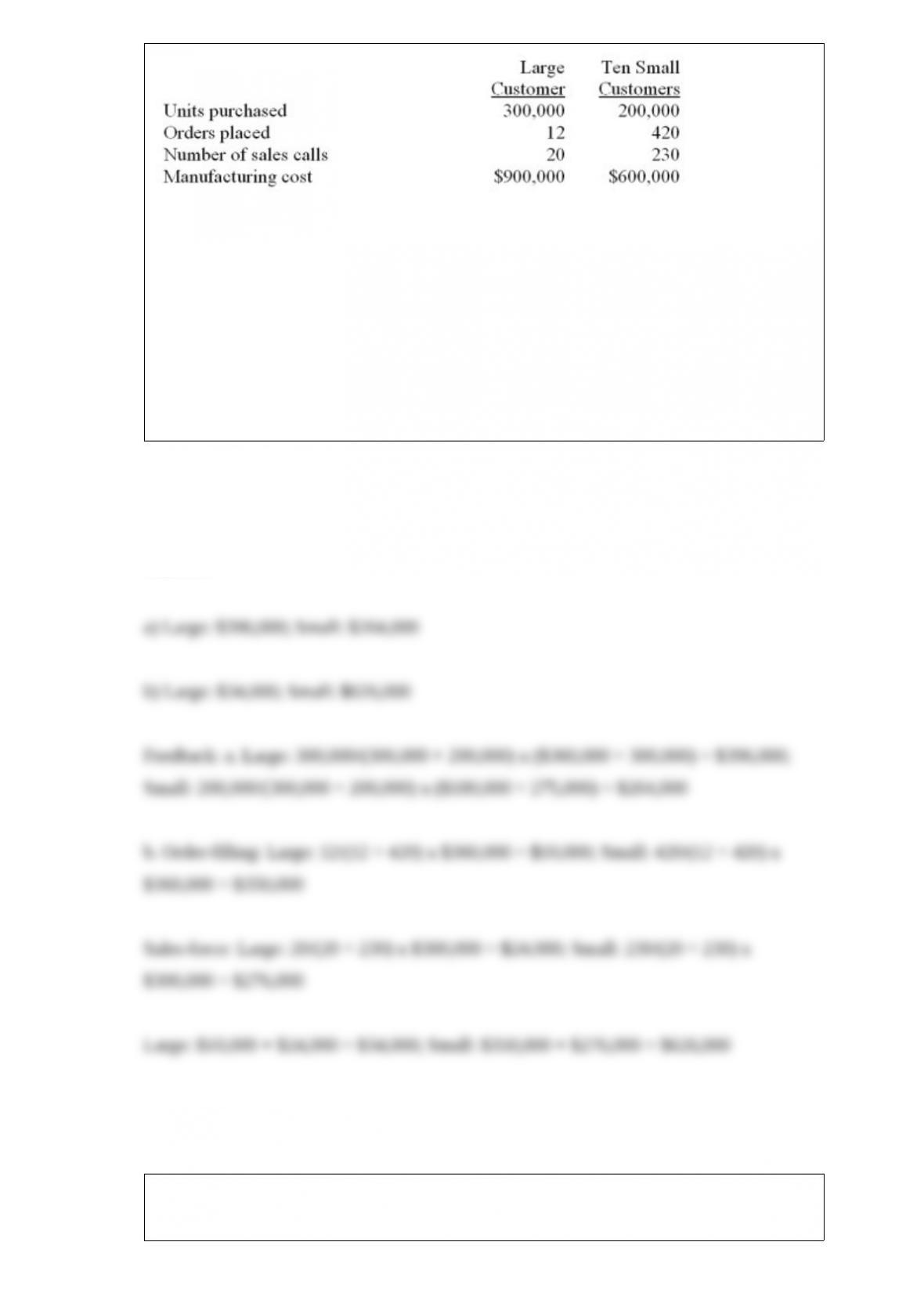
Order-filling costs for Redmond Company total $360,000, and sales-force costs are
$300,000.
Required:
a) Allocate the order-filling and sales force costs to the customers based on sales
volume?
b) Allocate the order-filling and sales force costs to the customers using an
activity-based costing approach?
Answer:
Which of the following activities would not be considered a value-added activity?
A. Production
B. Marketing
C. Accounting
D. Distribution
Answer:
The basic difference between a master budget and a flexible budget is that a
A. flexible budget considers only variable costs but a master budget considers all costs.
B. flexible budget allows management latitude in meeting goals whereas a master
budget is based upon a fixed standard.
C. master budget is for an entire production facility but a flexible budget is applicable
to single departments only.
D. master budget is based on one specific level of production and a flexible budget can
be prepared for any production level within a relevant range.
Answer:
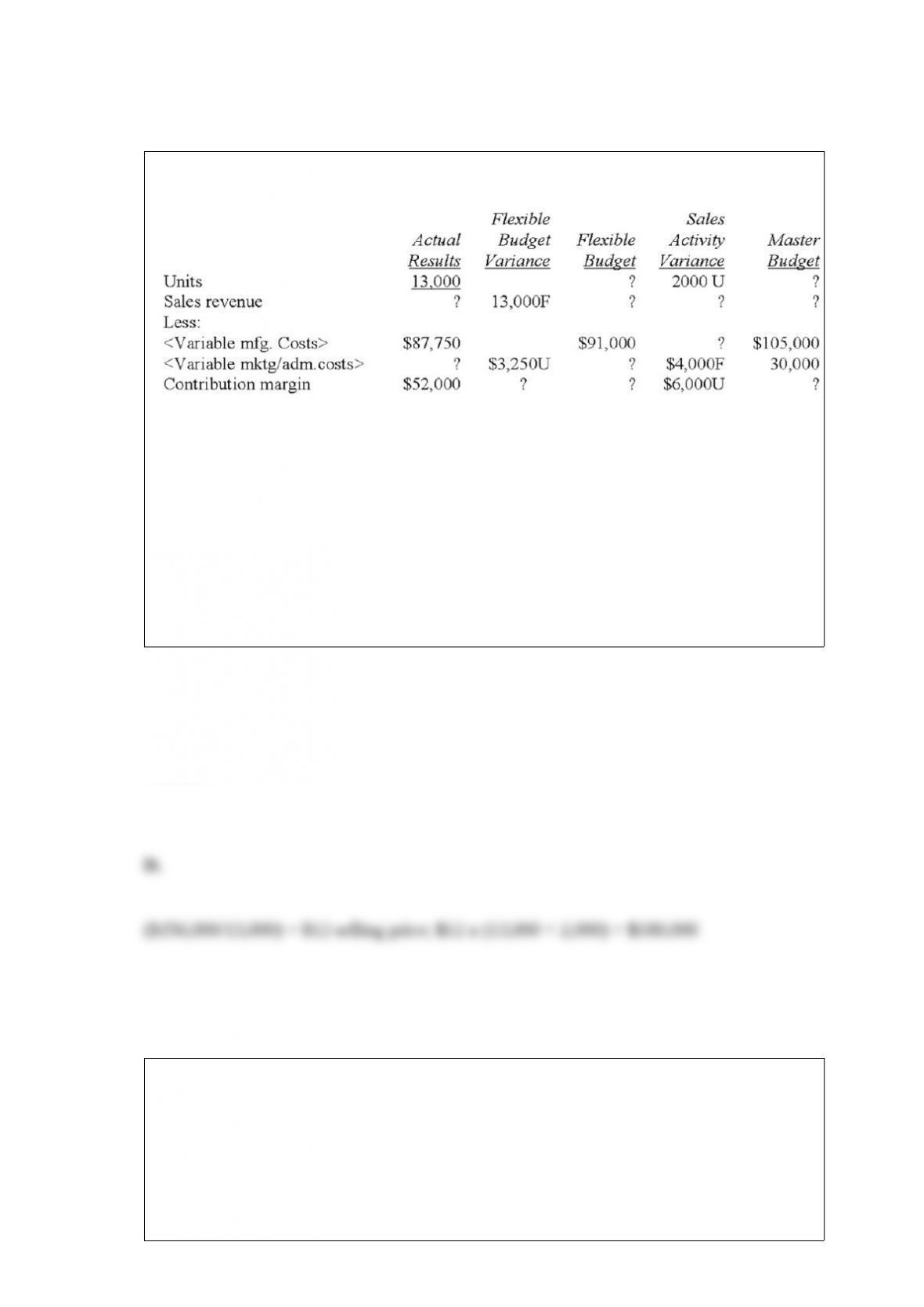
What is the master budget sales revenue?
A. $124,000.
B. $148,000.
C. $156,000.
D. $180,000.
Answer:
In 2010, the MoreForLess Company had revenues of $2,000,000 while costs were
$1,500,000. In 2011, MoreForLess will be introducing a new product line that will
generate $200,000 in sales revenues and $160,000 in costs. Assuming no changes are
expected for the other products, the differential operating profit for 2011 is
A. $540,000.

B. $200,000.
C. $160,000.
D. $40,000.
Answer:
The Sun Company manufactures a special line of graphic tubing items. The company
estimates it will sell 75,000 units of this item in 2008. The beginning finished goods
inventory contains 20,000 units. The target for each year’s ending inventory is 10,000
units.
Each unit requires five feet of plastic tubing. The tubing inventory currently includes
70,000 feet of the required tubing. Materials on hand are targeted to equal three month’s
production. Any shortage in materials will be made up by the immediate purchase of
materials. Sales take place evenly throughout the year.
What are the materials requirements (in feet) for 2008?
A. 313,750
B. 336,250
C. 363,750
D. 386,250
Answer:
Scottso Corporation applies overhead using a normal costing approach based upon
machine-hours. Budgeted factory overhead was $266,400, budgeted machine-hours
were 18,500. Actual factory overhead was $287,920, actual machine-hours were
19,050. How much overhead would be applied to production?
A. $266,400.
B. $274,320.
C. $279,607.
D. $287,920.
Answer:
The Eastern division sells goods internally to the Western division of the same
company. The quoted external price in industry publications from a supplier near
Eastern is $200 per ton plus transportation. It costs $20 per ton to transport the goods to
Western. Eastern’s actual market cost per ton to buy the direct materials to make the
transferred product is $100. Actual per-ton direct labor is $50. Other actual costs of
storage and handling are $40. The company president selects a $220 transfer price. This
is an example of (CIA adapted)
A. market-based transfer pricing.
B. cost-based transfer pricing.
C. negotiated transfer pricing.
D. cost plus 20% transfer pricing.
Answer:
Read, Inc. instituted a new process in October 2008. During October, 10,000 units were
started in Department A. Of the units started, 8,000 were transferred to Department B,
and 2,000 remained in Work-in-Process at October 31, 2008. The Work-in-Process at
October 31, 2008, was 100% complete as to material costs and 50% complete as to
conversion costs. Material costs of $27,000 and conversion costs of $36,000 were
charged to Department A in October. What were the total costs transferred to
Department B assuming Department A uses weighted-average process costing?
A. $46,900
B. $53,600
C. $56,000
D. $57,120
Answer:
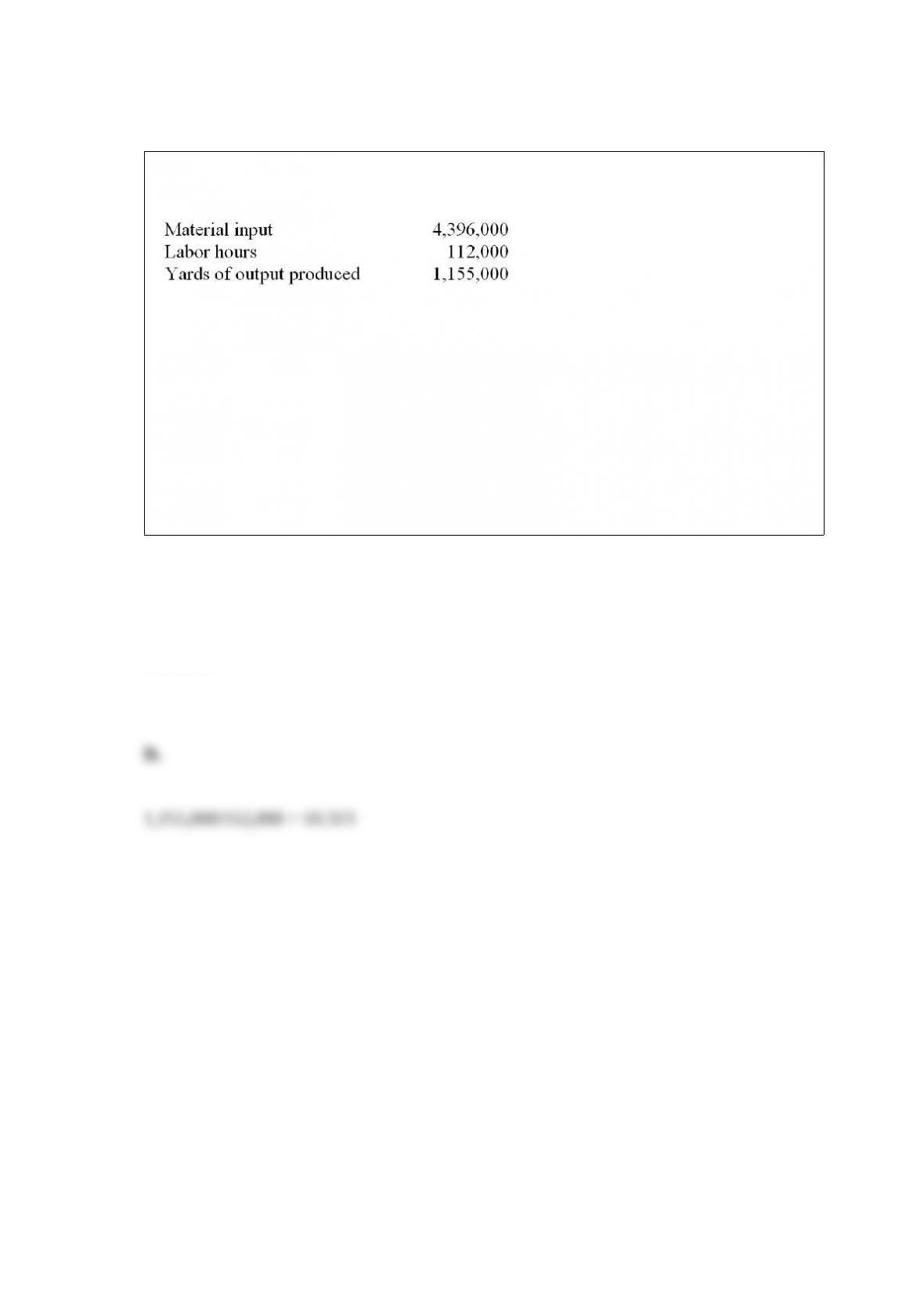
The Albertville Co has the following information for last year
The partial productivity for labor is
A. 0.097
B. 0.256
C. 3.906
D. 10.313
Answer: