
Profit maximization is the major focus of value engineering.
Unexpired costs are reflected on the balance sheet.
The margin of safety is an effective measure of risk for a company.
In setting compensation structures, fixed salary expense is normally not considered.

Lead time in a production process includes both value and non-value added time.
In the future competitive environment, companies will emphasize
A. achievement of financial results.
B. development of strategic alliances.
C. development of annual plans.
D. conformity to project expectations.
Louwers Corporation recently sold a used machine for $50,000. The machine had a
book value of $75,000 at the time of the sale. What is the after-tax cash flow from the
sale, assuming the company’s marginal tax rate is 25 percent?
A. $43,750
B. $50,000
C. $56,250
D. $75,000
According to JIT philosophy,
A. inventories of finished goods always should be available to meet customer demand.
B. push-through manufacturing flows are the most efficient.
C. maintaining inventories wastes resources and frequently covers up poor work or
other problems.
D. long production runs and large production lot sizes take advantage of economies of
scale.
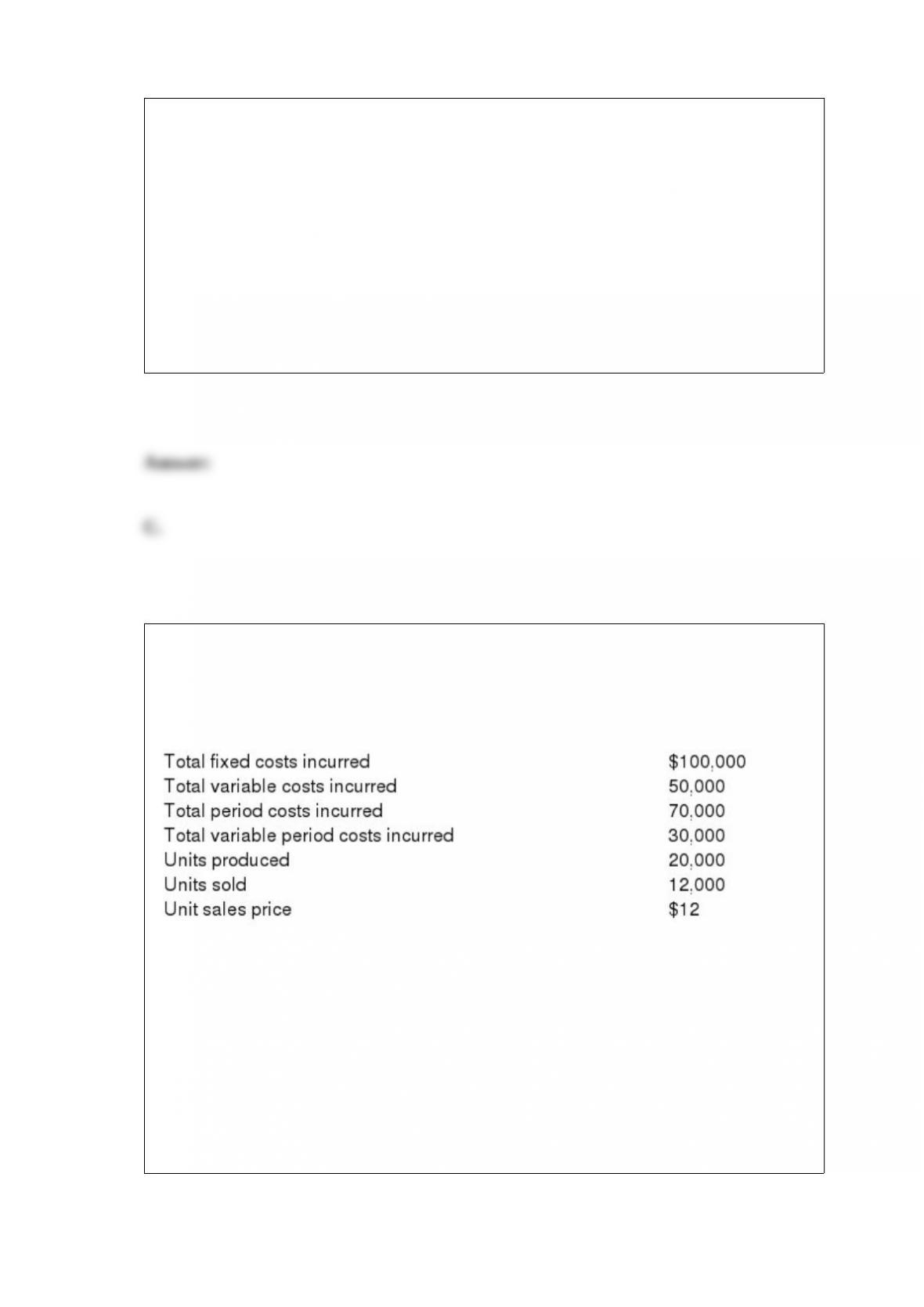
Ellis Corporation
The following information was extracted from the first year absorption-based
accounting records of Ellis Corporation
Refer to Ellis Corporation. What is Cost of Goods Sold for Ellis Corporation’s first
year?
A. $80,000
B. $90,000
C. $48,000
D. can’t be determined from the information given
Discuss briefly the type of information contained on (a) a bill of materials and (b) an
operations flow document.
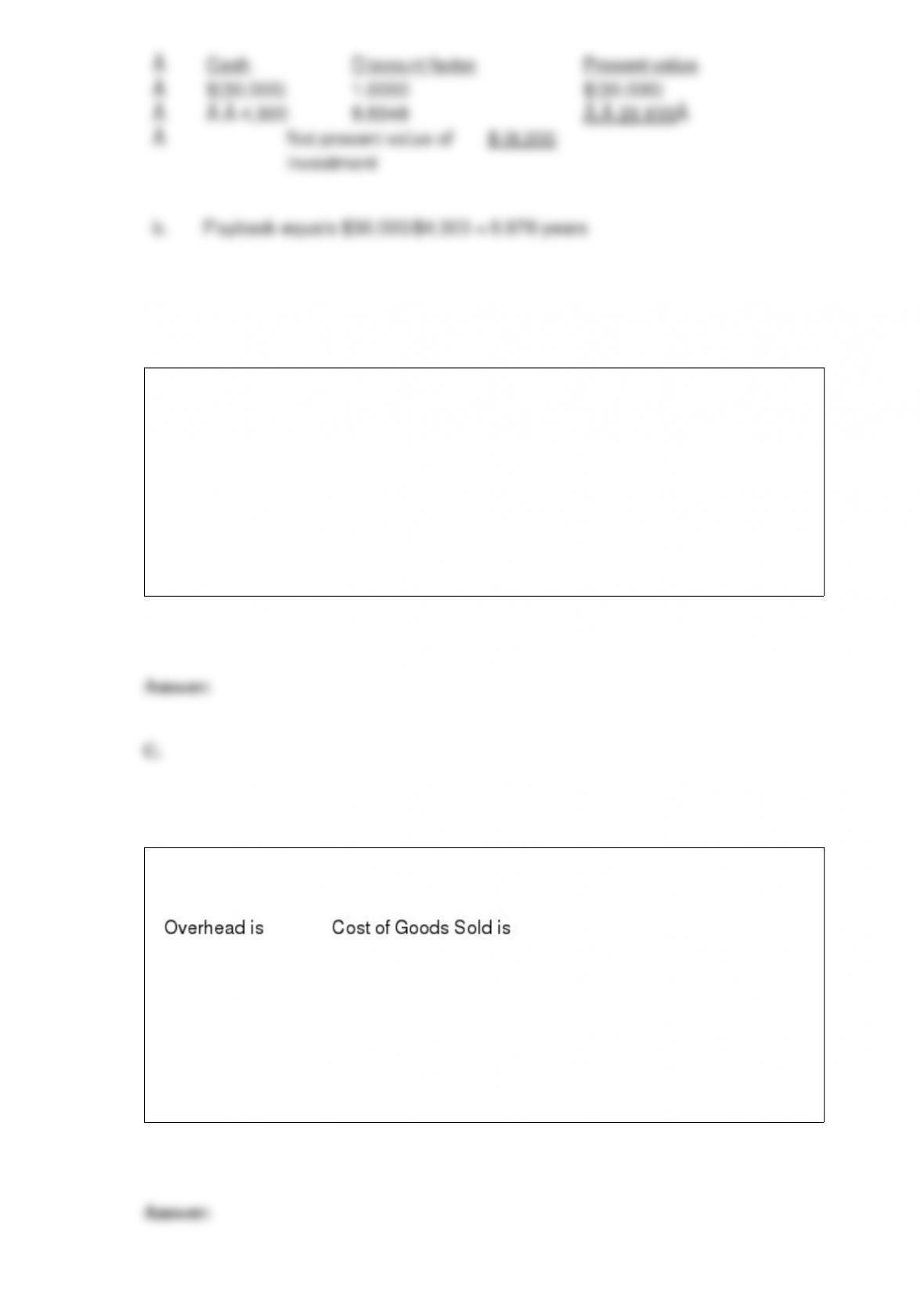
Merrill Productions is considering the purchase of a new movie camera, which will be
used for major motion pictures. The new camera will cost $30,000, have an eight-year
life, and create cost savings of $5,000 per year. The new camera will require $700 of
maintenance each year. Merrill Productions uses a discount rate of 9 percent.
Present value tables or a financial calculator are required.
BPR stands for
A. business product reengineering.
B. business purchase reengineering.
C. business process reengineering.
D. business process reduction.
If actual overhead is less than applied overhead, which of the following will be true?
Upon closing,
A. underapplied credited
B. underapplied debited
C. overapplied debited
D. overapplied credited

Return on investment is computed by dividing income by
A. contribution margin.
B. inventory turnover.
C. assets invested.
D. long-term assets.
The source document that records the amount of time an employee worked on a job
and his/her pay rate is the
A. job-order cost sheet.
B. employee time sheet.
C. interoffice memo.
D. labor requisition form.
From a cost management view, research and development cost represents
A. a life-cycle investment

B. a period expense.
C. an unearned revenue.
D. a risk reserve.
In the formula y = a + bX, y represents
A. fixed costs.
B. total cost.
C. variable costs.
D. mixed costs.
The selling, general, and administrative expense budget is based on the ____ budget.
A. production
B. sales
C. cash
D. purchases

In CVP analysis, linear functions are assumed for
A. contribution margin per unit.
B. fixed cost per unit.
C. total costs per unit.
D. all of the above.
Which of the following would be considered a non-financial performance
measurement?
A. increase in market share
B. variances from standards
C. number of customer complaints
D. cost of engineering changes
Traditional standard costs are inappropriate measures for performance evaluation in the
“new era” of manufacturing because they

A. build in allowances for non-value-adding activities.
B. are based on historical information.
C. don’t reflect current costs.
D. are ideal goals.
A company has set a target rate of return of 16% for its investment center. An
investment center manager in this company would
A. acquire assets that would increase divisional income by more than 16%.
B. sell all assets that do not generate divisional income of more than 16%.
C. acquire assets that would increase sales by more than 16%.
D. acquire any technologically advanced assets that would cause costs to be reduced by
16% or more.
Use of activity-based costing and activity-based management requires
A. the creation of an environment for change in an organization.
B. elimination of all non-value-added activities in an organization.
C. that company processes be automated and the use of direct labor be minimal.
D. each process be fully mapped and all activities be identified as value-added or
non-value-added.

With JIT manufacturing, which of the following costs would be considered a direct
product cost?
A. insurance on the plant
B. utilities used for manufacturing
C. janitors’ salaries
D. salary of the plant supervisor
Which of the following statements about business-value-added activities (BVAs) is
true?
A. BVAs reflect the same processes in all organizations.
B. A process map will not reflect BVAs because such activities are not essential to
process performance.
C. BVAs are actually value-added activities of an organization that relate to
administrative processes.
D. It is impossible to eliminate all BVAs in an organization.
Discuss the three elements of a cost management system.
How should employees be motivated so open-book management will succeed?
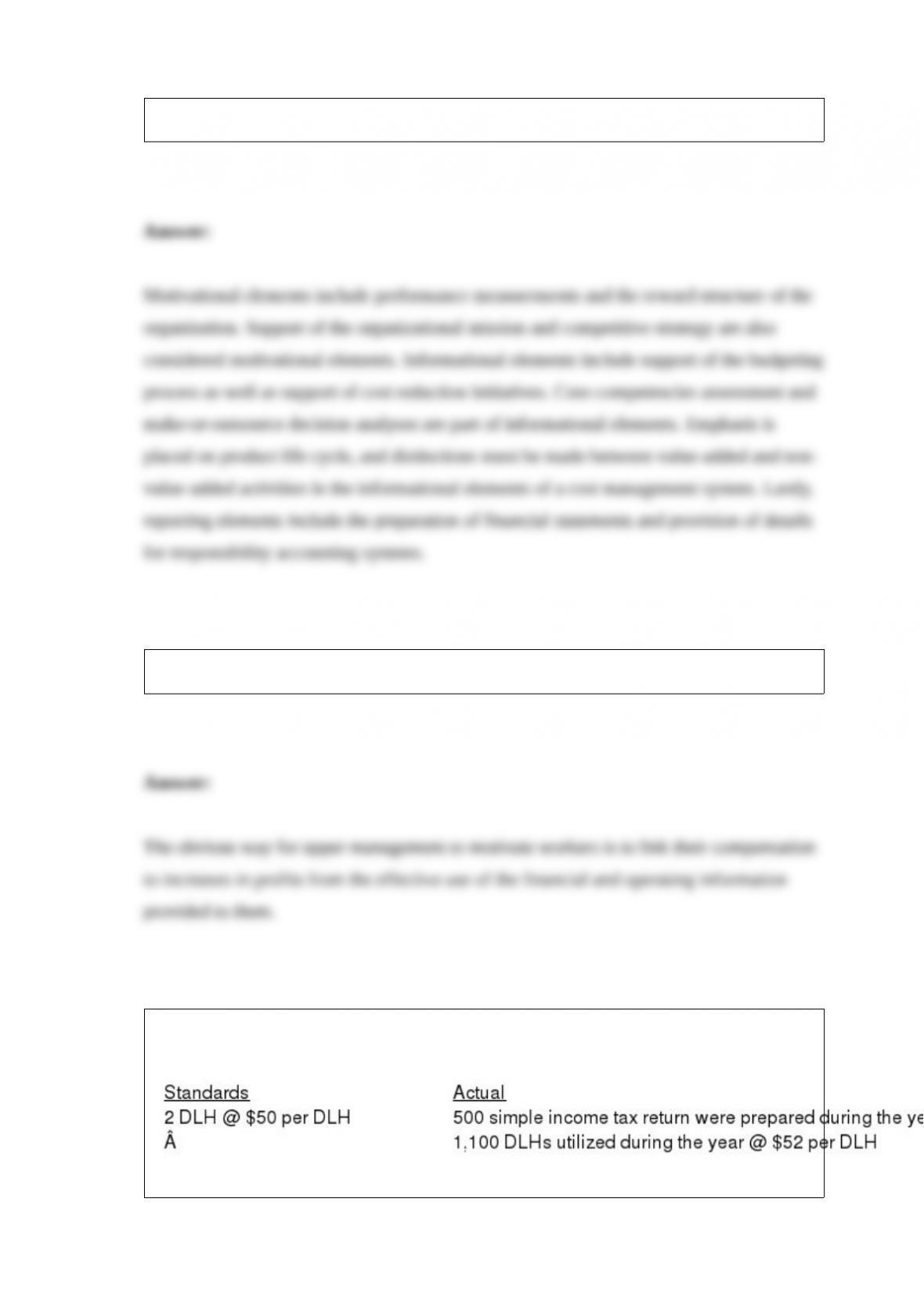
McKinney and Associates provided the following information relative to the times and
costs to prepare a simple income tax return:
Compute the price and efficiency variances.
Discuss the application of the high-low method.
The difference between what was paid for inputs and what should have been paid for
inputs is referred to as a _________________________.
Name five items that would be considered critical success factors by most world-class
companies. Why is each of these factors so important to organizational longevity?
What distinct advantage does a return on investment measure have over a residual
income measure? Explain.
What is the relationship between the incurrence of the various types of quality costs
and the quantity of output that meets specification?
Discuss the characteristics of a company for which ABC would be appropriate.
List and discuss the four stages in the design of a cost management system.