The necessary financial statement disclosure is accomplished if the amount presented is
properly calculated.
Z-Mart’s quick assets are $147,000. With current liabilities of $143,000, Z-Mart’s
acid-test ratio is 1.03 to 1.
Accounts receivable turnover is calculated by dividing net sales by average accounts
receivable.
The terms 2/10, n/30 means that the seller offers the purchaser a 2% cash discount if the
amount is paid in full within 10 days. Otherwise, the full amount is due in 30 days.
Adjusting entries are always dated at the end of the accounting period.
The withdrawals account is normally closed by debiting it.
All increases and decreases in cash are not necessarily recorded in the Cash account.
A credit memorandum informs a customer of a credit to its Accounts Payable account
from a sales return or allowance.
Items such as sales slips, invoices, cheques, purchase orders, and employee earnings
records are also called source documents.
The cash basis of accounting commonly results in financial statements that are not
comparable from period to period.
A columnar journal is a journal with only one column.
Managerial accounting is an area of accounting that provides internal reports to assist
the decision-making needs of internal users.
The entry to increase the balance in petty cash from $50 to $75 would include a credit
to Petty Cash of $25.
If the cost to retail ratio is 60% and ending inventory at retail is $45,000, then estimated
ending inventory at cost is $27,000.
The purchase of supplies for cash impacts both the investing and financing sides of the
accounting equation.
A work sheet is prepared before entering the adjustments in the accounts.
Goods sold on credit to customers are called accounts payable.
Internal control devices for banking activities include signature cards, deposit slips,
cheques, and bank statements.
A trial balance that is in balance is proof that no errors were made in journalizing the
transactions, posting to the ledger, and preparing the trial balance.
Accrued expenses at the end of one period result in cash payments in a subsequent
period.
The merchandise turnover ratio is calculated by dividing average merchandise
inventory by cost of goods sold.
Goods and services tax (GST) or Harmonized Sales Tax (HST) is calculated on the
original purchase price plus the provincial sales tax (PST).
Cash, short-term investments and receivables, are called acid-test assets.
External users include creditors, shareholders, suppliers, and lawyers.
Interim financial reports cover a firm’s business activity for one year.
A revenue account normally has a debit balance.
A building is an example of an asset that does not provide any benefit to its owner.
Goods on consignment are goods shipped by their owner, called the consignee, to
another party called the consignor.
Ethical practices are not necessary to build trust and long-term relationships with
customers.
A classified balance sheet organizes assets and liabilities into important subgroups.
Adjusting entries are normally entered in the General Journal before they are recorded
on the work sheet.
An adjusting entry may include an entry to Cash.

The payee is the person who signs a cheque.
Outdoors Unlimited has the following transactions. For each transaction, indicate the
appropriate journal.
(a) Sales Journal
(b) Purchases Journal
(c) Cash Receipts Journal
(d) Cash Disbursements Journal
(e) General Journal
______ (1) Purchased merchandise for cash.
______ (2) Sold merchandise for cash.
______ (3) Purchased merchandise on credit.
______ (4) Sold merchandise on credit.
______ (5) Paid the utility bill.
______ (6) Owner invested more cash in the business.
______ (7) Recorded depreciation for the period.
______ (8) Borrowed money from the bank and received cash.
______ (9) Bought store supplies for cash.
______ (10) Customer paid off an account receivable.
The purchase on credit of a delivery truck for $9,600 was posted to Delivery Trucks as
a $9,600 debit and to Rent Expense as a $9,600 debit. What effect would this error have
on the trial balance?
A. The total of the Debit column of the trial balance will exceed the total of the Credit
column by $9,600.
B. The total of the Credit column of the trial balance will exceed the total of the Debit
column by $9,600.
C. The total of the Debit column of the trial balance will exceed the total of the Credit
column by $19,200.
D. The total of the Credit column of the trial balance will exceed the total of the Debit
column by $19,200.
E. The total of the Debit column of the trial balance will equal the total of the Credit
column.
Enterprise-application software is a stand-alone program not commonly used in North
America.

Equity is also known as:
A. Net income.
B. Expenses.
C. Net assets.
D. Revenue.
E. Net loss.
Celery Company has assets of $150,000, liabilities of $90,000, and equity of $60,000. It
buys supplies for cash $5,000. What effect would this transaction have on the
accounting equation?
A. Assets, $5,000 increase, equity, $5,000 increase.
B. Assets, $5,000 increase, equity, $5,000 decrease.
C. Liabilities, $5,000 increase, equity, $5,000 decrease.
D. Assets, $5,000 decrease, equity, $5,000 decrease.
E. Assets, no effect, liabilities, no effect.
A note receivable discounted with recourse is:
A. A contingent liability.
B. An outright sale of a note receivable to a bank.
C. Sold to a bank and the bank assumes liability.
D. A contingent liability and an outright sale of a note receivable to the bank.
E. An outright sale of a note receivable to a bank and the bank assumes liability.
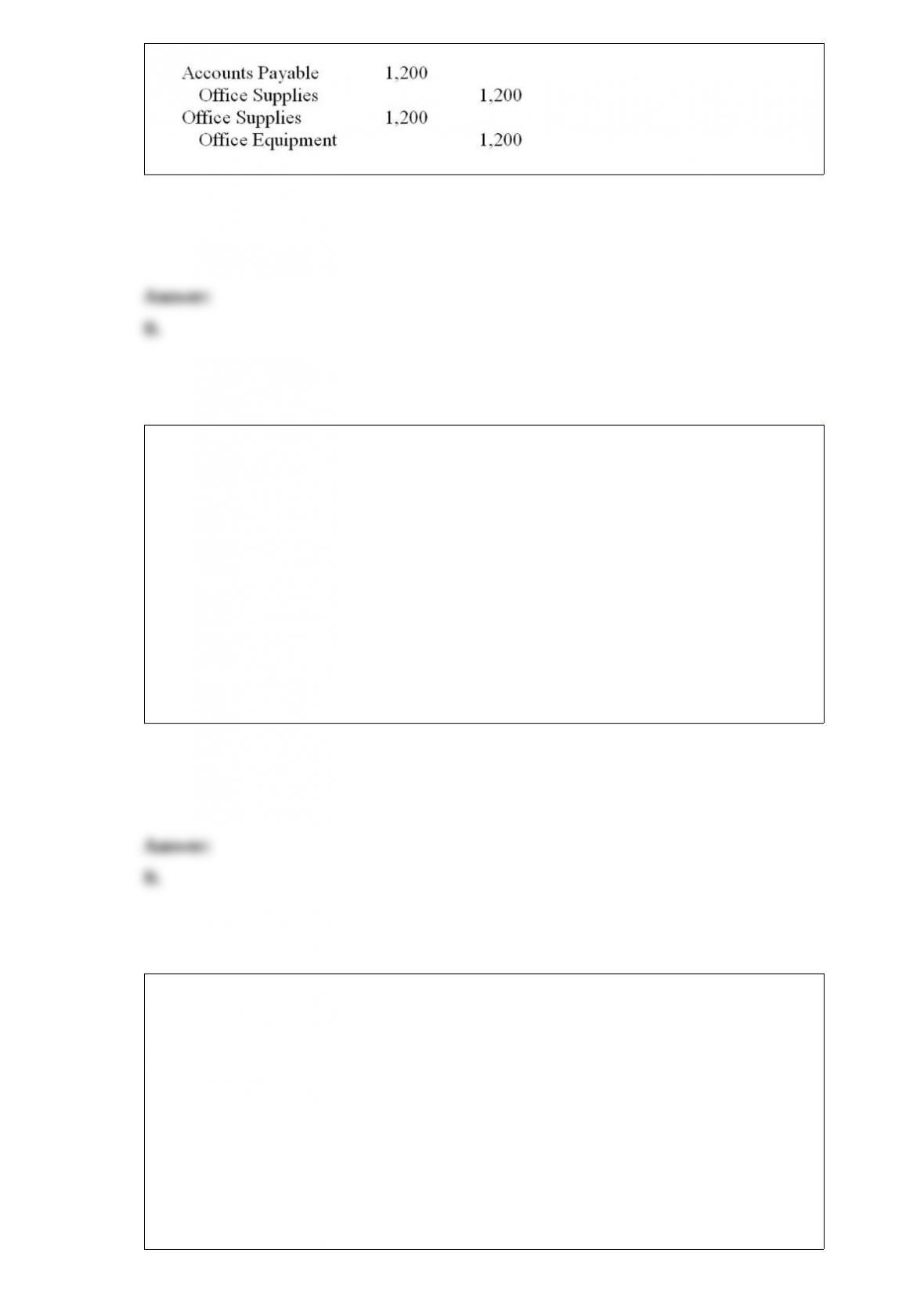
The following journal entry (incorrectly) recorded the purchase of office supplies for
$1,200 on credit:
If only one entry is to be made to correct this entry it would be:
A. None required. The original entry above is correct.
B.
C.
D.
E.
The pricing of an inventory where the purchase invoice of each item in the ending
inventory is identified and used to determine the cost assigned to the inventory is:
A. Weighted-average inventory method.
B. First-in, first-out method.
C. Average costing method.
D. Specific identification method.
E. Retail method.
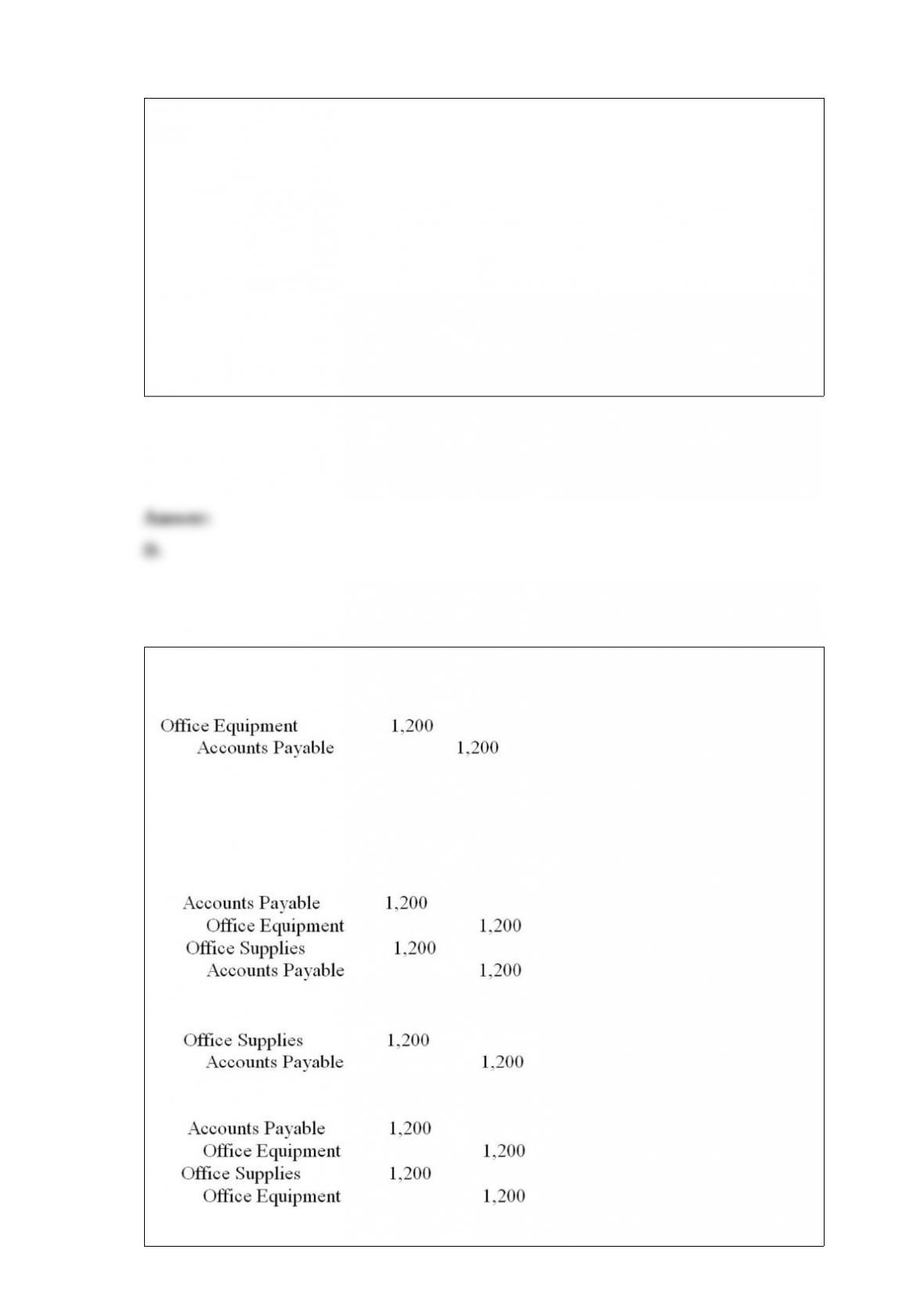
The following journal entry (incorrectly) recorded the purchase of office supplies for
$1,200 on credit:
What entry or entries best correct and document the correction of this error?
A. None required. The original entry above is correct.
B.
C.
D.
E.
Most of the transactions of a merchandising company fall into four groups, including all
of the following except:
A. Sales on credit.
B. Sales returns and allowances.
C. Purchases on credit.
D. Cash receipts.
E. Cash disbursements.
If the assets of a business increased $9,000 during a period of time and its liabilities
increased $5,000 during the same period, equity in the business must have:
A. Increased $14,000.
B. Decreased $14,000.
C. Increased $4,000.
D. Decreased $4,000.

E. Decreased $6,000.
TechCom has net sales of $435,000 and average accounts receivable of $87,000. What
is the accounts receivable turnover for the period?
A. 5.
B. 73.
C. 65.
D. 95
E. 105.
A broad principle that requires identifying the activities of a business with specific time
periods such as months, quarters, or years is the:
A. Operating cycle of a business.
B. Timeliness principle.
C. Going-concern principle.
D. Matching principle.
E. Accrual basis of accounting.

Internal control procedures for cash receipts require:
A. Separation of custody of cash receipts from their recordkeeping.
B. In-store cash sales be recorded on a cash register at the time of each sale.
C. All cheques to be numbered in sequence.
D. Separation of custody of cash receipts from its recordkeeping and in-store cash sales
be recorded on a cash register at the time of each sale.
E. All of these answers are correct.
Willie’s Attic has the following account balances for the dates given:
What would equity be on September 1 and September 30?
A. $86,000; $4,000.
B. $86,000; $106,000.
C. $74,000; $106,000.
D. $74,000; $4,000.
E. None of these answers is correct.

A payment from a proprietorship or partnership to its owner or owners is called a(n):
A. Dividend.
B. Withdrawal.
C. Expense.
D. Equity.
E. Cheque.
A periodic inventory system:
A. Gives more timely information.
B. Is widely used in practice.
C. Was historically used by companies that sold large quantities of low-value items.
D. Provides point of sale data.
E. Does not use a Purchases account.

Reversing entries are:
A. Optional.
B. Linked to accrued assets and liabilities that were created by adjusting entries at the
end of the previous accounting period.
C. Used to simplify a company’s record keeping.
D. Dated the first day of the next accounting period.
E. All of these answers are correct.
Which of the following statements is incorrect?
A. Permanent accounts are another name for nominal accounts.
B. Temporary accounts carry a zero balance at the beginning of each accounting period.
C. The Income Summary account is a temporary account.
D. Real accounts remain open as long as the asset, liability, or equity items recorded in
the accounts continue in existence.
E. Permanent accounts are another name for real accounts.
The Office Supplies account shows a beginning balance of $600 and an ending balance

of $400. If office supplies expense for the year is $3,100, what amount of office
supplies was purchased during the year?
A. $2,700.
B. $2,900.
C. $3,300.
D. $3,500.
E. $3,700.
During the current year, TechCom concluded that a customer’s $4,400 account
receivable was uncollectible and that the account should be written off. What effect will
this write-off have on TechCom’s current year net income and balance sheet assuming
the allowance method is used to account for bad debts?
A. No effect on net income or on total assets.
B. Decrease in net income; no effect on total assets.
C. Decrease in net income; decrease in total assets.
D. Increase in net income; no effect on total assets.
E. No effect on net income; decrease in total assets.
When closing entries are made:

A. All ledger accounts are closed to start the new fiscal period.
B. All temporary accounts are closed but not the permanent accounts.
C. All real accounts are closed but not the temporary accounts.
D. All permanent accounts are closed but not the temporary accounts.
E. All balance sheet accounts are closed.
The buyer who pays cash for accounts receivable is called:
A. Payor.
B. Pledgor.
C. Factor.
D. Payee.
E. Pledgee.
The use of an Accounts Payable controlling account:
A. Reduces the number of accounts in the subsidiary ledger.
B. Reduces the total number of accounts maintained.
C. Reduces the number of entries in the general journal.

D. Reduces the number of accounts in the general ledger.
E. Increases the number of columns in the journals.
The Cash Over and Short account:
A. Is used to record a credit balance in the cash account.
B. Is an income statement account used for recording the income effects of cash
overages and cash shortages from errors in making change and missing petty cash
receipts.
C. Is not necessary in a computerized accounting system.
D. Is an income statement account used for recording the income effects of cash
overages and cash shortages from errors in making change and missing petty cash
receipts and is not necessary in a computerized accounting system.
E. None of these answers is correct.
The description of the relationship between a company’s assets, liabilities, and equity,
which is expressed as Assets = Liabilities + Equity, is known as the:
A. Balance sheet.
B. Accounting equation.
C. Business equation.
D. Liability equation.

E. Net income.
The ending balance of owner’s capital is calculated as:
A. Owner’s capital account balance plus net income minus the withdrawals account
balance.
B. Owner’s capital account balance minus net loss plus the withdrawals account
balance.
C. Net income minus the withdrawals account balance.
D. Assets plus liabilities.
E. None of these answers is correct.
A cheque:
A. Involves the writer, the signers, the casher, and the bank.
B. Involves the maker, the payee, and the bank.
C. Involves the maker and the payee.
D. Involves the bookkeeper, the payee, and the bank.
E. Involves the signer, the casher, and the company.
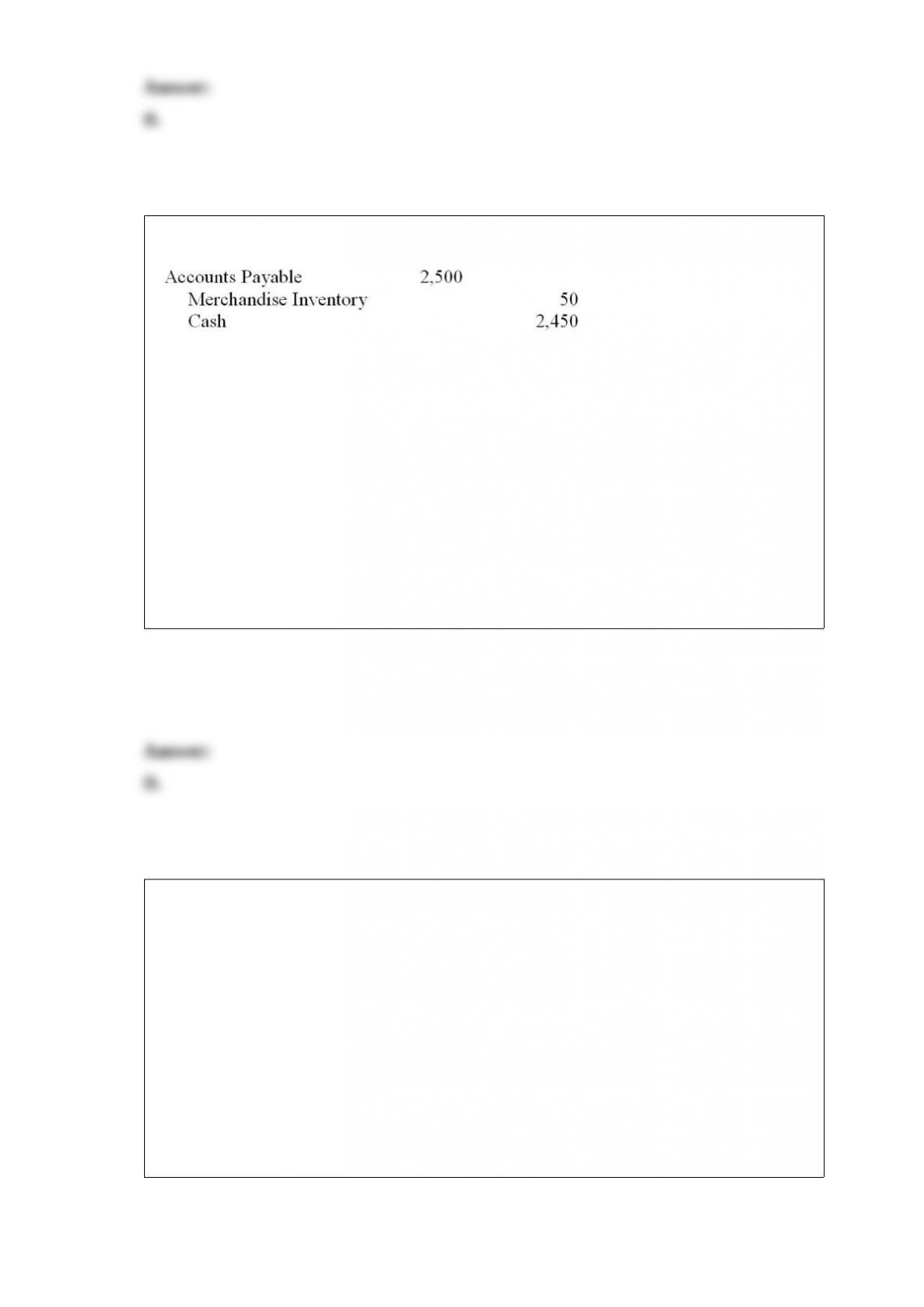
Z-Mart uses the perpetual inventory system and recorded the following journal entry:
The transaction was:
A. A purchase.
B. A return.
C. A return and payment of the account payable.
D. A payment of the account payable and recognition of a cash discount taken.
E. A purchase and recognition of a cash discount taken.
Z-Mart had sales of $569,300. Gross profit was $239,106. What is the cost of goods
sold?
A. $276,194.
B. $330,194.
C. $357,194.
D. $808,406.
E. 42%.
Explain debits and credits and their role in the accounting system.
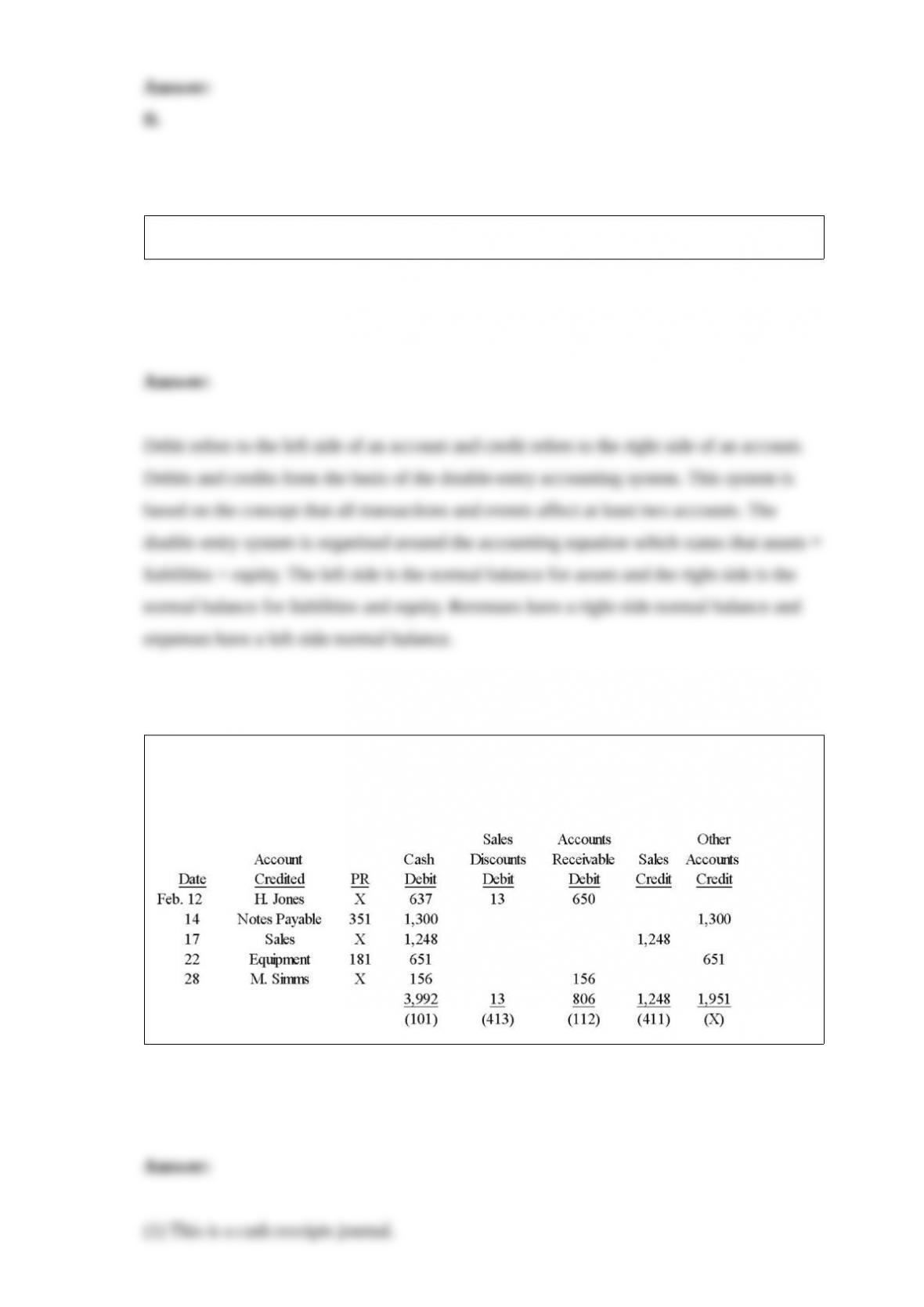
(1) What is the name of the journal illustrated below?
(2) Write an explanation for each entry.
Under the _______________ system, each purchase, purchase return and allowance,
purchase discount, and transportation-in transaction is recorded in the
_______________ account.
How does the cost principle support ethical behaviour?
Describe the periodic and perpetual inventory systems.
The ______________ refers to the steps in preparing financial statements for users.
The closing process resets ________, __________, and ________ account balances to
zero at the end of every accounting period.
The following information refers to Annie’s Attic and competitors in the antiques
business.
Explain the purpose of reversing entries.
__________________ are short-term, highly liquid investment assets that are readily
convertible to a known amount of cash.