
Craft, Inc. normally produces between 120,000 and 150,000 units each year. Producing
more than 150,000 units alters the company’s cost structure. For example, fixed costs
increase because more space must be rented, and additional supervisors must be hired.
The production range between 120,000 and 150,000 is called the:
A. differential range.
B. median range.
C. relevant range.
D. leverage range.
Which of the following is an appropriate cost driver for setting up production
equipment for a production run?
A. Machine hours
B. Number of setups
C. Setup hours
D. Either B or C would be appropriate
Which of the following statement is correct regarding the quick ratio?
A. The numerator for the quick ratio is current assets – inventory – accounts receivable.
B. The numerator for the quick ratio is current assets.
C. The quick ratio is also called the working capital ratio.
D. The quick ratio is a more conservative variation of the current ratio.
Which of the following statements is incorrect regarding preparing a statement of cash
flows using the direct method?
A. The direct method shows adjustments to net income.
B. The direct method shows the specific sources and uses of cash that are associated
with operating activities.
C. Noncash expenses, gains, and losses are not used in the determination of net cash
flow from operating activities.
D. A majority of companies use the indirect method rather than the direct method.
M and M, Inc. produces a product that has a variable cost of $3.00 per unit. The
company’s fixed costs are $30,000. The product is sold for $5.00 per unit and the
company desires to earn a target profit of $20,000. What is the amount of sales that will
be necessary to earn the desired profit?
A. $75,000
B. $50,000
C. $83,333
D. $125,000

Which source document provides information for the journal entry to transfer costs
from the work in process inventory account to the finished goods inventory account?
A. Job cost sheet
B. Work ticket
C. Standard cost card
D. Materials requisition
Which of the following is not a possible alternate term for costs that can be eliminated
by taking a specified course of action?
A. Avoidable costs
B. Opportunity costs
C. Relevant costs
D. Differential costs
Bates Company pays cash for all inventory purchases. Bates reports that it had a
beginning inventory of $2,500 and an ending inventory of $900. Its cost of goods sold
was $5,500. Based on this information, the amount of cash paid for inventory purchases
was:
A. $3,900
B. $7,100
C. $1,400
D. $9,100
A factor having a “cause and effect” relationship with a cost object is called a(n):
A. cost driver
B. allocation base
C. direct cost
D. indirect cost
Coleridge Company estimates that its production workers will work 125,000 direct
labor hours during the upcoming period and that overhead costs will amount to
$750,000. Assume Overhead to be allocated on the basis of direct labor hours. What
predetermined overhead rate would be used to apply overhead to production during the
period?
A. $6.00 per direct labor hour

B. $0.67 per direct labor hour
C. $0.67 per unit
D. $6.00 per unit
An investment that costs $40,000 will produce annual cash flows of $12,000 for a
period of 4 years. Given a desired rate of return of 10%, the investment will generate a
(Do not round your PV factors and intermediate calculations. Round your answer to
nearest whole dollar):
A. positive net present value of $38,038.
B. positive net present value of $1,962.
C. negative net present value of $38,038.
D. negative net present value of $1,962.
The length of time required to recover the initial investment in a capital asset is known
as the:
A. the rate of return.
B. investment period.
C. present value period.
D. payback period.
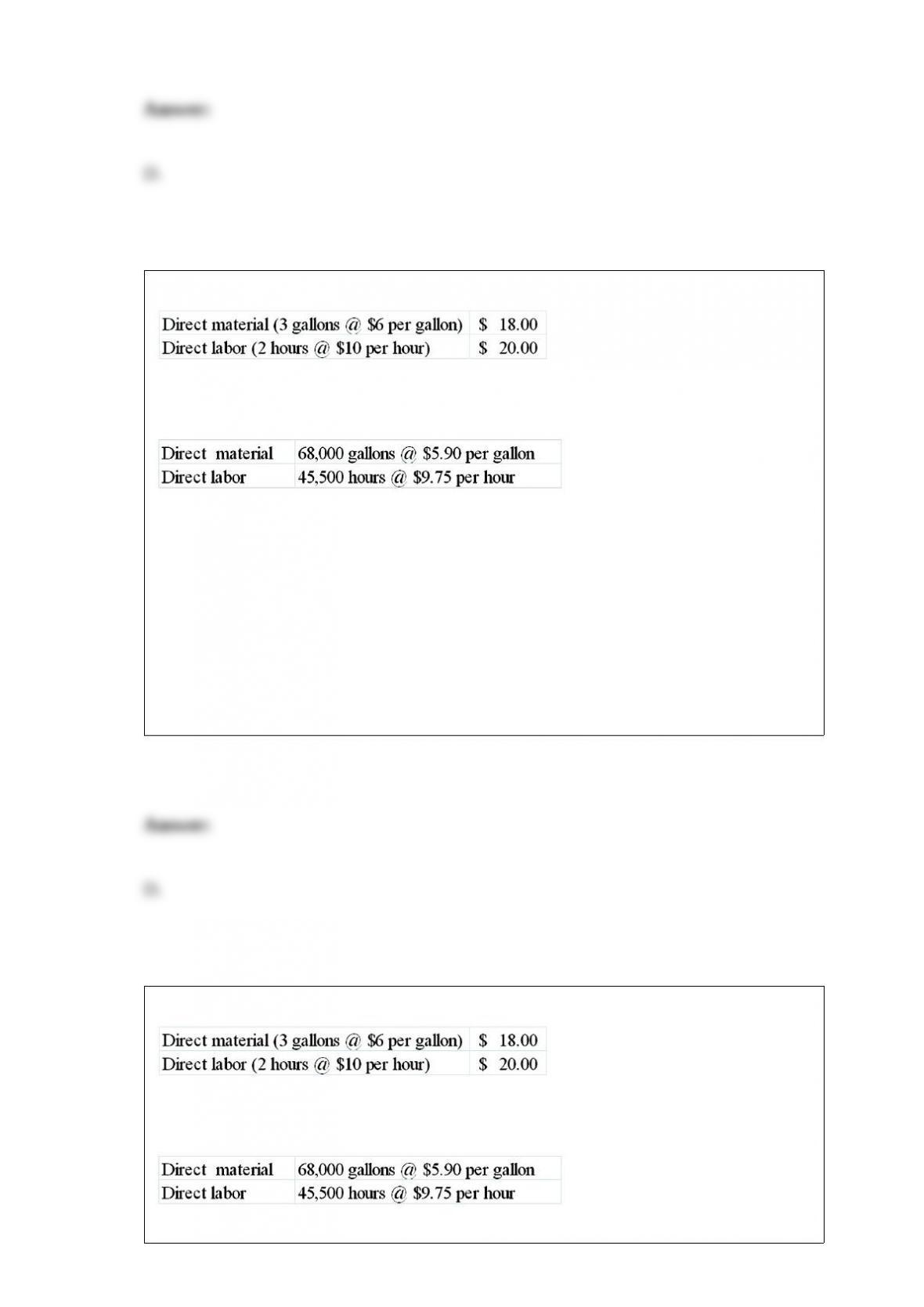
The Russell Company provides the following standard cost data per unit of product:
During the period, the company produced and sold 22,000 units incurring the following
costs:
The direct material price variance was:
A. $6,600 unfavorable.
B. $6,600 favorable.
C. $6,800 unfavorable.
D. $6,800 favorable.
The Russell Company provides the following standard cost data per unit of product:
During the period, the company produced and sold 22,000 units incurring the following
costs:

The direct material usage variance was:
A. $12,000 unfavorable.
B. $12,000 favorable.
C. $11,800 unfavorable.
D. $11,800 favorable.
Select the incorrect statement concerning the human factor of performance evaluation.
A. Variances should not be used to single out managers for punishment.
B. Variances must be analyzed carefully to ensure that they are fully understood.
C. Just because a cost variance is labeled as favorable doesn’t necessarily mean that the
manager should be commended for a job well done.
D. Managers should always be punished for unfavorable variances.
Budgeted depreciation expense would not appear on a:
A. Selling and administrative expense budget.
B. Budgeted income statement.
C. Cash budget.
D. All of these answers are correct.

Accrual accounting requires the use of many estimates, including:
A. Uncollectible accounts expense.
B. Warranty costs.
C. Assets’ useful lives.
D. All of these answers are correct.
Rialto Company collected $5,000 on account. What impact will this transaction have on
the firm’s current ratio?
A. No impact
B. Increase it
C. Decrease it
D. Not enough information is provided to answer the question.
Travis Company had no beginning work in process inventory. Its total manufacturing
costs for the year were $427,000. If cost of goods manufactured was $332,000 and cost
of goods sold was $250,000, the amount of ending work in process inventory would
have been:
A. $82,000.
B. $105,000.
C. $95,000.
D. $127,000.
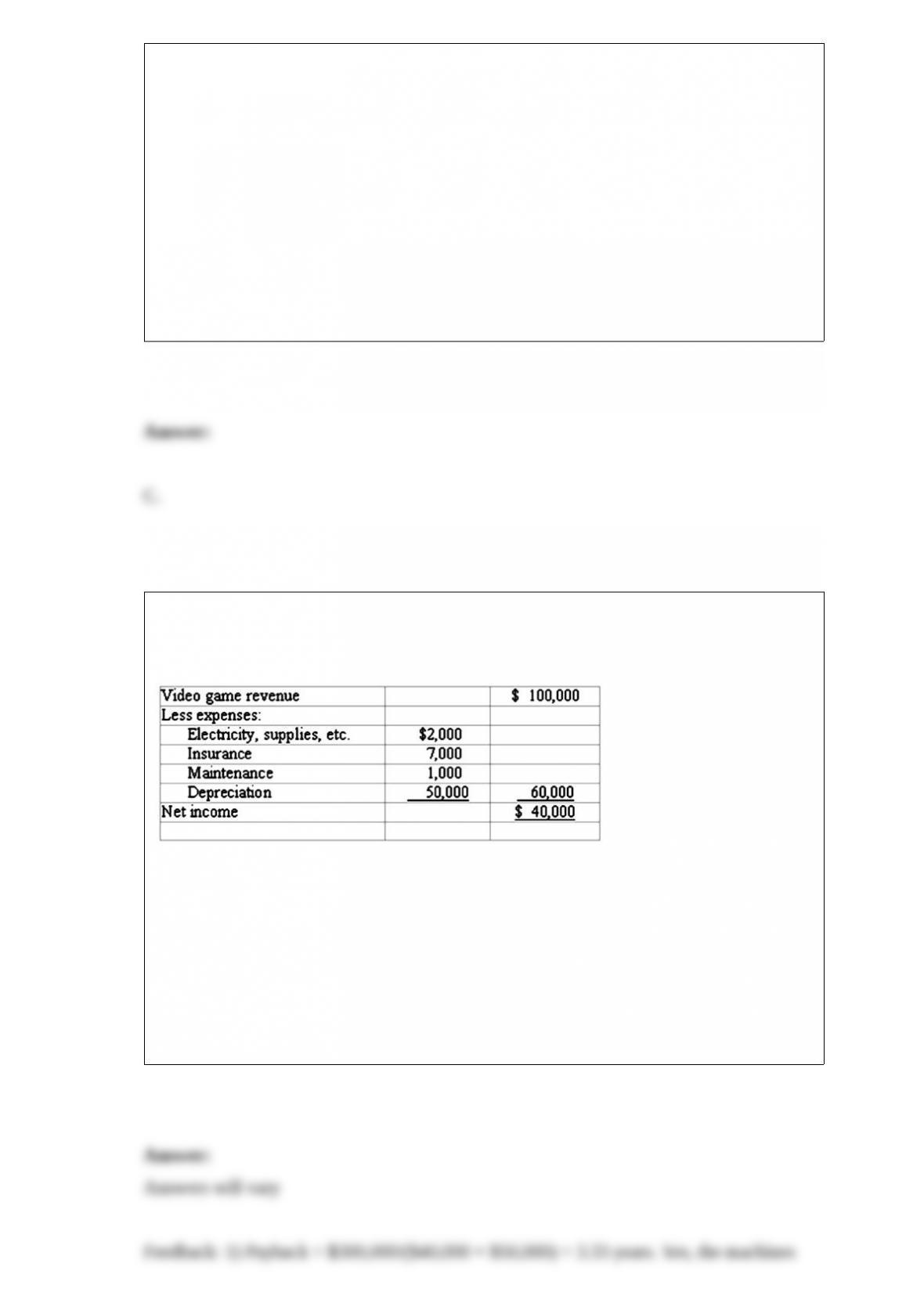
Seven Day Mini Mart is considering installing video games in its stores. The machines
cost $300,000 and have an estimated six-year useful life. Ignore income taxes. The
following projected income statement is provided:
Required:
1) Seven Day Mini Mart would like to recoup its original investment in less than five
years. Compute the payback period for the video game machine investment. Would you
recommend that the machines be purchased? Why or why not?
2) Seven Day Mini Mart’s target unadjusted rate of return is 12%. Compute the
unadjusted rate of return on the original investment. Would you recommend that the
machines be purchased? Why or why not?
Sharon Company has variable costs of $80 per unit, total fixed costs of $200,000, and a
break-even volume of 5,000 units. If the sales price per unit is increased by $10, how
many units must Sharon Company sell to break-even?
A. 4,000 units
B. 5,000 units
C. 6,000 units
D. 3,000 units
Which of the following is not a provision of the Sarbanes-Oxley Act of 2002?
A. The chief executive officer and the chief financial officer are jointly responsible for
establishment and enforcement of internal controls.
B. Companies are required to report on the effectiveness of their internal controls.
C. The company’s external auditor is charged with the ultimate responsibility for the
accuracy of the company’s financial statements and accompanying footnotes.
D. The company’s external auditors are required to attest to the accuracy of the internal
controls report.

Which of the following is a benefit of participative budgeting?
A. Employees tend to be more motivated to achieve the budget.
B. A twelve-month planning horizon is maintained at all times.
C. Budget planning is highly centralized.
D. Communication is clearer because it flows in only one direction – upward.
Select the incorrect statement regarding upstream and downstream costs.
A. Companies normally incur significant downstream costs.
B. To be profitable, companies must recover the total cost of developing, producing,
and delivering products.
C. Pricing decisions must consider both upstream and downstream costs in addition to
manufacturing costs.
D. Upstream and downstream costs are reported as product costs on the income
statement.
What are the two methods used to prepare the statement of cash flows? What section(s)
of the statement of cash flows are impacted by the choice of method?
As a Certified Management Accountant, Steven is bound by the Institute of
Management Accountant’s Standards of Ethical Conduct. Describe the actions Steven
should take when faced with an ethical dilemma at work.
Pierce Company is considering the purchase of new equipment that will cost $150,000.
The equipment will save the company $48,000 per year in cash operating costs. The
equipment has an estimated useful life of five years and no expected salvage value. The
company’s cost of capital is 12%.
Required:
1) Assuming the company is subject to a 40% tax rate, compute the net present value.
2) Compute the amount of the annual depreciation tax shield provided by the new
equipment.
3) Should the equipment be purchased? Why or why not?
Indicate whether each of the following statements about financial statement analysis is
true or false.
Vertical analysis of a company’s balance sheet is useful in assessing its liquidity.
Common size financial statements are a form of vertical analysis, but the common size
statements for two or more years may usefully be compared.
Vertical analysis of a balance sheet involves converting each component to a percentage
of stockholders’ equity.
Small percentage changes resulting from vertical analysis may still represent large
dollar amounts; therefore, changes in both absolute dollar amounts and percentages
should be examined.
A common size income statement is prepared by converting each component to a
percentage of net income.
Indicate whether each of the following statements is true or false.
Accepting a special order will usually involve incurring product-level costs.
An outsourcing decision typically affects unit-level and batch-level costs but not
product-level costs.
Eliminating a business segment often allows a company to avoid some facility-level
costs.
Classifying a cost as unit-level, batch-level, product-level, or facility-level is based
primarily on the dollar amount of the cost.
Facility-level costs generally are not relevant in special order decisions.