1) Decentralization allows top management to concentrate on long-term strategic
planning.
2) Raw material, ruined through mistakes during production, will result in a materials
quantity variance.
3) In a regression output, the “intercept coefficient” represents the fixed cost component
of a mixed cost equation.
4) Lean thinking is a management strategy that includes maintaining large inventories.
5) When making a pricing decision, it is not necessary to separate costs into fixed and
variable.
6) There will be little benefit to using an activity-based costing system when products
are vastly different from each other and consume different amounts of resources.
7) When graphing total fixed costs, the fixed cost per unit is the slope of the fixed cost
line.
8) Capital budgeting is done when common stock is issued.
9) Job costing should only be used by manufacturers.
10) Prime costs include direct labor and direct materials.
11) Under variable costing, all nonmanufacturing costs are treated as inventoriable
product costs.
12) Facility-level activities and costs are incurred for every individual unit.
13) A labor time record identifies the employee and the amount of time the employee
spent on a particular job.
14) The use of return on investment (ROI) as a performance measure may lead
managers to reject projects that would be profitable for the company as a whole.

15) The cost associated with renovating a warehouse to be used as a restaurant would
be considered to be a capital asset.
16) The cost equation determined using the high-low method should be the same as the
cost equation determined using regression analysis.
17) The data provided by the horizontal or vertical analysis of the financial statements
can be used in benchmarking.
18) If all direct materials are added at the beginning of the production process, and the
units have made it 50% of the way through the production process, then the percentage
completion for direct materials is 100%.
19) The maintenance department at Continental Airlines is likely to be classified as a(n)
A) cost center
B) investment center
C) profit center
D) revenue center
20) Which ethical standard is demonstrated when you attend a class to maintain your
professional knowledge?
A) Credibility
B) Integrity
C) Competence
D) Confidentiality

21) Which of the following terms describes the process of reevaluating activities to
reduce costs while satisfying customers’ needs?
A) Design engineering
B) Developmental engineering
C) Value engineering
D) Total engineering
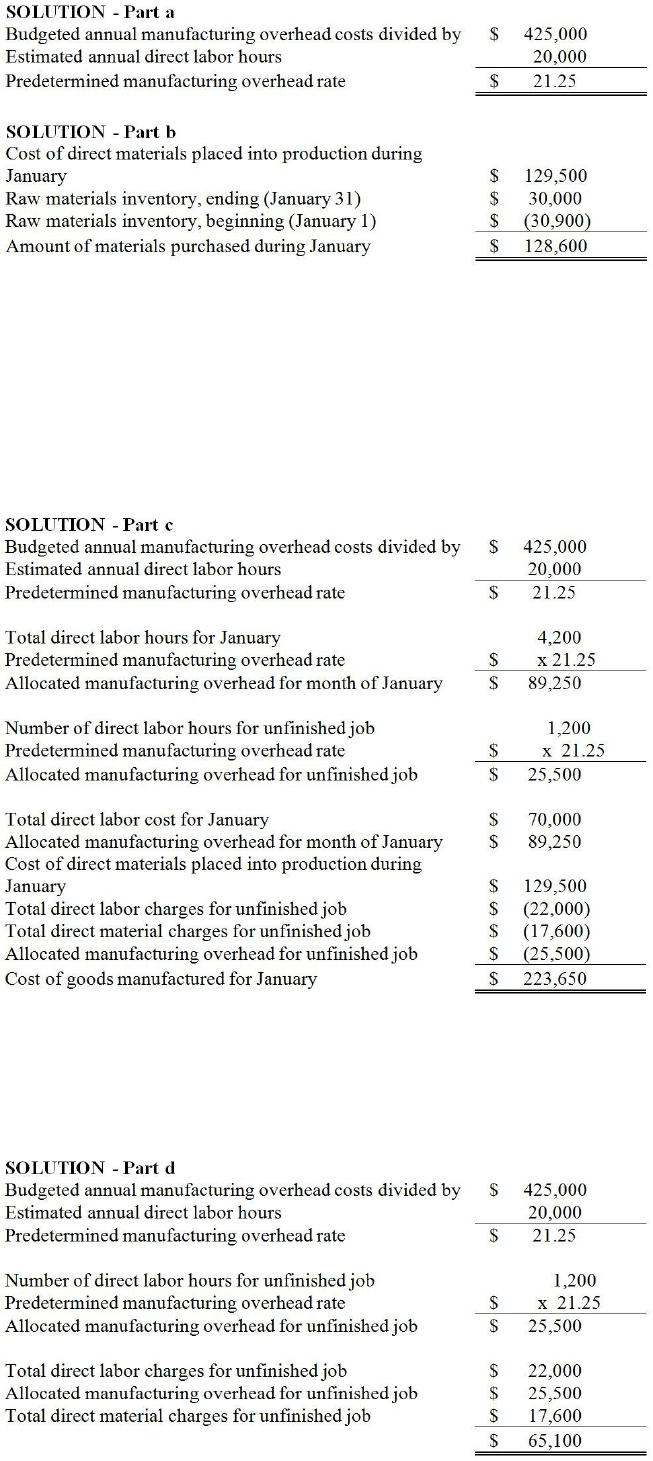
22) The following account balances at the beginning of January were selected from the
general ledger of Bluestone Industries:
Work in process inventory$0
Raw materials inventory$30,900
Finished goods inventory$54,800
Additional data:
1> Actual manufacturing overhead for January amounted to $80,500.
2> Total direct labor cost for January was $70,000; actual direct labor hours for January
were 4,200.
3> The predetermined manufacturing overhead rate is based on direct labor hours. The
budget for the year called for $350,000 of direct labor cost and $425,000 of
manufacturing overhead costs. Estimated direct labor hours for the year were expected
to be 20,000.
4> The only job unfinished on January 31 was Job No. 449, for which total direct labor
charges were $22,000 (1,200 direct labor hours) and total direct material charges were
$17,600.
5> Cost of direct materials placed in production during January totaled $129,500. There
were no indirect material requisitions during January.
6> January 31 balance in raw materials inventory was $30,000.
7> Finished goods inventory balance on January 31 was $44,700.
Required:
a)Determine the predetermined manufacturing overhead rate.
b)Determine the amount of materials purchased during January.
c)Determine cost of goods manufactured for January.
d)Determine the work in process inventory balance on January 31 .
e)Determine cost of goods sold for January.
f)Determine whether manufacturing overhead is overallocated or underallocated and by
what amount at Jan. 31 .
23) Managers should consider which of the following when deciding whether to
outsource a product or service?
A) Quality of the product or service
B) Delivery schedule of the product or service
C) Cost charged for the product or service
D) All of the above
24) The CEO of Banana Republic, a division of The Gap, Inc. would be in charge of
a(n)
A) cost center
B) investment center
C) profit center
D) revenue center
25) Assigning manufacturing overhead costs and other indirect costs is called
A) cost driver
B) cost allocation
C) materials requisition
D) predetermined manufacturing overhead rate
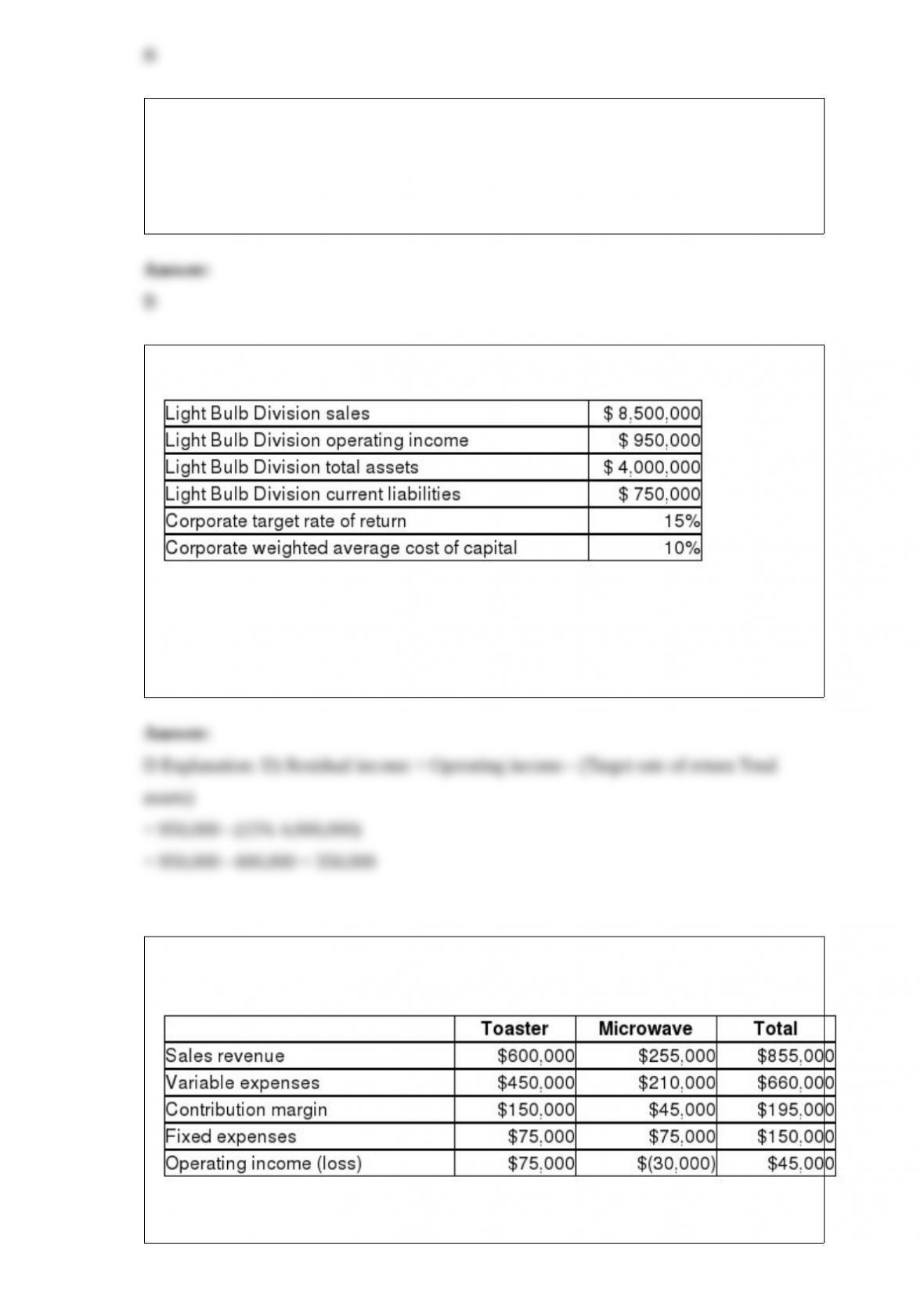
26) The following data relates to Haven Corporation and its Northern Division.
What is the Northern Division’s Residual Income (RI)?
A) $600,000
B) $950,000
C) $400,000
D) $350,000
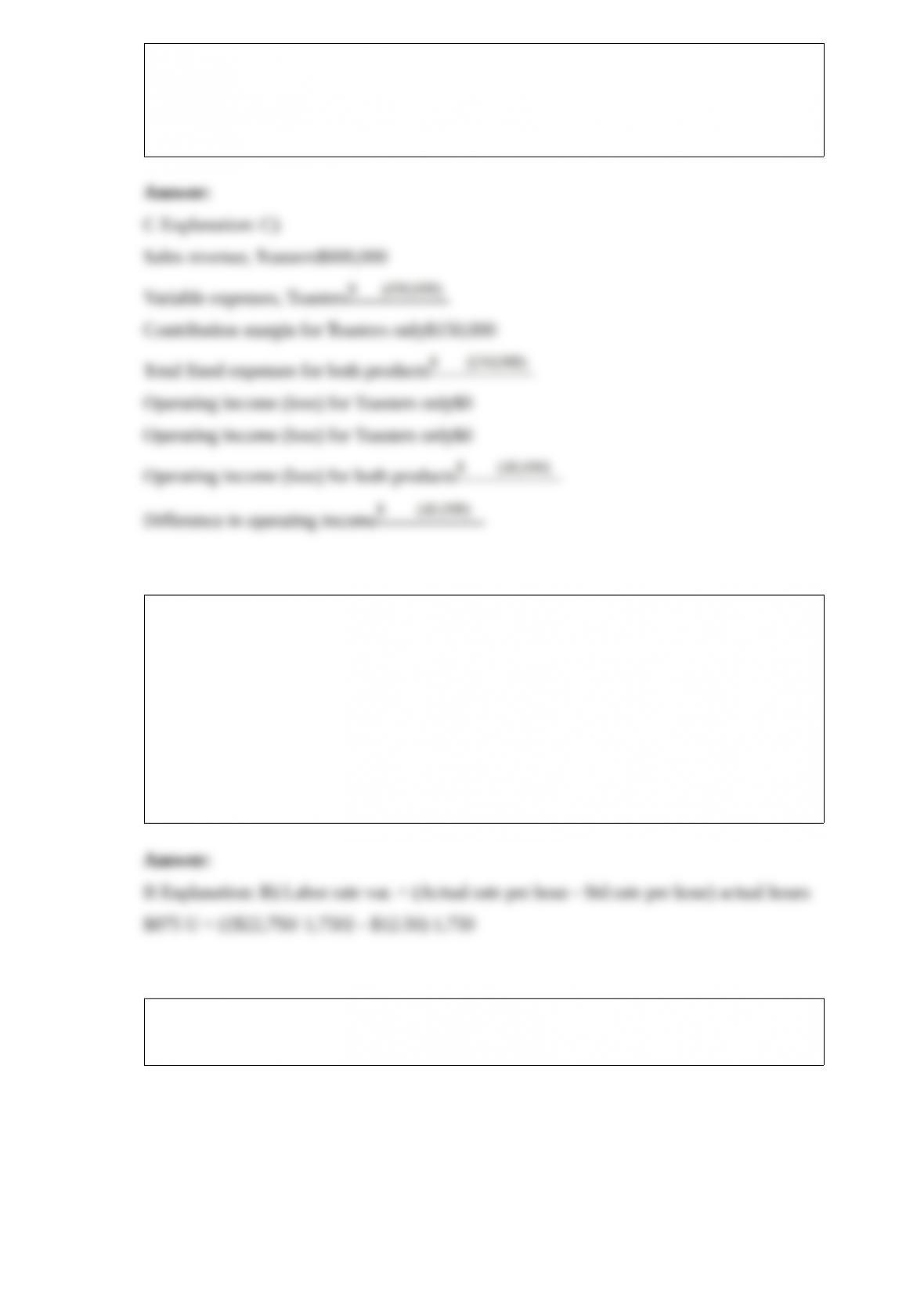
27) The income statement for Germain Appliances is divided by its two product lines,
Toasters and Microwaves, as follows:
If fixed costs remain unchanged and Germain Appliances discontinues the Microwave
line, how will operating income change?
A) Will decrease by $150,000
B) Will increase by $45,000
C) Will decrease by $45,000
D) Will increase by $150,000
28) Simon Sayz is a regional manufacturer of baby toys produced from plastic derived
from organic and non-toxic sources. Management budgeted one-half hour of direct
labor per toy at a standard rate of $12.50 per hour. The most current production run
produced 1,850 toys and used 1,750 labor hours at a total cost of $22,750. What is the
direct labor rate variance for this production run?
A) $875 favorable
B) $875 unfavorable
C) $350 favorable
D) $350 unfavorable
29) At Hodgson Corporation, direct materials are added at the beginning of the process
and conversions costs are uniformly applied. Other details include:
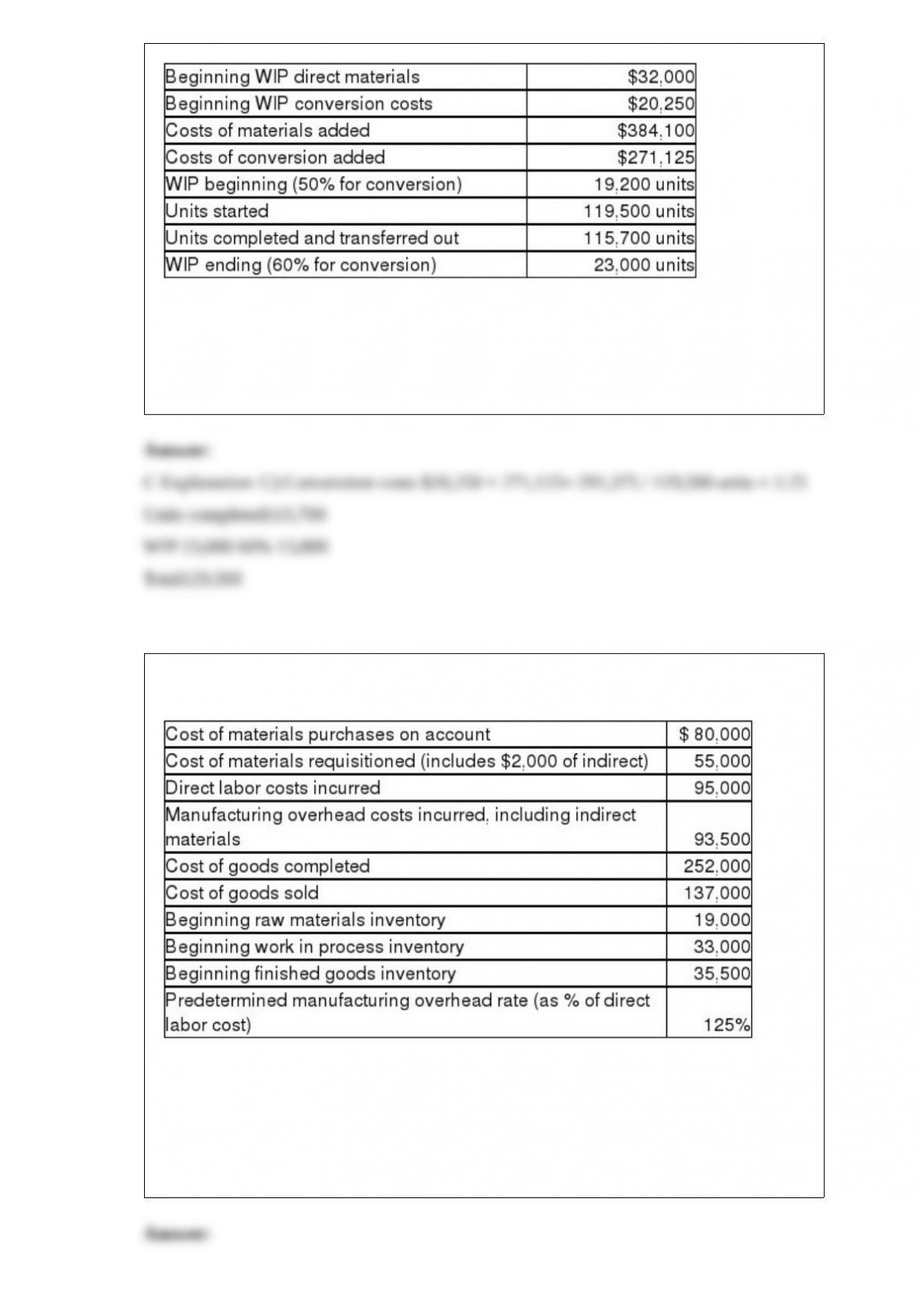
What is the cost per equivalent unit for conversion costs?
A) $2.32
B) $2.09
C) $2.25
D) $2.10
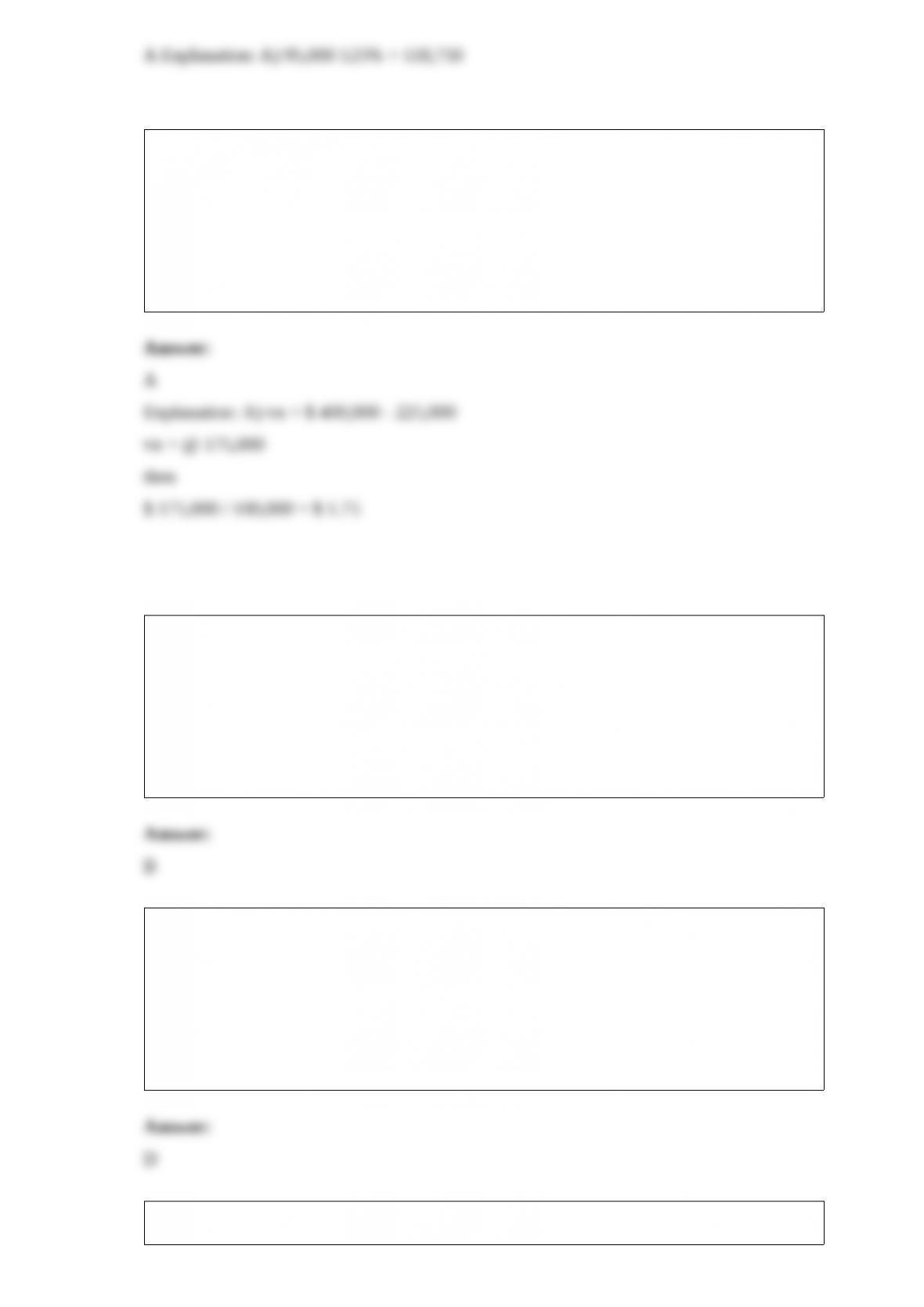
30) Here is some basic data for Bella Company:
The journal entry to record the allocation of manufacturing overhead involves a debit to
work in process inventory of
A) $118,750
B) $93,500
C) $68,750
D) $76,000
31) At Dwight Incorporated, total fixed and variable costs are $400,000 at a production
level of 100,000 units. The company has total fixed costs of $225,000. The variable cost
per unit at 150,000 units is
A) $1.75
B) $2.25
C) $4.00
D) $1.17
32) How is the direct labor efficiency variance calculated?
A) The difference between the standard labor hours allowed and the actual labor hours
used multiplied by the actual labor rate
B) The difference between the standard labor hours allowed and the actual labor hours
used multiplied by the standard labor rate
C) The difference between the standard labor hours and the actual labor hours used
D) The difference between the standard labor rate and the actual labor rate
33) If jobs have been undercosted due to underallocation of manufacturing overhead,
then cost of goods sold (COGS) is too low and which of the following corrections must
be made?
A) Decrease COGS for the amount of the underallocation
B) Increase COGS for double the amount of the underallocation
C) Decrease COGS for double the amount of the underallocation
D) Increase COGS for the amount of the underallocation
34) Kepple Manufacturing currently uses a traditional costing system. The company
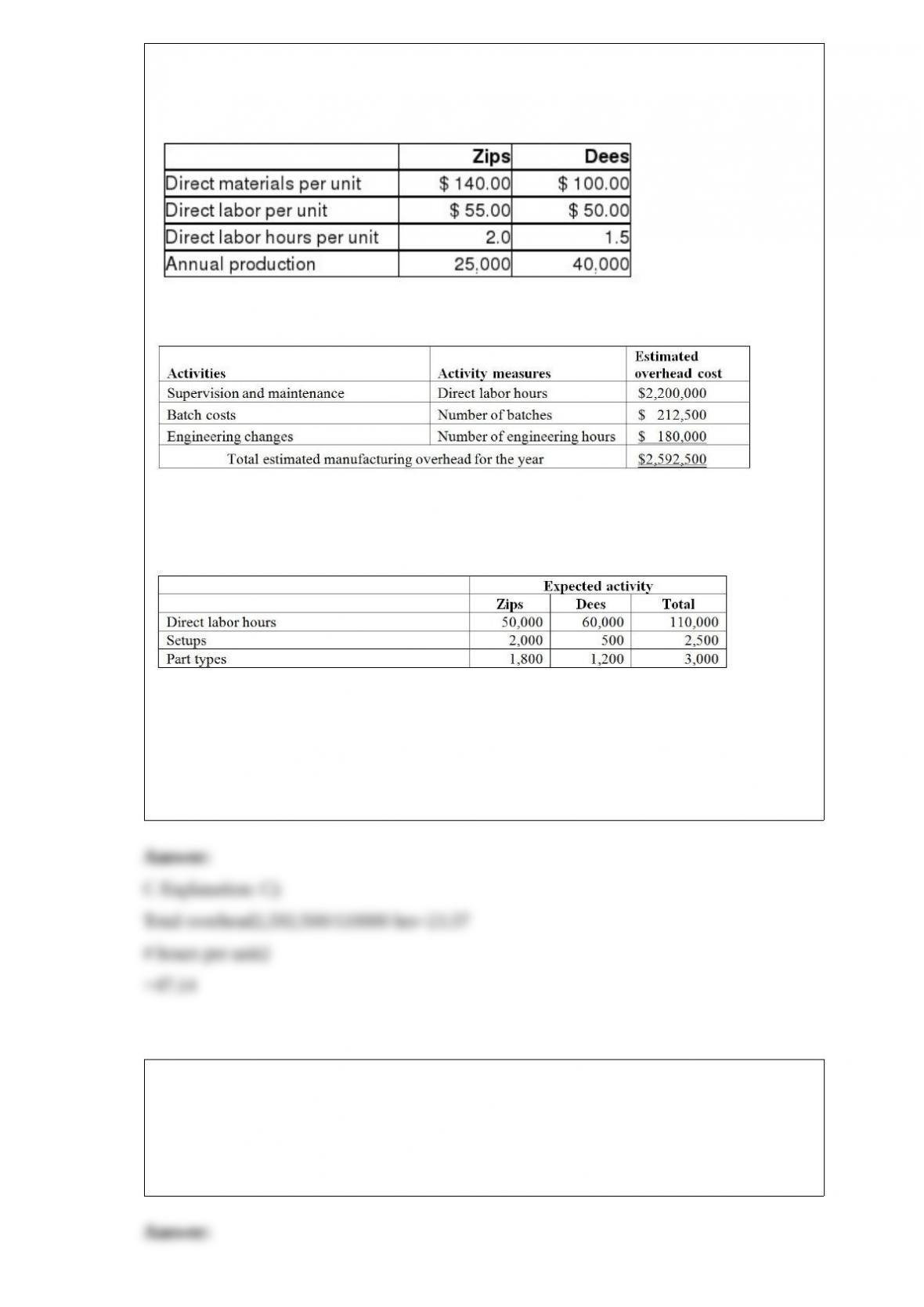
allocates overhead to its two products, Zips and Dees, using a predetermined
manufacturing overhead rate based on direct labor hours. Here is data related to the
company’s two products:
Information about the company’s estimated manufacturing overhead for the year
follows:
Total estimated direct labor hours for the company for the year are 110,000 hours.
The company is evaluating whether it should use an activity-based costing system in
place of its traditional costing system. Additional information about production needed
for the activity-based costing system follows:
The amount of manufacturing overhead that would be allocated to one unit of Zips
using the traditional costing system would be closest to
A) $35.35
B) $23.57
C) $47.14
D) $32.86
35) What is a document that accumulates job costs called?
A) Bill of materials
B) A job cost record
C) Labor time record
D) Production schedule
36) Manufacturing costs are usually combined into two categories in a process costing
system. These two categories are
A) direct labor and conversion costs
B) direct materials and conversion costs
C) manufacturing overhead and conversion costs
D) direct materials and direct labor
37) Sam’s Toys budgeted sales of $300,000 for the month of November and cost of
goods sold equal to 80% of sales. Beginning inventory for November was $50,000 and
ending inventory for November is estimated at $55,000. How much are the budgeted
purchases for November?
A) $245,000
B) $65,000
C) $235,000
D) $135,000
38) During a period, 38,200 units were completed and 4,200 units were in ending WIP
inventory. Ending WIP was 75% complete for direct materials and 50% complete for
conversion costs. What are the equivalent units for conversion costs?
A) 40,300
B) 41,350
C) 42,400
D) 21,200
39) Using ________ may cause a manager to reject a project that would be profitable
for the company as a whole.
A) operating income
B) residual income
C) ROI
D) EVA
40) What are the total assets reported by Sparrow Enterprises if operating income is
$650,000, its return on investment (ROI) is 40%, and its target rate of return is 10%?
A) $260,000
B) $1,625,000
C) $6,500,000
D) $650,000
41) With respect to variable costs per unit, which of the following statements is TRUE?
A) They will decrease as production increases within the relevant range
B) They will increase as production decreases within the relevant range
C) They will decrease as production decreases within the relevant range
D) They will remain the same as production levels change within the relevant range
42) Variable costs are described by which of the following statements?
A) They vary per unit of output
B) They are fixed in total
C) They are fixed per unit and vary in total
D) They decrease per unit as production volume increases
43) In the flow of costs, which of the following comes third?
A) Finished goods inventory
B) Cost of goods sold
C) Raw materials inventory
D) Work in process inventory
44) Doggie Pals produces 100,000 dog collars each month that give off a fresh scent to
keep your dog smelling clean between baths. Total manufacturing costs are $200,000.
Of this amount, $150,000 are variable costs. What are the total production costs when
125,000 collars are produced? (Assume both production levels are in the same relevant
range.)
A) $387,500
B) $250,000
C) $237,500
D) $187,500
45) Omega Technology’s work in process inventory on June 1 has a balance of $27,200
representing Job No. 36 . During June, $68,900 of direct materials were requisitioned
for Job No. 36 and $5,500 of direct labor cost was incurred on Job No. 36 .
Manufacturing overhead is allocated at a rate of $16.00 per direct labor hour. Actual
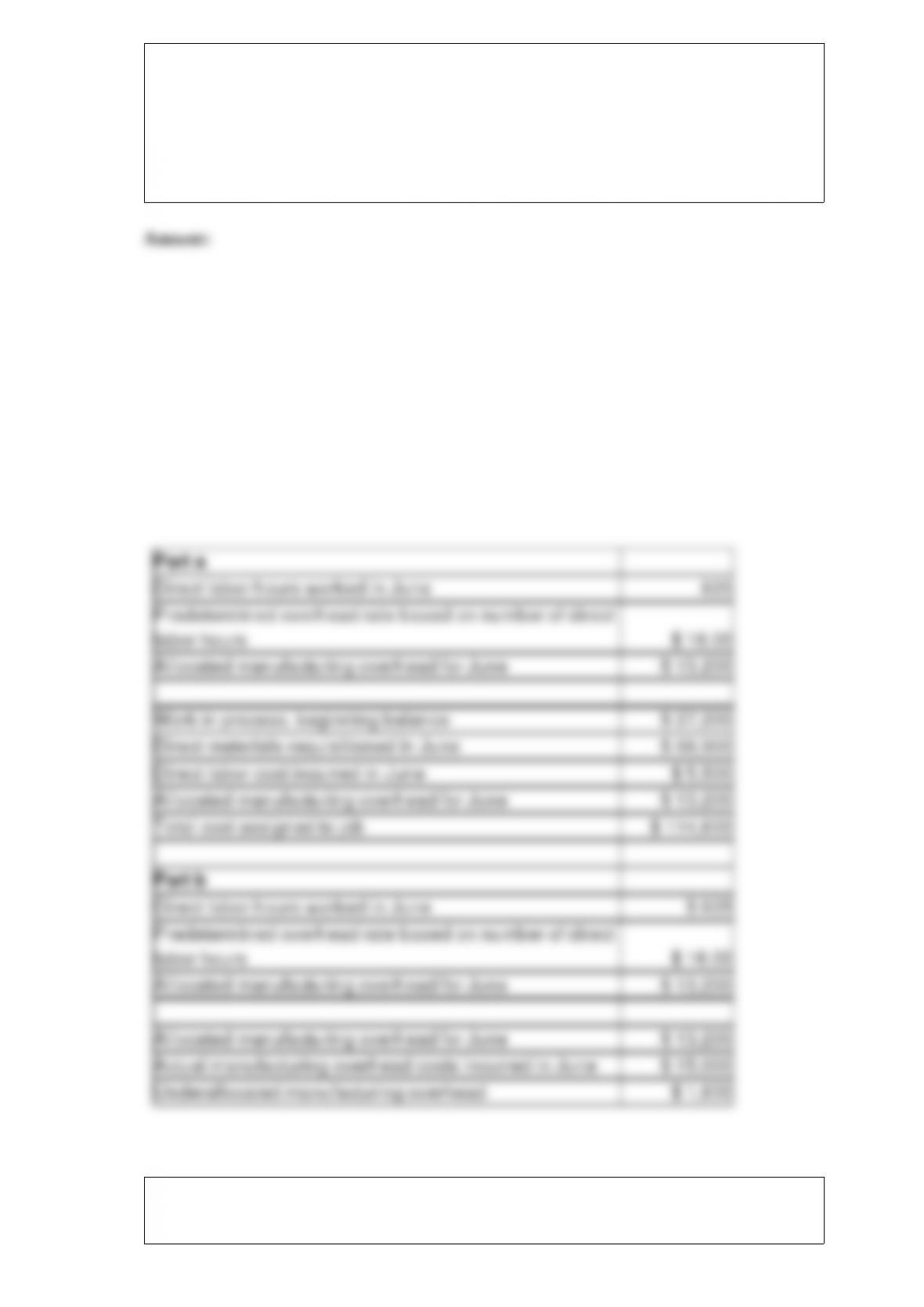
manufacturing overhead costs incurred in June amounted to $15,000. There were 825
actual direct labor hours worked in June. No new jobs were started during June. Job No.
36 is completed on June 28 .
a) Determine the total cost assigned to Job No. 36 .
b) Is manufacturing overhead overallocated or underallocated for the month of June?
By how much?
46) Davis Corporation manufactures and sells portable radios. The radio sells for $35
per unit and its variable costs per unit are $30. Fixed costs are $64,000 per month for
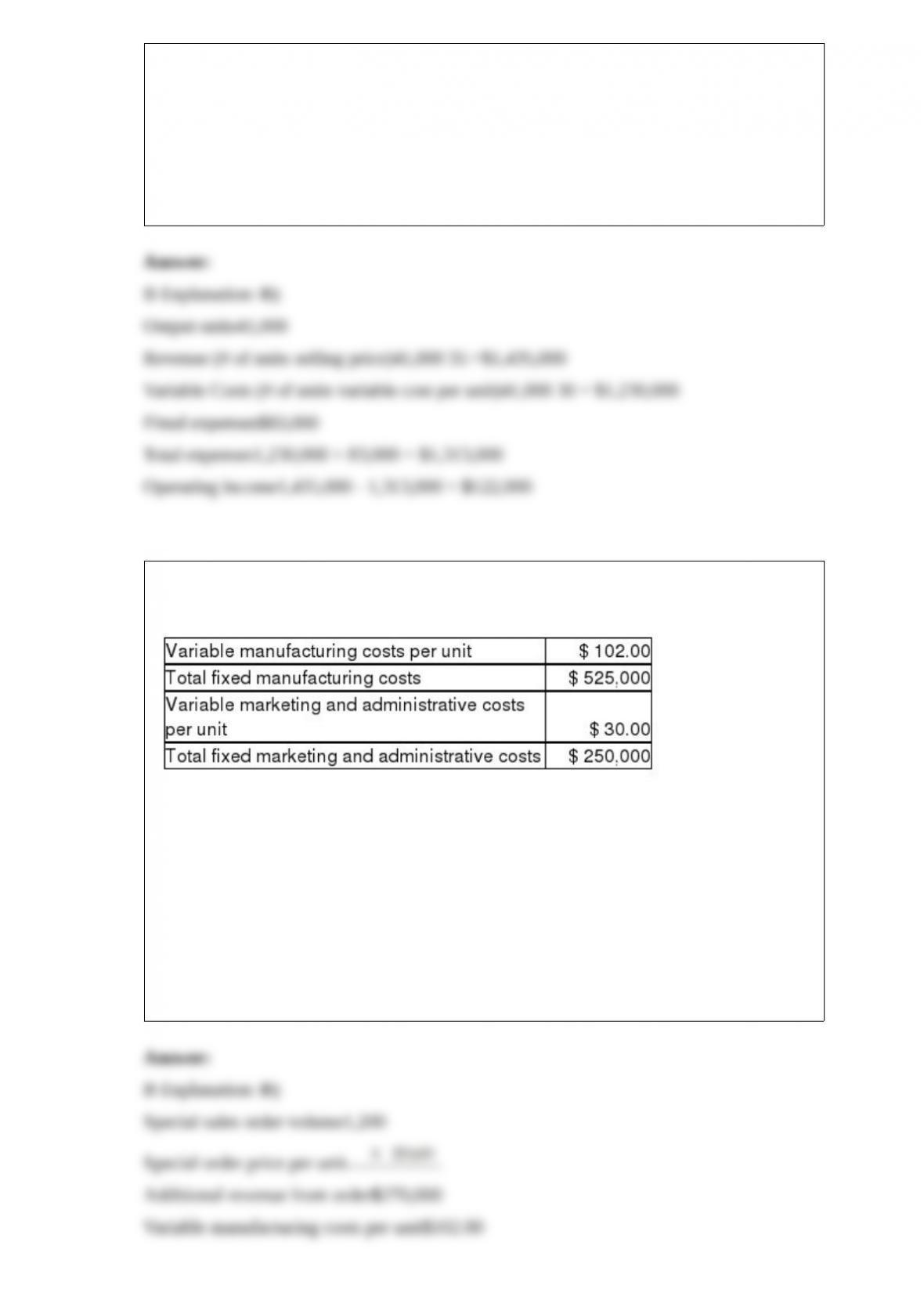
sales volumes up to 32,000 radios. If more than 32,000 radios are sold, the fixed costs
will be $83,000. The flexible budget would reflect what monthly operating income for a
sales volume of 41,000 radios?
A) $141,000
B) $122,000
C) $1,435,000
D) $205,000
47) The following information relates to current production of outdoor chaise lounges at
Backyard Posh:
The regular selling price per chaise lounge is $300.00. The company is analyzing the
opportunity to accept a special sales order for 1,200 chaise lounges at a price of $225.00
per unit. Fixed costs would remain unchanged. The company has the capacity to
produce 15,000 chaise lounges per year, but is currently producing and selling 10,000
chaise lounges per year. Regular sales will not be affected by the special order. If the
company were to accept this special order, how would operating income be affected?
A) Increase by $270,000
B) Increase by $111,600
C) Decrease by $111,600
D) Decrease by $270,000
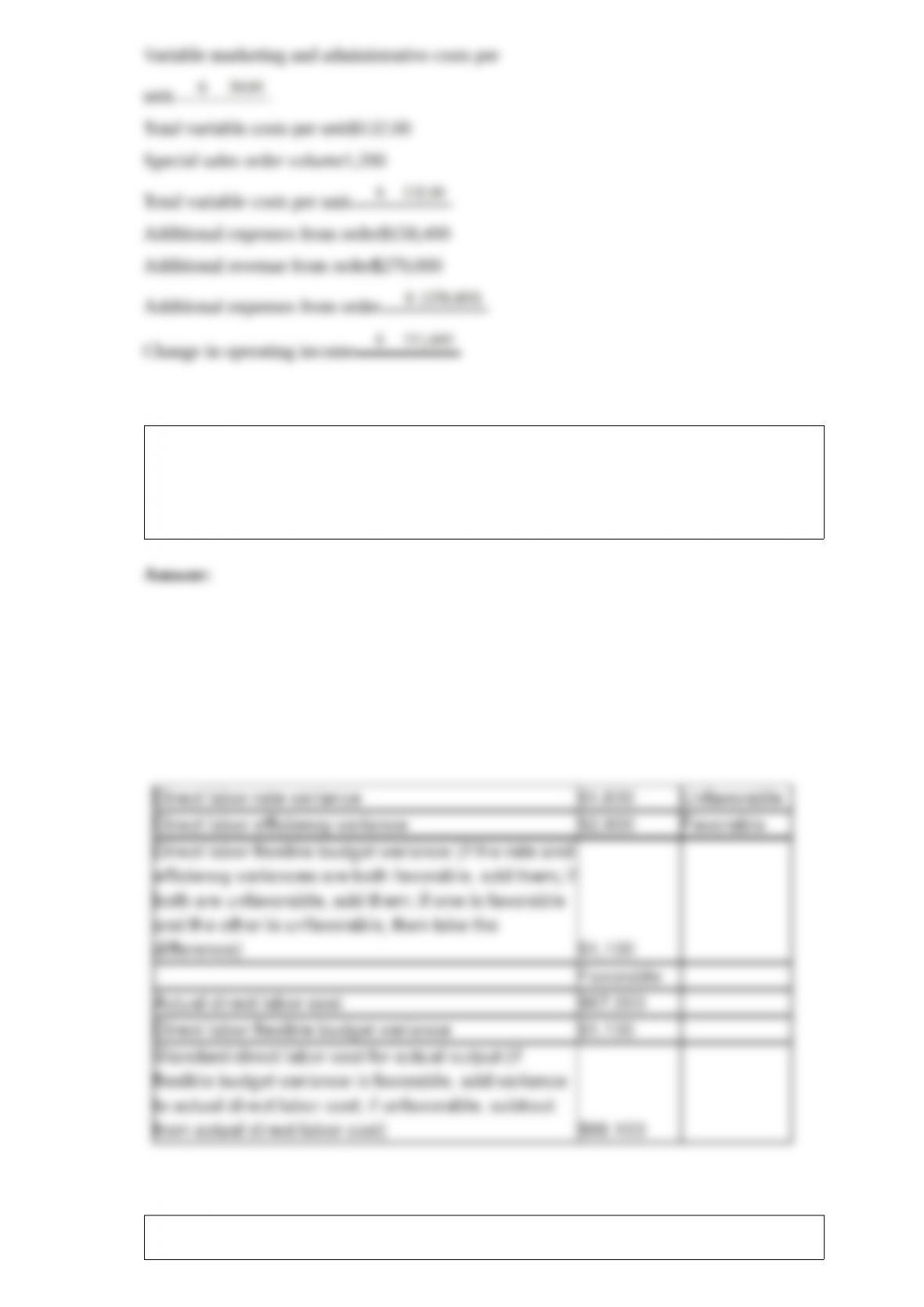
48) Howard Industries’ actual direct labor cost was $67,000 during the current period.
Howard reported an unfavorable direct labor rate variance of $1,800 and a favorable
direct labor efficiency variance of $2,900. What was the standard direct labor cost for
actual output during the period?
49) Standard Products Company recognizes variances from standards at the earliest
opportunity, and the quantity of direct materials purchased is equal to the quantity used.
The following information is available for the most recent month. Assume the
allocation base for fixed overhead costs is the number of units.
Direct MaterialsDirect Labor
Standard quantity/unit6.00 lbs.2.5 hrs.
Standard price/lb. or hr.$8.10/lb.$8.00/hr.
Actual quantity/unit6.25 lbs.2.8 hrs.
Actual price/lb. or hr.$8.00/lb.$7.50/hr
Price variance$562.50 F$1,260.00 F
Quantity/Efficiency variance$1,822.50 U$2,160.00 U
Static budget volume800 units
Actual volume900 units
Actual overhead cost$11,000
Standard variable overhead cost$5/unit
Standard fixed overhead cost$5,600
Overhead flexible budget variance$900 U
Production volume variance$700 F
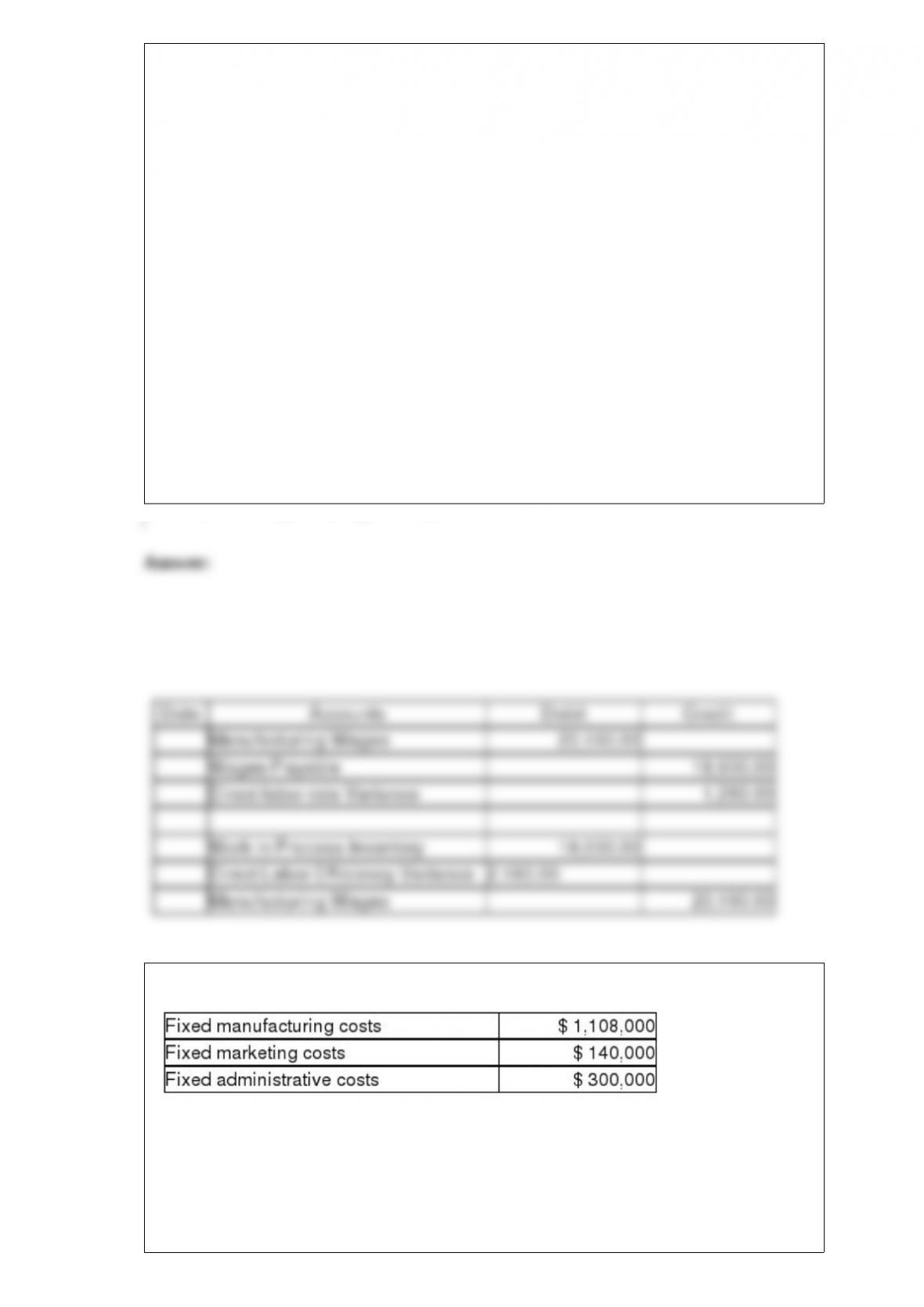
Journalize the direct labor costs incurred and the assignment of direct labor to Work in
Process Inventory, including the related variances.
50) William’s Steel had the following fixed costs:
The company also had the following variable costs:
Variable manufacturing costs$ 1,980,000
Variable marketing costs$ 60,000
Variable administrative costs$ 95,000
During the year, the company produced and sold 55,000 units of the product at a selling
price of $100.00 per unit. The company had no inventory at the beginning of the year.
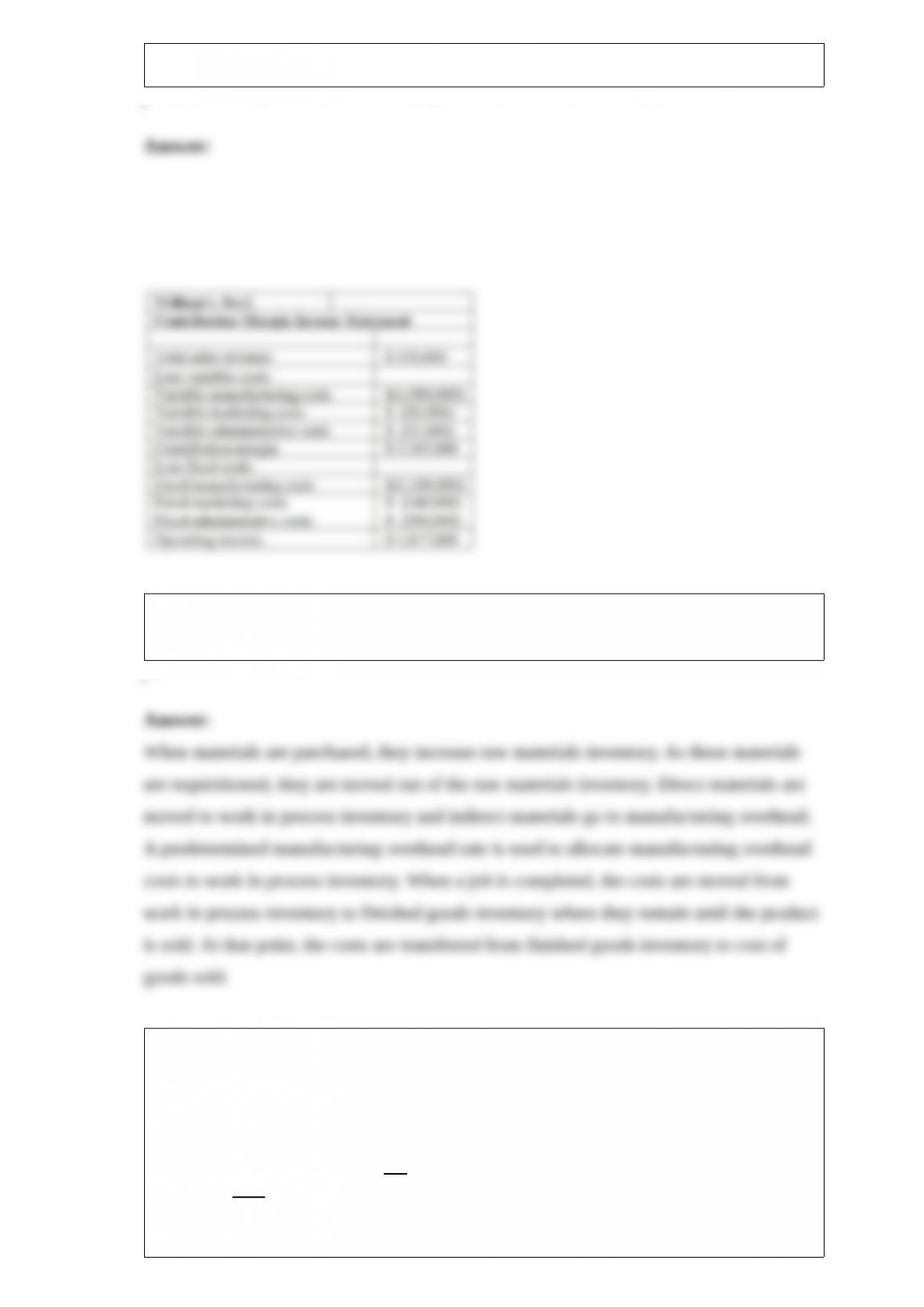
Required: Prepare a contribution margin income statement for the year.
51) Briefly explain the cost flow of materials through a job costing system from the
purchase to the sale.
52) Jeff’s Widget Corporation produces and sells a part used in the production of
bicycles. The unit costs associated with this part are as follows:
Direct materials$.14
Direct labor.30
Variable manufacturing overhead.20
Fixed manufacturing overhead.05
Total cost $.69
Saturn Company has approached Jeff’s Widget Corporation with an offer to purchase
20,000 units of this part at a price of $.80. Accepting this special sales order will put
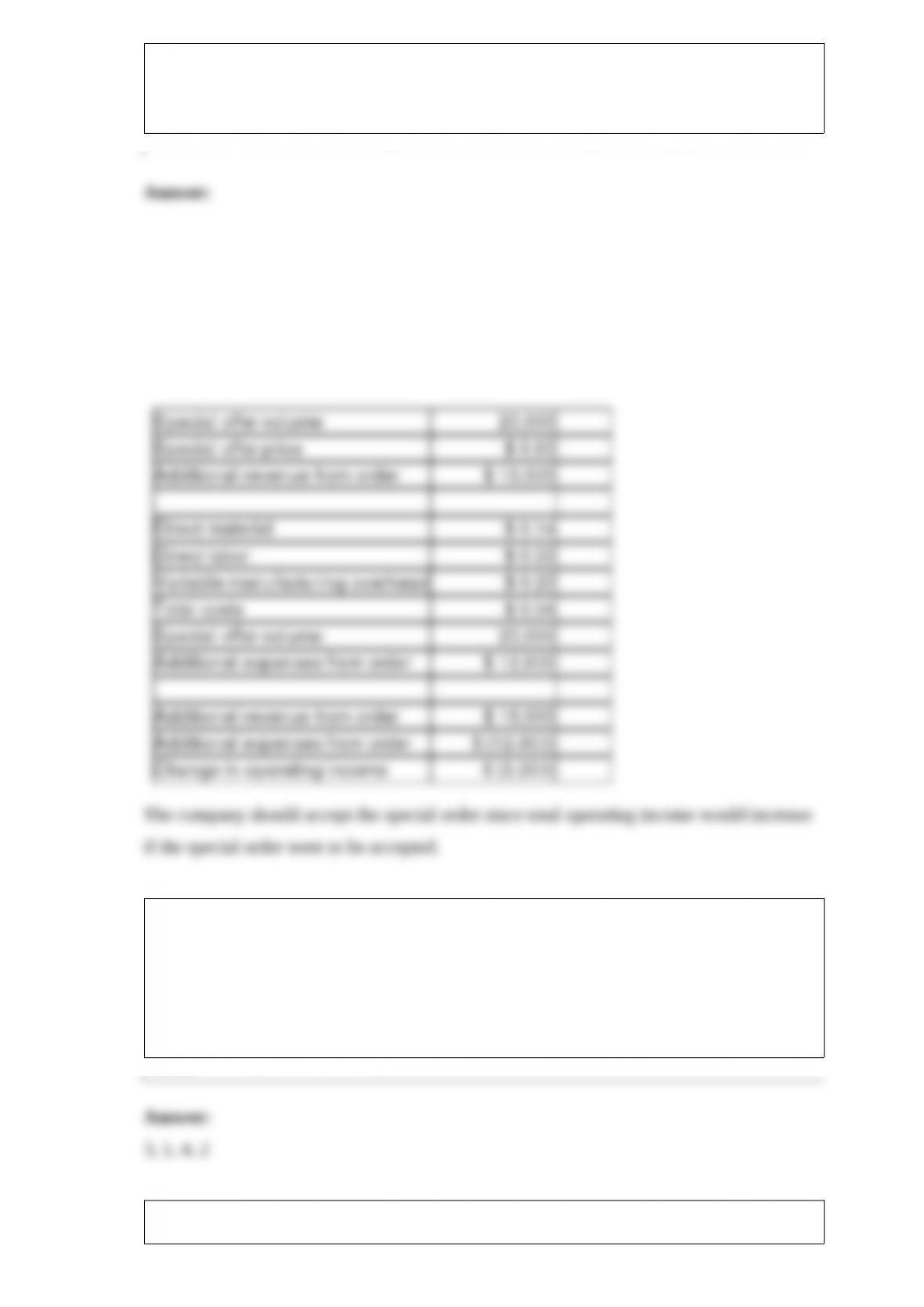
idle manufacturing capacity to use and will not affect regular sales. Total fixed costs
will not change.
Determine whether or not the special order should be accepted. Justify your conclusion.
53) For a manufacturer that uses job costing, show the order of the cost flow through
the following accounts by numbering them from 1 to 4 .
____finished goods inventory
____raw materials inventory
____cost of goods sold
____work in process inventory
54) Standard Products Company recognizes variances from standards at the earliest
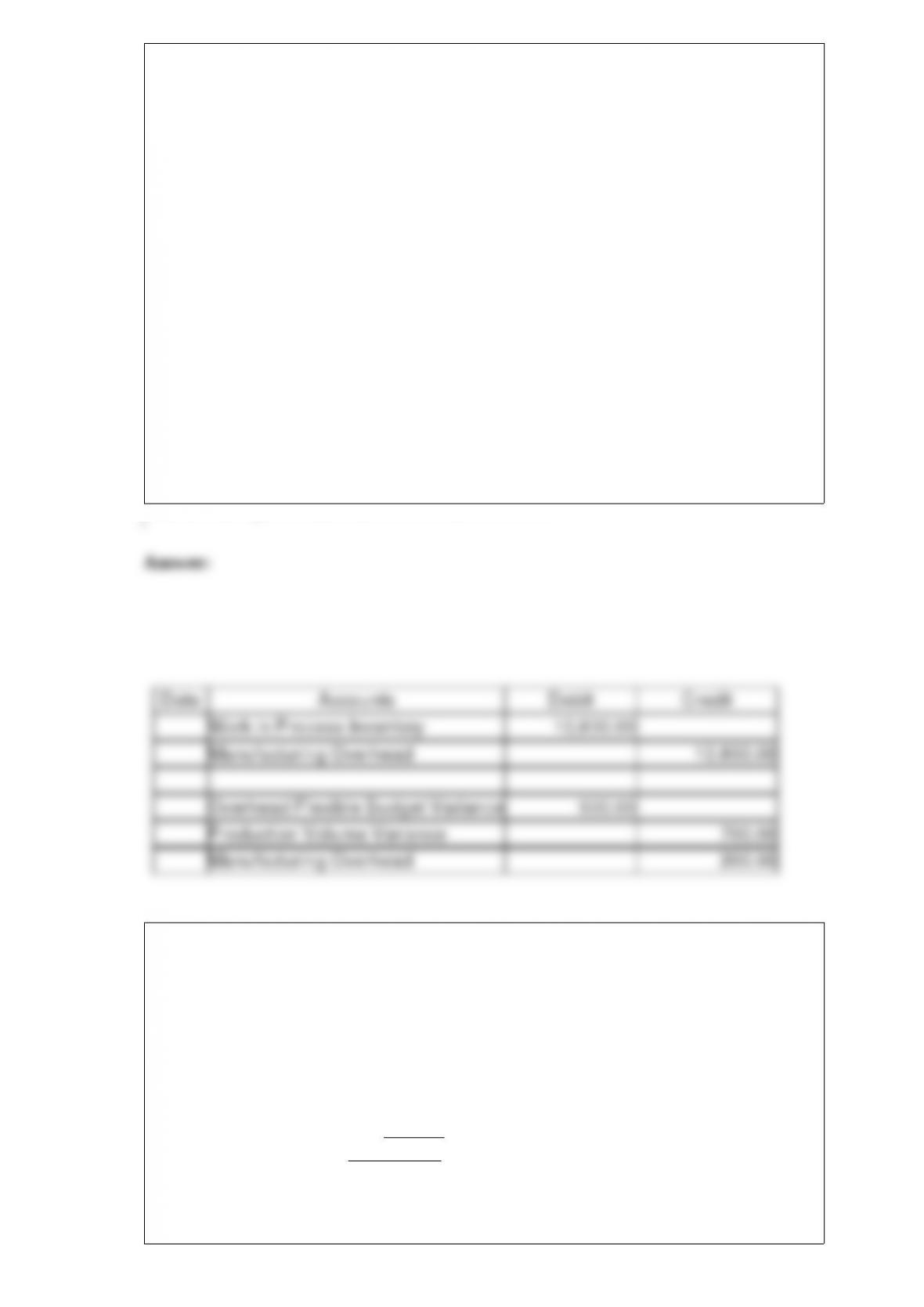
opportunity, and the quantity of direct materials purchased is equal to the quantity used.
The following information is available for the most recent month. Assume the
allocation base for fixed overhead costs is the number of units.
Direct MaterialsDirect Labor
Standard quantity/unit6.00 lbs.2.5 hrs.
Standard price/lb. or hr.$8.10/lb.$8.00/hr.
Actual quantity/unit6.25 lbs.2.8 hrs.
Actual price/lb. or hr.$8.00/lb.$7.50/hr
Price variance$562.50 F$1,260.00 F
Quantity/Efficiency variance$1,822.50 U$2,160.00 U
Static budget volume800 units
Actual volume900 units
Actual overhead cost$11,000
Standard variable overhead cost$5/unit
Standard fixed overhead cost$5,600
Overhead flexible budget variance$900 U
Production volume variance$700 F
Journalize the allocation of overhead costs to Work in Process Inventory and closing
manufacturing overhead costs to overhead variances.
55) Victoria Technologies makes a part used in the manufacture of digital cameras.
Management is
considering whether to continue manufacturing the part, or to buy the part from an
outside source at a cost of $24.00 per part. Victoria Technologies needs 60,000 parts per
year. The cost of manufacturing 60,000 parts is computed as follows:
Direct materials$ 750,000
Direct labor600,000
Variable manufacturing overhead525,000
Fixed manufacturing overhead750,000
Total manufacturing costs$2,525,0000
If Victoria Technologies buys the part, it would pay $.60 per unit to transport the parts
to its manufacturing plant. Purchasing the part from an outside source would enable the
company to avoid 50% of fixed manufacturing overhead costs. Victoria Technologies’
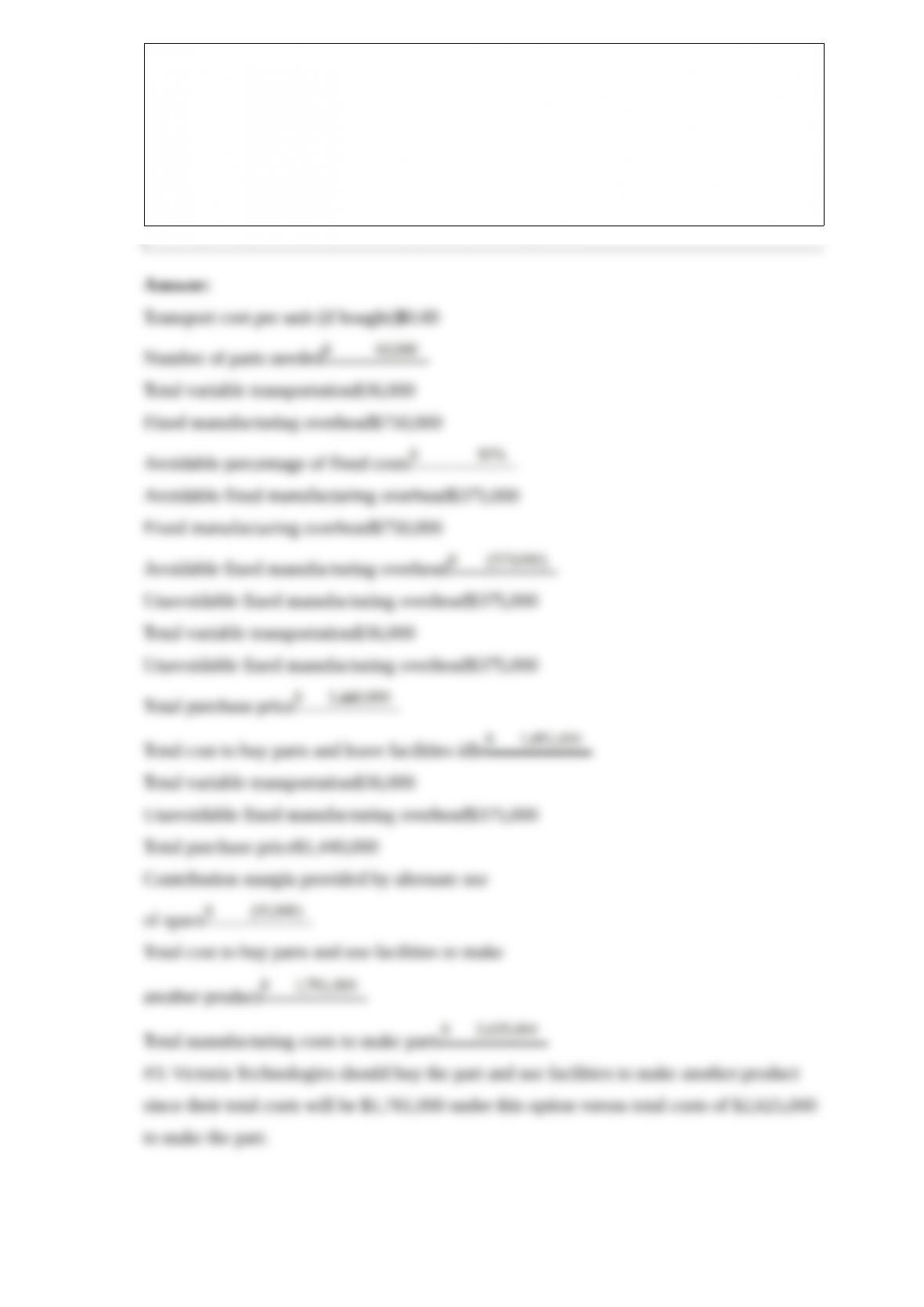
factory space freed up by purchasing the part from an outside supplier could be used to
manufacture another product with a contribution margin of $70,000.
Prepare an analysis to show which alternative makes the best use of Victoria
Technologies’ factory space:
1> Make the part
2> Buy the part and leave facilities idle
3> Buy the part and use facilities to make another product