
Materials are transferred from the storeroom to the factory in response to materials
requisitions.
Answer:
In the liquidating process, any uncollected cash becomes a loss to the partnership and is
divided among the remaining partners’ capital balances based on their income-sharing
ratio.
Answer:
A company is considering the purchase of a new piece of equipment for $90,000.
Predicted annual cash inflows from the investment are $36,000 (year 1), $30,000 (year
2), $18,000 (year 3), $12,000 (year 4), and $6,000 (year 5). The average income from
operations over the 5-year life is $20,400. The payback period is 3.5 years.
Answer:
If a proposed expenditure of $70,000 for a fixed asset with a 4-year life has an annual
expected net cash flow and net income of $32,000 and $12,000, respectively, the cash
payback period is 2.5 years.
Answer:
Job order cost systems can be used to compare unit costs of similar jobs to determine if
costs are staying within expected ranges.
Answer:
In most business organizations, the chief accountant is called the treasurer.
Answer:
Cash withdrawals by owners decrease assets and increase equity.

Answer:
Accounts reported on the balance sheet that are carried forward from year to year are
known as permanent accounts.
Answer:
Ideal standards are developed under conditions that assume no idle time, no machine
breakdowns, and no materials spoilage.
Answer:
Zero-coupon bonds do not provide for interest payments.
Answer:
The use of a separate payroll bank account is not an advantageous control, because it
creates more complexity in reconciliation functions for a company and invites theft.
Answer:
In using the variable cost concept of applying the cost-plus approach to product pricing,
fixed manufacturing costs and both fixed and variable selling and administrative
expenses must be covered by the markup.
Answer:
In horizontal analysis, the current year is the base year.
Answer:
The amount of depreciation expense for a fixed asset costing $95,000, with an
estimated residual value of $5,000 and a useful life of 5 years or 20,000 operating
hours, is $21,375 by the units-of-production method during a period when the asset was
used for 4,500 hours.
Answer:
Posting from a revenue journal to the customer account is normally done only at the end
of the month.
Answer:
Under the direct method of preparing a Statement of Cash Flows, the gain on the sale of
land is not adjusted or reported as part of cash flows from operating activities.
Answer:
The Other Accounts column in the Cash Receipts journal is used for recording debits to
any account for which there is no special debit column.
Answer:
The cost of a patent with a remaining legal life of 10 years and an estimated useful life
of 7 years is amortized over 10 years.
Answer:
If the standard to produce a given amount of product is 2,000 units of direct materials at
$12 and the actual was 1,600 units at $13, the direct materials quantity variance was
$5,200 favorable.
Answer:

Journalizing is the process of entering amounts in the ledger.
Answer:
Product costs include direct labor and advertising expense.
Answer:
A job order cost accounting system provides for a separate record of the cost of each
particular quantity of product that passes through the factory.
Answer:
The drawing account is closed to the income summary account.
Answer:
Information about costs developed through a job order cost system can not be used to
evaluate an organization’s cost performance.
Answer:
Favorable volume variances are never harmful, since achieving them encourages
managers to run the factory above normal capacity.
Answer:
Liability accounts are increased by debits.

Answer:
The first budget to be prepared is usually the production budget.
Answer:
The flexible budget is, in effect, a series of static budgets for different levels of activity.
Answer:
Standard cost variances are usually not reported in reports to stockholders.
Answer:

When the goods are sold, their costs are transferred from Work in Process to Finished
Goods.
Answer:
If the costs for direct materials, direct labor, and factory overhead were $522,200,
$82,700, and $45,300, respectively, for 16,000 equivalent units of production, the
conversion cost per equivalent unit was $8.00.
Answer:
The petty cash fund eliminates the need for a bank checking account.
Answer:

The balanced scorecard is a set of financial and nonfinancial measures that reflect the
performance of the business.
Answer:
A firm’s internal control environment is not influenced by
A.management’s operating style
B.organizational structure
C.personnel policies
D.monitoring policies
Answer:
When the three sections of a balance sheet are presented on a page in a downward
sequence, it is called the
A.account form
B.comparative form
C.horizontal form
D.report form

Answer:
The cost method of accounting for stock
A.recognizes dividends as income
B.is only appropriate as part of a consolidation
C.requires the investment be increased by the reported net income of the investee
D.requires the investment be decreased by the reported net income of the investee
Answer:
On April 25, Gregg Repair Service extended an offer of $115,000 for land that had been
priced for sale at $140,000. On May 3, Gregg Repair Service accepted the seller’s
counteroffer of $125,000. On June 20, the land was assessed at a value of $95,000 for
property tax purposes. On August 4, Gregg Repair Service was offered $150,000 for the
land by a national retail chain. At what value should the land be recorded in Gregg
Repair Service’s records?
A.$115,000
B.$95,000
C.$140,000
D.$125,000
Answer:
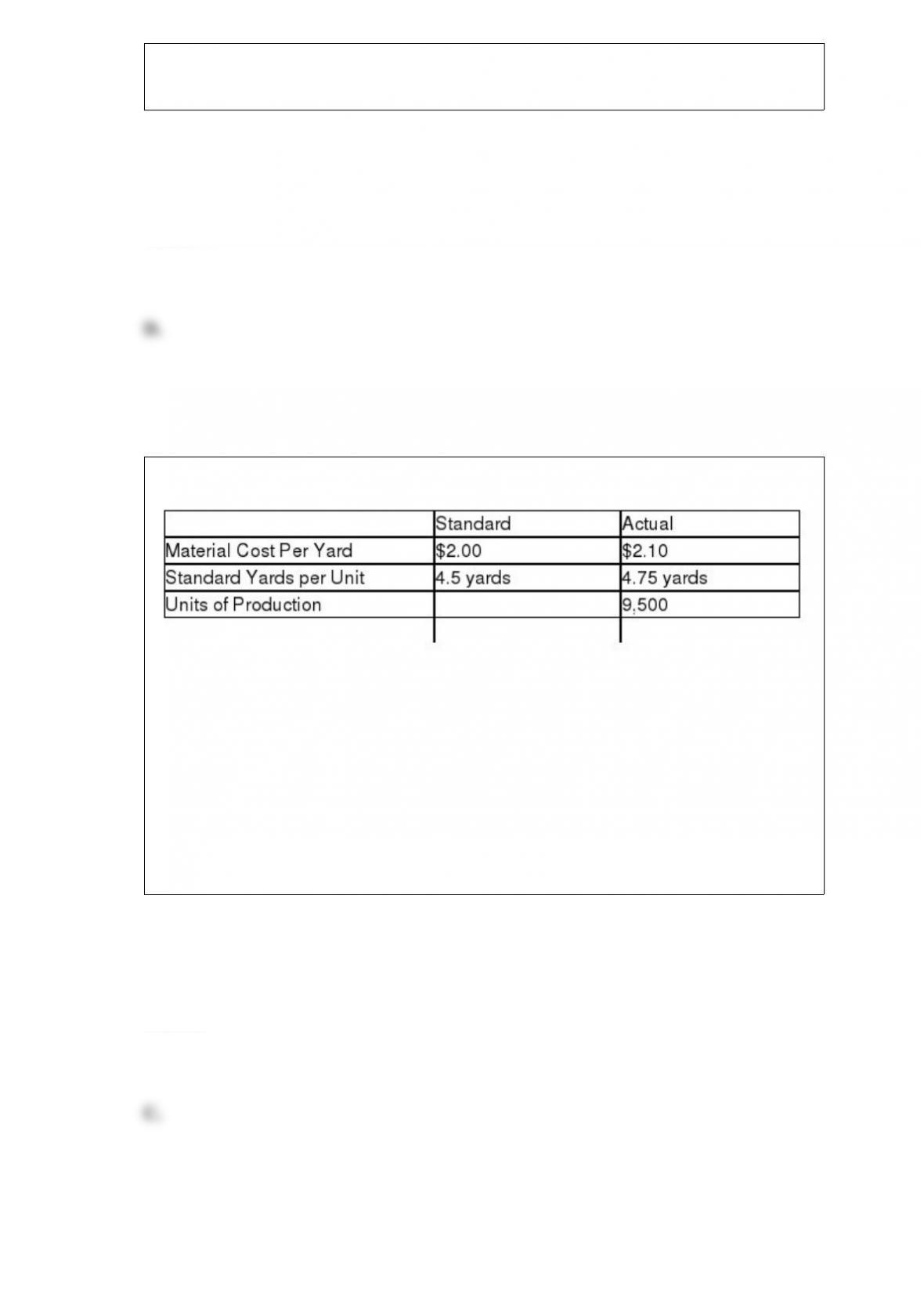
Calculate the Direct Materials Quantity variance using the above information:
A.$4,512.50 Unfavorable
B.$4,512.50 Favorable
C.$4,750 Unfavorable
D.$4,750 Favorable
Answer:

The recording of the jobs shipped and customers billed would include a credit to:
A.Accounts Payable
B.Cash
C.Finished Goods
D.Cost of Goods Sold
Answer:
Singer and McMann are partners in a business. Singer’s original capital was $40,000
and McMann’s was $60,000. They agree to salaries of $12,000 and $18,000 for Singer
and McMann respectively and 10% interest on original capital. If they agree to share
remaining profits and losses on a 3:2 ratio, what will Singer’s share of the income (loss)
be if the net loss for the year was $10,000?
A.($12,600)
B.($14,000)
C.($6,000)
D.($10,000)
Answer:

The balance in the prepaid rent account before adjustment at the end of the year is
$32,000, which represents four months’ rent paid on December 1. The adjusting entry
required on December 31 is
A.debit Rent Expense, $8,000; credit Prepaid Rent, $8,000
B.debit Prepaid Rent, $24,000; credit Rent Expense, $8,000
C.debit Rent Expense, $24,000; credit Prepaid Rent, $8,000
D.debit Prepaid Rent, $8,000; credit Rent Expense, $8,000
Answer:
An analysis in which all the components of an income statement are expressed as a
percentage of net sales is called
A.vertical analysis
B.horizontal analysis
C.liquidity analysis
D.solvency analysis
Answer:

As time passes, fixed assets other than land lose their capacity to provide useful
services. To account for this decrease in usefulness, the cost of fixed assets is
systematically allocated to expense through a process called
A.equipment allocation
B.depreciation
C.accumulation
D.matching
Answer:
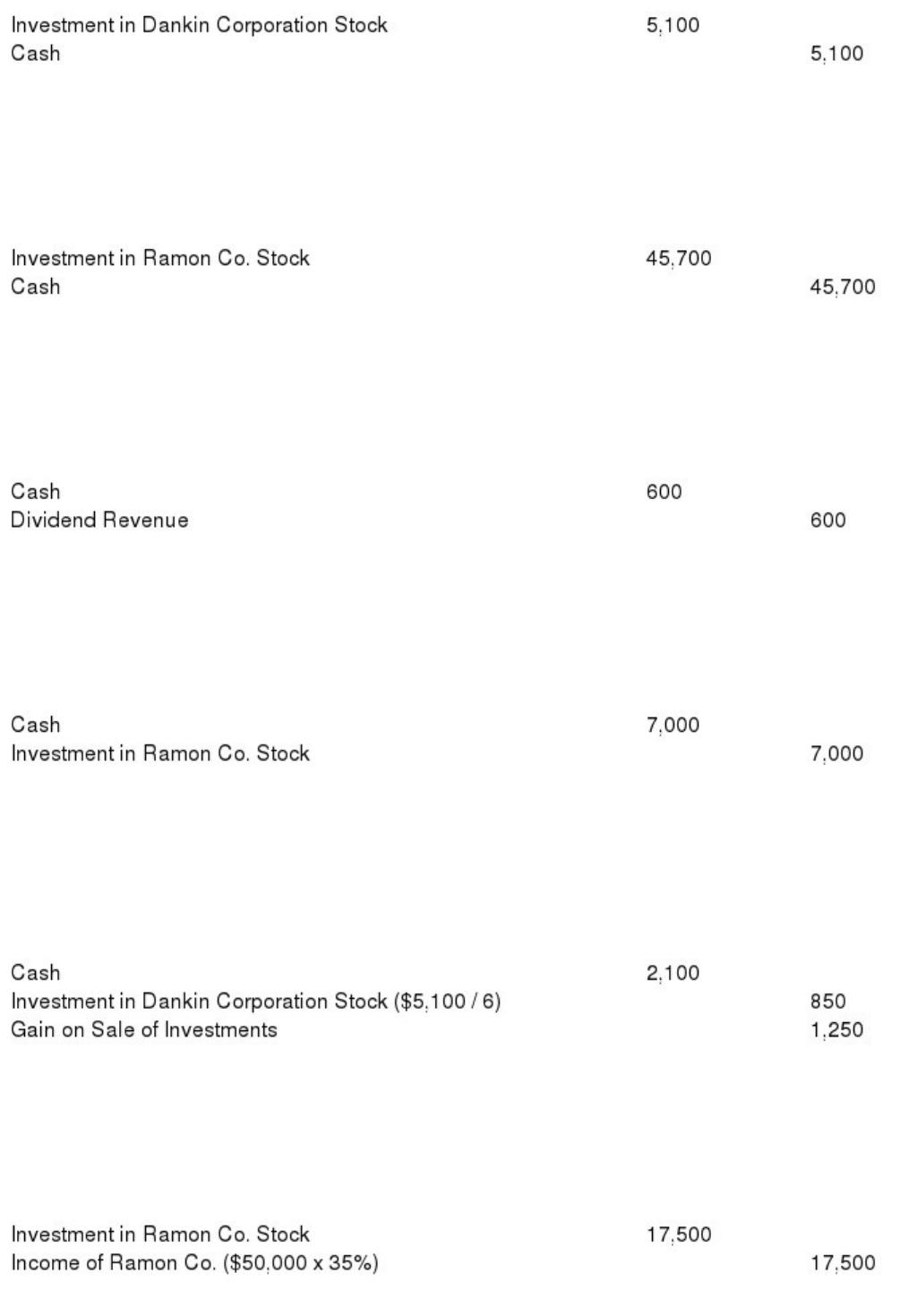
Present entries to record the following selected transactions of Masterson Co.
(a) Purchased 600 shares of the 100,000 shares outstanding $10 par common shares of
Dankin Corporation for $5,100.
(b) Purchased 3,500 shares of the 10,000 shares no par common shares of Ramon Co.
for $45,700. The investment was accounted for by the equity method.
(c) Received a cash dividend of $1 per share on the Dankin Corporation stock acquired
in (a).
(d) Received a cash dividend of $2 per share on the Ramon Co. stock acquired in (b).
(e) Sold 100 shares of the Dankin Corporation shares acquired in (a) for $2,100.
(f) Dankin Corporation reported net income of $30,000 and Ramon Company’s reported
net income was $50,000.
Answer:

Who are the individuals charged with the responsibility for directing the day-to-day
operations of a business?
A.Investors
B.Managers
C.Shareholders
D.Customers
Answer:
Costs that are treated as assets until the product is sold are called:
A.product costs
B.period costs
C.conversion costs
D.selling expenses
Answer:
ABC Printing Company uses a job order cost system.
(a) Indicate the source of the data for debiting Work in Process for each of the
following:
1
Direct materials requisitioned
2
Direct labor used
(b) Indicate the source of the data for crediting Work in Process for jobs completed.
(c) Present a list of the three controlling accounts used in the general ledger to record
the inventories and, in each case, indicate the related subsidiary ledger.
Answer:
Details of the division of net income for a partnership should be disclosed

A.in the asset section of the balance sheet
B.in the partners’ subsidiary ledger
C.in the statement of cash flows
D.in the partnership income statement
Answer:
Corporate annual reports typically do not contain which of the following?
A.management discussion and analysis
B.SEC statement expressing an opinion
C.accompanying foot notes
D.auditor’s report
Answer:
If the seller is to pay the freight costs of delivering merchandise, the delivery terms are
stated as

A.FOB shipping point
B.FOB destination
C.FOB n/30
D.FOB seller
Answer:
Merchandise inventory at the end of the year was understated. Which of the following
statements correctly states the effect of the error?
A.net income is understated
B.net income is overstated
C.cost of merchandise sold is understated
D.merchandise inventory reported on the balance sheet isoverstated
Answer:
One reason that a common-size statement is a useful tool in financial analysis is that it

enables the user to
A.judge the relative potential of two companies of similar size in different industries.
B.determine which companies in a single industry are of the same value.
C.determine which companies in a single industry are of the same size.
D.make a better comparison of two companies of different sizes in the same industry.
Answer:
The target cost approach assumes that:
A.markup is added to total cost
B.the selling price is set by the marketplace
C.markup is added to variable cost
D.markup is added to product cost
Answer:
Waller Company does business in two regional segments: North and South. The
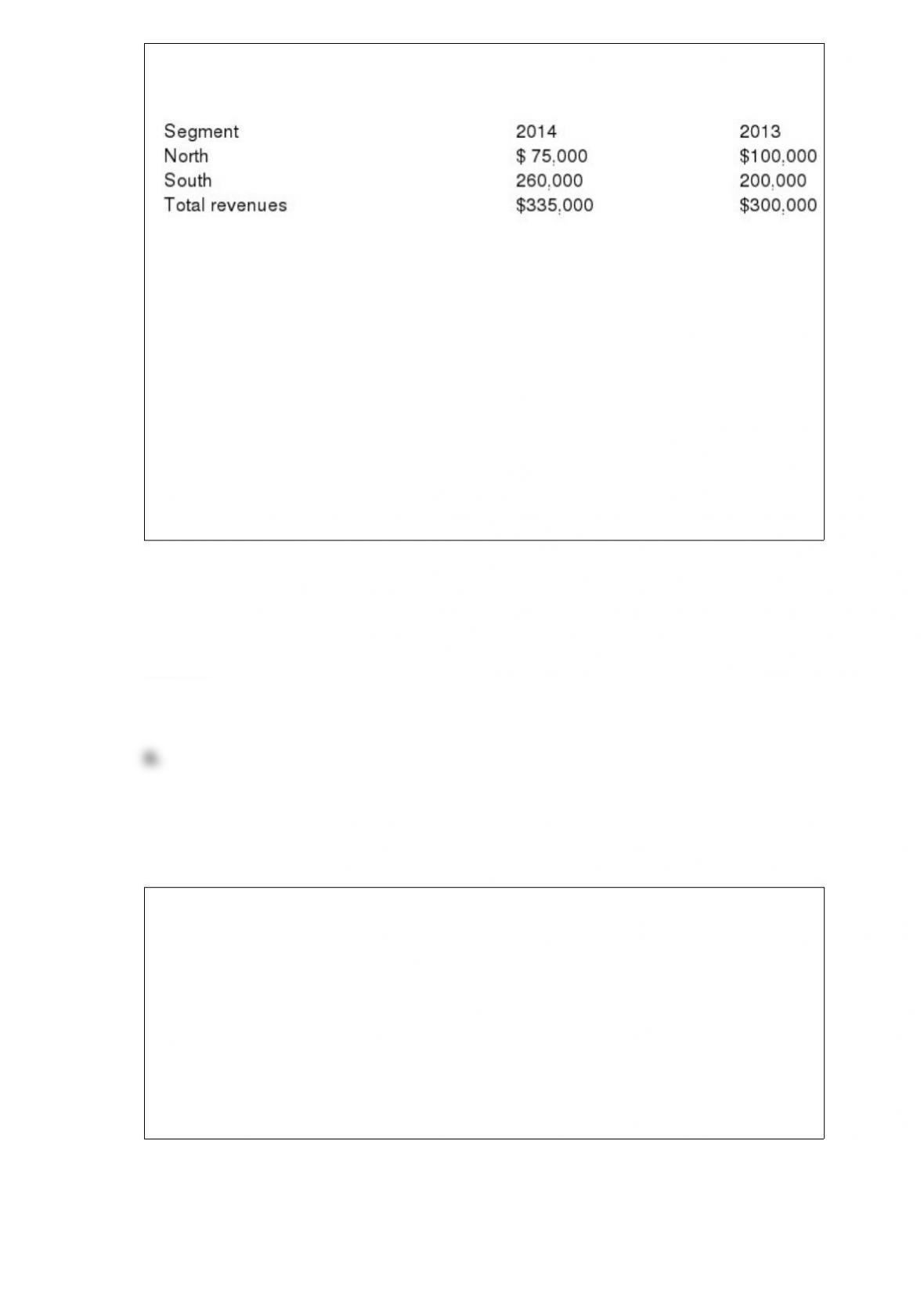
following annual revenue information was determined from the accounting system’s
invoice information:
Using horizontal analysis, determine the percentage change in revenues for the North
region.
Round to one decimal place.
A.22.4%
B.(25.0%)
C.25.0%
D.(22.4%)
Answer:
Accounting designed to meet the needs of decision-makers inside the business is
referred to as:
A.general accounting
B.financial accounting
C.managerial accounting
D.external accounting
Answer:
Treasury stock shares are
A.shares held by the U.S. Treasury Department
B.part of the total outstanding shares but not part of the total issued shares of a
corporation
C.unissued shares that are held by the treasurer of the corporation
D.issued shares that have been reacquired by a corporation
Answer:
The following financial information was summarized from the accounting records of
Train Corporation for the current year ended December 31:
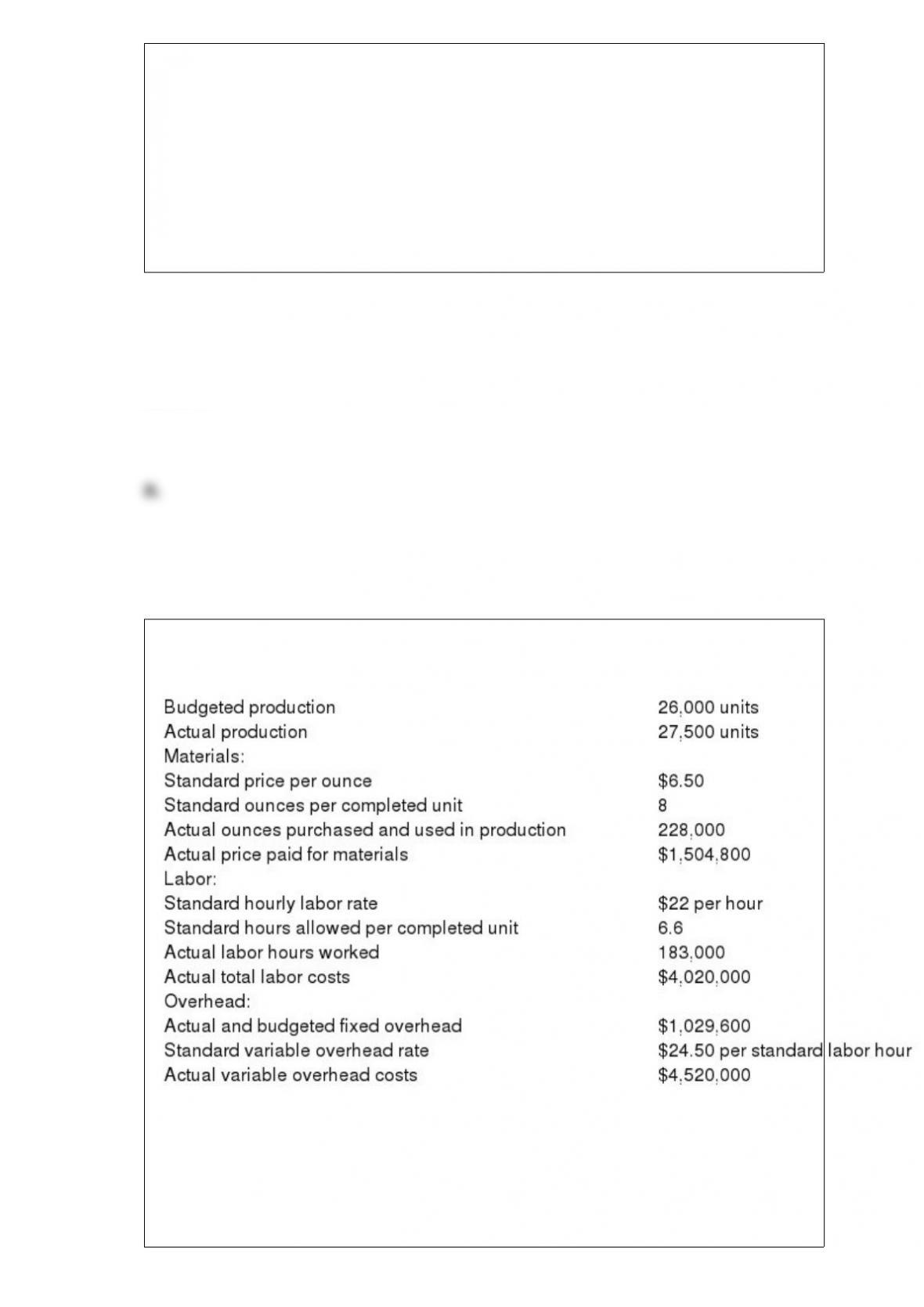
The net income for Train Corporation is:
A.$83,180
B.$35,940
C.$48,390
D.$60,840
Answer:
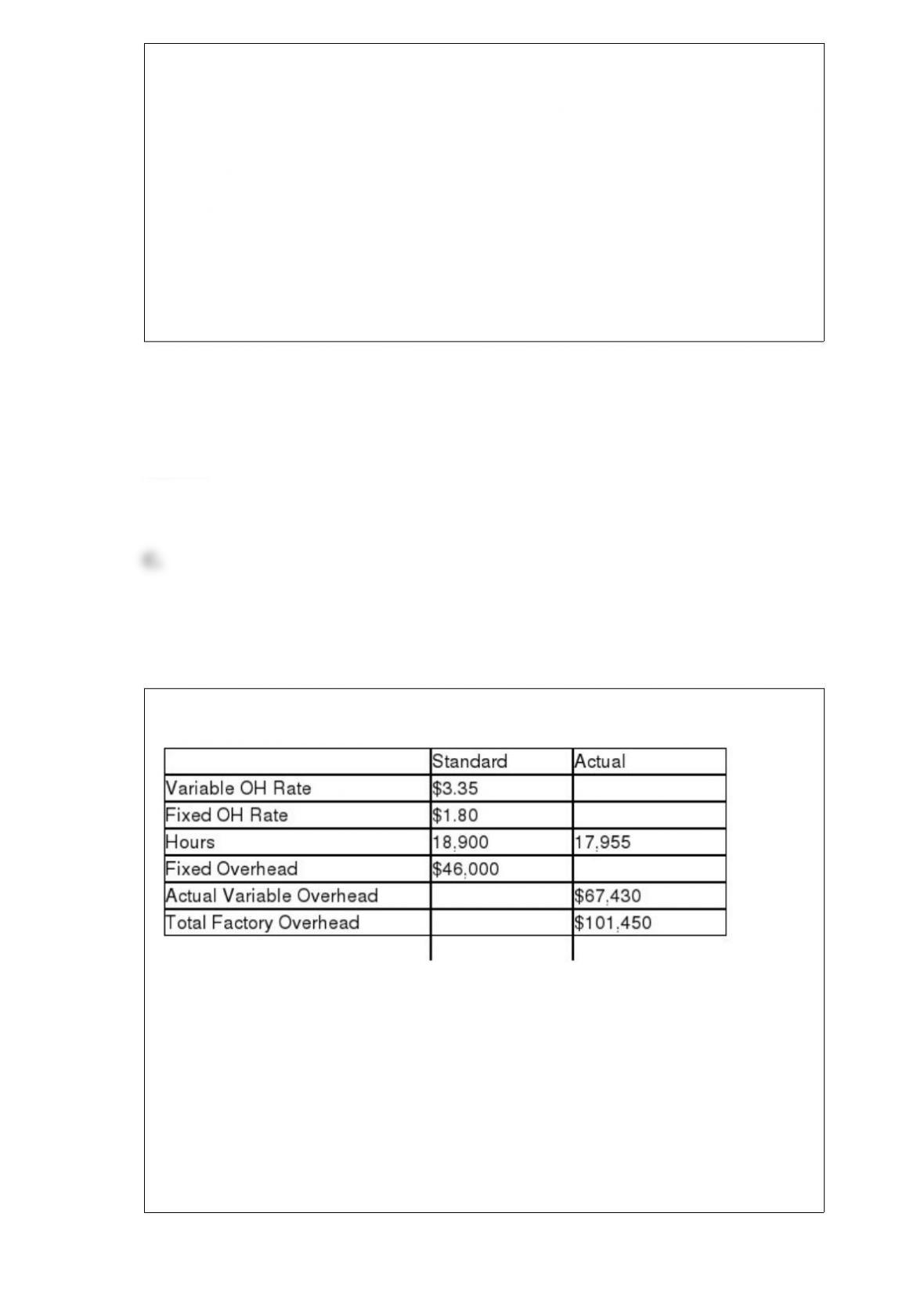
The following data is given for the Harry Company:
Overhead is applied on standard labor hours.
The direct labor time variance is:

A.6,000F
B.6,000U
C.33,000U
D.33,000F
Answer:
Gilbert’s expects its September sales to be 20% higher than its August sales of
$150,000. Purchases were $100,000 in August and are expected to be $120,000 in
September. All sales are on credit and are collected as follows: 30% in the month of the
sale and 70% in the following month. Merchandise purchases are paid as follows: 25%
in the month of purchase and 75% in the following month. The beginning cash balance
on September 1 is $7,500. The ending balance on September 30 would be:
A.$61,500
B.$75,000
C.$72,300
D.$71,500
Answer:
Which of the following conditions normally would not indicate that standard costs
should be revised?
A.The engineering department has revised product specifications in responding to
customer suggestions.
B.The company has signed a new union contract which increases the factory wages on
average by $5.00 an hour.
C.Actual costs differed from standard costs for the preceding week.
D.The world price of raw materials increased.
Answer:
Calculate the total factory overhead cost variance using the above information:
A.$4,866.75 Unfavorable
B.$4,866.75 Favorable
C.$8,981.75 Favorable
D.$8,981.75 Unfavorable

Answer:
When does an account become uncollectible?
A.when accounts receivable is converted into notes receivable
B.when discount is availed on notes receivable
C.there is no general rule for when an account becomes uncollectible
D.at the end of the fiscal year
Answer:
The gross increases in owner’s equity attributable to business activities are called
A.assets
B.liabilities
C.revenues
D.expenses
Answer:

Which of the following isnot a characteristic of a corporation?
A.Corporations are organized as a separate legal taxable entity
B.Ownership is divided into shares of stock.
C.Corporations experience an ease in obtaining large amounts of resources by issuing
stock.
D.A corporation’s resources are limited to their individual owners’ resources.
Answer:
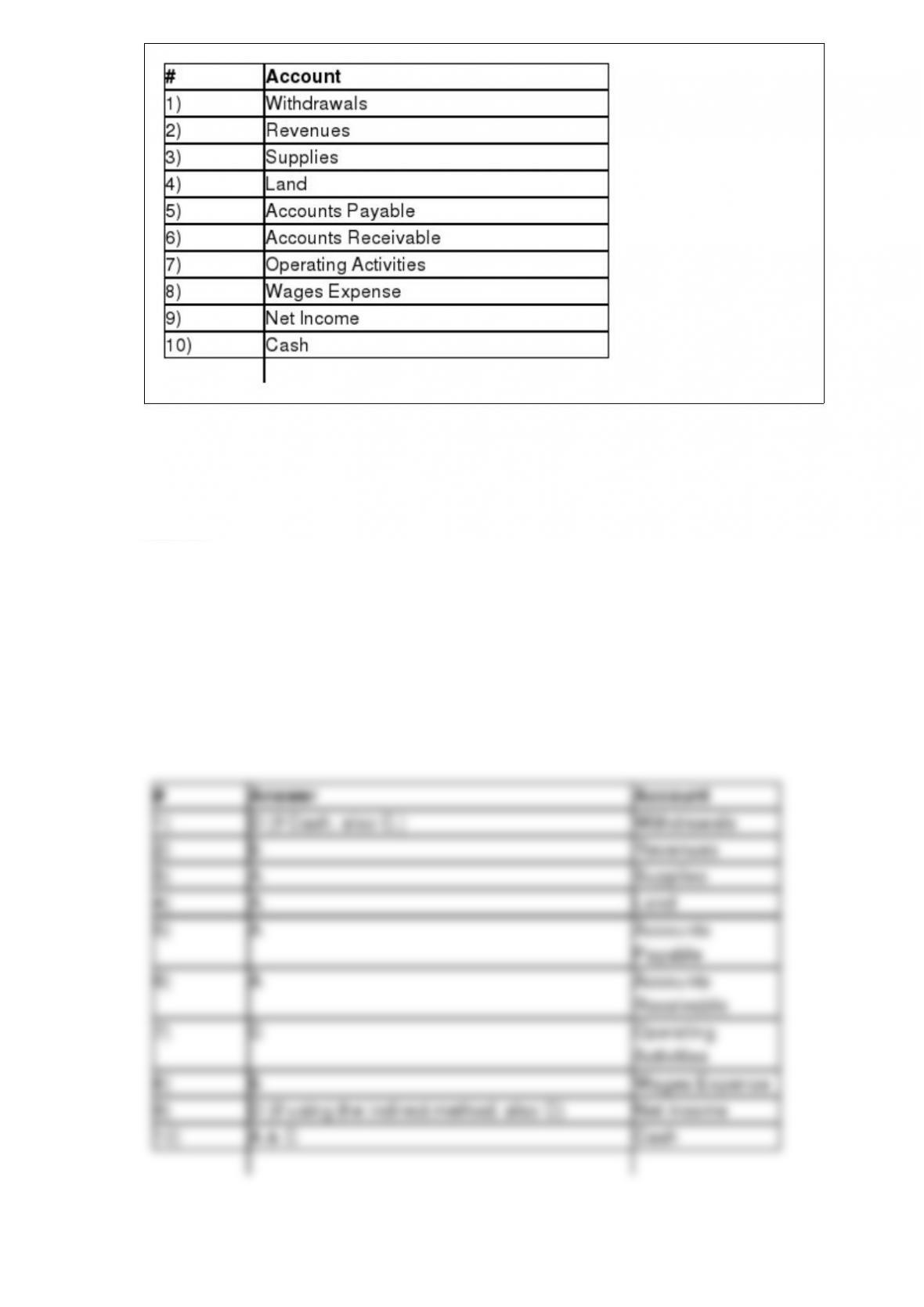
Match the following accounts to the financial statement where they can be found. (Hint:
Some of the accounts can be found in more than one financial statement.)
A. Balance Sheet
B. Income Statement
C. Statement of Cash Flows
D. Statement of Owner’s Equity
Answer:
A building with a book value of $54,000 is sold for $63,000 cash Using the indirect
method, this transaction should be shown on the statement of cash flows as follows:
A.an increase of $54,000 from investing activities
B.an increase of $63,000 from investing activities and a deduction from net income of
$9,000
C.an increase of $9,000 from investing activities
D.an increase of $54,000 from investing activities and an addition to net income of
$9,000
Answer:
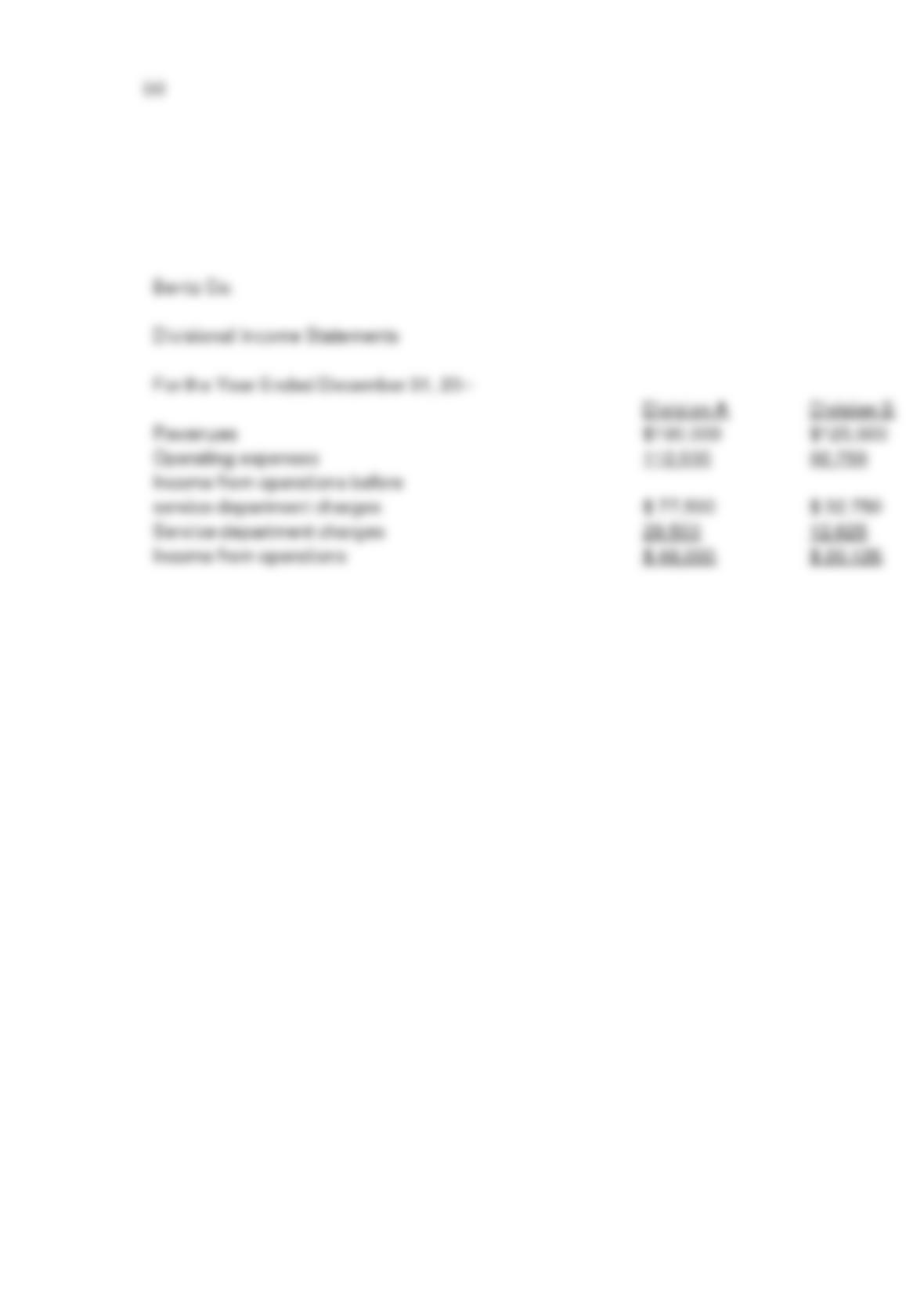
Bentz Co. has two divisions, A and B. Invested assets and condensed income statement
data for each division for the past year ended December 31 are as follows:
Answer:
An oven with a book value of $67,000 has an estimated 5 year life. A proposal is
offered to sell the oven for $8,500 and replace it with a new oven costing $110,000. The
new machine has a five year life with no residual value. The new machine would reduce
annual maintenance costs by $23,000. Provide a differential analysis on the proposal to
replace the machine.
Answer:
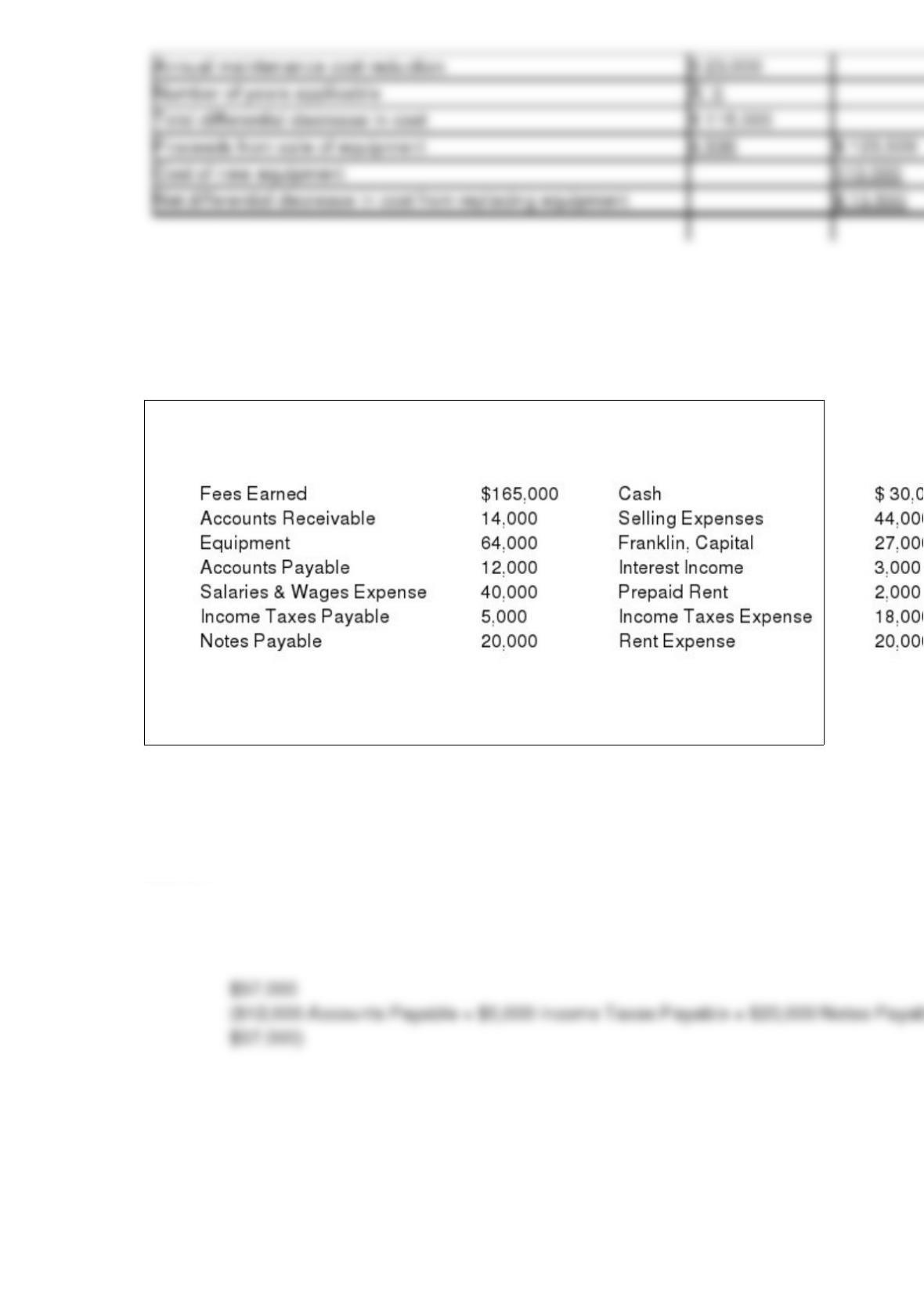
The accountant for Franklin Company prepared the following list of account balances
from the company’s records for the year ended December 31, 2011:
Determine the total liabilities at the end of 2011 for Franklin Company.
Answer:
On May 1, 2015, Chase Inc. purchases $60,000 of 10-year, Manus Corporation 6%
bonds dated March 1, 2015 at 100 plus accrued interest. What entry would Chase record
when receiving its semiannual interest on September 1?
Answer:
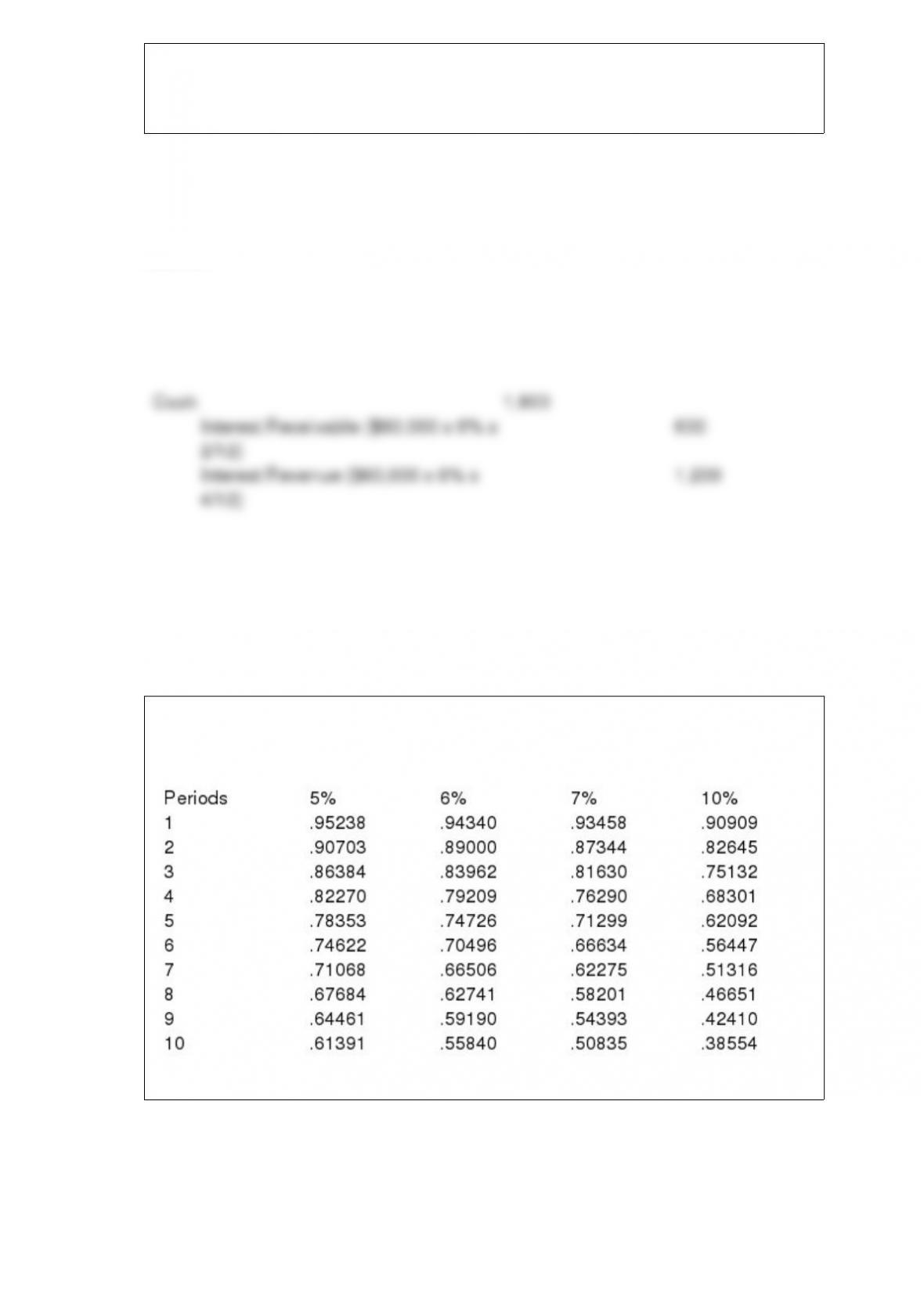
Using the following table, what is the present value of $5,000 to be received 5 years, if
the market rate is 10% compounded annually?
Answer:
What is comprehensive income? How is it calculated? What are some examples of
items included in other comprehensive income? Where is comprehensive income
reported?
Answer:
On February 12, Addison, Inc. purchased 6,000 shares of Lucas Company at $22 per
share plus a $240 brokerage fee. On August 22, Lucas paid a $0.42 dividend per share.
On November 10, 4,000 shares of Lucas stock were sold for $28 per share less a $160
brokerage fee.
Answer:
Match the following terms with their definitions.
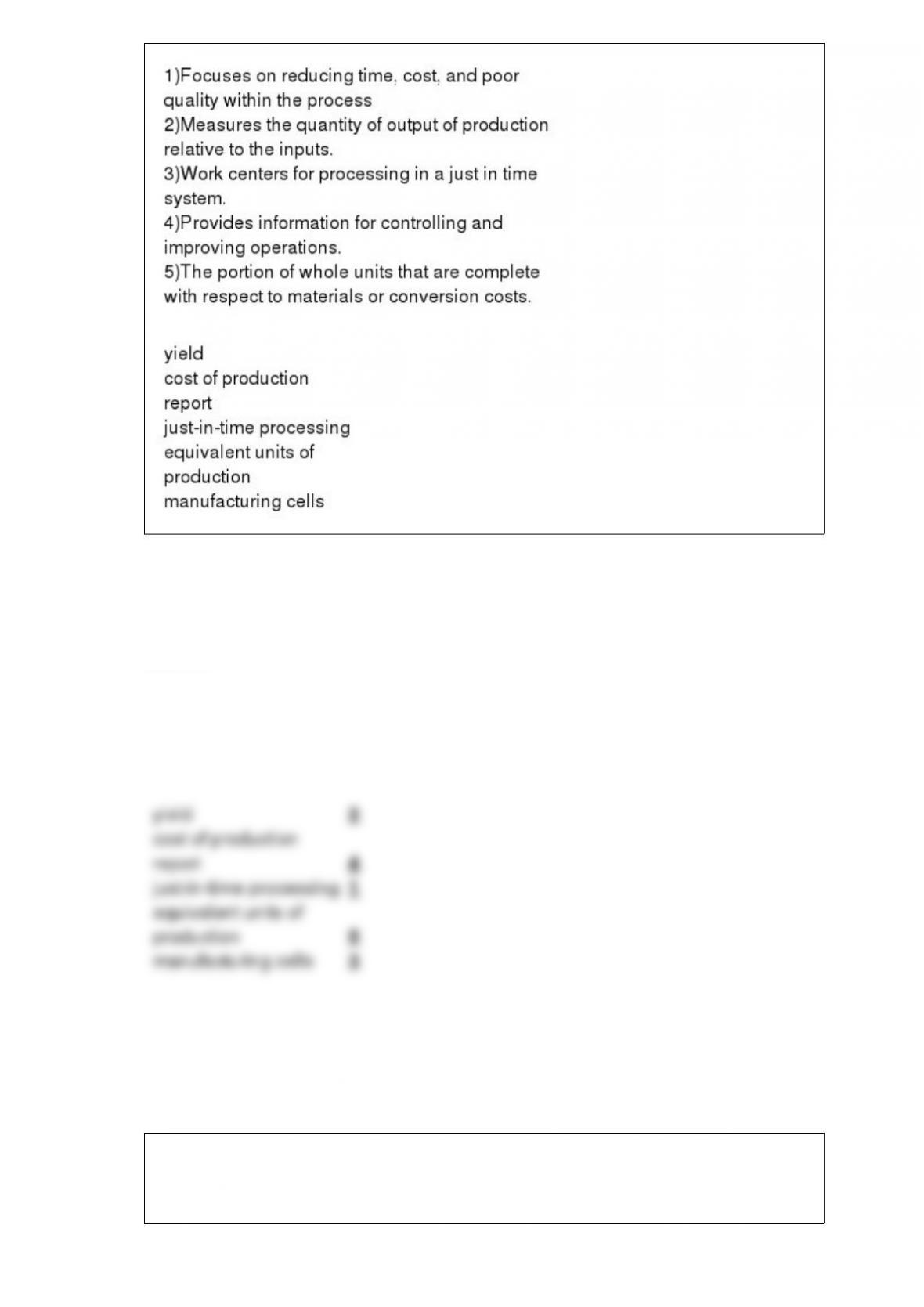
Answer:
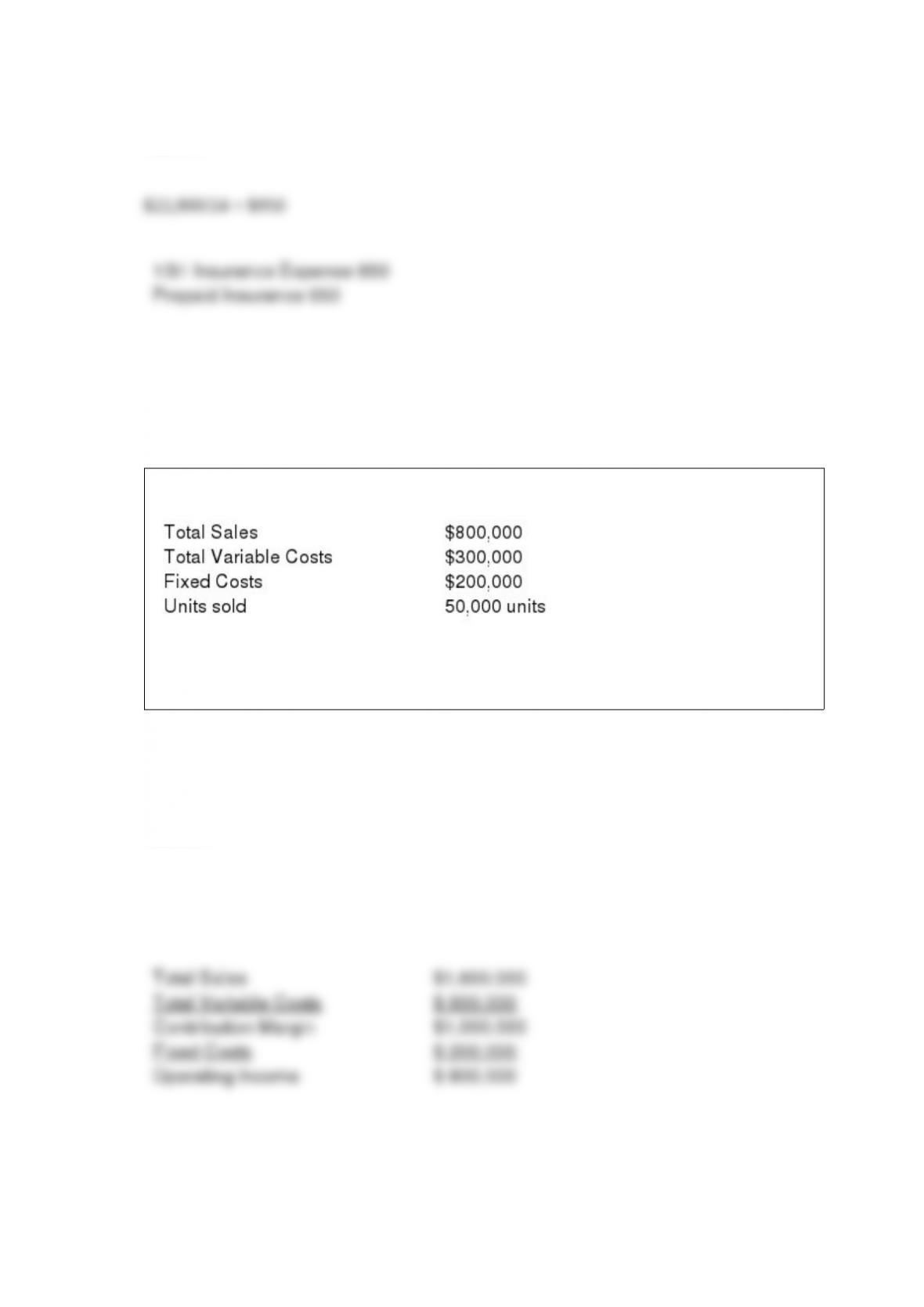
On January 1, DogMart Company purchased a two-year liability insurance policy for
$22,800 cash. The purchase was recorded to Prepaid Insurance. Prepare the January 31
adjusting entry.
Answer:
Blane Company has the following data:
What will operating income be if units sold double to 100,000 units?
Answer:
The materials used by the Hibiscus Company Division A are currently purchased from
outside supplier at $55 per unit. Division B is able to supply Division A with 20,000
units at a variable cost of $42 per unit. The two divisions have recently negotiated a
transfer price of $48 per unit for the 20,000 units. By how much will each division’s
income increase as a result of this transfer?
Answer:
Match each statement to the item listed below.
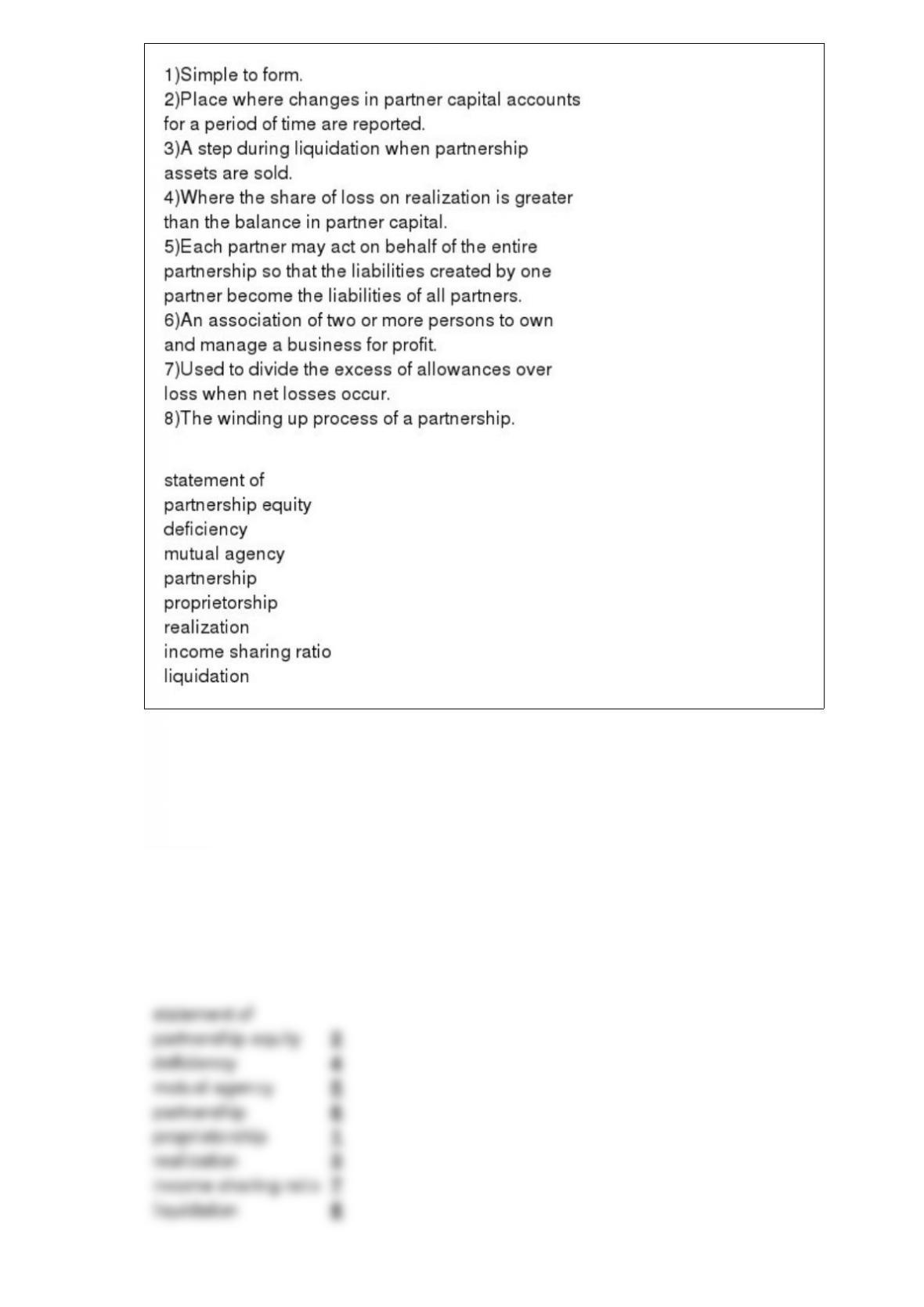
Answer:
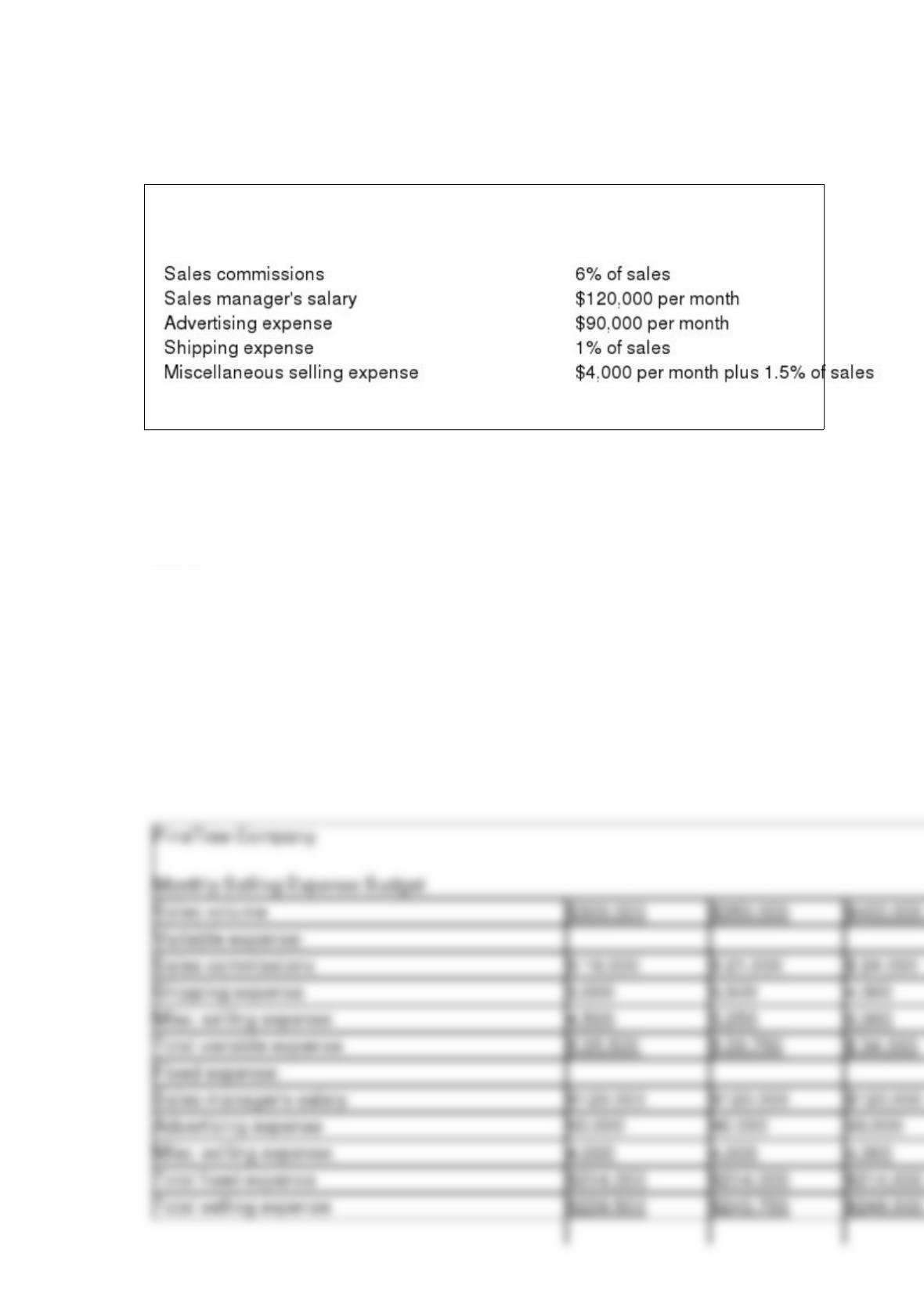
Prepare a monthly flexible selling expense budget for PineTree Company for sales
volumes of $300,000, $350,000, and $400,000, based on the following data:
Answer:
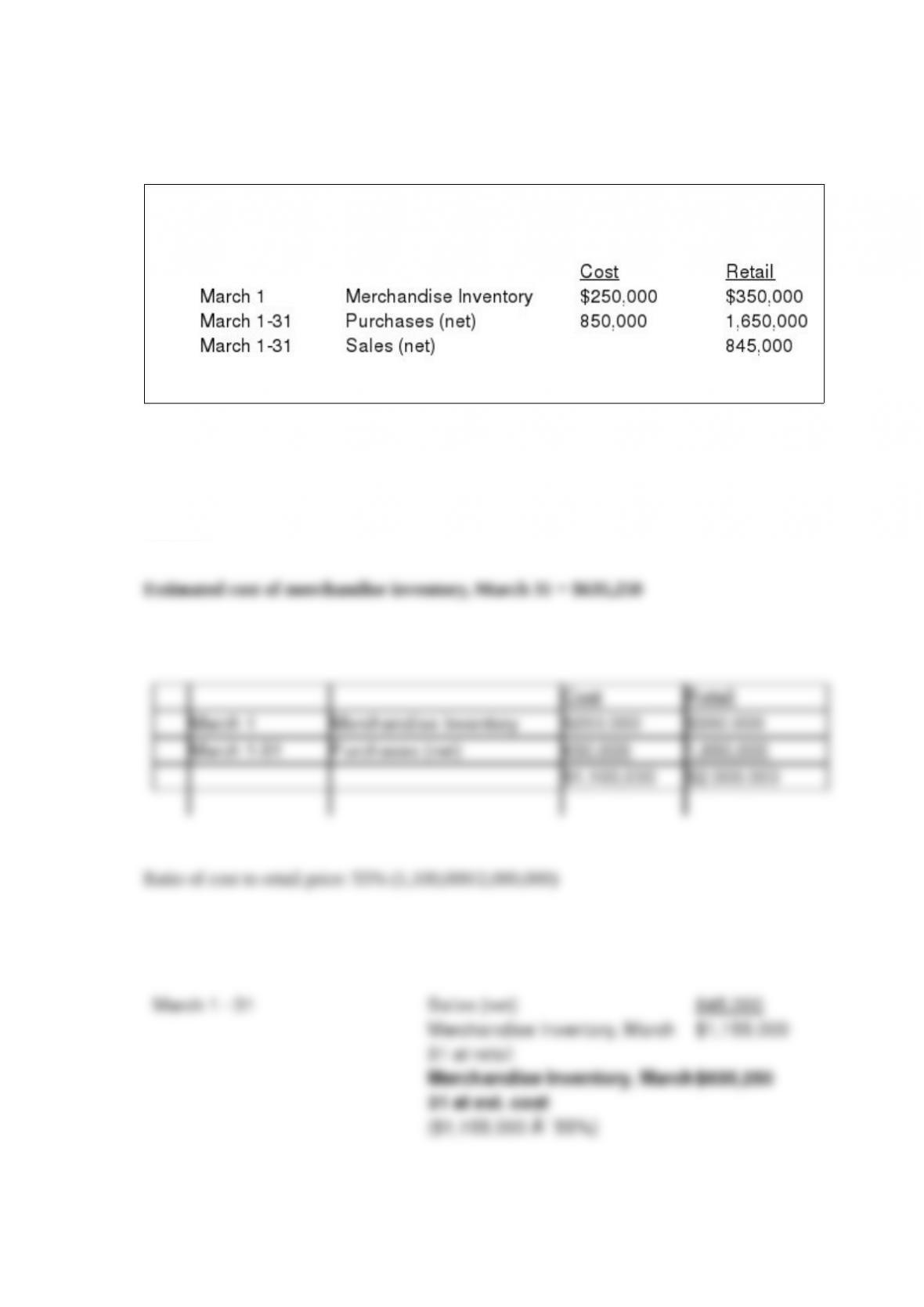
On the basis of the following data, estimate the cost of the merchandise inventory at
March 31 by the retail method:
Answer:
Discuss how equivalent units are computed under the average cost method.
Answer:
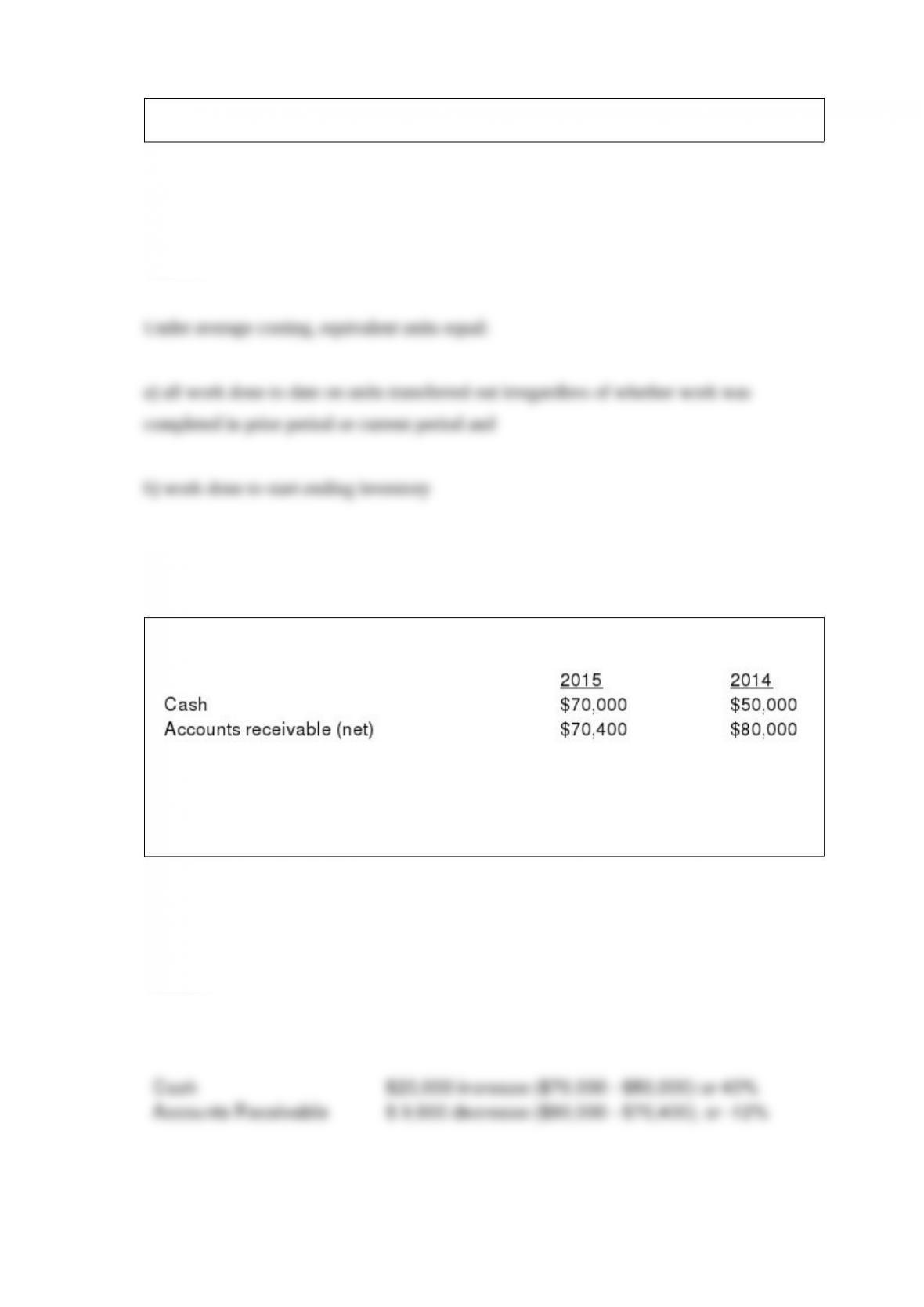
The Cash and Accounts Receivable for a company are provided below:
Based on this information, what is the amount and percentage of increase or decrease
that would be shown in a balance sheet with horizontal analysis?
Answer:
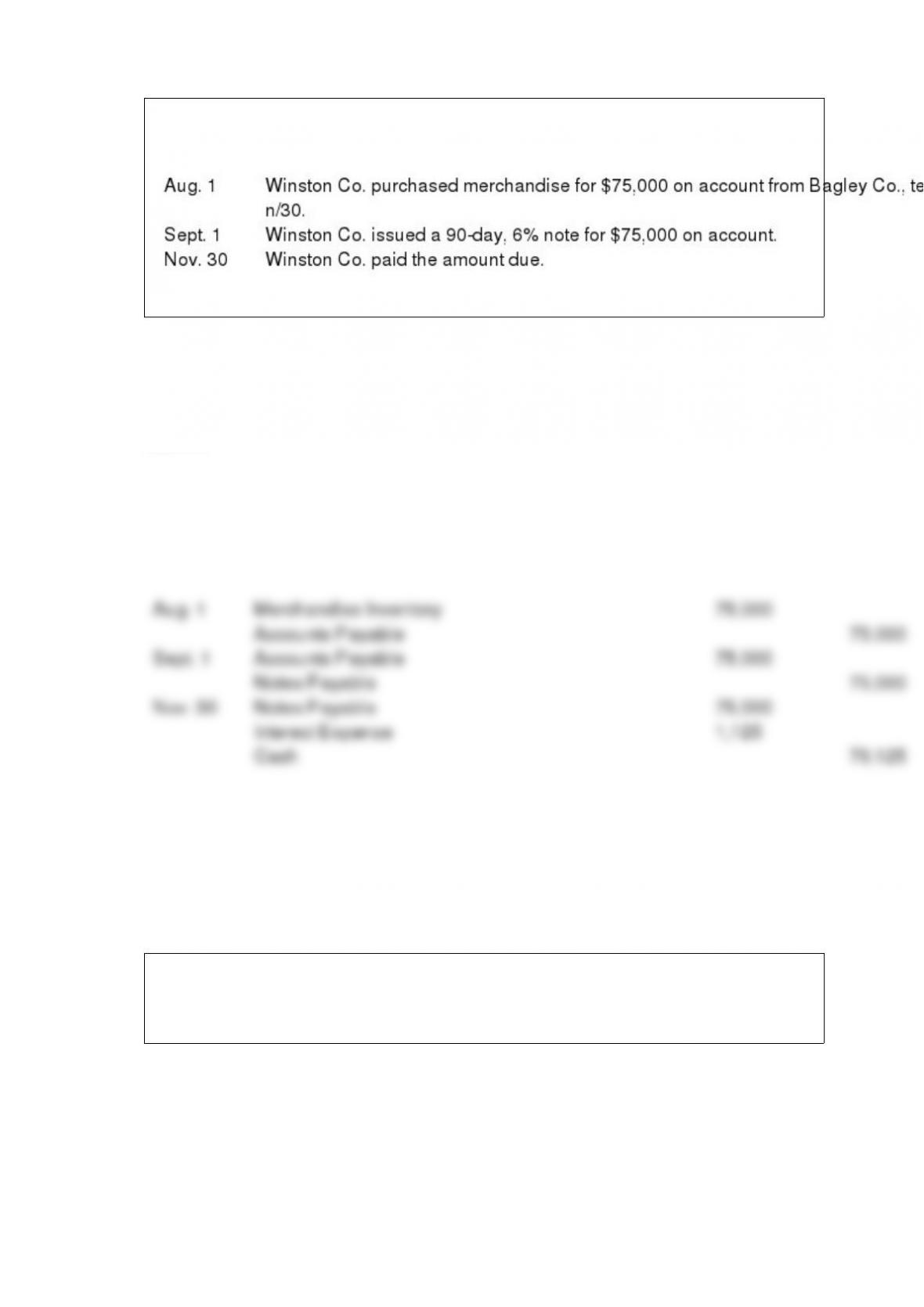
Journalize the following entries on the books of Winston Co. for August 1, September
1, and November 30. (Assume a 360-day year is used for interest calculations.)
Answer:
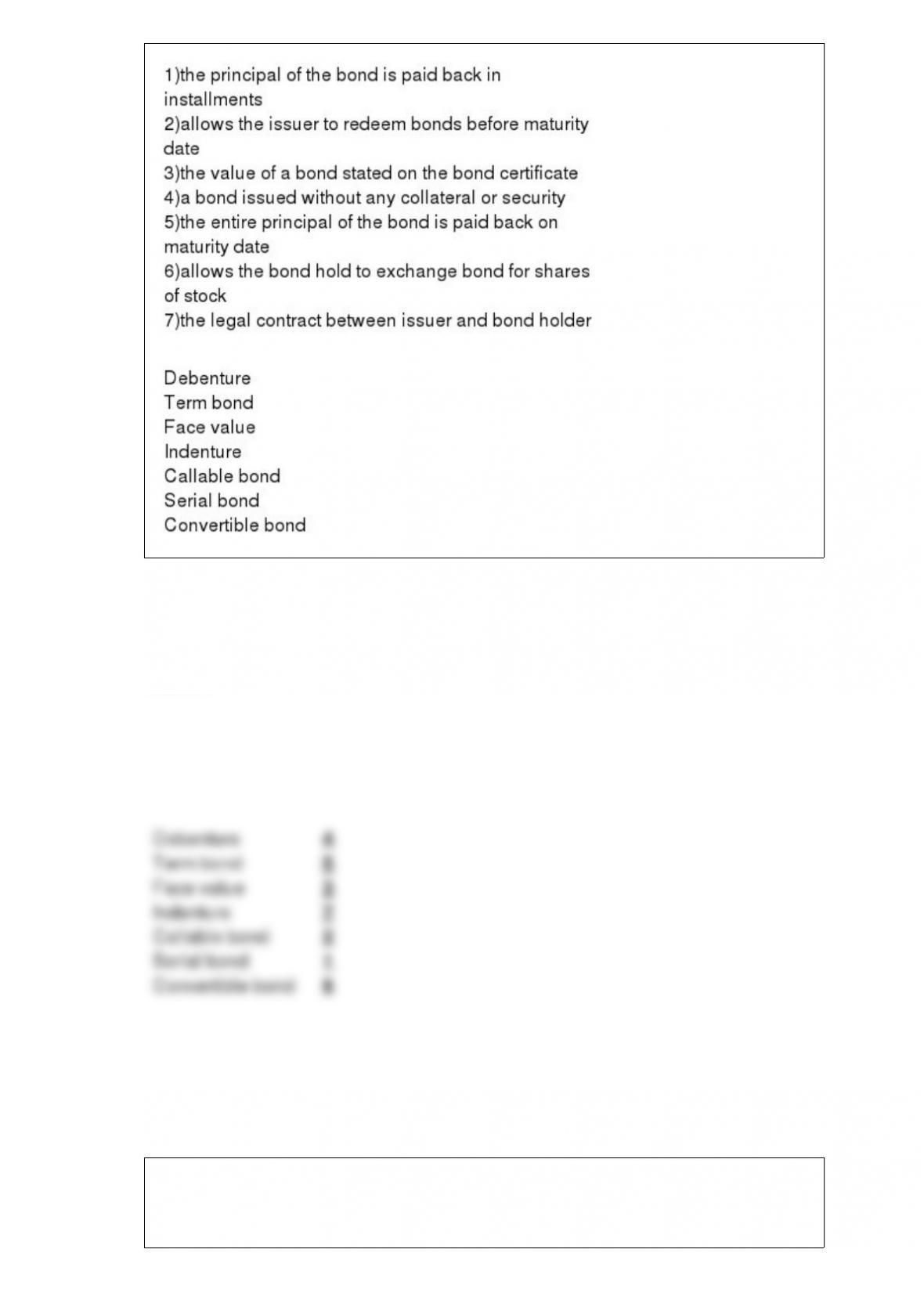
Match the following terms to the most appropriate
Answer:
Crane Company Division B recorded sales of $360,000, variable cost of goods sold of
$315,000, variable selling expenses of $13,000, and fixed costs of $61,000, creating a
loss from operations of $29,000. Determine the differential income or loss from the
sales of Division B. Should this division be discontinued?
Answer:
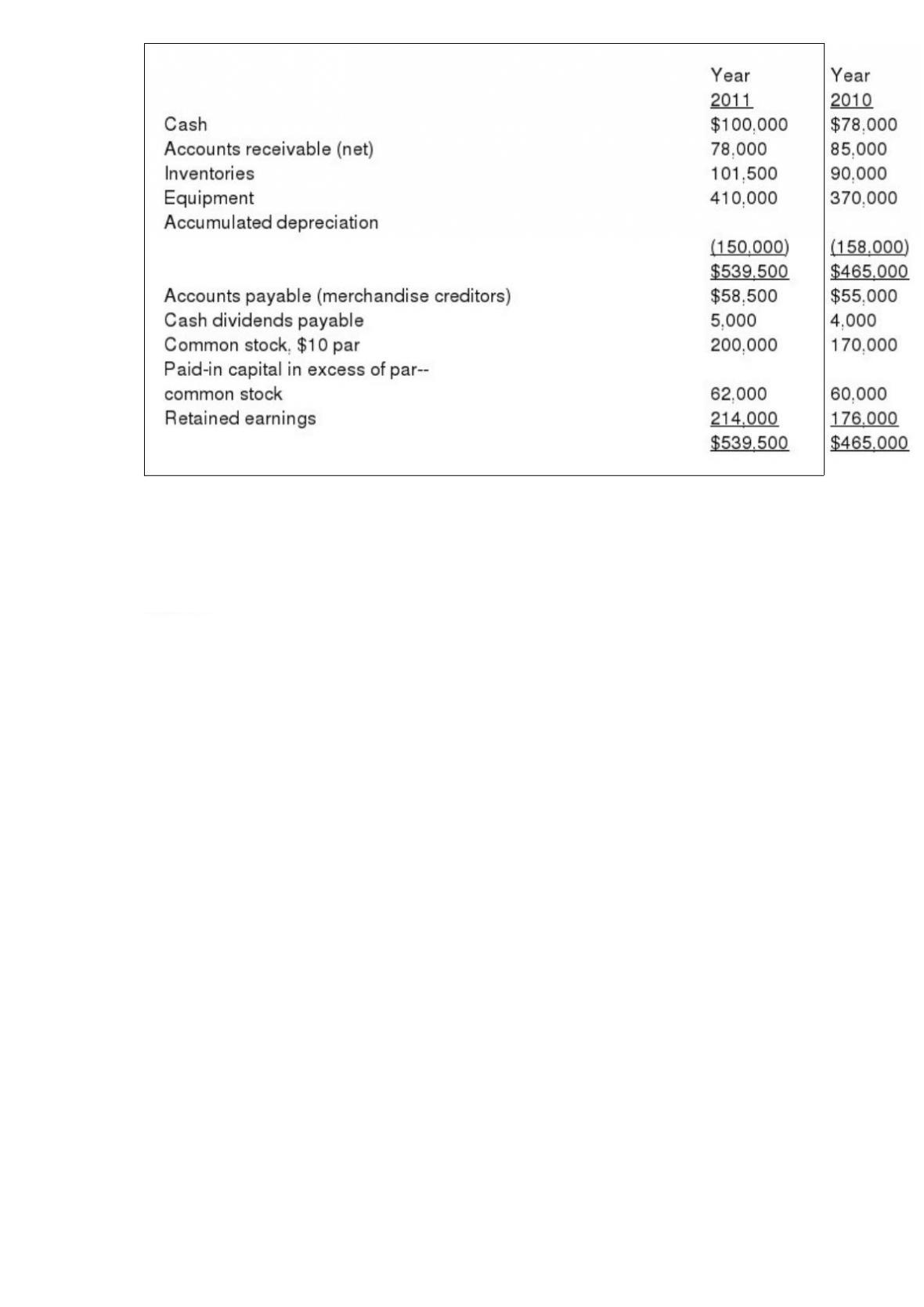
On the basis of the following data for Larson Co. for the year ending December 31,
2011 and the preceding year ended December 31, 2010, prepare a statement of cash
flows. Use the indirect method of reporting cash flows from operating activities. In
addition to the balance sheet data, assume that:
Equipment costing $125,000 was purchased for cash.
Equipment costing $85,000 with accumulated depreciation of $65,000 was sold for
$15,000.
The stock was issued for cash.
The only entries in the retained earnings account were net income of $51,000 and cash
dividends declared of $13,000.
Answer:
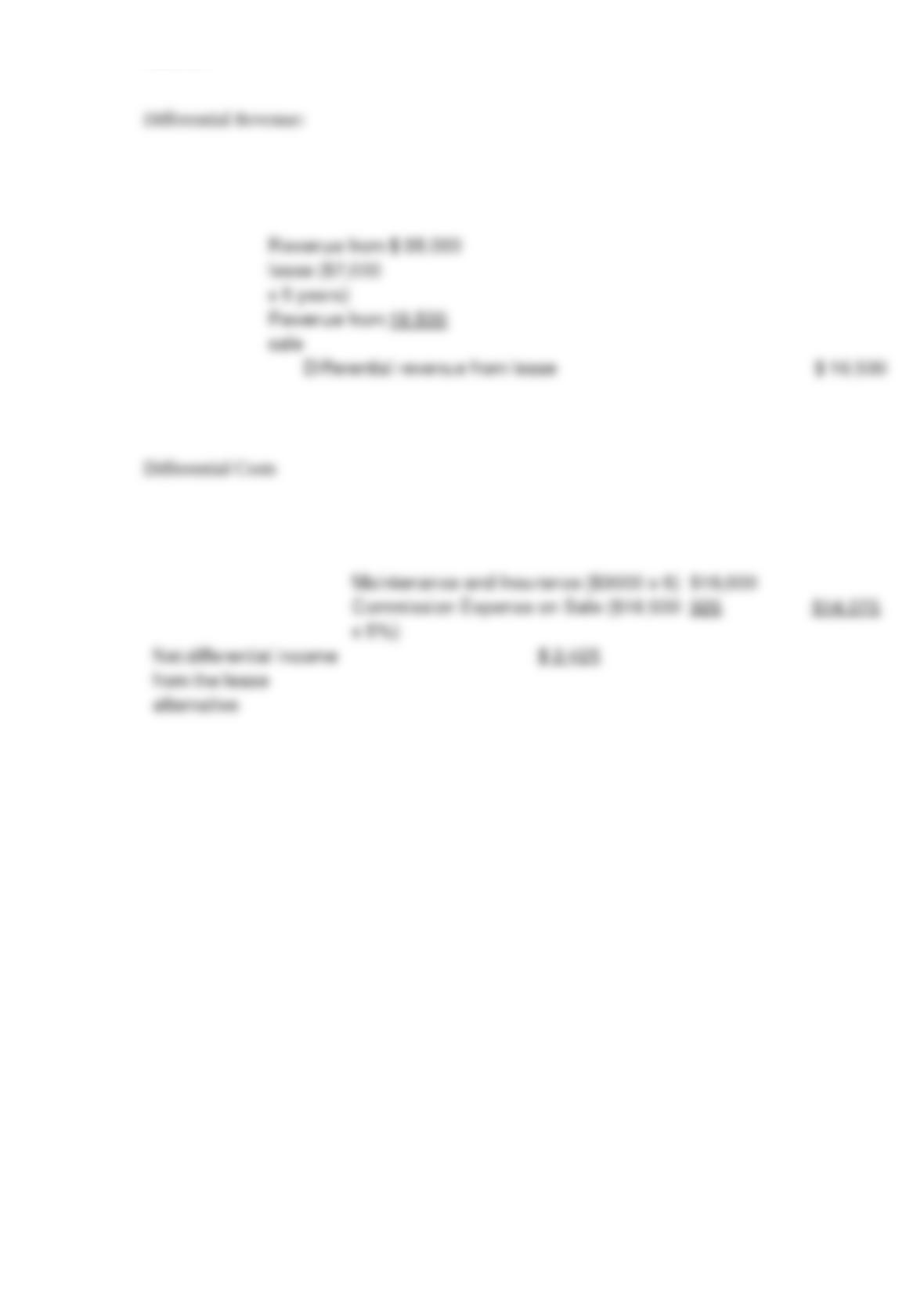
Finch, Inc. has bought a new server and is having to decide what to do with the old one.
The cost of the old server was originally $60,000 and has been depreciated $45,000.
The company has received two offers that it must consider. One offer was made to
purchase the equipment outright for $18,500 less a 5% sales commission. The other
offer was to lease the equipment for $7,000 for the next five years but the company will
be required to provide maintenance and insurance totaling $3,000 per year. What offer
should Finch, Inc. accept?
Answer: