
Consider the following short case as you respond to the question:
Amanda is a partner in a CPA firm; she supervises a staff of ten professionals, some of
whom are already licensed CPAs and some of whom are still working toward licensure.
She is responsible for audits of independent bookstores in California, Nevada and
Arizona. Amanda is concerned that the less experienced professionals she supervises
are repeating the mistakes she and the more experienced professionals on her team
made when they began auditing. She therefore wants to create a knowledge
management system.
In assigning personnel to a specific audit team, Amanda normally has one licensed CPA
working with a professional who is not yet licensed, thus cutting down on information
overload due to:
A. Organizational design.
B. Poor use of information technology.
C. Both organizational design and poor use of information technology.
D. Neither organizational design nor poor use of information technology.
Advantages of using the systems development life cycle include: (i) strong control, (ii)
opportunity for user input, (iii) rigidity.
A. I and II only
B. I and III only
C. II and III only
D. I, II and III

McDonald stated that professionals have autonomy of practice. In the accounting
profession, autonomy of practice has been limited by:
A. FAS
B.
B. COSO.
C. PCAO
B.
D. All of these.
One output of the accounting information system is the balance sheet. Transactions
commonly associated with an organization’s acquisition/payment process are most
likely to be reflected in which sections of balance sheet?
A. Current assets and current liabilities
B. Current assets and long-term liabilities
C. Long-term assets and current liabilities
D. Long-term assets and long-term liabilities

Liam has developed a good process for safeguarding his company’s information
technology assets. He has completed the following actions with respect to the process:
(i) talked about his methodology with some of his co-workers, (ii) created a schedule
for applying his process to various kinds of information technology assets, (iii)
explained how his process relates to similar processes in his company. Which of the
following best pairs one of Liam’s actions with a level of the capability maturity model?
A. I, chaotic
B. I, optimized
C. III, defined
D. None of these, since the CMM cannot be applied in this situation.
The chapter discussed five key terms related to XBRL: extensible, specification,
taxonomy, namespace and instance document. Specify which term is most appropriately
associated with each item below.
a. A specific example of properly tagged XBRL information.
b. A way to organize knowledge.
c. The Internet address that contains the meanings of XBRL tags.
d. The quality of XBRL that allows people to add to it as necessary.
e. The relationship between XBRL and XML.

Consider the following statements as you answer the question:
i. Felix, a cash receipts clerk, applied Allison’s payment to the invoices indicated on her
remittance advice.
ii. In purchasing books, Allison filled out a form on a bookstore’s web site.
iii. The bookstore’s web site verified Allison’s credit limit.
iv. William, a warehouse worker, prepared Allison’s books for shipment.
Which of the following phrases relates most closely to the sixth step in the
sales/collection process?
A. Applied Allison’s payment to the invoices indicated
B. Filled out a form
C. Verified Allison’s credit limit
D. None of these phrases is related to the sixth step in the sales/collection process.
MCL Corporation recently hired a consultant to design and implement a new
information system. The consultant was trying to decide whether to discard the old
system all at once and put the new system in its place, or to make the transition more
gradual. Which step in the systems development life cycle is the consultant dealing
with?
A. Test
B. Operations & maintenance

C. Design
D. Implementation
Which of the following exemplifies the role and purpose of the sales/collection
process?
A. American Home Shield sells warranties to new homeowners.
B. New homeowners pay cash to American Home Shield for warranties.
C. Both American Home Shield sells warranties to new homeowners and new
homeowners pay cash to American Home Shield for warranties.
D. Neither American Home Shield sells warranties to new homeowners nor new
homeowners pay cash to American Home Shield for warranties.
Consider the following partially completed risk/control matrix as you answer the
questions:
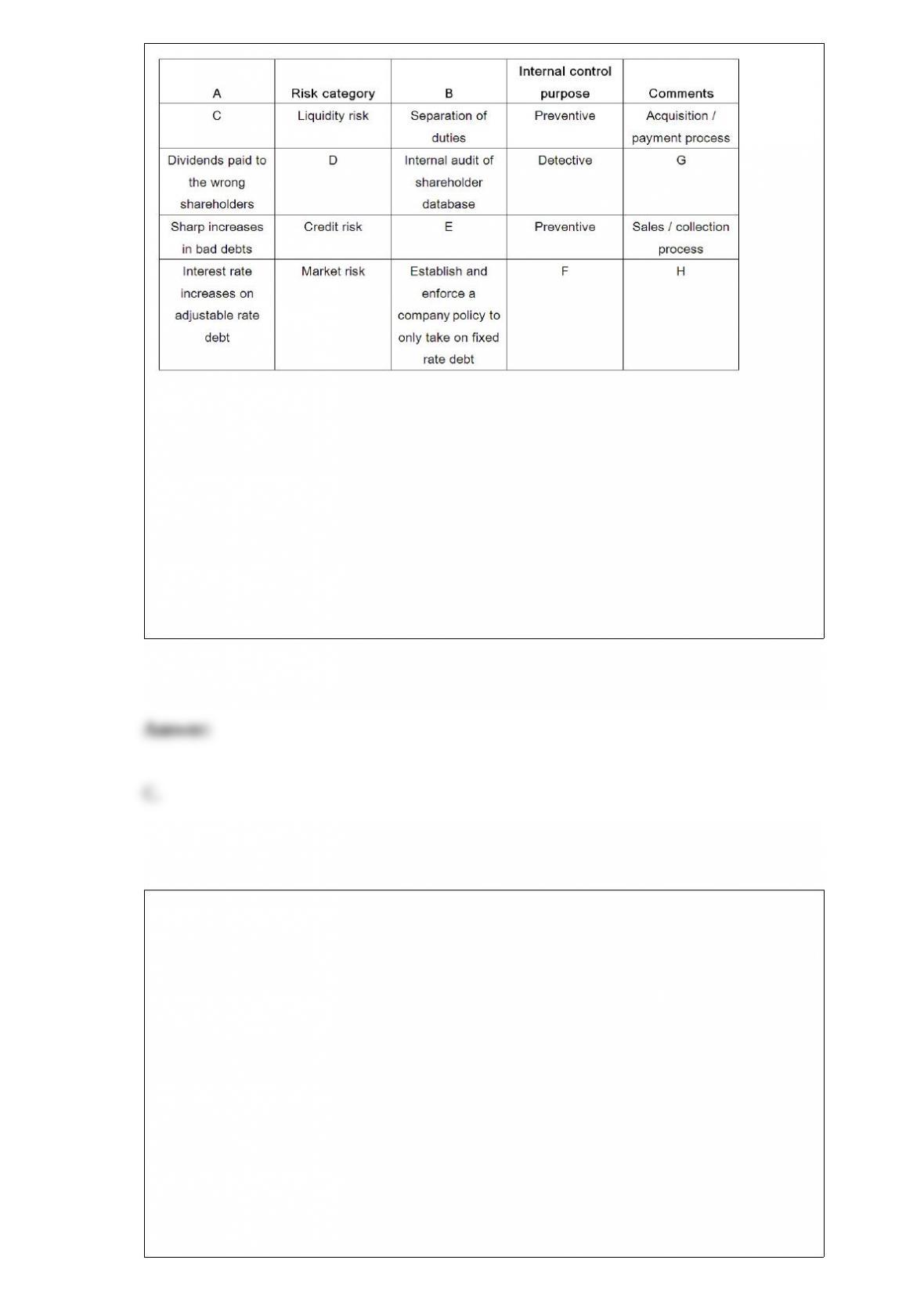
Assume the risk/control matrix is organized like the one presented in the chapter. The
best entry for Item H is:
A. Acquisition/payment process
B. Conversion process
C. Financing process
D. Reporting process
Consider the following information items as you respond to the question:
i. Customer master file
ii. Journal entry to record the receipt of cash
iii. Pre-numbered documents
iv. Schedule of accounts receivable
Accounting information systems have five generic elements. Which of the following is
an example of the same element as “pre-numbered documents?”
A. Adequate supervision

B. Balance sheet
C. Both adequate supervision and balance sheet
D. Neither adequate supervision nor balance sheet
SBL Corporation is preparing to expand into B2B e-business. If SBL sells office
supplies to its customers, its database for sales transactions should include all of the
following tables except:
A. Supplies
B. Inventory
C. Order
D. Order/inventory
Please refer to the following case as you answer the question:
Comprehensive Waste Management (CWM) provides trash hauling services for several
communities in southern California. When a new client wants to establish service, the
client calls the company’s main office on the phone. A CWM employee collects the
following information from the client: name, street address, city, state, ZIP code, area
code, telephone number, e-mail address. The employee gives the new client information
regarding regular weekly service dates, special services provided by the company, fees

and billing procedures. CWM bills its clients every two months in advance of the
service; for example, bills are sent to clients at the beginning of January for the months
of January and February. Initially, CWM does all its billing manually; they send out
paper bills and collect payment from clients via check. Once service is established, a
client can create an online account; the online account provides an option for paperless
billing and a separate option for charging a credit card rather than paying with a mailed
check. To create an online account, the client creates login credentials (user name and
password); they provide their CWM account number (provided on the invoice) and
relevant credit card data (type of card, name, billing address, and security code).
CWM’s database uses the account number to look up the client’s original information,
then merges the new information with it.
CWM stores clients’ information electronically. The database file would be represented
in a data flow diagram with a(n):
A. Circle
B. Arrow
C. Rectangle
D. Set of parallel lines
The COBIT framework comprises five principles and seven enablers. In your own
words, explain the relationship between each principle and enabler paired below; the
first one is done as an example.
a. Meeting stakeholder needs/People, skills and competencies. People inside and
outside the organization are stakeholders.
b. Covering the enterprise end-to-end/Processes.
c. Applying a single integrated framework/Principles, policies and frameworks.
d. Enabling a holistic approach/Information.
e. Separating governance from management/Culture, ethics and behavior.
f. Meeting stakeholder needs/Processes.
Which of the following statements about white space in a flowchart is most true?
A. “Adequate white space” is a matter of judgment.
B. A flowchart should not span more than three pages.
C. Both “adequate white space” is a matter of judgment and a flowchart should not span
more than three pages.
D. Neither “adequate white space” is a matter of judgment nor a flowchart should not
span more than three pages.
Samantha and Josephine were preparing to start their own clothing business; they
contacted their friend David, a recent graduate from Big State University’s accounting
program, to learn about setting up their accounting information system. Which of the
following methodologies could David use to assist them?
A. Systems development life cycle

B. Steps for Better Thinking
C. Either systems development life cycle or steps for Better Thinking
D. Neither systems development life cycle nor steps for Better Thinking
Bumble Beasley was making a presentation on internal control to a group of
prospective clients. Which of the following statements is the least appropriate for
Bumble to make?
A. Responsibility for internal control should be shared throughout the organization.
B. All companies must use the COSO definition of internal control as a guide.
C. Internal controls are not designed specifically to prevent fraud.D. Part of internal
control is ensuring that a company is making the best possible use of its resources.
Which of the following best pairs a characteristic of a professional with an example of
that characteristic?
A. Appropriately uses technical knowledge, closed nominal accounts at the end of the
fiscal year
B. Integrates knowledge from many disciplines, closed nominal accounts at the end of
the fiscal year
C. Appropriately uses technical knowledge, prepared a schedule of cash receipts and
cash payments in Excel

D. Integrates knowledge from many disciplines, prepared a schedule of cash receipts
and cash payments in Excel
Which of the following internal controls could be applied to processing payroll
transactions in the human resources process?
A. Outsourcing
B. Use of information technology
C. Both outsourcing and use of information technology
D. Neither outsourcing nor use of information technology