
Three presentation and disclosure audit objectives are not affected by assessed control
risk for the sales transactions. These are
A) rights and obligations, valuation, understandability.
B) understandability, valuation, occurrence.
C) valuation, rights and obligations, classification.
D) classification, understandability, rights and obligations.
As part of the audit, the auditor may examine authorization procedures with respect to
the repurchase or redemption of capital stock. In particular, for a public company the
auditor would verify that which of the following details have been authorized?
A) general ledger accounts affected, dividends included, amount to be paid
B) type of stock, timing, amount to be paid
C) individuals from whom repurchase will be permitted, maximum amount
D) type of stock, amount to be paid, effect upon bond sinking funds
A code of ethics is an important document for organizational conduct. In response to the
Sarbanes-Oxley Act in the U.S., the SEC requires which of the following actions for
organizations that have not adopted a code of ethics?

A) explanation of why it has not done so
B) disclosure of actions undertaken to prevent and detect fraud
C) disclosure of all related parties in management and discussion documents
D) a cost-benefit analysis for immediate implementation of one
If audit risk is increased, what happens to detection risk? It
A) stays the same.
B) increases.
C) changes based upon the audit procedures conducted.
D) decreases.
With the use of electronic working papers, each team member should have a unique
access identification code and a password to access the working papers. Once a
working paper is completed, what type of access should the staff auditor who prepared
the working paper file have?
A) edit capability
B) update for current information

C) read only
D) change based upon review
A document which the auditor receives from the client, but which was prepared by
someone outside the client’s organization, is a(n)
A) external confirmation.
B) copy of sales invoice.
C) copy of bank note payable.
D) inventory receiving report.
An auditor should perform alternative procedures to substantiate the existence of
accounts receivable when
A) no reply to a positive confirmation request is received.
B) no reply to a negative confirmation request is received.
C) collectability of the accounts receivable is in doubt.
D) pledging of the accounts receivable is probable.

When manufacturing labour affects inventory valuation, a knowledgeable manager
should approve wage rate allocations to make sure that labour is distributed to the
proper accounts. Which of the following controls helps to prevent error in the resulting
job costing?
A) comparison of wage rates to the authorized payroll master file
B) independent comparison of the approved amounts to the data entered
C) continuity check of the payroll cheque numbers issued
D) reconciliation of gross pay on the payroll register with gross pay according to the
payroll master file
Audit risk is a measure of
A) the auditor’s assessment of the likelihood that a material misstatement might occur in
the first place.
B) the probability that the financial statements contain errors.
C) how willing the auditor is to accept that the financial statements may be materially
misstated after the audit is completed.
D) the probability that errors in the financial statements that were not detected by the
internal controls of the firm are not detected by the auditor.

According to the CICA Handbook, the auditor’s responsibility for failure to detect fraud
arises
A) when such failure clearly results from failure to comply with generally accepted
auditing standards.
B) whenever the amounts involved are material.
C) only when the examination was specifically designed to detect fraud.
D) only when such failure clearly results from negligence so gross as to sustain an
inference of fraud on the part of the auditor.
Otto decided to outsource the payroll function to Magna Plus. From the purpose of an
assurance engagement, Magna is considered a
A) service organization.
B) user entity.
C) payroll administrator.
D) human resource company.

A code of professional conduct typically includes principles, rules of conduct, and
interpretations or examples. What is the purpose of the principles?
A) state what a practitioner must do for each audit engagement conducted
B) provide discussions of the rules of conduct and how they relate to practical situations
C) provide minimum standards of ethical conduct stated specifically
D) provide ideal standards of ethical conduct stated in philosophical terms
In determining that the accounts payable cutoff is correct, it is essential that the cutoff
tests be coordinated with the
A) confirmation of accounts payable.
B) tests on long-term liabilities.
C) observation of inventory.
D) cash count.
How much control does the auditor have over inherent risk? The auditor
A) adjusts the controls that are considered – high levels of control.

B) considers inherent risk for the business as a whole – some control.
C) assesses the factors that make up inherent risk – no control.
D) calculates inherent risk values as a residual – no control.
What information would be considered semi-permanent as well as transaction
information?
A) Customer number or code
B) Customer credit limit
C) Transaction amount
D) Current balance outstanding
Management has several responsibilities that are important to the auditor. One of these
is that management is responsible for
A) internal controls that prevent material misstatements either due to fraud or error.
B) maintaining control of evidence (such as confirmations) until assessed by the
auditor.
C) evaluating evidence against acceptable criteria.

D) providing reasonable assurance that the financial statements are fairly stated.
Which of the following is an example of an attestation engagement?
A) Accounting and bookkeeping services for the accounts
B) An audit of internal controls over financial reporting
C) Preparation of the annual financial statements, with notes
D) Completion of provincial and federal tax returns
The audit of Simcoe Transports Inc. was completed three months ago so the PA firm
proceeded to the file archive stage in accordance with Canadian Audit Standards. If the
audit firm receives additional information related to the audit but the information does
not affect the audit conclusions, the information should be
A) disregarded as it the file archive was already done.
B) added to the audit file in the section to which it pertains.
C) separately identified and added at the front of the audit file.
D) added to the audit file and request that the reviewing partner reviews the new
information.

Poor controls over credit limit approval or in changing the credit limit in the master file
may result in
A) confused and frustrated customers.
B) incomplete sales records.
C) financial statement errors for sales and AR accounts.
D) excessive bad debts and uncollectible account receivables.
Segregation of duties between production, inventory control, and accounting are
important controls in the inventory and distribution cycle. How would the auditor test
these controls? Using
A) inquiry and reperformance.
B) observation and inquiry.
C) observation and reperformance.
D) discussion with managment.

Kendra is inquiring about subsequent events with regards to lawsuits and contingent
claims. To obtain a meaningful answer, Kendra should hold the enquiry with
A) the Vice President, legal of the company.
B) the accountant in charge of the legal liability reconciliation.
C) the mail clerk.
D) the assistant controller.
Choosing the appropriate analytical procedures requires the auditor to use
A) the standards developed by the auditor’s firm.
B) automated working paper software.
C) computer assisted audit techniques.
D) professional judgment.

To operate effectively, an internal auditor must be independent of the
A) line functions of the organizations.
B) entity that is being audited.
C) employer-employee relationship which exists for other employees in the
organization.
D) outsourcing organizations used.
Sampling risk (sampling error) is an inherent part of sampling that results from
A) inappropriate audit procedures.
B) failure to recognize exceptions.
C) testing less than the entire population.
D) weaknesses in the client’s internal control system.
Which of the following audit procedures assists the auditor with testing for
completeness?
A) Analyze interest expense to uncover a payment to a creditor who is not included in
the notes payable schedule

B) examine note to determine whether the company has obligations for payment
C) examine duplicate copies of notes to determine whether notes were dated on or
before the balance sheet date
D) examine the dates on duplicate copies of notes to determine whether all or part of
the notes are a non-current liability
An accountant who reviews the financial statements of an entity should issue a report
stating that a review
A) does not constitute an audit.
B) provides negative assurance that the internal control structure is functioning as
designed.
C) provides only limited assurance that the financial statements are fairly presented.
D) is substantially more in scope than a compilation.
An important reason for auditors to obtain a good knowledge of a client’s industry is
that
A) payroll processing functions could differ from client to client.
B) control risks will vary from zero to 100% and can be better assessed in context.

C) detection risk must be set in accordance with the needs of the industry as well as of
the individual client.
D) organizations like city governments have unique accounting requirements that could
be complex.
Mario, the owner of Clayton’s ice cream, is giving Steve, the manager of the audit, a
private tour of the production facilities. By doing the tour, Steve will
A) be better able to identify control risks.
B) understand the client’s business and operations better.
C) be able to gather audit evidence on operational efficiencies.
D) Steve should not be taking a tour alone with the owner as this could compromise his
independence.
There is agreement within the auditing profession and the courts that the auditor is
A) not a guarantor or insurer of financial statements.
B) a guarantor but not an insurer of the statements.
C) an insurer but not a guarantor of the statements.
D) both a guarantor and an insurer of the financial statements.

Three of the following conditions would, by themselves, require the auditor to issue a
report other than an unqualified report. Which one would permit a standard unqualified
report?
A) The financial statements show a significant net loss for each of the last three years,
including the current fiscal period.
B) The financial statements have not been prepared in accordance with an acceptable
financial reporting framework and are misleading.
C) The auditor is not independent during the fiscal period under audit.
D) The scope of the auditor’s examination has been restricted, although the cause of the
restriction was not the client’s fault.
Frank has discovered that his employer is part of a group of banks that is manipulating
interest rates. He would like to stop this practice at his employer, and is not sure how
best to talk to his boss. He has heard of the GVV (Giving Voice to Values) approach,
and thinks he may be able to use it successfully because his company has recently
implemented new initiatives to empower employees to speak of improvements to
business practices. After considering his personal and professional purpose and choices,
what should Frank do next?
A) identify the stakeholders, what is at stake for them, and how to connect with them
B) identify the values underpinning the different positions in the conflict and the
possibilities for action

C) practice what he is going to say, with help from a mentor or coach
D) develop a powerful response that he can use with his boss, using external research or
resources
Porterville, Ontario, is the home of the largest leather tanning operation in Canada.
Hides from various animals are stretched and treated, then cut into shapes for shipment
to wholesalers.
Computer assisted operations are important in maintaining temperature, humidity, and
proper mix proportions in chemical solutions used for the tanning process. Computer
assistance has helped improve the quality of the tanning process, as well as provide a
safer environment for employees. Computer operations and backup is supported by the
warehouse manager, Joe.
Individual hides are tagged with a bar code and tracked for quality control purposes.
The HomeTown Tanning Company uses a centralized microcomputer based system for
its manufacturing and accounting operations. The two owners of the company are active
in the business, and approve all new hardware and software acquisitions.
The controller is responsible for network upgrades as well as maintaining passwords
and user identification codes on the network. Accounting transactions are entered by
accounting staff, although the controller has the ability to review and correct
transactions.
Required:
List the six categories of functions that need to be separated from each other. Does
HomeTown Tanning have these functions separated? For any functions that are not
separated, indicate the potential impact upon controls and upon the audit.
The management letter
A) is required by the CAS whenever there are “reportable conditions.”
B) must follow the format prescribed by the CICA.
C) spells out to the audit committee the auditor’s responsibilities under generally
accepted auditing standards.

D) is optional and is intended to help the client operate its business more effectively.
It is important for the auditor to obtain a good understanding of the industry of the
client to develop a client risk profile. If the auditor is looking at a client in the fashion
clothing industry, a risk specific to the industry would be
A) the high risk of poor governance and management oversight.
B) the high risk of defective products.
C) the high risk of obsolescence of their inventory.
D) the volatility in the stock market with regards to common stock.
Auditor confirmation of accounts payable balances at the balance sheet date may be
unnecessary because
A) this is a duplication of cutoff tests.
B) accounts payable balances at the balance sheet date may not be paid before the audit
is completed.
C) correspondence with the audit client’s lawyer will reveal all legal action by vendors
for nonpayment.
D) there is likely to be other reliable external evidence available to support the
balances.
Xiao, PA, is the audior of Minkle Credit Union, a medium-sized credit union. Xiao has
prepared a management letter with several serious control weaknesses. Management
agrees with the facts, but does not want to present the letter with the weaknesses to the
audit committee or the board of directors. Management has implied that they will
request a change of auditors if your firm presents the management letter to the board.
Required: Discuss the actions that Xiao should take. Justify your response.
Your PA firm audits the Barney Bloke Parts company, which manufactures plastic
bumpers and other automobile parts in eight factories scattered across southern Ontario.
The company has a December year end. It is now November 14.
The planning file indicates that internal controls in the accounts receivable area are
poor, as there has been significant employee turnover. A review of the prior year’s
working paper file indicates that there was a poor response to the accounts receivable
and accounts payable confirmation requests. There were several errors in inventory
pricing and problems with obsolescence.
Required:
List the financial statement cycles that need to be tested. For each cycle, identify at least
one transaction that needs to be examined. For that transaction, identify a management
assertion that may have a high risk of error associated with it and explain why you
believe the risk of error is high.
Juniper Berry is a private company, operating in the fruits and vegetable industry,
located in the Niagara region. In its main St-Catharines plant, it receives the picked
berries and proceeds to sort, package and also make some related products such as
jams, cookies and pies. Your firm has recently been hired as the auditor of Juniper
Berry. The partner in charge of the audit has asked you to write a memo explaining why

it is important to gain understanding of the business operations and processes of Juniper
Berry and also to list some suggested procedures to be performed in the process of
understanding the business operations and processes.
To assist you with your memo, the partner provided you with some notes he took at a
recent meeting with the management of Juniper Berry.
– Juniper Berry (JB) sells and manufactures a wide range of products. From fresh to
frozen berries, to jam, cookies and pies. Fresh and Frozen berries make up most of the
revenues of JB.
– JB sells mostly to grocery stores directly. Its frozen berries however are packaged with
the Mondo Grocers logo as they have an exclusive contract to sell all of their frozen
berry production to Mondo.
– In 2011, JB installed a high tech scale system where the berries received from the
various farms are weighed when they are delivered and the amount to be paid to the
farmer is calculated and recorded immediately. The system automatically records the
inventory and the central system also issues an electronic payment for the amount
calculated by the scale. JB is proud to be technologically advanced as it allowed the
company to cut some jobs and be more cost efficient.
– Given that most of the packaging and processing of berries into derived products is
automated, capital assets represent a significant portion of the balance sheet and also
required JB to obtain large bank loan in 2011 when the plant upgrade took place.
You have recently been hired as an audit trainee with an internal audit department. Your
first assignment will be to select the sample for a test of new capital assets acquired
over the last two years. Your review of the internal audit files indicates that the last time
this work was done the sample to be tested was selected on a judgmental nonstatistical
basis.
However, based on your university/college audit course, you believe the work offers
good potential for the use of statistical sampling techniques. You know that you will
have to be able to explain and justify your opinion to the internal audit manager.
Required:
Both statistical sampling as well as nonstatistical or judgmental sampling have
advantages and disadvantages. Briefly state two advantages and two disadvantages of
statistical sampling and one advantage and one disadvantage of nonstatistical sampling.
Identify three analytical procedures commonly performed for notes payable.
Bratlett Company has purchased all of the shares of another company, but does not
want to consolidate its financial statements. Management has drafted a rather long and
confusing note to the financial statements that describes the transaction that took place
briefly, and states that debt has been acquired in a foreign currency. In your view, the
transaction, its effect on the company and the accounts have not properly been
disclosed.
Required:
List the audit objectives about presentation and disclosure that have been affected and
explain how they are affected.
You are the auditor of Brody Grass Inc. The CEO expressed a concern that the audit
fees for the year were very high. You then explained that this is largely due to poor
internal controls in the cash and transaction cycle and that the audit fees could decrease
if better controls were in place.
Provide 5 examples of general cash account controls that Brody Grass Inc. could
implement.
State three types of information that should be included in a standard letter of inquiry of
client’s law firms.

The following are audit procedures in the sales and collection cycle.
1. Inspect a sample of shipping documents to determine if each has a sales invoice
number included on it.
2. Discuss with the sales manager whether any sales allowances have been granted after
the balance sheet date that may apply to the current period.
3. Add the columns on the aged trial balance and compare the total with the general
ledger.
4. Observe whether the controller makes an independent comparison of the total in the
general ledger with the trial balance of accounts receivable.
5. For the month of May, count the approximate number of shipping documents filed in
the shipping department, and compare the total with the number of sales invoices in the
sales journal.
6. Compare the date on a sample of shipping documents throughout the year with
related duplicate sales invoices and the accounts receivable master file.
7. Examine a sample of customer orders and see if each has a credit authorization.
8. Send letters directly to former customers whose accounts have been written off as
uncollectible to determine if any have actually been paid.
9. Examine the master file of accounts receivable to see if each has an indication of “C”
for a regular customer, “N” for interest-bearing receivables, and “R” for related parties.
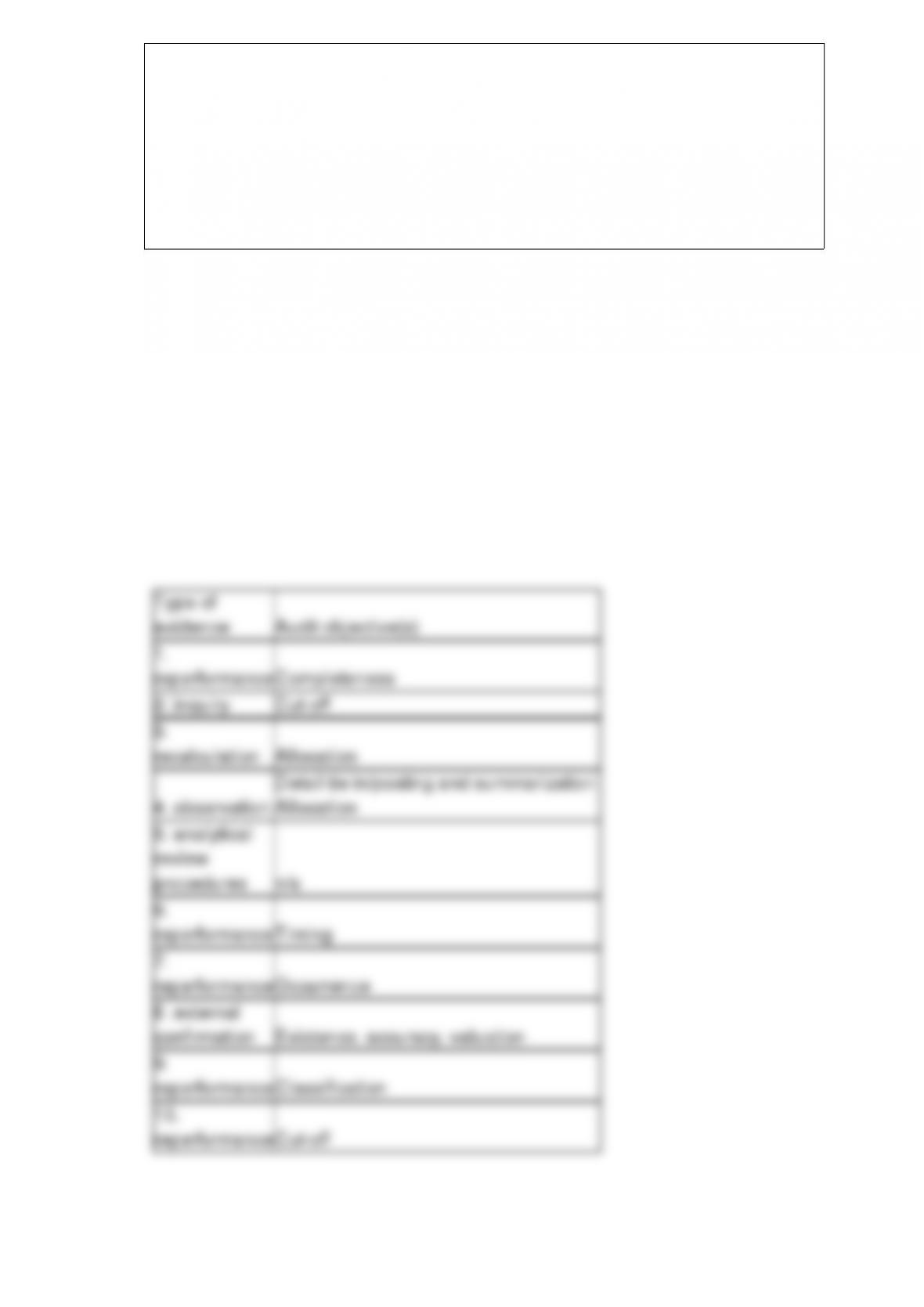
10. Compare the date on a sample of shipping documents a few days before and after
the balance sheet date with related sales journal transactions.
Required:
For each procedure, identify the type of evidence being used. For each procedure,
identify either the transaction-related audit objective(s) being met or the balance-related
audit objective(s) being met.
There are four major sources of auditor’s legal liability. Briefly summarize the four
sources.
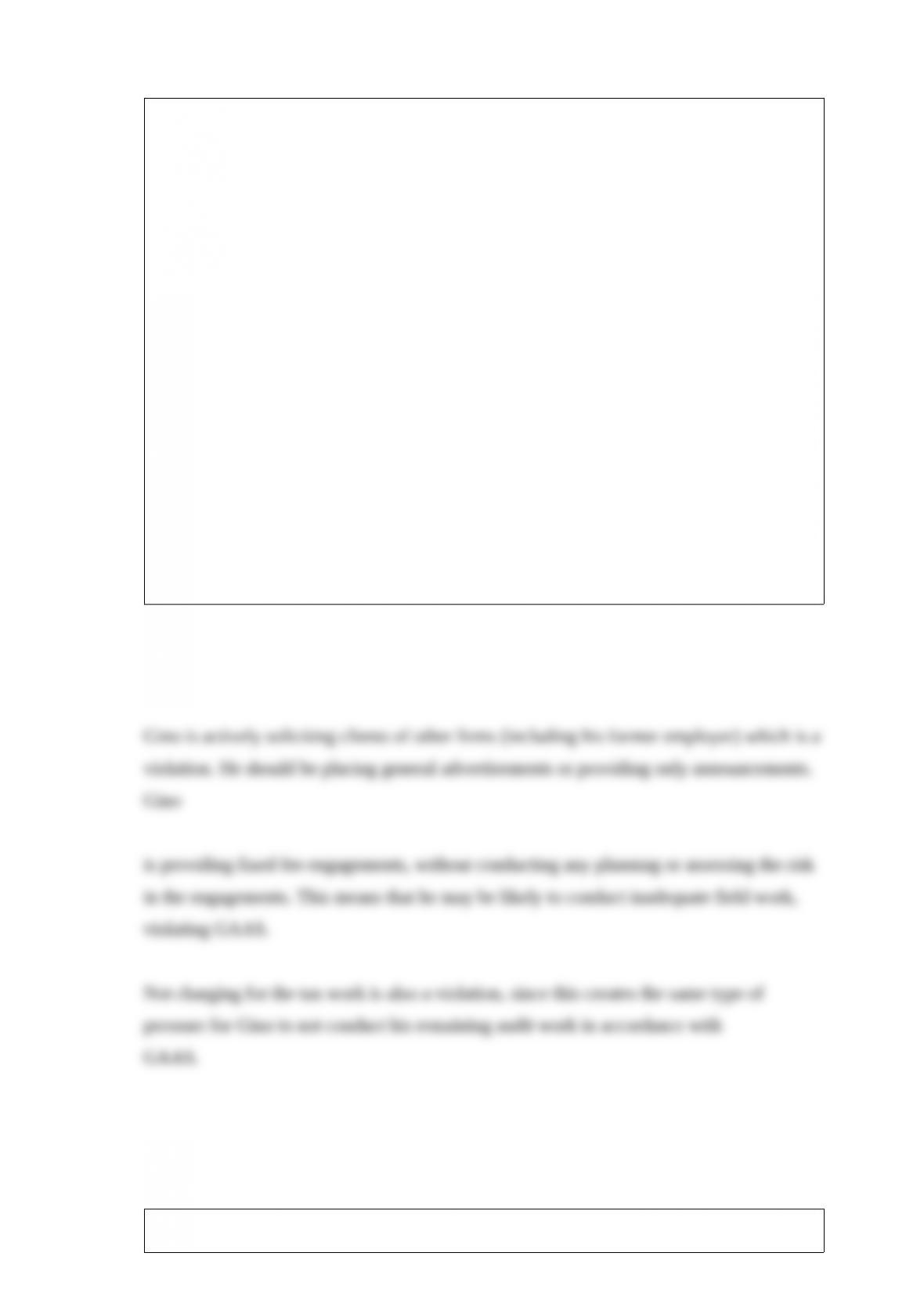
Below are four situations that involve the audit risk model as it is used for planning
audit evidence requirements in the audit of inventory. For each situation, calculate
planned detection risk.
SITUATION
You are having lunch with a former employee of your firm, a friend of yours. Gino had
been laid off last year when he had failed to pass his professional examinations for the
third year in a row. Gino told you that he managed to obtain a CMA designation in the
past year, and has started his public practice.
He has been circulating flyers and electronic email announcements with fixed rates:
$400 for a compilation engagement, $1,000 for a review, and $5,000 for an audit where
revenues are less than $1 million, $15,000 for an audit for a client with revenues up to
$5 million. He already has clients to keep him busy for the next three months. He even
has some feelers for clients that he personally handled while he was working for your
firm – there were a lot of contacts developed during the five years that he was working
there! To help attract some of the larger clients, he is considering not charging any fee
for the first ten hours spent on tax-related services.
Gino ended the conversation by asking you if you would like to join him in his new
firm, because at this rate he’ll need a second person real soon!
Required:
Identify the violations in the professional rules of conduct and explain why they are
violations.
In practice, auditors rarely assign numerical probabilities to inherent risk, control risk,
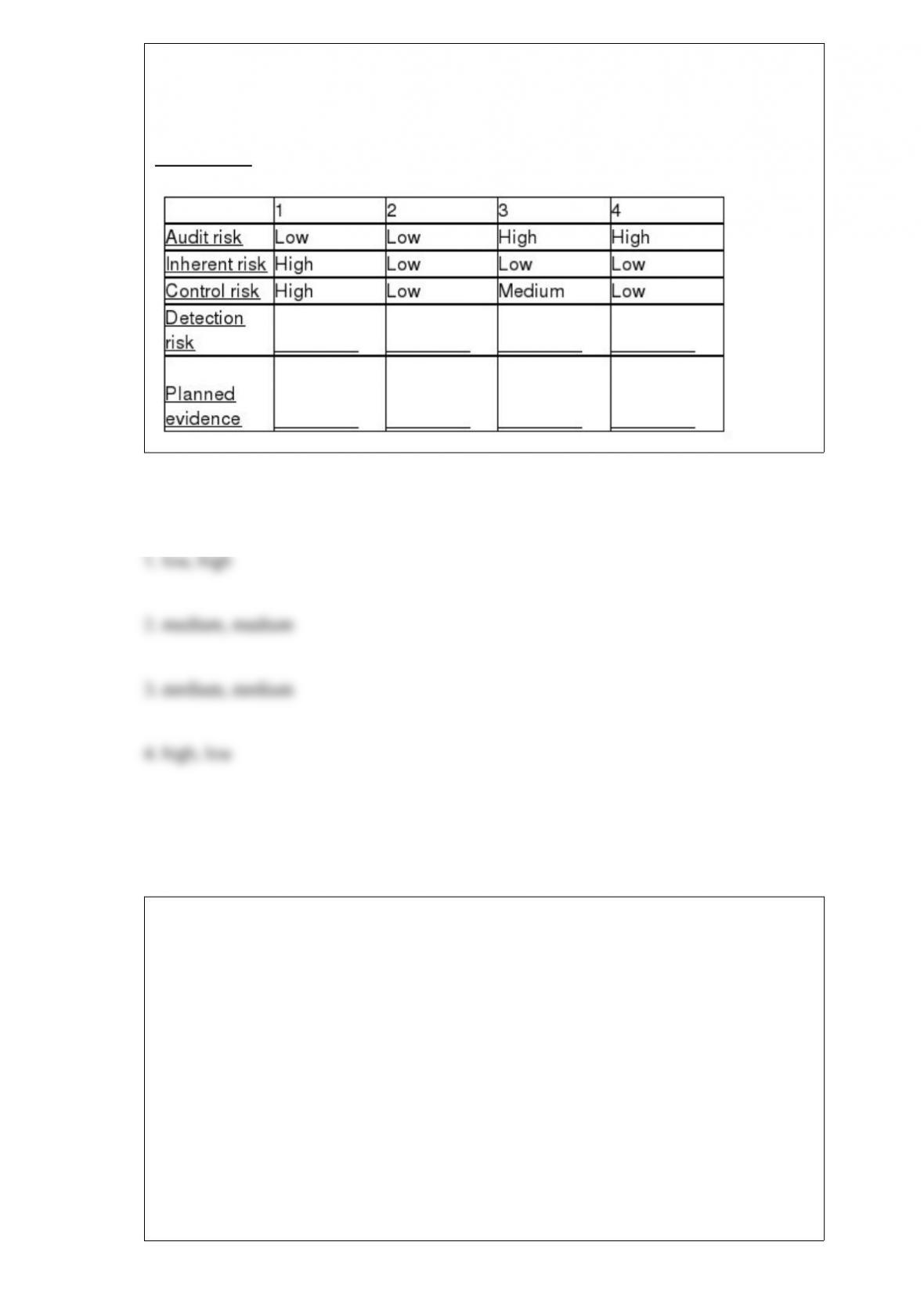
or audit risk. It is more common to assess these risks as high, medium, or low. For each
of the four situations below, fill in the blanks for detection risk and the amount of
evidence you would plan to gather (“planned evidence”) using the terms high, medium,
or low.
SITUATION
As part of a loan agreement that it is thinking of obtaining, Always Quick
Manufacturing Limited has decided that it will use accounts receivable and inventory as
security for working capital funds.
The bank has indicated that in addition to an annual financial statement audit, that it
would require quarterly assurance on the accounts receivable and inventory amounts.
The type of assurance required has not been stated.
The bank has told Jose, the owner of the company, that he would need to provide a
detailed inventory list and an aged accounts receivable trial balance on the fifteenth of
each month for the information as at the preceding month end. Jose would like to know
what his alternatives are.
Required:
Your partner is going to meet with Jose next week, and would like you to prepare a
memo to file that will be used as part of the meeting. The memo should include a list of
alternative types of engagements that could be used to provide assurance on the
accounts receivable and inventory balances.
Your firm has been the auditor of Chappello Design and Construction Limited for
several years. During the current year, a consultant on staff at your firm assisted
Chappello in the selection and implementation of a new computer system. The audit
staff were not involved in this process.
The new system was an enterprise wide system that was to be implemented without
modification using the direct cut-over approach (the old system was discontinued and
the new one continued the next day). Unfortunately, staff had extreme difficulty using
the system, and discontinued it after two months. During that time, Chappello was
unable to document and bill its work for progress billings, and borrowed heavily to
continue to pay its employees while work continued. The company reverted to its old
system and claims that it has lost several hundreds of thousands of dollars in revenues
as it was unable to issue quotes and bids on new contracts.
Chappello has sued your firm for negligence with respect to the implementation of the
computer system.
Required:
Which defences should the firm use? Support your answer with reasons.
Two types of services provided by public accounting firms are audits and reviews.
Discuss the similarities and differences between these two types of services. Which type
provides the most assurance?