
1) The method used to measure the estimated total error amount in a population when
there is both a recorded value and an audited value for each item in the sample is:
A) difference estimation
B) mean-per-unit estimation
C) ratio estimation
D) monetary-unit sampling
2) Whenever the client imposes restrictions on the scope of the audit, the auditor should
be concerned that management may be trying to prevent discovery of misstatements. In
such cases, the auditor will likely issue a:
A) disclaimer of opinion in all cases
B) qualification of both scope and opinion in all cases
C) disclaimer of opinion whenever materiality is in question
D) qualification of both scope and opinion whenever materiality is in question
3) Which of the following is not one of the major types of analytical procedures?
A) compare client with industry averages
B) compare client with prior year
C) compare client with budget
D) compare client with SEC averages
4) An audit of historical financial statements most commonly includes the:
A) balance sheet, statement of retained earnings, and the statement of cash flows
B) income statement, the statement of cash flows, and the statement of net working
capital
C) statement of cash flows, balance sheet, and the statement of retained earnings
D) balance sheet, income statement, and the statement of cash flows
5) Evidence is usually more persuasive for balance sheet accounts when it is obtained:
A) as close to the balance sheet date as possible
B) only from transactions occurring on the balance sheet date
C) from various times throughout the client’s year
D) from the time period when transactions in that account were most numerous during
the fiscal period
6) Of the three types of attestation engagements, examination engagements provide a
higher level of assurance than agreed-upon procedures engagements but less than
review engagements.
A) True
B) False
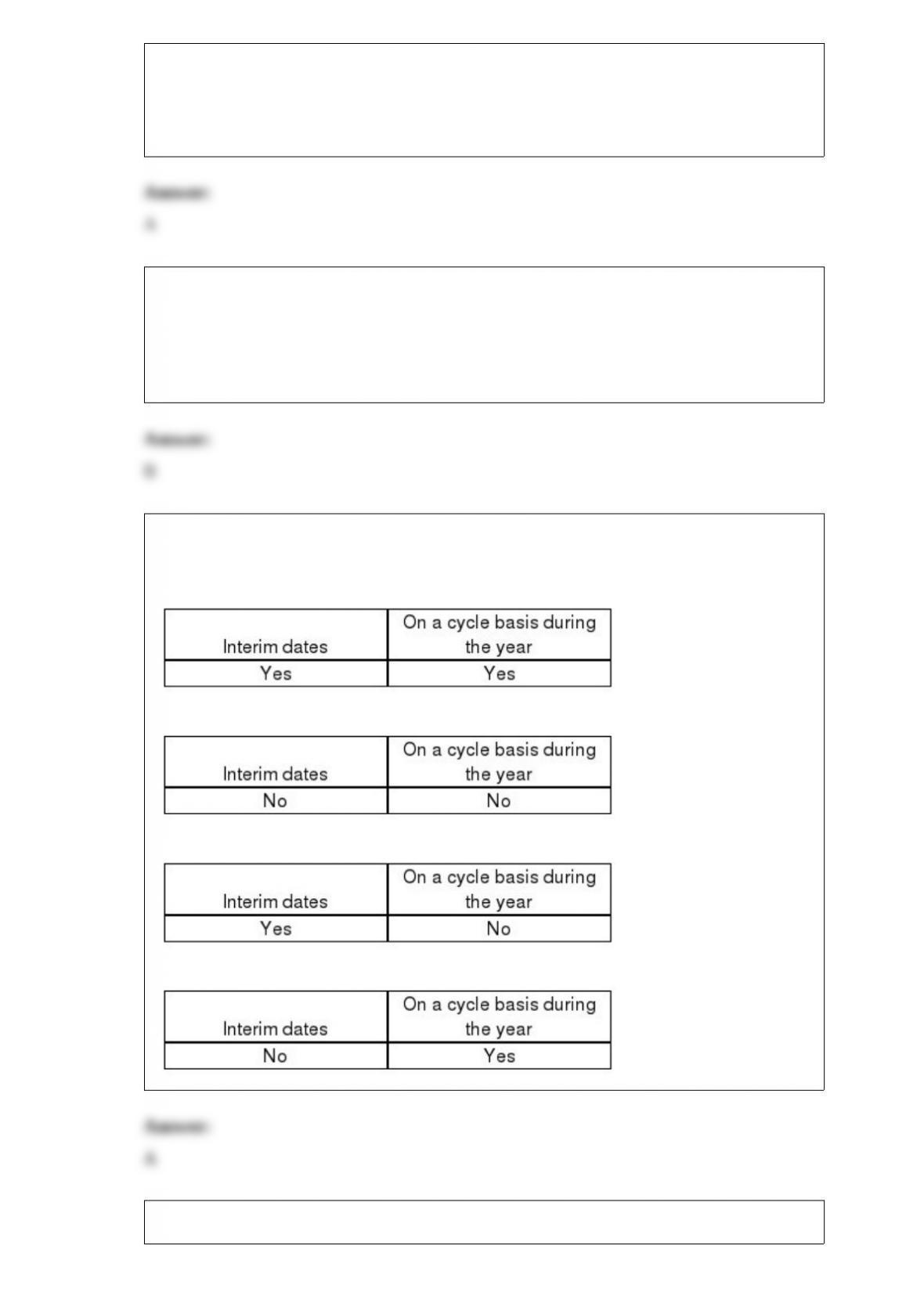
7) The physical counting of inventory may be performed at which of the following
times?
A)
B)
C)
D)
8) The periodic payment from the general cash account to the payroll account for net

payroll should be tested for at least one payroll period. The primary audit procedure is
a(n):
A) analytical review procedure that net pay is reasonable
B) test of controls that an imprest account is being used for payroll
C) substantive test that the correct amount was transferred for this test period
D) test of transactions that the check is prepared for the proper amount and transmitted
to an imprest bank account before payroll checks are handed out
9) Which of the following statements is not correct?
A) Materiality is a relative rather than an absolute concept
B) The most important base used as the criterion for deciding materiality is total assets
C) Qualitative factors as well as quantitative factors affect materiality
D) Given equal dollar amounts, frauds are usually considered more important than
errors
10) If an auditor desires a greater level of assurance in auditing a balance, the
acceptable risk of incorrect acceptance:
A) is reduced
B) is increased
C) is not changed
D) may be reduced or increased depending upon other circumstances
11) Which of the following controls would be appropriate regarding the release of
materials from a stockroom?
A) Production employees request materials be delivered to their work areas as they
need them
B) Stockroom employees deliver materials to work areas throughout the day to
maintain acceptable levels of safety stock no written records are maintained
C) Production employees submit approved requisition forms to the stockroom for
materials needed
D) Production employer in need of materials should personally pick up needed
materials from the stockroom

12) The legal term for when an auditor issues an opinion of an audit, knowing that an
adequate audit was not performed is called?
A) breach of contract
B) tort action for negligence
C) constructive fraud
D) fraud
13) When tolerable misstatement is exceeded by ________ the auditor should request
the client to adjust their account balance.
I.Known misstatements
II.Projected misstatement
A) I only
B) II only
C) I and II
D) None of the above
14) When IT programs or files can be accessed from terminals, users should be required
to enter a(n):
A) echo check
B) parity check
C) self-diagnosis test
D) authorized password
15) The use of the Certified Public Accountant title is regulated by:
A) the federal government
B) state law through a licensing department or agency of each state
C) the American Institute of Certified Public Accountants through the licensing
departments of the tax and auditing committees
D) the Securities and Exchange Commission
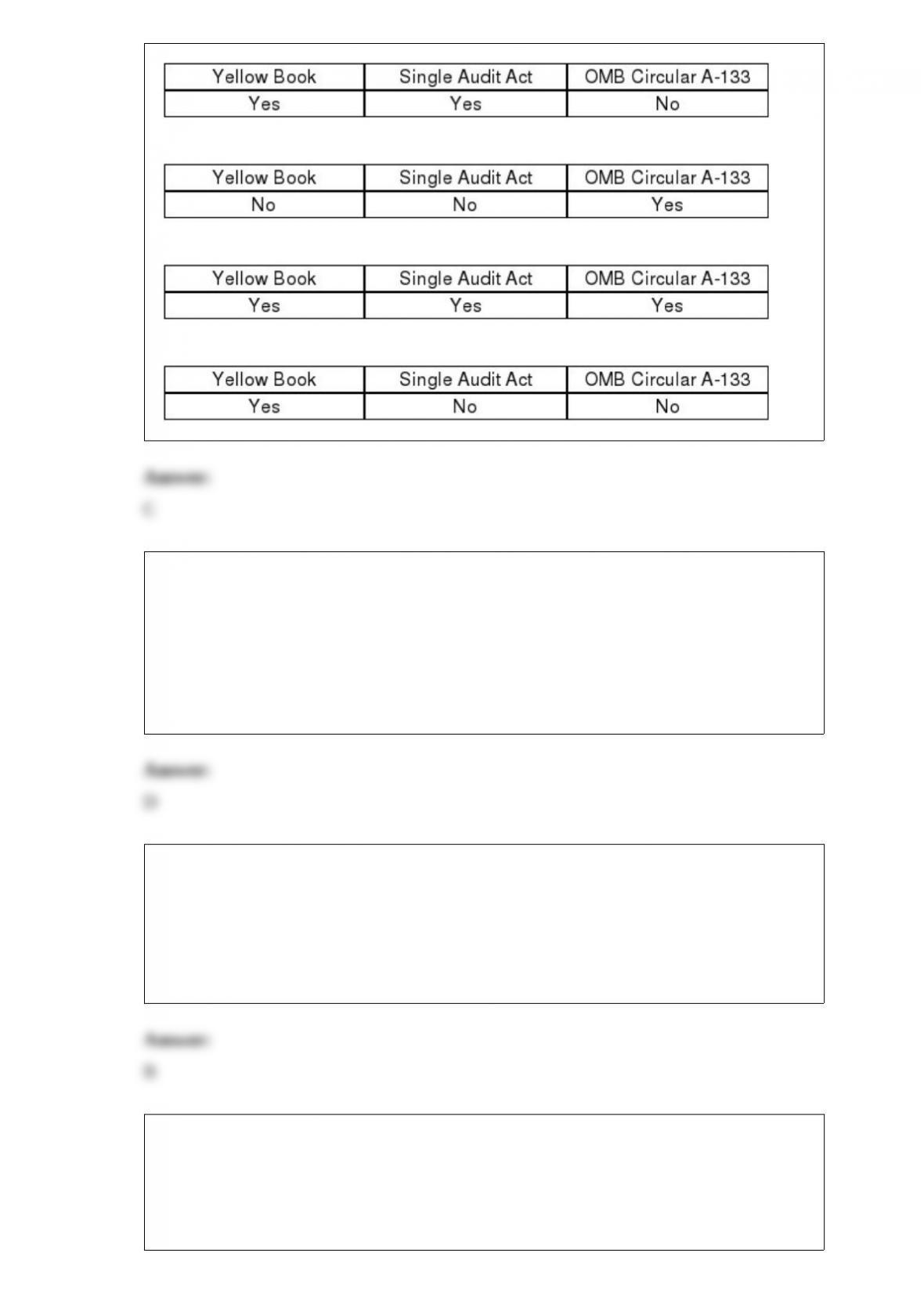
16) When a state or local government agency receives federal funds, it is subject to the
audit requirements of:
A)
B)
C)
D)
17) As a result of management’s refusal to permit the auditor to physically examine
inventory. The auditor must depart from the unqualified audit report because:
A) the financial statements have not been prepared in accordance with GAAP
B) the scope of the audit has been restricted by circumstances beyond either the client’s
or auditor’s control
C) the financial statements have not been audited in accordance with GAAS
D) the scope of the audit has been restricted
18) A predecessor auditor who has been contacted by a successor auditor for
information about the client does not have to obtain permission from the former client
before providing any confidential information to the successor auditor because the
confidentiality requirement does not extend to former clients.
A) True
B) False
19) The most effective and efficient audit approach in the examination of the income
statement would be which of the following?
A) Examination of income statement accounts concurrently with the related balance
sheet accounts
B) Compare company’s components of net income to other businesses in the same

industry
C) Compare company’s components of net income to the previous two years
D) Examine changes in all balance sheet accounts
20) In monetary unit sampling, a sampling interval of 900 means that:
A) every 900th item will be selected
B) every 900th dollar in the account will be sampled
C) expected misstatement is 900
D) tolerable misstatement is 900
21) In attributes sampling, an estimate of the expected population exception rate is
necessary to plan the sample size. The relationship of expected population exception
rate (EPER) to sample size is:
A) direct (small EPER = small sample)
B) inverse (small EPER = large sample)
C) a variable (sometimes small, sometimes large) dependent on other factors present
D) indeterminate
22) An analytical procedure used to test the reasonableness of an account balance
occurs when the auditor calculates the expected balance and compares it with the actual
balance. The auditor’s expected account balance may be determined by:
A) using industry standards
B) using Dun and Bradstreet reports
C) relating it to another account that involves financial statement articulation
D) inquiry of the client
23) Which of the following is not a correct combination of terms and related type of
audit evidence?
A) Inquire inquiries of client
B) Count physical examination
C) Recompute documentation
D) Read documentation
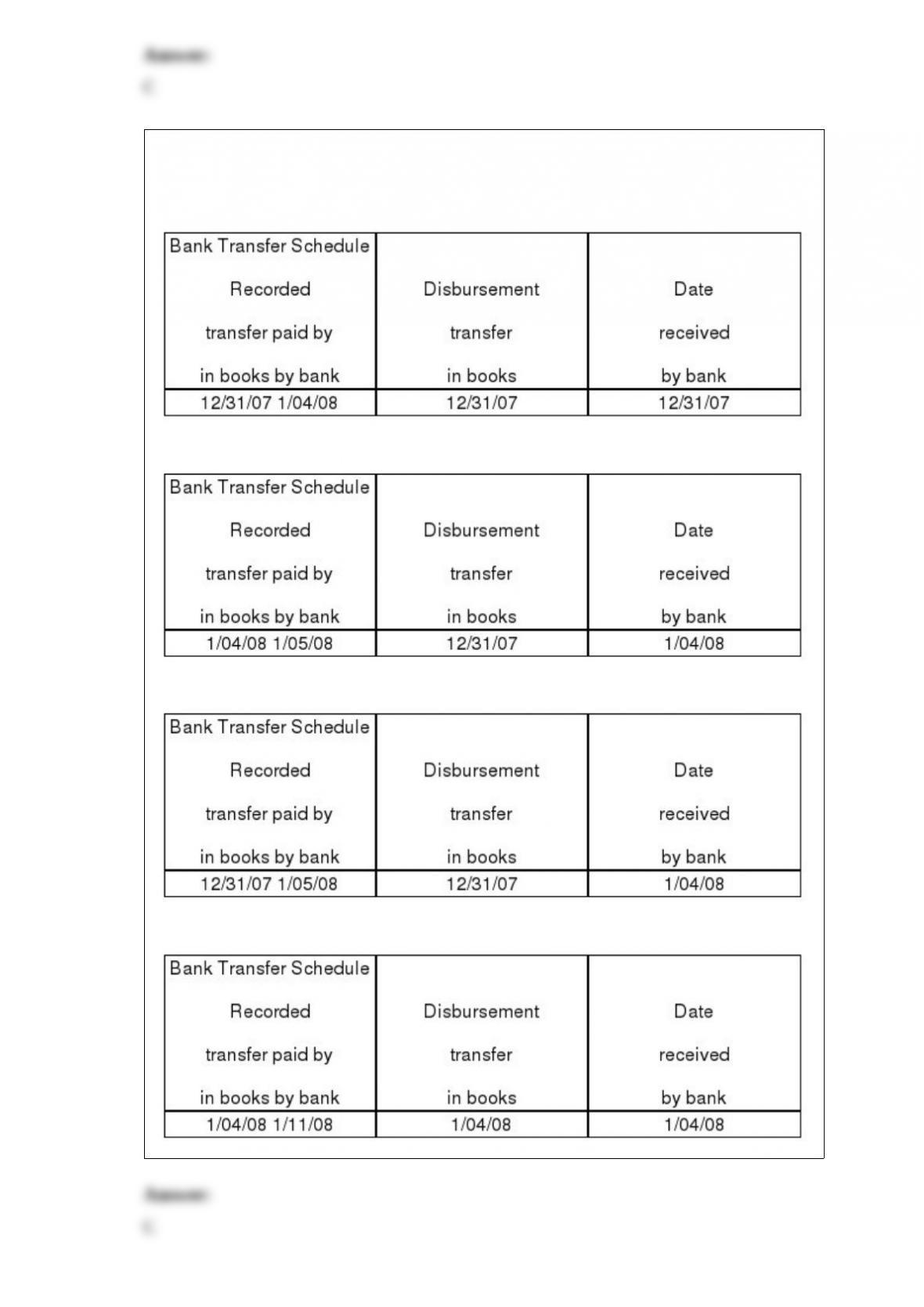
24) Which of the following cash transfers results in a misstatement of cash on
December 31, 2007?
A)
B)
C)
D)

25) When finished goods are completed, they are usually stored in the packing area.
A) True
B) False
26) An exception or deficiency found in a test of controls:
A) indicates a financial statement misstatement
B) indicates that a financial statement misstatement may be likely
C) indicates that the financial statements are misstated
D) indicates that an adverse opinion is warrarnted on the Audit of Internal Control
27) The use of monetary-unit sampling is most appropriate when the auditor expects to
find many errors and when a monetary result is desired.
A) True
B) False
28) When analytical procedures are performed during substantive testing, they are
typically more focused and extensive than when performed as part of audit planning.
A) True
B) False
29) The leading precedent-setting auditing case in third-party liability is:
A) Escott et al. v. Bar Chris Construction Corp
B) Hochfelder v. Ernst & Ernst
C) Ultramares Corporation v. Touche
D) United States v. Simon
30) Efficiency refers to the degree to which costs are reduced without changing
effectiveness. The auditor’s opinion as to the appropriateness and sufficiency of
evidence in forming an opinion on the financial statements.
A) True
B) False
31) The basic legal concept which was affirmed in the 1985 New York case, Credit
Alliance, was that:
A) the auditor’s defense of privity of contract is still valid against third parties
B) the auditor is liable for ordinary negligence to specifically foreseen third parties
C) the auditor is liable for ordinary negligence to reasonably foreseeable third parties
D) the auditor’s defense of contributory negligence is no longer valid
32) Generally, is the inherent risk level for the audit of the payroll and personnel set at
low, moderate, or high? Explain.
33) Auditors will often prepare a Proof of Cash when the client has material internal
control weaknesses in cash receipts and cash disbursements. The purpose of the proof
of cash is to determine the client’s accounting records for cash are reliable. List below
the four requirements the proof of cash is designed to provide for the auditor.
34) The nine steps in planning the sample are almost identical for nonstatistical
sampling and difference estimation. However, there are three important differences.
Discuss each of the three differences.
35) Listed below are some management assertions made for the acquisition and
payment cycle. For each one give an example of how the auditor by using the
documents normally found in the process can apply an auditing procedure to test the
assertion.
Completeness
Timing
Accuracy
36) In performing expense account analysis the focus is on substantive tests of
transactions. How do these tests of transactions differ from tests to assess control risk.
37) Discuss the essential activities involved in the initial planning of an audit.
38) Auditors routinely conduct analytical procedures in the planning, testing, and
completion phases of the audit. Identify the primary and secondary purposes of
performing analytical procedures in each phase of the audit.