
1) companies frequently describe the terms of all long-term liability agreements in
notes to the financial statements.
2) equity security holdings between 20 and 50 percent indicates that the investor has a
controlling interest over the investee.
3) if the fair value of an unlimited life intangible other than goodwill is less than its
book value, an impairment loss must be recognized.
4) companies may not use the fair value option for investments that follow the equity
method of accounting.
5) assets under construction for a companys own use do not qualify for interest cost
capitalization.
6) fultz company had 300,000 shares of common stock issued and outstanding at
december 31, 2012. during 2013, no additional common stock was issued. on january 1,
2013, fultz issued 400,000 shares of nonconvertible preferred stock. during 2013, fultz
declared and paid $210,000 cash dividends on the common stock and $175,000 on the
nonconvertible preferred stock. net income for the year ended december 31, 2013, was
$1,120,000. what should be fultz’s 2013 earnings per common share, rounded to the
nearest penny?
a.$1.35
b.$2.45
c.$3.15
d.$3.73
7) financial accounting standard-setting in the united states
a.can be described as a social process which reflects political actions of various
interested user groups as well as a product of research and logic
b.is based solely on research and empirical findings
c.is a legalistic process based on rules promulgated by governmental agencies
d.is democratic in the sense that a majority of accountants must agree with a standard
before it becomes enforceable
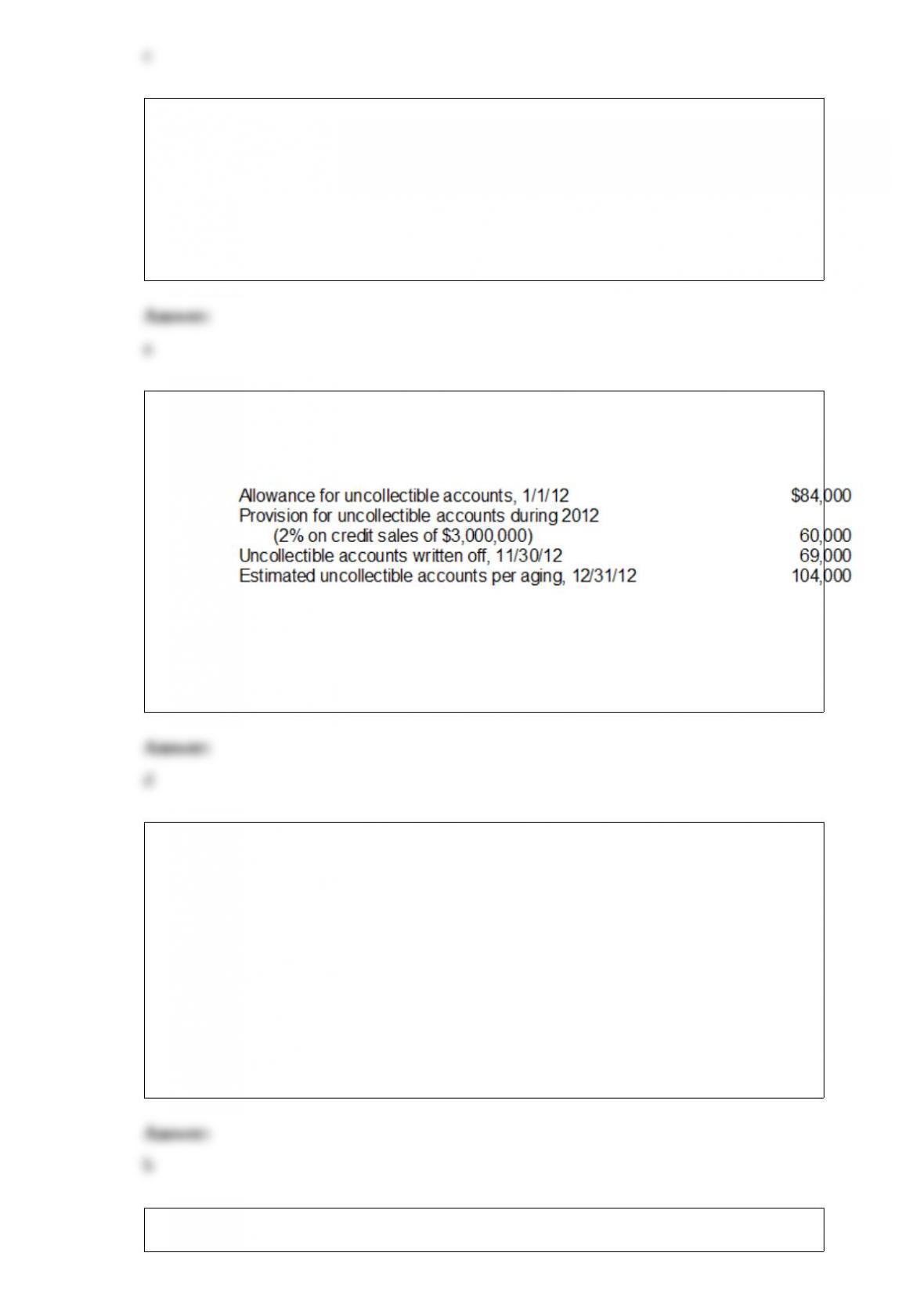
8) for the year ended december 31, 2012, dent co. estimated its allowance for
uncollectible accounts using the year-end aging of accounts receivable. the following
data are available:
after year-end adjustment, the uncollectible accounts expense for 2012 should be
a.$69,000
b.$60,000
c.$104,000
d.$89,000
9) each year a company has been investing an increasingly greater amount in
machinery. since there is a large number of small items with relatively similar useful
lives, the company has been applying straight-line depreciation at a uniform rate to the
machinery as a group. the ratio of this group’s total accumulated depreciation to the
total cost of the machinery has been steadily increasing and now stands at .75 to 1.00.
the most likely explanation for this increasing ratio is the
a.company should have been using one of the accelerated methods of depreciation
b.estimated average life of the machinery is less than the actual average useful life
c.estimated average life of the machinery is greater than the actual average useful life
d.company has been retiring fully depreciated machinery that should have remained in
service
10) the ifrs income statement classification of expenses by nature results in descriptions

which include all of the following except
a.salaries
b.depreciation
c.distribution
d.utilities
11) danks corporation purchased a patent for $900,000 on september 1, 2010. it had a
useful life of 10 years. on january 1, 2012, danks spent $220,000 to successfully defend
the patent in a lawsuit. danks feels that as of that date, the remaining useful life is 5
years. what amount should be reported for patent amortization expense for 2012?
a.$206,000
b.$200,000
c.$188,000
d.$156,000
12) in the cases cited below, five different conditions are possible when x is compared
with y. these possibilities are as follows:
a.x equals yd.x is equal to or greater than y
b.x is greater than ye.x is equal to or less than y
c.x is less than y
instructions
in the space provided show the relationship of x and y for each of the following
independent statements.
1>”cost or market, whichever is lower,” may be applied to (1) the inventory as a whole
or to (2) categories of inventory items. compare (x) the reported value of inventory
when procedure (1) is used with (y) the reported value of inventory when procedure (2)
is used.
2>prices have been rising steadily. physical turnover of goods has occurred
approxi-mately 4 times in the last year. compare (x) the ending inventory computed by
lifo method with (y) the same ending inventory computed by the moving average
method.
3>the retail inventory method has been used by a store during its first year of operation.
compare (x) markdown cancellations with (y) markdowns.
4>prices have been rising steadily. at the beginning of the year a company adopted a
new inventory method; the physical quantity of the ending inventory is the same as that
of the beginning inventory. compare (x) the reported value of inventory if lifo was the
new method with (y) the reported value of inventory if fifo was the new method.
5>prices have been rising steadily. physical turnover of goods has occurred five times
in the last year. compare (x) unit prices of ending inventory items at moving average
pricing with (y) those at weighted average pricing.
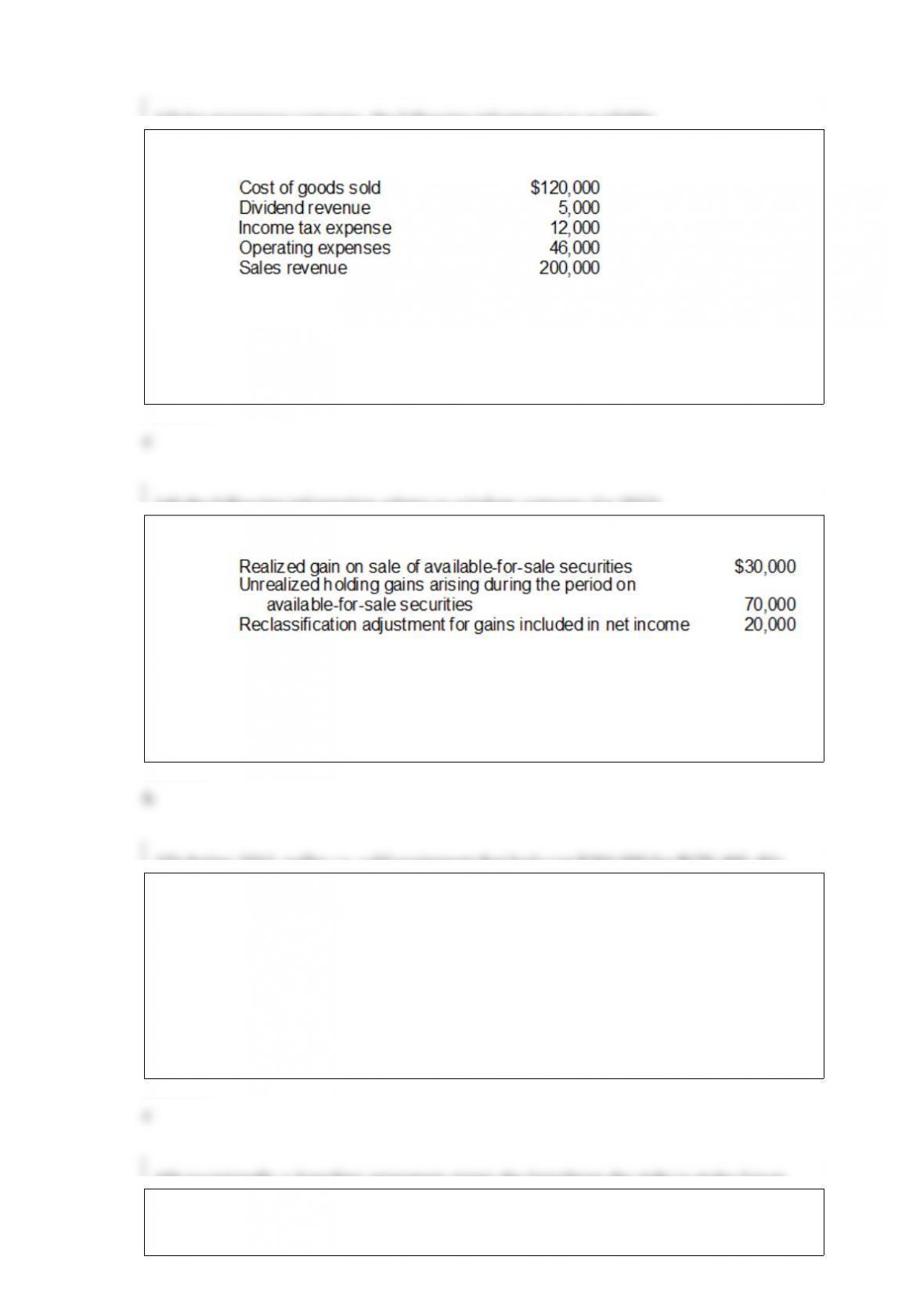
13) for mortenson company, the following information is available:
in mortensons multiple-step income statement, gross profit
a.should not be reported
b.should be reported at $27,000
c.should be reported at $80,000
d.should be reported at $85,000
14) the following information relates to windom company for 2013:
windoms 2013 other comprehensive income is
a.$50,000
b.$80,000
c.$100,000
d.$120,000
15) during 2012, noller co. sold equipment that had cost $294,000 for $176,400. this
resulted in a gain of $12,900. the balance in accumulated depreciationequipment was
$975,000 on january 1, 2012, and $930,000 on december 31. no other equipment was
disposed of during 2012. depreciation expense for 2012 was
a.$45,000
b.$57,900
c.$85,500
d.$175,500
16) occasionally a franchise agreement grants the franchisee the right to make future
bargain purchases of equipment or supplies. when recording the initial franchise fee, the

franchisor should
a.increase revenue recognized from the initial franchise fee by the amount of the
expected future purchases
b.record a portion of the initial franchise fee as unearned revenue which will increase
the selling price when the franchisee subsequently makes the bargain purchases
c.defer recognition of any revenue from the initial franchise fee until the bargain
purchases are made
d.none of these
17) prophet corporation has an extraordinary loss of $600,000, an unusual gain of
$420,000, and a tax rate of 40%. at what amount should prophet report each item?
extraordinary lossunusual gain
a.$(600,000)$420,000
b.(600,000)252,000
c.(360,000)420,000
d.(360,000)252,000
18) the 2012 financial statements of sito company reported a beginning inventory of
$80,000, an ending inventory of $120,000, and cost of goods sold of $800,000 for the
year. sitos inventory turnover ratio for 2012 is
a.10.0 times
b.8.0 times
c.6.7 times
d.5.7 times
19) cotton hotel corporation recently purchased emporia hotel and the land on which it
is located with the plan to tear down the emporia hotel and build a new luxury hotel on
the site. the cost of the emporia hotel should be
a.depreciated over the period from acquisition to the date the hotel is scheduled to be
torn down
b.written off as an extraordinary loss in the year the hotel is torn down
c.capitalized as part of the cost of the land
d.capitalized as part of the cost of the new hotel
20) technique co. has equipment with a carrying amount of $1,600,000. the expected
future net cash flows from the equipment are $1,630,000, and its fair value is
$1,360,000. the equipment is expected to be used in operations in the future. what
amount (if any) should technique report as an impairment to its equipment?
a.no impairment should be reported.
b.$240,000
c.$30,000
d.$270,000
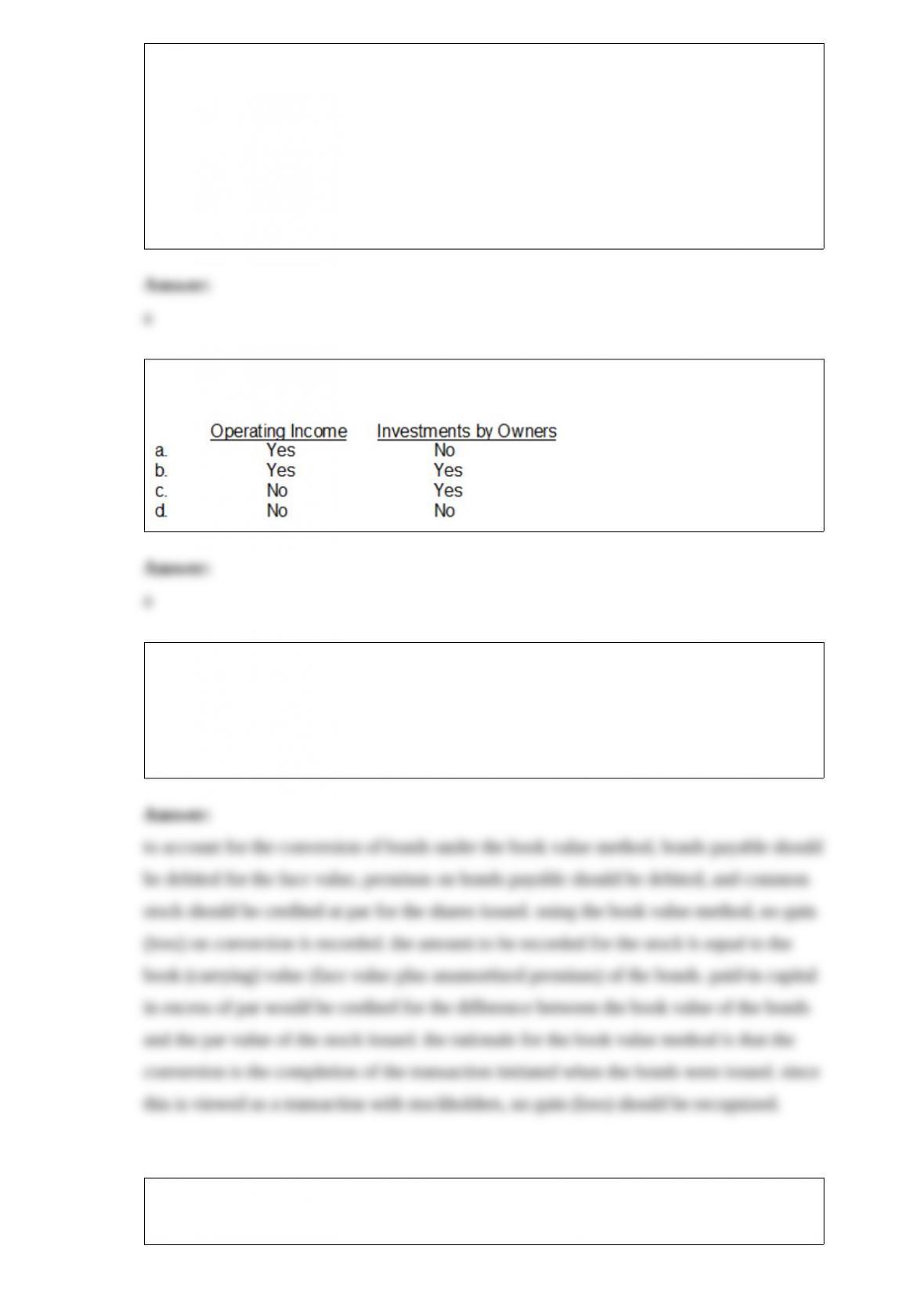
21) according to the fasb’s conceptual framework, comprehensive income includes
which of the following?
22) koch co. sold convertible bonds at a premium. interest is paid on may 31 and
november 30. on may 31, after interest was paid, 100, $1,000 bonds are tendered for
conversion into 3,000 shares of $10 par value common stock that had a market price of
$40 per share. how should koch co. account for the conversion of the bonds into
common stock under the book value method? discuss the rationale for this method.
23) at the beginning of 2013, pitman co. purchased an asset for $900,000 with an
estimated useful life of 5 years and an estimated salvage value of $75,000. for financial
reporting purposes the asset is being depreciated using the straight-line method; for tax
purposes the double-declining-balance method is being used. pitman co.s tax rate is
40% for 2013 and all future years.
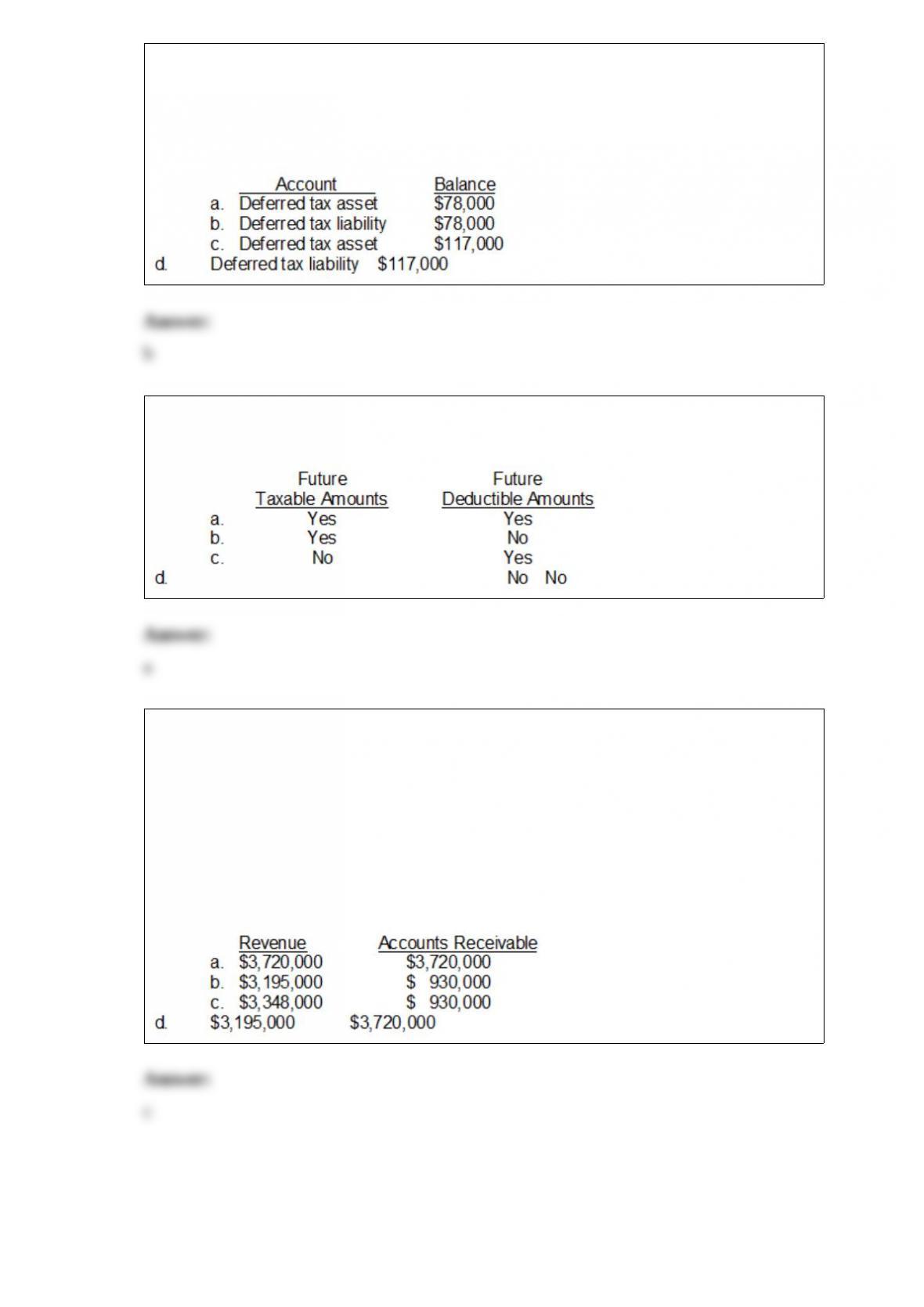
at the end of 2013, which of the following deferred tax accounts and balances is
reported on pitmans balance sheet?
24) machinery was acquired at the beginning of the year. depreciation recorded during
the life of the machinery could result in
25) seasons construction is constructing an office building under contract for cannon
company. the contract calls for progress billings and payments of $930,000 each
quarter. the total contract price is $11,160,000 and seasons estimates total costs of
$10,650,000. seasons estimates that the building will take 3 years to complete, and
commences construction on january 2, 2012.
at december 31, 2012, seasons estimates that it is 30% complete with the construction,
based on costs incurred. what is the total amount of revenue from long-term contracts
recognized for 2012 and what is the balance in the accounts receivable account
assuming cannon cafe has not yet made its last quarterly payment?