
A common inventory observation procedure is to be alert for items that are damaged,
rust- or dust-covered, or located in inappropriate places. The balance-related audit
objective being achieved by this procedure is
A) classification.
B) cutoff.
C) valuation.
D) rights.
You are a public accountant retained by the manager of a cooperative retirement village
to do “write-up work.” You are expected to prepare unaudited financial statements with
each page marked “unaudited” and accompanied by a disclaimer of opinion stating no
audit was made. In performing the work, you discover that there are no invoices to
support $25,000 of the manager’s claimed disbursements. The manager informs you that
all the disbursements are proper. What should you do?
A) Submit the expected statements but omit $25,000 of unsupported disbursements
B) Include the unsupported disbursements in the statements since you are not expected
to make an audit
C) Obtain, from the manager, a written statement that you informed him of the missing
invoices and include his assurance that the disbursements are proper
D) Obtain further information about the $25,000 unsupported items and withdraw if the
situation is not satisfactorily resolved
A) Describe each of the major types of cash accounts maintained by business entities.
B) Discuss the advantages of using an imprest bank account for payroll transactions.

If accounts receivable accounts with credit balances are significant, they should be
A) written off.
B) reclassified as accounts payable.
C) corrected by making adjusting entries.
D) moved to the debit side.
The auditor’s evaluation of the likelihood of material employee fraud is normally done
initially as a part of
A) the assessment of whether to accept the audit engagement.
B) understanding the entity’s internal controls.
C) the tests of controls.
D) the tests of transactions.
Stella is auditing the electronic receipts and payments. The extent of her audit work
conducted on the bank reconciliation will
A) be less extensive than if the company did not engage in electronic receipts and
payments.

B) be more extensive than if the company did not engage in electronic receipts and
payments.
C) depend on the assessed quality of internal controls.
D) be significantly diminished if Stella can determine that the receipts and payments
come from a reputable bank with proper internal controls.
The accountant is working on an engagement with respect to the client’s financial
statements. Which of the following engagements would omit an assessment of the
client’s accounting policies’ compliance with GAAP?
A) Review
B) Compilation
C) Audit
D) Attestation
PA was engaged by Microcomputer Distributor Limited (MDL) to conduct a review
engagement. The financial statements are used primarily by the shareholders,
management, and by the bank. Recently, an employee was fired for stealing computer
parts, primarily chips and boards that could easily be placed in a pocket. MDL is suing
PA because they believed that audit procedures, such as counting inventory, would have
detected this fraud. What is PA’s best defence?

A) absence of causal connection
B) lack of negligence
C) contributory negligence
D) lack of duty to perform
A normal audit procedure is to analyze the current year’s repairs and maintenance
accounts to provide evidence in support of the audit proposition that
A) expenditures for capital assets have been recorded in the proper period.
B) capital expenditures have been properly authorized.
C) non-capitalizable expenditures have been properly expensed.
D) expenditures for capital assets have been capitalized.
In the sales and collection cycle, the results of the tests of controls determine
A) the extent to which planned detection risk is satisfied for each accounts receivable
objective.
B) whether assessed control risk for sales and cash receipts needs to be revised.
C) if tests of details of balances need to be performed.

D) whether positive or negative confirmations should be used for this engagement.
If an auditor would like to estimate how many sales invoices have errors (such as no
required order number showing or authorization for customers exceeding their credit
limit) , the auditor would likely use
A) random sampling with replacement.
B) sampling for attributes.
C) sampling for variables.
D) stratified random sampling.
Which of the following control procedures may prevent the failure to bill customers for
some shipments?
A) Each shipment should be supported by a prenumbered sales invoice that is
accounted for.
B) Each sales order should be approved by authorized personnel.
C) Sales journal entries should be reconciled to daily sales summaries.
D) Each sales invoice should be supported by a shipping document.

When would the public accountant conduct audit procedures during a review
engagement? When
A) junior staff are assigned to the engagement.
B) required to assess plausibility.
C) it is a first time review engagement.
D) a higher level of assurance is required for the bank.
The provincial institutes’ Rules of Professional Conduct state, in part, that a public
accountant should maintain integrity and due care. Integrity in the Rules refers to a
public accountant’s
A) ability to maintain an impartial attitude on all matters that come under the public
accountant’s review.
B) ability to distinguish independently between accounting practices that are acceptable
and those that are not.
C) ability to be unyielding in all matters dealing with auditing procedures.
D) reputation for honesty and fair dealing.

Mugsy Brights Limited (MBL) is a private company in Winnipeg that sells mugs, jars
and bottles in a variety of colours, sizes and materials. MBL is owned by four equal
owners since inception. The owners have different skills – creative design, marketing,
finance and information systems. The company attributes much of its success to the use
of materials that can be easily shipped without breaking, and unique designs that appeal
to a variety of buyers, particularly commercial buyers who purchase for restaurants, or
for businesses who choose to advertise their business by giving away or selling regular
or travel mugs.
The owners meet formally every month, and have informal meetings two or three times
per week to discuss particular clients or new approaches. About a quarter of the sales
are via the company’s secure web site, while the remainder are by telephone or purchase
order. MBL works with distributors of kitchenware, selling wholesale to hundreds of
outlets in Canada. Most of these sales are done via the telephone, although a
salesperson does spend some time in major cities across the country visiting some of
the large customers, helping with shelf layout and marketing to the ultimate consumers
for larger distributors. These efforts have resulted in gradually increasing market share
for the company.
All sales are recorded in the accounting software package used by the company. The
accounting manager reports directly to one of the owners, and there are two other
employees in the accounting department. Password controls are used to limit functions
that are accessible by employees. For example, only the controller can implement wage
rate increases or product price increases (which are reviewed and approved by the
owner responsible for marketing). Two owners are required to sign cheques, and do so
with source documents attached. Similarly, two owners are required to approve new
employees.
All manufacturing is outsourced to local producers who work with different materials.
For example, a different supplier handles steel mugs versus plastics or glass. Ceramics
is rarely used as it is quite breakable, whereas some forms of glass are very durable.
MBL does not hold any inventory, as manufacturing is all done to order. However, as
there have been some collection problems from customers, the company has had to go
to the maximum of its line of credit, and has no additional borrowing capacity
available. It is waiting for the results of the audited financial statements to approach the
bank for an increase in its line of credit.
Internet sales are prepared (via credit card), while sales to distributors are net thirty. The
company has an April year end.
Following are extracts from the annual financial statements:
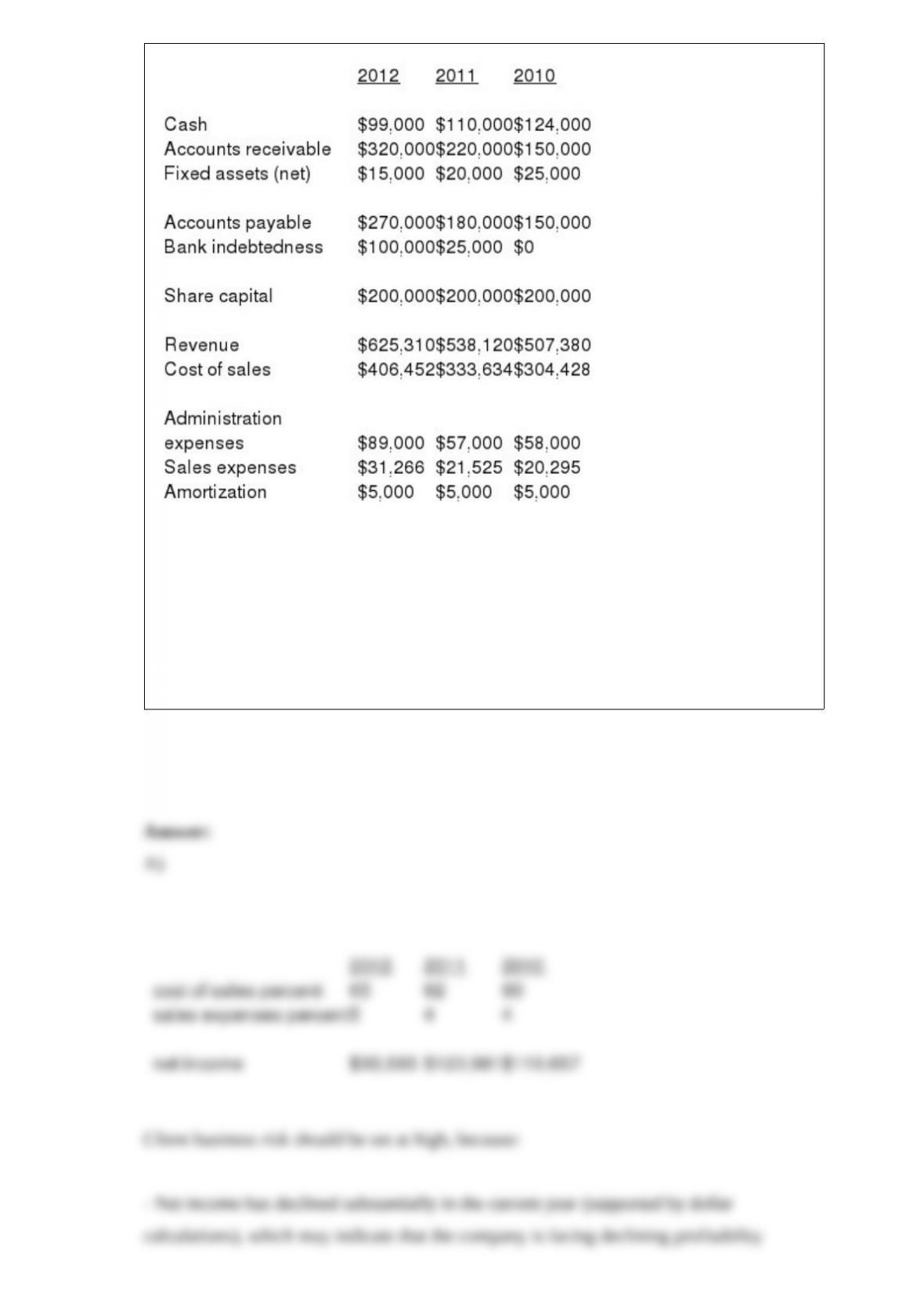
Required:
A) What audit risk would you assign to the company? Why? [Tip: Do some calculations
and consider client business risk.]
B) Calculate preliminary materiality. Justify your decision of materiality base and
choice of materiality.
The most common statistical technique for analytical procedures is
A) analysis of variance.
B) bell-curve analysis.
C) time-series analysis.
D) regression analysis.
A PA firm is conducting the audit of a company that has operations in both Canada and
Finland. There is a conflict between ISAs (International Statements on Auditing) and
CASs (Canadian Auditing Standards) for the foreign operations that will be
consolidated with the Canadian operations. Which reporting standards should the PA
firm follow?
A) reporting standards of Finland
B) international reporting standards
C) Canadian reporting standards
D) the best of Canadian or international

Materiality should be adjusted for the effect of net anticipated misstatements to
determine performance materiality available for
A) identified misstatements.
B) likely misstatements.
C) unanticipated misstatements.
D) further possible misstatements.
It is frequently possible to test the physical inventory prior to the balance sheet date
when
A) there are accurate perpetual inventory master files.
B) year-end sales are small.
C) the internal control system is no better at year-end than at an earlier point in time.
D) client counts inventory at interim dates.

An abnormal fluctuation in gross profit that might suggest the need for extended audit
procedures for sales and inventories would most likely be identified in the planning
phase of the audit by the use of
A) tests of details of balances.
B) procedures to obtain an understanding of internal controls.
C) specialized audit programs.
D) analytical procedures.
A branch bank account is helpful for
A) limiting the impact of a fraud.
B) improving internal controls.
C) empowering the different branches of the company.
D) building public relations in local communities.

From an audit perspective, an imprest bank account at a client can
A) require less time for the audit of general cash.
B) increase audit risk.
C) result in an increase in control risk.
D) improve client internal controls.
Proper accounting requires that an account receivable must be written off by the client
when
A) the client company concludes that an amount is no longer collectible.
B) the customer files for bankruptcy.
C) a collection agency cannot inspire the customer to pay the debt.
D) the account is at least six months old.
Which of the following tests of controls would pertain to whether existing payroll
transactions are recorded?
A) Compare cancelled cheques with payroll journal details
B) Compare cancelled cheques with payroll records

C) Foot payroll journal and trace details to general ledger
D) Conduct gap testing for a sequence of payroll cheques
It is important that sales be billed and recorded in the journal as soon as possible after
A) the order is received.
B) the order is received and credit is approved.
C) credit is approved and it is verified that there is enough inventory to fill the order.
D) shipment takes place.
A substantive procedure is used to
A) assess the likelihood of material misstatement in the financial statements.
B) obtain an understanding of internal controls.
C) analyze the account balance to see if there are potential errors.
D) quantify the amount of potential error in an account or transaction stream.
A) Describe the five types of audit tests used to determine whether financial statements
are fairly stated. Identify which of the five types are substantive tests, and which are
used to reduce assessed control risk.
B) There are several types of audit procedures that relate to the auditor’s understanding
of internal control. One type of procedure is “Update and evaluate the auditor’s previous
experience with the entity.” Identify the five additional types of procedures related to
understanding internal control, and four types of procedures that are used to test
controls.
The independent auditor’s report is the
A) communication of the result of the audit to the users.

B) set of audited financial statements.
C) invoice of the auditor detailing the work they have performed.
D) report presented to management about the possible improvements.
The highest cost audit will be incurred when the auditor expects that the internal control
system would
A) be effective, but the auditor found extensive control test deviations.
B) have few effective controls, but client’s personnel were well-trained and
knowledgeable.
C) be very sophisticated, and the tests of controls confirmed this.
D) have few effective controls, and tests of balances found many errors.
Where an independence threat occurs, it may be that only the person affected needs to
be removed from the engagement. In this case, other members of the firm can complete
the engagement. An example of a situation where only the student or member would be
excluded from the engagement is where PA
A) has a significant financial interest in the client, such that influence could be exerted.
B) used to be a controller at the client, but now works for the PA firm.

C) owns ten percent of the shares of the client.
D) is a board member of the client with signing authority for cheques.
The auditor’s responsibility with regards to contingent liabilities is to
A) identify the appropriate accounting treatment.
B) decide on the appropriate accounting treatment.
C) prepare note disclosure.
D) evaluate the accounting treatment of known contingent liabilities.
Each of the following situations involves a possible violation of the provincial
institutes’ Rules of Professional Conduct. For each situation, (1) decide whether or not
the Rules have been violated, and (2) briefly explain how the situation violates (or does
not violate) the Rules.
A) Johnny Line has a successful dentistry practice in Calgary. Johnny has
recommended one of his patients to Leslie King, public accountant. To show gratitude
for the referral, Leslie has agreed to pay Johnny 5% of the fee for audit services
rendered by Leslie to Johnny’s patient. Leslie discloses the payment agreement to her
new client.
Violation? Yes No

Explanation:
B) The accounting firm of Bayer & Peng, public accountants, is negotiating a fee with a
new audit client. They agree the client will pay $75,000 if Bayer & Peng issues a clean,
unqualified opinion, $50,000 if a qualified opinion is issued, $40,000 if an adverse
opinion is issued, and $10,000 if a denial of opinion is issued.
Violation? Yes No
Explanation:
C) Don Smith, public accountant, takes part in the audit of Shaw Corporation. Don is
not a partner or a manager in the public accounting firm, and does not own any stock in
Shaw Corporation. Don’s five year-old daughter, Betty Lou, received one share of Shaw
Corporation’s common stock for her fifth birthday. The stock was a gift from Betty
Lou’s grandmother. Betty Lou treasures that share of stock and is absolutely unwilling
to part with it.
Violation? Yes No
Explanation:
D) On August 5, 2012, Page Dane, public accountant, issued the audit report on Borhut
Corporation’s June 30, 2012 financial statements. On August 30, 2012, Borhut paid
Page’s audit fee with stock rather than cash. Page sold the stock on September 15, 2012,
two months prior to the beginning of the planning phase for the audit of the June 30,
2013, financial statements.
Violation? Yes No
Explanation:
A) State five specific balance-related audit objectives for inventory pricing and
compilation and, for each objective, describe one common test of details of balances
related to that objective.
B) Explain why the audit of work-in-process and finished goods inventory is generally
more complex than the audit of purchased inventory.