
1) on january 1, 2012, sharp corp. granted an employee an option to purchase 9,000
shares of sharp’s $5 par value common stock at $20 per share. the black-scholes option
pricing model determines total compensation expense to be $210,000. the option
became exercisable on december 31, 2013, after the employee completed two years of
service. the market prices of sharp’s stock were as follows:
for 2011, should recognize compensation expense under the fair value method of
a.$135,000
b.$45,000
c.$105,000
d.$0
2) a plant site donated by a township to a manufacturer that plans to open a new factory
should be recorded on the manufacturer’s books at
a.the nominal cost of taking title to it
b.its fair value
c.one dollar (since the site cost nothing but should be included in the balance sheet)
d.the value assigned to it by the company’s directors
3) on january 3, 2012, moss co. acquires $400,000 of adam companys 10-year, 10%
bonds at a price of $425,672 to yield 9%. interest is payable each december 31. the
bonds are classified as held-to-maturity.
assuming that moss co. uses the straight-line method, what is the amount of premium
amortization that would be recognized in 2014 related to these bonds?
a.$2,568
b.$1,688
c.$1,840
d.$2,008
4) on may 1, 2012, a company purchased a new machine which it does not have to pay
for until may 1, 2014. the total payment on may 1, 2014 will include both principal and
interest. assuming interest at a 10% rate, the cost of the machine would be the total
payment multiplied by what time value of money factor?
a.future value of annuity of 1
b.future value of 1
c.present value of annuity of 1
d.present value of 1
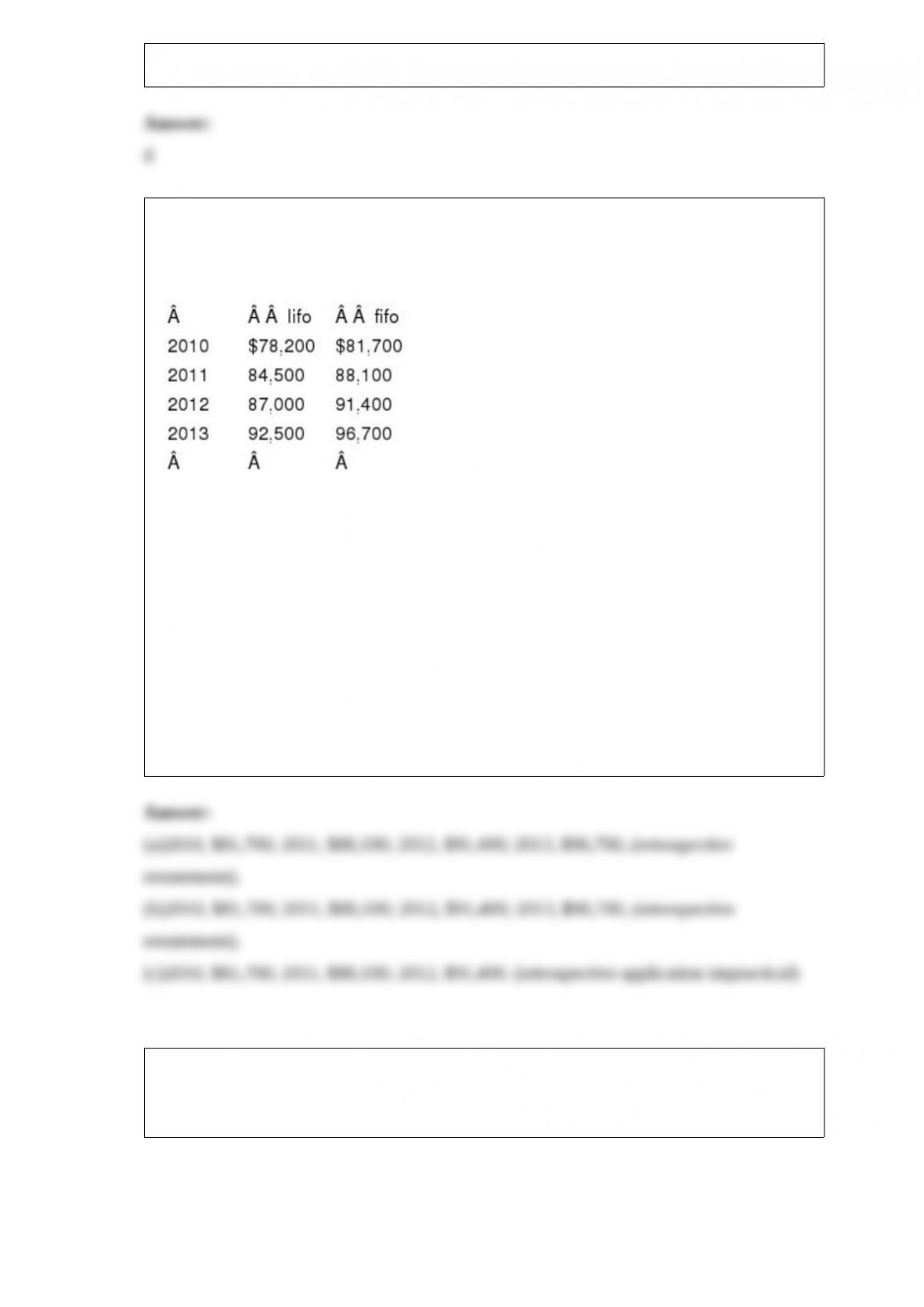
5) in 2013, fischer corporation changed its method of inventory pricing from lifo to fifo.
net income computed on a lifo as compared to a fifo basis for the four years involved is:
(ignore income taxes.)
instructions
(a)indicate the net income that would be shown on comparative financial statements
issued at 12/31/13 for each of the four years, assuming that the company changed to the
fifo method in 2013.
(b)assume that the company had switched from the average cost method to the fifo
method with net income on an average cost basis for the four years as follows: 2010,
$80,400; 2011, $86,120; 2012, $90,300; and 2013, $93,600. indicate the net income that
would be shown on comparative financial statements issued at 12/31/13 for each of the
four years under these conditions.
(c)assuming that the company switched from the fifo to the lifo method, what would be
the net income reported on comparative financial statements issued at 12/31/13 for
2010, 2011, and 2012?
6) the following differences enter into the reconciliation of financial income and taxable
income of abbott company for the year ended december 31, 2012, its first year of
operations. the enacted income tax rate is 30% for all years.
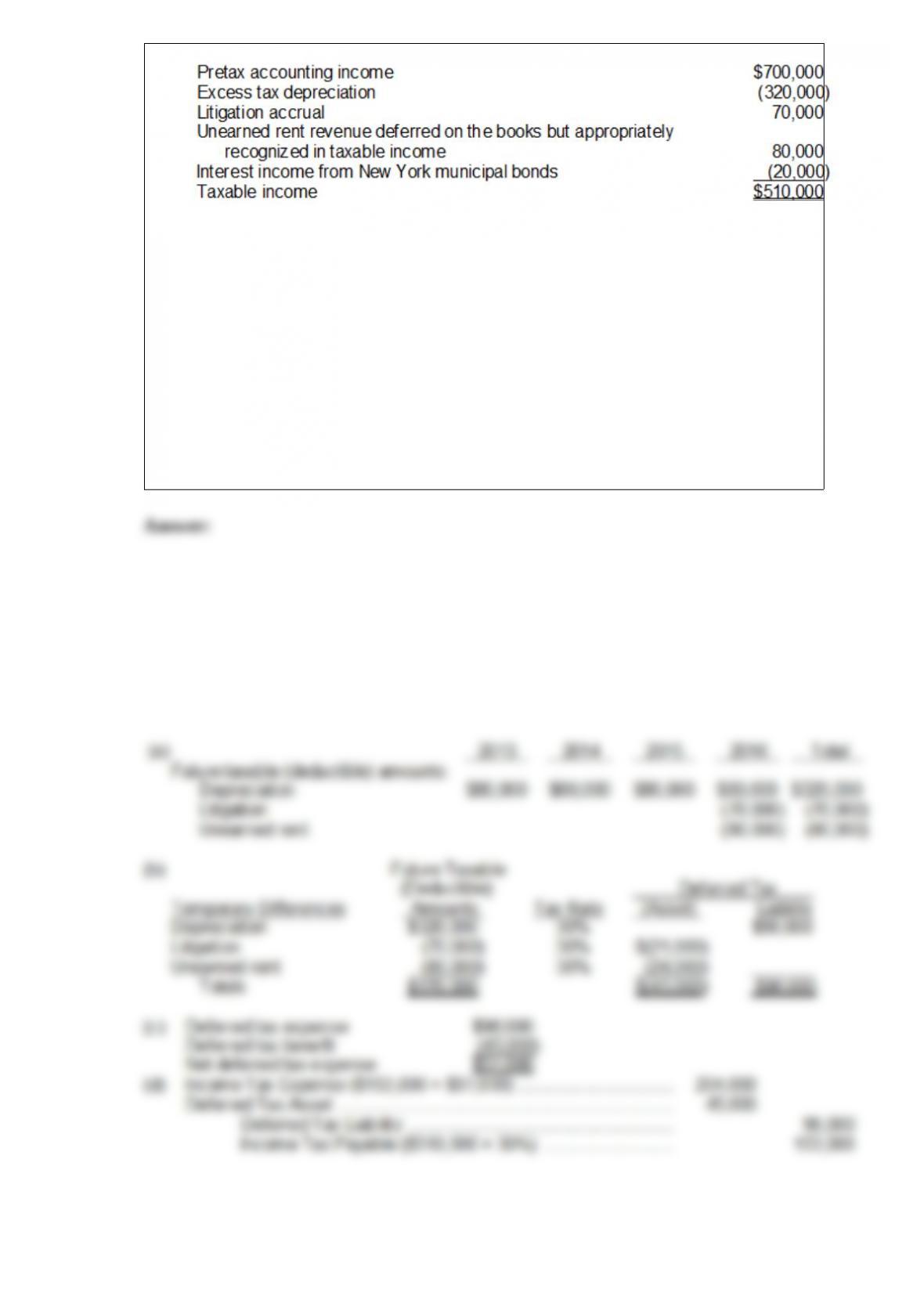
1>excess tax depreciation will reverse equally over a four-year period, 2013-2016.
2>it is estimated that the litigation liability will be paid in 2016.
3>rent revenue will be recognized during the last year of the lease, 2016.
4>interest revenue from the new york bonds is expected to be $20,000 each year until
their maturity at the end of 2016.
instructions
(a)prepare a schedule of future taxable and (deductible) amounts.
(b)prepare a schedule of the deferred tax (asset) and liability.
(c)since this is the first year of operations, there is no beginning deferred tax asset or
liability. compute the net deferred tax expense (benefit).
(d)prepare the journal entry to record income tax expense, deferred taxes, and the
income taxes payable for 2012.

7) stockholders of a business enterprise are said to be the residual owners. the term
residual owner means that shareholders
a.are entitled to a dividend every year in which the business earns a profit
b.have the rights to specific assets of the business
c.bear the ultimate risks and uncertainties and receive the benefits of enterprise
ownership
d.can negotiate individual contracts on behalf of the enterprise
8) for 2012, hoyle company reports beginning of the year total assets of $900,000, end
of the year total assets of $1,100,000, net sales of $750,000, and net income of
$150,000.
the rate of return on assets for hoyle in 2012 is
a.12.0%
b.13.6%
c.15.0%
d.16.7%
9) which accounting assumption or principle is being violated if a company is a party to
major litigation that it may lose and decides not to include the information in the
financial statements because it may have a negative impact on the company’s stock
price?
a.full disclosure
b.going concern
c.historical cost
d.expense recognition
10) during the first year of wilkinson co.’s operations, all purchases were recorded as
assets. supplies in the amount of $25,800 were purchased. actual year-end supplies
amounted to $8,600. the adjusting entry for store supplies will
a.increase net income by $17,200
b.increase expenses by $17,200
c.decrease supplies by $8,600
d.debit accounts payable for $8,600

11) a review of the december 31, 2012, financial statements of somer corporation
revealed that under the caption “extraordinary losses,” somer reported a total of
$1,030,000. further analysis revealed that the $1,030,000 in losses was comprised of the
following items:
(1)somer recorded a loss of $300,000 incurred in the abandonment of equipment
formerly used in the business.
(2)in an unusual and infrequent occurrence, a loss of $500,000 was sustained as a result
of hurricane damage to a warehouse.
(3)during 2012, several factories were shut down during a major strike by employees,
resulting in a loss of $170,000.
(4)uncollectible accounts receivable of $60,000 were written off as uncollectible.
ignoring income taxes, what amount of loss should somer report as extraordinary on its
2012 income statement?
a.$300,000
b.$500,000
c.$800,000
d.$1,030,000
12) copyrights should be amortized over
a.their legal life
b.the life of the creator plus fifty years
c.twenty years
d.their useful life or legal life, whichever is shorter
13) the activity method of depreciation
a.is a variable charge approach
b.assumes that depreciation is a function of the passage of time
c.conceptually associates cost in terms of input measures
d.all of these