In deciding whether to outsource a service department or not, the cost of the service
department should be estimated using the step method of allocation.
Answer:
One potential disadvantage of the reciprocal method is it could overstate the cost of
running the organization’s service departments.
Answer:
It is important to not consider an organization’s compensation and reward system when
designing its performance evaluation system.
Answer:
An organization’s sales staff is more likely to provide a lower sales forecast than a
forecast provided by market researchers.
Answer:
If the fixed costs are $2,400, targeted operating profit is $1,200, selling price per unit is
$2, and the contribution margin ratio is 40%, then the required sales volume is 9,000
units.
Answer:
Short-run decisions often have long-run implications.
Answer:
Divisional income statements do not have to follow generally accepted accounting
principles (GAAP) because they are internal reports.
Answer:
Since by-products have minor sales value, alternative methods of accounting for them
will not have a material effect on the financial statements.
Answer:
Production cost variances are input variances, while sales activity variances are output
variances.
Answer:
The journal entry to apply manufacturing overhead costs to completed jobs credits
either Applied Manufacturing Overhead or Manufacturing Overhead (Control).
Answer:
The contribution margin ratio is the contribution margin per unit divided by the selling
price per unit.
Answer:
In general, the use of multiple measures to evaluate performance is better than the use
of a single performance measure.
Answer:
The journal entry to record actual manufacturing overhead for indirect labor debits
Manufacturing Overhead (Control) and credits Work-in-Process inventory.
Answer:
Indirect material and indirect labor are two examples of manufacturing overhead costs.
Answer:
Activity-based costing (ABC) can be applied to administrative activities (e.g.,
purchasing) but not to marketing activities.
Answer:
ABC Company has 10,000 units on hand at the beginning of the year and plans to sell
100,000 units during the year. If the ending inventory needs to be twice the beginning
inventory, ABC will need to produce 90,000 units during the year.
Answer:
The term full cost refers to the cost of manufacturing and selling a unit of product and
includes both fixed and variable costs.
Answer:
If a company sells two products, it is possible for both products to have a favorable
sales mix variance.
Answer:
If a company sells two products, it is possible for both products to have an unfavorable
sales quantity variance.
Answer:
When a perfect intermediate market exists, the optimal transfer price is the
intermediate market price.
Answer:
The more prices change, the greater the difference between the costs assigned to units
transferred out using weighted-average costing and the costs assigned to units
transferred out using first-in, first-out (FIFO).
Answer:
Activity-based costing (ABC) can be used to provide information for managerial
decision-making in service, merchandising, and manufacturing companies.
Answer:
Only direct costs can be classified as product costs; indirect costs are classified as
period costs.
Answer:
The two-stage cost allocation process allocates costs to multiple cost pools and then to
individual cost objects using different allocation bases.
Answer:
Accounting for direct materials and direct labor is easier than accounting for
manufacturing overhead costs.
Answer:
A market price-based transfer price policy allows the selling division to determine the
price for transfers between divisions within the same organization.
Answer:
The difference between operating profits in the master budget and operating profits in
the flexible budget is called a sales price variance.
Answer:
The number of units in the beginning Work-in-Process Inventory plus the units
transferred out during the period equals the number of units started during the period
plus the number of units in the ending Work-in-Process Inventory.
Answer:
Unused capacity costs incurred for the benefit of a company’s customers (e.g., meet
seasonal demands) should be assigned to the customers that require (use) the excess
capacity.
Answer:
In the weighted-average approach, the number of physical units transferred out cannot
be greater than the equivalent number of units produced during the period.
Answer:
A budget is the plan, stated in financial terms, of how an organization expects to carry
out its activities and meet its goals.
Answer:
Bottlenecks in the production process can be discovered by the budgeting process
before they occur.
Answer:
The difference between the resources used and the resources supplied is called unused
resource capacity in a typical activity-based cost management (ABM) system.
Answer:
Residual income is the difference between the divisional income and the cost of
invested capital required to operate the division.
Answer:
The physical quantities method of allocating joint costs is often used when the output
sales prices are highly volatile.
Answer:
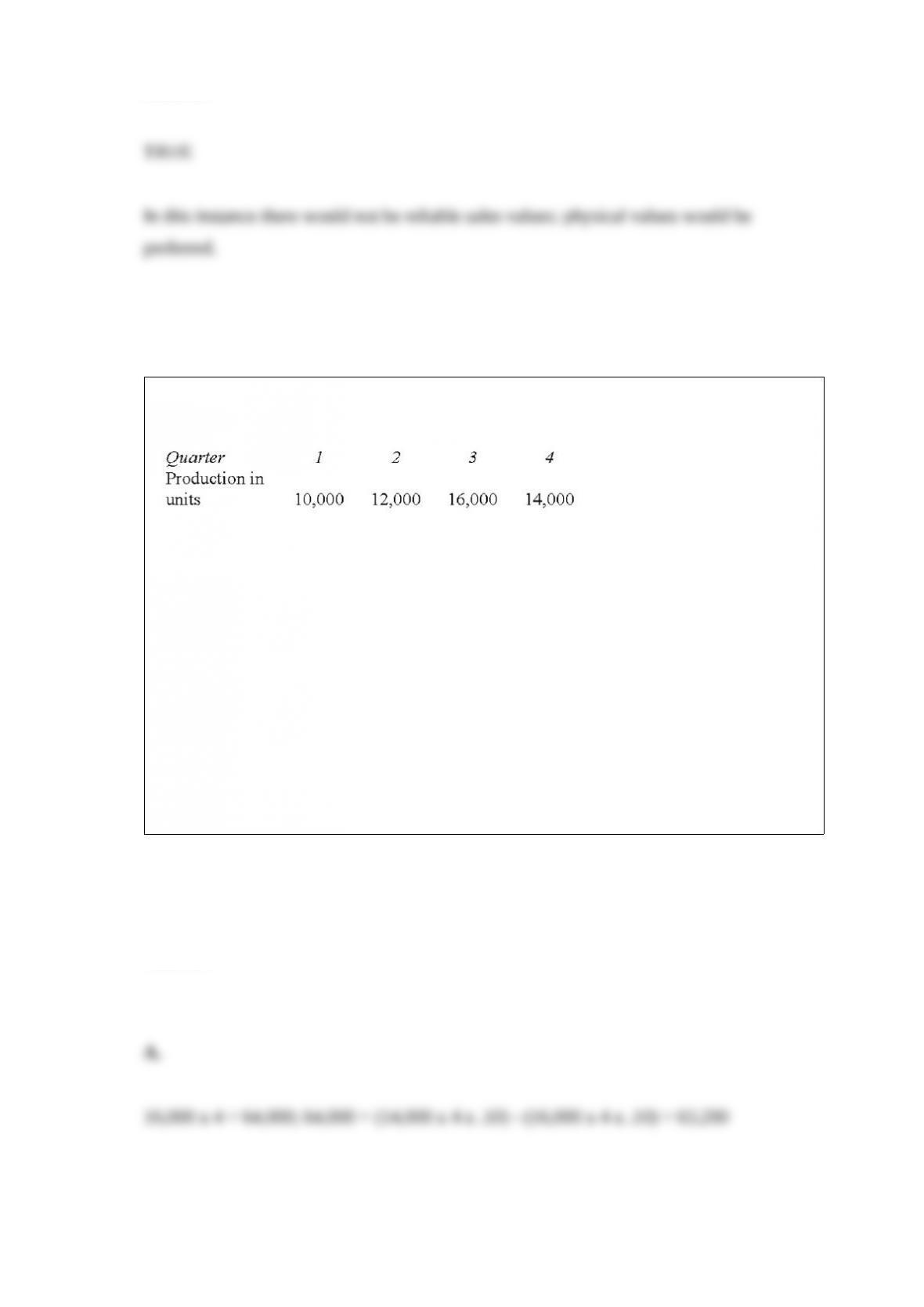
The Tobler Company had budgeted production for the year as follows:
Four pounds of raw materials are required for each unit produced. Raw materials on
hand at the start of the year total 4,000 lbs. The raw materials inventory at the end of
each quarter should equal 10% of the next quarter’s production needs in materials.
Budgeted purchases of raw materials in the third quarter would be (in lbs.)
A. 63,200 lbs.
B. 62,400 lbs.
C. 56,800 lbs.
D. 50,400 lbs.
Answer:
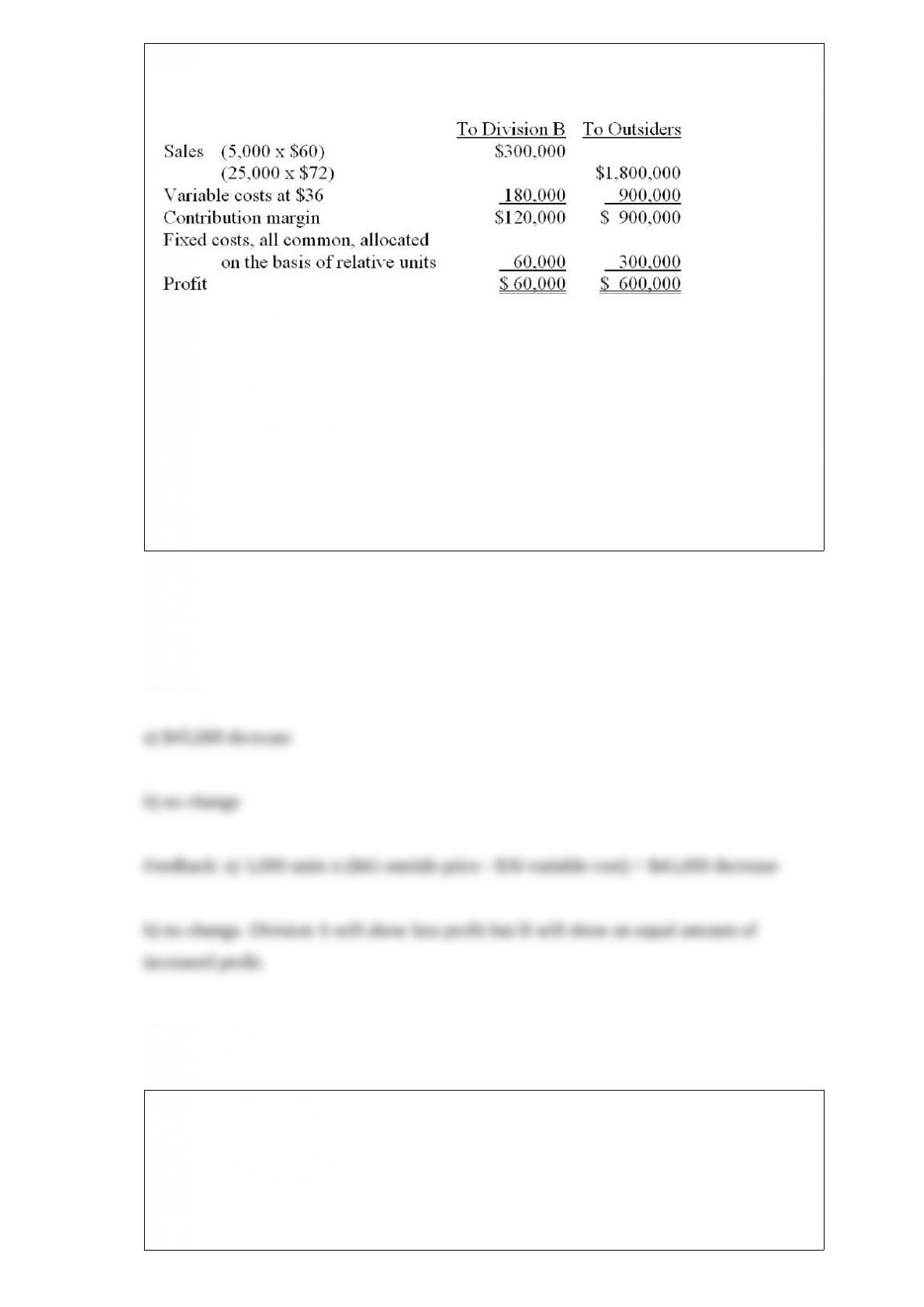
Division A of Stills Company expects the following results
Division B has the opportunity to buy its needs of 5,000 units from an outside supplier
at $45 each.
Required: Answer each question independently.
a) Division A refuses to meet the $45 price, sales to outsiders cannot be increased, and
Division B buys from the outside supplier. Compute the effect on the income of Stills.
b) Division A cannot increase its sales to outsiders, does meet the $45 price, and
Division B continues to buy from A. Compute the effect on the income of Stills.
Answer:
The budget for the month of May was for 9,000 units at a direct materials cost of $15
per unit. Direct labor was budgeted at 45 minutes per unit for a total of $81,000. Actual
output for the month was 8,500 units with $127,500 in direct materials and $77,775 in
direct labor expense. The direct labor standard of 45 minutes was obtained throughout
the month. Variance analysis of the performance for the month of May would show a(n)
(CMA adapted)
A. Favorable materials efficiency (quantity) variance of $7,500.
B. Favorable direct labor efficiency variance of $1,275.
C. Unfavorable direct labor efficiency variance of $1,275.
D. Unfavorable direct labor price (rate) variance of $1,275.
Answer:
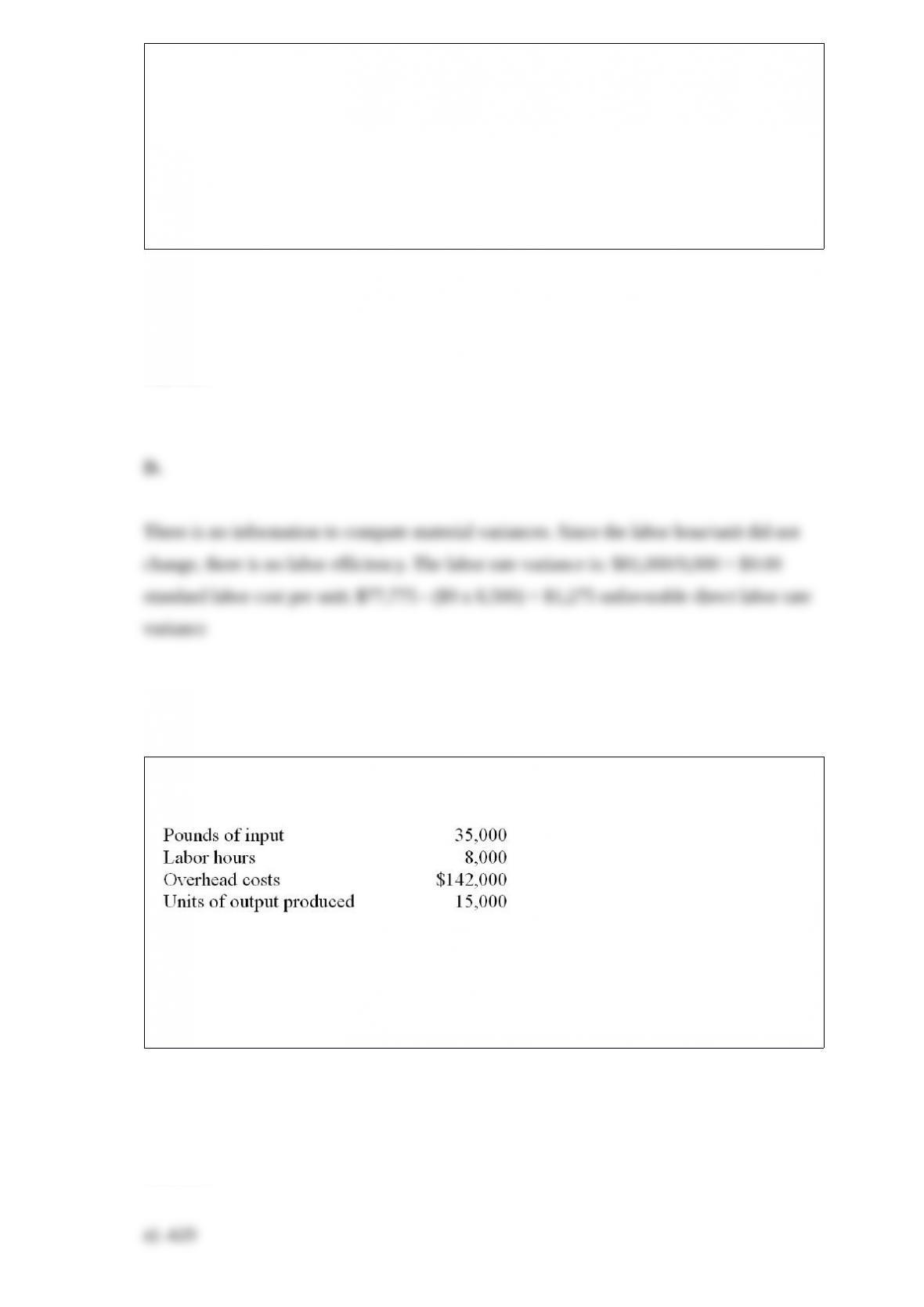
Colville Co. has provided the following information for last year:
Required: Calculate the partial productivity for:
a) Metal
b) Labor
Answer:

The Wisco Company has a process cost system. All materials are placed in process
when the process is first begun. At the beginning of September, there were no units of
product in process. During September 50,000 units were started; 5,000 of these were
still in process at the end of September and were 3/5 finished. The equivalent units of
material in September were
A. 40,000
B. 45,000
C. 48,000
D. 50,000
Answer:
The following information summarizes the standard cost for producing one metal
tennis racket frame. In addition, the variances for one month’s production are given.
Assume that all inventory accounts have zero balances at the beginning of the month.
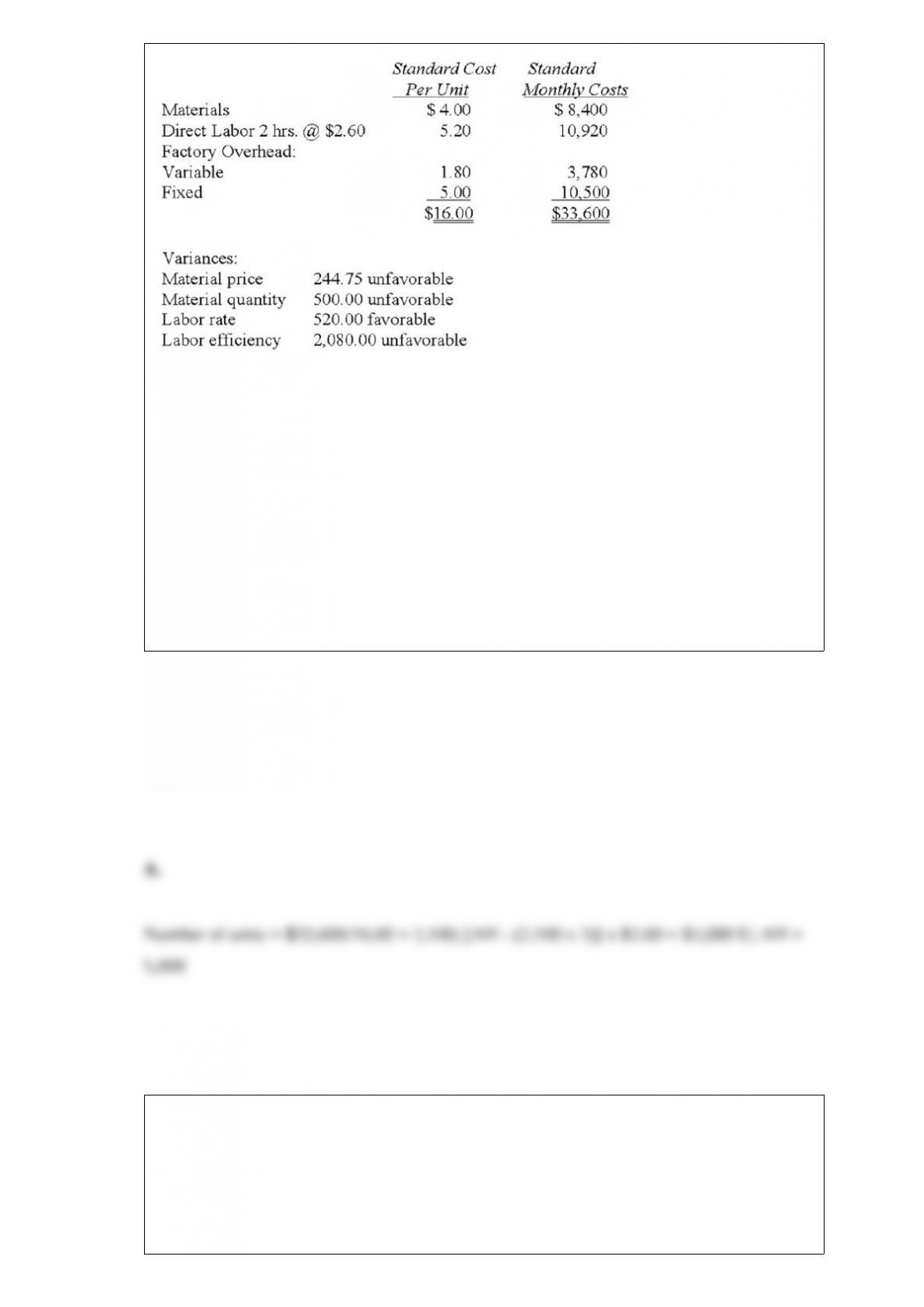
What were the actual direct labor hours worked during the month?
A. 5,000.
B. 4,800.
C. 4,200.
D. 4,000.
E. 3,400.
Answer:
Which of the following would not cause the break-even point to change?
A. Variable costs per unit increases.
B. Fixed costs increases.
C. Product mix shifts towards the more expensive products.
D. Sales volume decreases.
Answer:
Paro Products Co. has provided the following information for last year:
Required:
a) Calculate the total factor productivity measure.
Answer:
The basic cost flow model is:
A. EB + TO = TI + BB
B. BB + TO – TI = EB
C. EB = BB – TI + TO
D. EB – BB = TO – TI
E. EB + TI – TO = BB
Answer:
Which of the following statements is false?
A. The estimated net realizable value for a product is its estimated selling price after
processing the product beyond the split-off point.
B. In general, it is better to use a product’s market value at the split-off point than its
estimated net realizable value.
C. The estimated net realizable value at the split-off point is calculated by taking the
sales value after further processing and deducting the additional processing costs.
D. It is better to use the net realizable value method for allocating joint costs than the
estimated net realizable value method.
Answer:
Acme Sales has two store locations. Store A has fixed costs of $125,000 per month and
a variable cost ratio of 60%. Store B has fixed costs of $200,000 per month and a
variable cost ratio of 30%. At what sales volume would the two stores have equal
profits?
A. $250,000
B. $325,000
C. $361,111
D. Cannot determine with the information given.
Answer:
A standard cost system may be used in (CPA adapted)
A. job-order costing but not process costing.
B. either job-order costing or process costing.
C. process costing but not job-order costing.
D. neither process costing nor job-order costing.
Answer:
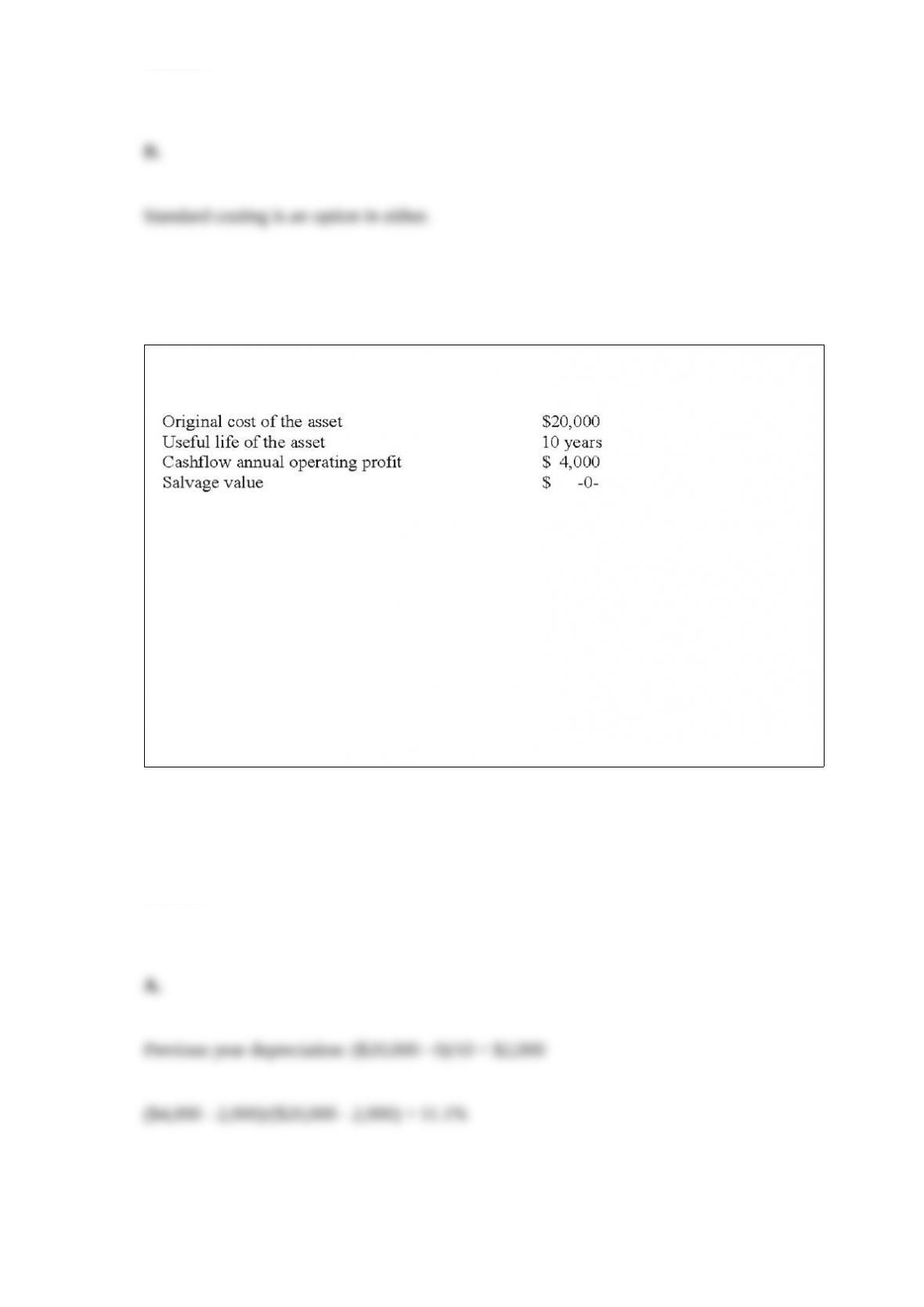
The following information was presented by Gamma Manufacturing Company for an
asset purchased at the end of the previous year.
What is the return on investment (ROI) assuming Gamma (a) uses the straight-line
method for depreciation and (b) beginning-of-year net book values to compute ROI?
A. 11.1%
B. 20.0%
C. 10.0%
D. 22.2%
Answer:
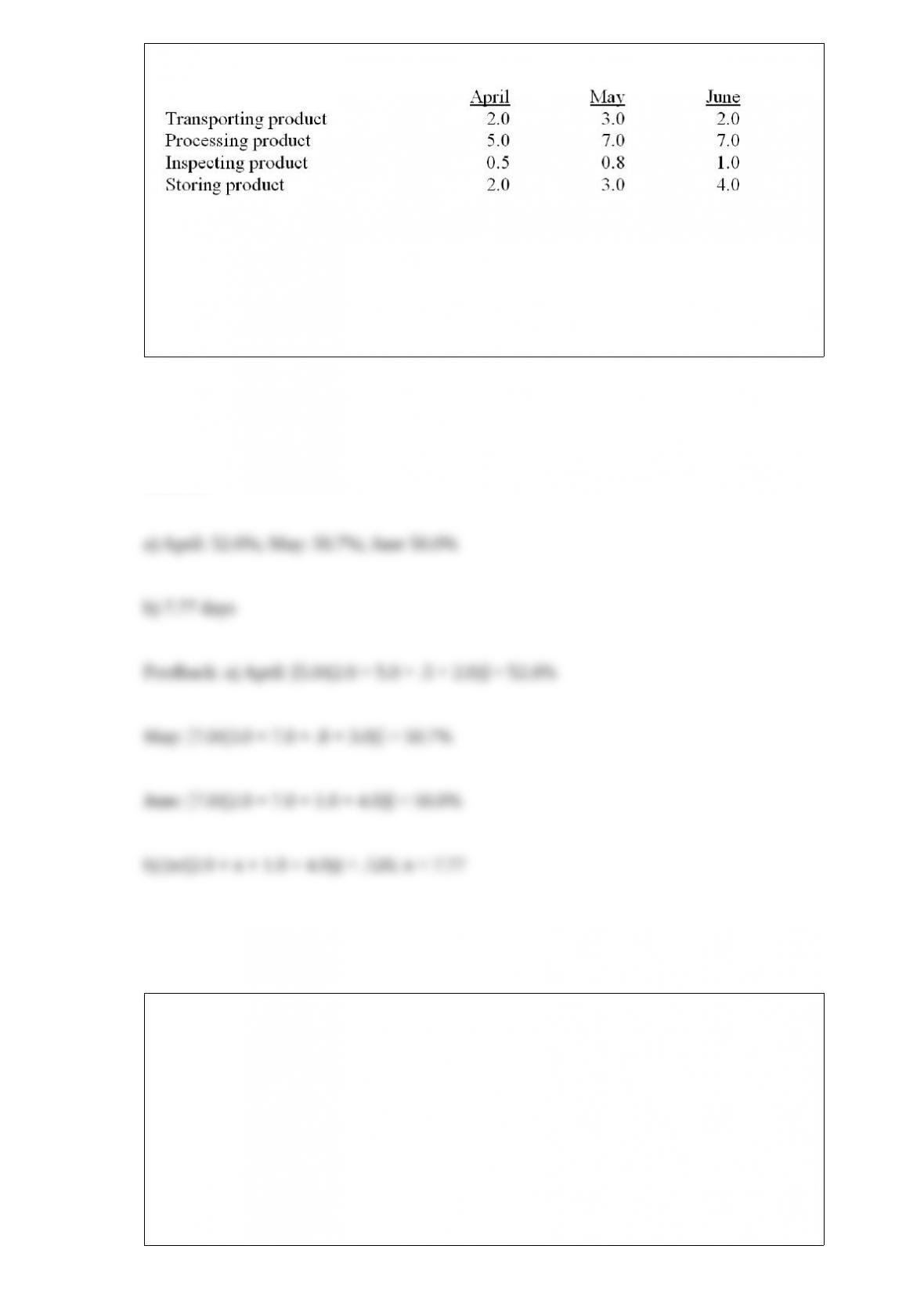
The Alcatane Manufacturing Company collected the following information (in days):
Required:
a) Calculate the manufacturing cycle efficiency for April, May, and June.
b) Calculate the processing time required for June so that the manufacturing cycle
efficiency is equal to the most efficient of the previous two months.
Answer:
The Finishing Department had 5,000 incomplete units in its beginning Work-in-Process
Inventory which were 100% complete as to materials and 30% complete as to
conversion costs. 15,000 units were received from the previous department. The ending
Work-in-Process Inventory consisted of 2,000 units which were 50% complete as to
materials and 30% complete as to conversion costs. The Finishing Department uses
first-in, first-out (FIFO) process costing. What are the equivalent units of production
for materials during the period?
A. 12,000
B. 13,000
C. 14,000
D. 15,000
Answer:
Which of the following statements regarding the two-stage cost allocation process is
(are) false?
(A) If a company has three cost pools, then it should also have three different cost
allocation bases.
(B) The selection of an appropriate cost allocation base is more important for
single-stage cost allocation systems than for two-stage cost allocation systems.
A. Only A is false.
B. Only B is false.
C. Both A and B are false.
D. Neither A nor B is false.
Answer:
Which of the following is not one of the basic standards of the Institute of Management
Accountants (IMA) Code of Ethics?
A. Competence
B. Confidentiality
C. Honesty
D. Integrity
E. Credibility
Answer:
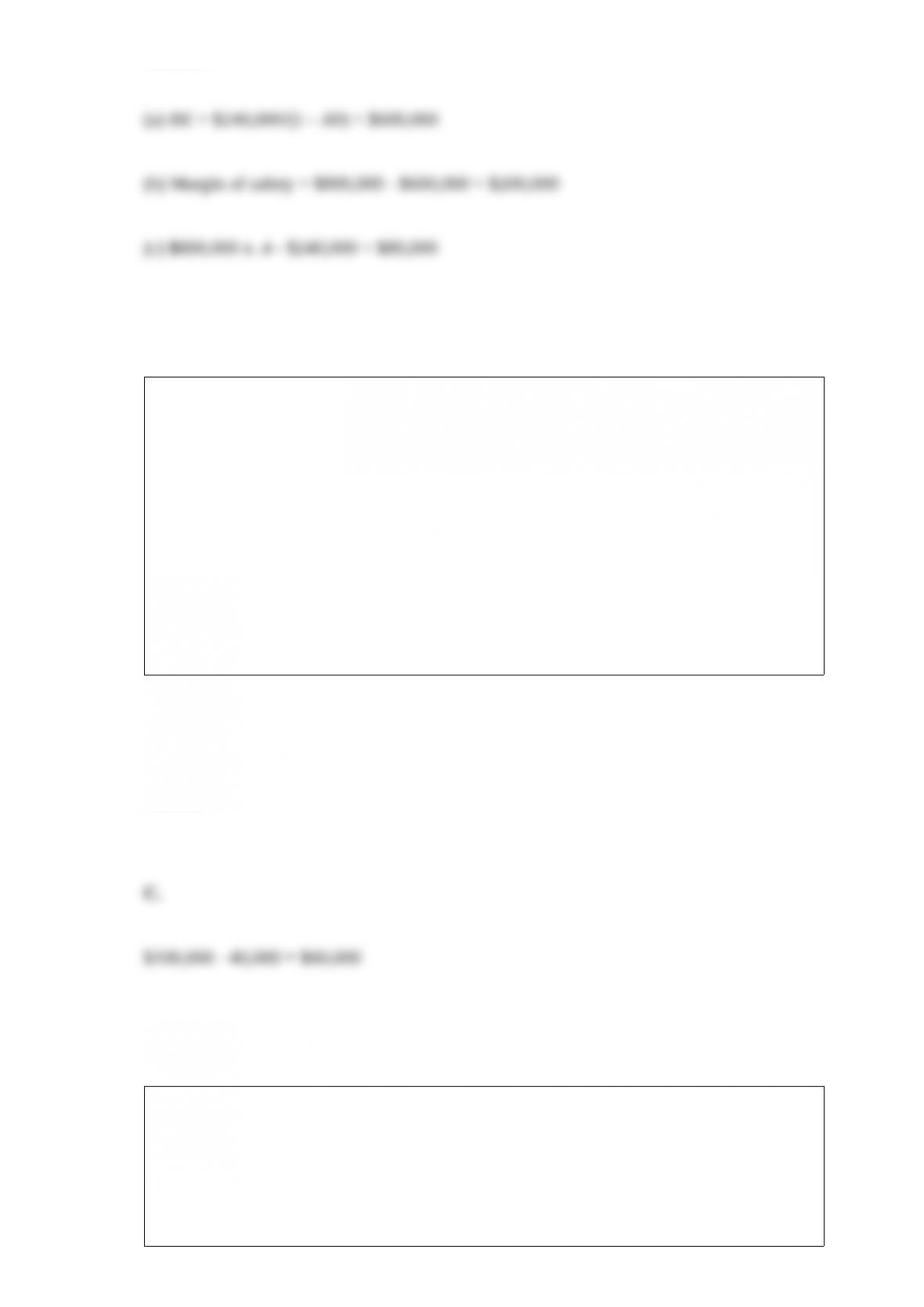
Rosy’s Creations has budgeted annual fixed costs of $240,000 and an estimated
variable cost ratio of 60%.
Required:
(a) Compute Rosy’s break-even point.
(b) Compute Rosy’s margin of safety if she expects to have revenues of $800,000.
(c) Compute Rosy’s expected operating profit at the $800,000 revenue.
Answer:
The JKL Restaurant had sales revenues and food costs in 2009 of $800,000 and
$600,000, respectively. In 2010, JKL will be introducing a new menu item that will
generate $100,000 in sales revenues and $40,000 in food costs. Assuming no changes
are expected for the other food items, the differential operating profit for 2010 is
A. $260,000.
B. $100,000.
C. $60,000.
D. $40,000.
Answer:
Companies using activity-based costing (ABC) have learned that costs are a function
of
A. volume and activities.
B. time and complexity.
C. volume and time.
D. resources and time.
E. volume and resources.
Answer:
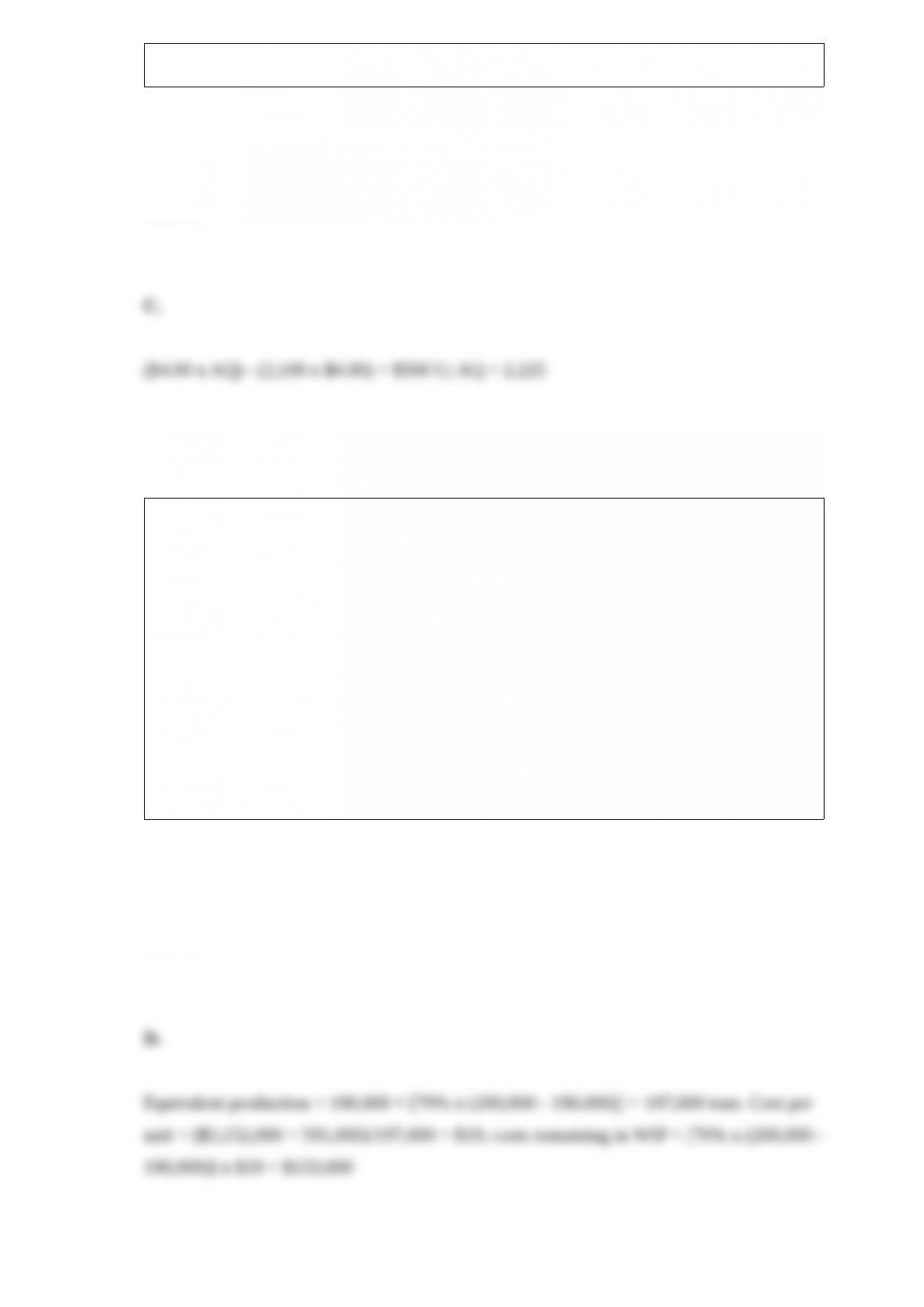
The following information summarizes the standard cost for producing one metal
tennis racket frame. In addition, the variances for one month’s production are given.
Assume that all inventory accounts have zero balances at the beginning of the month.
What were the actual quantity of materials used during the month?
A. 2,156.
B. 2,100.
C. 2,225.
D. 1,975.
Answer:
Lo-crete produces quick setting concrete mix. Production of 200,000 tons was started
in April, 190,000 tons were completed. Material costs were $3,152,000 for the month
while conversion costs were $591,000. There was no beginning work-in-process; the
ending work-in-process was 70% complete. What is the cost of the product that remains
in work-in-process?
A. $591,000
B. $131,005
C. $187,150
D. $133,000
Answer:
Which department is customarily held responsible for an unfavorable materials
quantity variance?
A. Quality control.
B. Purchasing.
C. Engineering.
D. Production.
Answer:
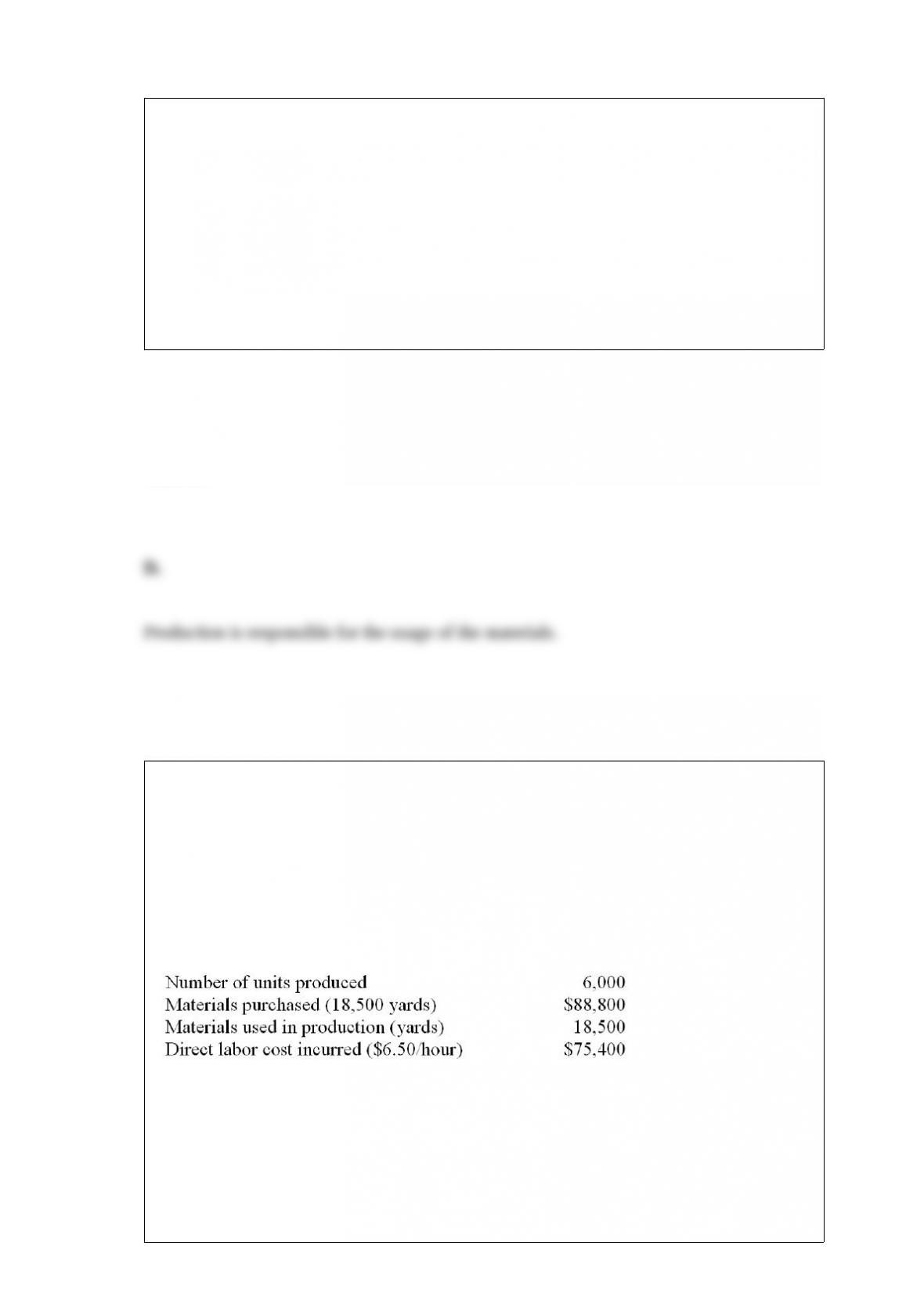
The XYZ Company uses a standard cost accounting system and estimates production
for the year to be 60,000 units. At this volume, the company’s variable overhead costs
are $.50 per direct labor hour.
The company’s single product has a standard cost of $30.00 per unit. Included in the
$30.00 is $13.20 for direct materials (3 yards) and $12.00 of direct labor (2 hours).
Production information for the month of March follows:
Required: (Be sure to indicate whether the variances are favorable or unfavorable.)
a) Compute the direct material price variance.
b) Compute the direct material efficiency variance.
c) Compute the direct labor price (rate) variance.
d) Compute the direct labor efficiency variance.
Answer:
The predetermined manufacturing overhead rate for the year was $14.00 per direct
labor hour; employees were paid $17.50 per hour. If the estimated direct labor cost was
$315,000, what was the estimated manufacturing overhead?
A. $22,500
B. $90,000
C. $252,000
D. $393,750
Answer:
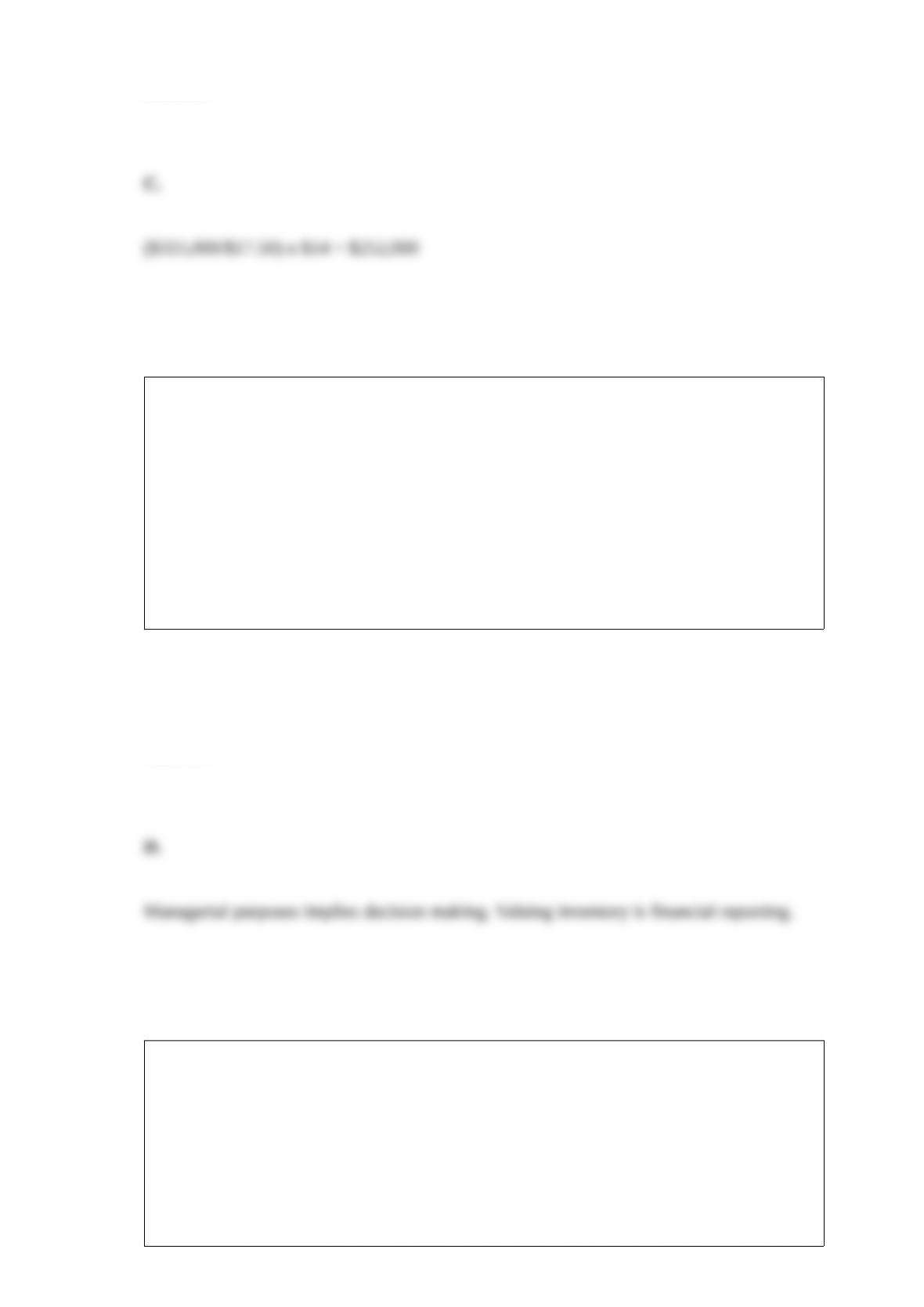
Which of the following statements does not reflect one of the fundamental themes
underlying the design of cost systems for managerial purposes?
A. Cost systems should have a decision focus.
B. Different cost information is used for different purposes.
C. Cost information for managerial purposes must meet the cost-benefit principle.
D. The primary purpose of cost systems is to gather information to value inventory.
Answer:
The Sarbanes-Oxley Act of 2002 requires that management of publicly traded
companies
A. use investment centers to evaluate top managers.
B. report on the adequacy of the company’s internal controls over financial reporting.
C. compensate managers with fixed compensation plans only.
D. eliminate stock options for managerial compensation.
Answer:
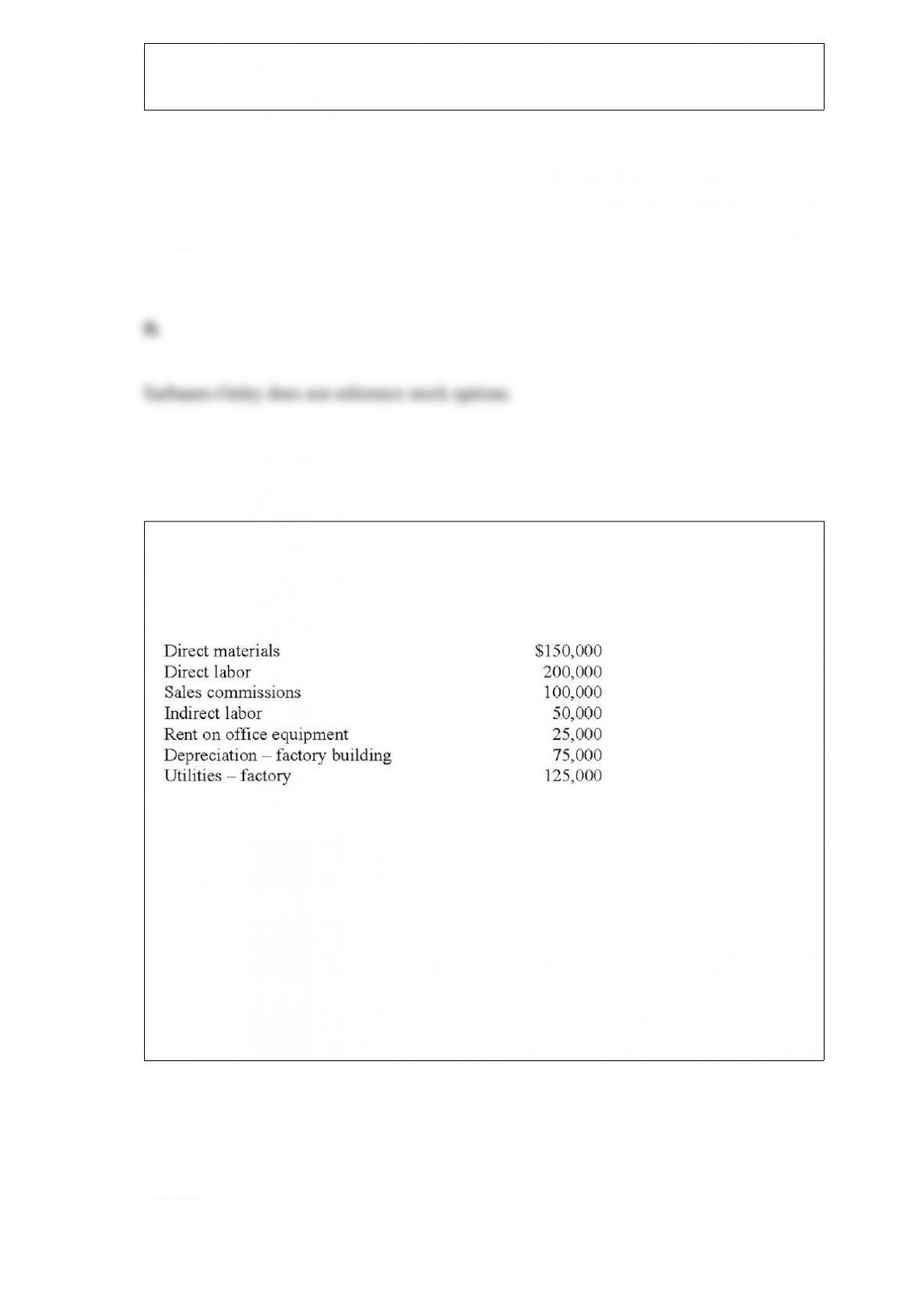
Techniques, Inc. uses a predetermined manufacturing overhead rate based on direct
labor hours to apply its indirect product costs to jobs. The following information has
been collected for the previous year:
Techniques used 25,000 direct labor hours and 50,000 machine hours during the
previous year. What is the predetermined overhead rate per direct labor hour?
A. $24.00
B. $15.00
C. $14.00
D. $10.00
Answer:
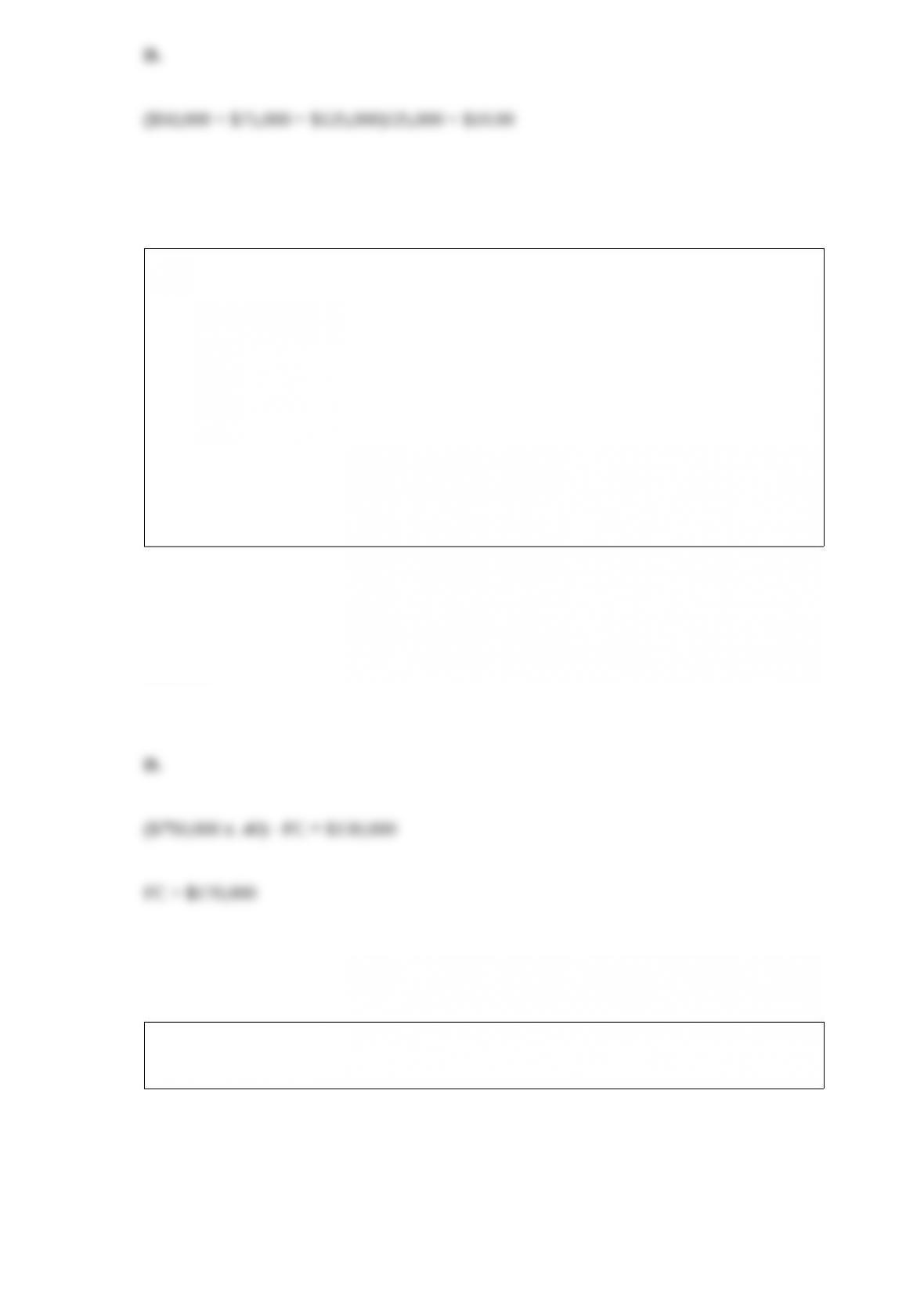
XYZ Company’s sales are $750,000 with operating profits of $130,000. If the
contribution margin ratio is 40%, what did the fixed costs amount to?
A. $370,000.
B. $300,000.
C. $270,000.
D. $170,000.
E. $130,000.
Answer:
BC Enterprises’ quality control report for August contains the following items.
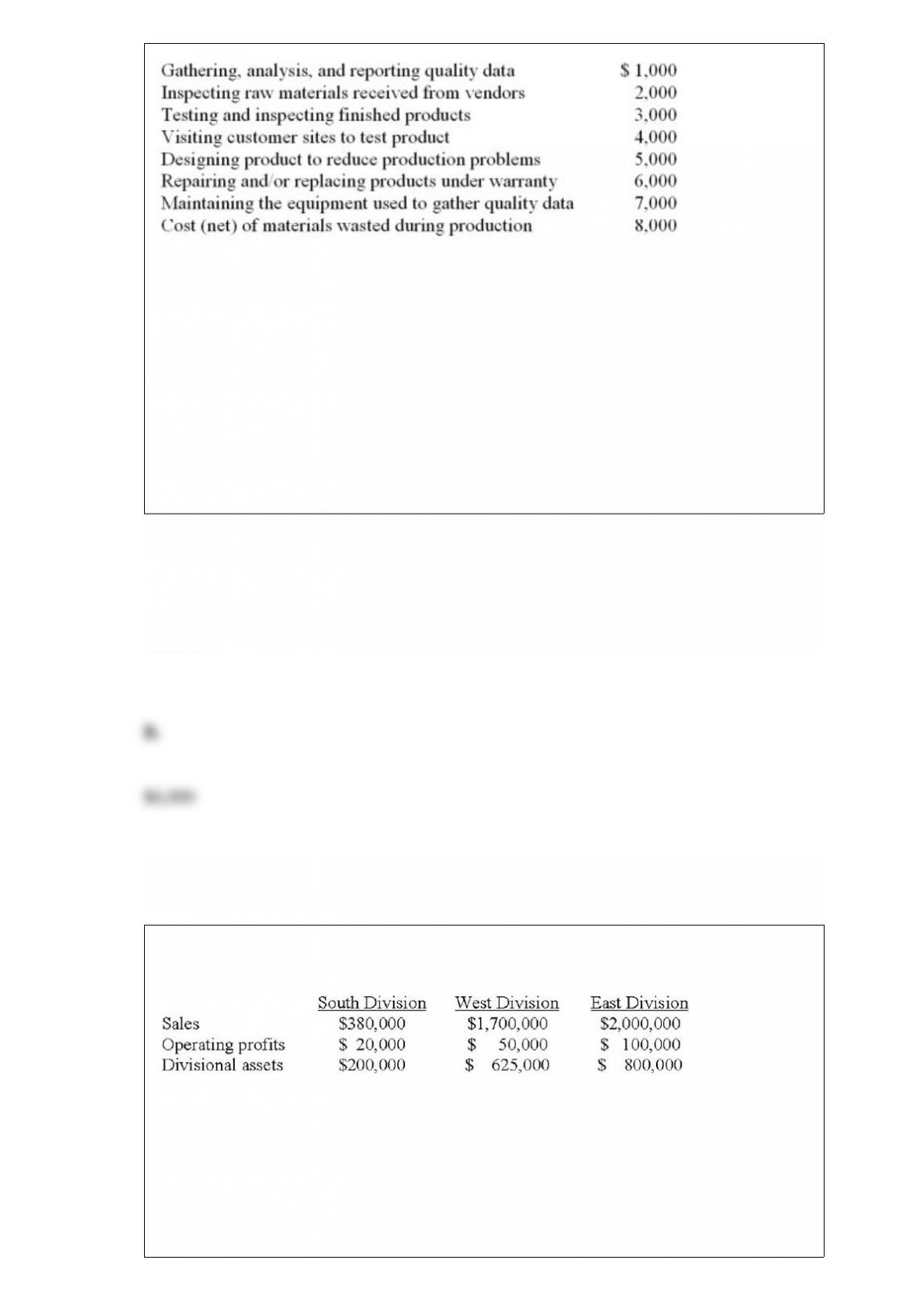
What would be the total of the external failure costs on the August quality control
report for BC Enterprises?
A. $4,000
B. $6,000
C. $7,000
D. $14,000
Answer:
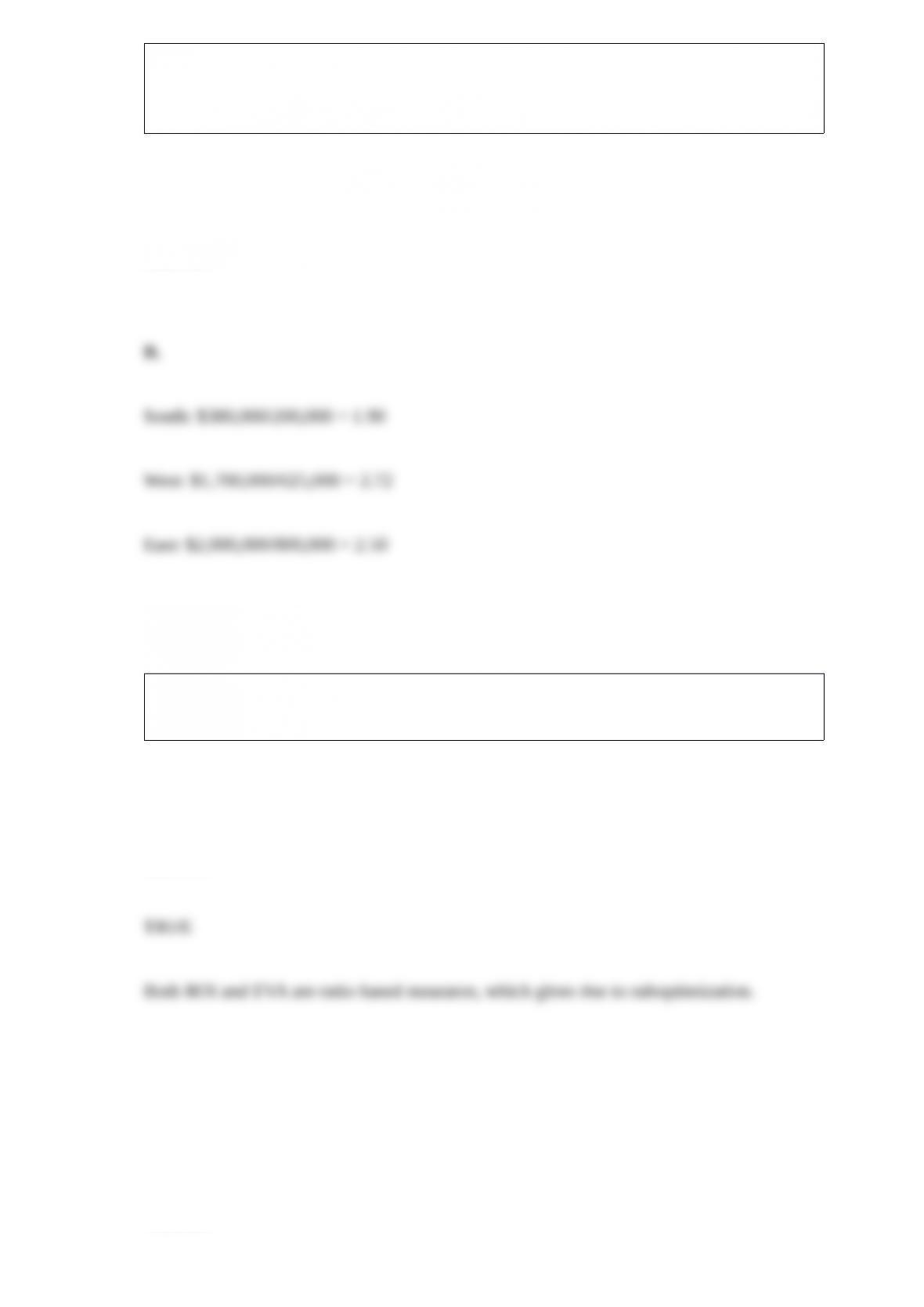
The Multidivision Corporation reported the following operating results for its three
divisions: South, West, and East.
Which division has the largest asset turnover?
A. South
B. West
C. East
D. All three divisions are the same
Answer:
Like return on investment (ROI), economic value added (EVA) adjustments fail to
sufficiently address the sub-optimization problem.
Answer:
Answer:
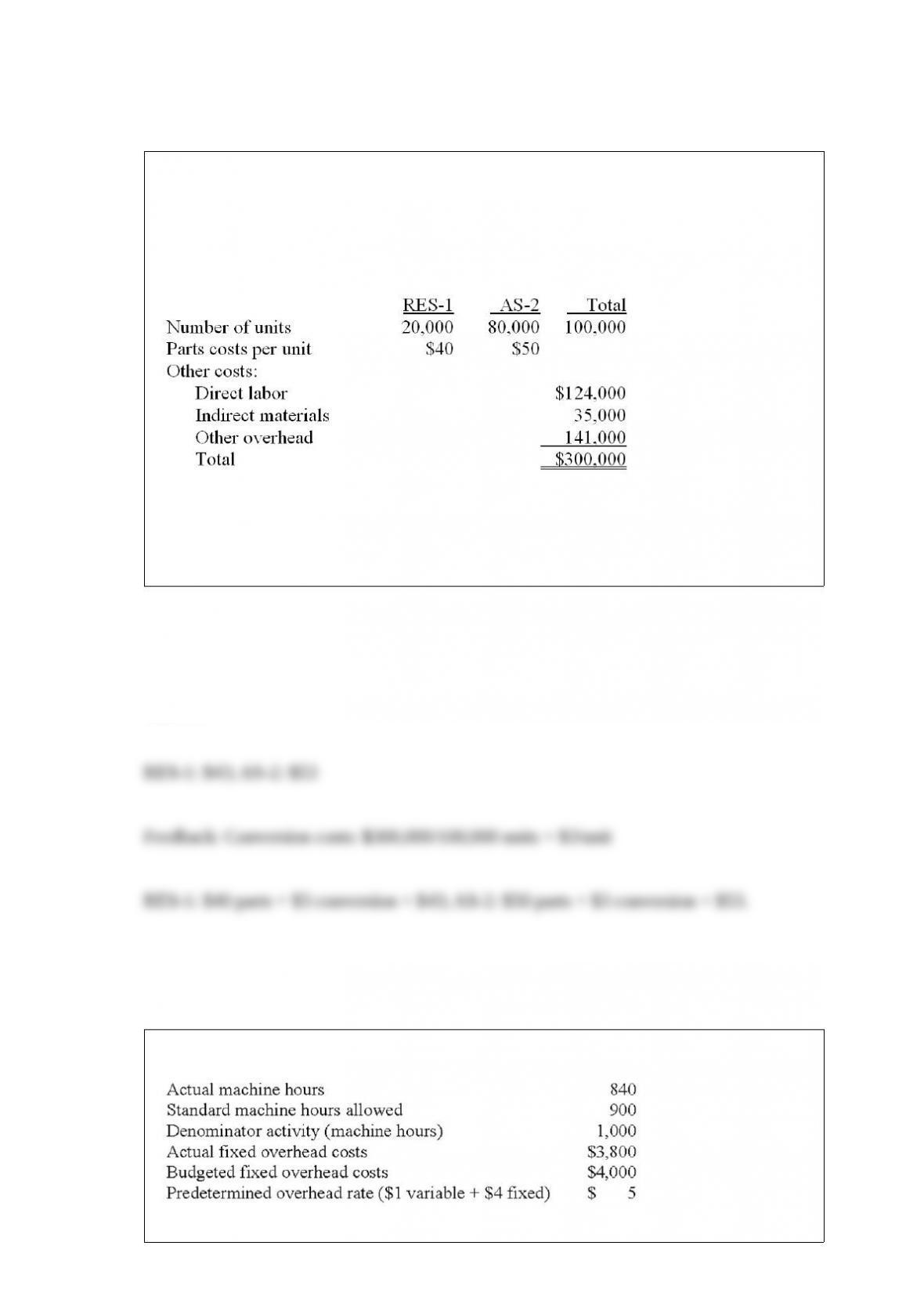
Wisigan Instruments manufactures two models of calculators. The research model is
the RES-1 and the student model is the AS-2. Both models are assembled in the same
plant and require the same assembling operations. The difference is in the cost of the
internal components. The following data are available for February.
Wisigan uses operations costing and assigns conversion costs on the number of units
assembled.
Required: Compute the cost of the RES-1 and AS-2 models for February.
Answer:
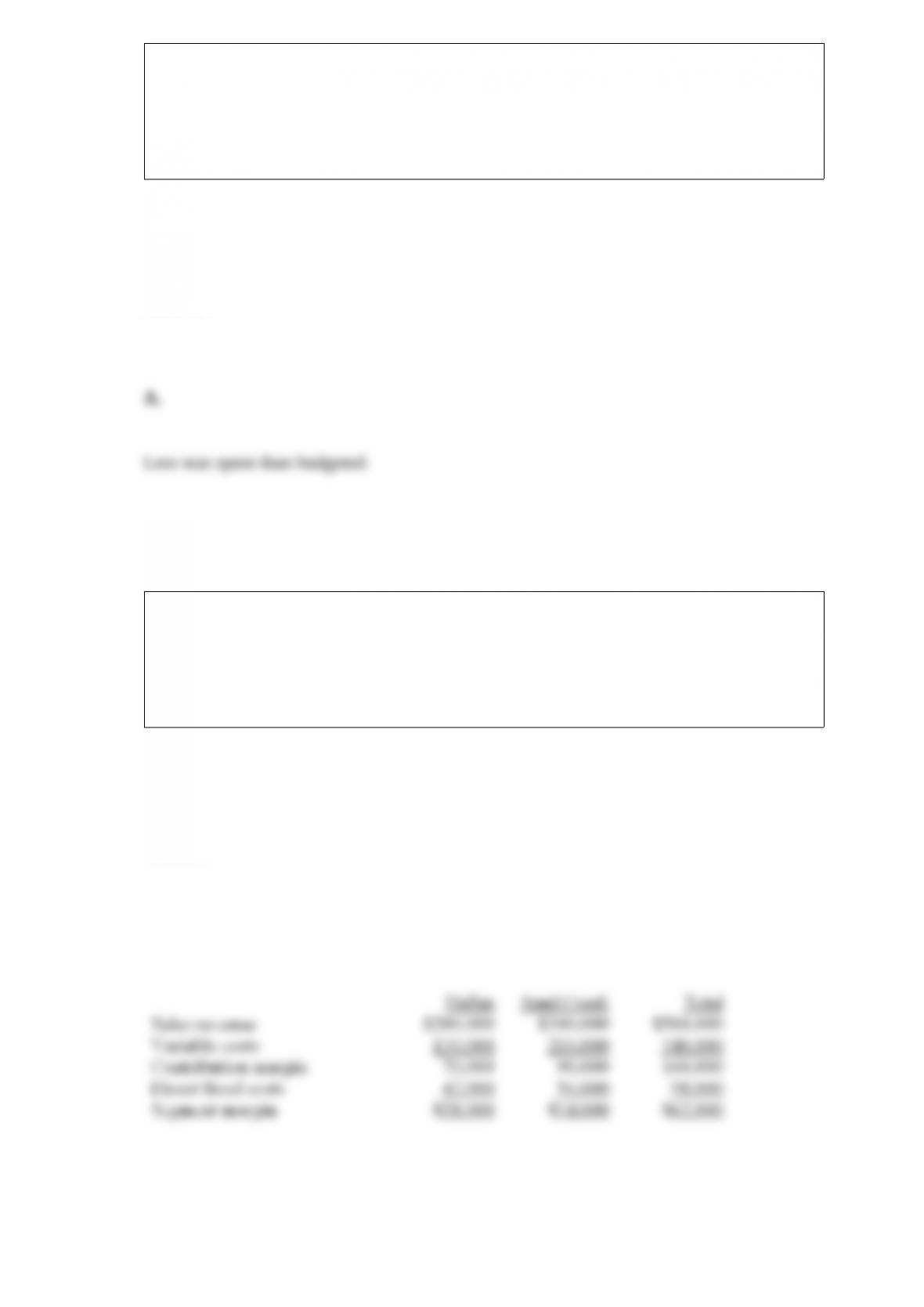
Is the fixed overhead spending (budget) variance favorable or unfavorable?
A. favorable
B. unfavorable
Answer:
Cameron Tool Company has two retail stores, one in Dallas and the other in Sand
Creek. The Dallas store had sales of $200,000, a contribution margin of 35 percent, and
a segment margin of $28,000. The company’s two stores have total sales of $500,000,
an average contribution margin of 32 percent, and a total segment margin of $62,000.
Prepare a segmented contribution approach statement for Cameron.
Answer:
Explain the differences between life-cycle product costing and target costing.
Answer:
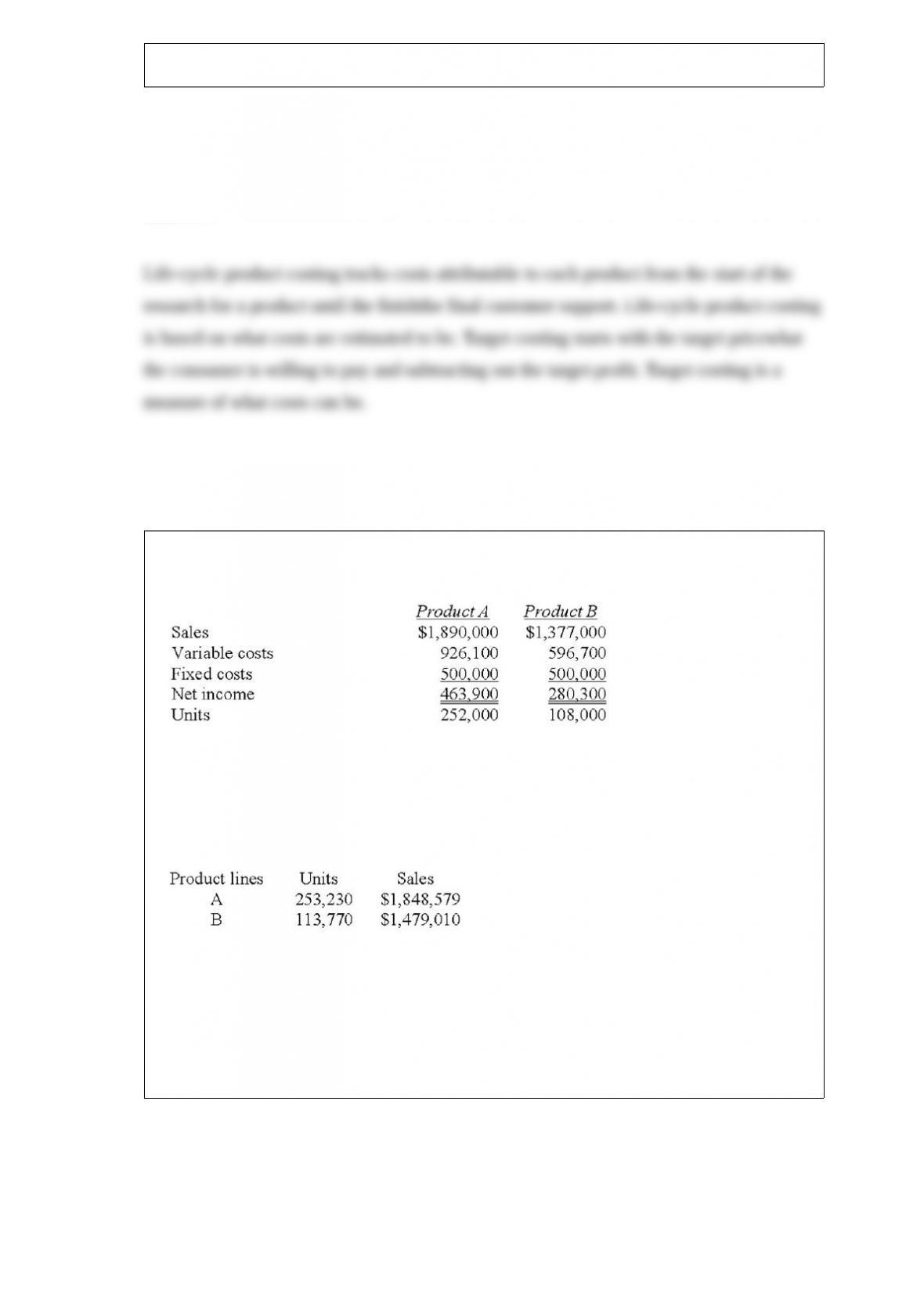
The next year’s budget for Green, Inc., a multi-product company, is given below:
At the end of the year, the total fixed costs and the variable costs per unit were exactly
as budgeted, but the following units per product line were sold. Green analyzes the
effects its sales variances have on the profitability of the company.
Is the total sales price variance favorable or unfavorable?
A. favorable.
B. unfavorable.
Answer:
Explain the difference between total contribution margin and gross margin.
Answer:
Answer:
If costs are allocated on a somewhat arbitrary base, what purpose does computing
product costs have?
Answer:
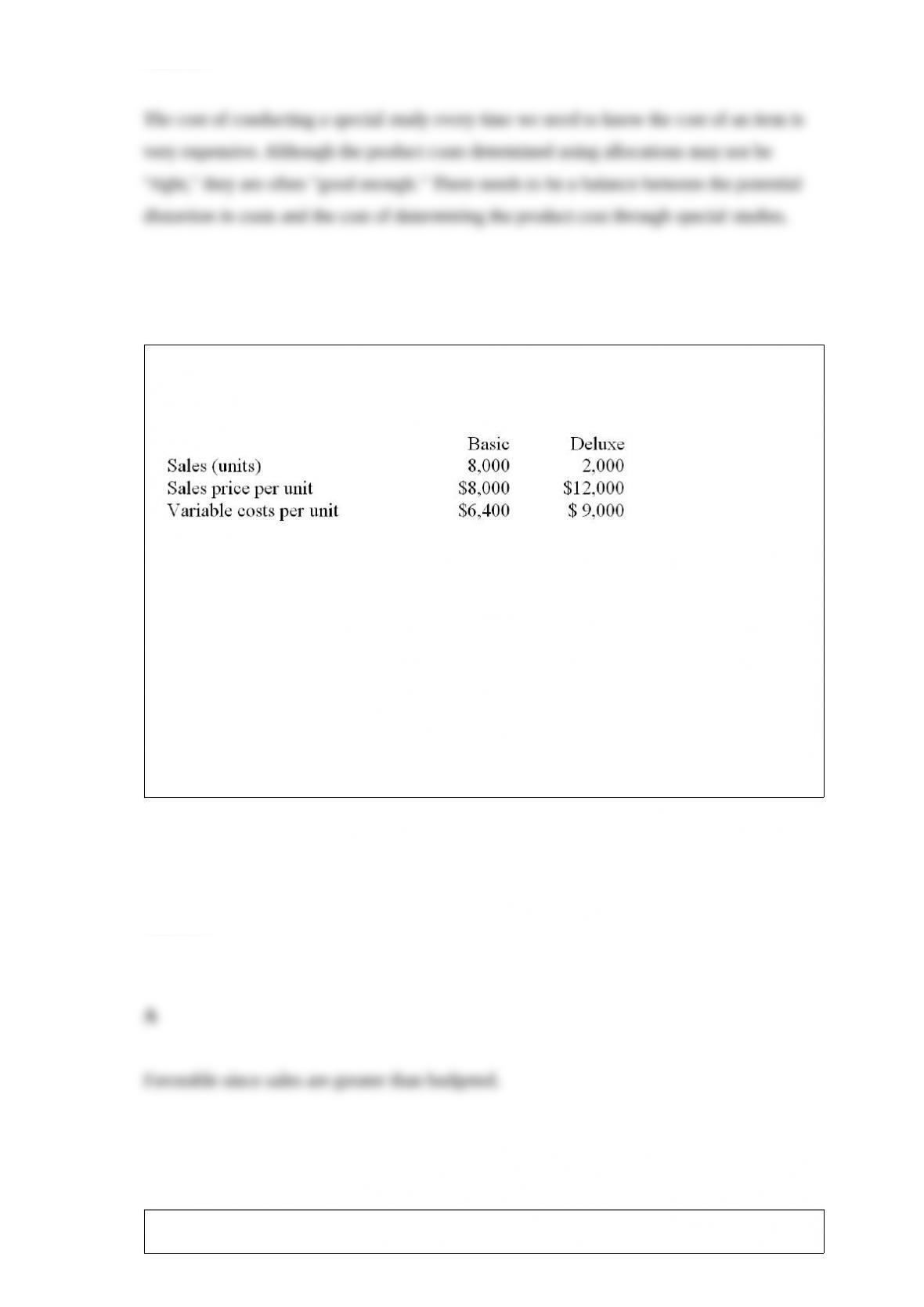
A machine distributor sells two models, basic and deluxe. The following information
relates to its master budget.
Actual sales were 7,000 basic models and 2,800 deluxe models. The actual sales prices
were the same as the budgeted sales prices for both models.
Is the sales activity variance for the deluxe model favorable or unfavorable?
A. favorable.
B. unfavorable.
Answer:
Describe two alternative approaches to the handling of over- or underapplied

overhead.
Answer: