
A company may use several different cost drivers to allocate its indirect costs.
When computing the break-even point in units, a company should round to the next
whole unit because partial units ordinarily are not sold.
The weighted average method of calculating equivalent units does not account for the
state of completion of units in beginning work in process inventory.
Lax standards make allowances for normal material waste and spoilage.
Both job-order and process costing require cost averaging procedures.

Assuming that the number of units produced exceeds the number of units sold,
misclassifying period costs as product costs will overstate net income relative to what
net income would be without this error.
A low magnitude of operating leverage is best for most companies.
Product costs are immediately recorded in expense accounts when the products are
manufactured.
How a particular cost behaves (fixed versus variable) is dependent of whether the cost
is classified as direct or indirect.

The cost of capital represents the maximum acceptable rate of return that a capital
investment should earn.
An alternative under consideration involves incurring $50 in costs to generate $60 in
revenue. The differential revenue for this alternative is $10.
Under the indirect method, losses would be added to net income when determining the
amount of cash flow from operating activities.
Traditional cost systems usually allocate overhead to products on the basis of direct
labor.
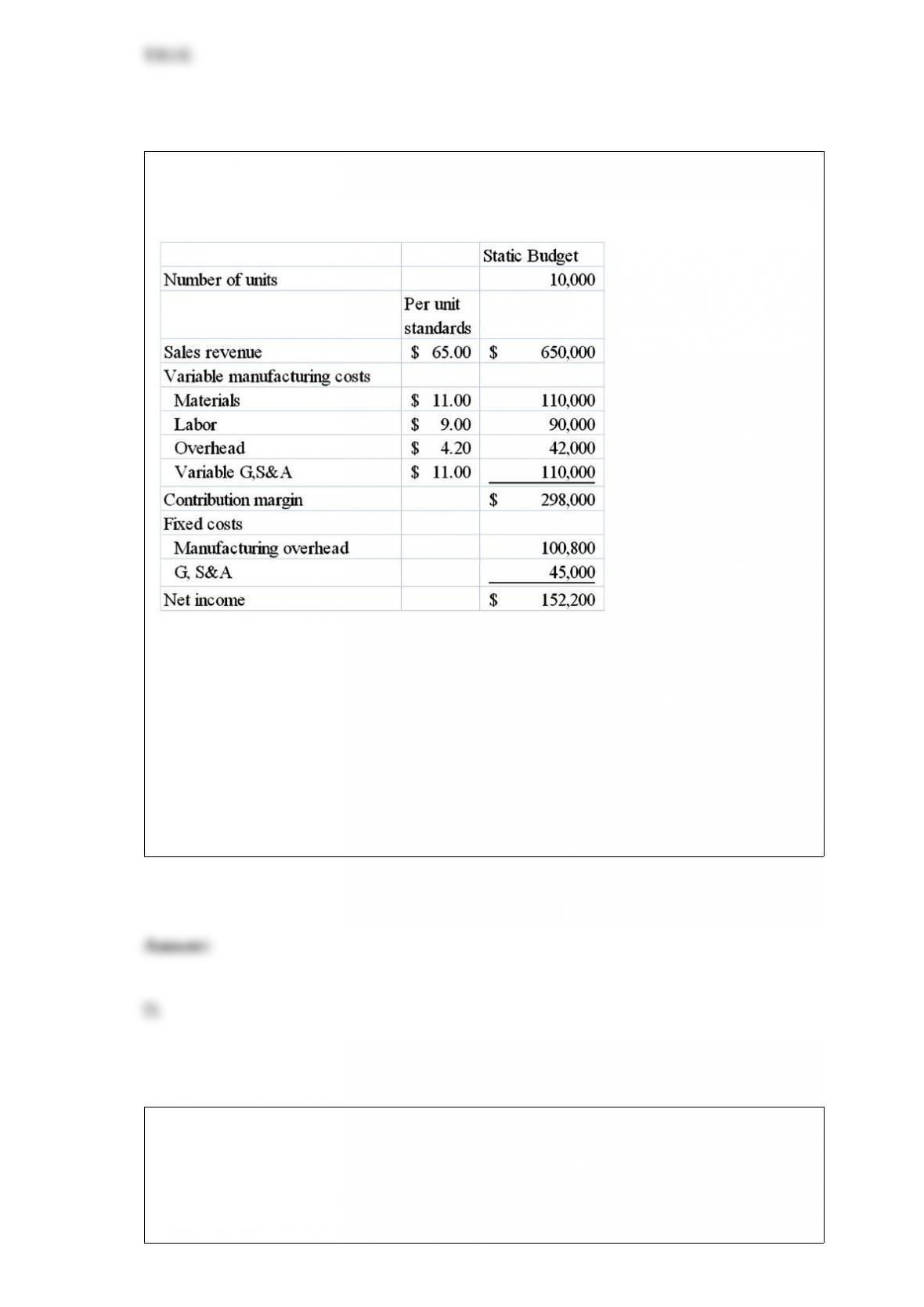
Stafford Company prepared a static budget that for a production and sales volume of
10,000 units.
What is net income if 9,000 units are sold?
A. $152,100
B. $152,400
C. $137,300
D. $122,400
Which of the following activity costs should usually be ignored when making a
decision regarding whether to eliminate a product?
A. Product-level costs

B. Batch-level costs
C. Unit-level costs
D. Facility-level costs
O’Hare Company, is a manufacturing firm that uses a job-order cost system to
determine the costs of its products. During 2014, O’Hare paid $700 for equipment rental
and other indirect costs. The recognition of this event would:
A. Decrease total assets.
B. Increase total assets.
C. Reduce net income.
D. Have no impact on total assets.
Which of the following items would be least useful in preparing a schedule of cash
receipts?
A. Expected revenue from cash sales.
B. Number of units expected to be purchased.
C. Service charges for credit card sales.
D. Past accounts receivable collection experience.
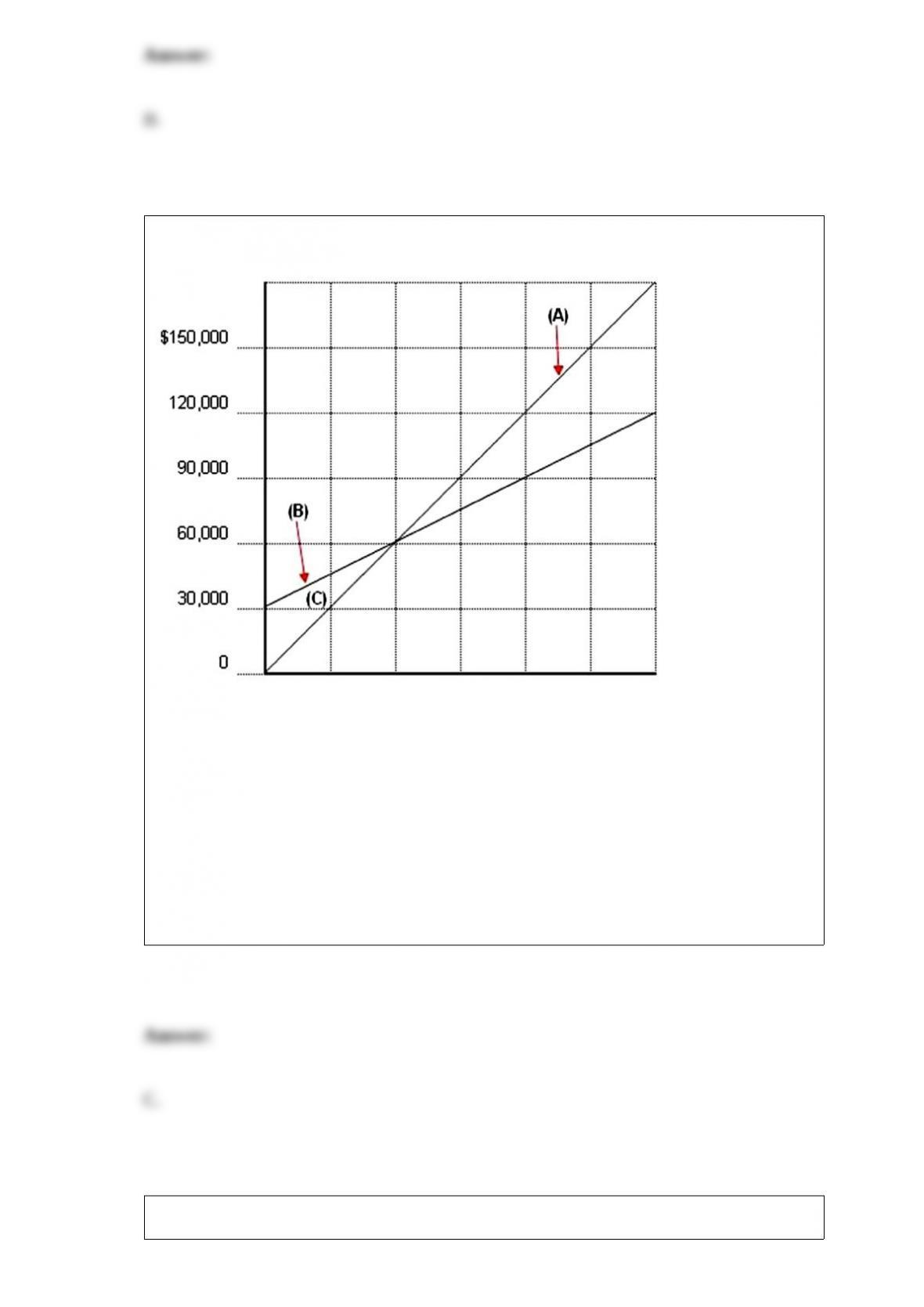
Consider the following cost-volume-profit graph:
Based on the information in the graph, the breakeven point in sales dollars is
approximately equal to:
A. $50,000.
B. $30,000.
C. $60,000.
D. $20,000.
Generro Company is considering the purchase of equipment that would cost $36,000

and offer annual cash inflows of $10,500 over its useful life of 5 years. Assuming a
desired rate of return of 12%, is the project acceptable?
A. No, since the negative net present value indicates the investment will yield a rate of
return below the desired rate of return.
B. Yes, since the investment will generate $52,500 in future cash flows, which is greater
than the purchase cost of $36,000.
C. Yes, since the positive net present value indicates the investment will earn a rate of
return greater than 12%.
D. The answer cannot be determined.
Wu Company incurred $40,000 of fixed cost and $50,000 of variable cost when 4,000
units of product were made and sold.
If the company’s volume increases to 5,000 units, the company’s total costs will be:
A. $100,000
B. $90,000
C. $102,500
D. $80,000
The following income statements are provided for Li Company’s last two years of
operation:
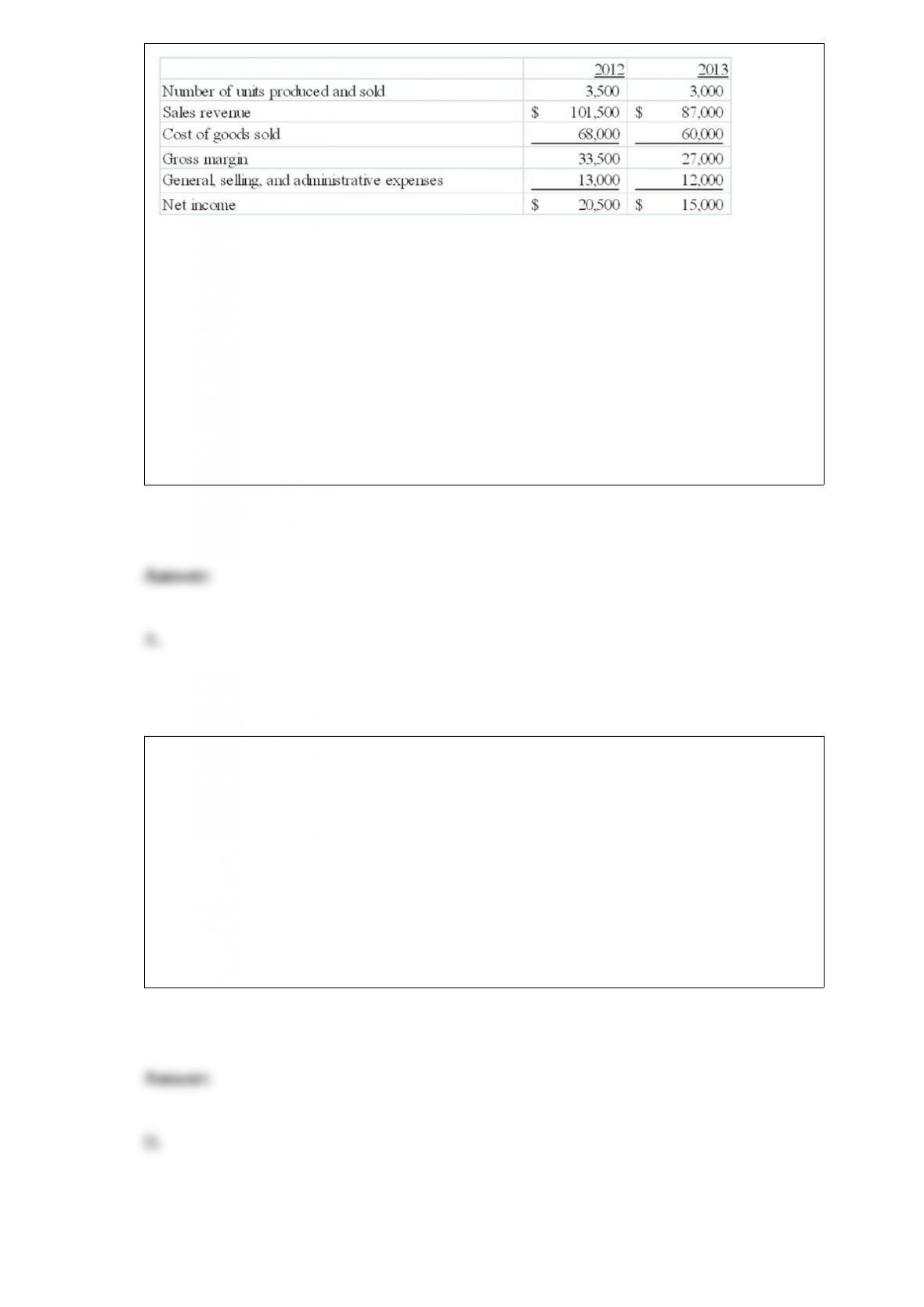
Assuming that cost behavior did not change over the two year period, what is the
annual amount of the company’s fixed manufacturing overhead?
A. $12,000
B. $24,000
C. $26,000
D. None of these
Which of the following would represent the order in which most master budgets are
prepared?
A. Sales, Income Statement, Cash, Purchases
B. Purchases, Cash, Sales, Income Statement
C. Purchases, Sales, Cash, Income Statement
D. Sales, Purchases, Cash, Income Statement
The Upton Company reported a beginning balance of $1,600 and an ending balance of
$2,200 in its unearned revenue account for 201 During the year, $8,000 of revenue was
recognized. Based on this information, how much cash was received from customers?
A. $8,000
B. $8,600
C. $8,200
D. $9,000
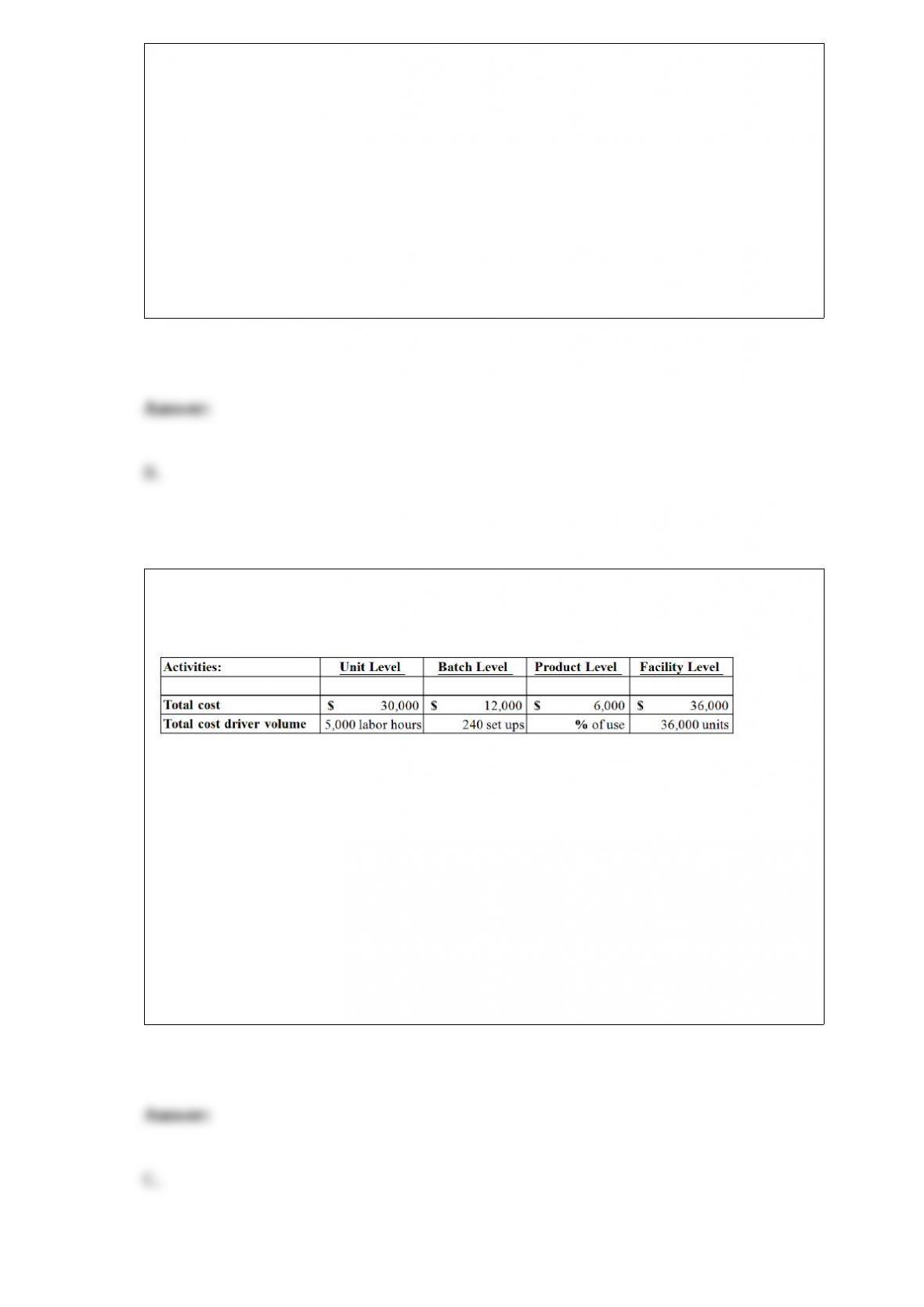
Rocoe Company produces a variety of garden tools in a highly automated
manufacturing facility. The costs and cost drivers associated with four activity cost
pools are given below:
Production of 10,000 units of a hand-held tiller required 1,000 labor hours, 80 setups,
and consumed 25% of the product sustaining activities. Assuming the company uses
activity-based costing, how much total overhead will be allocated to this tool?
A. $84,000
B. $26,000
C. $21,500
D. $11,500

Select the incorrect statement regarding the contribution margin income statement.
A. The contribution margin approach for the income statement is unacceptable for
external reporting.
B. Contribution margin represents the amount available to cover product costs and
thereafter to provide profit.
C. The contribution margin approach requires that all costs be classified as fixed or
variable.
D. Assuming no change in fixed costs, a $1 increase in contribution margin will result
in a $1 increase in profit.
If a company misclassifies a general, selling and administrative cost as a product cost in
a period when production exceeds sales:
A. net income will be overstated.
B. total assets will be understated.
C. gross margin will be understated.
D. Both net income will be overstated and gross margin will be understated.
Bates Manufacturing uses a job order cost system, and overhead is applied on the basis
of direct labor hours. At the beginning of the period, the company estimated that
overhead would be $64,000 and 10,000 direct labor hours would be worked. Two
projects were started and completed in the current accounting period. The following
transactions were completed during the period:

(a) Used $10,000 of direct material on Project I and $6,800 of direct material on Project
II.
(b) Labor costs for the two jobs amounted to the following: Project I, $24,000 (2,000
hours); Project II, $44,000 (6,000 hours).
(c) Project II was sold during the period for $120,000.
The company’s gross margin for the period was (Do not round your intermediate
calculation):
A. $30,800.
B. $18,000.
C. $89,200.
D. $69,200.
McDonnell Industries estimated manufacturing overhead for the year at $290,000.
Manufacturing overhead for the year was underapplied by $12,000. The company
applied $235,000 to work in process. The amount of actual overhead would have been:
A. $247,000.
B. $278,000.
C. $223,000.
D. none of these.

On January 1, 2014, the balance of Fink Corporation’s accounts receivable was
$10,000. Sales on account for 2014 amounted to $80,000 and the ending balance of
accounts receivable was $16,000. What is the amount of cash collected from
customers?
A. $64,000
B. $90,000
C. $86,000
D. $74,000
Which of the following activity costs would not likely be included in a unit-level
activity cost pool?
A. Indirect material
B. Packaging costs
C. Machine setup costs
D. Machine-related utilities
White Company budgeted for $200,000 of fixed overhead cost and volume of 40,000
units. During the year, the company produced and sold 39,000 units and spent $210,000
on fixed overhead.
The fixed overhead cost spending variance is:

A. $10,000 favorable.
B. $10,000 unfavorable.
C. $5,000 favorable.
D. $5,000 unfavorable.
Hansen Corporation reported net income of $328,000 for the current year. In addition,
accounts payable increased $24,000 during the year, inventory increased by $15,000,
and accounts receivable decreased by $20,000. Using the indirect method, what is the
net cash provided by operations?
A. $387,000
B. $357,000
C. $328,000
D. $317,000
An investment that cost $30,000 provided annual cash inflows of $9,000 per year for
five years. The desired rate of return is 10%. The internal rate of return from the
investment was (Do not round your PV factors and intermediate calculations):
A. less than the desired rate of return.
B. equal to the desired rate of return.
C. greater than the desired rate of return.
D. the answer cannot be determined from the information provided.
Indicate whether each of the following statements is true or false.
Eliminating a batch of work eliminates both batch-level and product-level costs.
Increasing the number of units in a batch increases batch-level costs.
Product-level costs are incurred to support specific products or services.
Some inventory management costs and engineering design costs are product-level costs.
Personnel administration and insurance are examples of facility-level costs.
Crawford Company’s current ratio for 2014 was 1.42, which was slightly above the
current ratio for similar companies in its industry. Crawford’s quick ratio for 2014 was
0.68, which is substantially lower than for similar companies in its industry. What
conclusion would you reach based on this information?

Indicate whether each of the following statements is true or false:
Calculation of a predetermined overhead rate is based on estimates and can be done at
the beginning of a period.
A spending variance is the difference between applied overhead costs and estimated
overhead costs.
A difference between the actual and estimated volume of activity causes a volume
variance.
A volume variance is unfavorable if actual volume is greater than expected.
For an accounting period, the volume variance is amount by which overhead was over-
or under-applied.
Indicate whether each of the following statements is true or false.
Purchase of raw materials on account is an asset exchange transaction.
Placing raw materials into production is an asset use transaction.
When raw materials are placed into production, total assets are not affected.
When raw materials are placed into production, the balance in Work in Process
increases.
Purchasing manufacturing supplies for cash is an asset use transaction.
Indicate whether each of the following statements is true or false.
Depreciation expense on a building or equipment is an example of a sunk cost.
Addison Company is using a hole-punching machine that originally cost $80,000 and
has a current market value of $45,000. The $45,000 is a measure of the opportunity cost
for continuing to use the machine.
The purchase price of a old machine is relevant to the decision of whether or not to
replace an old machine.
The estimated salvage value of new equipment is relevant to the decision to purchase
the new equipment even though it will not happen until the end of the asset’s useful life.
A department manager who feels pressured to maintain short-term profitability may
decide to keep old equipment, even when replacing the equipment would be in the
company’s best interest.
Describe the general approaches companies may use in evaluating potential capital
investments.
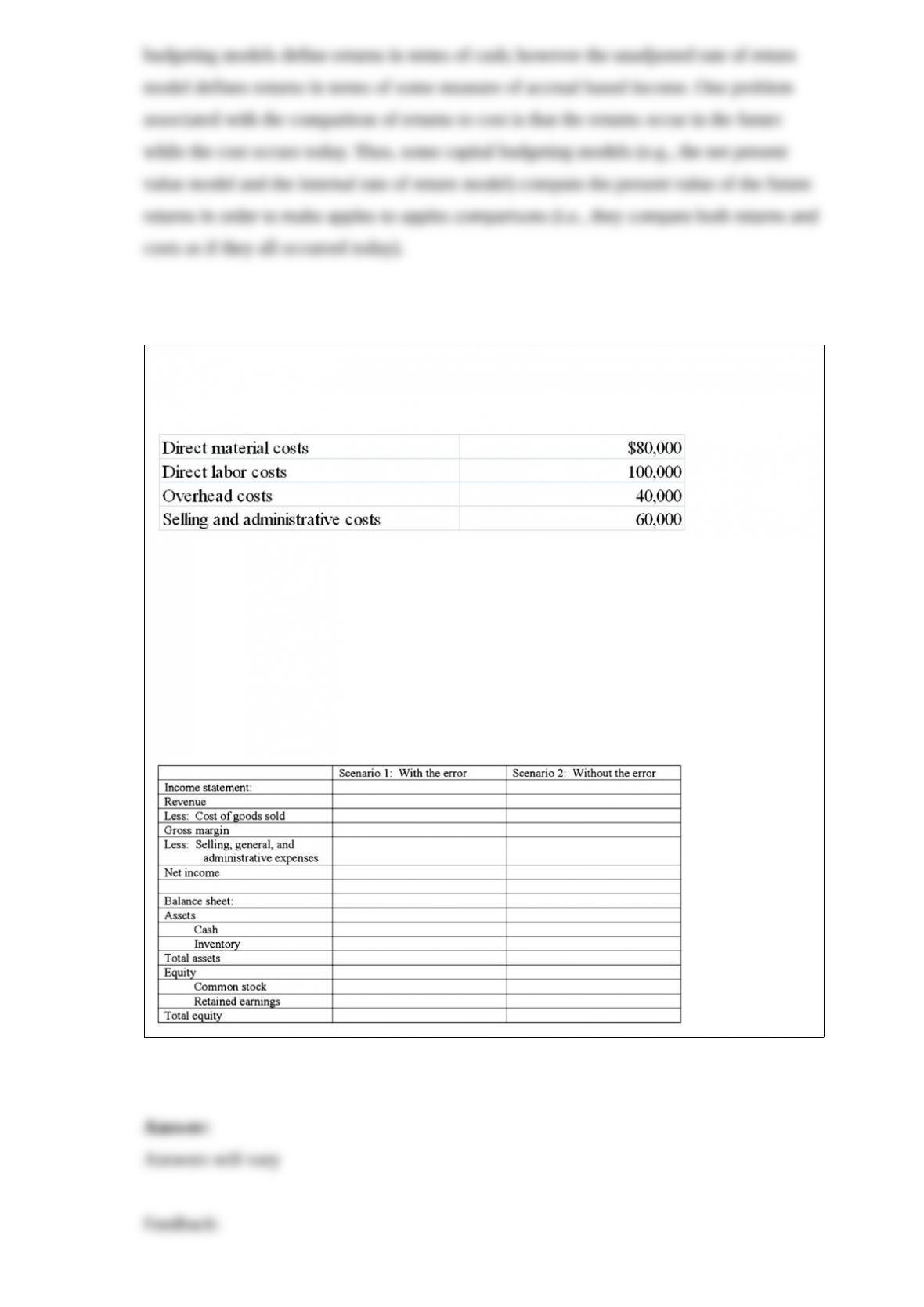
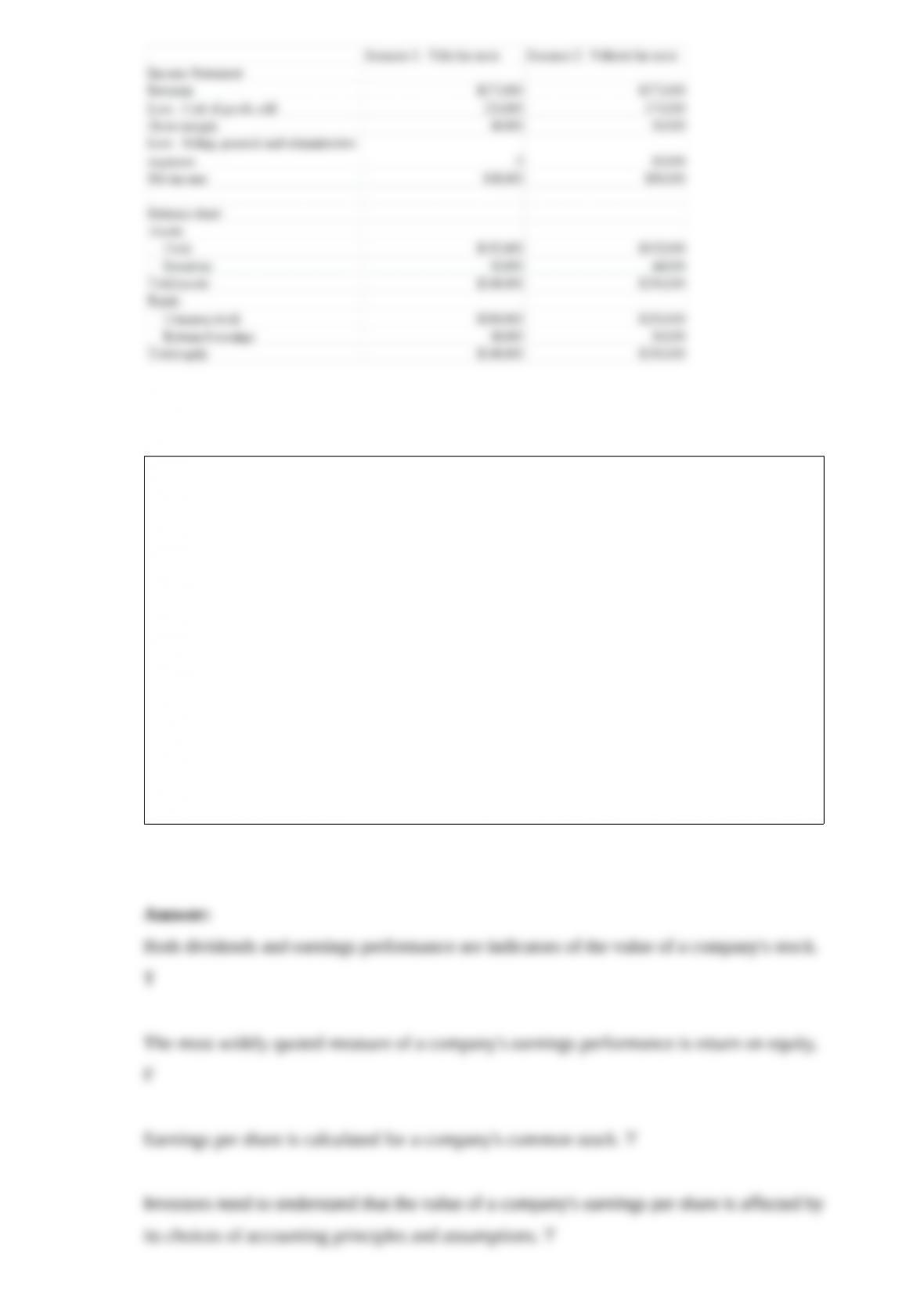
The Jacobson Manufacturing Company was started at the beginning of the current year
when it acquired $200,000 from its owners. During the year, the company incurred the
following costs, all for cash:
The company produced 10,000 units of product and sold 8,000 units. The average
selling price was $34 per unit; all sales were for cash. The accountant who prepared the
firm’s financial statements misclassified the selling and administrative costs as product
costs.
Required:
Demonstrate the impact of the error on the company’s income statement and balance
sheet by completing the following schedule:
Indicate whether each of the following statements about financial statement analysis is
true or false.
Both dividends and earnings performance are indicators of the value of a company’s
stock.
The most widely quoted measure of a company’s earnings performance is return on
equity.
Earnings per share is calculated for a company’s common stock.
Investors need to understand that the value of a company’s earnings per share is affected
by its choices of accounting principles and assumptions.
The book value per share measures the market value of a corporation’s stock.

Indicate whether each of the following statements is true or false.
In deciding whether to investigate a variance, managers should consider the materiality,
but not the type or direction of the variance.
A material variance is one that will influence stockholders’ investment decisions.
The primary advantage of a standard cost system is controlling costs efficiently.
Ideal standards will likely lead to variances that need not be investigated because they
are not the result from abnormalities.
Even a well-established and maintained standard cost system is likely to damage
employee morale.