
Grayson Company is considering purchase of equipment that costs $49,000 and is
expected to offer annual cash inflows of $13,000. Grayson’s minimum required rate of
return is 10%. How many years must the cash flows last, for the investment to be
acceptable? (Do not round your PV factors and intermediate calculations. Round to
nearest whole year.)
A. 4
B. 5
C. 3
D. 6
Which of the following costs is most likely to be directly traceable to a specific
department in a retail clothing store?
A. The cost of heating and air conditioning.
B. The cost of supplies.
C. The cost of the department manager’s salary.
D. Rent on the store building.
Cash outflows from a capital investment project include:
A. increases in operating expenses.
B. the reduction in the amount of working capital.

C. terminal salvage value.
D. all of these answers are correct.
Which of the following is not an adjustment when arriving at net cash provided by
operating activities under the indirect method?
A. Noncash expenses such as depreciation expense
B. Gains and losses on the sale of long-term assets
C. Changes in a company’s long-term assets
D. Changes in noncash current asset and current liability accounts
Which characteristic is true of the scatter graph method, high-low method, and
regression analysis?
A. All methods will produce the same estimate of variable and fixed costs.
B. All methods use historic data to estimate variable and fixed costs.
C. All methods use only two data points in analyzing a mixed cost.
D. None of these is true.

A pricing strategy that sets the price at a premium under the assumption that people will
pay more for the product because of the product’s brand name, media attention, or some
other reason that has piqued the interest of the public is known as:
A. cost-plus pricing.
B. contribution margin-based pricing.
C. target pricing.
D. prestige pricing.
An analysis procedure that uses percentages to compare each of the parts of an
individual statement to a key dollar amount from the financial statements is:
A. Ratio analysis.
B. Contribution analysis.
C. Horizontal analysis.
D. Vertical analysis.
What happens to break-even volume when the contribution margin ratio increases?
A. Break-even volume increases.
B. Break-even volume decreases.
C. Break-even volume stays the same.
D. Not enough information to answer the question.
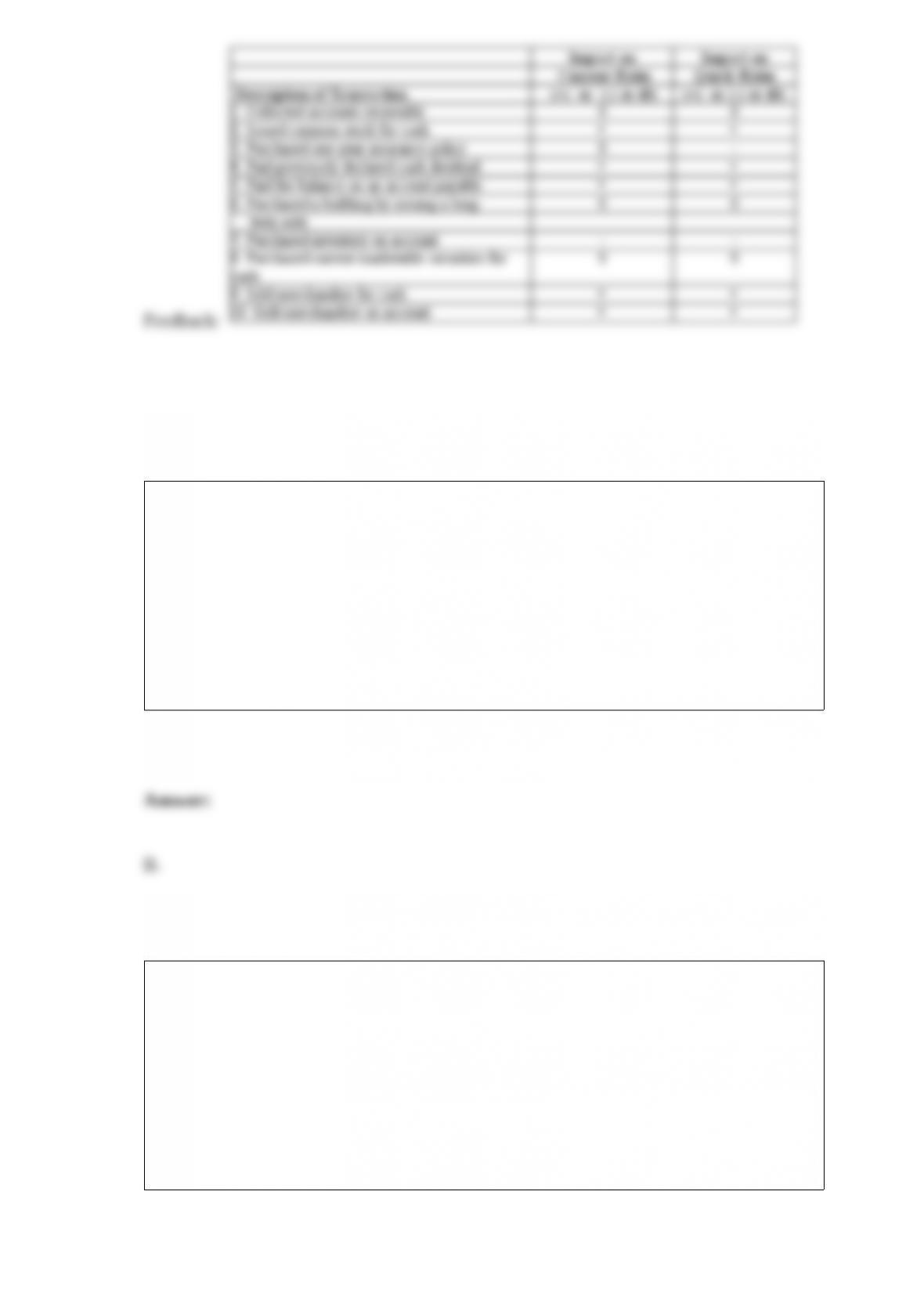
Many companies have to monitor closely certain ratios, such as the current ratio, due to
debt covenants. Selected transactions are provided below for a company that uses a
perpetual inventory system; sells its merchandise at a selling price that exceeds cost;
and had a current ratio of 1.85 and a quick ratio of 1.19 before the event occurred.
Required:
In the above table, indicate whether each transaction would increase (+), decrease (-), or
not affect (0) the company’s current ratio and quick ratio.
Which of the following best represents a characteristic of managerial accounting?
A. Information is historically based and reported annually.
B. Information is based on estimates and is bounded by relevance and timeliness.
C. Information is regulated by the Securities and Exchange Commission.
D. Information is characterized by reliability and objectivity.
The margin of safety ratio can be defined as the:
A. Excess of budgeted sales over break-even sales divided by break-even sales.
B. Excess of budgeted sales over break-even sales divided by budgeted sales.
C. Excess of budgeted sales over fixed costs divided by budgeted sales.
D. Excess of budgeted sales over variable costs divided by budgeted sales.

Paying for factory utilities is a(n):
A. asset exchange transaction.
B. asset use transaction.
C. asset source transaction.
D. claims exchange transaction.
Martin Company currently produces and sells 40,000 units of product at a selling price
of $12. The product has variable costs of $6 per unit and fixed costs of $150,000. The
company currently earns a total contribution margin of:
A. $280,000
B. $200,000
C. $240,000
D. $90,000

Which of the following statements is correct?
A. A postaudit should be conducted at the time a capital investment is purchased.
B. The postaudit of a capital investment project should be made using the same
analytical technique that was used in deciding to make the investment.
C. The purpose of postaudits is to improve a company’s cost-volume-profit analysis.
D. The postaudit process uses expected cash flows and the company’s cost of capital.
The Knott Company reported depreciation expense of $10,000 and net income of
$16,000 on its 2014 income statement. During 2014 the company’s accounts receivable
balance decreased by $4,000. Based on this information, what was the amount of cash
flow from operating activities?
A. $12,000.
B. 16,000.
C. $32,000.
D. $30,000.
Which of the following is not an advantage of using a standard cost system?
A. Promotes the efficient use of management talent to control costs
B. Provides immediate feedback that permits rapid response to problems
C. The easiest cost system to develop and maintain
D. Can boost morale and motivate employees
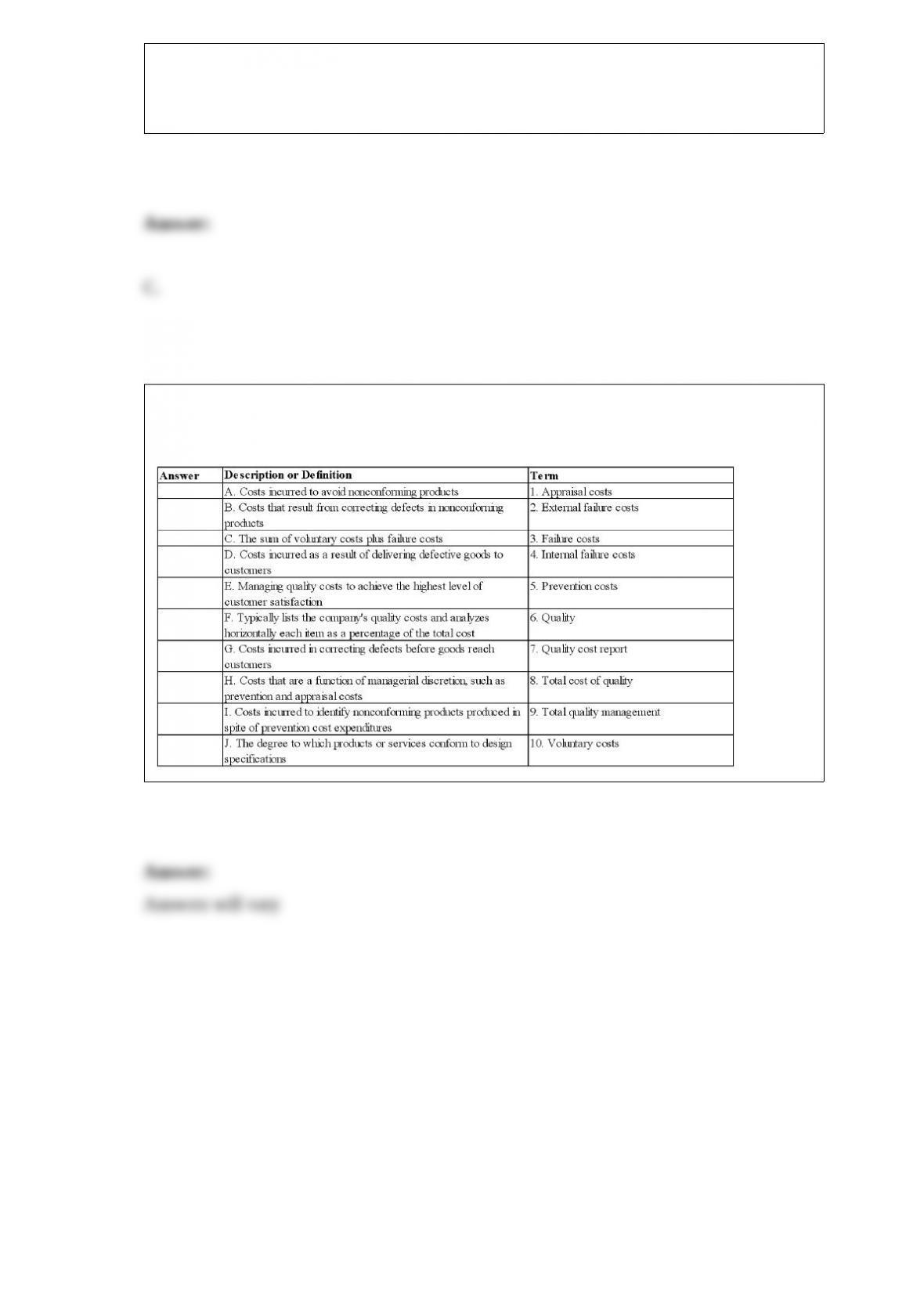
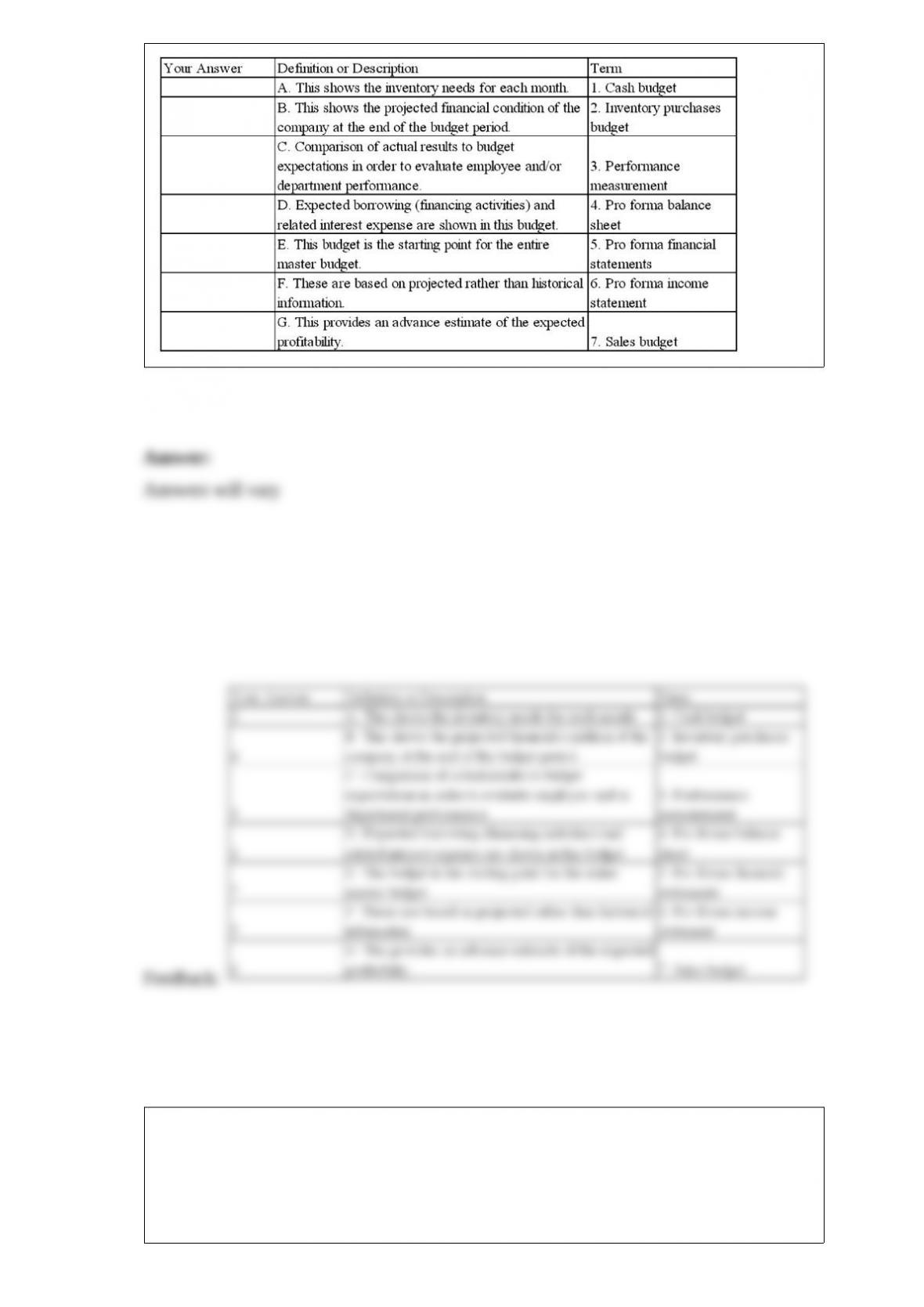
Select the term from the list provided that best matches each of the following
descriptions.
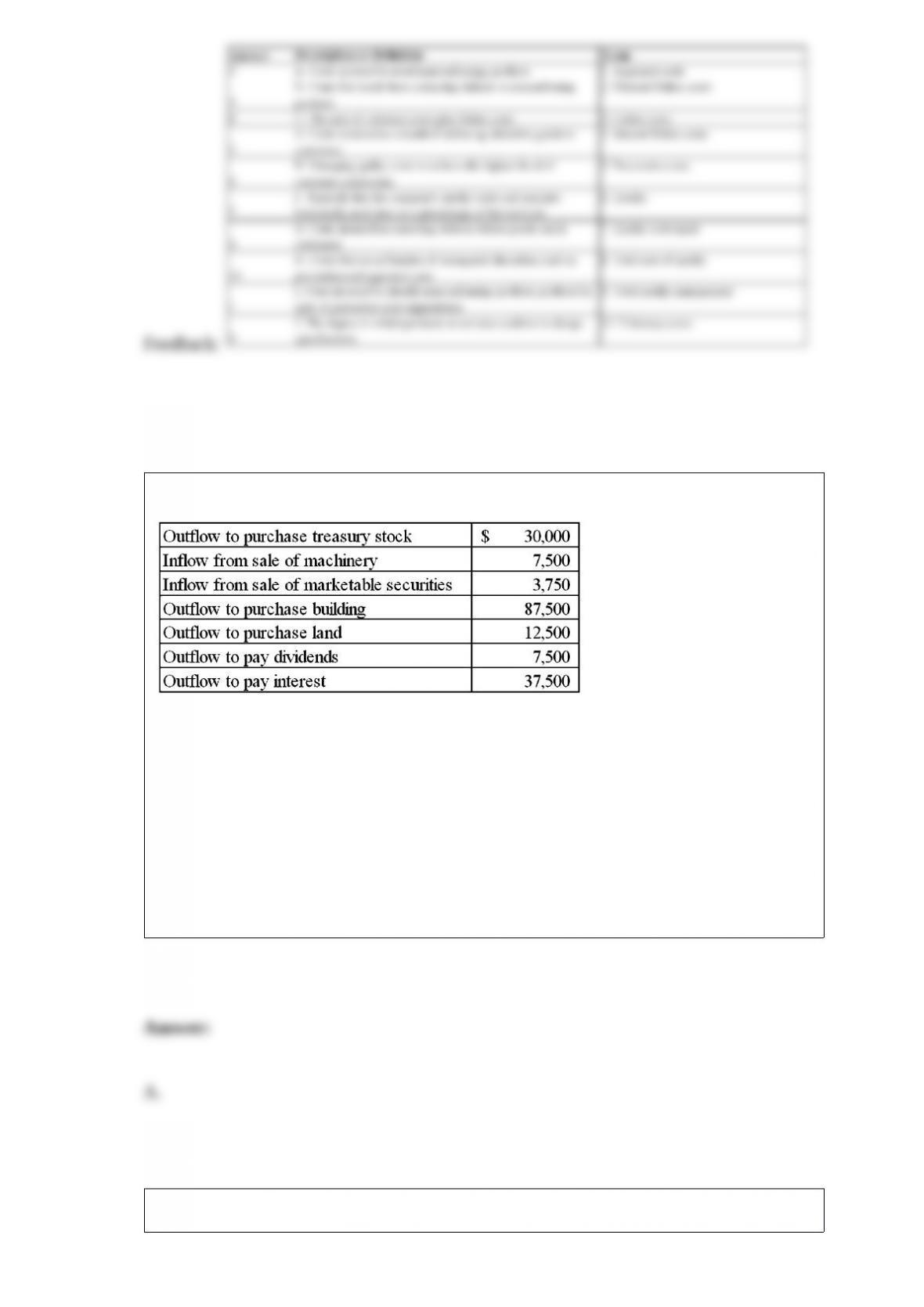
Phibbs Company prepared the following data for the year.
What is the net cash flow from investing activities?
A. $88,750 outflow
B. $141,250 outflow
C. $152,500 outflow
D. $41,250 outflow
Purchases on account are given below:
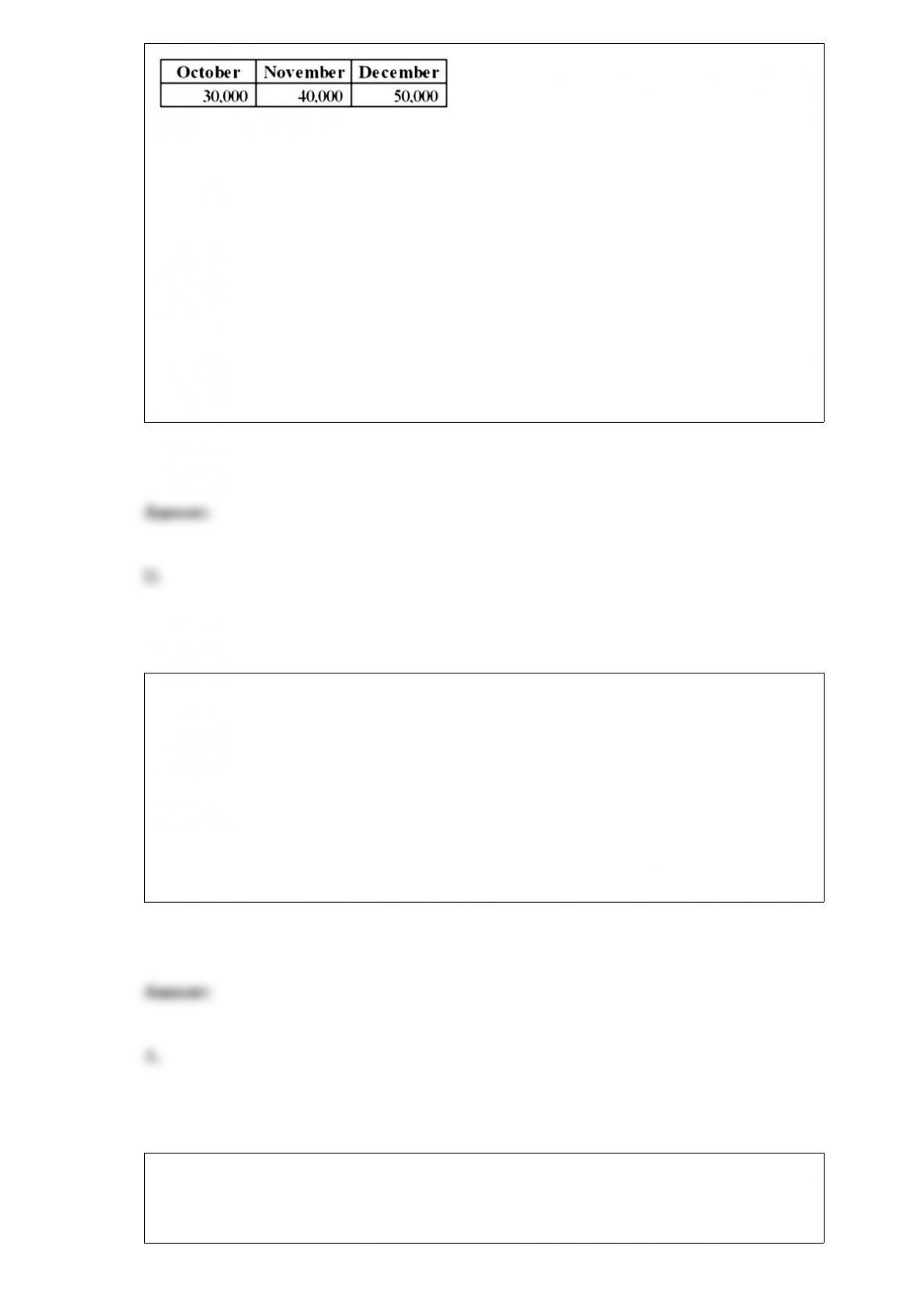
55% of the month’s purchases will be paid in the month of the purchase; the remaining
45% will be paid in the following month.
How much will the cash payments for purchases be in December?
A. $44,500
B. $50,000
C. $46,000
D. $45,500
All of the following quality costs are directly controllable by management except?
A. Repair and rework
B. Product design
C. Training costs
D. Reliability testing
Which of the following is an internal failure cost?
A. Costs to rework defective units

B. Warranty replacement costs
C. Engineering and design costs
D. Depreciation on testing equipment
Allocation of costs to various cost objects:
A. may affect managers’ performance evaluation.
B. may affect the overall profitability of a company.
C. may affect the apparent profitability of the various products a company makes.
D. Both may affect managers’ performance evaluation and may affect the apparent
profitability of the various products a company makes are correct.
With regards to financial statements, “pro forma” means:
A. Budgeted.
B. Prepared in advance.
C. Financial condition or position that can be expected if planning assumptions prove
correct.
D. All of these answers are correct.
What is the purpose of target pricing? What are the steps in target pricing?
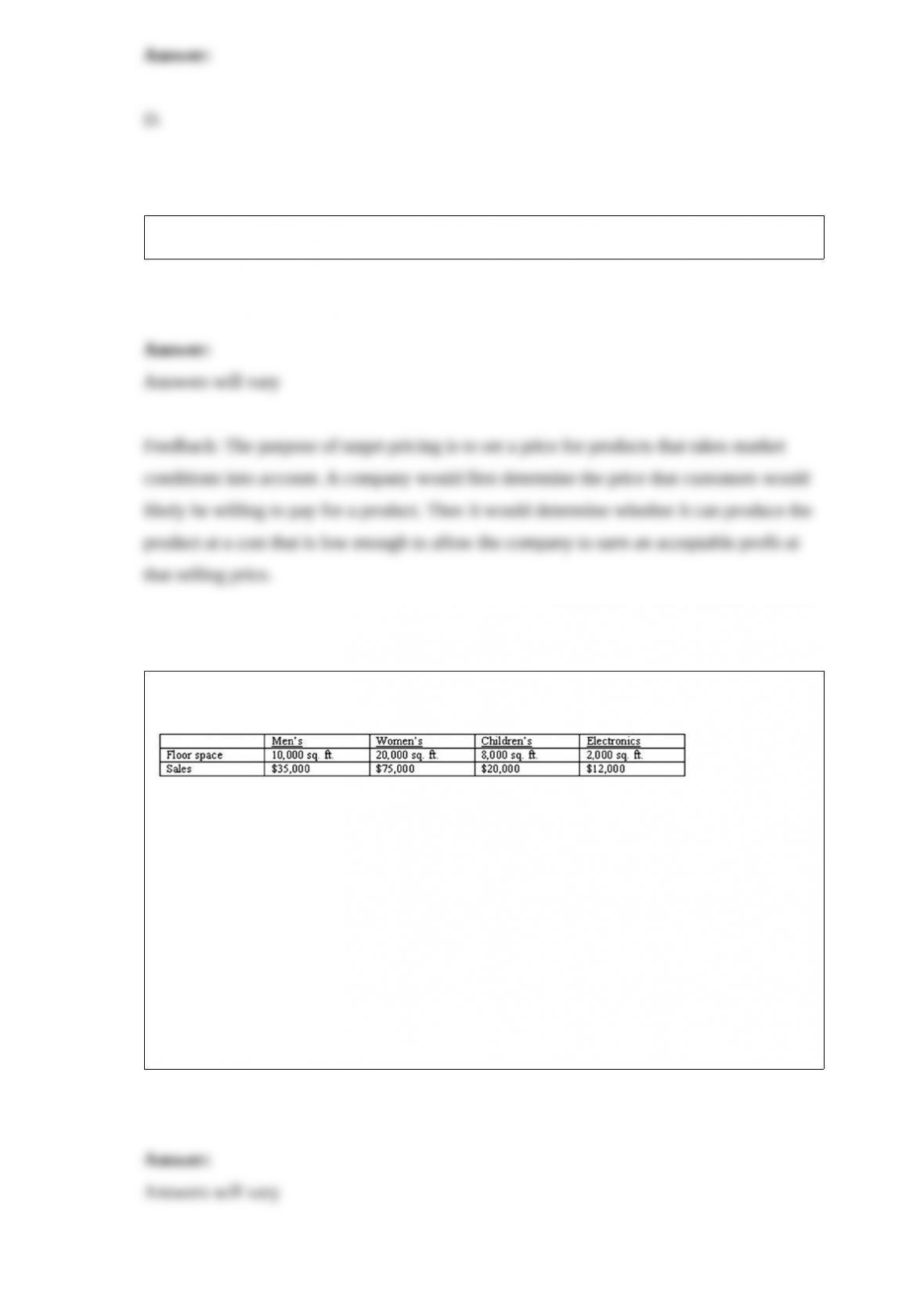
Biden Department Store has four departments: men’s, women’s, children’s, and
electronics. The following information is provided:
The company’s accountant needs to allocate the store’s annual rent of $160,000.
Required:
1) Compute the allocation rate that should be used to allocate the rent cost to the four
departments.
2) Compute the amount of rent that should be allocated to each of the four departments.
3) Currently, the managers are paid a bonus based on sales. As you can see from the
above table, the women’s department manager will receive the largest bonus. Do you
believe this bonus plan is fair to all four department managers? Why or why not?
How does total fixed cost behave when volume increases?
Company A makes and sells a single product, unless otherwise indicated. For each of
the following changes, indicate whether the break-even point increases (i.e., break even
would occur at a higher volume of sales), decreases, is not affected, or the direction of
change cannot be determined from the information given. Assume that nothing changes
except the given item(s).
What happens to the break-even volume when total fixed costs increase?
Who are the primary users of financial accounting information? Who are the primary
users of managerial accounting information?
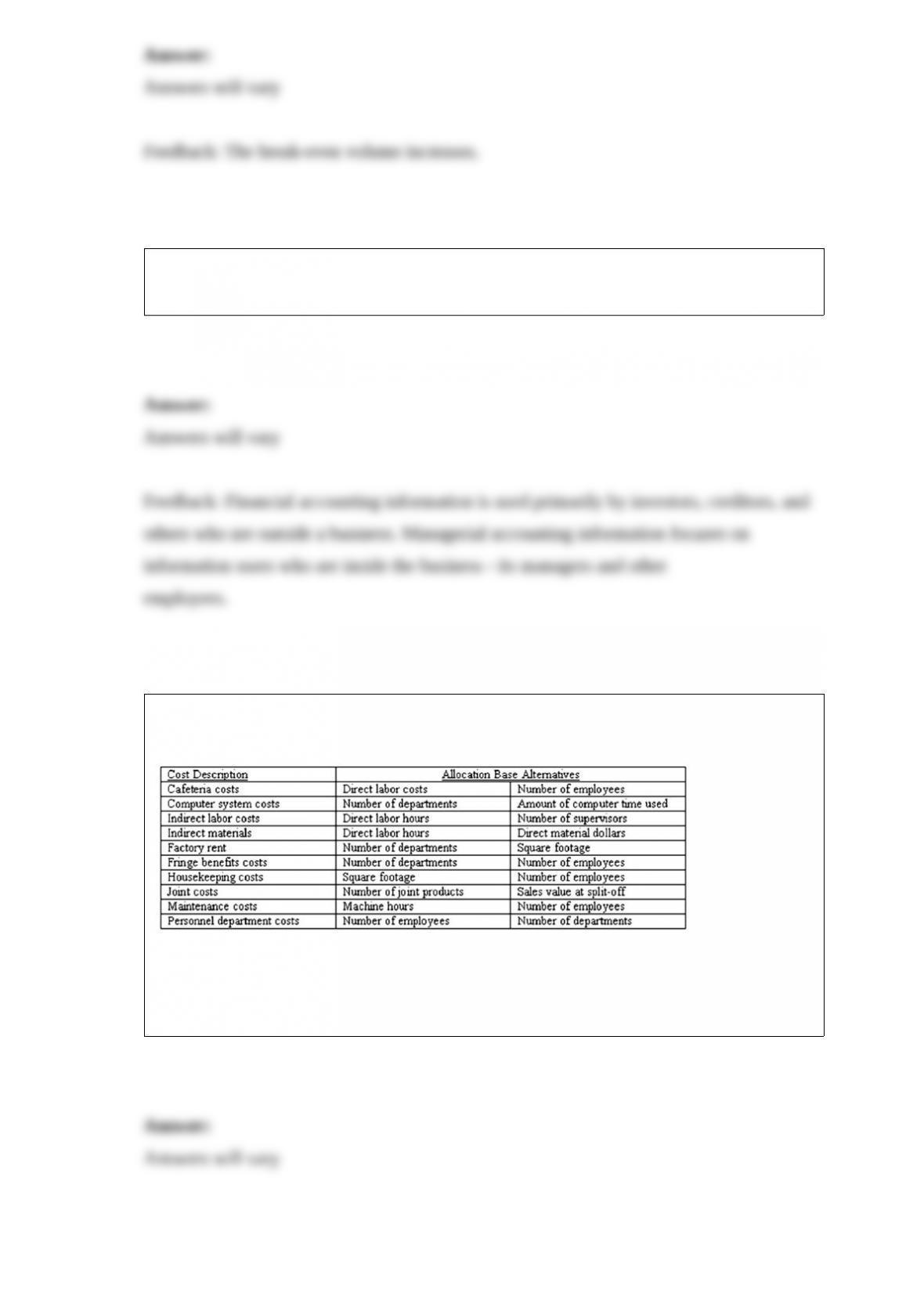
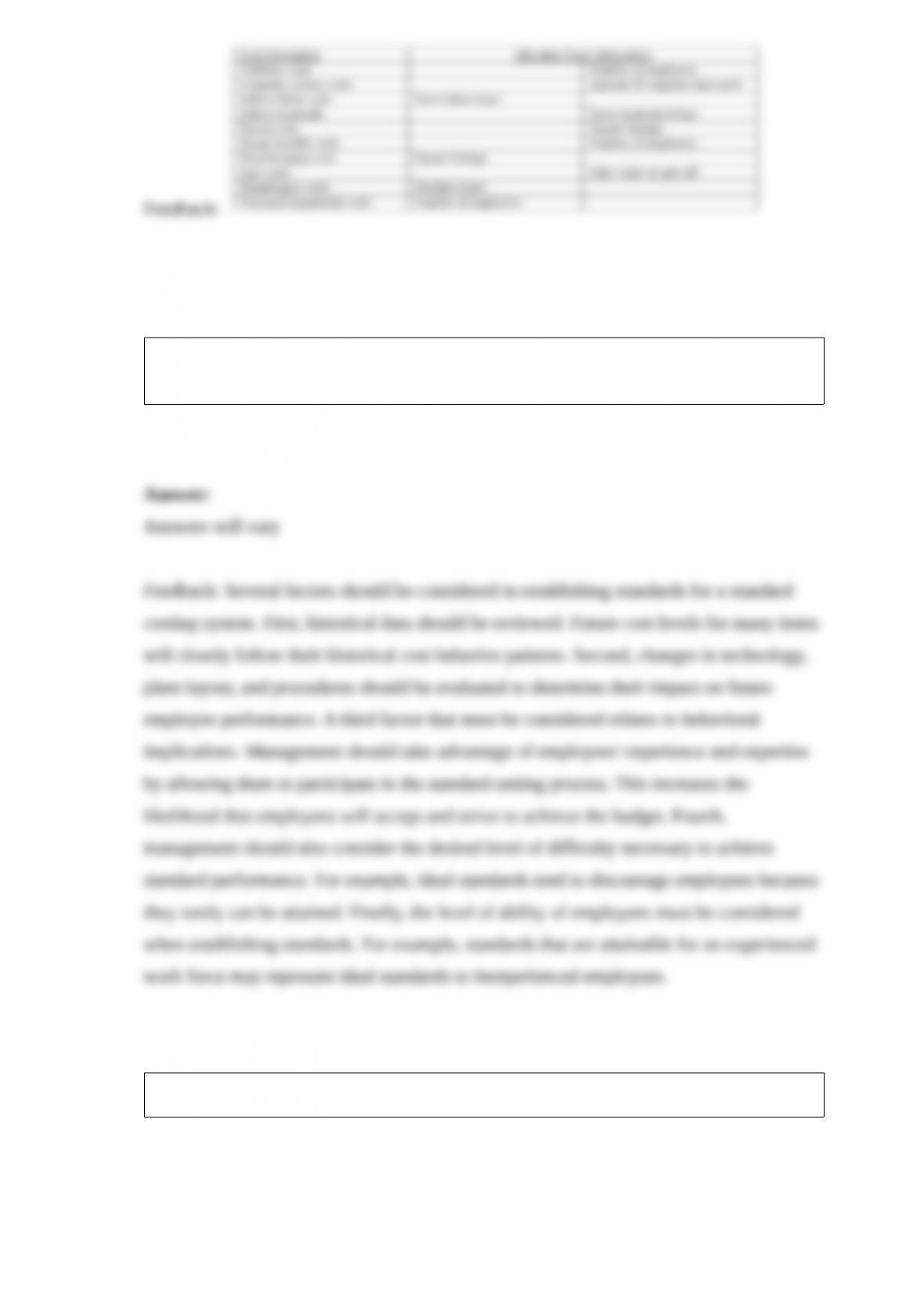
A number of costs that are commonly allocated are listed in the following table
followed by two alternative cost allocation bases.
Required:
For each cost listed, circle the cost allocation base that you believe would be more
appropriate for allocating the cost.
Describe several factors that should be considered in establishing standards for use with
a standard costing system.
Select the term from the list of terms that best matches the description provided.
Indicate whether each of the following statements about financial statement analysis is
true or false.
The ratio, plant assets to long-term liabilities, is a measure of a company’s ability to
obtain additional long-term financing.
Generally, a company’s current assets should be purchased using long-term financing
such as bonds payable.
Ratios that measure a company’s profitability provide some measure of the
effectiveness of the company’s management.
Net margin indicates the amount remaining from each sales dollar after cost of goods
sold has been subtracted out.
Net margin is also sometimes called the return on assets ratio.