
On December 15, 2016, Rigsby Sales Co. sold a tract of land that cost $3,600,000 for
$4,500,000. Rigsby appropriately uses the installment sales method of accounting for
this transaction. Terms called for a down payment of $500,000 with the balance in two
equal annual installments payable on December 15, 2017, and December 15, 2018.
Ignore interest charges. Rigsby has a December 31 year-end. In 2016, Rigsby would
recognize realized gross profit of:
a. $500,000.
b. $0.
c. $900,000.
d. $100,000.
In the balance sheet at the end of its first year of operations, Dinty Inc. reported an
allowance for uncollectible accounts of $82,000. During the year, Dinty wrote off
$32,000 of accounts receivable it had attempted to collect and failed. Credit sales for
the year were $2,200,000, and cash collections from credit customers totaled
$1,950,000.
In Dinty’s adjusting entry for bad debts at year-end, which of these would be included?
a. Debit to bad debt expense for $114,000.
b. Credit to allowance for uncollectible accounts for $82,000.
c. Debit to accounts receivable for $32,000.
d. All of these answer choices are correct.
Liquidity refers to:
a. The amount of cash on hand at a given time.
b. The readiness of an asset to be converted to cash.
c. The period until cash is used and refinancing becomes necessary.
d. Financial leverage.
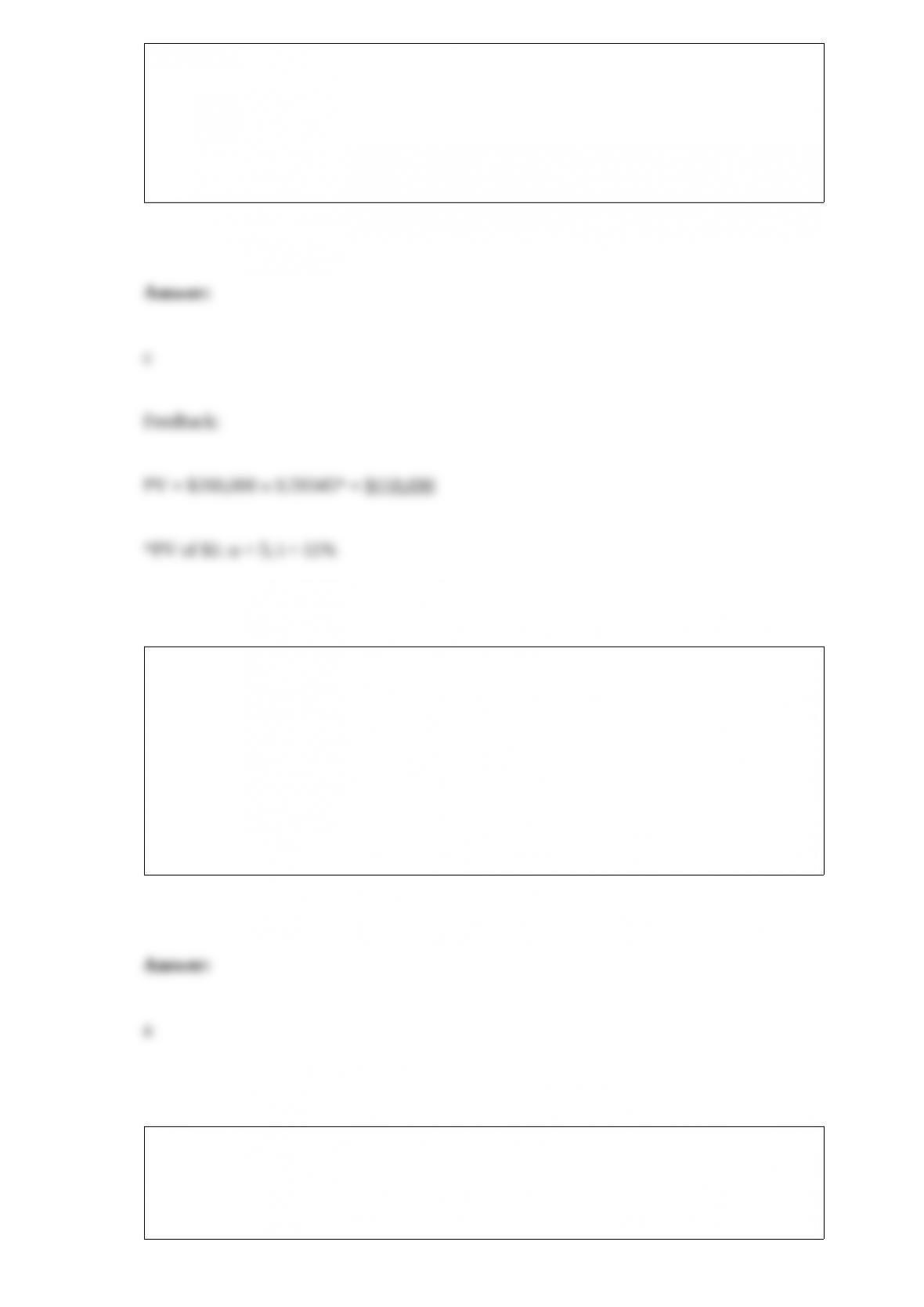
Present and future value tables of 1 at 11% are presented below.
Spielberg Inc. signed a $200,000 noninterest-bearing note due in five years from a
production company eager to do business. Comparable borrowings have carried an 11%
interest rate. What is the value of this debt at its inception?
a. $200,000.
b. $178,000.
c. $118,690.
d. $222,000.
Accounting standard-setting has been characterized as:
a. A political process.
b. Using the scientific method.
c. Pure deductive reasoning.
d. Pure inductive reasoning.
Mike Bradley & Company, a family-owned corporation, declared and distributed a
property dividend from its overstocked inventory instead of declaring its usual cash
dividend. The inventory’s book value exceeded its fair value. The excess is:

a. Reported as a direct reduction of shareholders’ ‘equity.
b. Reported as other comprehensive income.
c. Reported as a loss.
d. Not reported.
The conceptual framework’s recognition and measurement concepts recognize which
one of the following as an assumption?
a. Going concern.
b. Historical cost.
c. Full disclosure.
d. Realization.
Company C is identical to Company D in every respect except that Company C uses
LIFO and Company D uses average costs. In an extended period of rising inventory
costs, Company C’s gross profit and inventory turnover ratio, compared to Company
D’s, would be:
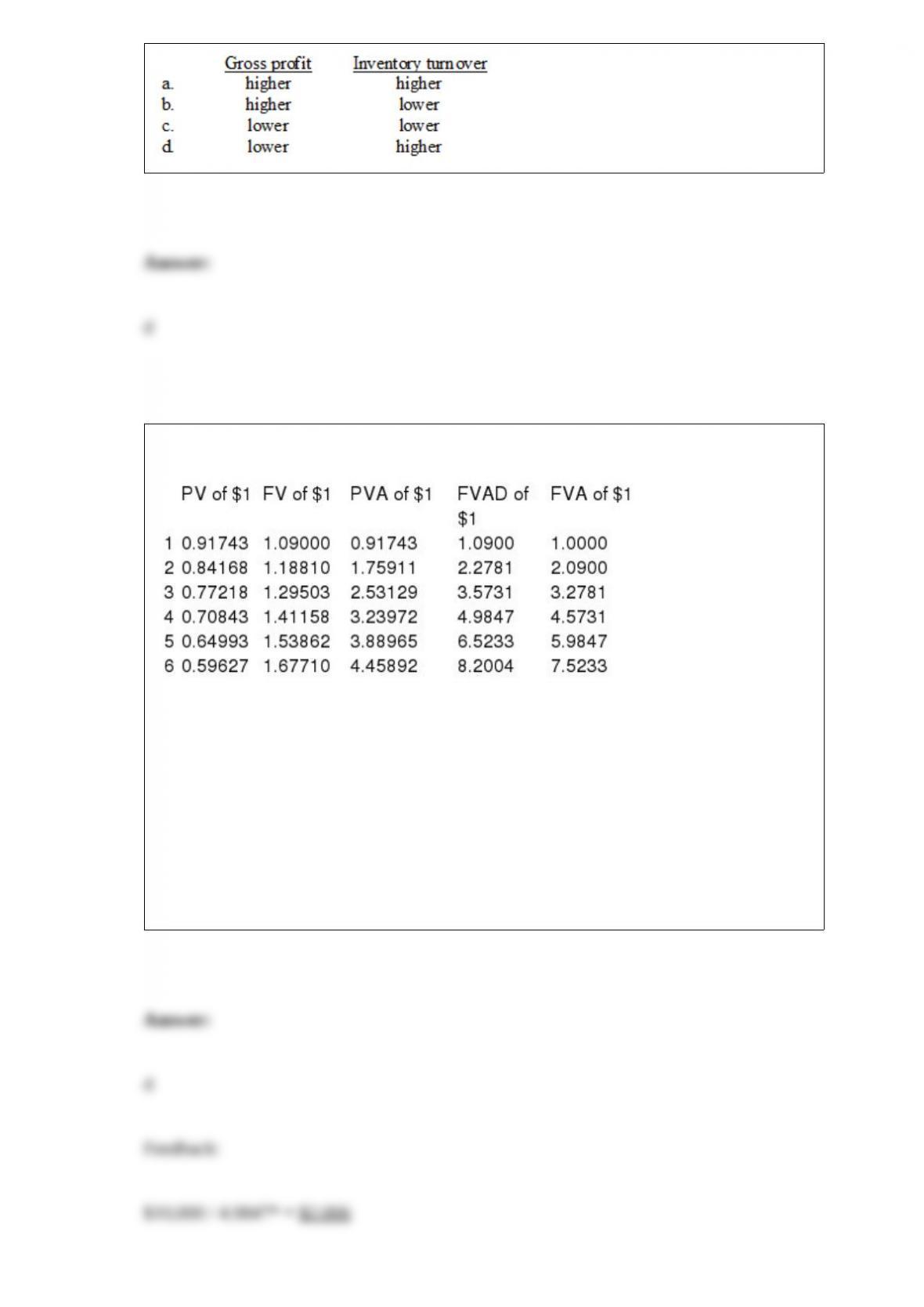
Present and future value tables of 1 at 9% are presented below.
How much must be deposited at the beginning of each year to accumulate to $10,000 in
four years if interest is at 9%?
a. $1,671.
b. $2,570.
c. $2,358.
d. $2,006.

A noncancelable lease contains a bargain purchase option. The fair value of the asset
exceeds the lessor’s cost of the asset. Collectibility of the lease payments is assured and
there are no material cost uncertainties surrounding the lease. Therefore, the lease will
be accounted for by the lessor as a(n):
a. Sales-type lease.
b. Direct financing lease.
c. Operating lease.
d. Guaranteed lease.
Under its executive stock option plan, Q Corporation granted options on January 1,
2016, that permit executives to purchase 15 million of the company’s $1 par common
shares within the next eight years, but not before December 31, 2018 (the vesting date).
The exercise price is the market price of the shares on the date of grant, $18 per share.
The fair value of the options, estimated by an appropriate option pricing model, is $4
per option. No forfeitures were anticipated; however, unexpected turnover during 2017
caused the forfeiture of 5% of the stock options. Ignoring taxes, what is the effect on
earnings in 2018?
a. $18.5 million.
b. $18 million.
c. $19 million.
d. $20 million.
Howard Co.’s 2016 income from continuing operations before income taxes was
$280,000. Howard Co. reported before-tax income on discontinued operations of
$50,000. All tax items are subject to a 40% tax rate. In its income statement for 2016,
Howard Co. would show the following line-item amounts for net income and income
tax expense:
a. $198,000 and $112,000.
b. $230,000 and $92,000.
c. $330,000 and $132,000.
d. $198,000 and $79,000.
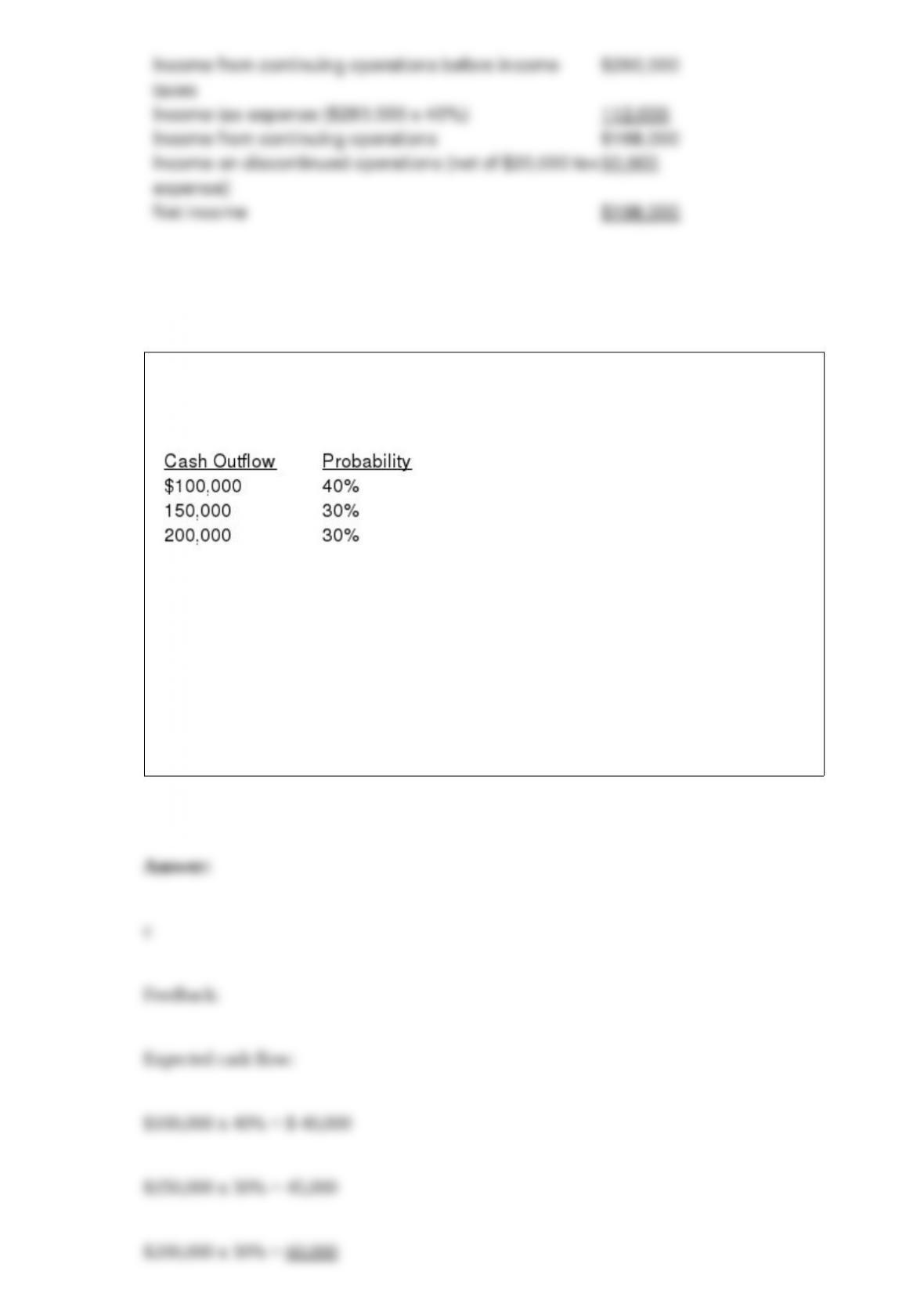
Simpson Mining is obligated to restore leased land to its original condition after its
excavation activities are over in three years. The cash flow possibilities and
probabilities for the restoration costs in three years are as follows:
The company’s credit-adjusted risk-free interest rate is 5%. The liability that Simpson
must record at the beginning of the project for the restoration costs is: a. $ 129,576.
b. $ 145,000.
c. $ 125,257.
d. $ 172,768.
Which of the following is not an approach for estimating stand-alone selling prices?
a. Adjusted market assessment approach
b. Expected cost plus margin approach
c. Residual approach
d. Fair market appraisal approach
In a recent press release, Estee Lauder Co. reported “a fiscal fourth-quarter loss due to a
restructuring charge but said it expects to see earnings growth in its fiscal second
through fourth quarters.” The New York skin care and cosmetics company reported a
net loss of $25.4 million, or 13 cents a share, for the quarter ended June 30, compared
with net income of $20.4 million, or six cents a share, a year earlier. Excluding the
restructuring charge of $76.9 million, or 32 cents a share, the company said profit
would have been $51.5 million, or 19 cents a share. Discuss how Estee Lauder’s press
release relates to its earnings quality.
Why do companies find the issuance of convertible bonds to be an attractive form of
financing?
The balance sheet reports the balances of shareholders’ ‘equity accounts. What
additional information is provided by the statement of shareholders’ equity?
The accounting records of Eastlake Industries provided the data below.
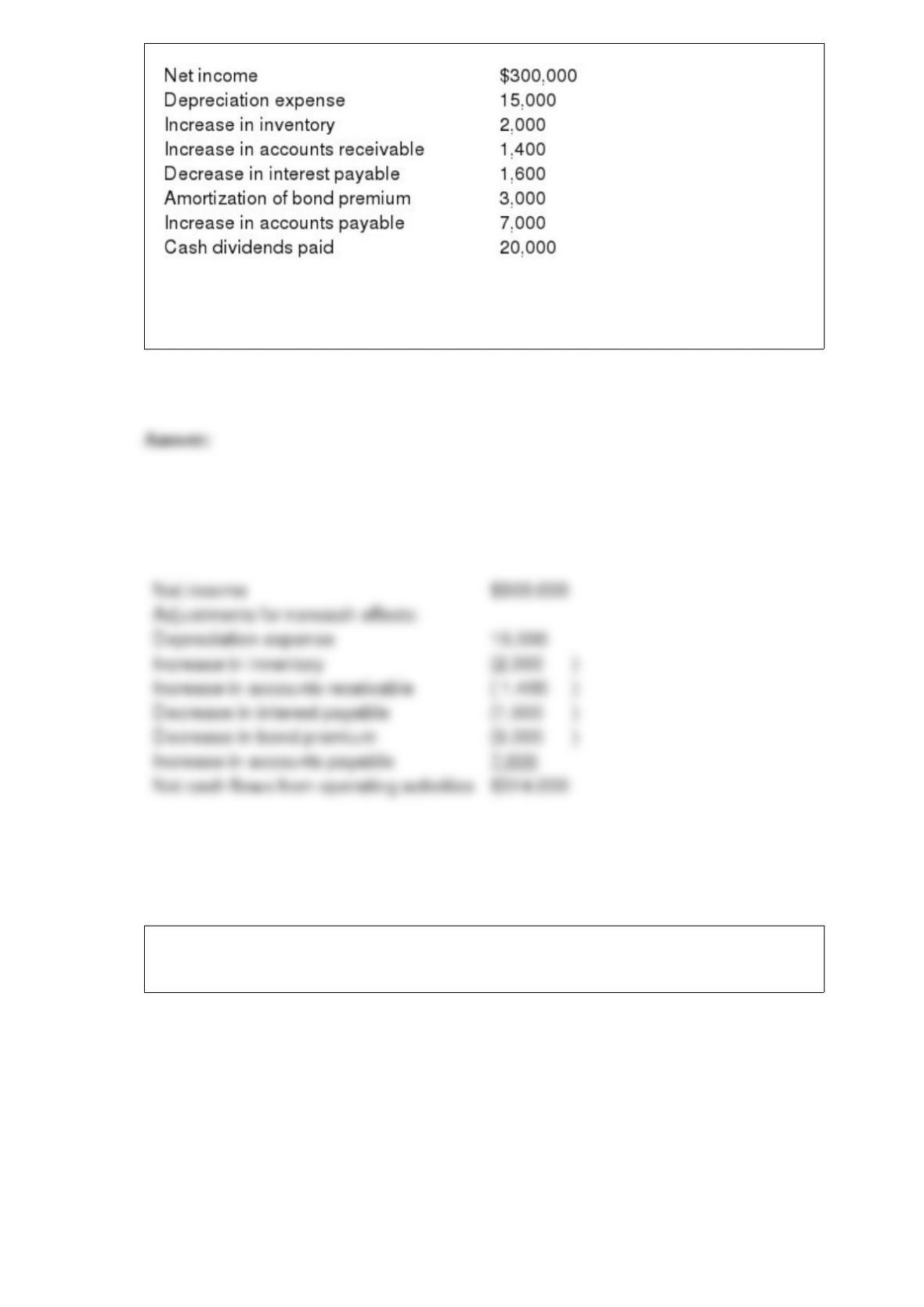
Required:
Prepare a reconciliation of net income to net cash flows from operating activities.
Burrito Corporation has a defined benefit pension plan. Burrito received the following
information for the current calendar year:
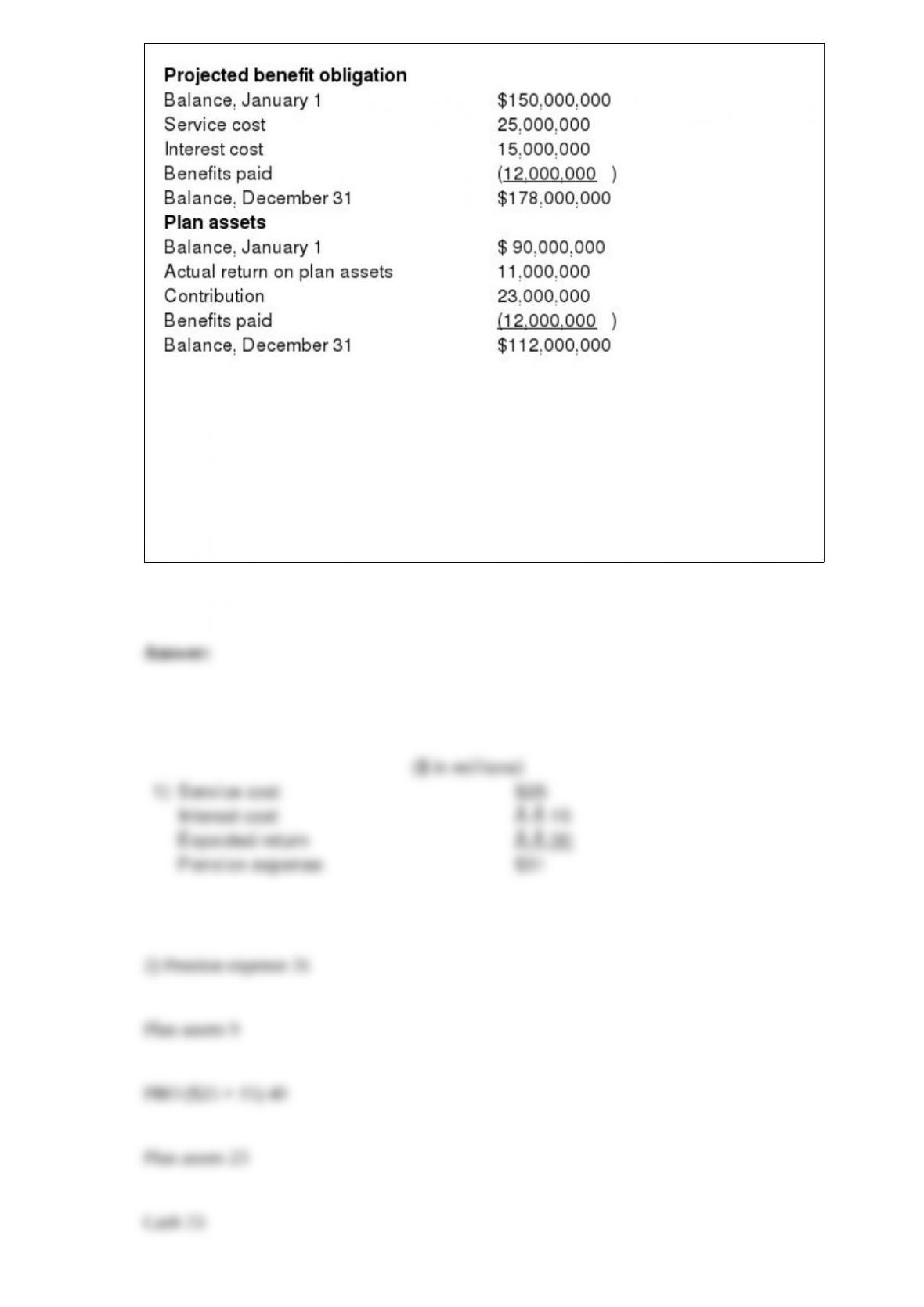
The expected long-term return on plan assets is 10%. There were no other relevant data
for the year.
Required:
1) Determine Burrito’s pension expense for the year.
2) Prepare the journal entries to record the pension expense and funding for the year.
Lux Hotels, Inc. has signed a service outsourcing contract with Deluxe Rooms, Inc. for
$3 million, which was received in cash at contract inception. Under the agreement,
Deluxe Rooms is obligated to clean and prepare over 5,000 hotels rooms managed by
Lux Hotel on a daily basis from August 1, 2016 to July 31, 2017. Required: Prepare
any journal entry that Delux would record:
(1) at inception of the contract and
(2) at the end of 2016 to recognize all revenue associated with this contract that should
be recognized in 2016.
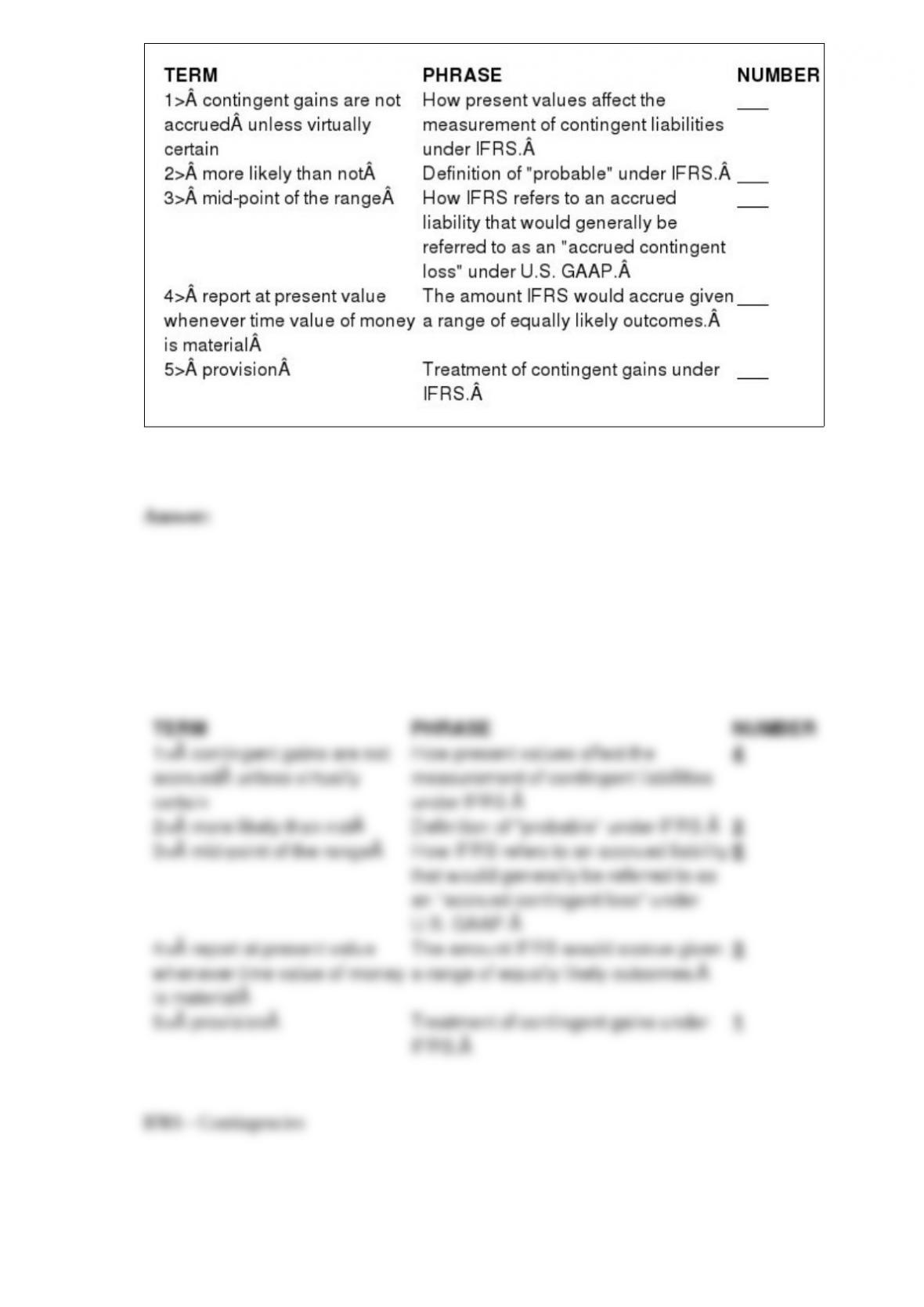
Listed below are five terms followed by a list of phrases that describe or characterize
five of the terms related to accounting for contingent liabilities under IFRS. Match each
phrase with the number for the most correct term.
Shown below is activity for one of the products of Denver Office Equipment: January 1
balance, 500 units @ $55 $27,500
Purchases:
January 10: 500 units @ $60
January 20: 1,000 units @ $63
Sales:
January 12: 800 units
January 28: 750 units Required: Compute the January 31 ending inventory and cost of
goods sold for January, assuming Denver uses LIFO and a periodic inventory system.