
Law, CPA is using nonstatistical sampling in his examination of Jye Company’s
accounts receivable. The recorded balance of Jye’s accounts receivable was $750,000.
Law selected a sample of customer accounts for examination, which were recorded at
$50,000. Based on the responses received from accounts receivable confirmations, Law
determined an audited value of $45,000 for the accounts receivable.
If tolerable misstatement is $60,000, which of the following statements is not true?
A. The actual misstatement identified by Law is $5,000.
B. The estimated account balance would be $825,000.
C. Law would conclude that the account balance is not fairly stated, since the estimated
misstatement is greater than the tolerable misstatement.
D. Law is not able to provide a quantitative conclusion as to the exposure to the risk of
incorrect acceptance.
In Case 10.4 (No Treasure in This Treasure Planet), Disney overvalued net assets by
capitalizing unrecoverable production costs. The lesson for the auditors in this case was
to
A. always recalculate the client’s figures regardless of how simple they appear.
B. maintain professional skepticism when evaluating clients’ estimates.
C. always look into the background of the client before accepting an engagement.
D. none of the above.

Which of the following procedures ordinarily should be applied when an independent
accountant conducts a review of interim financial information of a publicly held entity?
A. Verify changes in key account balances.
B. Read the minutes of the board of directors’ meetings.
C. Inspect the open purchase order file.
D. Perform cut-off tests for cash receipts and disbursements.
Analytical procedures are evaluations of financial information made by a study of
plausible relationships among financial and nonfinancial data. Understanding and
evaluating such relationships are essential to the audit process.
The following financial statements were prepared by ABC Manufacturing Co. for the
year ended December 31, 2013. Also presented are various financial statement ratios for
Holiday as calculated from the prior year’s financial statements. Sales represent net
credit sales. The total assets and the receivables and inventory balances at December
31, 2013, were the same as at December 31, 2012.

For audits of financial statements made in accordance with generally accepted auditing
standards, the use of analytical procedures is required to some extent.
A. As a substantive test: Yes; In the final review stage: Yes
B. As a substantive test: Yes; In the final review stage: No
C. As a substantive test: No; In the final review stage: Yes
D. As a substantive test: No; In the final review stage: No
The auditors’ report on the entity’s financial statements included an additional paragraph
disclosing a difference of opinion between the auditors and the entity for which the
auditors believed an adjustment to the financial statements should be made. The opinion
paragraph of the auditors’ report should express a(n)
A. unmodified opinion.
B. qualified opinion citing a departure from generally accepted accounting principles.
C. qualified opinion citing a scope limitation and lack of specific evidence.
D. disclaimer of opinion.

What is the primary purpose of obtaining written representations?
A. To provide auditors with substantive evidence of important assertions
B. To impress upon management its primary responsibility for the financial statements
C. To allow auditors to communicate important internal control deficiencies to
management
D. To allow auditors to communicate important suggestions for improvement to
management
To conceal defalcations involving receivables, a dishonest bookkeeper might charge
which of the following accounts?
A. Miscellaneous income.
B. Petty cash.
C. Miscellaneous expense.
D. Sales returns.
An audit team’s purpose in reviewing the documentation concerning the renewal of a
note payable shortly after the balance-sheet date most likely is to obtain evidence
concerning management’s assertions about
A. existence.
B. valuation.

C. completeness.
D. classification.
An auditor who uses statistical sampling for attributes in testing internal controls should
reduce the planned reliance on a prescribed control when the
A. sample rate of deviation plus the allowance for sampling risk equals the tolerable
rate of deviation.
B. sample rate of deviation is less than the expected rate of deviation used in planning
the sample.
C. tolerable rate less the allowance for sampling risk exceeds the sample rate of
deviation.
D. sample rate of deviation plus the allowance for sampling risk exceeds the tolerable
rate of deviation.
Jeter, CPA, performed a nonstatistical sampling plan to examine the inventory balances
of Big Apple Company and estimated the account balance based on the ratio of audited
value to recorded balances. He audited 200 items from a sample and found an audited
value of $36,000. The sample had a recorded value of $40,000. If the entire inventory
contained 3,000 items and the total recorded value of the inventory was $500,000, the
estimated account balance using nonstatistical estimation and projecting the error based
on number of items examined is
A. $393,600.

B. $474,500.
C. $450,000.
D. $540,000.
Which of the following would not result in a lower level of the risk of incorrect
acceptance?
A. An increase in the acceptable level of audit risk from 5% to 10%
B. The inability of the auditor to rely on the internal control as planned
C. An increase in the susceptibility of the account balance to misstatement
D. A reduction in the utilization of analytical procedures in the audit examination
When performing substantive procedures, auditors run the sampling risk(s) of
A. assessing control risk too high or too low.
B. incorrect acceptance and incorrect rejection.
C. assessing control risk too low only.
D. incorrect acceptance only.

Which of the following is the best way to compensate for the lack of adequate
segregation of duties in a small organization?
A. Disclosing lack of segregation of duties to the external auditors during the annual
review
B. Replacing personnel every three or four years
C. Requiring accountants to pass a yearly background check
D. Allowing for greater management oversight of incompatible activities
The probability that the information circulated by a company will be false or misleading
is referred to as
A. business risk.
B. information risk.
C. assurance risk.
D. audit risk.
The essential advantages of a computer-assisted audit techniques (CAATs) package

would not include the fact that
A. the same software can be used on different types of clients’ computer environments.
B. a large number of CAATs packages are currently available.
C. software packages are always inexpensive.
D. the ability to control and modify the program to meet an auditors’ need.
Which of the following statements is true when selecting a sample of invoices from a
population to perform tests of controls?
A. The audit team should select a few more items than needed to replace any cases in
which an invoice is missing or destroyed.
B. If the audit team wishes to use statistical sampling, either block or haphazard
selection is appropriate.
C. Computerized audit techniques can be used to define the population but not to select
sample items.
D. The audit team’s goal in selecting a sample is to increase the likelihood that it is
representative of the population.
The type of financial analysis that expresses balance sheet accounts as percentages of
total assets is known as
A. horizontal analysis.

B. vertical analysis.
C. net worth analysis.
D. expenditure analysis.
Violet, CPA, audits Big Bank, a local financial institution. Which of the following
would most likely impair Violet’s independence with regard to Big Bank?
A. A home loan with the value of the house exceeding the mortgage balance
B. A car loan collateralized by the car
C. A personal loan collateralized by cash deposits at Big Bank
D. A Visa credit card issued by Big Bank with a balance of $2,500
When a circumstance-imposed scope limitation has a material but not pervasive effect
on the sufficiency of the auditors’ evidence, the auditors’ report will
A. modify the opinion paragraph.
B. modify the Auditor’s Responsibility section and opinion paragraph.
C. modify the introductory paragraph, Auditor’s Responsibility section, and opinion
paragraphs.
D. modify the introductory and opinion paragraphs and omit the Auditor’s
Responsibility section.

Green, CPA, was engaged to audit the financial statements of Essex Co. after its fiscal
year had ended. The timing of Green’s appointment and the start of field work made
confirmation of accounts receivable by direct communication with the customers not
feasible. However, Green applied other procedures and was satisfied as to the
reasonableness of the account balances. Green’s auditors’ report most likely contained
a(n)
A. unmodified opinion.
B. unmodified opinion with an emphasis-of-matter paragraph.
C. qualified opinion due to a scope limitation.
D. qualified opinion due to a departure from generally accepted auditing standards.
Which of the following procedures would not be performed in a review of financial
statements of a nonpublic company?
A. Inquire about the accounting system and bookkeeping procedures.
B. Perform analytical procedures to identify relationships and individual items that
appear to be unusual.
C. Obtain an attorney’s letter regarding litigation and unasserted claims.
D. Study the financial statements for indications that they conform to generally
accepted accounting principles.

In an audit of financial statements, an auditor’s primary consideration regarding an
internal control policy or activity is whether the policy or activity
A. reflects management’s philosophy and operating style.
B. affects management’s financial statement assertions.
C. provides adequate safeguards over access to assets.
D. enhances management’s decision making processes.
Which of the following best describes the main reason independent auditors report on
management’s financial statements?
A. Management fraud may exist and it is likely to be detected by independent auditors.
B. The management that prepares the statements and the persons who use the
statements may have conflicting interests.
C. Misstated account balances may be corrected as the result of the independent audit
work.
D. The management that prepares the statements may have a poorly designed system of
internal control.

While performing interim audit procedures of accounts receivable, numerous
unexpected errors are found resulting in a change of risk assessment. Which of the
following audit responses would be most appropriate?
A. Move detailed analytical procedures from year end to interim.
B. Increase the dollar threshold of vouching customer invoices.
C. Send negative accounts receivable confirmations instead of positive accounts
receivable confirmations.
D. Use more experienced audit team members to perform year-end testing.
As the auditors’ assessments of control risk and analytical procedures risk decrease,
which of the following statements is true?
A. The sample size will not be affected.
B. The allowable risk of incorrect acceptance will increase.
C. The sample size will increase.
D. The allowable risk of incorrect acceptance will decrease.
Using an incremental confidence factor of 1.58 (corresponding to the risk of incorrect
acceptance of 10%), what is the incremental allowance for sampling risk?
A. $5,000
B. $7,900

C. $8,700
D. $23,700
Under the liability provisions of section 11 of the Securities Act of 1933, auditors may
be liable to any purchaser of a security for certifying materially misstated financial
statements that are included in the registration statement. Under section 11, auditors
usually will not be liable to the purchaser
A. if auditors can show contributory negligence on the part of the purchaser.
B. if auditors can demonstrate due diligence.
C. unless the purchaser can prove privity with auditors.
D. unless the purchaser can prove scienter on the part of auditors.
Which of the following statements describes an appropriate relationship with respect to
the reliability of audit evidence?
A. Receiving confirmation from third parties as to the existence of securities is more
reliable than the auditors’ personal inspection of those securities.
B. Verbal inquiries received from the client regarding sales made to customers are more
reliable than sales invoices prepared by the client for its customers.
C. A bank confirmation received directly by the auditor is more reliable than a bank
confirmation initially received by the client and forwarded to the auditor.

D. Evidence drawn from a document prepared by the client is more reliable than
evidence drawn from a document prepared by an external party that is forwarded to the
auditor by the client.
Which of the following controls should prevent an invoice for the purchase of
merchandise from being paid twice?
A. The check signer accounts for the numerical sequence of receiving reports used in
support of each payment.
B. An individual independent of cash operations prepares a bank reconciliation.
C. The check signer reviews and cancels the voucher packets.
D. Two check signers are required for all checks over a specified amount.
Which of the following management policies would increase the probability of fraud in
a company?
A. Diversifying authority throughout divisions and subsidiaries in the organization
B. Measuring performance and awarding bonuses based on short-term operating results
C. Giving employees performance feedback that considers positive and constructive
praise along with critical and negative observations on their work
D. Establishing work teams that share responsibilities, performance, and bonuses based
on collective efforts

Which component of the expanded audit risk model is most closely associated with the
risk of incorrect acceptance?
A. Analytical procedures risk
B. Risk of material misstatement
C. Nonsampling risk
D. Test of details risk
Small Corporation uses a Wages Clearing Account for its payroll disbursements. At the
end of February, a reasonably large debit balance remained in this account. The most
likely reason for this is that
A. more labor cost had been assigned to the expense accounts than had been paid.
B. some labor cost had not been properly classified in the expense accounts.
C. some employees had not yet cashed their checks.
D. not enough cash had been transferred to the bank account.
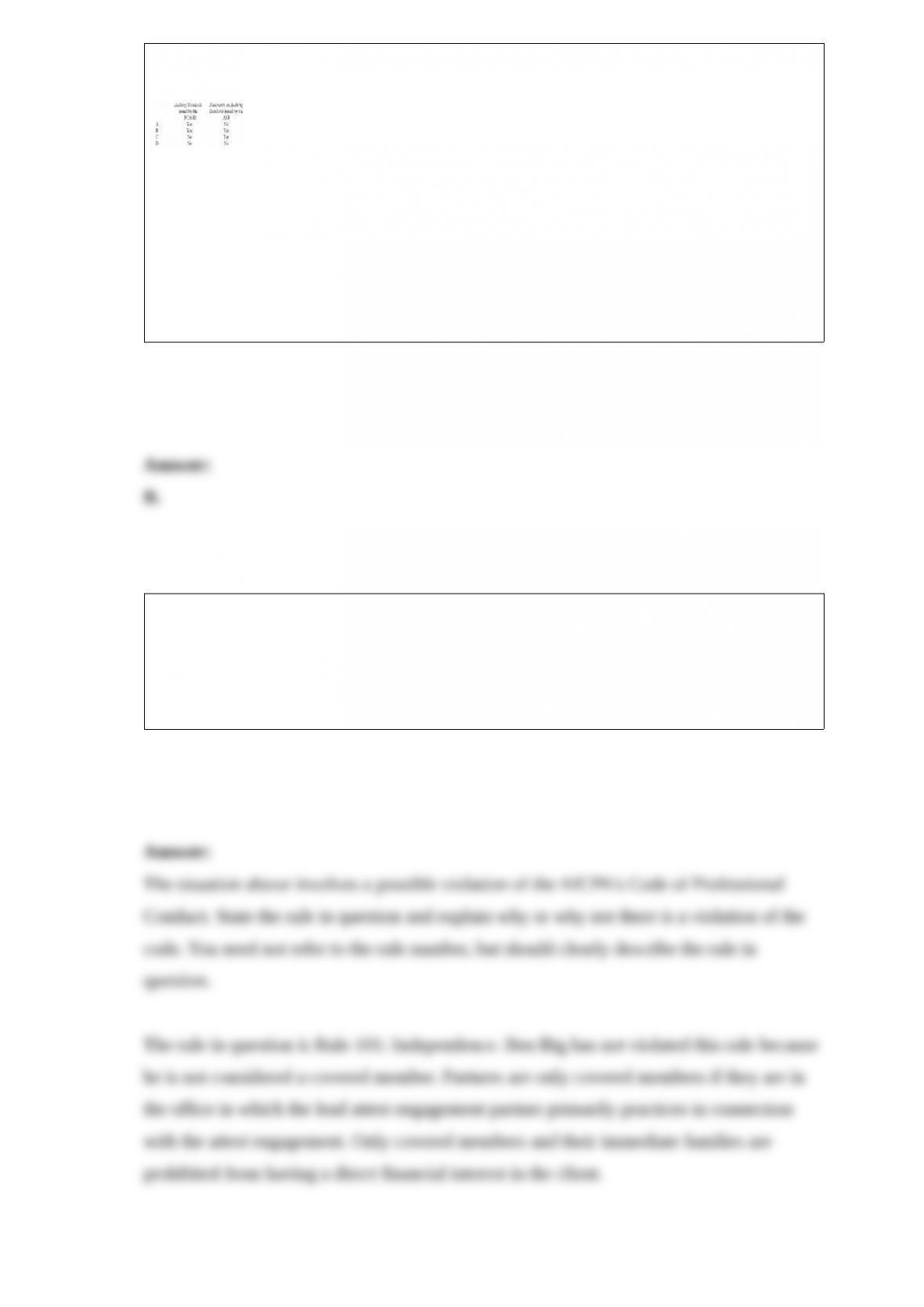
Which of the following could serve as a source of professional guidance in the audit of
a public entity?
A. Option A
B. Option B
C. Option C
D. Option D
Ben Big is a partner in the Cleveland office of the national accounting firm of Price
Brickhouse. He owns 1,000 shares of common stock in Public, Inc., an audit client of
the firm. This amount is not material to his personal investments. The Public, Inc. audit
is done out of the New York office. Ben Big has not informed the firm that he owns the
shares because he is not on the audit and it is not done out of the Cleveland office.
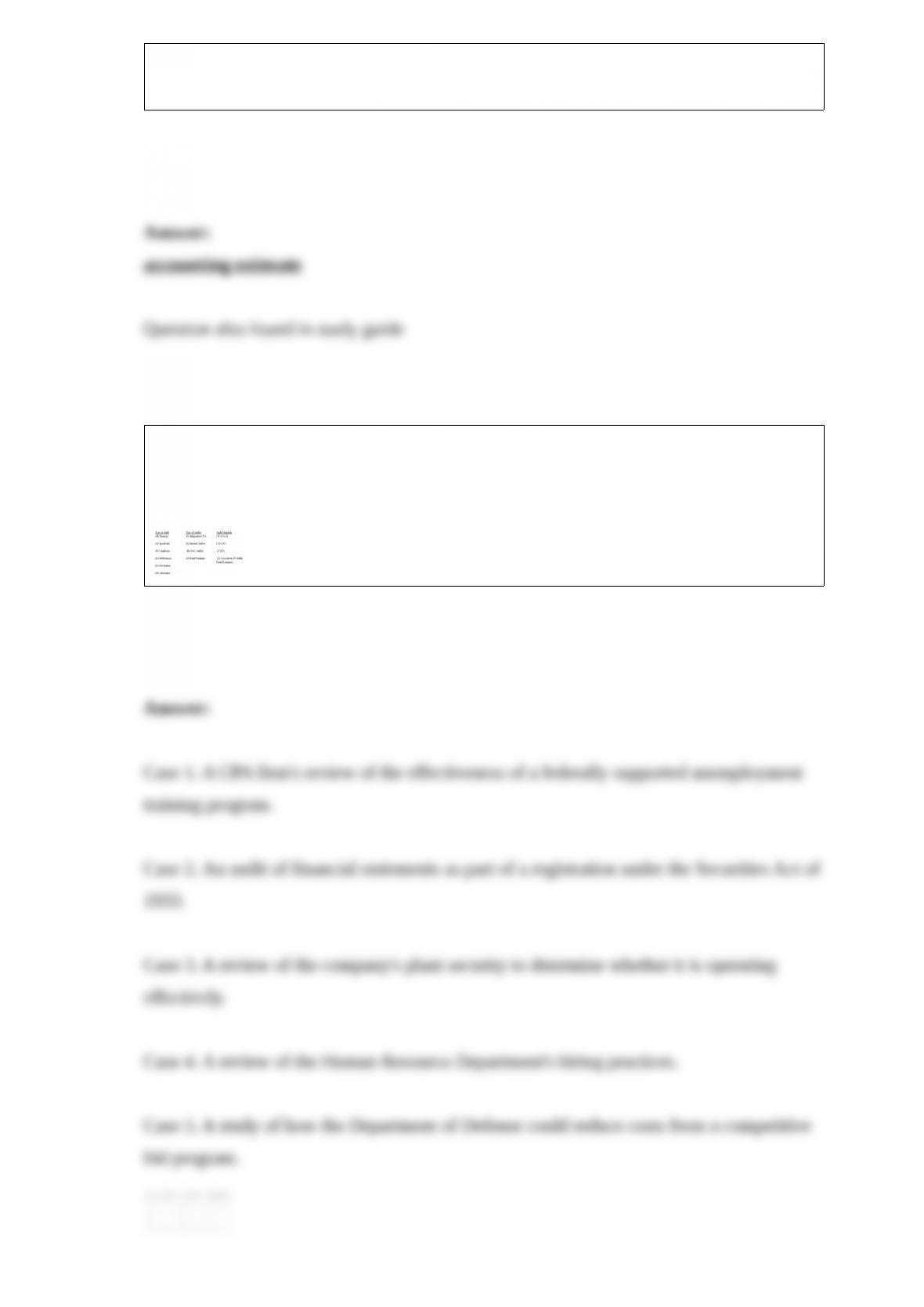
An ___________________________________ is an approximation of a financial
statement element, item, or account.
Following are five cases (1-5) illustrating different types of audit engagements. In the
space provided by each case, indicate the type of audit that would be conducted (H-M),
the specific type of auditor who might perform the engagement (P-S), and the auditing
standards that would probably apply for the engagement (W-Z).

Match each of the following input controls with the description or type of error that
might be detected by this control. Each input control relates to only one description or
type of error.
1. Sum of a data field that has no numerical significance (such as the total of employee
numbers).
2. Data are inadvertently input in an incorrect field.
3. Sum of a data field that has numerical significance (such as the total of hours
worked).
4. Data fields have the appropriate positive or negative sign.
5. Ability of data entry personnel to correct data conversion errors in a timely fashion.
6. A numerical field appended to another numerical field to ensure accurate input of
data.
7. Comparing number of payroll transactions received for processing with the number
of transactions entered into a transaction file.
8. Data conversion personnel will not fail to enter data in a particular field.
9. Data fields have the appropriate numeric or alphabetic characters.
10. Data values exceed or fall below some predetermined limit.
11. Computer may automatically generate and authorize transactions.
A. Limit and reasonableness tests
B. Record count
C. Valid sign tests
D. Batch totals
E. Error correction and resubmission procedures
F. Authorization and approval controls
G. Check digit
H. Hash totals

I. Valid character tests
J. Missing data tests
K. ata entry and formatting
Auditors ______________________________ the inventory taking and make
________________________________, but they seldom
_____________________________ the entire inventory.
You are the auditor for Wilson Wholesale Products Inc. As part of the audit of accounts
receivable, Wilson has provided you an electronic file representing its accounts
receivable as of its fiscal year-end. The file includes the customer name, customer
address, customer number, sales invoice number, sales invoice date, and amount.
Describe three or more substantive audit procedures you might perform using
computer-assisted audit tools and techniques (CAATs) with this computer file.

At a meeting of the corporate audit committee attended by the general manager of the
products division (Smith) and the internal audit manager (Marks), the following
dialogue took place between Smith and Jones (chair of the corporate audit committee):
Jones: Ms. Marks has suggested that the internal audit department conduct an
examination of the computer activities of the products division.
Smith: I don’t know much about the technicalities of computers, but the division has
some of the best computer people in the company.
Jones: Do you know whether the internal controls we have implemented are
satisfactory?
Smith: I suppose they are. No one has complained. What’s so important about controls
anyway, as long as the system works? I don’t even know what type of controls we
should have for our system.
Jones: Ms. Marks, can you explain the objective of computer controls and provide us
with some examples?

Susan Small, CPA has Medium Corporation as an audit client. Medium has asked Small
to create and install a new computerized payroll system. Because Small does not have
the appropriate level of expertise, she referred Medium to Compusystems, Inc., a local
software consulting company. Small has an arrangement where she is paid ten percent
of any fee received by Compusystems from her referrals. Small has disclosed this to her
client.
The situation above involves a possible violation of the AICPA’s Code of Professional
Conduct. State the rule in question and explain why or why not there is a violation of
the code. You need not refer to the rule number, but should clearly describe the rule in
question.