
1) The internal rate of return equals the rate that yields a net present value of zero for an
investment.
2) Equivalent units of production need to be determined only if a processing department
adds materials and labor to its products at different rates.
3) An annuity is a series of equal payments.
4) Financial reporting includes not only general purpose financial statements, but also
information from SEC filings, press releases, shareholders’ meetings, forecasts,
management letters, auditor’s reports, and Webcasts.
5) A short-term note payable is a written promise to pay a specified amount on a
definite future date within one year or the operating cycle, whichever is longer.
6) The Inventory account is a controlling account for the inventory subsidiary ledger
that contains a separate record for each separate product.
7) If the indirect materials cost for a reporting period was $37,500, the following
journal entry would be recorded in the process cost accounting system:
8) The accrual basis of accounting recognizes revenues when cash is received from
customers.
9) If a corporation is authorized to issue 1,000 shares of $50 common stock, it is said to
have $50,000 of stock outstanding.
10) The Goods in Process Inventory account is found only in the ledgers of
merchandising companies.
11) Total quality management and just-in-time manufacturing are two modern systems
designed to improve the quality of management and the products and services offered.
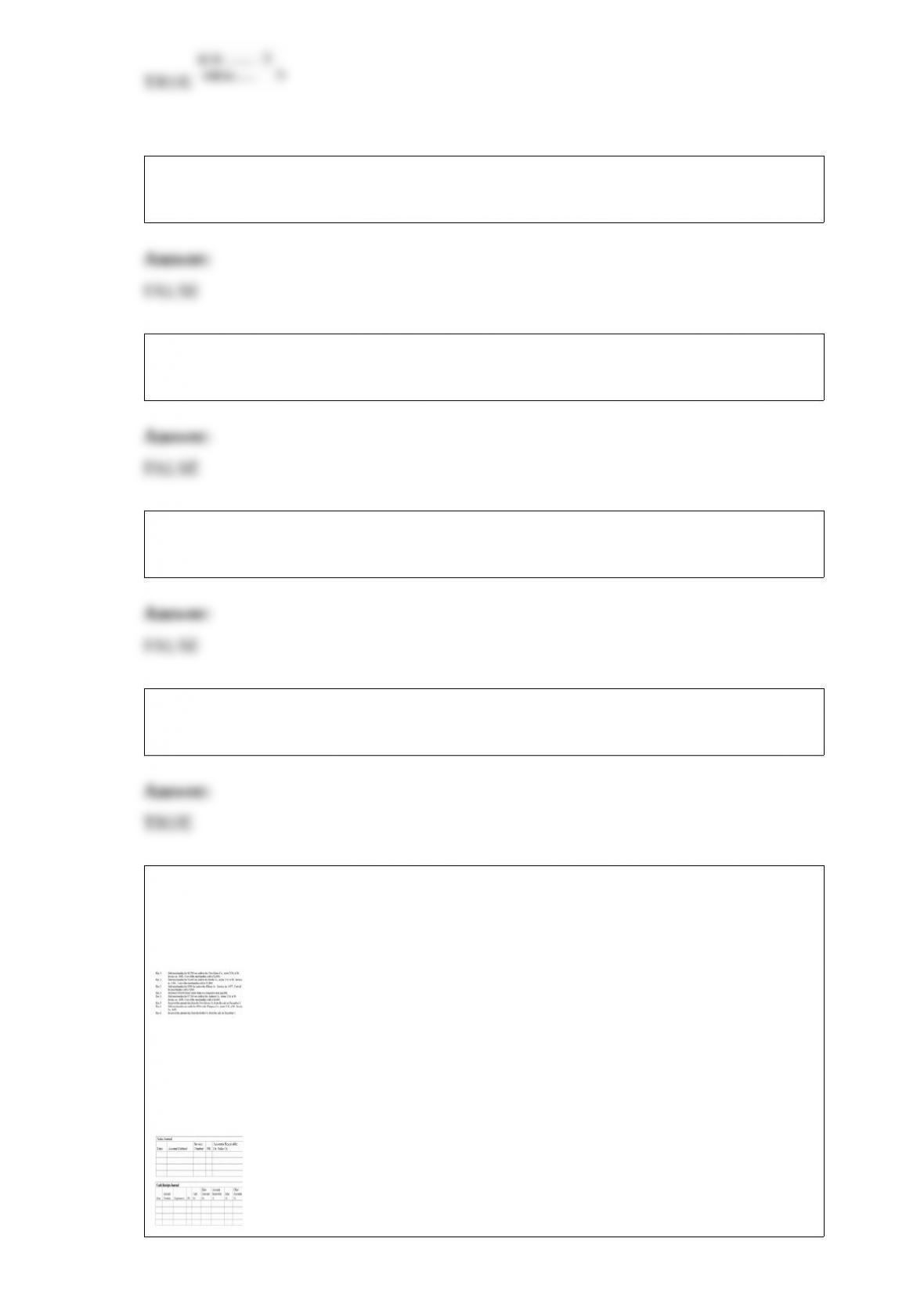
12) The Sun Company completed the following sales and cash receipts transactions
during the first week of December. The Sun Company uses the periodic inventory
system.
a. Use the sales journal and the cash receipts journal to record these transactions.
b. Prepare a schedule of accounts receivable. There was no accounts receivable balance
at December 1

13) Within an organizational structure, the person most likely to be evaluated in terms
of controllable costs would be:
A.A payroll clerk
B.A cost center manager
C.A production line worker
D.A maintenance worker
E.All of these
14) The total cost of an asset less its accumulated depreciation is called:
A.Historical cost
B.Book value
C.Present value
D.Current (market) value
E.Replacement cost
15) Direct labor and indirect labor are recorded, respectively, to:
A.Factory Overhead and Goods in Process Inventory
B.Goods in Process Inventory and Finished Goods Inventory
C.Finished Goods Inventory and Goods in Process Inventory
D.Goods in Process Inventory and Factory Overhead
E.Cost of Goods Sold and Finished Goods Inventory
16) The difference between the total budgeted fixed overhead cost and the fixed
overhead applied to production using the predetermined overhead rate is the:
A.Production variance
B.Volume variance
C.Overhead cost variance
D.Quantity variance
E.Controllable variance

17) A properly designed internal control system:
A.Lowers the company’s risk of loss
B.Insures profitable operations
C.Eliminates the need for an audit
D.Requires the use of non-computerized systems
E.Is not necessary if the company uses a computerized system
18) Brig Company had $800,000 in sales, sales discounts of $12,000, sales returns and
allowances of $18,000, cost of goods sold of $380,000, and $275,000 in operating
expenses. Gross profit equals:
A.$770,000.
B.$115,000.
C.$390,000.
D.$402,000.
E.$408,000.
19) Failure by a promissory note’s maker to pay the amount due at maturity is known
as:
A.Protesting a note
B.Closing a note
C.Dishonoring a note
D.Discounting a note
E.Depreciating a note
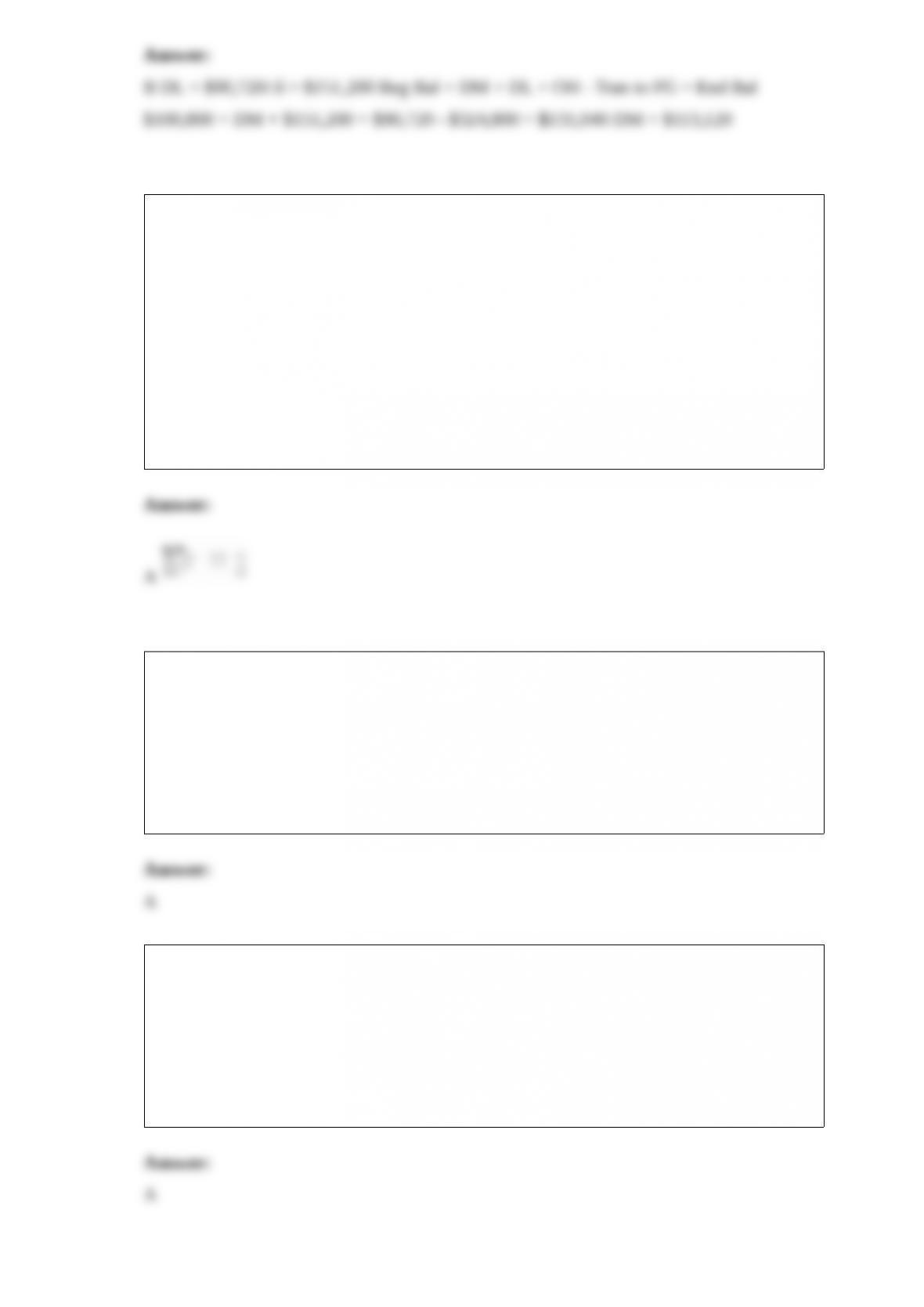
20) A company’s overhead rate is 60% of direct labor cost. Using the following
incomplete accounts, determine the cost of direct materials used.
A.$106,400
B.$113,120
C.$30,240
D.$211,680
E.$324,800
21) A company uses the weighted average method for inventory costing. During a
period, a production department had 20,000 units in beginning goods in process
inventory which were 40% complete; the department completed and transferred
165,000 units. At the end of the period, 22,000 units were in the ending goods in
process inventory and are 75% complete. Compute the number of equivalent units
produced by the department.
A.181,500
B.165,000
C.173,500
D.145,000
E.187,000
22) A short-term note payable:
A.Is a written promise to pay a specified amount on a definite future date within one
year or the company’s operating cycle, whichever is longer
B.Is a contingent liability
C.Is an estimated liability
D.Is not a liability until the due date
E.Cannot be used to extend the payment period for an account payable
23) To be sure that total debits and credits in a columnar journal are equal, before
posting we should:
A.Crossfoot
B.Foot
C.Journalize
D.Post
E.Reconcile

24) Presented below are terms preceded by letters a through j and followed by a list of
definitions 1 through 10. Enter the letter of the term with the definition, using the space
preceding the definition.
1>Flexible budget A. The difference between the total budgeted overhead cost and the
overhead cost that was allocated to products using the predetermined fixed overhead
rate.
2>Quantity variance B. A planning budget based on a single predicted amount of sales
or production volume; unsuitable for evaluations if the actual volume differs from the
predicted volume.
3>Management by exception C. Preset costs for delivering a product, component, or
service under normal conditions.
4>Standard costs D. A process of examining the differences between actual and
budgeted sales or costs and describing them in terms of the amounts that resulted from
price and quantity differences.
5>Price variance E. The difference between actual and budgeted sales or cost caused by
the difference between the actual price per unit and the budgeted price per unit.
6>Variance analysis F. A budget prepared based on predicted amounts of revenues and
expenses corresponding to the actual level of output.
7>Volume variance G. The difference between actual and budgeted cost caused by the
difference between the actual quantity and the budgeted quantity.
8>Cost variance H. The combination of both overhead spending variances (variable and
fixed) and the variable overhead efficiency variance.
9>Controllable variance I. A management process to focus on significant variances and
give less attention to areas where performance is close to the standard.
10>Fixed budget J. The difference between actual cost and standard cost, made up of a
price variance and a quantity variance.
25) Goods a company acquires to use in making products are called:
A.Cost of goods sold
B.Raw materials inventory
C.Finished goods inventory
D.Goods in process inventory
E.Conversion costs
26) A mixed cost:
A.Requires the future outlay of cash and is relevant for future decision making
B.Does not change with changes in the volume of activity within the relevant range
C.Is directly traceable to a cost object
D.Contains a combination of fixed costs and variable costs
E.Has already been incurred and cannot be avoided so it is irrelevant for decision
making

27) The ability to generate future revenues and meet long-term obligations is referred to
as:
A.Liquidity and efficiency
B.Solvency
C.Profitability
D.Market prospects
E.Creditworthiness
28) Match each of the following terms with the appropriate definitions.
1>Price-earnings ratio A. A ratio of the annual amount of cash dividends distributed to
common shareholders relative to the stock’s market value.
2>Date of record B. Occurs when a corporation calls in its stock and replaces each
share with more than one new share; decreases both the market value per share and the
par or stated value per share.
3>Reverse stock split C. A document that gives a designated agent the right to vote a
stockholder’s stock.
4>Dividend yield D. Retained earnings reported separately as a way to inform
stockholders of funding needs.
5>Transfer agent E. Occurs when a corporation calls its stock and replaces each share
with less than one new share; increases both the market value per share and the par or
stated value per share.
6>Basic earnings per share F. A stock dividend that is 25% or less of the previously
outstanding shares.
7>Appropriated retained earnings G. Net income less preferred dividends divided by
weighted-average common shares outstanding.
8>Stock split H. The date specified by directors of a corporation for identifying
stockholders to receive dividends.
9>Proxy I. The ratio of a company’s current market value per share to its earnings per
share.
10>Small stock dividend J. A bank or trust company that assists with purchases and
sales of shares by receiving and issuing certificates as necessary.
29) Once the estimated depreciation expense for an asset is calculated:
A.It cannot be changed due to the historical cost principle
B.It may be revised based on new information
C.Any changes are accumulated and recognized when the asset is sold
D.The estimate itself cannot be changed; however, new information should be disclosed

in financial statement footnotes
E.It cannot be changed due to the consistency principle
30) Everrine Corporation owns 30% of JRW Corporation. Everrine Corporation
received $9,000 in cash dividends from JRW Corporation. The entry to record receipt of
these dividends is:
A.Debit Cash, $9,000; credit Long-Term Investments, $9,000
B.Debt Long-Term Investment, $9,000; credit Cash, $9000
C.Debit Cash, $9,000; credit Interest Revenue, $9,000
D.Debit Unrealized Gain-Equity, $9,000; credit Cash, $9,000
E.Debit Cash, $9,000; credit Dividend Revenue, $9,000
31) The unadjusted trial balance of Bade Cleaning Service is entered on the partial work
sheet below. Complete the work sheet using the following information:
(a) Salaries earned by employees that are unpaid and unrecorded, $4,000.
(b) An inventory of supplies showed $3,000 of unused supplies still on hand.
(c) Depreciation on automobiles, $30,000.
(d) Services paid in advance by customers of $12,000 have now been provided to
customers.
(e) Advertising for November and December in the amount of $8,000 remains unpaid
and unrecorded.
32) A debit to Sales Returns and Allowances and a credit to Accounts Receivable:
A.Reflects an increase in amount due from a customer.
B.Recognizes that a customer returned merchandise and/or received an allowance.
C.Requires a debit memorandum to recognize the customer’s return.
D.Is recorded when a customer takes a discount.
E.Reflects a decrease in amount due a supplier.

33) Increases in equity from a company’s earnings activities are:
A.Assets
B.Revenues
C.Liabilities
D.Owner’s Equity
E.Expenses
34) Temporary accounts include all of the following except:
A.Consulting revenue
B.Withdrawals
C.Rent expense
D.Prepaid rent
E.Income Summary
35) Kyoto, Inc. predicts the following sales in units for the coming four months:
Although each month’s ending inventory of finished units should be 60% of the next
month’s sales, the March 31 finished goods inventory is only 100 units. A finished unit
requires five pounds of raw material B. The March 31 raw materials inventory has 200
pounds of B. Each month’s ending inventory of raw materials should be 30% of the
following month’s production needs. The budgeted production for May is:
A.200 units
B.212 units
C.268 units
D.280 units
E.292 units
36) All of the following statements regarding liabilities are True except:
A.A liability is a probable future payment of assets or services
B.Unearned future wages to be paid to employees should be recorded as liabilities
C.For a liability to be reported, it must be a present obligation that results from a past
transaction or event, and requires a future payment of assets or services
D.Information about liabilities is more useful when the balance sheet identifies them as

either current or long term
E.All of these are True
37) A measure of the productivity of a process with respect to its use of direct materials,
direct labor, or overhead, and an expression of the activity of a process as the number of
units that would have been processed during a period if all effort had been applied to
units that were started and finished during the period, is called:
A.Manufacturing overhead
B.Units in process
C.A job cost sheet
D.Equivalent units of production
E.Process cost summary
38) The inventory valuation method that tends to smooth out erratic changes in costs is:
A.FIFO
B.Weighted average
C.LIFO
D.Specific identification
E.WIFO
39) Flash reported net income of $17,500 for the past year. At the beginning of the year
the company had $200,000 in assets and $50,000 in liabilities. By the end of the year,
assets had increased to $300,000 and liabilities were $75,000. Calculate its return on
assets:
A.8.8%
B.7.0%
C.5.8%
D.35.0%
E.23.3%
40) Match each of the following terms with the appropriate definitions.

1>C corporation A. A financial statement that shows total capital balances at the
beginning of the period, any additional investment by partners, the income or loss of the
period, the partners’ withdrawals, and the ending capital balances.
2>Partnership B. A partnership that has two classes of partners, limited partners and
general partners. Limited partners have no personal liability beyond the amount they
invest in the partnership, and have no active role except as specified in the partnership
agreement.
3>Mutual agency C. A partnership that protects innocent partners from malpractice or
negligence claims resulting from the acts of another partner.
4>General partner D. The legal relationship among general partners that makes each of
them responsible for paying the debts of the partnership if the other partners are unable
to pay their shares.
5>Limited partnership E. The agreement between partners that sets terms under which
the affairs of the partnership are conducted.
6>Unlimited liability of partners F. An unincorporated association of two or more
persons to pursue a business for profit as co-owners.
7>Partnership contract G. A partner who assumes unlimited liability for the debts of the
partnership.
8>Limited liability partnership H. The legal relationship among partners whereby each
partner can commit or bind the partnership to any contract within the scope of the
partnership’s business.
9>Statement of partners’ equity I. A corporation that does not qualify for nor elect to be
treated as a partnership for income tax purposes and therefore is subject to income
taxes.
10>S corporation J. A corporation that meets special tax qualifications so as to be
treated like a partnership for income tax purposes.
41) An estimated liability:
A.Is an unknown liability of a certain amount
B.Is a known obligation of an uncertain amount that can be reasonably estimated
C.Is a liability that may occur if a future event occurs
D.Can be the result of a lawsuit
E.Is not recorded until the amount is known for certain
42) All of the following statements regarding stock dividends are true except:
A.Directors can use stock dividends to keep the market price of the stock affordable
B.Stock dividends provide evidence of management’s confidence that the company is
doing well
C.Stock dividends do not reduce assets or equity
D.Stock dividends decrease the number of shares outstanding
E.Stock dividends transfer a portion of equity from retained earnings to contributed
capital
43) Mueller Corp. manufactures compact discs that sell for $5.00. Fixed costs are
$28,000 and variable costs are $3.60 per unit. Mueller can buy a newer production
machine that will increase fixed costs by $8,000 per year, but will decrease variable
costs by $0.40 per unit. What effect would the purchase of the new machine have on
Mueller’s break-even point in units?
A.4,444 unit increase
B.9,850 unit decrease
C.5,714 unit increase
D.4,444 unit decrease
E.No effect on the break-even point in units
44) A _______________________ contains relevant information that compares actual
results to planned activities.
45) Based on the following trial balance for Smyth’s Repair Shop, prepare an income
statement, statement of owner’s equity, and a balance sheet. Smyth made no additional
investments in the company during the year.
46) If actual price per unit of materials is greater than the standard price per unit of
materials, the direct materials price variance is ______________________.
47) What is the high-low method? Briefly describe how it is applied.
48) Khalid, Dina, and James are partners with beginning-of-year capital balances of
$400,000, $320,000, and $160,000, respectively. The partners agreed to share income
and loss as follows: Salary of $30,000 to Khalid, $50,000 to Dina, and $55,000 to
James. An interest allowance of 10% on beginning-of-year capital balances. Any
remaining balance is to be divided equally. If partnership net income for the year is
$190,000, determine each partner’s share and make the appropriate journal entry to
close the Income Summary to the capital accounts.
49) Explain how accounting adjustments affect financial statements.
50) Unearned revenues are amounts received _______________ for future products or
services.