Preferred stock differs from common stock in that:
A) preferred stock has more voting power and, as such, greater control over the
management of the company.
B) preferred stockholders are paid dividends before common stockholders.
C) preferred stock pays tax-free dividends.
D) preferred stock has no preemptive rights or residual claims.
Assume that no dividends were declared during the current year. Which of the
following statements about the effect of a net loss on the closing process is correct?
A) If a company has a net loss during the current accounting period, then the ending
Retained Earnings will be smaller than the beginning Retained Earnings.
B) When closing entries are prepared, Common Stock is debited if a company has a net
loss.
C) If a company has a net loss, the closing entry will include debits to the revenue
accounts, credits to the expense accounts, and a credit to Retained Earnings.
D) If a company has a net loss, the amount of revenues to be closed will be greater than
the amount of expenses to be closed in the closing process.
Shockglass Company had a beginning inventory of $15,000. During the year, the
company recorded inventory purchases of $45,000 and cost of goods sold of $50,000.
The ending inventory must equal:
A) $10,000.
B) $25,000.
C) $26,000.
D) $27,000.
In a common size balance sheet, each item on the balance sheet is expressed as a
percentage of:
A) total assets.
B) total liabilities.
C) net income.
D) total stockholders’ equity.
Allsop Company had no beginning inventory. The company purchases 300 units of
inventory in January at $5 each, 500 units at $4 each in August, and 200 units at $6
each in November. The company sells 150 units during the year. Allsop uses a periodic
inventory system and the LIFO inventory costing method. What is the cost of goods
sold?
A) $600
B) $934
C) $750
D) $900
A corporation declared a stock dividend on November 1 and issued 9,000 shares of
stock to its stockholders. Prior to the dividend, the balance in Retained Earnings was
$850,000, the number of shares of $5 par value stock issued and outstanding was
60,000, and the market value of the stock was $12. This stock dividend will cause total
stockholders’ equity to:
A) remain unchanged.
B) increase by $45,000.
C) decrease by $108,000.
D) decrease by $63,000.
Urban Outsiders has a building that originally cost $375,000. The company expects to
be able to sell the facility for $107,000 at the end of its useful life. The balance of the
related Accumulated Depreciation account is $258,000. The depreciable cost of the
facility is:
A) $117,000.
B) $151,000.
C) $268,000.
D) $107,000.
Relevance is an objective of external financial reporting that means:
A) the financial reports of a business are assumed to include the results of only that
business’s activities.
B) financial information can be compared across businesses because similar accounting
methods have been applied.
C) the financial information possesses a feature that allows it to influence a decision.
D) the financial information depicts the economic substance of business activities.
When a company uses excess cash to buy back some of its outstanding common stock,
which of the following ratios will be affected directly in the manner described below?
A) Return on equity (ROE) will decrease.
B) Earnings per share (EPS) will increase.
C) The Price Earnings (PE) ratio will increase.
D) There will not be any effect on the three ratios.
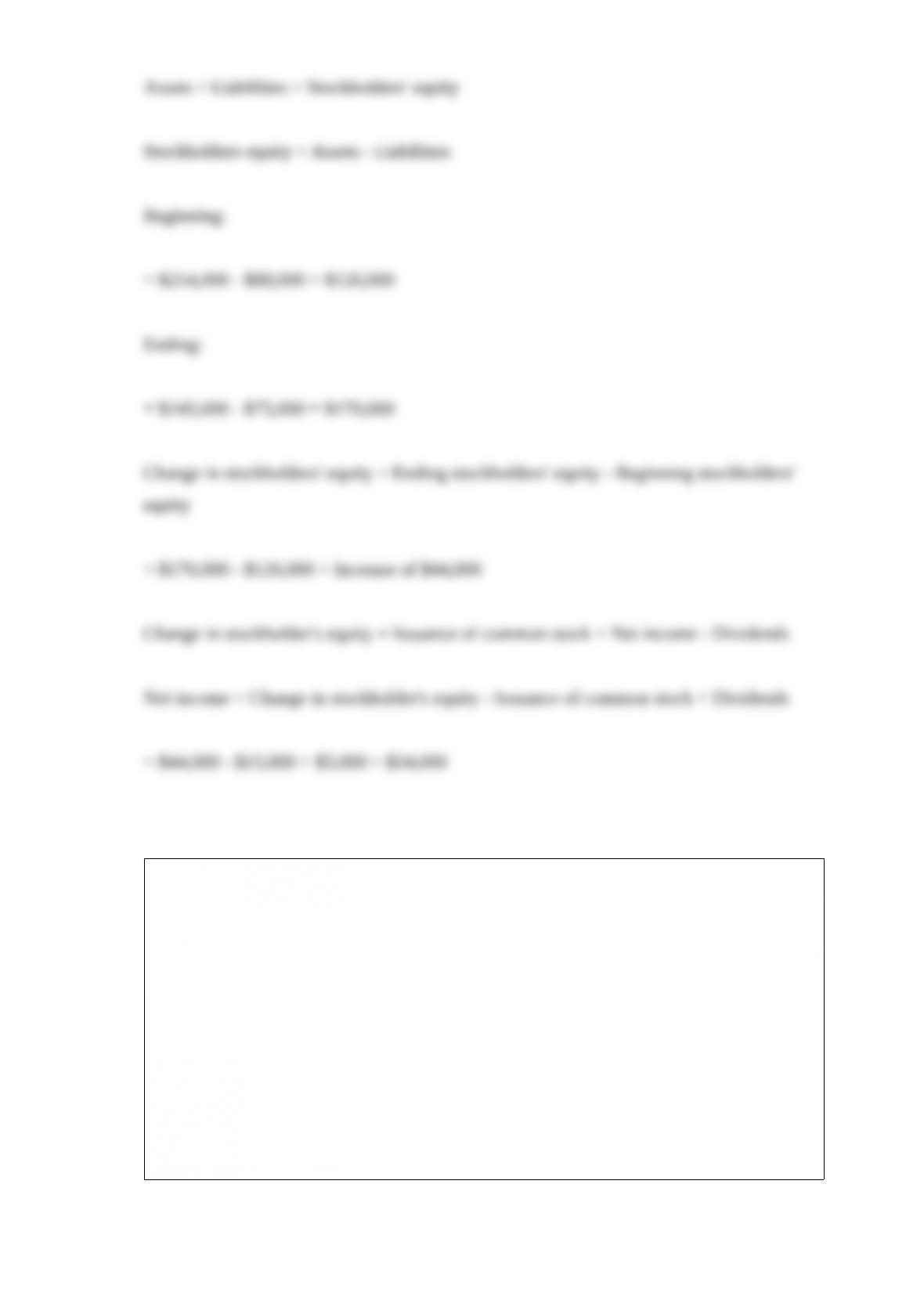
A company had the following assets and liabilities at the beginning and end of the
current year:
Common stock in the amount of $15,000 was issued and dividends of $5,000 were paid
during the year. What is the amount of net income for the year?
A) $44,000.
B) $34,000.
C) $24,000.
D) $54,000.
Which of the following statements relating to restricted cash is not correct?
A) Restricted cash is not available for general use but rather restricted for a specific
purpose.
B) Restricted cash must be reported separately on the balance sheet.
C) By including restricted cash as part of the amount reported as cash and cash
equivalents, the company more clearly conveys to financial statement users the actual
amount of cash available to pay liabilities.
D) Companies are sometimes legally or contractually required to set aside cash for a
specific purpose and are not allowed to use it for day-to-day operations.