Victoria Company
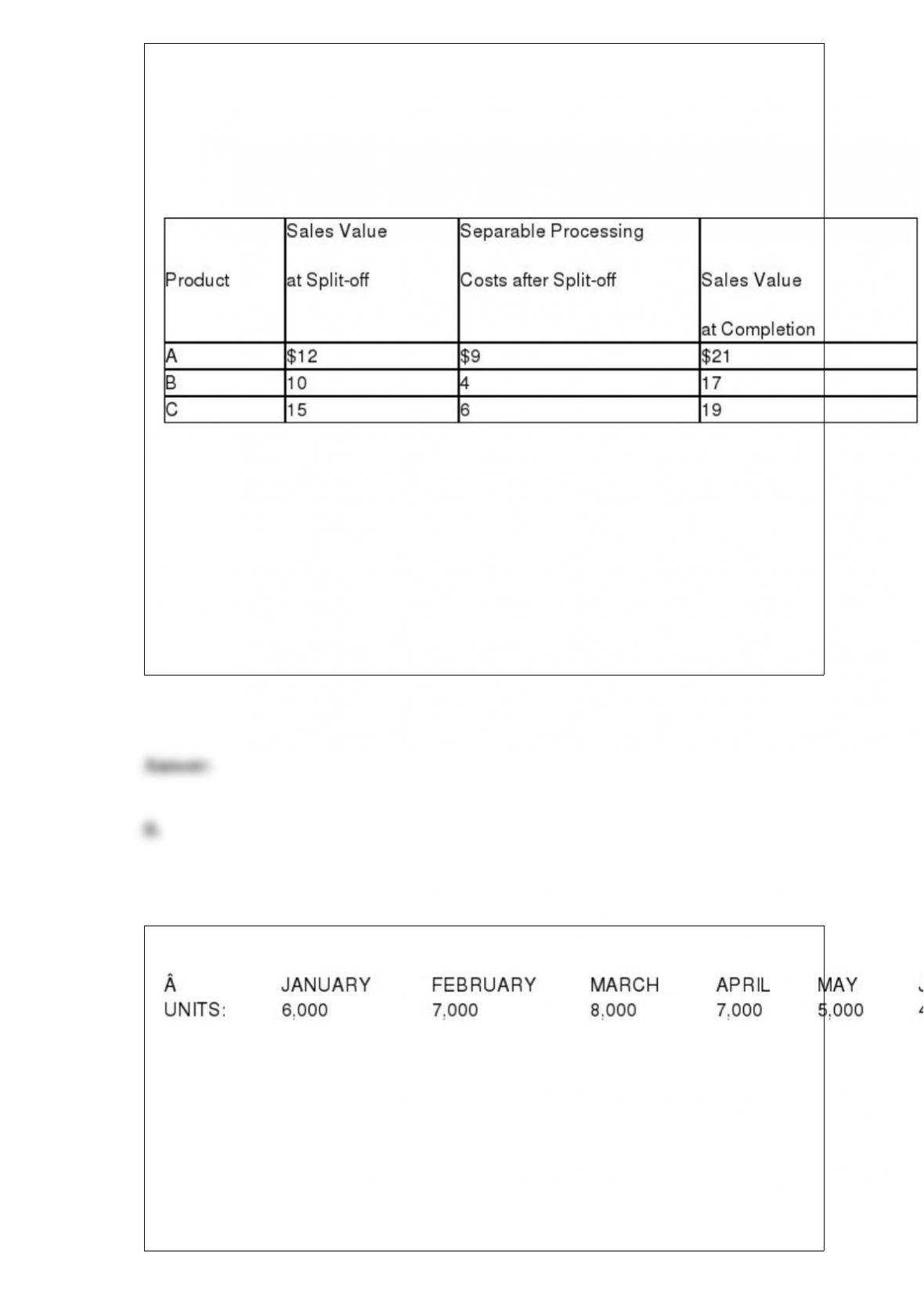
Victoria Company manufactures three products in a joint process which costs $25,000.
Each product can be sold at split-off or processed further and then sold. 10,000 units of
each product are manufactured. The following information is available for the three
products:
Refer to Victoria Company. To maximize profits, which products should Victoria
process further?
A. Product A only
B. Product B only
C. Product C only
D. Products A, B, and C
Budgeted sales for the first six months for Stone Corporation are listed below:
Stone Corporation has a policy of maintaining an inventory of finished goods equal to
40 percent of the next month’s budgeted sales. If Stone Corporation plans to produce
6,000 units in June, what are budgeted sales for July?
A. 3,600 units
B. 1,000 units
C. 9,000 units

D. 8,000 units
When a firm redesigns a product to reduce the number of component parts, the firm is
A. increasing consumer value.
B. increasing the value added to the product.
C. decreasing product variety.
D. decreasing non-value-added costs.
Performance reports are useful only to the extent that performance is measured against
A. a meaningful benchmark.
B. the performance of all other units or managers.
C. the budget as adopted for the period.
D. competitors’ achievements.

The salvage value of an old lathe is zero. If instead, the salvage value of the old lathe
was $20,000, what would be the impact on the net present value of the proposal to
purchase a new lathe?
A. It would increase the net present value of the proposal.
B. It would decrease the net present value of the proposal.
C. It would not affect the net present value of the proposal.
D. Potentially it could increase or decrease the net present value of the new lathe.
In a CVP graph, the area between the total cost line and the total revenue line
represents total
A. contribution margin.
B. variable costs.
C. fixed costs.
D. profit.
Profit sharing is a method of employee compensation that
A. allocates an equal amount of profit reward to each manager in the organization.

B. allows organizational profits to be divided among employees in a non-taxable status.
C. is contingent based on the level of subunit profit generated.
D. is used in many foreign companies but is virtually nonexistent in most U.S.
organizations.
A primary purpose of a balanced scorecard is to give
A. managers a way to judge past performance.
B. stockholders a way to judge current performance.
C. managers a way to forecast future performance.
D. stockholders a way to tie strategy to profitability.
The balanced scorecard perspective that addresses concerns about organizational
growth is the:
A. learning and growth perspective
B. internal business perspective
C. customer value perspective
D. financial perspective
Joplin Corporation produces three products from a common manufacturing process.
The total joint cost of producing 2,000 pounds of Product A; 1,000 pounds of Product
B; and 1,000 pounds of Product C is $7,500. Selling price per pound of the three
products are $15 for Product A; $10 for Product B; and $5 for Product C. Joint cost is
allocated using the sales value method.
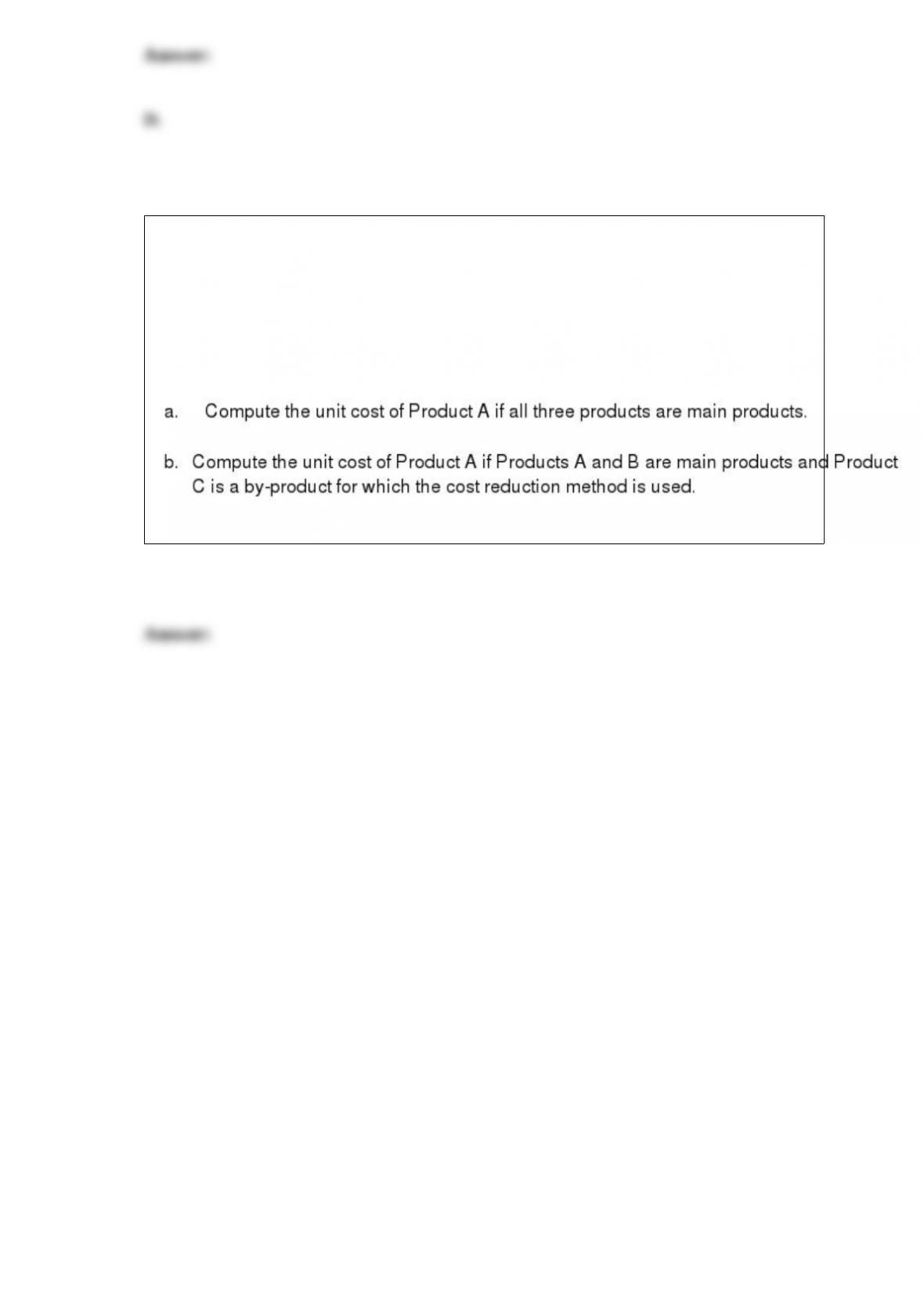
Required: