When using a standard costing system, recording events related to variable overhead
requires four separate entries.
Since the purchasing agent is responsible for ordering raw materials, he or she would be
the one to negotiate a volume discount.
When production volume equals sales volume, fixed overhead expensed is higher using
absorption costing than with variable costing.
Under activity-based costing, selling and administrative costs should be allocated to
products if they are incurred to provide resources that are consumed by unit-level,
batch-level, or product-level activities.
If a cost is related to running the manufacturing facility, but does not qualify as direct
materials or direct labor, it must be part of overhead.
Benchmarking is about trying to achieve another company’s metrics.
When choosing the right performance measures, the best measures relate to day-to-day
operations.
The direct materials price variance is calculated using the standard quantity of direct
materials purchased, the actual price paid for the direct materials, and the standard price
for the direct materials purchased.
On the cash flow statement, issuing new debt is an example of a use of cash.
Dividends declared is not a cash flow.

Capital assets are also referred to as long-lived assets.
A performance dashboard is a visual display of the key measures related to an
organization’s operational goals and strategies.
Pro-forma financial statements are prepared based on assumed rather than actual
results.
Which of the following is not a reason companies use key performance indicators?
a. Mandate to report company performance to stakeholders

b. Increase accuracy of business decisions
c. Improve company performance
d. All of these answer choices are reasons companies use key performance indicators
The goal of an ERP system is to
a.Reduce waste and inefficiency in the production process.
b.To integrate all data from the company ‘s many business processes into a single
information system.
c.To establish the direction in which an organization wishes to go.
d.To monitor day-to-day operations to ensure that processes are operating as expected.
Barber Industries reported net sales of $92,000, net income of $32,000, dividends paid
to preferred stockholders of $7,000, dividends paid to common stockholders of
$10,000, average number of shares outstanding is 5,000. What is the earnings per
share?
a. $18.40
b. $16.40
c. $6.40
d. $5.00

When using variable costing, fixed manufacturing overhead is treated as which of the
following types of costs?
a. Product
b. Mixed
c. Period
d. Variable
Managers perform controlling activities
a.In real time as operations are occurring.
b.With a frequency such as once a day or once an hour.
c.Both in real time as operations are occurring and with a frequency such as once a day
or once an hour.
d.Neither in real time as operations are occurring nor a frequency such as once a day or
once an hour.
You are on a team responsible for addressing cash flow problems with other managers
in your corporate division. Your accounting department has provided your team with
the statement of cash flows prepared using the indirect method. At your first meeting,
some of the managers have expressed concerns about the statement’s understandability
and do not view the statement as anything other than a “rearranged income statement”.
The managers have requested that your team explain to them how the statement is
constructed.
Required:
Answer the following questions posed by the managers relating to the investing and
financing sections of the statement of cash flows.
a. What types of items are reported in the investing section of the statement of cash
flows?
b. What about the book value of an asset? How is it shown on the statement of cash
flows?
c. What types of items are reported in the financing section of the statement of cash
flows?
d. What about interest received and dividends received. Why are these items not shown
in the investing section of the statement of cash flows?

If a company produces its products in a constrained resource environment, the company
should
a. Always produce the product with the lowest contribution margin per constrained
resource.
b. Always produce the product with the highest contribution margin per constrained
resource.
c. Produce a mix of products such that opportunity cost is minimized.
d. Produce a mix of products so that customer service needs and customer preferences
are met.
Which of the following is not a step in using activity-based costing to estimate
customer profitability?
a. Calculate earnings per share
b. Calculate activity cost pool rates
c. Allocate selling costs to customers
d. Calculate customer profitability
As volume changes, which of the following items also change?
a. Total sales revenue
b. Total variable costs, Total contribution margin
d. Total sales revenue, variable costs and contribution margin
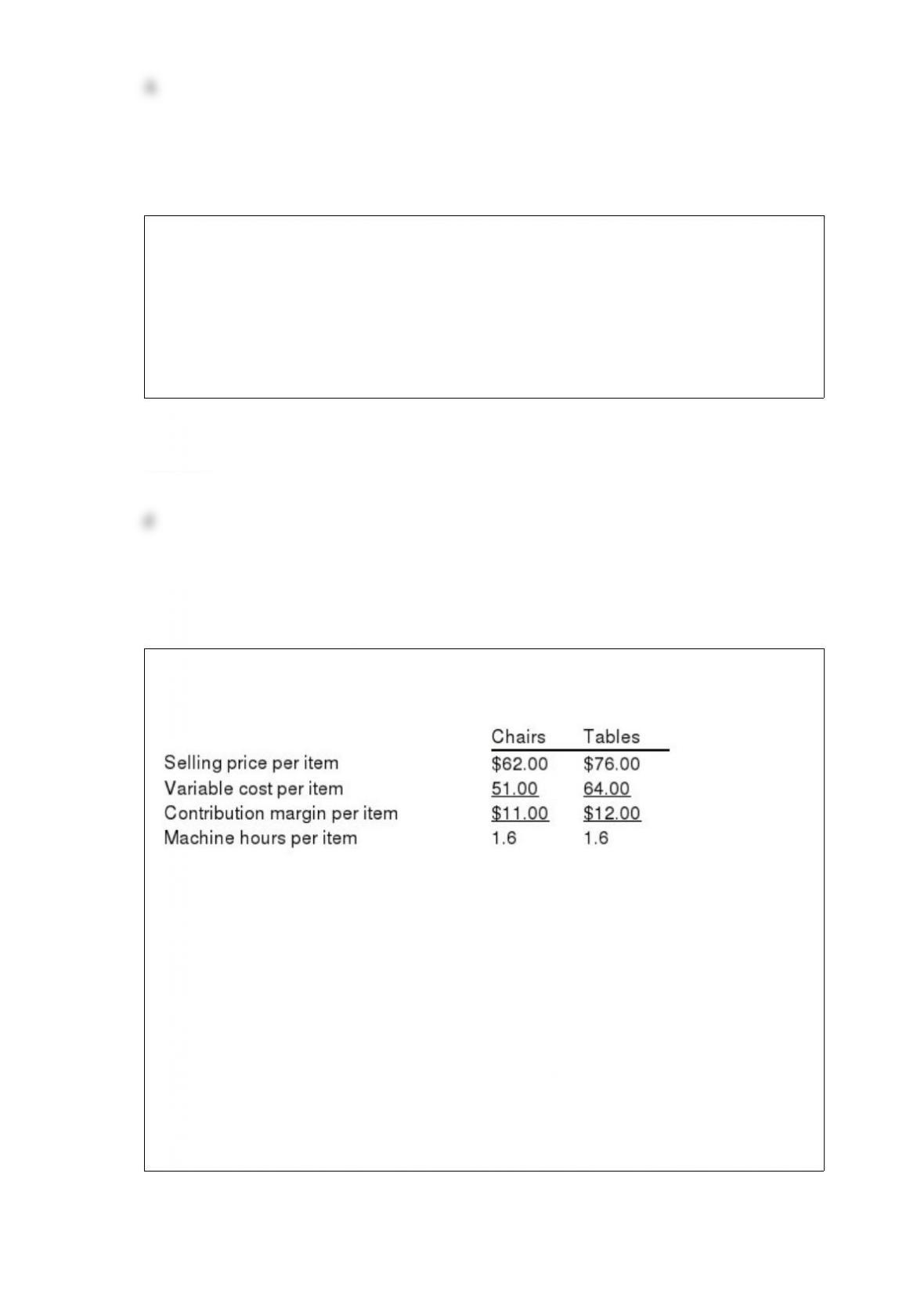
Range Rider Industries manufactures chairs and tables that are in high demand by local
office furniture stores. Following is information for each of these products:
Range Rider has 900 machine hours available each month. The demand for chairs is
560 units per month and the demand for tables is 340 units per month. If Range Rider
allocates its production capacity between the chairs and tables so that it maximizes the
company ‘s contribution margin, what will the contribution margin be?
a. $6,744
b. $6,522
c. $6,182
d. $10,240
The key to reducing costs through activity management is
a. Reducing the number of activities.
b. Eliminating the resources associated with the reduced activities.
c. Reducing the work force.
d. None of these answer choices are correct..
One way companies have tried to combat information overload is through the creation
of
a. Information firewalls.
b. Information dashboards.
c. Information warning signals.
d. Information ceilings.
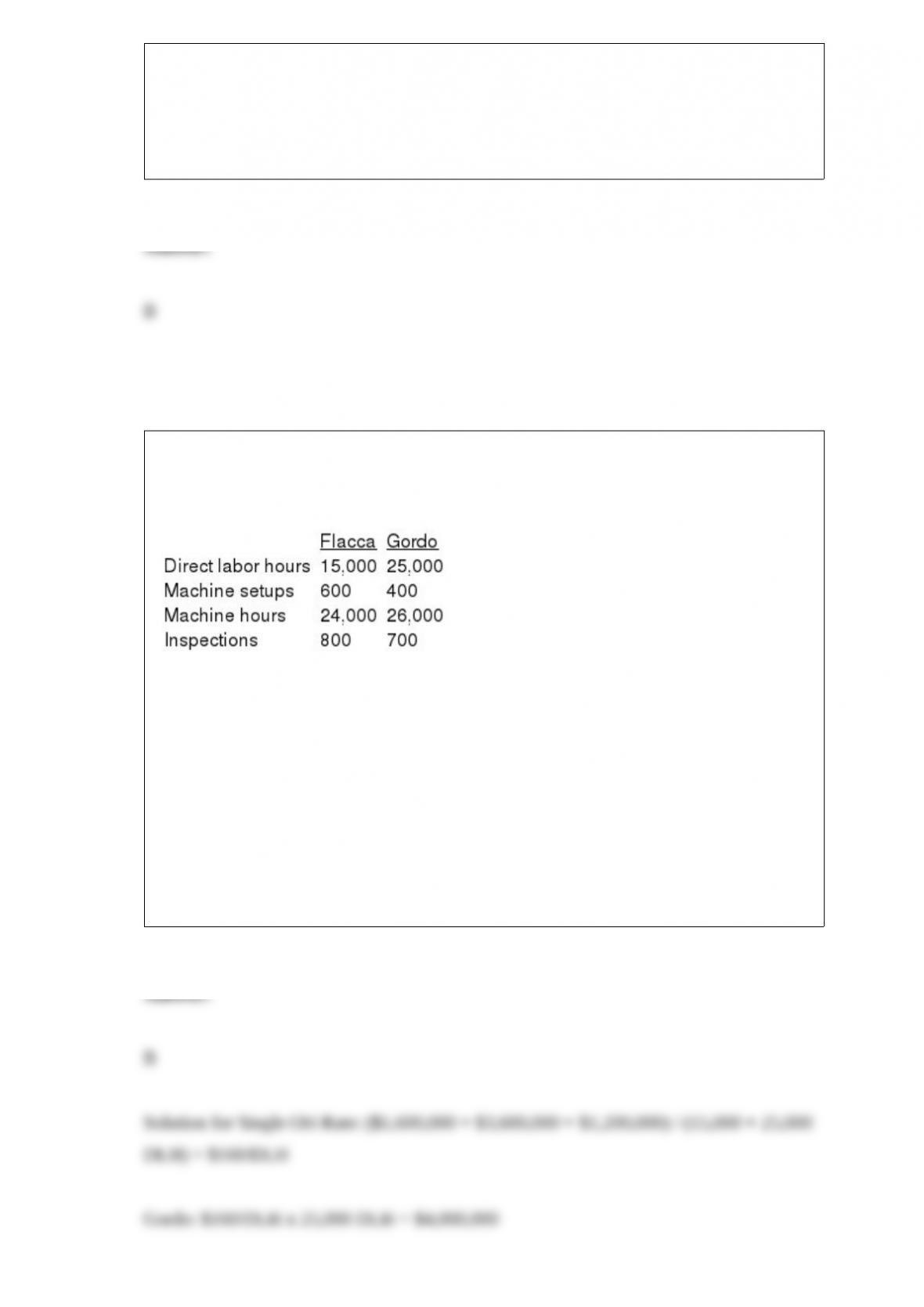
Austin Company manufactures 2 products, Flacca and Gordo. Overhead costs are
comprised of machine set-ups $1,600,000; machining $3,600,000; and inspecting
$1,200,000. Recent data are shown below:
Overhead assigned to Gordo using a single overhead rate based on direct labor hours
and using ABC, respectively, would be:
a. $4,000,000 and $2,400,000
b. $4,000,000 and $3,072,000
c. $2,400,000 and $3,328,000
d. $2,400,000 and $3,072,000
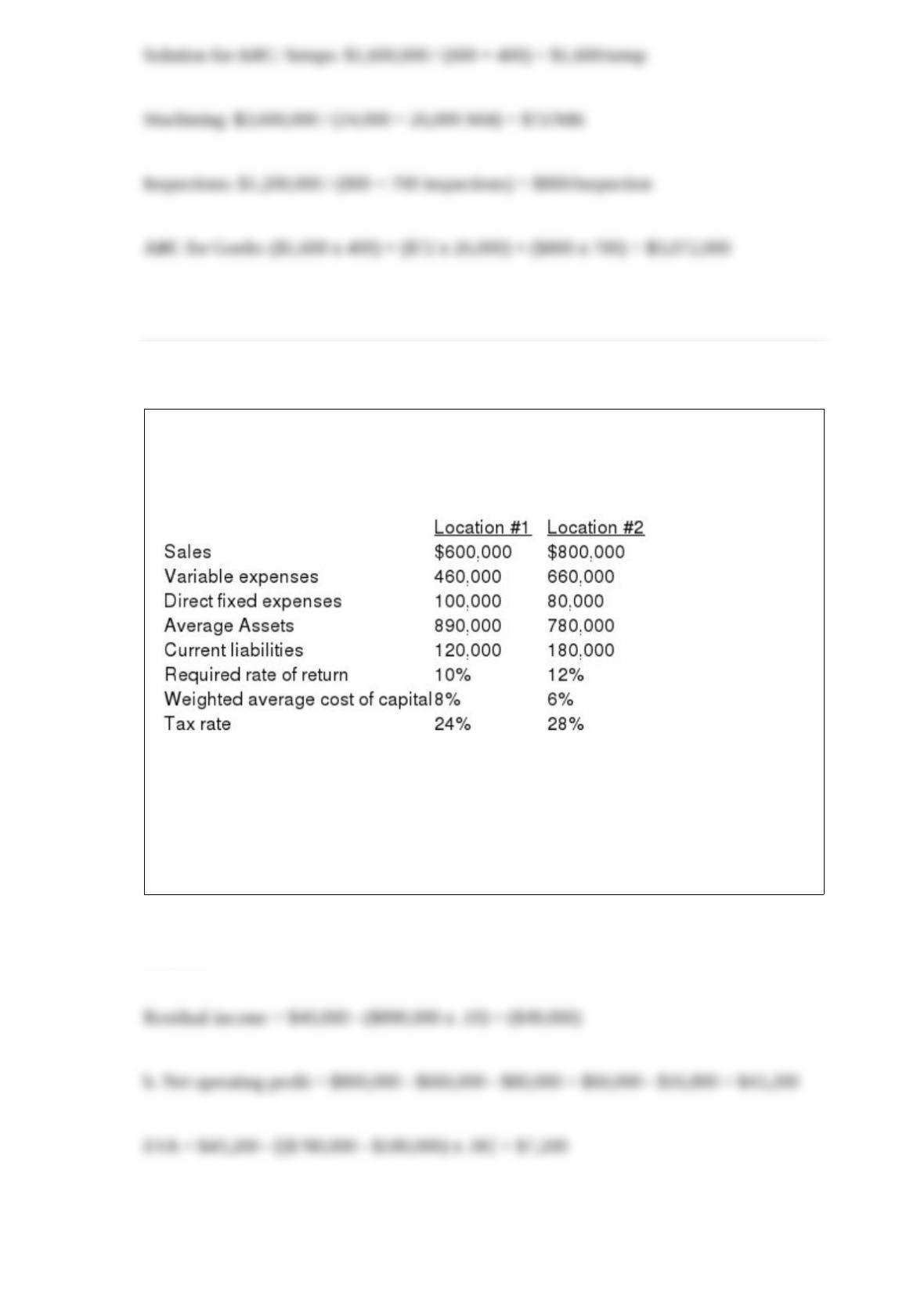
Major Corporation operates a wholesale electrical supply company with two locations.
Each location is evaluated as an investment center. Selected results from the latest year
are as follows:
Required:
a. Calculate the residual income for Location #1.
b. Calculate the EVA for Location #2.
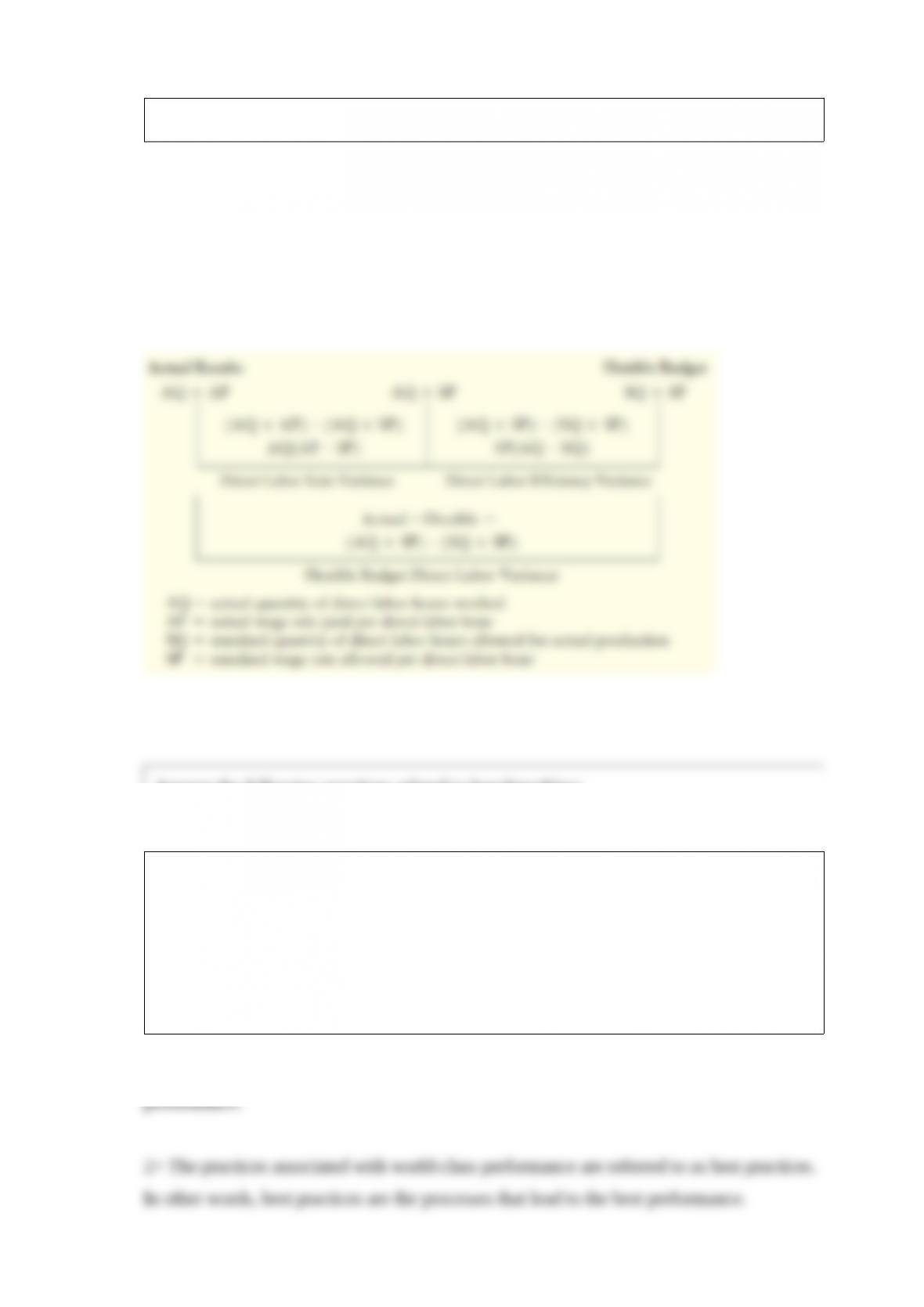
Calculate the direct labor rate and efficiency variances.
Answer the following questions related to benchmarking:
1> What is benchmarking?
2> What is a best practice?
3> What are the five items on which benchmarking is focused?
A profit center manager ‘s performance is measured using methods such as return on
investment or residual income.
Haygood, Inc. is a manufacturer of cast iron fire pits. Budgeted production is 20,000
units for January and 18,000 for February and 15,000 for March. The manufacturing
process is highly automated, but requires ¼ hour of direct labor time for each unit.
The standard wage rate is $10.
Required:
Prepare a direct labor budget for the first quarter.
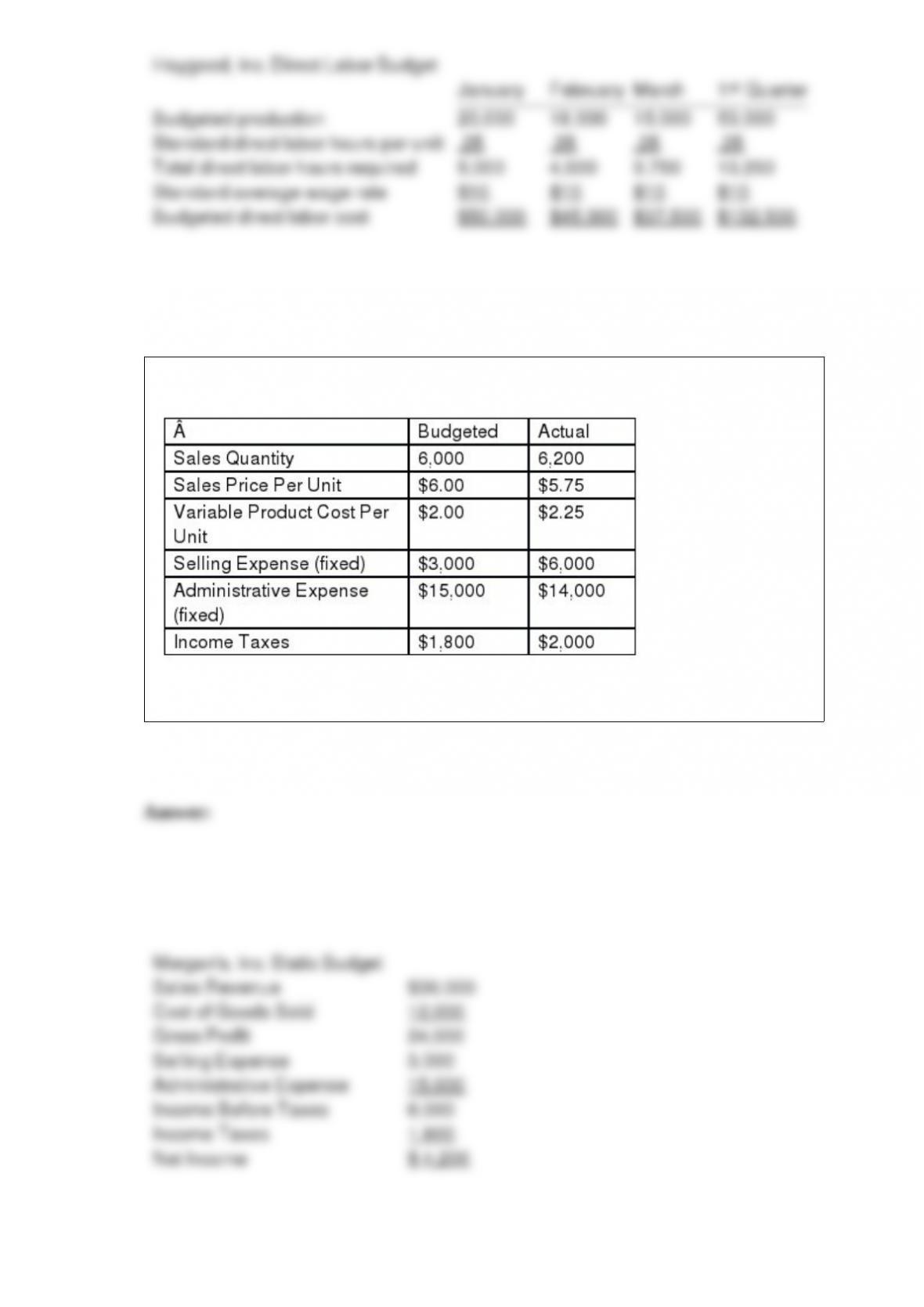
Morgan’s, Inc. has provided you with the following financial information:
Prepare a static budget.
Calculate cash flows provided by financing activities.
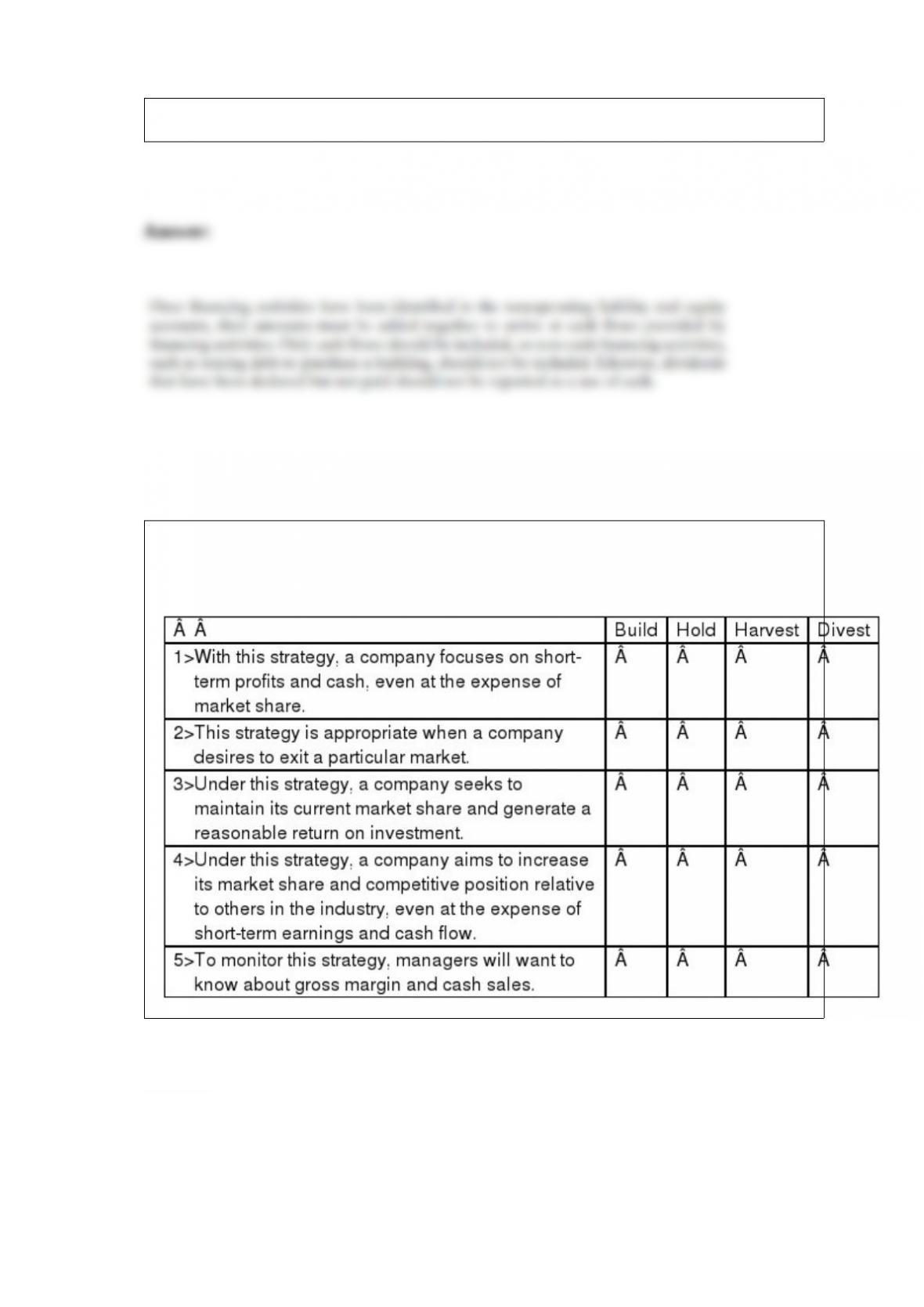
For each of the statements below indicate which approach to market share growth is
being used.
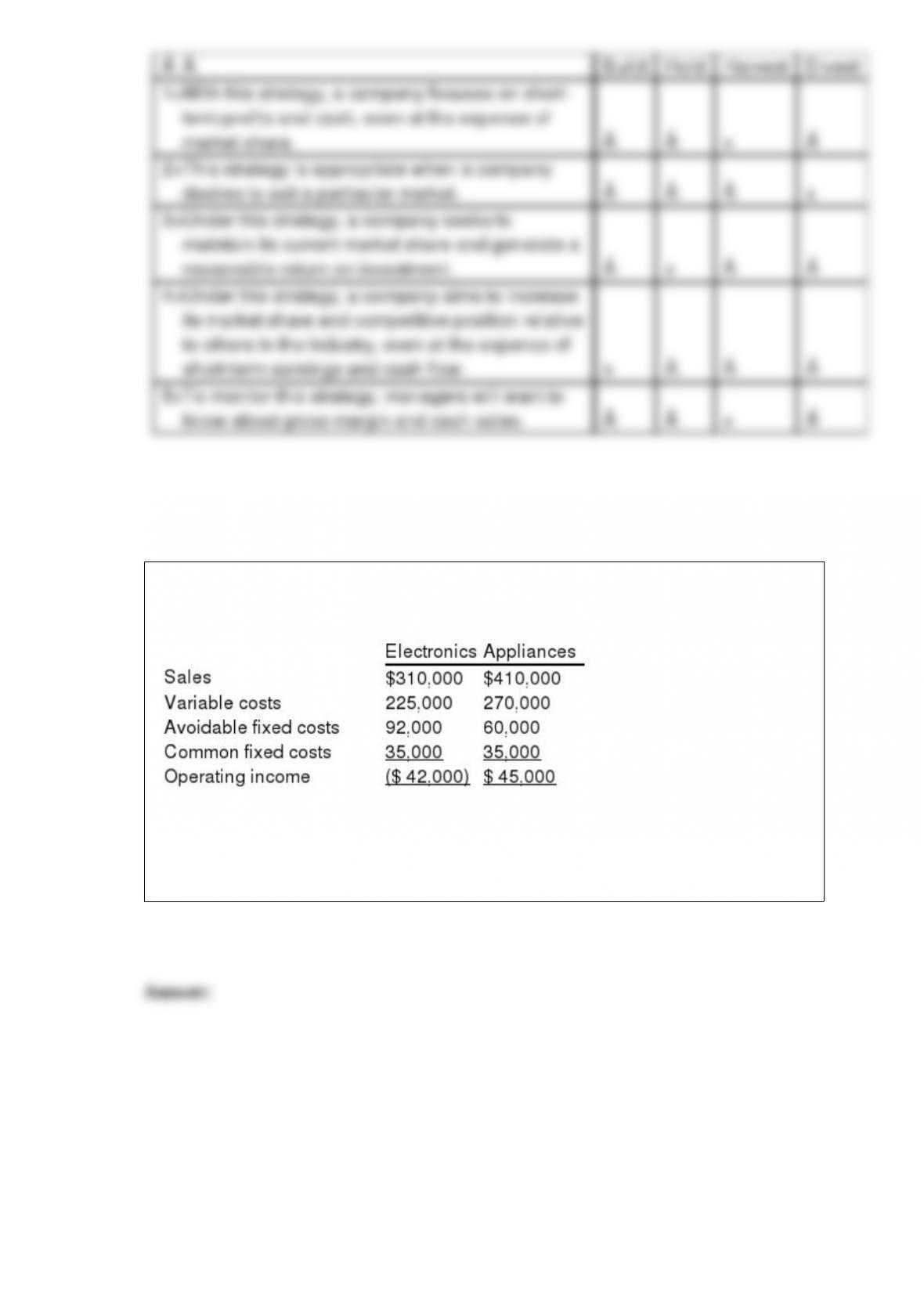
Cabells, Inc. has two divisions -Electronics and Appliances. The divisions have
provided the following financial information:
Cabells ‘ executives are considering the elimination of the Electronics division. If the
division is eliminated, the common fixed costs will remain unchanged. Given these
data, should the Electronics division be eliminated? Why?
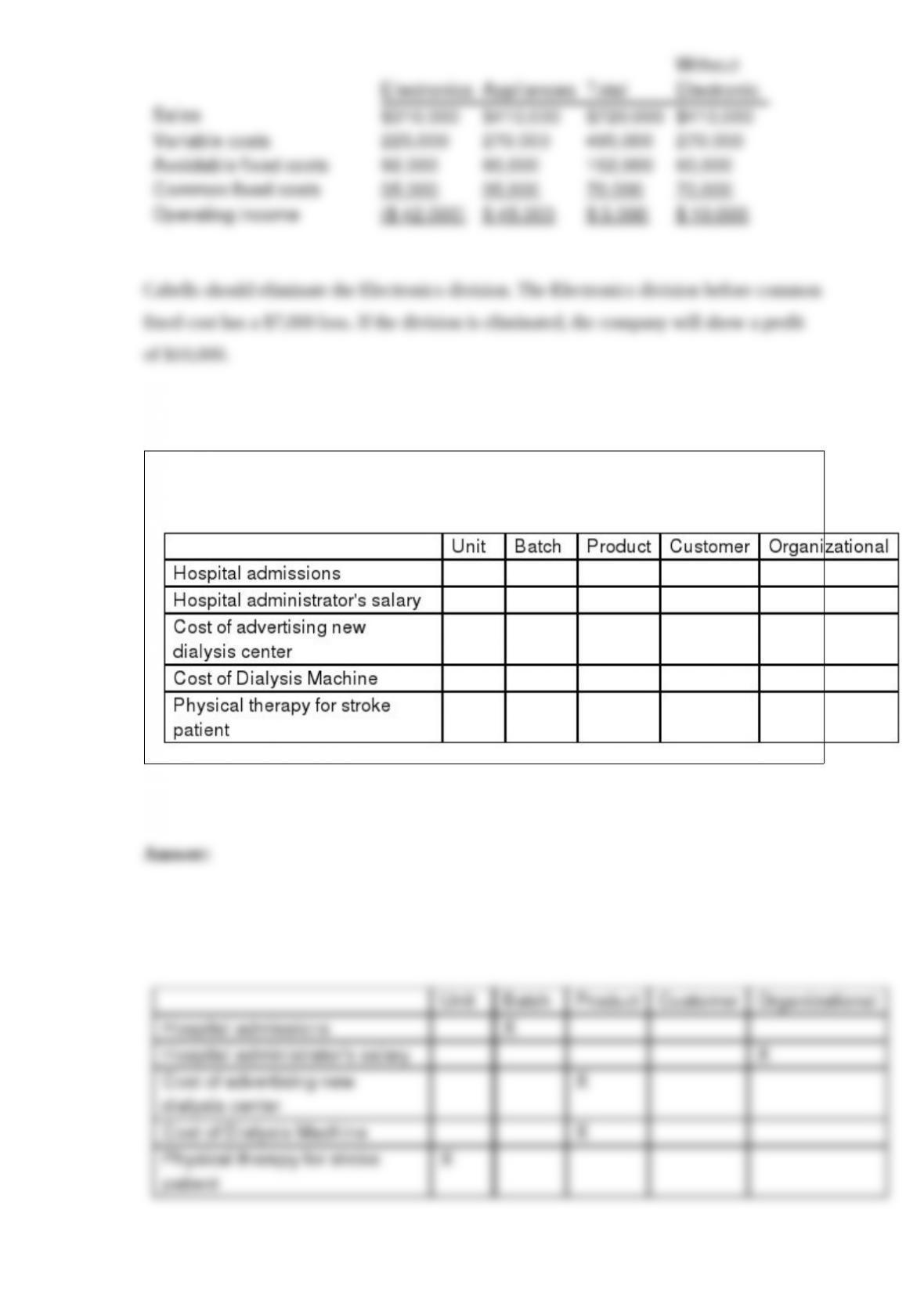
Place an “X” in the column that corresponds to the type of activity level referred to in
the following hospital setting.
The process of using activity-based costing information to manage a business’s
activities, and thus its costs, is called activity-based management. How do managers use
the information provided by an activity-based costing system?