Lower of cost or market can be applied on an item or product category basis.
Inventory shrinkage is the difference between inventory recorded and inventory
counted.
When the net cash flows from operating, investing, and financing activities are
combined to arrive at the overall net change in cash, a net decrease in cash is subtracted
from the beginning cash balance to calculate the ending cash balance.
The gross earnings for all employees is credited to Salaries and Salaries and Wages
Payable.
You paid $10,000 to buy 1% of the stock in a corporation that is now bankrupt. The
company owes $10 million dollars to its creditors. As a result of the bankruptcy, you are
responsible for paying $100,000 (or $10 million x 1%) of the amount owed to the
creditors.
The amount charged for a good or service provided to a customer on account is
recorded only after the payment is received.
Notes receivable are typically only used when a company sells large dollar value items
(such as cars).
Langley Company uses the allowance method. During January 2016, Langley writes off
a $500 customer account balance when it becomes clear that the customer will never
pay. The entry to record the write-off will:
A) decrease total assets by $500.
B) decrease net income for 2016 by $500.
C) decrease net accounts receivable by $500.
D) not increase the expenses for 2016.
Which of the following business organizations has only one owner?
A) Corporation
B) Sole proprietorship
C) Public company
D) Partnership
B-Mart has a perpetual inventory system. B-Mart sells $5,000 of blue jeans. The
customer later brings $600 of blue jeans back to B-Mart because they are defective.
Those blue jeans had a cost of $200. The customer agrees to keep the blue jeans and
B-Mart agrees to a $200 allowance. Which of the following is one of the entries that
B-Mart will use to record the return?
A) Debit Accounts Receivable for $200 and credit Inventory for $200
B) Debit Inventory for $200 and credit Accounts Receivable for $200
C) Debit Accounts Receivable for $200 and credit Sales Returns & Allowances for
$200
D) Debit Sales Returns & Allowances for $200 and credit Accounts Receivable for
$200
Which of the following is not one of the primary goals of inventory management?
A) Maintain a sufficient quantity of inventory to meet customer needs.
B) Ensure inventory quality meets customers ‘ expectations and company standards
C) Minimize the cost of acquiring and carrying inventory (including costs related to
purchasing, production, storage, spoilage, theft, obsolescence, and financing).
D) Minimize the quantity of ending inventory.
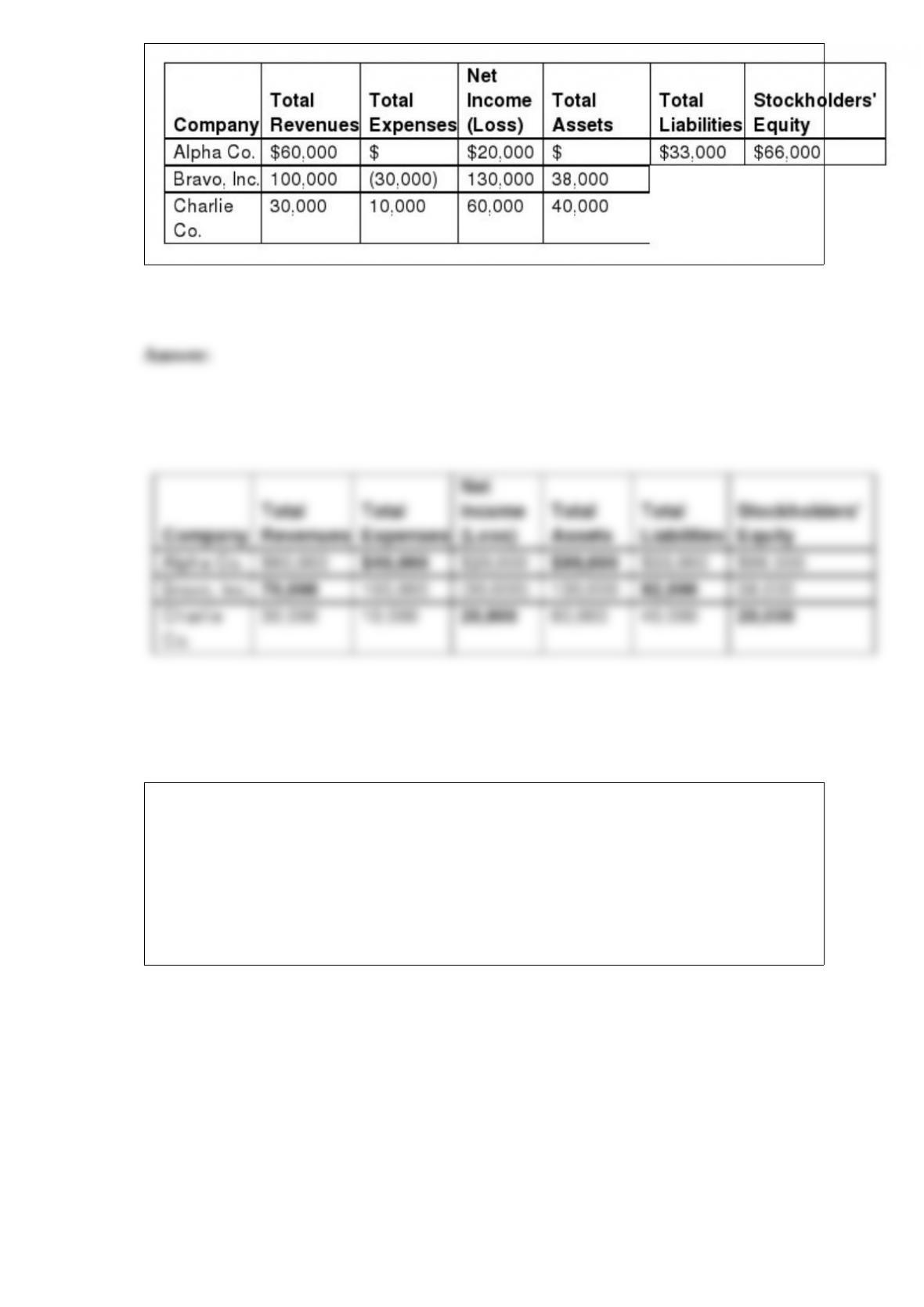
Each of the following independent companies is missing numerical data.
Required:
Use your knowledge of the financial statement equations and their interrelationships to
fill in the missing amounts.
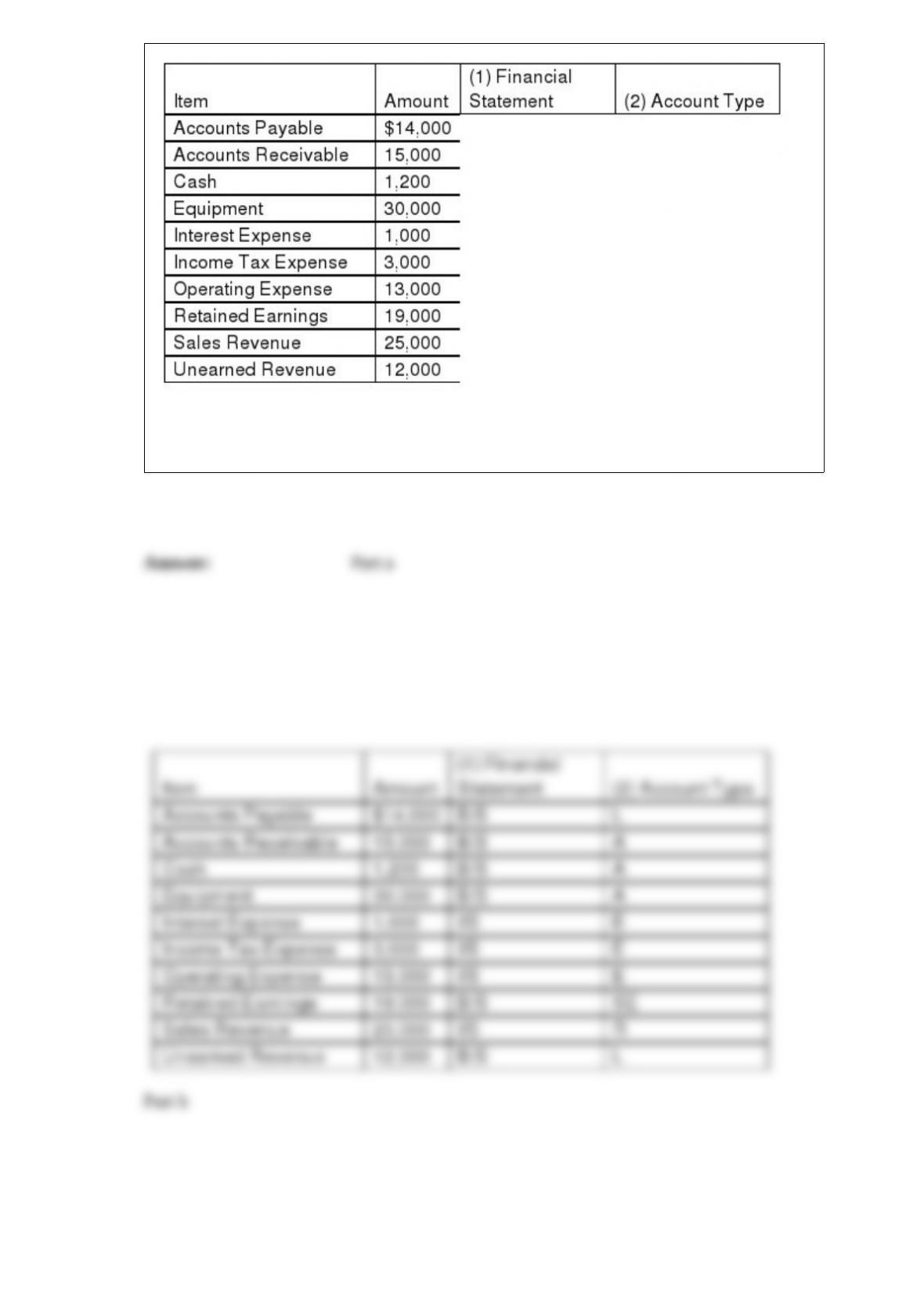
The records of Dame Inc. included the account balances set forth in the table below as
of September 30.
Part a. Complete the two columns in the table set forth below by indicating (column 1)
whether it is reported in the income statement (I/S) or balance sheet (B/S) and (column
2) whether it is an asset (A), liability (L), stockholders’ equity (SE), revenue (R), or
expense (E) account.
Part b. Prepare an income statement for the year ended September 30.
Part c. Determine the company’s net profit margin expressed as a percent.
Which of the following accounts has a normal credit balance?
A) Cash
B) Notes Receivable
C) Salaries and Wages Expense
D) Unearned Revenue
The Discount on Bonds Payable account is reported in the financial statements as:
A) a reduction from the Bond Payable account on the balance sheet.
B) an expense on the income statement.
C) an asset on the balance sheet.
D) revenue on the income statement.
Core Corporation had 400,000 shares of $2 par value common stock authorized. On
December 31, 2015, there were 200,000 shares issued and outstanding. The market
value of its common stock on that date was $100 per share. On January 5, 2016, the
board of directors declared a five-to-four stock split (i.e., a 25% increase in the number
of shares).
Required:
Part a. Briefly explain the how a stock spilt affects the stockholders’ equity accounts
and the total resources of the company.
Part b. Assume that you have 100 shares of Core Corporation common stock.
Determine how many shares will you have after the stock split.
Part c. Determine how the stock split will impact the number of authorized shares, the
number of issued and outstanding shares, and the par value per share.
Part d. Determine the total par value of the company’s issued and outstanding shares
(that is, the balance of the Common Stock account) before the stock split and after the
stock split.
Which of the following equations is correct?
A) Change in cash = Change in noncash assets
B) Change in cash = Change in liabilities + Change in stockholders’ equity
C) Change in cash = Change in liabilities + Change in stockholders’ equity – Change in
noncash assets
D) Change cash = Change in liabilities + Change in stockholders’ equity + Change in
noncash assets
The Grass is Greener Company borrows money from a bank. Part of the loan agreement
requires Grass is Greener to maintain stockholders’ equity of at least 40% of assets or
otherwise to pay a higher interest rate. This requirement is referred to as a:
A) loan covenant.
B) credit rating.
C) bond rating.
D) call feature.