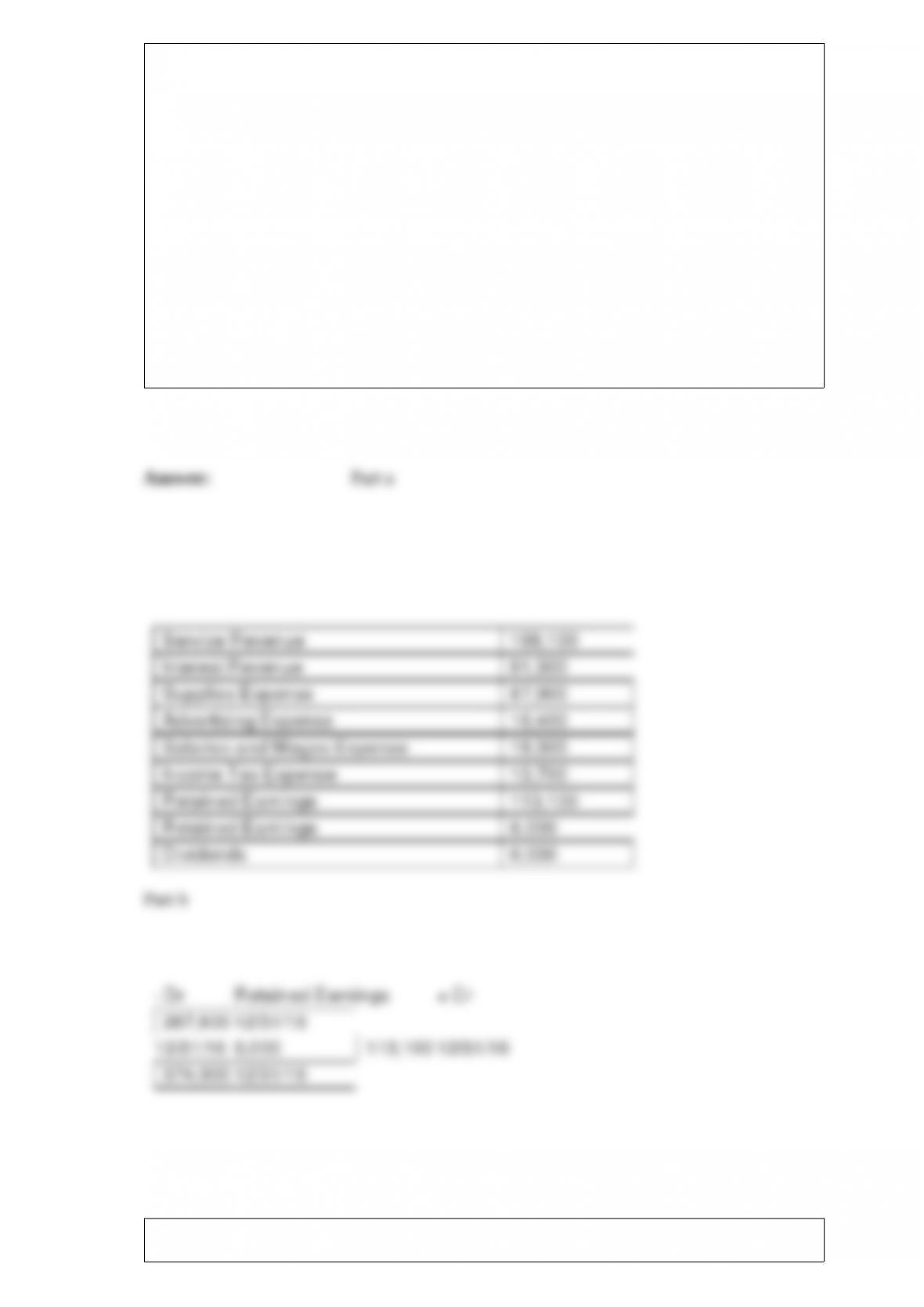
On December 31, 2016, Ditka Inc. had Retained Earnings of $267,800 before its
closing entries were prepared and posted. During 2016, the company had service
revenue of $168,100 and interest revenue of $81,300. The company used supplies in the
amount of $87,900, advertising expenses were $16,400, salaries and wages totaled
$18,300, and income tax expense was calculated as $13,700. During the year, the
company declared and paid dividends of $6,000.
Required:
Part a. Prepare the closing entries dated December 31, 2016.
Part b. Draw a T-account for the Retained Earnings account. Enter the beginning
balance into the T-account, post the closing entries, and then determine the ending
balance.
The cashier uses the cash register and its accompanying point-of-sale accounting
system to perform three important functions. Which of the following is not one of those
functions?
A) Document total cash sales
B) Document amount charged for each item sold
C) Segregate duties
D) Restrict access
On the date of record for a dividend, the company:
A) debits Dividends and credits Dividends Payable for the amount of the dividend.
B) debits Dividend Expense and credits Cash for the dividend amount.
C) debits Dividends Payable and credits Cash for the dividend amount.
D) establishes who will receive the dividend payment.
Which of the following statements about payroll is correct?
A) Payroll deductions are an expense of the company.
B) When recording the payroll, Salaries and Wages Expense equals the sum of all the
deductions.
C) The net pay is debited to Salaries and Wages Expense when the payroll is recorded.
D) Gross earnings are computed by multiplying the time worked by the pay rate
promised by the employer.
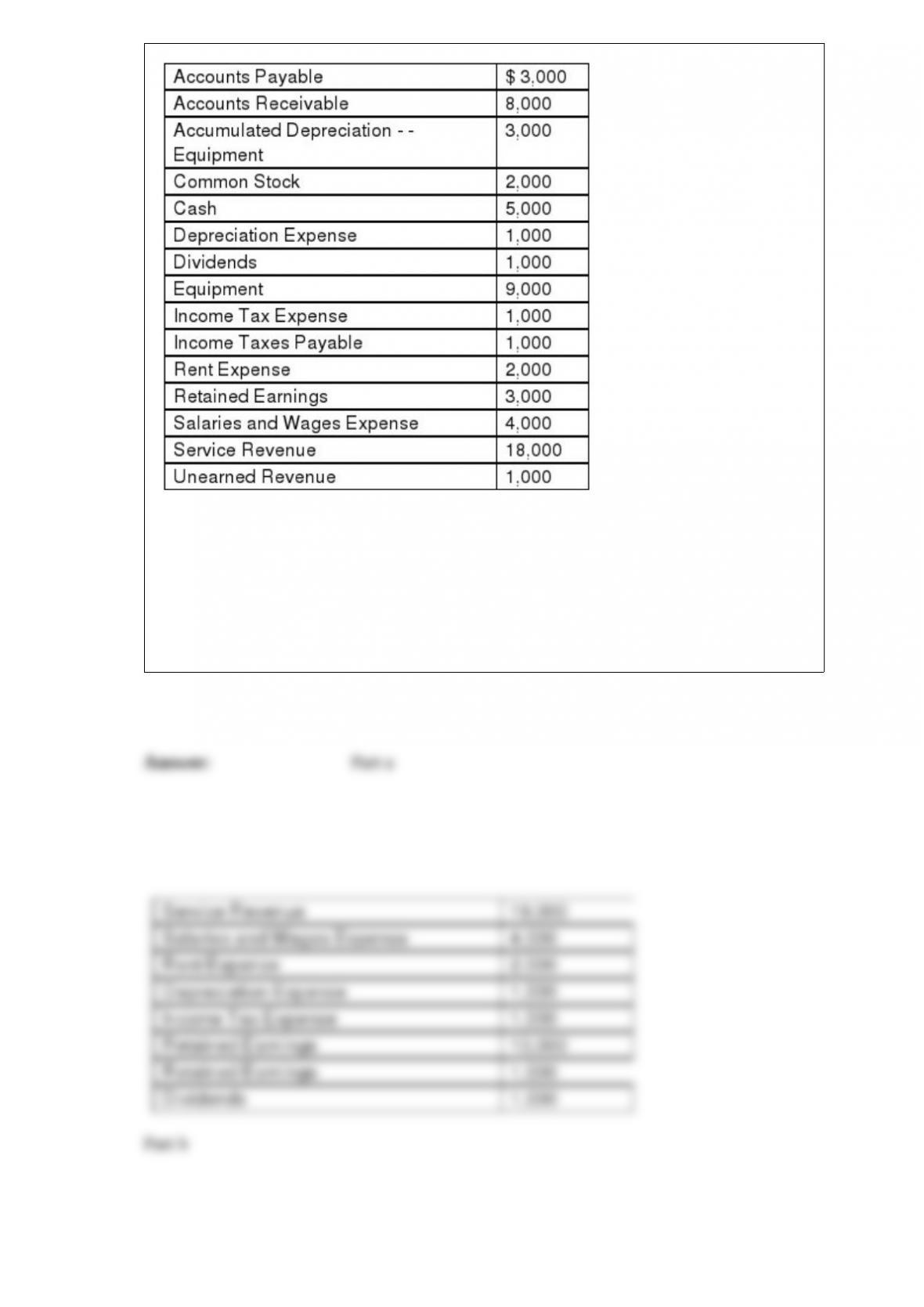
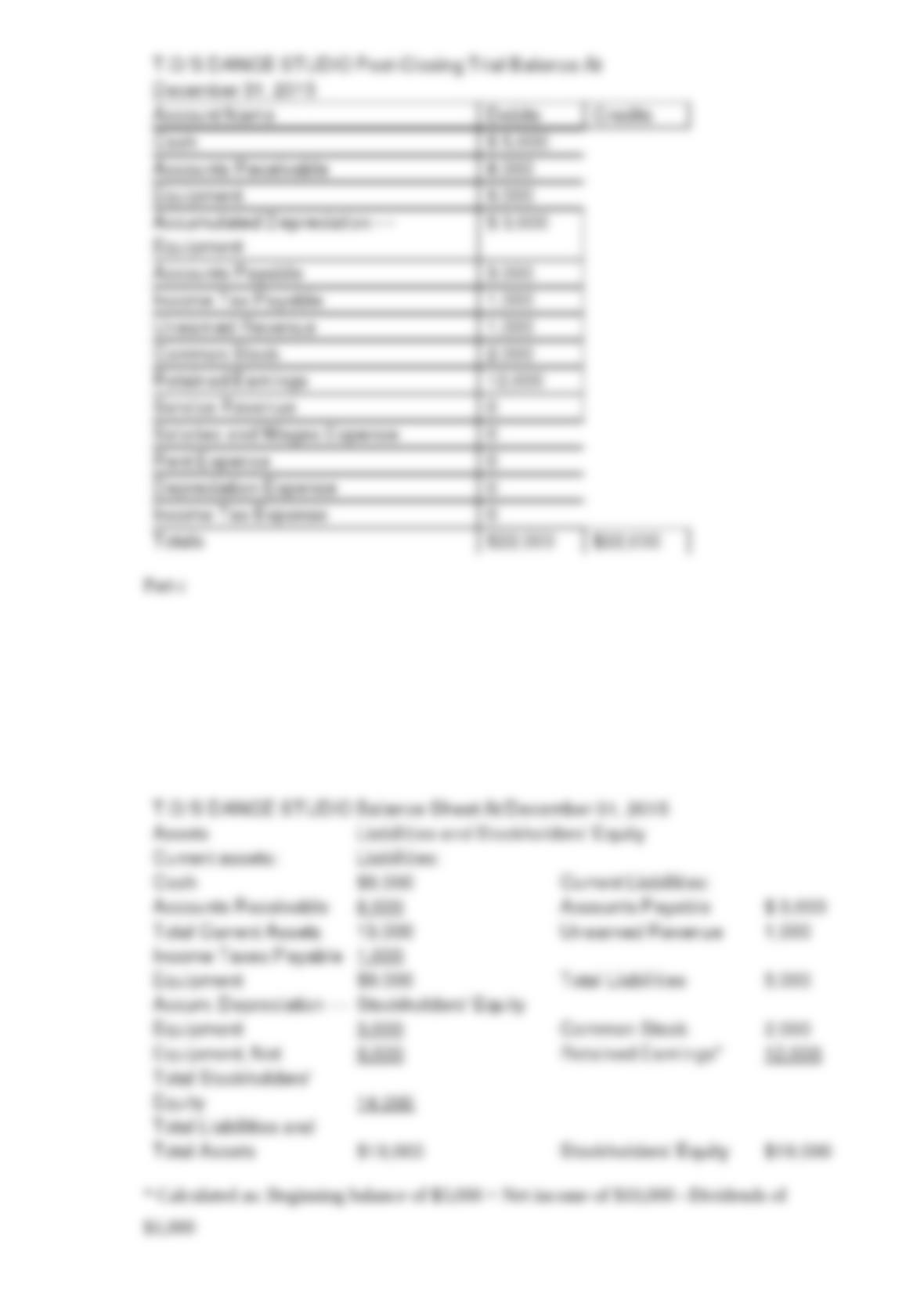
The alphabetical listing below includes all of the adjusted account balances of T.O.’s
Dance Studio as of December 31, 2015. All account balances are normal.
Required:
Part a. Prepare the closing entries.
Part b. Prepare the post-closing trial balance as of December 31, 2015.
Part c . Prepare the classified balance sheet at December 31, 2015.
The amount of beginning retained earnings is equal to the:
A) beginning retained earnings of the prior year.
B) ending retained earnings of the prior year.
C) beginning retained earnings of the next year.
D) ending retained earnings of the next year.
The market price of a share of common stock at the time of issuance was $19.50, while
the market price of a preferred share of stock at the time of issuance was $32. The
company paid $12.50 per share for its treasury stock.
Required:
Determine the missing amount in the stockholders’ equity section of the balance sheet
set forth below.
STOCKHOLDERS’ EQUITY
Contributed Capital:
Preferred Stock, $2.00 par value, authorized 1,000,000 shares; issued 300,000 shares $
(a)
Additional Paid-in Capital (b)
Common Stock, $3.00 par value, authorized 40,000,000 shares; issued 25,600,000
shares (c)
Additional Paid-in Capital (d)
Total Contributed Capital (e)
Retained Earnings 305,683,000
Treasury Stock (10,000 shares, at cost) (f)
Total Stockholders’ Equity $ (g)
(a) ________
(b) ________
(c) ________
(d) ________
(e) ________
(f) ________
(g) ________
An investor who is looking at a company’s financial statements cannot determine
whether the:
A) company’s earnings are rising or falling.
B) company pays a dividend.
C) company has positive cash flow.
D) company’s owners are financially sound.
Thompson Company updates its inventory records perpetually. The company ‘s records
showed a beginning inventory of $600, cost of goods sold of $1,400, and ending
inventory of $800. How much inventory was purchased during the year?
A) $1,200
B) $1,000
C) $900
D) $1,600
Treasury stock:
A) does not appear on the balance sheet.
B) is a contra-equity account.
C) is an asset account.
D) is recorded as additional paid-in capital.
Which of the following would cause the greatest increase in a company ‘s inventory
turnover ratio?
A) Keeping the same amount of inventory on hand while unit sales are increasing
B) Increasing the amount of inventory on hand while unit sales are increasing
C) Keeping the same amount of inventory on hand while unit sales are decreasing
D) Decreasing the amount of inventory on hand while unit sales are increasing
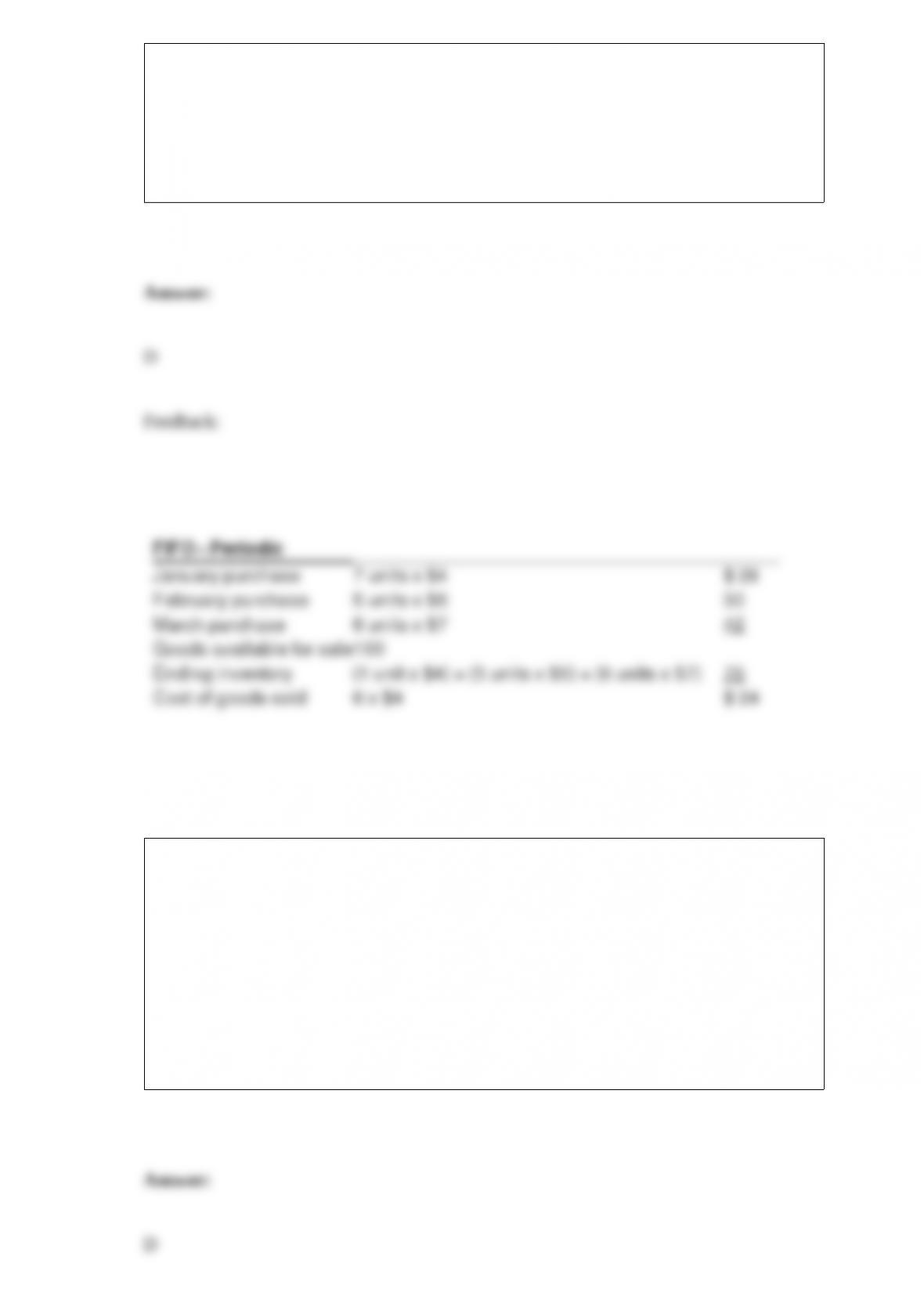
Alphabet Company, which uses the periodic inventory method, purchases different
letters for resale. Alphabet had no beginning inventory. It purchased A thru G in January
at $4 per letter. In February, it purchased H thru L at $6 per letter. It purchased M thru R
in March at $7 per letter. It sold A, D, E, H, J and N in October. There were no
additional purchases or sales during the remainder of the year.
Use the information above to answer the following question. If Alphabet Company uses
the FIFO method, what is the cost of its ending inventory?
A) $24
B) $42
C) $58
D) $76
The combined effect of the declaration and payment of a cash dividend on a company’s
financial statements is to:
A) increase total liabilities and decrease stockholders’ equity.
B) increase total expenses and decrease assets.
C) increase total assets and increase stockholders’ equity.
D) decrease total assets and decrease stockholders’ equity.
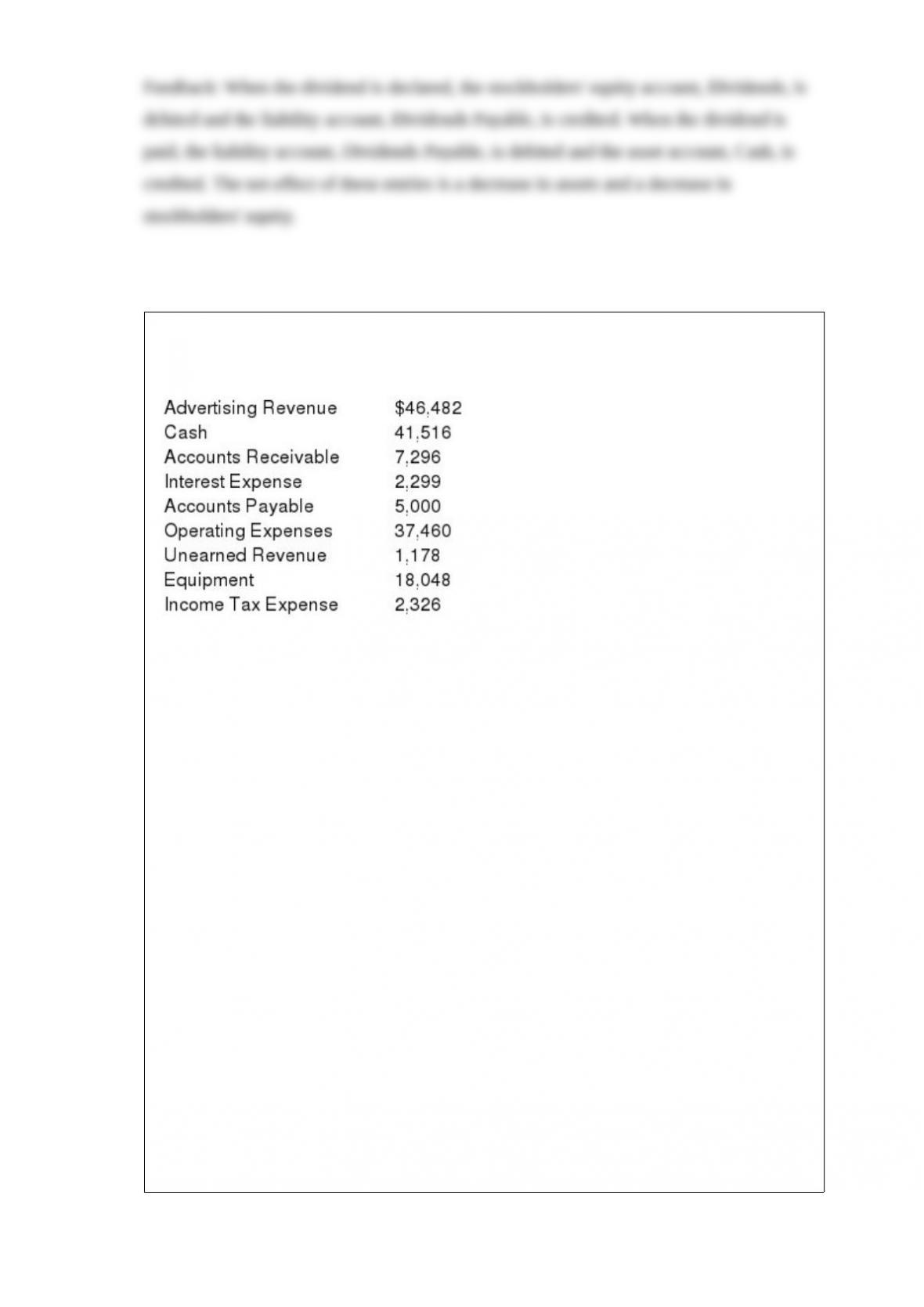
The following account balances are taken from the December 31, 2015, financial
statements of ABZ Advertising Company. The company uses accrual basis accounting.
The following activities occurred in 2016:
1> Performed advertising services on account, $55,000.
2> Received cash payments on account, $10,400.
3> Received deposits from customers for advertising services to be performed in 2017,
$2,500.
4> Made payments to suppliers on account, $5,000.
5> Incurred $45,000 of operating expenses; $39,000 was paid in cash and $6,000 was
on account and unpaid as of the end of the year.
Use the information above to answer the following question. What is the balance in the
Cash account at December 31, 2016?
A) $46,116.
B) $41,516.
C) $10,416.
D) $46,916.
Because interest rates have fallen, a company retires bonds which had been issued at
their face value of $200,000. The company bought the bonds back at 97. The journal
entry to record this retirement includes a debit of:
A) $200,000 to Bonds Payable, a credit of $6,000 to Gain on Bond Retirement, and a
credit of $194,000 to Cash.
B) $194,000 to Bonds Payable, a debit to Gain on Bond Retirement of $6,000, and a
credit of $200,000 to Cash.
C) $200,000 to Bonds Payable, a credit of $6,000 to Interest Expense, and a credit of
$194,000 to Cash.
D) $194,000 to Bonds Payable and a credit of $194,000 to Cash.
Jay-Cee Corporation had 20,000 shares of $4 par value common stock outstanding on
January 1. On January 20, the company purchased 2,000 of its stock for $16 per share.
On July 3, the company reissued 1,000 of the shares at $20 per share. Jay-Cee uses the
cost method to account for its treasury stock.
Use the information above to answer the following question. What journal entry will
record the reissuance on July 3?
A) Debit Cash and credit Treasury Stock for $20,000
B) Debit Cash for $20,000, credit Treasury Stock for $16,000, and credit Additional
Paid-in Capital for $4,000
C) Debit Cash for $20,000, credit Common Stock for $6,000, and credit Additional
Paid-in Capital for $14,000
D) Debit Cash for $20,000, credit Common Stock for $16,000, and credit Gain on
Reissuance of Stock for $4,000
A company paid $500,000 to purchase equipment and $15,000 to have the equipment
delivered to and installed in the company’s production facilities. The equipment is
expected to be used a total of 28,000 hours throughout its estimated useful life of six
years. The estimated residual value of the equipment is $5,000. The company began
using the equipment on May 1, 2016. The company has an October 31, 2016 year-end.
It used the equipment for a total of 11,200 hours between May 1 and October 31, 2016.
Using the units-of- production method, what amount of depreciation expense would the
company report in the income statement prepared for the year-ended October 31, 2016?
A) $102,000
B) $198,000
C) $204,000
D) $206,000
Following are seven items (a) through (g) that would cause Coyle Company’s book
balance of cash to differ from its bank statement balance of cash.
(a) A service charge imposed by the bank.
(b) A check listed as outstanding on the previous period’s reconciliation and still
outstanding at the end of this month.
(c) A customer’s check returned by the bank is marked “Not Sufficient Funds. (NSF)”
(d) A deposit that was mailed to the bank on the last day of the current month and is
unrecorded on this month’s bank statement.
(e) A check paid by the bank at its correct $190 amount was recorded in error in the
company’s Check Register at $109.
(f) An unrecorded credit memorandum indicated that bank had collected a note
receivable for Xavier Company and deposited the proceeds in the company’s account.
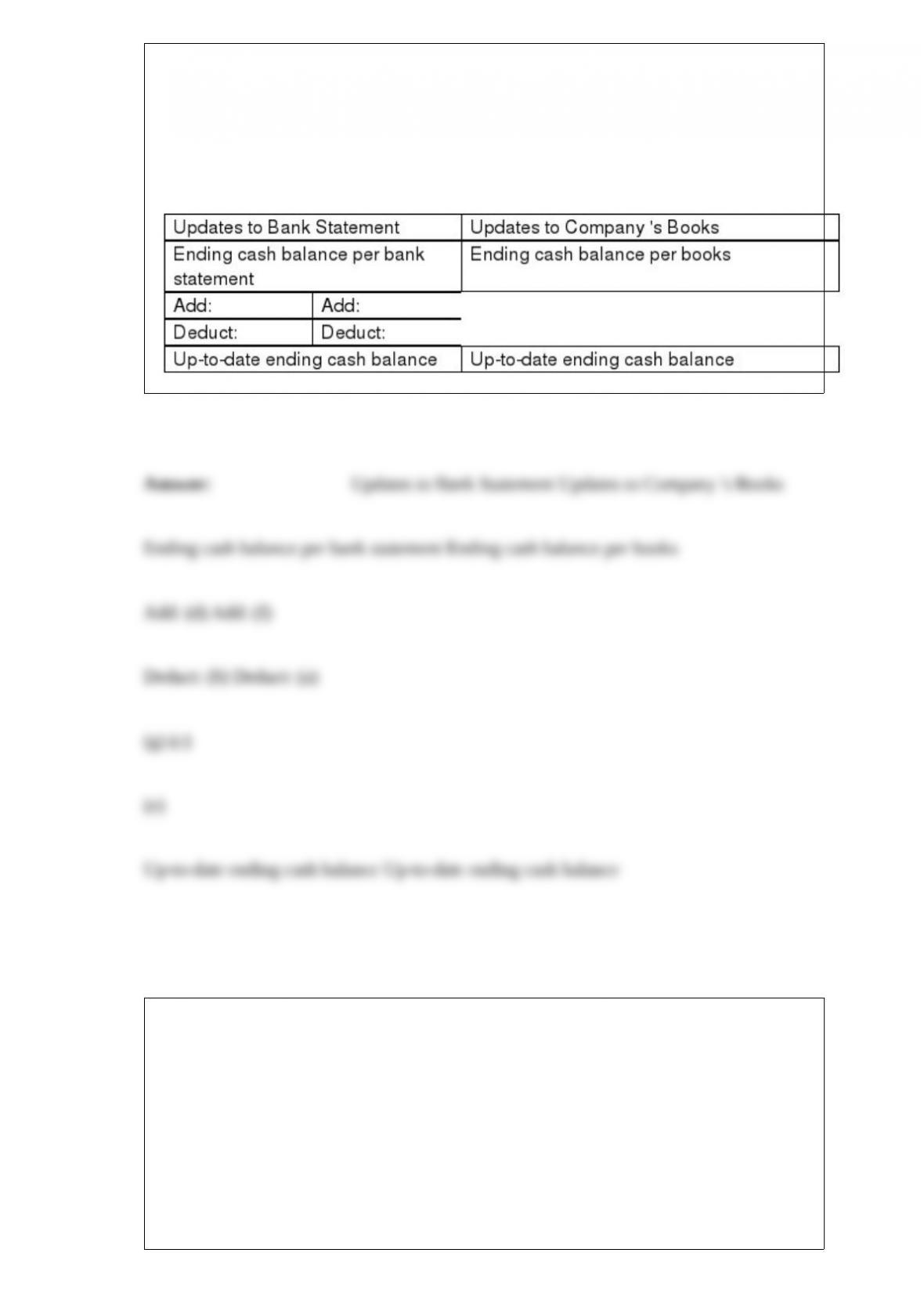
(g) A check was written in the current period that is not yet paid or returned by the
bank.
Indicate where each item (a) through (g) would appear on Coyle ‘s bank reconciliation
by placing its identifying letter in the parentheses in the proper section of the form
below.
When a company uses the direct method to determine the cash flows from operating
activities, cash flows from operating activities will:
A) be identical to the amount reported using the indirect method.
B) be larger if there is a net cash inflow and smaller if there is a net cash outflow
compared to the amount reported using the indirect method.
C) always be larger than the amount reported using the indirect method.

D) be larger if there is a net cash outflow and smaller if there is a net cash inflow
compared to the amount reported using the indirect method.