
Which of the following is true about an unfavorable variance appearing in a
performance report?
A. actual revenue exceeded budgeted revenue.
B. budgeted expense exceeded actual expense.
C. budgeted variable costs exceeded actual variable costs.
D. budgeted revenue exceeded actual revenue.
A firm has an ROI of 15%, turnover of 3, and sales of $12 million. The firm’s margin is:
A. $1,800,000
B. 5%
C. 30%
D. $600,000 15% = ? * 3
Regardless of the inventory cost flow assumption used, inventories on the balance sheet
are stated at:
A. original cost.
B. realizable value.
C. replacement cost.
D. the lower of cost or market.
Selling price per unit $100 Variable expenses per unit $40 Fixed expenses per month
$60,000
If the selling price per unit were to drop $2, from $100 to $98, the sales volume were to
increase 500 units to 4,500 units per month, and advertising expense were to increase
by $1,000:
A. the break-even point would increase.
B. the break-even point would decrease.
C. the contribution margin ratio would increase.
D. operating income would decrease.
Product Z sells for $18 per unit as is, but if enhanced it can be sold for $24 per unit. The
enhancement process will cost $50,000 for 10,000 units. If the 10,000 units of Product
Z are sold as is without further processing, the company:
A. will incur an incremental profit of $10,000.
B. will incur an opportunity cost of $10,000.
C. will incur an incremental profit of $1 per unit.
D. will incur an incremental loss of $6 per unit. Incremental revenue = ($24 – $18) *
10,000 units = $60,000. Incremental cost = $50,000; $60,000 – $50,000 = $10,000
increase in overall profit if product Z is processed further. If company does not process
further, they will lose the opportunity of making an additional $10,000.
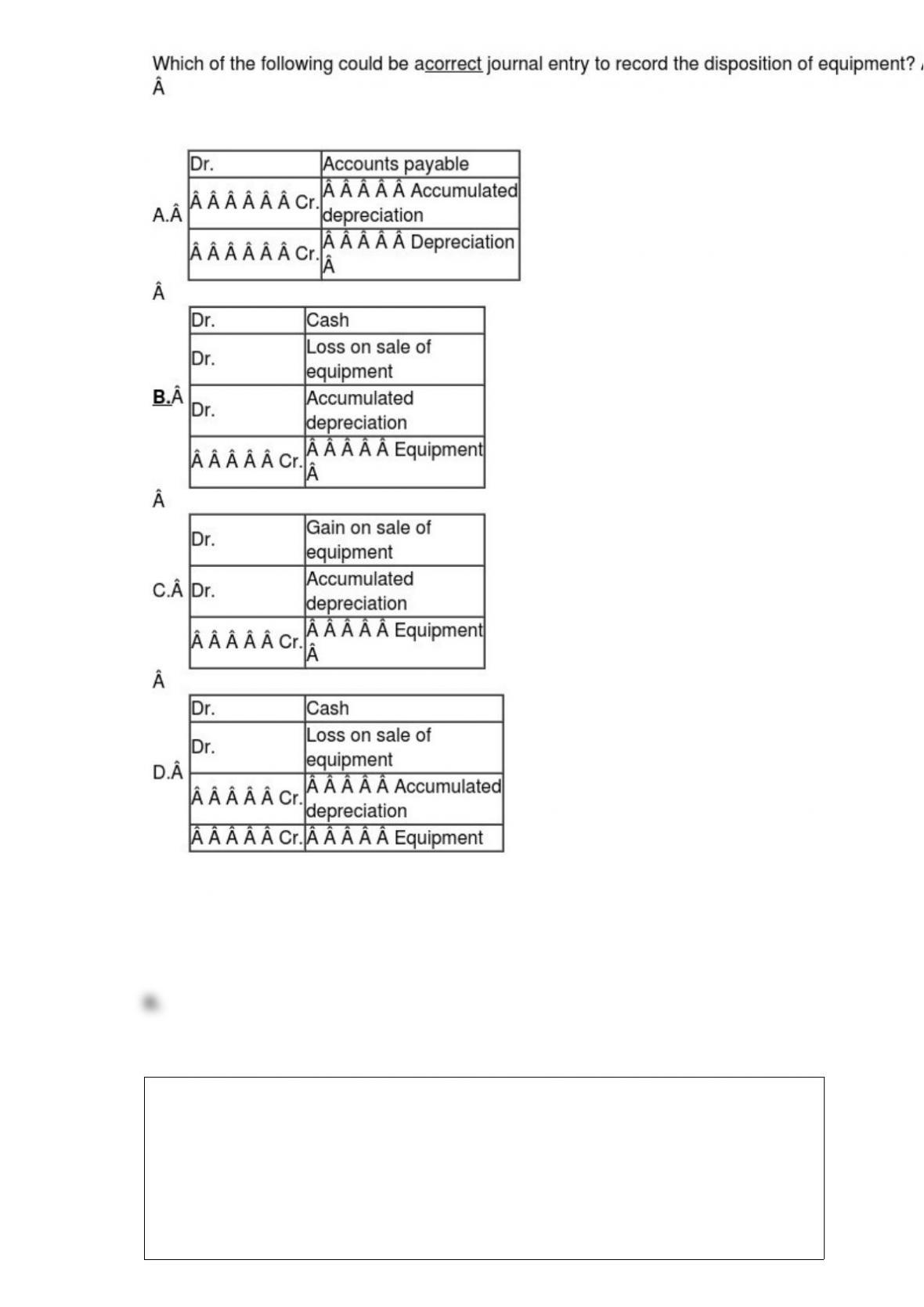
When a firm purchases supplies for use in its business, and the cost of the supplies
purchased is recorded as an asset, the following adjustment to recognize the cost of
supplies used will probably be required:

Which of the following lists the components of the master budget in correct
chronological order?
A. cash budget, budgeted income statement, budgeted balance sheet.
B. budgeted balance sheet, cash budget, budgeted income statement.
C. budgeted income statement, cash budget, budgeted balance sheet.
D. it doesn’t matter in which order they are prepared.
Which of the following is a true statement regarding interest calculation methods?
A. Interest is calculated on either a straight-basis or a delayed-basis.
B. Interest is calculated on either a straight-basis or an undiscounted-basis.
C. If a borrower receives a loan on a discount-basis, the APR will be less than the
simple interest.
D. If a borrower receives a loan on a discount-basis, the APR will be more than the
simple interest rate.
The three sections of a statement of cost of goods manufactured include:
A. raw material, direct labor, manufacturing overhead.
B. variable expenses, contribution margin, fixed expenses.
C. sales revenue, gross profit, selling and administrative expenses.
D. direct costs, indirect costs, operating profit.
Which of the following is a true statement regarding the net present value method in
capital budgeting?
A. it provides the same basic information as the accounting rate of return.
B. it calculates the present value of future cash flows.
C. it calculates the proposal’s rate of return.
D. it doesn’t consider the time value of money.
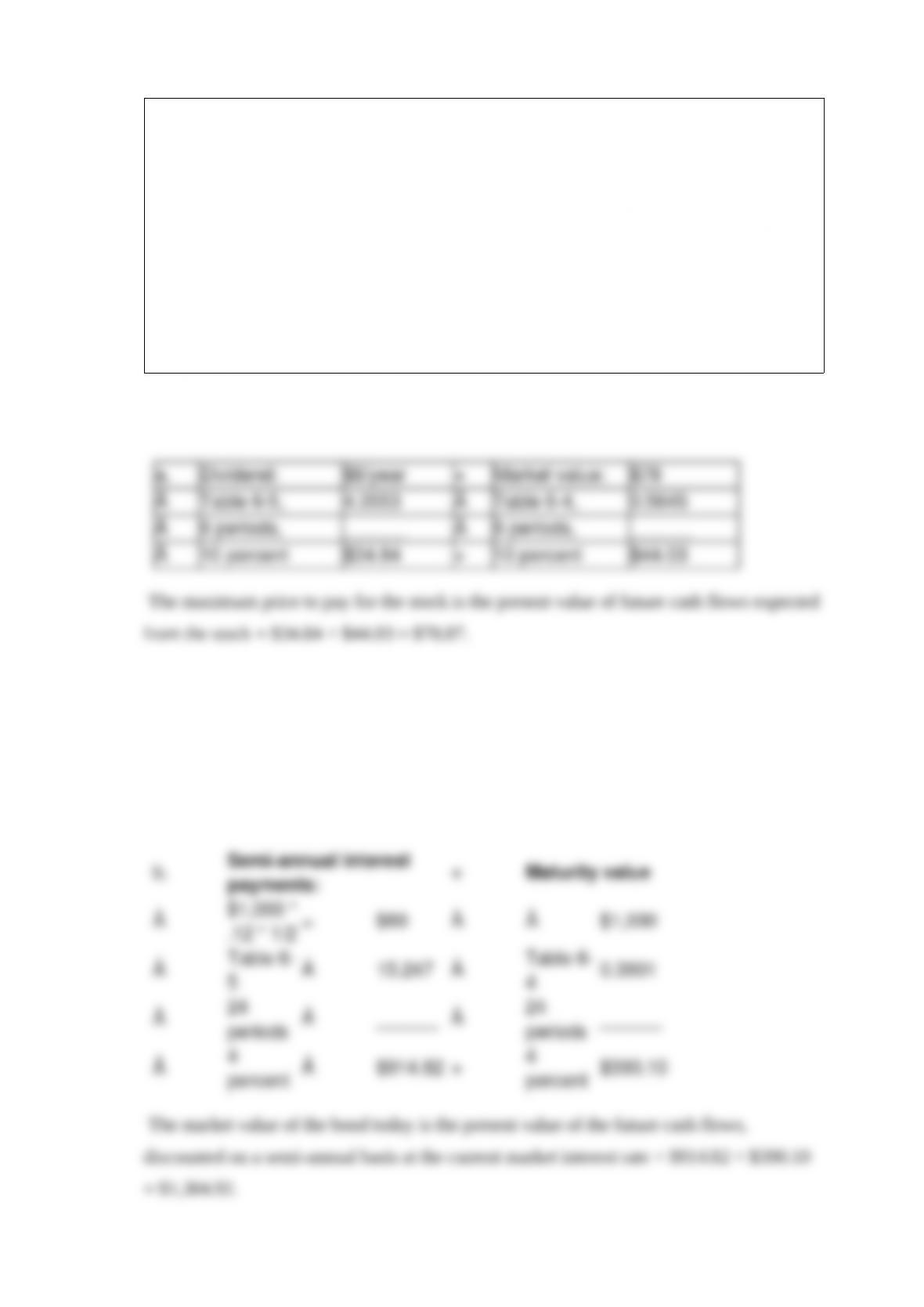
Use the appropriate factors from Table 6-4 or Table 6-5 to answer the following
question.
(a.) ABC Co.’s common stock is expected to have a dividend of $8 per share for each of
the next six years, and it is estimated that the market value per share will be $78 at the
end of six years. If an investor requires a return on investment of 10%, what is the
maximum price the investor would be willing to pay for a share of ABC Co. common
stock today?
(b.) Gregory bought a bond with a face amount of $1,000, a stated interest rate of 12%,
and a maturity date 20 years in the future for $980. The bond pays interest on a
semi-annual basis. Eight years have gone by and the market interest rate is now 8%.
What is the market value of the bond today?
An example of a product cost is:
A. advertising expense for the product.
B. a portion of the president’s travel expenses.
C. interest expense on a loan to finance inventory.
D. production line maintenance costs.
Accrual accounting:
A. is designed to match revenues and expenses.
B. results in the balance sheet showing the fair value of the entity’s assets.
C. means that expenses are recorded when they are paid.
D. cannot result in the entity having net income unless cash is received from customers.
Direct costing may be used for:
A. internal reporting purposes.
B. external financial reporting purposes.
C. income tax reporting purposes.
D. all of the above.
Baja Industries has recently switched its method of applying manufacturing overhead
from a single predetermined overhead rate based on direct labor hours to activity-based
costing (ABC). Assume that the direct labor rate is $18.00 per hour and that there were
no beginning inventories. The following cost drivers and rates have been developed for
allocating manufacturing overhead costs:
The following production, costs, and activities occurred during the month of August:
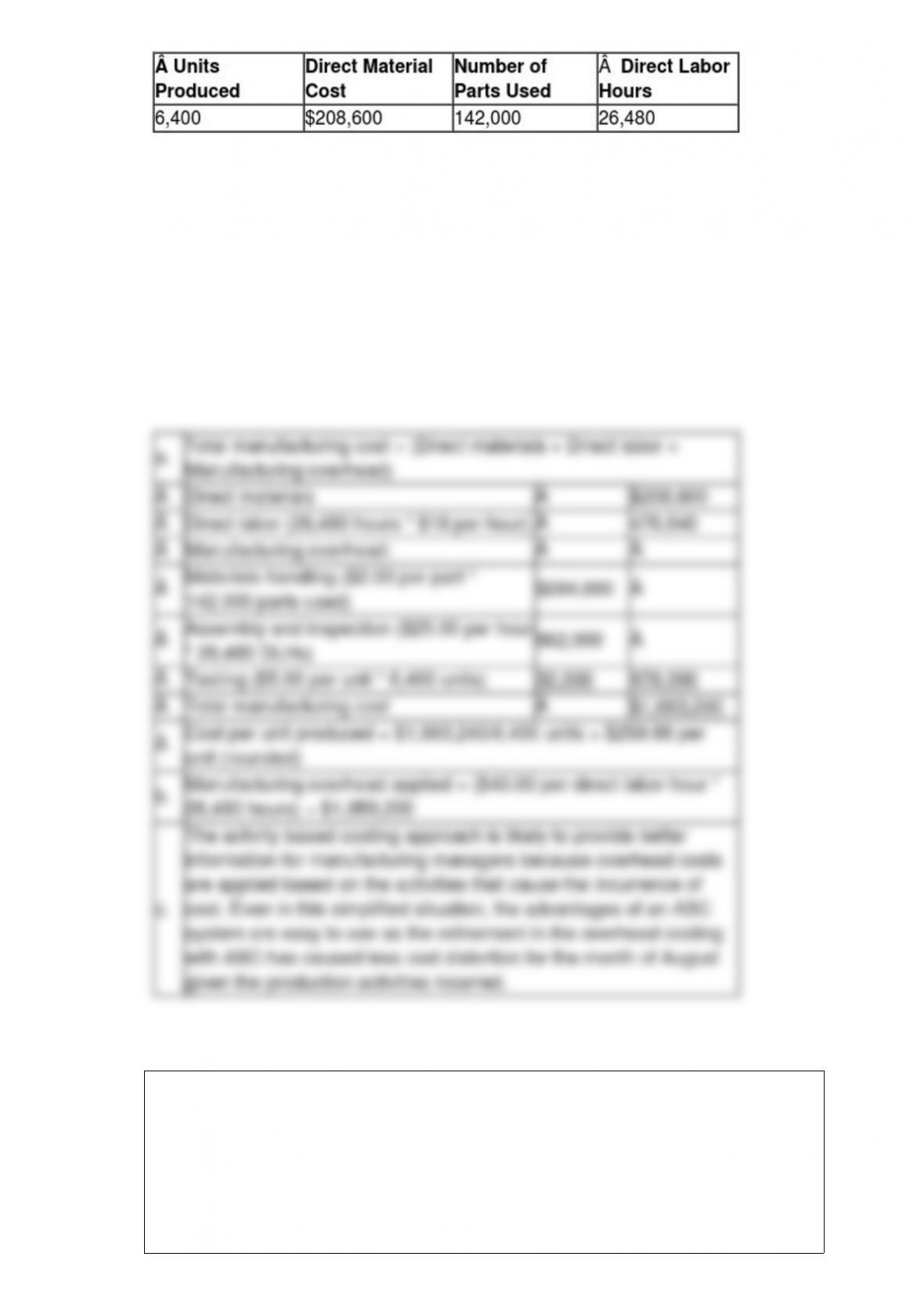
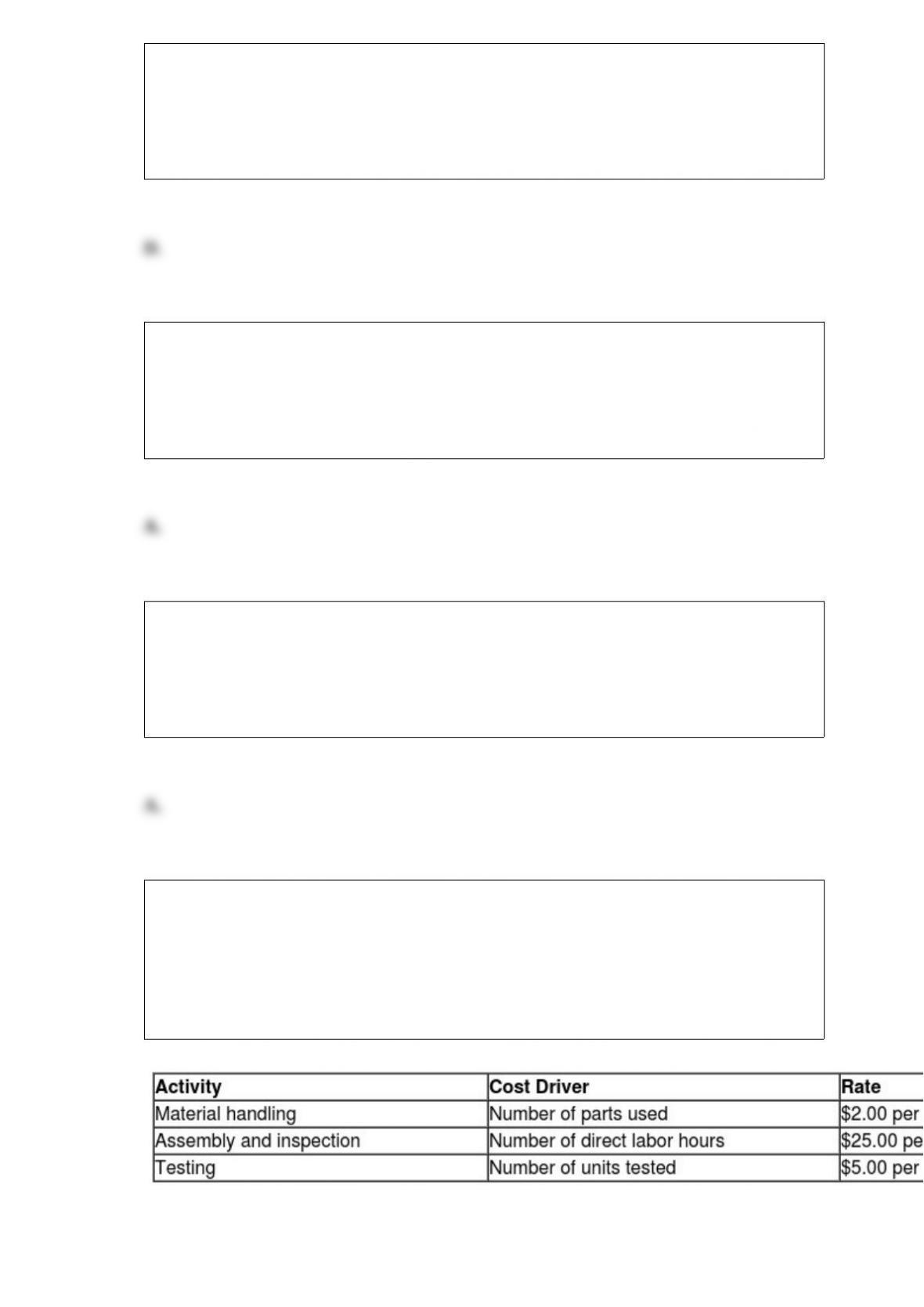
(a.) Calculate the total manufacturing cost and the cost per unit for the month of August.
(b.) Assume instead that Baja Industries applies manufacturing overhead on the basis of
$40.00 per direct labor hours (rather than the ABC method). Calculate the total
manufacturing overhead cost applied for the month of August.
(c.) Which method of applying overhead do you think provides better information for
manufacturing managers?
The notes to the financial statements:
A. should be referred to if more than a cursory, and perhaps misleading impression of a
firm’s financial position and its results of operations is to be achieved.
B. are not an integral part of the financial statements.
C. include a great deal of detailed information that is potentially useful only to a
financial analyst making a detailed appraisal of the future prospects of the entity.
D. are used by many entities to hide information from the reader of the financial

statements by including in the notes information that should be shown in detail on the
financial statements themselves.
The ethical concept of independence means that an accountant employed:
A. by a corporation cannot prepare financial statements for use by the company’s bank.
B. by one company cannot work part-time for another company.
C. by an auditing firm cannot own any stock in the company being audited.
D. by one company cannot accept a job with another company in the same industry.
The discount rate used to determine the present value of an investment proposal being
analyzed is also known as the:
A. present value ratio.
B. earnings growth rate.
C. payback rate.
D. hurdle rate.
The three components of product costs are:
A. direct material, supervisor salaries, selling expenses.
B. direct labor, manufacturing overhead, indirect material.
C. direct material, direct labor, manufacturing overhead.
D. manufacturing overhead, indirect material, indirect labor.
When common stock has a par value:
A. the liability of the stockholders is limited to the par value.
B. there will probably be additional paid-in capital on the balance sheet.
C. the market value of the stock will be higher than if there is no par value.
D. the paid-in capital will equal the par value of the number of shares issued.

For which of the following reconciling items would an adjusting entry be necessary on
the company’s book?
A. A deposit in transit.
B. An error by the bank.
C. Outstanding checks.
D. A bank service charge.
Which of the following is a true statement regarding absorption and/or direct costing?
A. A firm can choose to use either absorption or direct costing for income tax purposes.
B. A firm can choose to use either absorption or direct costing for financial reporting
purposes.
C. Direct costing assigns only direct materials and direct labor to products.
D. Absorption costing includes fixed overhead in product costs whereas direct costing
does not.

In considering whether to accept a special order at a price less than the normal selling
price of the product and where the additional sales will make use of present idle
capacity, which of the following costs will not be relevant?
A. direct labor.
B. direct materials.
C. variable manufacturing overhead.
D. fixed manufacturing overhead that cannot be avoided.
In the T-account cost flow diagram of balance sheet inventory accounts and the income
statement cost of goods sold account:
A. raw materials purchases are debited to work in process.
B. direct labor costs are credited to work in process.
C. cost of goods manufactured is debited to finished goods inventory.
D. cost of goods sold is debited to finished goods inventory.
An expanded version of the accounting equation could be:
A. Assets + Revenues = Liabilities + Stockholders’ Equity – Expenses
B. Assets – Liabilities = Paid-in Capital – Revenues – Expenses
C. Assets = Liabilities + Paid-in Capital + Beginning Retained Earnings + Revenues –
Expenses – Dividends
D. Assets = Liabilities + Paid-in Capital – Revenues + Expenses
Common costs pertain to costs that:
A. are directly traceable to a cost object.
B. are not directly traceable to a cost object.
C. are commonly incurred.
D. are direct costs.

The going concern concept refers to a presumption that:
A. the entity will be profitable in the coming year.
B. the entity will not be involved in a merger within a year.
C. the entity will continue to operate in the foreseeable future.
D. top management of the entity will not change in the coming year.
A transaction that is likely to cause an increase in a current liability is:
A. payment of accrued wages.
B. accrual of interest expense.
C. depreciation of equipment.
D. accrual of bad debts expense.
Discounting a future cash inflow at an 8% discount rate will result in a higher present
value than discounting it at a:
A. 7% rate.
B. 8% rate.
C. 9% rate.
D. all of the above.
The Interest Receivable account for February showed transactions totaling $17,000 and
an adjustment of $22,400.
A. The transactions probably resulted from accruing interest income earned.
B. The transactions were probably entered on the credit side of the account.
C. The adjustment was probably for cash receipts of interest receivable accrued in prior
months.
D. The balance in the interest receivable account decreased $5,400.

The dividend payout ratio describes:
A. the proportion of earnings paid as dividends.
B. the relationship of dividends per share to market price per share.
C. the percentage change in dividends this year compared to last year.
D. dividends as a percentage of the price/earnings ratio.