1) Which of the following is not a duty of the cost accountant in a process cost system?
A.Estimating the stage of completion of in-process units at the end of the month
B.Collecting the periodic production costs
C.Preparing the journal entries to record the factory operations
D.Computing the amount of equivalent units
2) The general ledger entry to record the purchase of materials is:
A.Debit-Purchases Received
Credit-Purchase Orders Outstanding
B.Debit-Materials
Credit-Purchase Orders Outstanding
C.Debit-Purchases Received
Credit-Accounts Payable
D.Debit-Materials
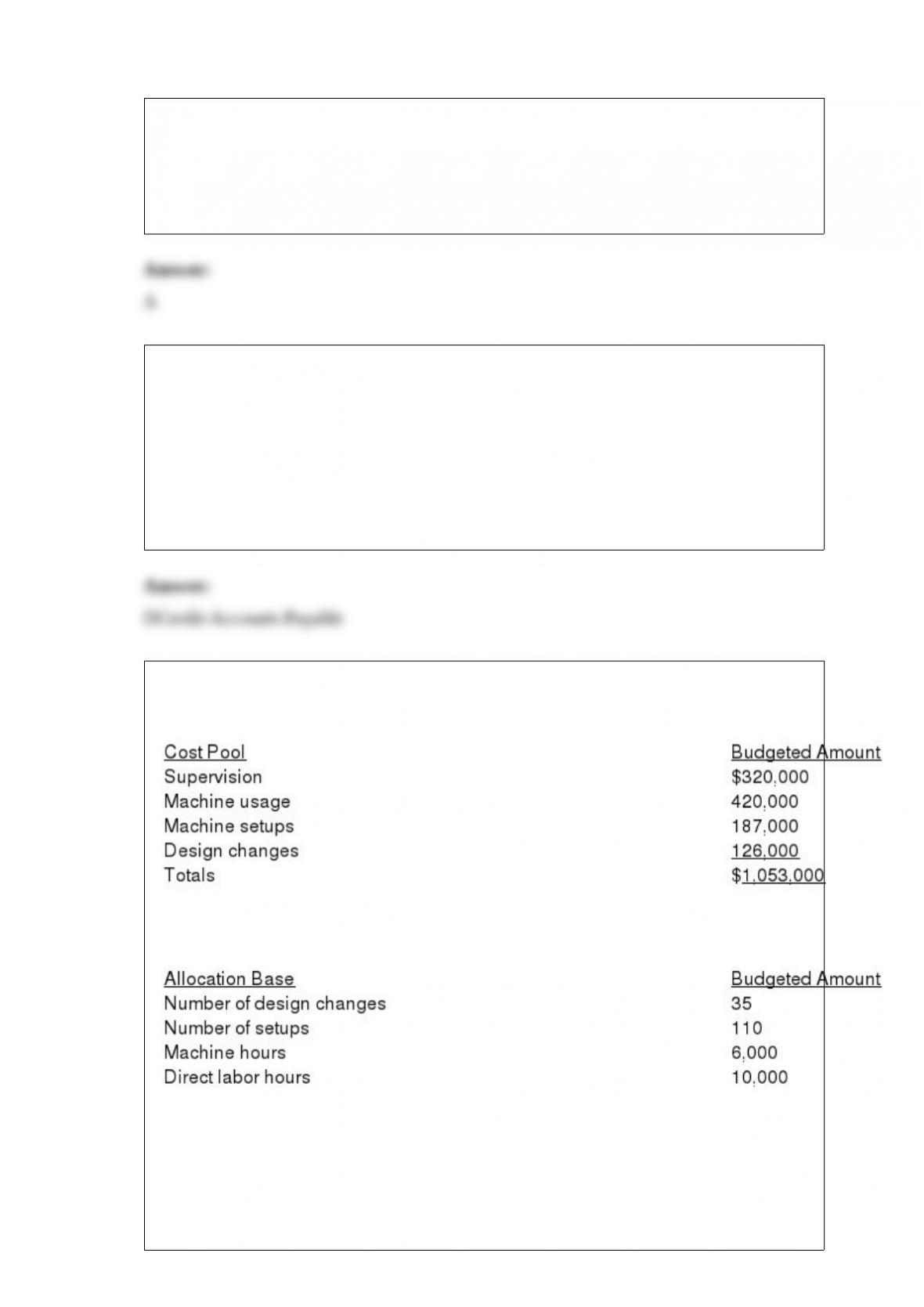
3) Hansen Company uses activity-based costing. The factory overhead budget for the
coming period is $1,053,000, consisting of the following:
The potential allocation bases and their estimated amounts were as follows:
a. Determine the overhead rate for each cost pool, using the most appropriate allocation
base for each pool.
b. Job 80130 required $45,000 for direct materials, $20,000 for direct labor, 2,000 direct
labor hours, 800 machine hours, five setups, and four design changes. Determine the
cost of Job 80130 .
c. Determine the cost of Job 80130 if Hansen used the direct labor hour method of
applying overhead.
d. What is the reason behind the difference in the costs of the job using Activities-based
costing vs. the direct labor hour method of applying overhead?
4) Martin Printing pays employees on a weekly basis on Friday for the week ended the
previous Friday. Employees compensation is earned evenly each day over a 5-day work
week. This year, March 31 fell on Tuesday. Payroll costs for the week ended April 3
follow:
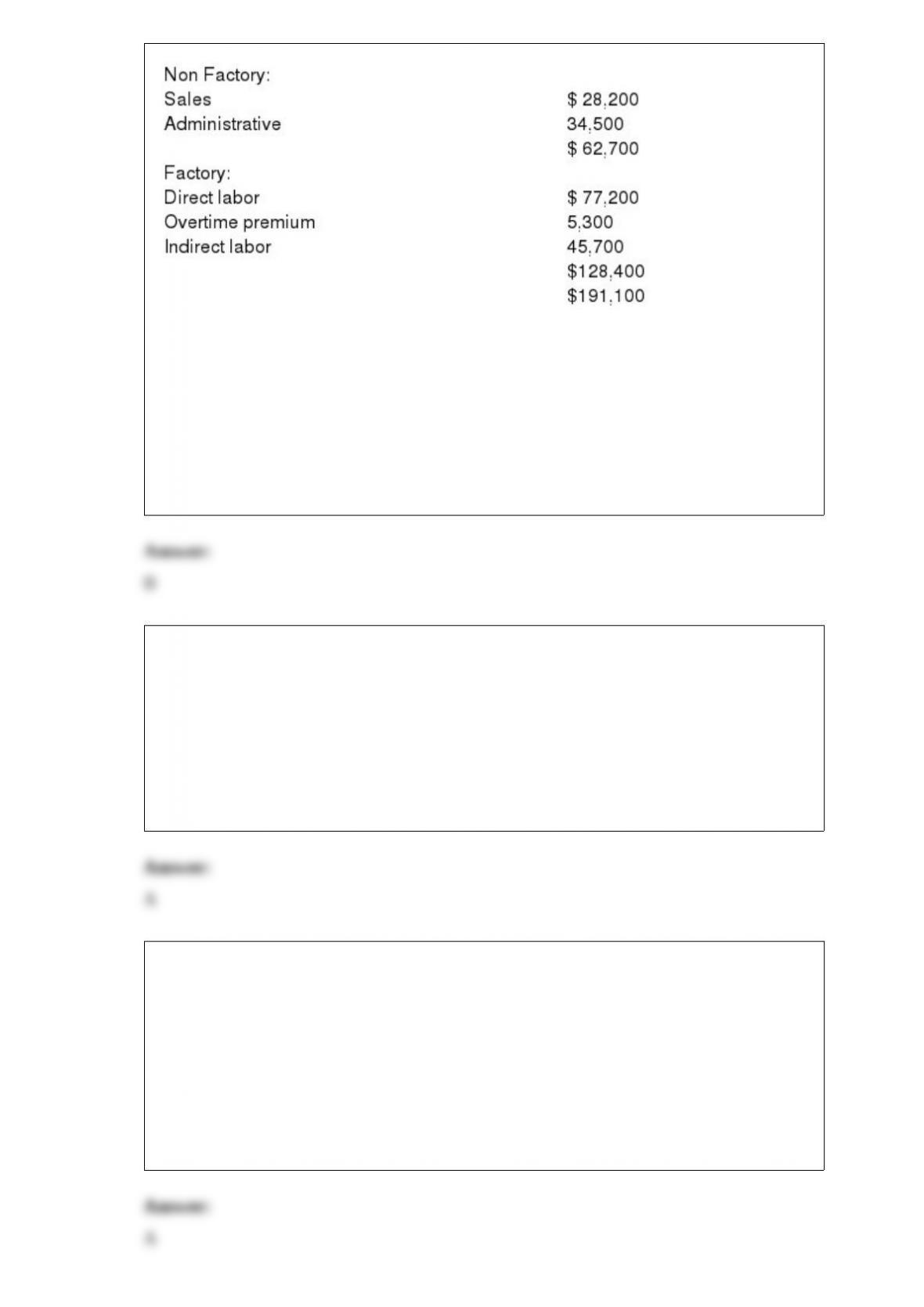
Excluding payroll taxes, what amount should be accrued to the payroll account for the
period ended April 30?
A.$51,360
B.$76,440
C.$191,100
D.$114,660
5) Which of the following statements best describes a characteristic of a performance
report prepared for use by a production line department head?
A.The costs in the report should include only those controllable by the department head
B.The report should be stated in dollars rather than in physical units so the department
head knows the financial magnitude of any variances
C.The report should include information on all costs chargeable to the department,
regardless of their origin or control
D.It is more important that the report be precise than timely
6) An unfavorable labor efficiency variance is the:
A.Number of actual hours worked in excess of the standard hours allowed multiplied by
the standard labor rate
B.Number of actual hours worked in excess of the standard hours allowed multiplied by
the actual labor rate
C.The number of actual hours worked below the standard hours allowed multiplied by
the standard labor rate
D.Number of actual hours multiplied by the difference in the actual and standard labor
rates
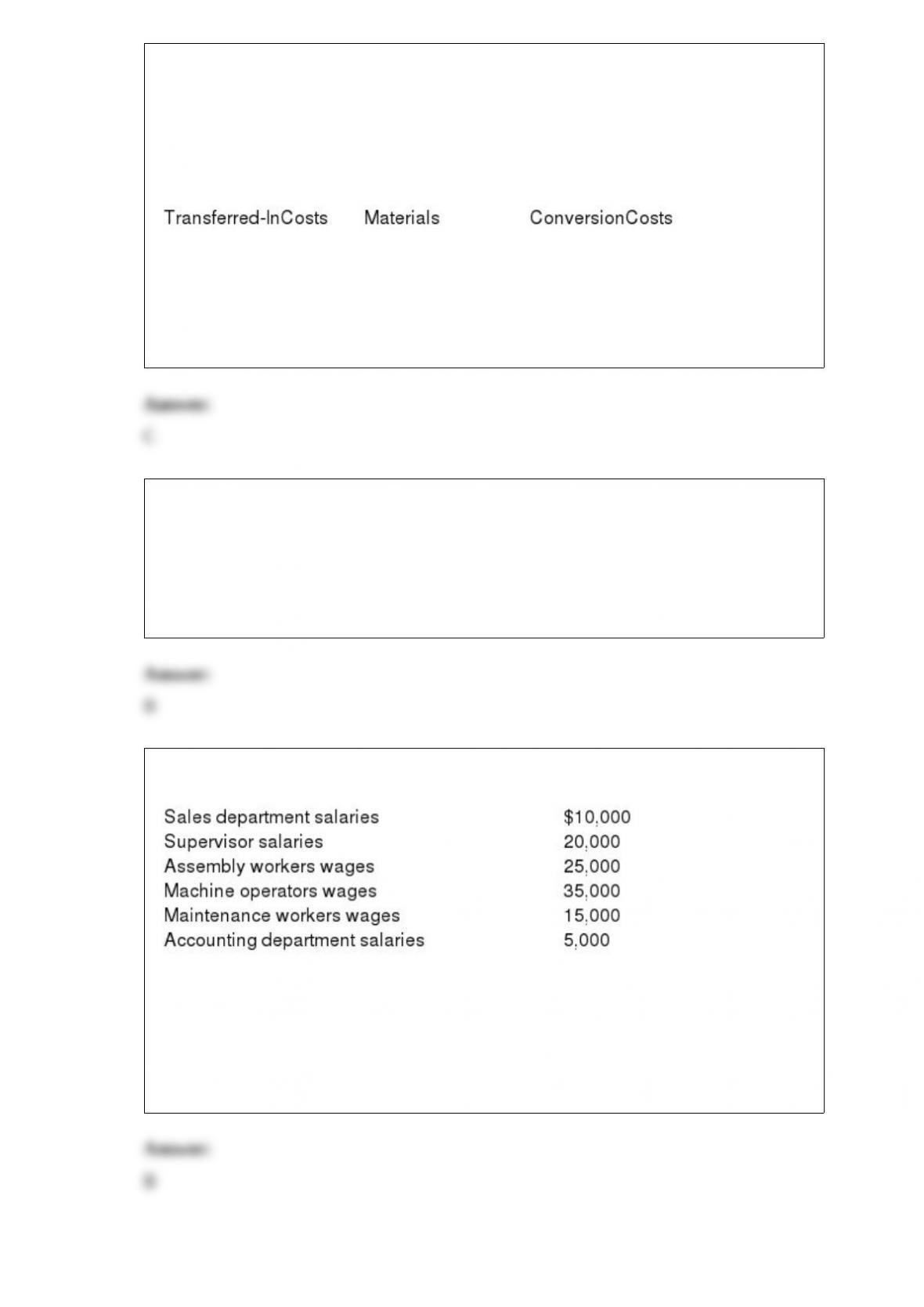
7) The Assembly Department is the second stage of Pine Company’s production cycle.
On May 1, the beginning work in process contained 15,000 units that were 40 percent
complete. During May, 85,000 units were transferred in from the first stage of Pine’s
production cycle. On May 31, the ending work in process contained 20,000 units that
were 75 percent complete. Using the average cost method, the equivalent units of the
Assembly Department are:
A.85,00070,000 70,000
B.100,00080,00080,000
C.100,00095,00095,000
D.120,000100,000100,000
8) One possible explanation for a company that experiences a favorable labor efficiency
variance, but an unfavorable labor rate variance could be:
A.The company paid the workers overtime
B.The company hired more experienced workers
C.The company purchased materials that were hard to work with
D.The workers goofed around and wasted time
9) The Macke Companys payroll summary showed the following in November:
What is the amount that would be included in direct labor in November?
A.$25,000
B.$60,000
C.$95,000
D.$120,000

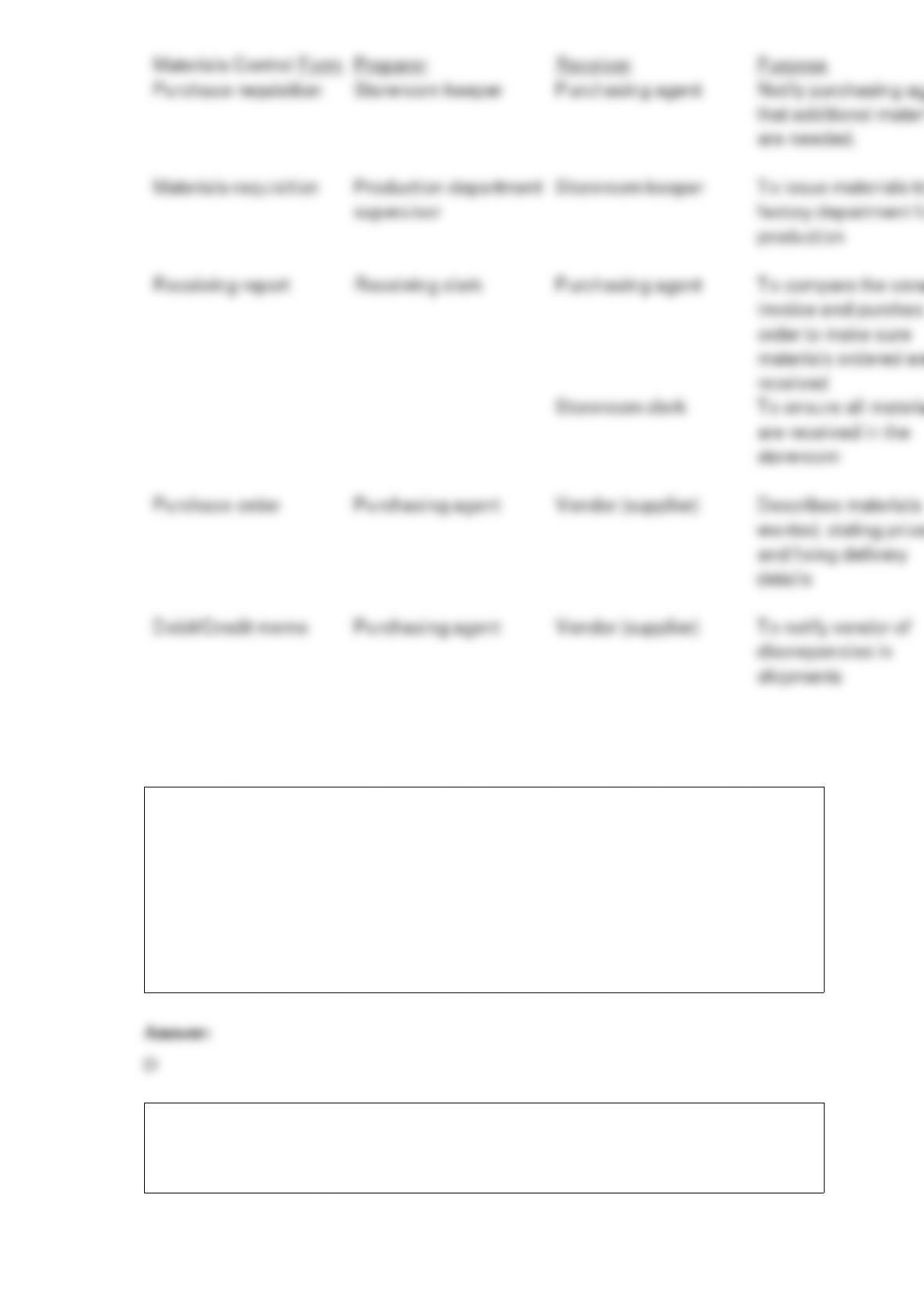
10) For the following materials control forms, please indicate the following:
a. who prepares the form;
b. who receives the form; and
c. the forms intended purpose.
1> Purchase Requisition
2> Materials Requisition
3> Receiving Report
4> Purchase Order
5> Debit/Credit Memo
11) The Dehl Company payroll for the first week in January was $12,000. The amount
of income tax withheld was 12 percent and the FICA, state unemployment, and federal
unemployment tax rates were 8 percent, 5 percent, and 1 percent, respectively. The
amount of the employer’s payroll taxes are:
A.$3,120
B.$1,440
C.$ 720
D.$1,680
12) Lynch Audio produces stereo components for a major automotive stereo
manufacturer. It currently uses the machine hour method of applying factory overhead
to production. Information for the previous year follows:
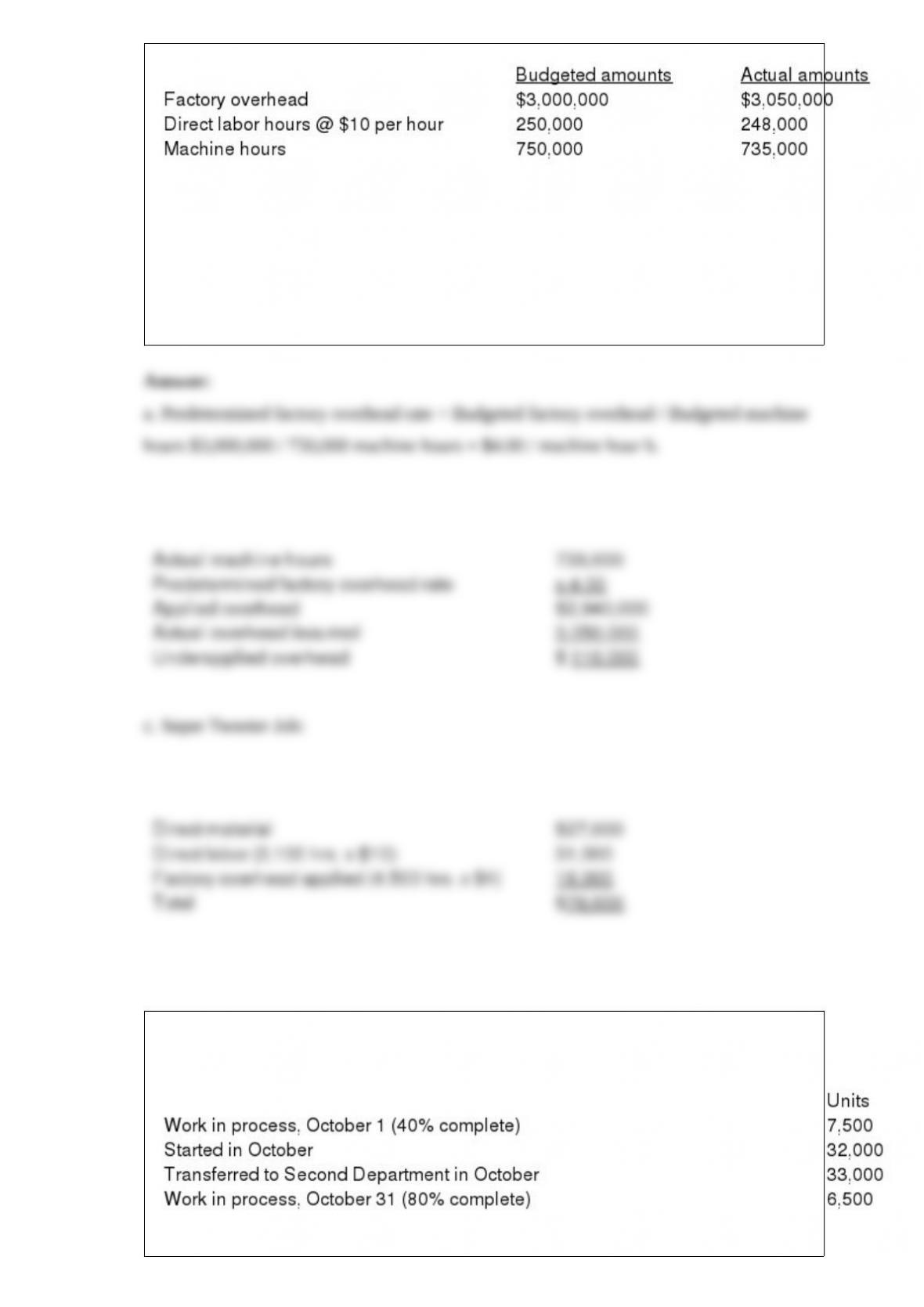
During the year, Lynch produced a new product, Super Tweeters, which involved
$27,000 of material, 3,100 direct labor hours and 4,500 machine hours.
a. Compute the predetermined factory overhead rate.
b. Compute the amount of under- or overapplied factory overhead.
c. Determine the cost of the Super Tweeter job.
13) The following information is available for the month of October from the First
department of the Vaughn Corporation:
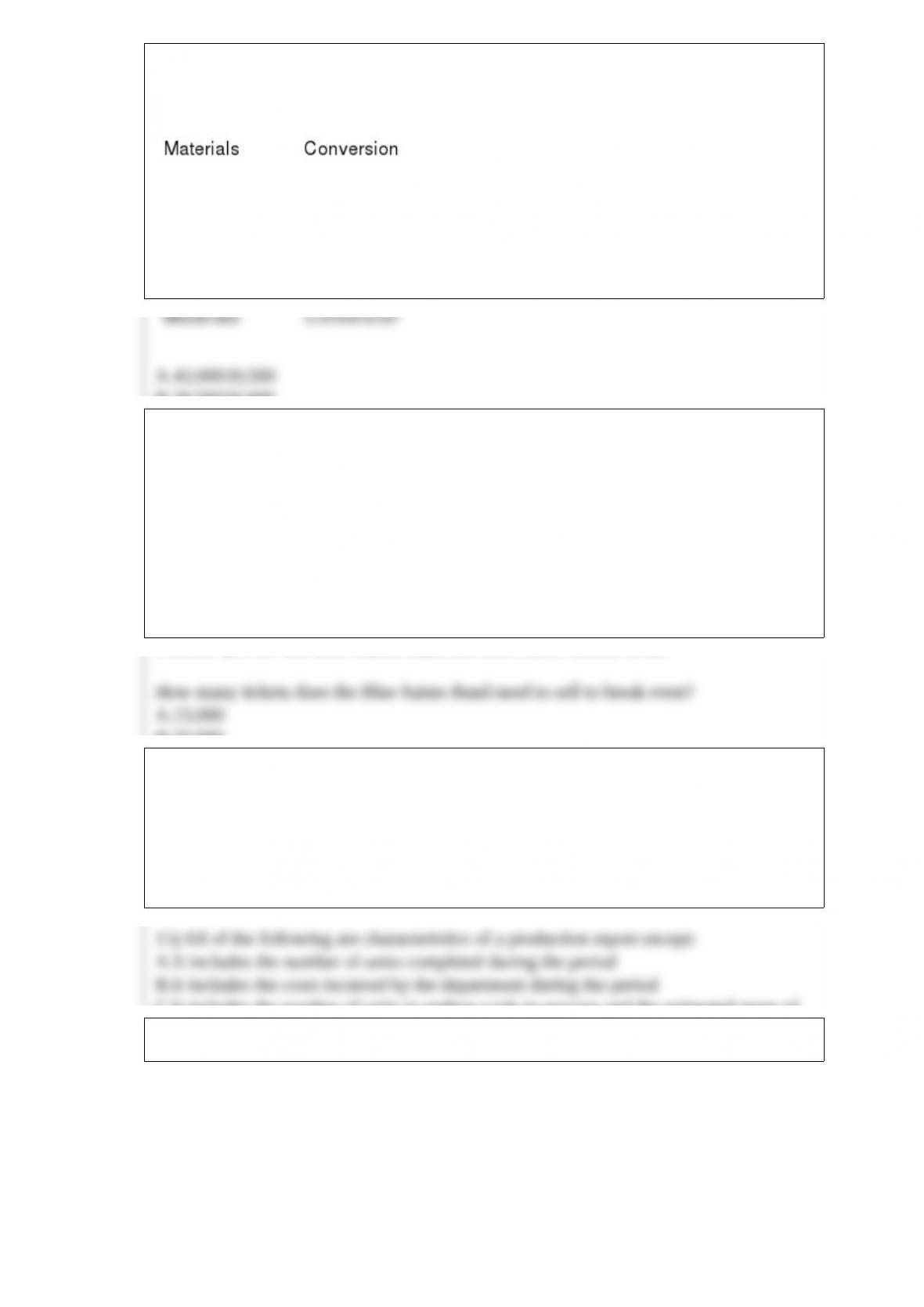
Materials are added in the beginning of the process in the First department. Using the
average cost method, what are the equivalent units of production for the month of
October?
A.43,00039,500
B.39,50036,000
C.38,50034,300
D.39,50038,200
14) The Blue Saints Band is holding a concert in Toronto. Fixed costs relating to
staging a concert are $350,000. Variable costs per patron are $5.00. The selling price for
a tickets $25.00. The Blue Saints Band has sold 23,000 tickets so far.
How many tickets does the Blue Saints Band need to sell to break even?
A.23,000
B.20,000
C.14,000
D.17,500
15) All of the following are characteristics of a production report except:
A.It includes the number of units completed during the period
B.It includes the costs incurred by the department during the period
C.It includes the number of units in ending work-in-process and the estimated stage of
completion
D.The department manager completes the report on a monthly basis
16) The following information is available from the Arugula Company:
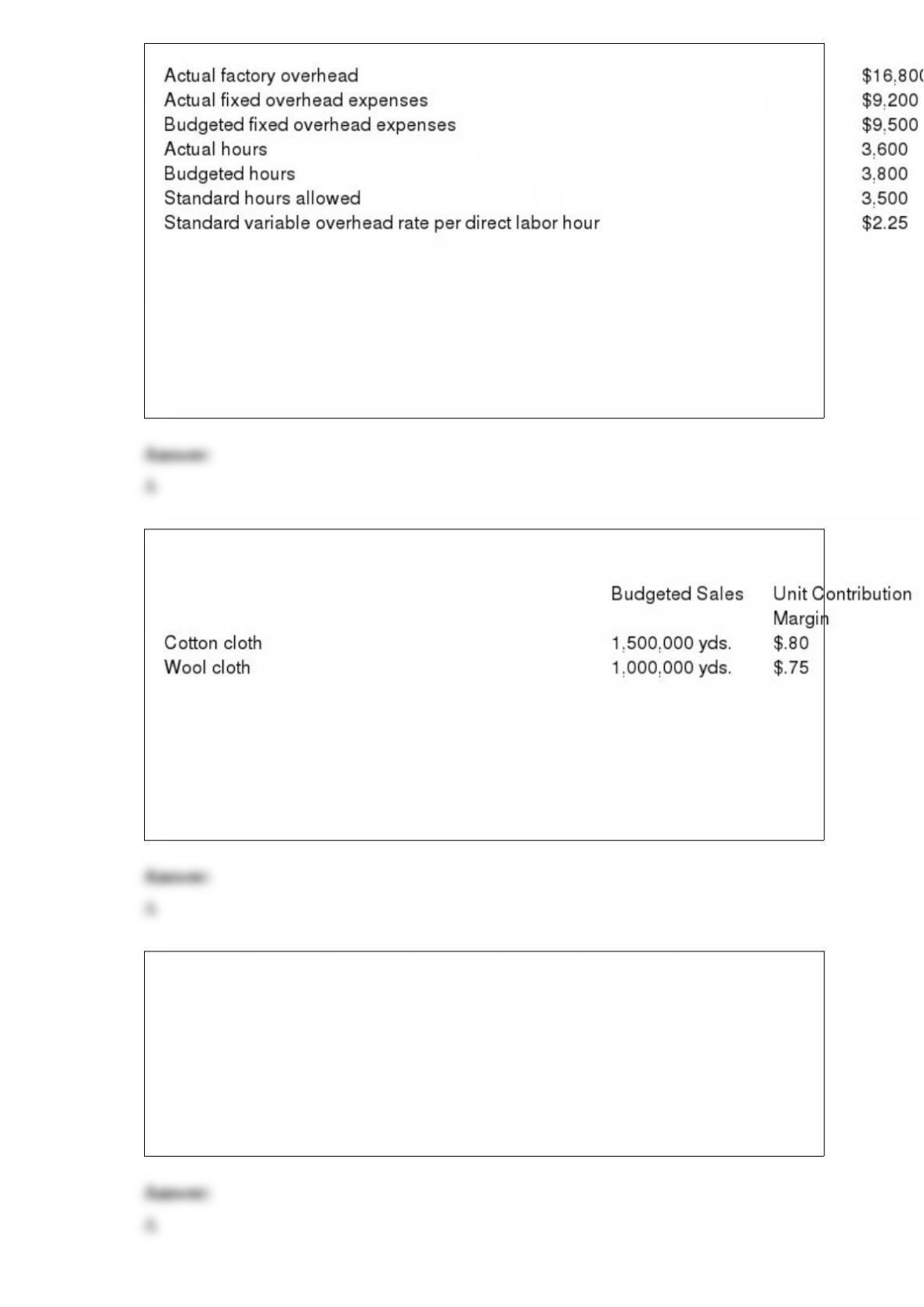
Assuming that Arugula uses a three-variance analysis of overhead variances, what is the
spending variance?
A.$800 favorable
B.$800 unfavorable
C.$500 favorable
D.$500 unfavorable
17) Calico Corporation makes the following products:
Budgeted fixed costs are $1,560,000. The break-even point in total yards is:
A.2,000,000
B.2,500,000
C.1,950,000
D.2,080,000
18) An example of a process where all of the materials would be added at the beginning
of the process would be:
A.A bakery where the ingredients for bread are combined and left to rise
B.The second process of a snack factory where snack chips coming from the frying
process are cooled and dried for an hour, then bagged
C.A baker where the wet ingredients for a cake are added one-at-a-time after the dry
ingredients have been thoroughly blended
D.None of the above
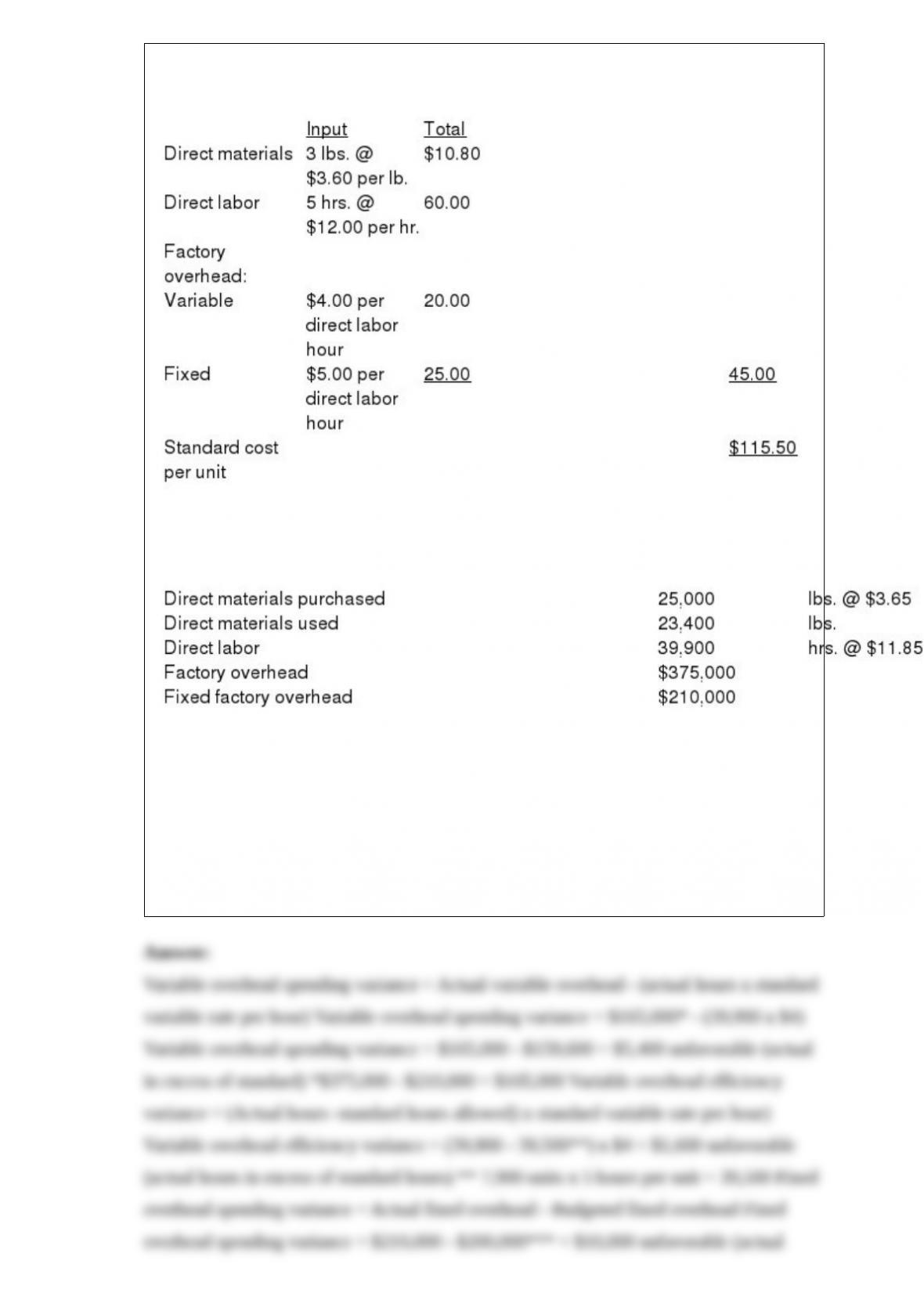
19) Palek Company has adopted the following standards:
Palek’s January budget was based on normal volume of 40,000 standard labor hours.
During January, Palek produced 7,900 units with records indicating the following data:
Assuming Palek uses the four-variance method of analyzing factory overhead, compute
the following variances for the month of January and indicate whether each is favorable
or unfavorable:
a. Variable overhead spending variance
b. Variable overhead efficiency variance
c. Fixed overhead spending variance
d. Fixed overhead production-volume variance
20) Dye and Dye, Attorneys-at-Law, each bill 1,500 hours per year and receive pay of
$100,000 each. Four paralegals work for the firm and each receives pay of $40,000 and
works 2,000 hours per year. Overhead of $396,000 is anticipated, of which $300,000 is
attorney support, and the rest is paralegal support. Determine overhead under each of
the following circumstances:
a. A simplified cost approach is used based on hours.
b. A simplified cost approach is used based on payroll dollars.
c. An activity-based costing approach is used. Attorney support is based on labor costs,
and paralegal support is based on hours worked.
21) A company has fixed costs of $700,000. The selling price and variable cost per unit
are $50.00, and $10.00, respectively.
How many units does the company need to sell to achieve net income of $100,000 after
income tax, assuming the income tax rate is 50%?
A.2,500
B.18,000
C.22,500
D.17,500

22) Mobile, Inc., manufactured 700 units of Product A, a new product, during the year.
Product A’s variable and fixed manufacturing costs per unit were $00 and $2.00,
respectively. The inventory of Product A on December 31 of the year consisted of 100
units. There was no inventory of Product A on January 1 of the year. What would be the
change in the dollar amount of inventory on December 31 if the variable costing
method was used instead of the absorption costing method?
A.$800 decrease
B.$200 decrease
C.$500 decrease
D.$200 increase
23) In a two-variance system for analyzing factory overhead, a favorable
production-volume variance could be caused by:
A.The top salesman leaving the company
B.Receiving more orders than anticipated
C.A machine breakdown
D.A work slow-down by workers
24) At a certain level of operations, per unit costs and selling price are as follows:
manufacturing costs, $50; selling and administrative expenses, $10; selling price, $80.
Given this information, the mark-on percentage to manufacturing cost used to
determine selling price must have been:
A.40 percent
B.60 percent
C.33 percent
D.25 percent
25) The normal capacity of the Malloy Company is 20,000 direct labor hours and
10,000 units per month. A finished unit requires 15 pounds of materials at an estimated
cost of $1.00 per pound. The estimated cost of labor is $12.00 per hour. It is estimated
that overhead for a month will be $15,000.
During the month of June, 19,000 direct labor hours were worked at an average rate of
$11.50 an hour. The number of units produced was 9,000, using all 132,000 pounds of
material that were purchased at a cost of $1.05 per pound.
a. Prepare a standard cost summary showing the standard unit cost.
b. Calculate the material and labor variances.
c. Prepare entries in general journal form to charge materials and labor to work in
process. Indicate whether the variances are favorable or unfavorable.
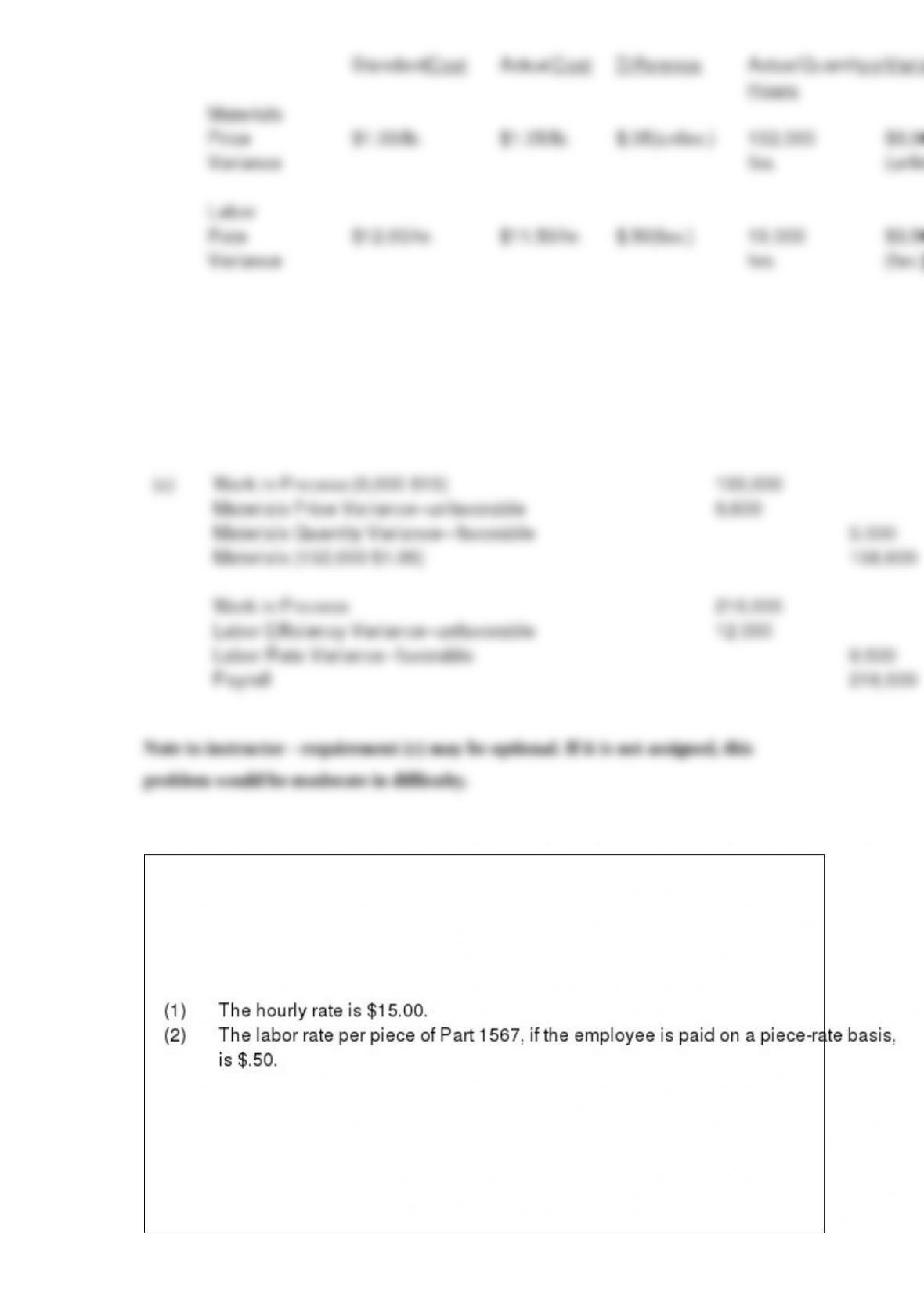
26) Management of the Robinson Manufacturing Company requests that you calculate
the effect of two different wage payment plans upon employee earnings and also on the
unit labor cost of Product B12.
The following information is available:
Ten pieces of Part 1567 are required for one unit of Product B12. The plant works a
5-day week and an 8-hour day, totaling 40 hours per week. No overtime premium pay is
to be considered in your analysis.
During a selected week, the following pieces of Part 1567 were produced:
An agreement with the union requires a minimum rate of $10.00 per clock hour be paid
to employees.
27) In a company that uses process costing, the cost of goods manufactured is equal to:
A.total production costs added during the period
B.total production costs accounted for
C.the cost of goods completed in the period
D.the cost of ending work in process at the end of the period
28) Perez Company adopted a standard cost system several years ago. The standard
costs for the prime costs of its single product follow:
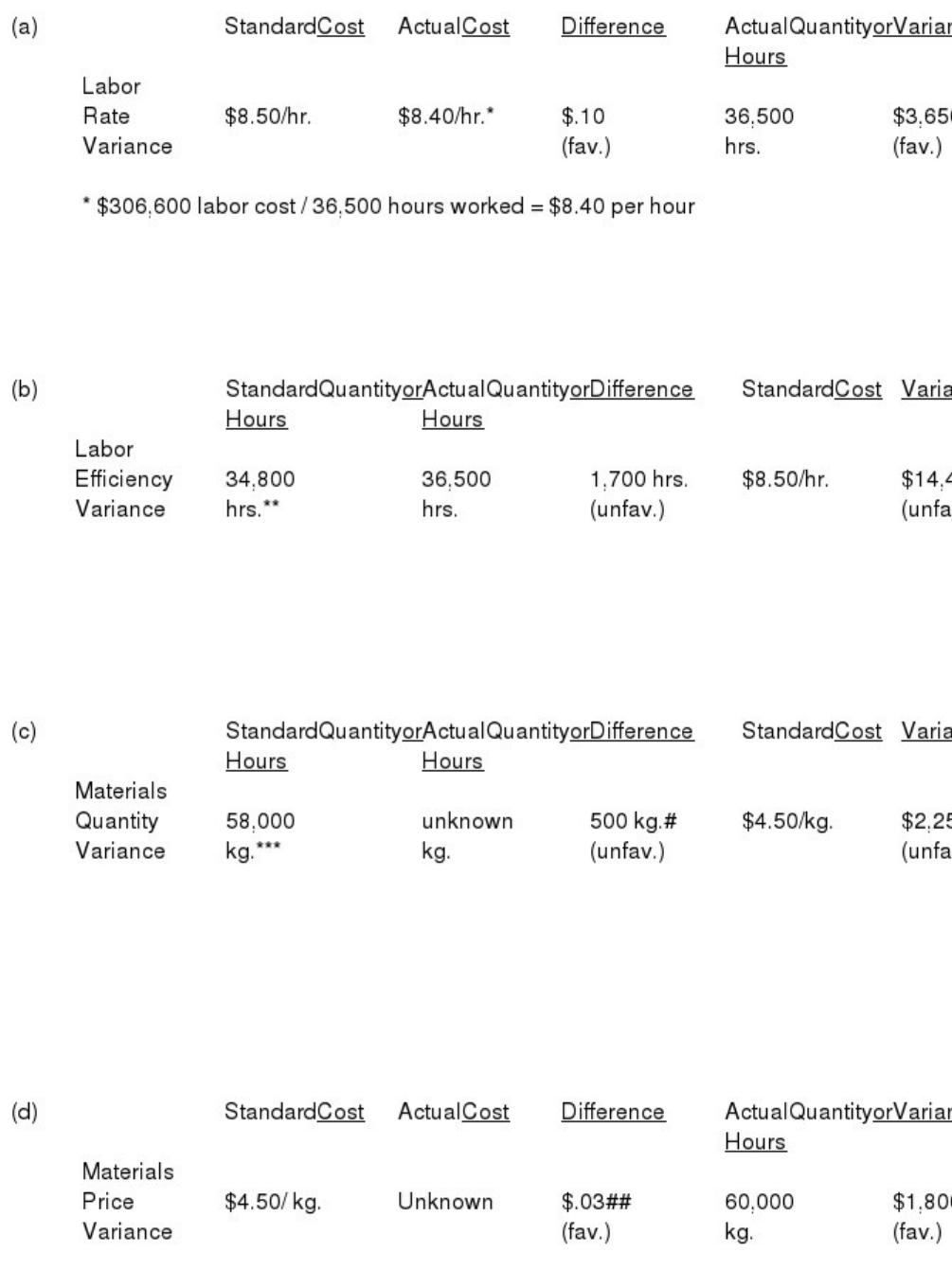
The following operating data were taken from the records for November:
Compute the following:
a. Labor rate variance
b. Labor efficiency variance
c. Actual kilograms of material used in the production process
d. Actual cost paid per kilogram of material
29) Woodside Company manufactures tables with vinyl tops. The standard material cost
for the vinyl used per Style-R table is $7.20 based on 8 square feet of vinyl at a cost of
$.90 per square foot. A production run of 1,000 tables in January resulted in usage of
8,300 square feet of vinyl at a cost of $.85 per square foot, a total cost of $7,055. If the
materials price variance was recorded when the material was issued to production, that
variance was:
A.$145 favorable
B.$415 unfavorable
C.$145 unfavorable
D.$415 favorable
30) Jerrod Sampson is paid $10 an hour for 40 hours a week, with time-and-a-half for
overtime and double-time for Sundays and holidays. Overtime premium is charged to
Factory Overhead.
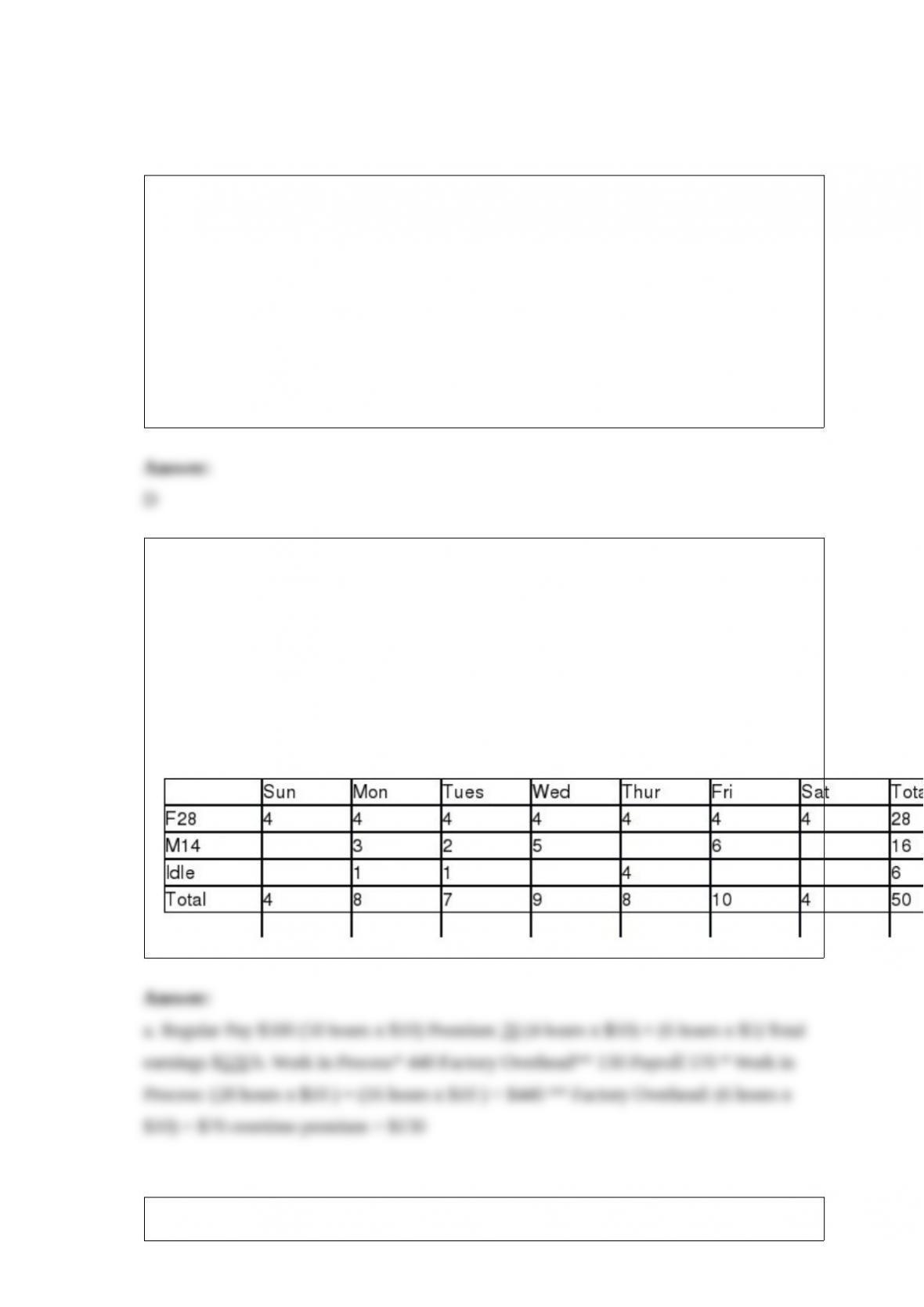
Using the labor-time record below:
a. Compute Jerrods total earnings for the week.
b. Present the journal entry to distribute Jerrods total earnings.
SUTA = 4%, FUTA = 1%, FICA = 8%, FIT = 10%
31) An effective cost control system should include:
A.An established plan of objectives and goals to be achieved
B.Regular reports showing the difference between goals and actual performance
C.Specific assignment of duties and responsibilities
D.All of these are correct
32) In a backflush accounting system, a single account is used for the following:
A.Work in process and finished goods inventories
B.Finished goods inventories and cost of goods sold
C.Factory overhead and raw materials
D.Labor and overhead
33) An accrued expense such as Wages Payable can best be described as an amount:
A.Paid and not currently matched with earnings
B.Not paid and not currently matched with earnings
C.Not paid and currently matched with earnings
D.Paid and currently matched with earnings
34) Overapplied overhead will always result when a predetermined factory overhead
rate is employed and:
A.Overhead incurred is more than overhead applied
B.Overhead incurred is less than overhead applied
C.Production is greater than sales
D.Actual overhead costs are more than expected
35) The method of analyzing cost behavior that uses two data points to first determine
the variable cost per unit and then the total fixed cost is the:
A.Method of least squares
B.Scattergraph method
C.High-low method
D.Observation method
36) A manager can increase income under absorption costing by
A.increasing variable costs
B.increasing production
C.increasing fixed costs
D.increasing leased assets
37) Which of the following statements is true?
I. An expense-type factory overhead analysis spreadsheet makes it possible to distribute
expenses on a departmental basis as they are incurred.
II. A department-type factory overhead analysis worksheet makes it possible to
distribute expenses on a departmental basis as they are incurred.
A.I only
B.II only
C.Both I and II
D.Neither I nor II
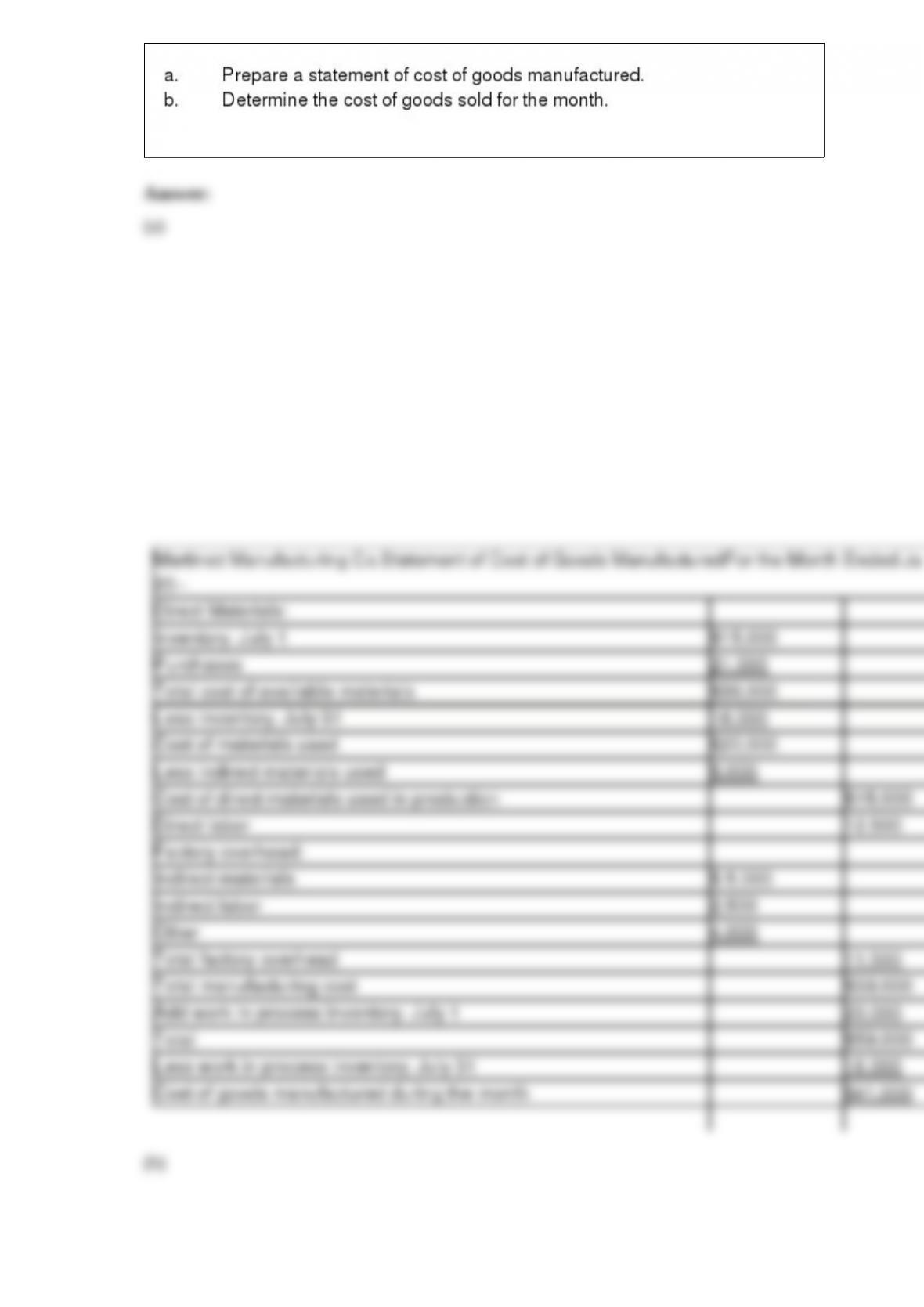
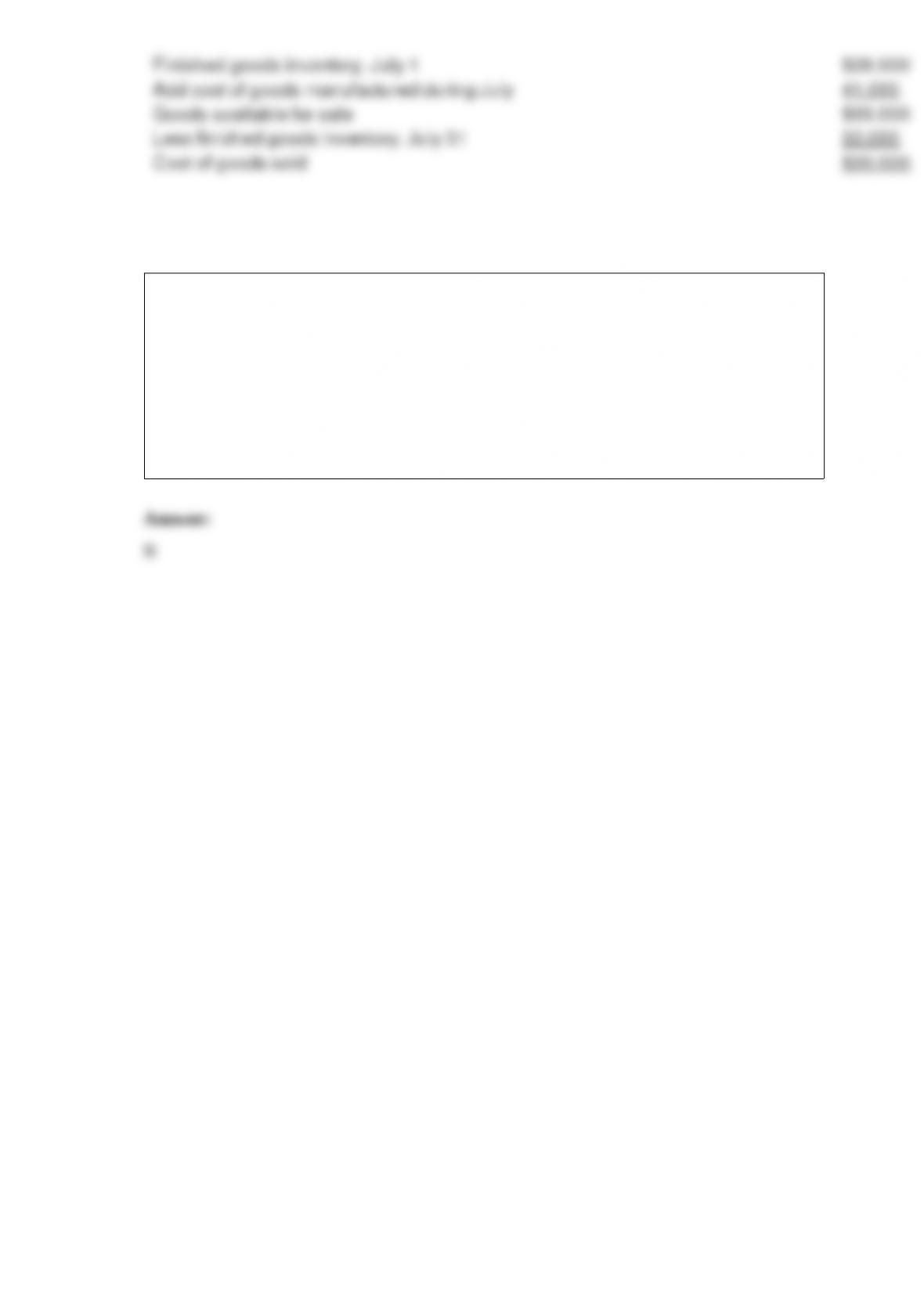
38) The following data was taken from the general ledger and other records of Martinez
Manufacturing Co. at July 31, the end of the first month of operations in the current
fiscal year:
39) Arwen Company has correctly computed its economic order quantity at 500 units;
however, management feels it would rather order in quantities of 600 units. How should
Arwen’s total annual order cost and total annual carrying cost for an order quantity of
600 units compare to the respective amounts for an order quantity of 500 units?
A.Higher total order cost and lower total carrying cost
B.Lower total order cost and higher total carrying cost
C.Higher total order cost and higher total carrying cost
D.Lower total order cost and lower total carrying cost