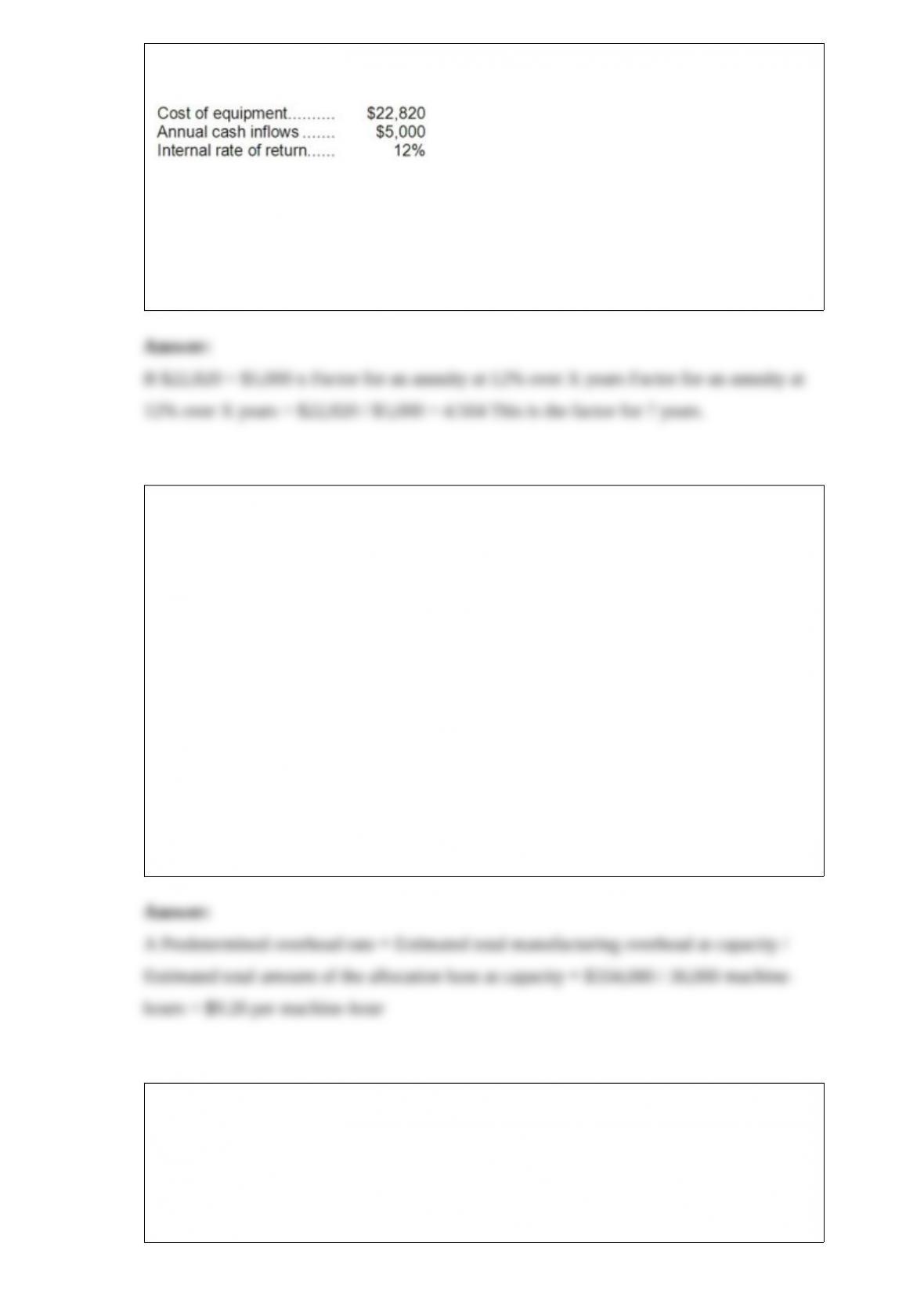
1) ( An investment project has the following characteristics:
The life of the equipment is closest to:
A.It is impossible to determine from the data given.
B.7 years
C.12 years
D.4.56 years.
2) If the company bases its predetermined overhead rate on capacity, the predetermined
overhead rate is closest to:
The management of Richbourg Corporation would like to investigate the possibility of
basing its predetermined overhead rate on activity at capacity. The company’s controller
has provided an example to illustrate how this new system would work. In this
example, the allocation base is machine-hours and the estimated amount of the
allocation base for the upcoming year is 63,000 machine-hours. In addition, capacity is
70,000 machine-hours and the actual level of activity for the year is 66,200
machine-hours. All of the manufacturing overhead is fixed and is $2,866,500 per year.
For simplicity, it is assumed that this is the estimated manufacturing overhead for the
year as well as the manufacturing overhead at capacity. It is further assumed that this is
also the actual amount of manufacturing overhead for the year.
A.$9.28
B.$12.56
C.$11.52
D.$10.34
3) Fife & Jones PLC, a consulting firm, uses an activity-based costing in which there
are three activity cost pools. The company has provided the following data concerning
its costs and its activity based costing system:
Costs:
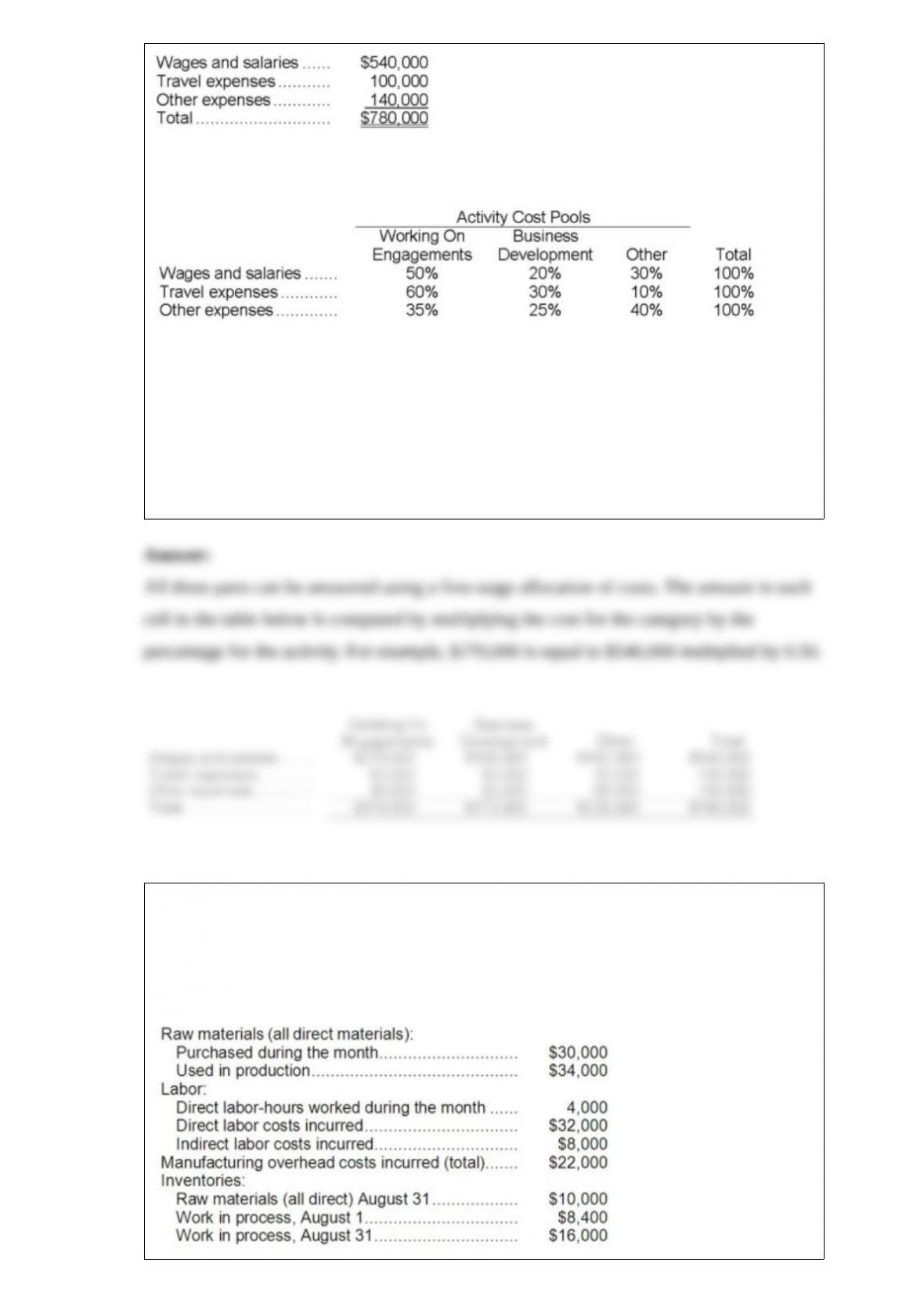
Distribution of resource consumption:
Required:
a. How much cost, in total, would be allocated to the Working On Engagements activity
cost pool?
b. How much cost, in total, would be allocated to the Business Development activity
cost pool?
c. How much cost, in total, would be allocated to the Other activity cost pool?
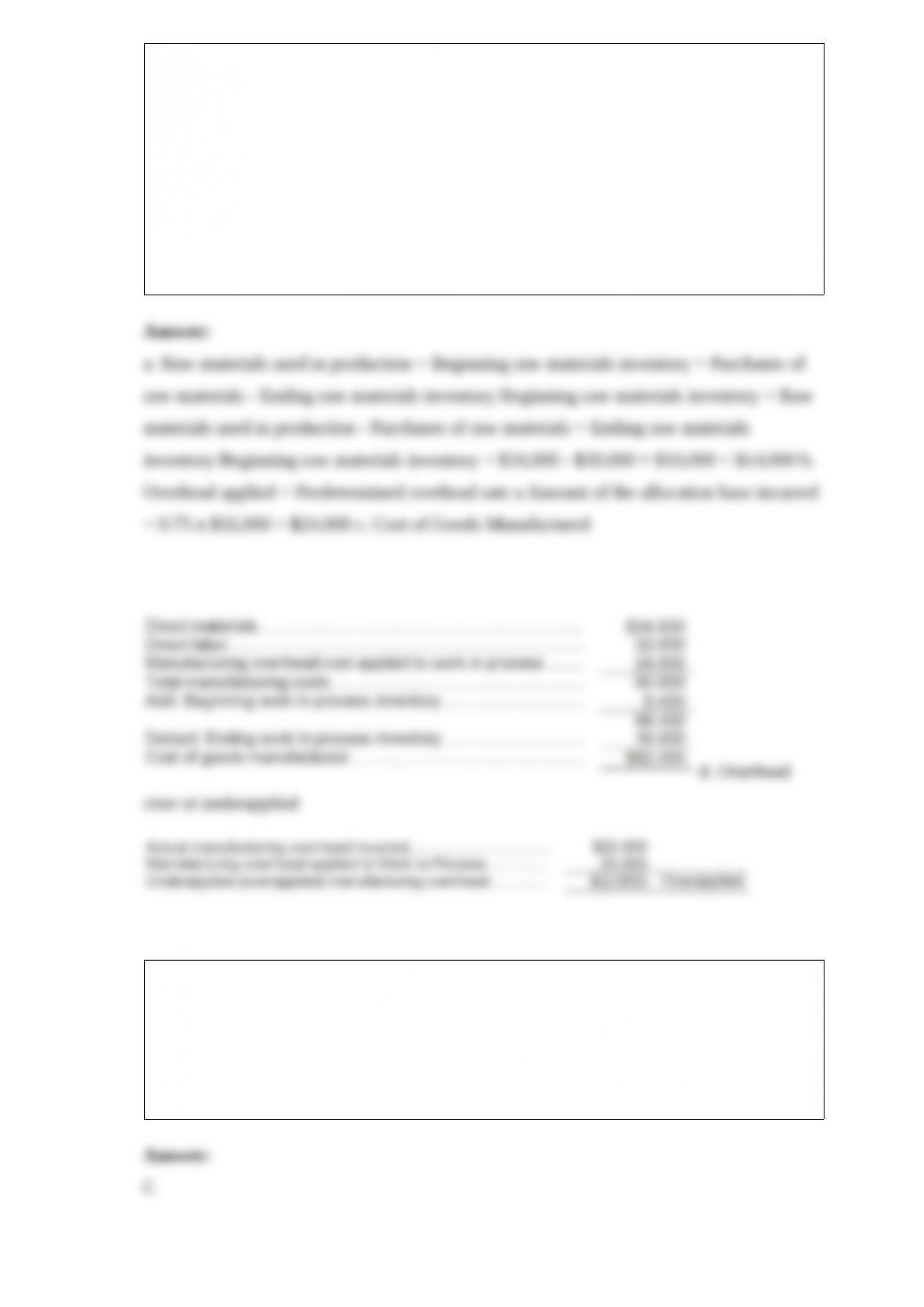
4) Maggie Manufacturing Company applies manufacturing overhead to jobs using a
predetermined overhead rate of 75% of direct labor cost. Any underapplied or
overapplied overhead is closed to Cost of Goods Sold at the end of the month. During
August, the following transactions were recorded by the company:
Required:
Determine the following:
a. The August 1 balance of Raw Materials.
b. The amount of manufacturing overhead applied to jobs in August.
c. The Cost of Goods Manufactured for August.
d. The overapplied or underapplied manufacturing overhead for the month. Label this
amount appropriately.
5) Sand Company has an acid-test ratio of 0.8. Which of the following actions would
improve the acid-test ratio?
A.Collect some accounts receivable.
B.Acquire some inventory on account.
C.Sell some equipment for cash.
D.Use cash to pay off some accounts payable.
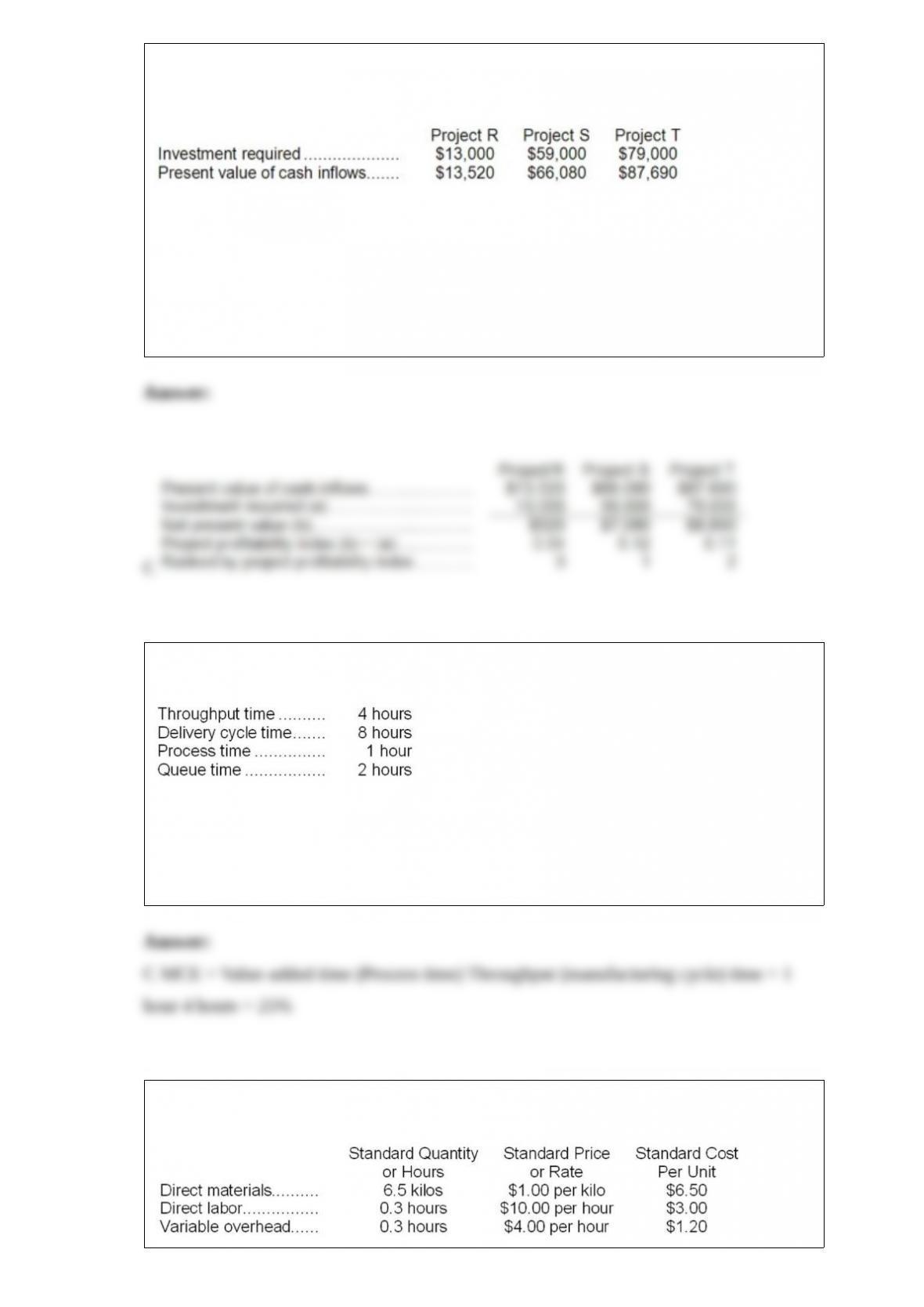
6) ( The management of Edelmann Corporation is considering the following three
investment projects:
Rank the projects according to the profitability index, from most profitable to least
profitable.
A.T, S, R
B.R, T, S
C.S, T, R
D.T, R, S
7) The following data pertain to operations at Quick Incorporated:
The manufacturing cycle efficiency (MCE) for this operation would be:
A.50%
B.75%
C.25%
D.12%
8) Eliezrie Corporation makes a product with the following standard costs:

In January the company’s budgeted production was 7,400 units but the actual
production was 7,500 units. The company used 45,580 kilos of the direct material and
2,030 direct labor-hours to produce this output. During the month, the company
purchased 48,500 kilos of the direct material at a cost of $53,350. The actual direct
labor cost was $18,473 and the actual variable overhead cost was $7,714.
The company applies variable overhead on the basis of direct labor-hours. The direct
materials purchases variance is computed when the materials are purchased.
The variable overhead efficiency variance for January is:
A.$836 F
B.$836 U
C.$880 F
D.$880 U
9) Bosques Corporation has in stock 35,800 kilograms of material L that it bought five
years ago for $5.55 per kilogram. This raw material was purchased to use in a product
line that has been discontinued. Material L can be sold as is for scrap for $1.67 per
kilogram. An alternative would be to use material L in one of the company’s current
products, Q08C, which currently requires 2 kilograms of a raw material that is available
for $9.15 per kilogram. Material L can be modified at a cost of $0.78 per kilogram so
that it can be used as a substitute for this material in the production of product Q08C.
However, after modification, 4 kilograms of material L is required for every unit of
product Q08C that is produced. Bosques Corporation has now received a request from a
company that could use material L in its production process. Assuming that Bosques
Corporation could use all of its stock of material L to make product Q08C or the
company could sell all of its stock of the material at the current scrap price of $1.67 per
kilogram, what is the minimum acceptable selling price of material L to the company
that could use material L in its own production process?
A) $5.365 per kg
B) $3.795 per kg
C) $2.133 per kg
D) $1.675 per kg
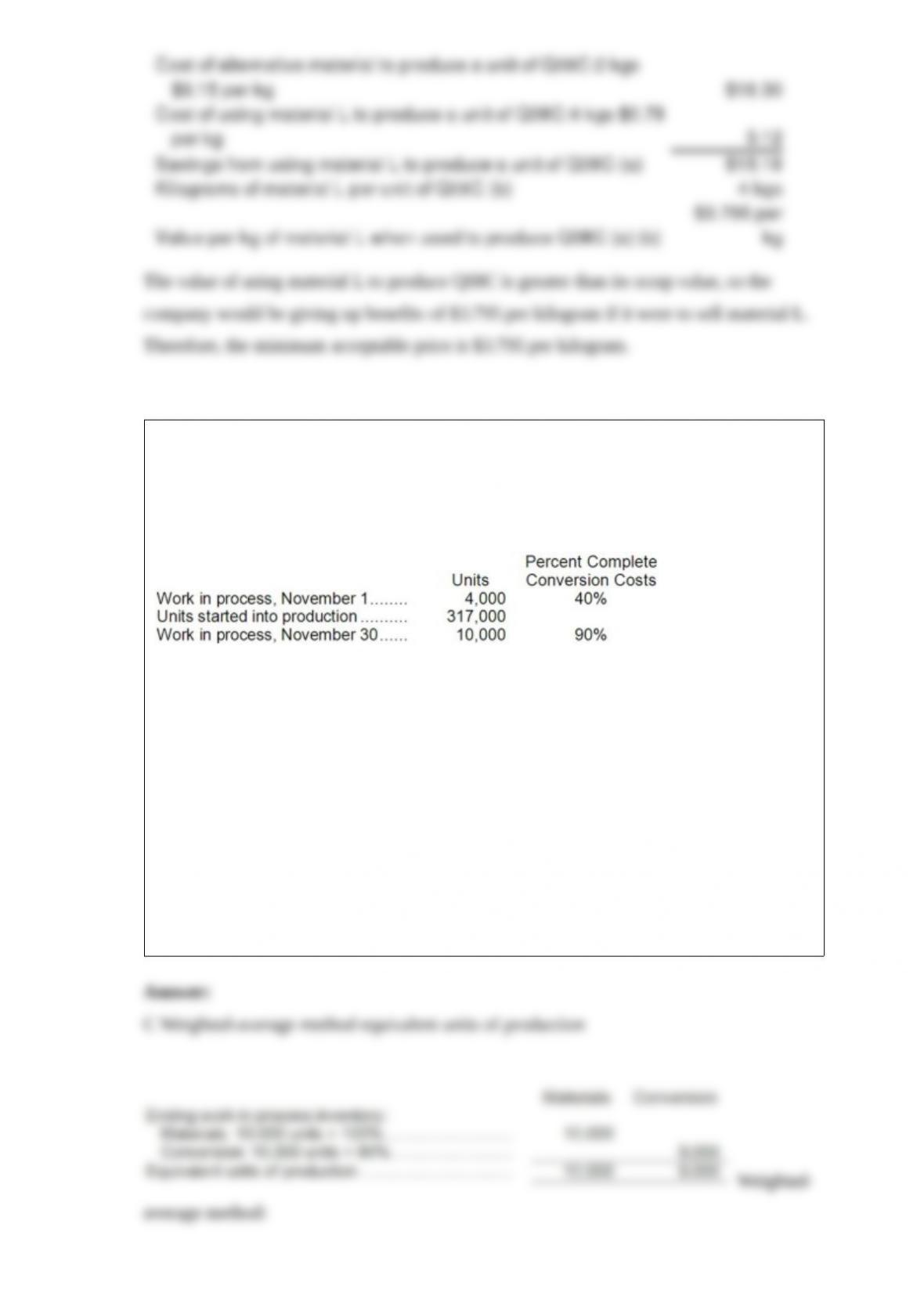
10) The following information relates to the Assembly Department of Jataca
Corporation for the month of November. Jataca uses a weighted-average process
costing system. All materials at Jataca are added at the beginning of the production
process.
On November 1, the work in process inventory account contained $6,400 of material
cost and $4,400 of conversion cost. Cost per equivalent unit for November was $1.50
for materials and $2.80 for conversion costs.
What total amount of cost should be assigned to the units in work in process on
November 30?
A.$17,800
B.$38,700
C.$40,200
D.$43,000
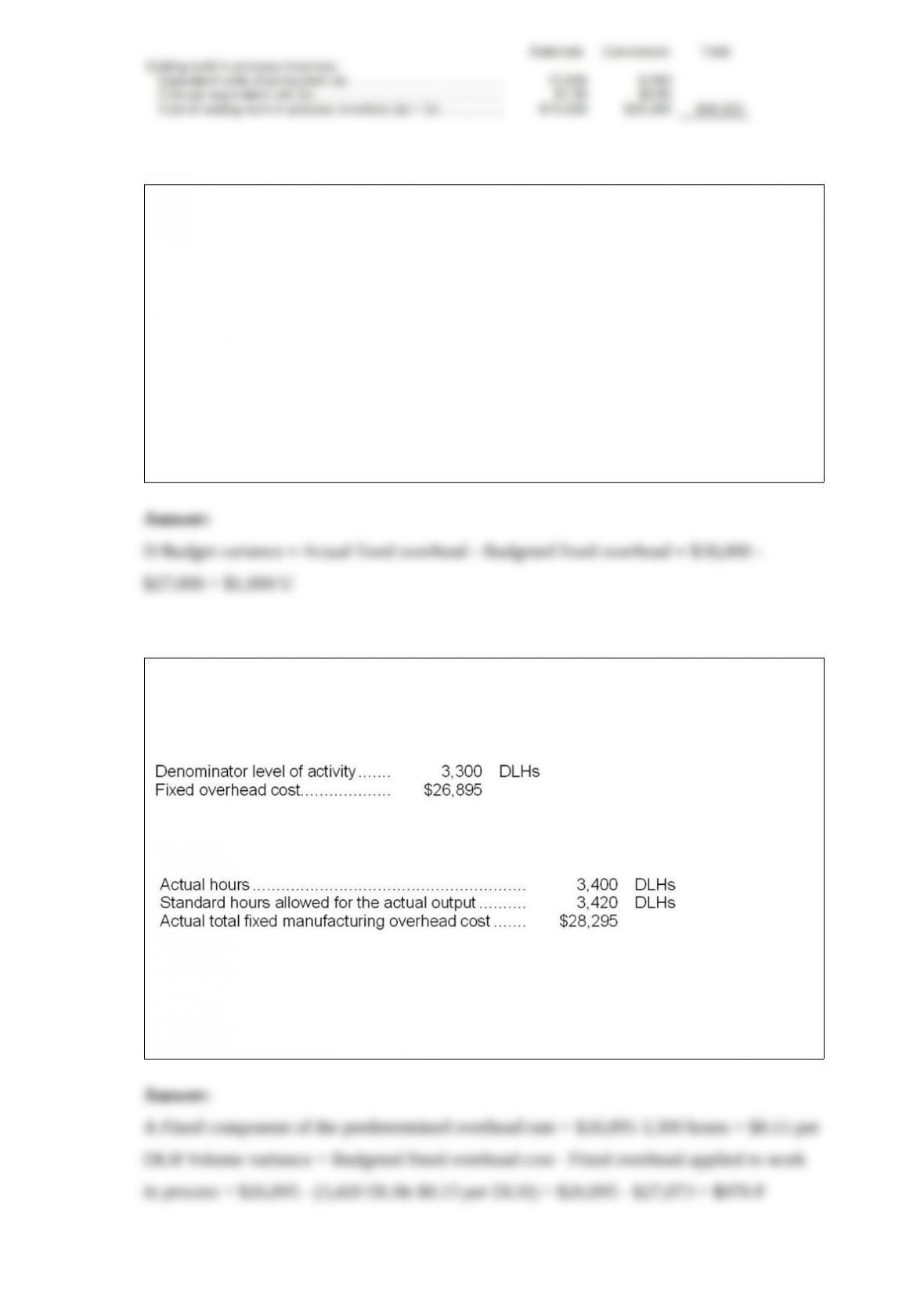
11) Derf Corporation uses a standard cost system in which it applies manufacturing
overhead on the basis of standard direct labor-hours. Two direct labor-hours are
required for each unit produced. The denominator activity was set at 9,000 units.
Manufacturing overhead was budgeted at $135,000 for the period; 20 percent of this
cost was fixed. The 17,200 hours worked during the period resulted in production of
8,500 units. Variable manufacturing overhead cost incurred was $108,500 and fixed
manufacturing overhead cost was $28,000.
The fixed manufacturing overhead budget variance for the period was:
A.$6,300 Unfavorable
B.$2,500 Unfavorable
C.$1,500 Unfavorable
D.$1,000 Unfavorable
12) An outdoor barbecue grill manufacturer has a standard costing system based on
standard direct labor-hours (DLHs) as the measure of activity. Data from the company’s
flexible budget for manufacturing overhead are given below:
The following data pertain to operations for the most recent period:
The fixed manufacturing overhead volume variance for the period is closest to:
A.$978 F
B.$993 F
C.$163 F
D.$815 F
13) Overapplied manufacturing overhead means that:
A.the applied manufacturing overhead cost was less than the actual manufacturing
overhead cost.
B.the applied manufacturing overhead cost was greater than the actual manufacturing
overhead cost.
C.the estimated manufacturing overhead cost was less than the actual manufacturing
overhead cost.
D.the estimated manufacturing overhead cost was less than the applied manufacturing
overhead cost.
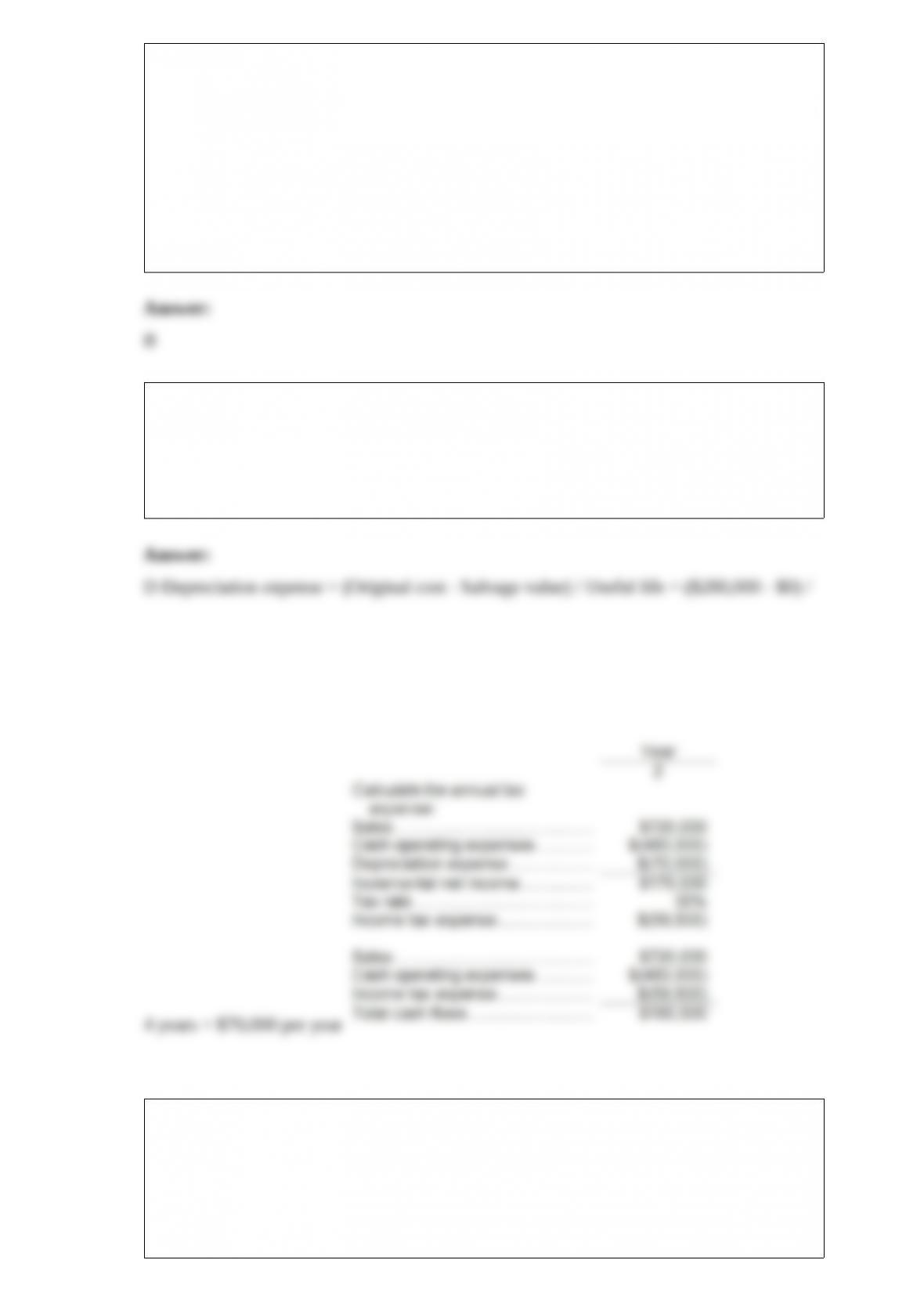
14) The total cash flow net of income taxes in year 2 is:
A.$170,000
B.$115,500
C.$240,000
D.$180,500
15) Kosakowski Corporation processes sugar beets in batches. A batch of sugar beets
costs $66 to buy from farmers and $17 to crush in the company’s plant. Two
intermediate products, beet fiber and beet juice, emerge from the crushing process. The
beet fiber can be sold as is for $23 or processed further for $13 to make the end product
industrial fiber that is sold for $36. The beet juice can be sold as is for $42 or processed
further for $20 to make the end product refined sugar that is sold for $84. How much
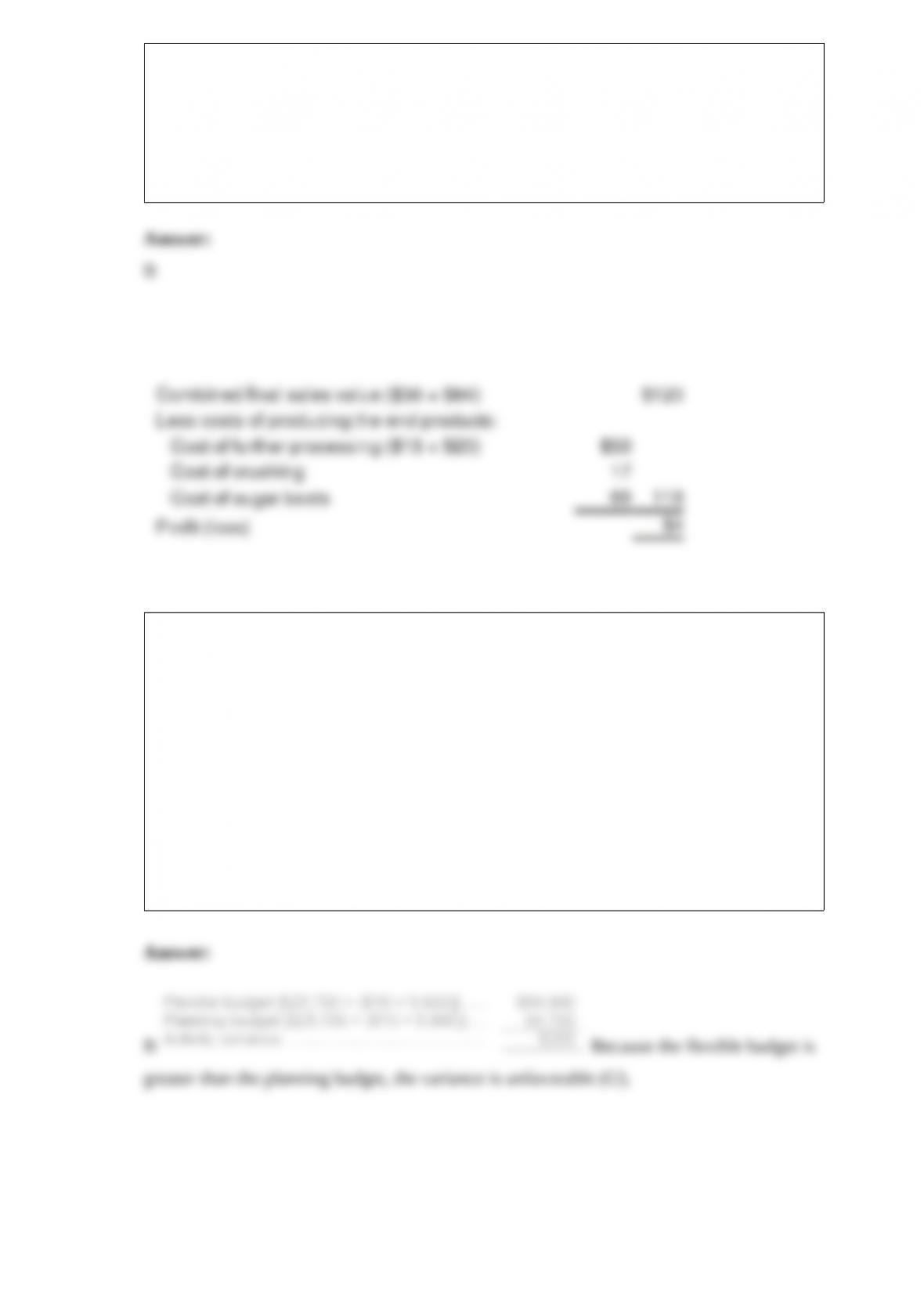
profit (loss) does the company make by processing one batch of sugar beets into the end
products industrial fiber and refined sugar?
A) $(18)
B) $4
C) $22
D) $(116)
16) Eberley Corporation’s cost formula for its manufacturing overhead is $25,700 per
month plus $10 per machine-hour. For the month of July, the company planned for
activity of 5,900 machine-hours, but the actual level of activity was 5,920
machine-hours. The actual manufacturing overhead for the month was $86,800.
The activity variance for manufacturing overhead in July would be closest to:
A.$2,100 U
B.$200 U
C.$200 F
D.$2,100 F