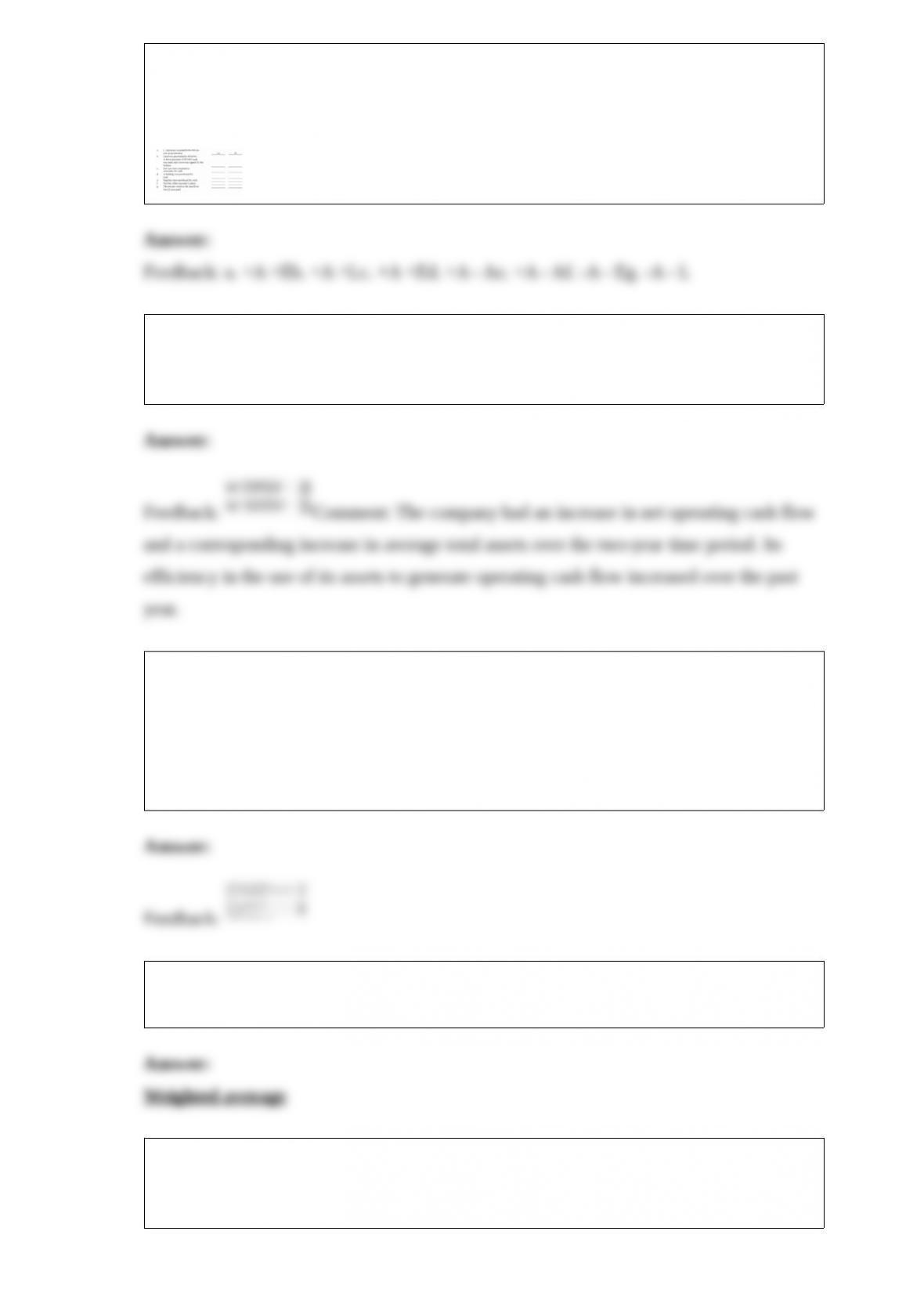
1) For each of the following transactions, identify the effects as reflected in the
accounting equation. Use “+” to indicate an increase and “-” to indicate a decrease. Use
“A”, “L”, and “E” to indicate assets, liabilities, and equity, respectively. Part A has been
completed as an example.
2) A company reported operating cash flows in Year 1 of $23,400 and $26,220 in Year
2. Its average total assets in Year 1 were $262,000 and $285,000 in Year 2. Calculate the
cash flow on total assets ratio for both years. Comment on the results.
3) The overhead allocation rate in Frantz Company’s job order cost accounting system
applies overhead based on direct labor costs. The company’s manufacturing costs for
the current year were: direct materials, $108,000; direct labor, $144,000; and factory
overhead, $18,000. At year-end, the total cost of goods in process is $36,000, which
includes $12,000 of direct labor cost. What amount of direct material cost is included in
the ending goods in process inventory?
4) An advantage of the _________________ method of inventory valuation is that it
tends to smooth out the effect of erratic changes in costs.
5) Explain the value of separating cash flows into operating activities, investing
activities and financing activities to financial statement users in analyzing cash flows
and the company’s financial performance and condition.
6) What is comprehensive income and how is it usually reported in the financial
statements?
7) A period’s ___________________ becomes the next period’s beginning inventory.
8) A partnership designed to protect innocent partners from malpractice or negligence
claims resulting from the acts of other partners is a ____________________________
partnership.
9) Describe the link between the income statement, the statement of owner’s equity, and
the balance sheet.
10) What is operating leverage? How can the degree of operating leverage be used in
analyzing changes in sales?