
1) If a potential loss on a contingent liability is remote, the liability usually is:
A) disclosed in footnotes, but not accrued
B) neither accrued nor disclosed in footnotes
C) accrued and indicated in the body of the financial statements
D) disclosed in the auditor’s report but not disclosed on the financial statements
2) Auditor confirmation of accounts payable balances at the balance sheet date may not
need to be performed by the auditor because:
A) this is a duplication of cutoff tests
B) there is likely to be other reliable external evidence available to support the balances
C) accounts payable balances at the balance sheet date may not be paid before the audit
is completed
D) correspondence with the audit client’s attorney will reveal all legal action by vendors
for nonpayment
3) An auditor should examine minutes of the board of directors’ meetings:
A) through the date of the financial statements
B) through the date of the audit report
C) only at the beginning of the audit
D) on a test basis
4) As a CPA, you have been engaged to perform an attestation engagement. You would
typically:
A) express a conclusion about an assertion
B) provide management consulting services
C) prepare financial forecasts to secure in preparation for receiving debt funding
D) compile financial statements for the client
5) An auditor’s decision concerning whether or not to “dual date” the audit report is
based upon the auditor’s willingness to:

A) extend auditing procedures and assume responsibility for a greater period of time
B) accept responsibility for subsequent events
C) permit inclusion of a footnote captioned: event (unaudited) subsequent to the date of
the auditor’s report
D) assume responsibility for events subsequent to the issuance of the auditor’s report
6) The process which requires the calculation of an interval and then selects the items
based on the size of the interval is:
A) statistical sampling
B) random sample selection
C) systematic sample selection
D) computerized sample selection
7) In practice, auditors do not know whether a sample is representative, even after all
testing is complete.
A) True
B) False
8) An important benefit of industry comparisons is as:
A) an aid to understanding the client’s business
B) an indicator of errors
C) an indicator of fraud
D) a least-cost indicator for audit procedures
9) When verifying the transfer of inventory from one location to another, the audit
objectives with which the auditor is primarily concerned are occurrence of recorded
transfers, completeness of recorded transfers, and accuracy of recorded transfers.
A) True
B) False

10) Which of the following best describes one of the primary objectives of audit
documentation?
A) Defend against claims of a deficient audit
B) Provide a basis for reviewing the work of subordinates
C) Provide reasonable assurance that the audit was conducted in accordance with
auditing standards
D) Provide additional support of recorded amounts to the client
11) In what order should the following steps occur?
A.assess client business risk
B.understand the client’s business and industry
C.perform preliminary analytical procedures
D.assess acceptable audit risk
A) D, B, C, A
B) B, A, D, C
C) B, D, A, C
D) D, C, B, A
12) An advantage of the principles of professional conduct in the Code of Professional
Conduct is that they are more easily enforced than are the specific rules of conduct.
A) True
B) False
13) In connection with a review of the prepaid insurance account, which of the
following audit procedures would you be least likely to use?
A) Recompute the portion of the premium that expired during the year
B) Prepare excerpts of insurance policies for audit working papers
C) Confirm premium rates with an independent insurance broker
D) Examine support for premium payments
14) Misstatements must be compared with some measurement base before a decision
can be made about materiality. A commonly accepted measurement base includes:
A) net income
B) total assets
C) working capital
D) all of the above
15) According to the Principles section of the Code of Professional Conduct, all
members:
A) should be independent in fact and in appearance at all times
B) in public practice should be independent in fact and in appearance at all times
C) in public practice should be independent in fact and in appearance when providing
auditing and other attestations services
D) in public practice should be independent in fact and in appearance when providing
auditing, tax, and other attestation services
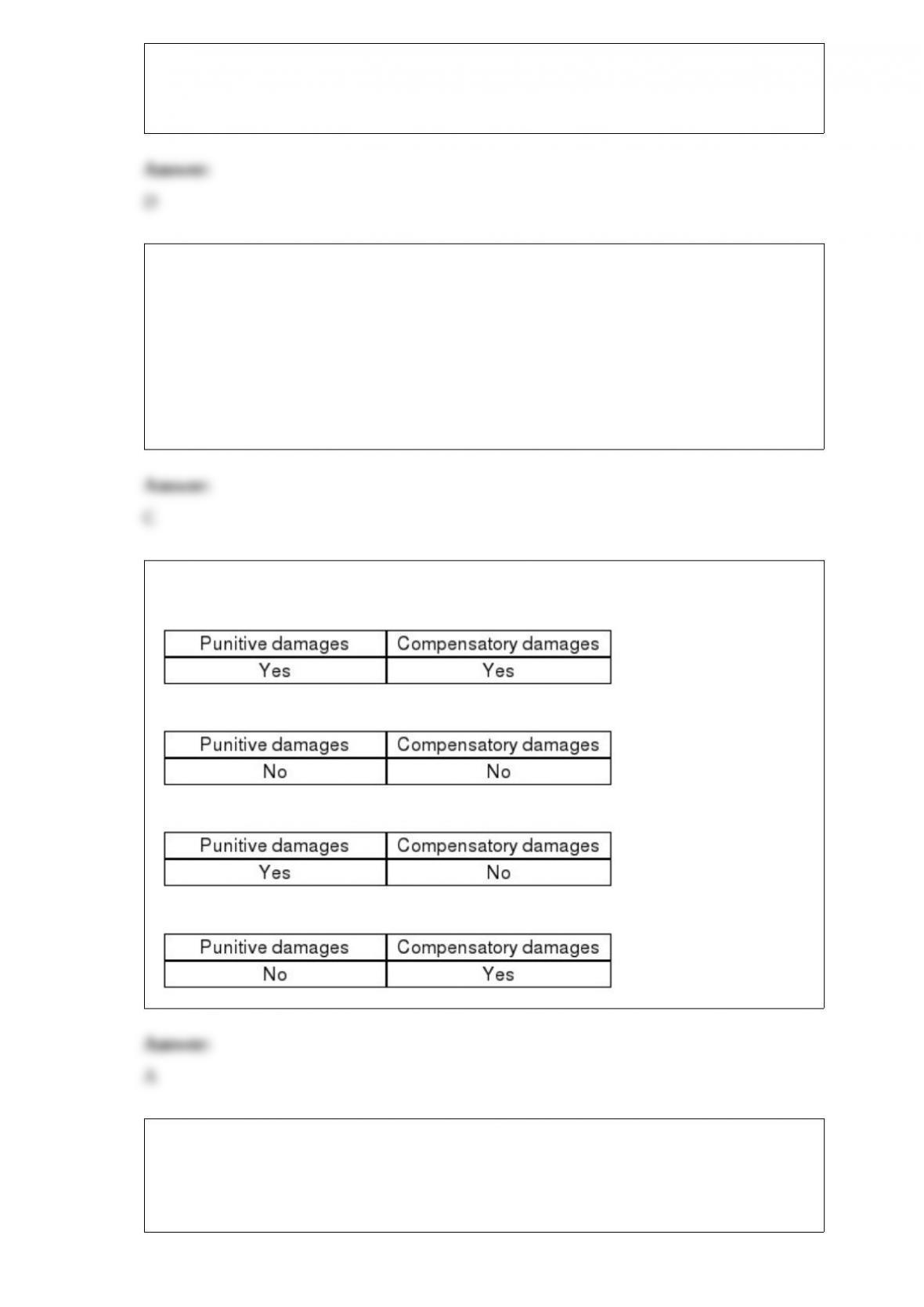
16) Auditors may be liable to their clients for:
A)
B)
C)
D)
17) Tests of detail tie-in are normally conducted last in the audit of the sales and
collections cycle.
A) True
B) False
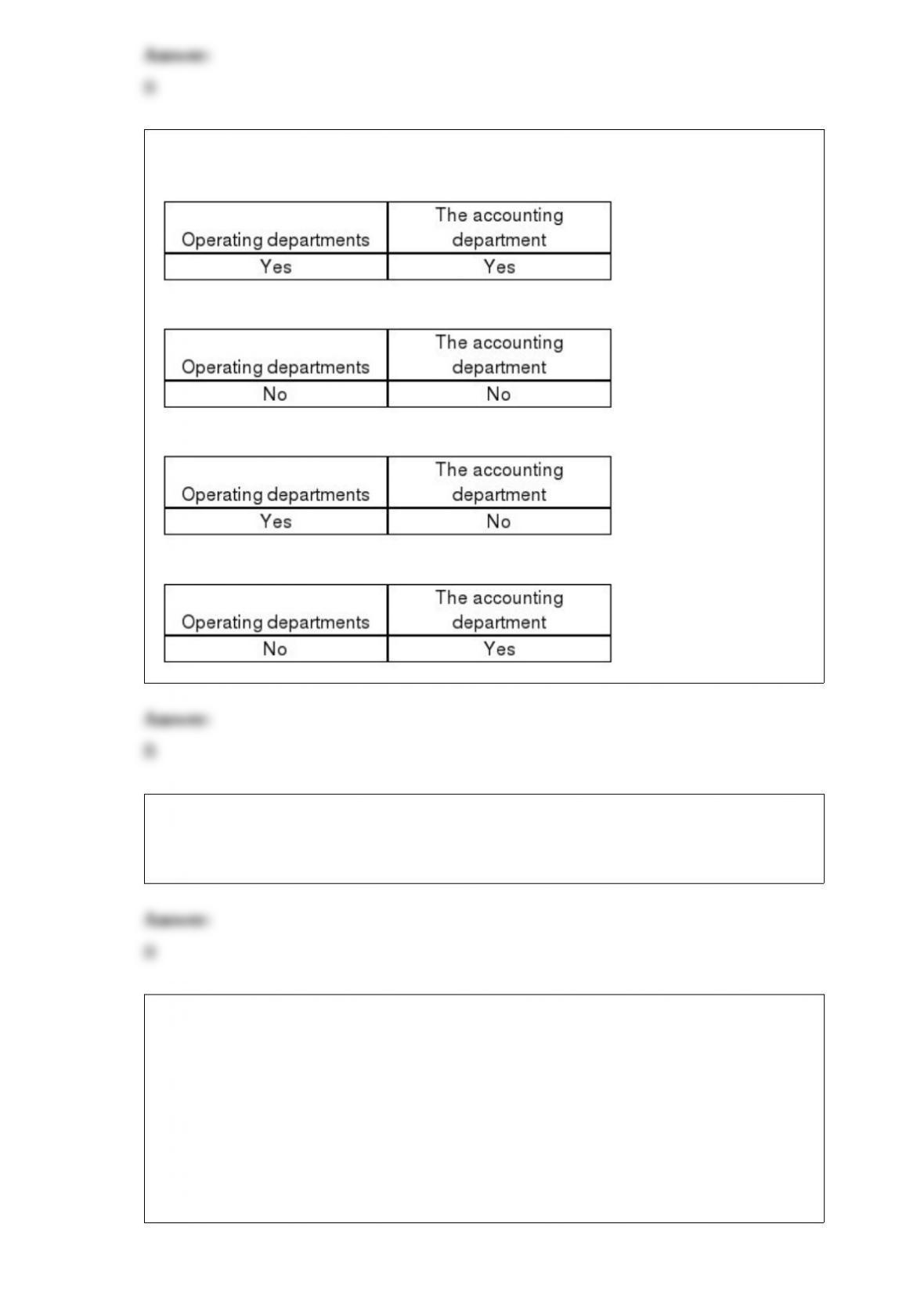
18) To be effective, an internal audit department must report to:
A)
B)
C)
D)
19) In the
A) True
B) False
20) Auditors, as part of completing the audit, will request the client to send a letter of
inquiry to those attorneys the company has been consulting with during the year under
audit regarding legal matters of concern to the company. The primary reason the auditor
requests this information is to:
A) determine the range of probable loss for asserted claims
B) corroborate of information supplied by management concerning litigation, claims,
and assessments
C) outside opinion of probability of losses in determining accruals for contingencies
D) outside opinion of probability of losses in determining the proper footnote disclosure

21) Which of the following statements regarding inherent risk is correct?
A) Inherent risk is unaffected by the auditor’s experience with client’s organization
B) Most auditors set a low inherent risk in the first year of an audit and increase it if
experience shows that it was incorrect
C) Most auditors set a high inherent risk in the first year of an audit and reduce it in
subsequent years as they gain experience, even when there is inherent risk
D) Inherent risk is dependent upon the strengths in client’s internal control system
22) Insurance expense for the period is a function of which of the following?
A) The beginning prepaid balance, current premium payments and the ending prepaid
balance
B) The beginning prepaid balance and the current period premium payments
C) The current period premium payments
D) The current period premium payments and the ending prepaid balance
23) ________ tests are for omitted transactions, while ________ tests are for
nonexistent transactions.
A) Tracing, vouching
B) Vouching, tracing
C) Verifying, tracking
D) Tracking, verifying
24) The Public Company Accounting Oversight Board:
A) perform inspections of the quality controls at audit firms that audit public companies
B) establish auditing standards that must be followed by CPAs on all audits
C) oversee auditors of private companies
D) perform any of the above functions
25) Several months after an unqualified audit report was issued, the auditor discovers

the financial statements were materially misstated. The client’s CEO agrees that there
are misstatements, but refuses to correct them. She claims that “confidentiality”
prevents the CPA from informing anyone.
A) The CEO is correct and the auditor must maintain confidentiality
B) The CEO is incorrect, but because the audit report has been issued it is too late
C) The CEO is correct, but to be ethically correct the auditor should violate the
confidentiality rule and disclose the error
D) The CEO is incorrect, and the auditor has an obligation to issue a revised audit
report, even if the CEO will not correct the financial statements
26) The audit of owners’ equity of public and private companies is very different.
Which of the following is not one of these differences?
A) The number of transactions (private companies have fewer transactions)
B) Payment of dividends (public companies rarely pay dividends)
C) Complexity of transactions (public companies generally have more complex
transactions)
D) Type of noncurrent debt (public companies issue more bonds)
27) Which of the following is the auditor least likely to do when aware of an illegal act?
A) Discuss the matter with the client’s legal counsel
B) Obtain evidence about the potential effect of the illegal act on the financial
statements
C) Contact the local law enforcement officials regarding potential criminal wrongdoing
D) Consider the impact of the illegal act on the relationship with the company’s
management
28) Explain why the audit of work-in-process and finished goods inventory is generally
more complex than the audit of purchased inventory.
29) Auditors are required to perform certain procedures in every audit to address the
risk of management override of internal controls. What are these procedures?
30) Discuss what is meant by “nonsampling risk.”
31) In addition to performing analytical procedures that examine the relationship of
inventory account balances with related financial statement accounts auditor’s will often
use non-financial measures in determining the reasonableness of inventory balances.
List below at least two non-financial measures that may be useful to auditors.
32) In evaluating the operational effectiveness of internal controls the auditor is likely
to use four types of audit procedures. List the procedures below.
33) Briefly describe each of the five Trust Services principles.
34) There are seven steps to calculate adjusted misstatement bounds when both
overstatement and understatement errors are discovered in monetary-unit sampling.
Step one is “Determine misstatement for each sample item, keeping overstatements and
understatements separate.” Discuss three of the remaining six steps.