
1) When numerous adjustments are necessary, companies often use a cash flow
worksheet instead of preparing a statement of cash flows.
2) When a company amends its defined benefit plan, and recognizes prior service, the
projected benefit obligation is increased to recognize this additional liability.
3) IFRS does not provide detailed guidance for leases of natural resources,
sale-leasebacks, and leveraged leases.
4) The cost of purchased patents should be amortized over the remaining legal life of
the patent.
5) The lower-of-cost-or-market method is used for inventory despite being less
conservative than valuing inventory at market value.
6) A pension plan is contributory when the employer makes payments to a funding
agency.
7) In determining present value, a company moves backward in time using a process of
accumulation.

8) Interest is the excess cash received or repaid over and above the amount lent or
borrowed.
9) When land with an old building is purchased as a future building site, the cost of
removing the old building is part of the cost of the new building.
10) If a stock dividend occurs after year-end, but before issuing the financial
statements, a company must restate the weighted-average number of shares outstanding
for the year.
11) The Supplies account had a balance at the beginning of year 3 of $8,000 (before the
reversing entry). Payments for purchases of supplies during year 3 amounted to $50,000
and were recorded as expense. A physical count at the end of year 3 revealed supplies
costing $11,500 were on hand. Reversing entries are used by this company. The
required adjusting entry at the end of year 3 will include a debit to:
a.Supplies Expense for $3,500
b.Supplies for $3,500
c.Supplies Expense for $46,500
d.Supplies for $11,500
12) In the context of dollar-value LIFO, what is a LIFO layer?
a.The difference between the LIFO inventory and the amount used for internal reporting
purposes
b.The LIFO value of the inventory for a given year
c.The inventory in base year dollars
d.The LIFO value of an increase in the inventory for a given year
13) On January 1, 2015, Yancey, Inc. signs a 10-year noncancelable lease agreement to
lease a storage building from Holt Warehouse Company. Collectibility of lease
payments is reasonably predictable and no important uncertainties surround the amount
of costs yet to be incurred by the lessor. The following information pertains to this lease
agreement.
(a)The agreement requires equal rental payments at the beginning each year.
(b)The fair value of the building on January 1, 2015 is $4,000,000; however, the book
value to Holt is $3,300,000.
(c)The building has an estimated economic life of 10 years, with no residual value.
Yancey depreciates similar buildings on the straight-line method.
(d)At the termination of the lease, the title to the building will be transferred to the
lessee.
(e)Yanceys incremental borrowing rate is 11% per year. Holt Warehouse Co. set the
annual rental to insure a 10% rate of return. The implicit rate of the lessor is known by
Yancey, Inc.
(f)The yearly rental payment includes $10,000 of executory costs related to taxes on the
property.
Future Value of Ordinary Annuity of 1
Period 5% 6% 8% 10% 12%
11.000001.000001.000001.000001.00000
22.050002.060002.080002.100002.12000
33.152503.183603.246403.310003.37440
44.310134.374624.506114.641004.77933
55.525635.637095.866606.105106.35285
66.801916.975327.335927.715618.11519
78.142018.393848.922809.4871710.08901
89.549119.8974710.6366311.4358912.29969
911.0265611.4913212.4875613.5794814.77566
1012.5778913.1807914.4865615.9374317.54874
Present Value of an Ordinary Annuity of 1
Period 5% 6% 8% 10% 12%
1.95238.94340.92593.90909.89286
21.859411.833391.783261.735541.69005
32.723252.673012.577102.486852.40183
43.545953.465113.312133.169863.03735
54.329484.212363.992713.790793.60478
65.075694.917324.622884.355264.11141
75.786375.582385.206374.868424.56376
86.463216.209795.746645.334934.96764
97.107826.801696.246895.759025.32825
107.721737.360096.710086.144575.65022
What is the amount of the minimum annual lease payment? (Rounded to the nearest
dollar.)
a.$181,801
b.$581,801
c.$591,801
d.$601,801

14) The balance sheet data of Kohler Company at the end of 2015 and 2014 follow:
2015 2014
Cash$ 100,000$ 140,000
Accounts receivable (net)240,000180,000
Inventory280,000180,000
Prepaid expenses40,000100,000
Buildings and equipment360,000300,000
Accumulated depreciationbuildings and equipment(72,000)(32,000)
Land 360,000 160,000
Totals$1,308,000$1,028,000
Accounts payable$272,000$220,000
Accrued expenses48,00072,000
Notes payablebank, long-term160,000
Mortgage payable120,000
Common stock, $10 par836,000636,000
Retained earnings (deficit) 32,000 (60,000)
$1,308,000$1,028,000
Land was acquired for $200,000 in exchange for common stock, par $200,000, during
the year; all equipment purchased was for cash. Equipment costing $20,000 was sold
for $8,000; book value of the equipment was $16,000 and the loss was reported as an
ordinary item in net income. Cash dividends of $40,000 were charged to retained
earnings and paid during the year; the transfer of net income to retained earnings was
the only other entry in the Retained Earnings account. In the statement of cash flows for
the year ended December 31, 2015, for Naley Company:
The net cash provided (used) by investing activities was
a.$52,000
b.$(80,000)
c.$(272,000)
d.$(72,000)
15) During 2014, which was the first year of operations, Oswald Company had
merchandise purchases of $985,000 before cash discounts. All purchases were made on
terms of 2/10, n/30. Three-fourths of the items purchased were paid for within 10 days
of purchase. All of the goods available had been sold at year end.
Which of the following recording procedures would result in the highest cost of goods
sold for 2014?
1>Recording purchases at gross amounts
2> Recording purchases at net amounts, with the amount of discounts not taken shown
under “other expenses” in the income statement
a. 1
b.2
c.Either 1 or 2 will result in the same cost of goods sold
d.Cannot be determined from the information provided
16) Which dividends do not reduce stockholders’ equity?
a.Cash dividends
b.Stock dividends
c.Property dividends
d.Liquidating dividends
17) Hayes Corp. is a manufacturer of truck trailers. On January 1, 2014, Hayes Corp.
leases ten trailers to Lester Company under a six-year noncancelable lease agreement.
The following information about the lease and the trailers is provided:
1>Equal annual payments that are due on January 1 each year provide Hayes Corp. with
an 8% return on net investment (present value factor for 6 periods at 8% is 4.99271).
2>Titles to the trailers pass to Lester at the end of the lease.
3>The fair value of each trailer is $50,000. The cost of each trailer to Hayes Corp. is
$45,000. Each trailer has an expected useful life of nine years.
4>Collectibility of the lease payments is reasonably predictable and there are no
important uncertainties surrounding the amount of costs yet to be incurred by Hayes
Corp.
Instructions
(a)What type of lease is this for the lessor? Discuss.
(b)Calculate the annual lease payment. (Round to nearest dollar.)
(c)Prepare a lease amortization schedule for Hayes Corp. for the first three years.
(d)Prepare the journal entries for the lessor for 2014 to record the lease agreement, the
receipt of the lease rentals, and the recognition of revenue (assume the use of a
perpetual inventory method and round all amounts to the nearest dollar).
18) The methods of accounting for a lease by the lessee are
a.operating and capital lease methods
b.operating, sales, and capital lease methods
c.operating and leveraged lease methods
d.None of these answers are correct
19) Which statement is true about the retail inventory method?
a.It may not be used to estimate inventories for interim statements
b.It may not be used to estimate inventories for annual statements
c.It may not be used by auditors
d.None of these answers are correct
20) The following costs are incurred during the research and development phases of a
laser bone scanner
Identify which of these are development phase items and will be immediately expensed
under
U.S. GAAP and IFRS.
U.S. GAAP IFRS
a. $1,200,000$1,200,000
b. 2,400,0001,400,000
c. 2,400,0003,400,000
d. 3,400,0003,400,000

21) Antique Company has notes receivable that have a fair value of $920,000 and a
carrying amount of $710,000. Antique decides on December 31, 2014, to use the fair
value option for these recently-acquired receivables. The adjusting entry to record this
change will include a:
a.debit to Unrealized Holding Gain or LossIncome for $210,000
b.credit to Notes Receivable for $210,000
c.credit to Unrealized Holding Gain or LossIncome for $210,000
d.debit to Notes Receivable for $920,000
22) Presented below is information related to Hale Corporation:
Common Stock, $1 par$4,500,000
Paid-in Capital in Excess of ParCommon Stock550,000
Preferred 8 1/2% Stock, $50 par2,000,000
Paid-in Capital in Excess of ParPreferred Stock400,000
Retained Earnings1,500,000
Treasury Common Stock (at cost)150,000
The total stockholders’ equity of Hale Corporation is
a.$8,800,000
b.$8,950,000
c.$7,300,000
d.$7,450,000
23) Minimum lease payments may include a
a.penalty for failure to renew
b.bargain purchase option
c.guaranteed residual value
d.any of these
24) When is a contingent liability recorded?
a.When the amount can be reasonably estimated
b.When the future events are probable to occur and the amount can be reasonably
estimated
c.When the future events are probable to occur
d.When the future events will possibly occur and the amount can be reasonably
estimated
25) Equipment that cost $400,000 and has accumulated depreciation of $315,000 is
exchanged for equipment with a fair value of $160,000 and $40,000 cash is received.
The exchange lacked commercial substance.
Instructions
(a)Show the calculation of the gain to be recognized from the exchange.
(b)Prepare the entry for the exchange. Show a check of the amount recorded for the
new equipment.
26) Which of the following is a characteristic of the expense warranty approach, but not
the sales warranty approach?
a.Estimated liability under warranties
b.Warranty expense
c.Unearned warranty revenue
d.Warranty revenue
27) Exiter Inc. owns the following assets:
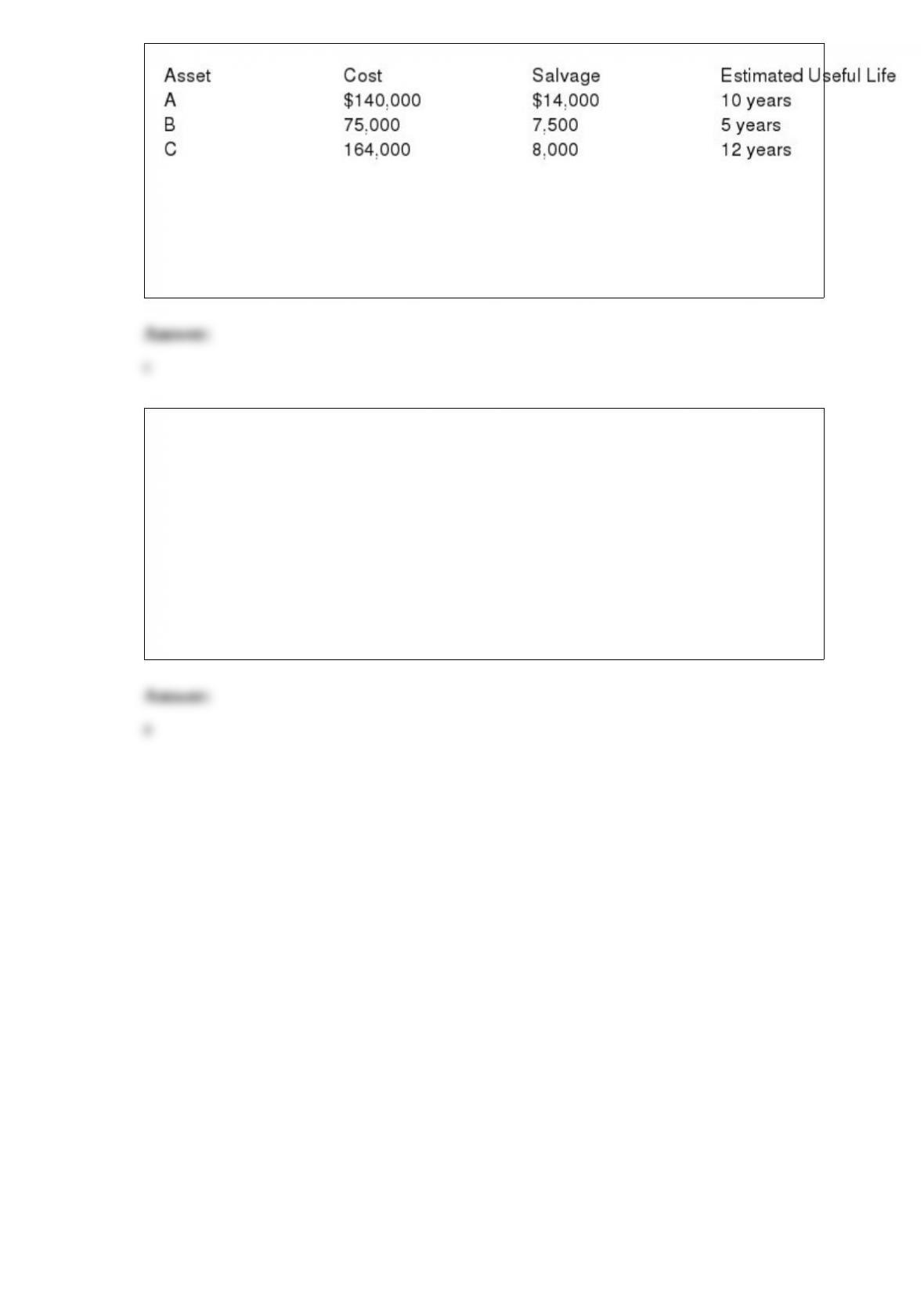
What is the composite life of Exiter’s assets?
a.14.0 years
b.9.7 years
c.8.9 years
d.10.3 years
28) Ernst Company purchased equipment that cost $2,250,000 on January 1, 2014 . The
entire cost was recorded as an expense. The equipment had a nine-year life and a
$90,000 residual value. Ernst uses the straight-line method to account for depreciation
expense. The error was discovered on December 10, 2016 . Ernst is subject to a 40%
tax rate.
Ernsts net income for the year ended December 31, 2014, was understated by
a.$1,206,000
b.$1,350,000
c.$2,010,000
d.$2,250,000