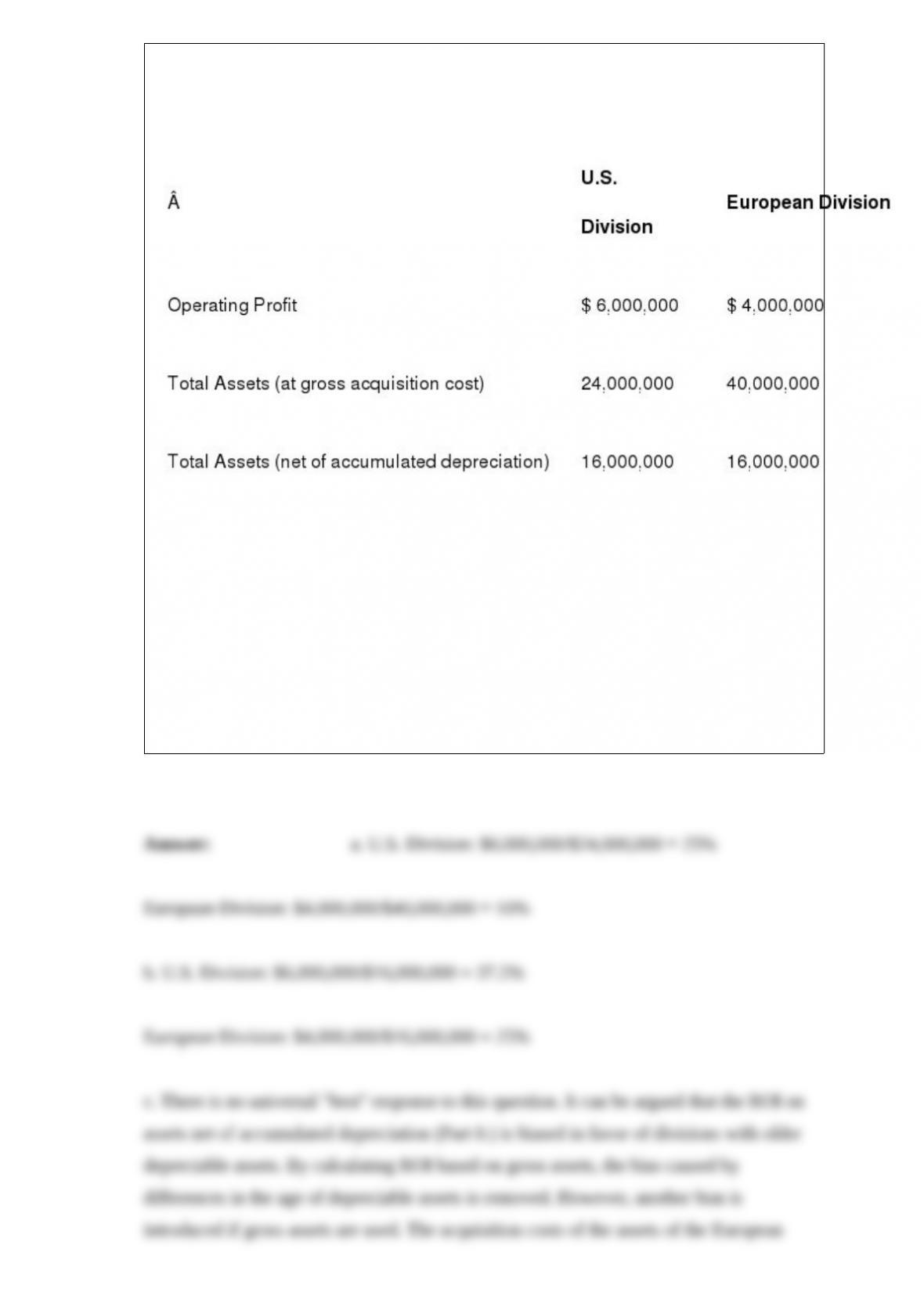
The following information relates to the operating performance of two divisions of
Sound Machine, Inc., for last year.
Required:
a. Compute the return on investment (ROI) of each division, using total assets at gross
book value as the investment base.
b. Compute the ROI of each division, using total assets net of accumulated depreciation
(net book value) as the investment base.
c. Which of the two measures do you think gives the better indication of operating
performance? Explain your reasoning.

What does a quality control chart reflect?
A.The manager who is in charge on a particular day.
B.Process variations that need to be analyzed.
C.Which product is controlling the market.
D.Which employee is to engage in strategic cost management techniques.
Which of the following prestigious, internationally renowned awards was created in
Japan?
A.The Baldrige Award.
B.The Deming Prize.
C.The ISO 9000 Award.
D.The AMA Prize.
The value chain is a linked set of value-creating activities leading from
A.supplier to marketing.
B.research and development to distribution.
C.design to customer service.
D.raw material sources to the ultimate end use of the goods or services produced.
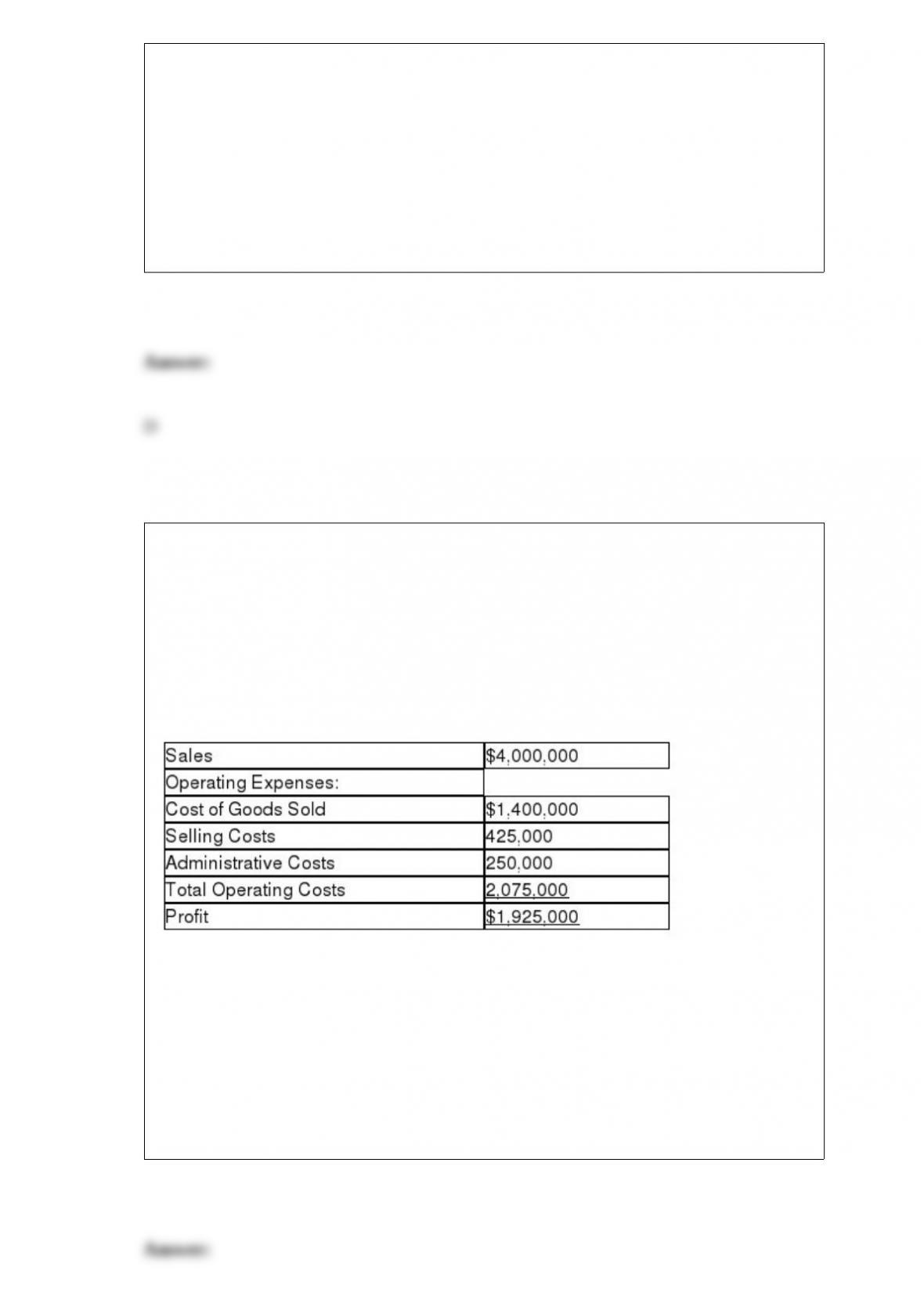
Cost-volume-profit; volume defined in sales dollars. An excerpt from the income
statement of the Kingston Company follows. Fixed costs in Year 1 are $325,000.
Kingston Company
Income Statement
Year ended December 31, year 1
Required:
a. What percentage of sales revenue is variable cost?
b. What is the break-even point in sales dollars for Kingston Company?
c. If sales revenue falls to $2,900,000, what will be the estimated amount of profit?
d. What amount of sales dollars produces a profit of $1,000,000?
Just-in-time
A.is a set of tools.
B.adds non-value-added activities to the production process.
C.seeks continuous improvement involving all employees.
D.All of the answers are correct.
Costs incurred for detecting nonconforming products and services after delivering them
to customers are called
A.prevention costs.

B.appraisal costs.
C.internal failure costs.
D.external failure costs.
Which of the following describes an activity that increases the product’s service to the
customer?
A.direct activity.
B.variable activity.
C.value-added activity.
D.non-value-added activity.
Thefirststep in activity-based costing (ABC) is to
A.identify the activities that consume resources, and assign costs to those activities.
B.identify the cost driver(s) associated with each activity.
C.compute a cost rate per cost driver unit.
D.assign costs to products by multiplying the cost driver rate by the volume of cost
drivers consumed by the product.

What is the first step in value engineering?
A.an analysis of the value-chain activities.
B.developing a product that satisfies the needs of potential customers.
C.choosing a target price based on customers’ perceived value for the product and the
competitors’ prices.
D.reducing costs while satisfying customer needs.
Which of the following is not an underlying assumption of cost-volume-profit analysis?
A.Variable costs are strictly variable.
B.All costs can be classified either as a fixed or variable cost and behave linearly.
C.Sales prices do not change in the relevant range.
D.Sales mix changes within the relevant range of production.
High-pressure performance evaluation systems designed to meet the demands of

stockholders, the expectation of financial analysts, or managements’ egos
A.will not motivate employees.
B.may not create incentives to commit fraudulent financial reporting.
C.may increase the present value of a company’s tax payments.
D.All of the answers are correct.
The impact of learning curves on time and cost behavior is as follows:
A.Average labor hours per unit doesn’t change, total labor hours decreases, and total
labor costs decreases.
B.Average labor hours per unit increases, total labor hours increases, and total labor
costs decreases.
C.Average labor hours per unit increases, total labor hours increases, and total labor
costs increases.
D.Average labor hours per unit decreases, total labor hours increases, and total labor
costs increases.
The method of allocating joint costs used when output product prices are highly volatile
or when significant processing occurs between the splitoff point and the first point of
marketability is called the
A.absolute quantities method.

B.physical qualities method.
C.physical quantities method.
D.absolute qualities method.